

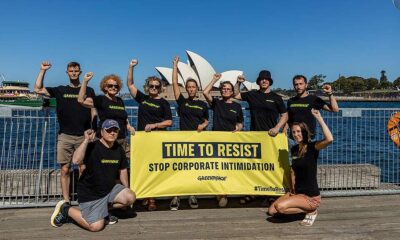
SYDNEY, Wednesday 8 May 2024 — In response to tomorrow’s expected release of Cattle Australia’s latest work attempting to develop an industry-led definition of deforestation, the following comments can be attributed to Head of Nature at Greenpeace Australia Pacific, Glenn Walker:
“Australia has one of the world’s worst rates of deforestation, driven mostly by the beef industry. Every single day about 100,000 native animals are killed from this destruction as threatened species habitat, including for the iconic koala, is bulldozed at a rate of knots.
“In just five years, 668,000 hectares of koala habitat was bulldozed by the beef industry for pasture — that’s 2,400 times the size of Sydney CBD.
“It is simply not credible for the beef industry to cook up their own fantasy definition of deforestation and deny there is a problem — it’s like the fox guarding the henhouse.
“Any meaningful definition of deforestation must include threatened species habitat and regenerated forest — this is the widely accepted, global best practice approach. To ignore vital habitat for the endangered koala, for example, will not pass muster. Claims that the vast swathes of forest bulldozed for beef is for weed management are patently false.
“Major global markets like the EU are moving rapidly towards responsibly-sourced beef — if the beef industry doesn’t clean up its act, it risks losing market and financial access. It’s deeply disappointing to see the Minister for Agriculture seemingly go against his own government’s goal of zero new species extinctions by railing against the EU’s critically important deforestation-free regulations.
“Any company in the beef supply chain, or financial institutions supporting the industry, should be very careful with any public claims they are deforestation-free based on deliberately weak definitions completely out of step with global best practice.
“Market and financial regulators have made it clear that greenwashing is a priority area of concern and Greenpeace will be referring any suspect claims to these regulators.
“The good news is that we already have the solutions — it’s only a relatively small number of operators doing most of the damage. The Australian beef industry can eliminate deforestation from the entire supply chain and be a leader in responsible beef production — this should be the focus of the industry, not continuing to deny a very serious problem.”
—ENDS—
High res images and footage of recent deforestation can be found here
For more information or to arrange an interview, please contact Kate O’Callaghan on 0406 231 892 or kate.ocallaghan@greenpeace.org
‘Fox guarding the henhouse’: Beef industry’s deforestation definition will not pass muster


Climate Change
Summit Sold Its Midwest Pipeline as a Carbon Solution. Now, It’ll Be Used for Fossil Fuels.
The pivot reveals a company adapting to Trump’s “drill, baby, drill” agenda and looking to cash in on recently boosted tax incentives for enhanced oil recovery.
For four years, battles over private property rights have gridlocked state legislatures across the Midwest and stalled plans for a pipeline to transport liquified carbon dioxide from ethanol plants in the region.
Summit Sold Its Midwest Pipeline as a Carbon Solution. Now, It’ll Be Used for Fossil Fuels.
“Today, as in the beginning, life is still made out of carbon dioxide, and the world’s problems are made out of carbon dioxide as well.”
From our collaborating partner Living on Earth, public radio’s environmental news magazine, an interview by Jenni Doering with Peter Brannen, the author of “The Story of CO2 Is the Story of Everything.”
The 4-Billion-Year Perspective to Understanding Earth’s Current Climate Crisis
Climate Change
Trump’s ‘God Squad’ Will Weigh Gulf Oil Drilling Against the Survival of Endangered Whales and Turtles
Citing national security, the Trump administration wants to exempt all federally regulated offshore oil from protections for endangered animals—even if it could cause their extinction.
The Trump administration is turning to the nuclear option on endangered-species protections in the name of national security.



-
Greenhouse Gases8 months ago
Guest post: Why China is still building new coal – and when it might stop
-
Climate Change8 months ago
Guest post: Why China is still building new coal – and when it might stop
-

 Greenhouse Gases2 years ago
嘉宾来稿:满足中国增长的用电需求 光伏加储能“比新建煤电更实惠”
-
Climate Change2 years ago
Bill Discounting Climate Change in Florida’s Energy Policy Awaits DeSantis’ Approval
-

 Climate Change2 years ago
嘉宾来稿:满足中国增长的用电需求 光伏加储能“比新建煤电更实惠”
-
Climate Change Videos2 years ago
The toxic gas flares fuelling Nigeria’s climate change – BBC News
-

 Carbon Footprint2 years ago
US SEC’s Climate Disclosure Rules Spur Renewed Interest in Carbon Credits
-

 Renewable Energy5 months ago
Sending Progressive Philanthropist George Soros to Prison?