


Forests are regaining global financial attention. According to the UNEP State of Finance for Forests 2025 report, investment in sustainable forest management, restoration, and conservation is increasing after years of underfunding. Governments, private firms, and international institutions are now channeling more capital into nature-based solutions as part of global climate strategies.
The report highlights an encouraging shift: while current funding still falls short of what’s needed to halt deforestation, the pace of growth in forest finance has accelerated sharply since 2020. If the trend continues, forests could play a stronger role in both climate mitigation and green economic recovery.
A Rising Wave of Forest Investment
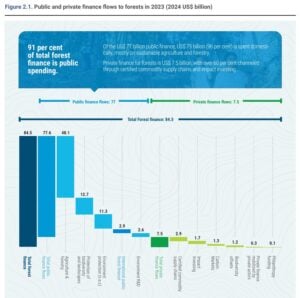
Between 2020 and 2024, global finance flowing toward forests and nature-based climate solutions nearly doubled. The report estimates that around $23.5 billion per year is now directed toward protecting and restoring forests worldwide, up from less than $12 billion annually just five years ago.
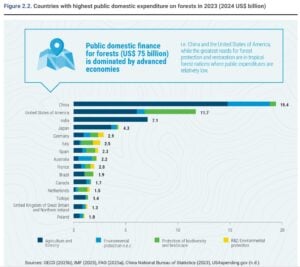
Public finance remains the largest source, accounting for roughly 60% of total flows. Governments and development banks fund reforestation, community forest management, and sustainable agriculture programs.
However, private capital is catching up fast. Private investments now represent 40% of forest-related finance, compared to about 25% in 2020.
Key drivers include growing corporate commitments to net-zero emissions and the expansion of carbon markets. The demand for verified forest carbon credits has encouraged companies to back reforestation and avoided-deforestation projects in Latin America, Southeast Asia, and Africa.
At the same time, emerging “blended finance” models — which combine public risk guarantees with private investment — have made nature projects more bankable. This mix has become crucial for attracting institutional investors who traditionally avoided forestry due to long payback periods and perceived risks.
Nature as an Economic Engine
The economic case for forest investment is becoming clearer. Forests absorb about 7.6 billion tonnes of CO₂ every year, roughly one-fifth of global emissions. Yet they receive less than 2% of total climate finance, according to UNEP data.
The 2025 report argues that increasing forest investment could deliver major returns. Every dollar spent on forest restoration can yield up to $30 in ecosystem services, such as water regulation, soil protection, and biodiversity conservation.
Moreover, the jobs generated by sustainable forestry are rising. Forest-related sectors already employ over 30 million people worldwide, many in rural areas. Expanding restoration and reforestation could create an additional 15 million green jobs by 2030, based on projections from the International Labour Organization.
Several countries have made measurable progress. Brazil and Indonesia, once deforestation hotspots, are now expanding conservation incentives and attracting foreign funding for forest protection.
In Africa, Ghana and Gabon are scaling up REDD+ (Reducing Emissions from Deforestation and Forest Degradation) programs, linking carbon revenue directly to forest governance improvements.
Private Capital Steps Up
Private investment in forests has grown from niche to mainstream in recent years. Asset managers, corporations, and impact investors are increasingly allocating funds to forestry and land-use projects that deliver both profit and carbon benefits.
The State of Finance for Forests 2025 report notes that private flows reached nearly $9 billion in 2024, led by large climate funds, corporate carbon credit purchases, and green bonds.
Notably, sustainability-linked bonds and loans are emerging as key financial tools. These instruments tie interest rates or repayment terms to measurable sustainability outcomes, such as reforestation acreage or emissions reduction.
Some of the largest moves include:
- Sovereign green bonds issued by countries like Indonesia and Chile, raising billions for forest protection.
- Corporate reforestation partnerships, such as Nestlé’s and Unilever’s investments in agroforestry supply chains.
- Investment funds like Mirova, Climate Asset Management, and the &Green Fund, which collectively manage more than $5 billion in nature-based assets.
Private actors are also entering carbon markets more actively. Voluntary carbon credit demand reached an estimated 250 million tonnes of CO₂ in 2024, with forestry projects representing nearly 50% of total credits traded.

- SEE MORE: The Top 6 AI-Powered Companies and How They Transform Climate, Nature, and Carbon Solutions
The Global Funding Gap
Despite progress, the funding gap remains wide. To meet global forest and land-use goals by 2030, annual investments need to reach $460 billion, the report finds. That is nearly 20 times current levels.
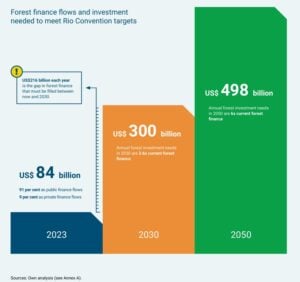
The shortfall reflects structural barriers: unclear land tenure, lack of local project pipelines, and limited data on returns. In many regions, smallholders lack access to affordable finance for sustainable farming and reforestation.
However, international climate finance mechanisms are helping bridge the gap. The Green Climate Fund and the Global Environment Facility have both expanded forest-related programs. Since 2020, more than $6 billion has been committed through multilateral channels, supporting over 50 countries in their efforts to protect and restore forests.
The report also highlights that emerging markets — particularly in Africa and Latin America — could attract much larger investments if credit risks were reduced. Blended finance remains one of the most promising tools to make this possible.
Integrity and Innovation Take Root
A key focus of the 2025 report is ensuring that forest finance delivers real, measurable impact. This means improving transparency and strengthening safeguards against greenwashing.
New global standards are now being applied to forest projects. The Integrity Council for the Voluntary Carbon Market (ICVCM) and the Forest Stewardship Council (FSC) are working to align certification systems with climate integrity principles. This includes satellite-based monitoring, standardized carbon accounting, and stronger community engagement.
More than 70% of new private forest projects launched in 2024 adopted third-party verification standards, showing a growing shift toward credibility. These frameworks are helping investors gain confidence that their money is delivering genuine environmental and social benefits.
Technology also plays a growing role. Digital tools such as remote sensing, AI-powered forest monitoring, and blockchain-based traceability systems are improving project tracking and investor reporting.
From Billions to Trillions: The Next Frontier
The overall tone of the State of Finance for Forests 2025 report is optimistic. It finds that forest finance has entered a period of acceleration, with stronger collaboration between governments, investors, and communities.
If growth continues at the current pace, total annual forest finance could exceed $50 billion by 2030 — more than four times the 2020 level. However, the report stresses that this is still below what’s needed to achieve global forest protection targets.
UNEP and the World Bank project that scaling up nature-based investment to the trillion-dollar range will require systemic changes:
- Embedding forests in national climate plans and green recovery packages.
- Expanding carbon pricing and nature credit markets.
- Strengthening transparency and local governance.
As deforestation pressures persist, the momentum around forest finance offers hope. The sector is no longer seen as an environmental niche but as a pillar of global climate and economic strategy.
Forests store carbon, support livelihoods, and protect biodiversity. Mobilizing finance at scale can help unlock their full potential — transforming them from victims of climate change into powerful drivers of climate resilience.
- READ MORE: Apple Stock (AAPL) Goes Green: 14,000-Acre California Forest Deal Advances Carbon Neutral Strategy
The post Forest Finance Hits Record Growth in 2025: Investment Doubles for Nature-Based Climate Action appeared first on Carbon Credits.

EU carbon credit claims changed on 27 September 2026, the day the Directive (EU) 2024/825 began to apply across the European Union. The change is narrow. It changes how a company can talk about the credits it buys. A product can no longer be called neutral on the strength of compensation alone; however, every specific, evidenced statement about what a company measured, reduced, and funded stays fully available.

The post Promoting Improved Cooking Practices in Nigeria appeared first on Terrapass.



-
Climate Change1 year ago
Guest post: Why China is still building new coal – and when it might stop
-

 Greenhouse Gases2 years ago
嘉宾来稿:满足中国增长的用电需求 光伏加储能“比新建煤电更实惠”
-
Greenhouse Gases1 year ago
Guest post: Why China is still building new coal – and when it might stop
-

 Climate Change2 years ago
嘉宾来稿:满足中国增长的用电需求 光伏加储能“比新建煤电更实惠”
-

 Renewable Energy12 months ago
Sending Progressive Philanthropist George Soros to Prison?
-
Climate Change2 years ago
Bill Discounting Climate Change in Florida’s Energy Policy Awaits DeSantis’ Approval
-
Greenhouse Gases1 year ago
嘉宾来稿:探究火山喷发如何影响气候预测
-

 Climate Change2 years ago
Analysis: China’s CO2 falls 1% in Q2 2024 in first quarterly drop since Covid-19