

For the Self-Employed Women’s Association (SEWA), just transition begins not just with carbon, but with resilience – the daily struggle of poor women to withstand the heatwaves, floods and crop failures already battering their lives. Climate shocks that are stripping poor women not only of income, but of dignity.
Representing 3.2 million informal workers across 18 states – street vendors, waste pickers, construction labourers, home-based producers and small farmers – SEWA has spent more than five decades fighting for rights and recognition.
“This is what ‘just transition’ must mean for us,” says Mansi Shah, senior coordinator at SEWA. “It is not only about future green jobs or phasing out polluting industries. For women workers on the frontlines, it is about surviving heatwaves, floods and crop failures today – and doing so with dignity.”
-
Business-as-usual: Donors pour climate adaptation finance into big infrastructure, neglecting local needs
A deep-sea port project in Bangladesh highlights how some major donor nations are labelling funds for industry-friendly transport and energy projects as adaptation finance, reporting by Climate Home News shows -
UN calls for faster emissions cuts for 2035 as first global estimate disappoints
UNFCCC “calculations” suggest a 10% drop in global emissions, but delays by many countries in submitting NDCs cloud official review of climate pledges -
Global South campaigners question inclusivity of COP30 as some stay home
Civil society groups hoped to send large numbers to the UN climate talks in Brazil, but developing-country activists say it’s too expensive and they have received limited badges


SEWA’s own surveys underline the urgency. More than 90% of women workers report livelihood losses from climate shocks, while 74% say their children’s education has been disrupted. Over 80% of households face water insecurity, 62% food insecurity, and nearly 40% report mental health impacts.
“When people talk about adaptation or resilience, it sounds abstract,” Shah says. “For our members, it means the difference between feeding your children and selling your dignity.”
“On one side, hungry children. On the other, her respect”
One member – a smallholder farmer – told SEWA organisers what happened when a prolonged heatwave dried her fields and wiped out any possible work as an agricultural labourer. With children to feed and no savings, she went to a local moneylender.
The terms were brutal: extortionate interest and demands for sexual favours.
“She had to choose between her children’s hunger and her own respect,” Shah says. “That is the kind of choice no woman should ever face. But climate change is forcing it every day.”
By chance, the woman had been enrolled in SEWA’s pilot parametric heat insurance scheme – designed to trigger automatic payouts when temperatures cross preset thresholds, providing fast, predictable relief when heat destroys livelihoods. On the very day she faced the moneylender, the insurance activated and 1,800 rupees (about $20) landed in her account – enough to buy food for two weeks, enough to walk away.
Climate change-driven heatwaves hit Delhi’s Red Fort market traders
Women-led solutions prove just transition works
For Meenaben, a SEWA smallholder in Kutch district, the blow came from unseasonal rain and hail. Her 1.5-acre rain-fed millet crop, almost ready for harvest – and crucial fodder for her cattle – was shredded overnight.
“Government relief can take months to reach a village,” Shah explains. “So women like Meenaben are pushed toward debt – often predatory – just to survive the gap.”
SEWA’s answer is speed and self-help. Through its Livelihood Recovery & Resilience Fund (LRRF) – a blended pool seeded by one day’s wage per member per month, matched by philanthropy – women can access rapid loans within 14 days of a climate shock, long before state compensation arrives. The fund kept Meenaben’s household afloat, paid for inputs for the next sowing, and avoided a spiral into debt.
“We can’t wait for others to save us,” says Shah. “So SEWA women build their own safety nets – and get back to work.”

From Gujarat to the Global South
After piloting its member-owned LRRF a decade ago, SEWA shared its results at a global women leaders’ meeting in 2023 with Secretary Hillary Clinton, Ambassador Melanne Verveer and women’s organisations from Africa and Latin America. The message was clear: women workers across the Global South face the same shocks and the same finance gap.
On the strength of that model, SEWA partnered with the Clinton Global Initiative to launch the Global Climate Resilience Facility (GCRF) in February 2024. Its framework is complete and fundraising is underway. Once capitalised, it will support frontline women’s organisations to run LRRF-style funds, expand parametric insurance, and scale women-led adaptation and clean-energy solutions across the Global South.
From rural daughter to solar entrepreneur
If these stories show the cost of climate shocks, Payalben Munjpura’s shows what investment unlocks.
Payalben grew up in a village of 250 households in Surendranagar district. Her father was an electrician. Like most rural daughters, she was expected to stay indoors – until SEWA persuaded her parents to let her train as a solar PV technician.
She completed a three-month course and certification, then formed a team of four. Drawing on her father’s skills, she brought him into the enterprise, saving costs and rooting the work in local expertise. Together, they now install rooftop solar systems in nearby villages through India’s new PM Surya Ghar scheme, which offers households subsidies covering up to 60% of installation costs.
Her income has transformed the family: she helped reclaim their mortgaged farm, paid for her younger brother’s education, and rebuilt their home.
“Women are always seen as energy users,” Shah says. “Payalben shows they can be owners, managers and distributors. If skills are brought to their doorstep, women will turn the climate crisis into opportunity.”
The women-led solutions already in motion
SEWA’s members are not waiting for policy promises – they are already building resilience from the ground up. Through its Building Cleaner Skies campaign, SEWA links local experience with a broader strategy of women-led adaptation.
Its Climate School turns climate science into simple visual lessons, training grassroots leaders as climate educators. Its Green Villages initiatives bring clean cooking, biogas, drip irrigation and rooftop solar – all managed by women handling finance, vendors and repairs.
Brazil’s environment minister urges heads of state to address fossil fuels at COP30
The movement also nurtures young women climate entrepreneurs who deliver adaptation technologies and green livelihoods. And when shocks hit, SEWA’s insurance and finance schemes move faster than the state, trigger quick payouts and provide loans within 14 days.
“These are not abstract pilots,” says Shah. “They are working now, in villages across Gujarat. The problem is not solutions. The problem is finance.”
Lessons for COP30
A just transition must also confront the realities of climate impacts. For informal women workers, it is not about distant promises of green jobs, but about surviving the effects of warming now – and building social protection systems that can secure their livelihoods.
SEWA’s experience shows that women-led action works. From grassroots insurance schemes to rooftop solar enterprises, women are already designing and scaling climate solutions that protect both their income and dignity.
To take these efforts further, finance for just transition policies must be deployed – and made accessible to women on the frontlines. The Belém Action Mechanism (BAM) for a Global Just Transition – proposed by civil society as a key deliverable for COP30 – could help bridge that gap by aligning governments, international institutions and community movements, creating clearer pathways for funding and technical support to reach grassroots initiatives directly.
But whatever happens in Belém this November, for millions of women like SEWA’s members, the transition has already begun.
The post For Indian women workers, a just transition means surviving climate impacts with dignity appeared first on Climate Home News.
For Indian women workers, a just transition means surviving climate impacts with dignity

Casting doubt on the determination that greenhouse gas emissions endanger public health and welfare, he said, “we’re not accepting all of the narrative of the left without any question or pushback.”
WASHINGTON—Addressing a conference of scientists and other experts skeptical of climate change, Environmental Protection Agency Administrator Lee Zeldin on Wednesday celebrated his decision to repeal what is known as the “endangerment finding,” which provided the backbone for federal regulation of greenhouse gas emissions.
Zeldin Celebrates Endangerment Finding Repeal With Climate Skeptics
With the U.S. bombing Iran and the Strait of Hormuz closed, energy experts say countries transitioning to renewables will be more resilient in the “face of the shock.”
The United States’ war on Iran could fundamentally alter how countries consume and generate energy and hamper international progress in combating climate change, a panel of energy experts said today.
The Global Energy Supply in a Decade ‘Is Not a World We’re Going to Recognize’
One month into the US and Israel’s war on Iran, at least 60 countries have taken emergency measures in response to the subsequent global energy crisis, according to analysis by Carbon Brief.
So far, these countries have announced nearly 200 policies to save fuel, support consumers and boost domestic energy supplies.
Carbon Brief has drawn on tracking by the International Energy Agency (IEA) and other sources to assess the global policy response, just as a temporary ceasefire is declared.
Since the start of the war in late February, both sides have bombed vital energy infrastructure across the region as Iran has blocked the Strait of Hormuz – a key waterway through which around a fifth of global oil and liquified natural gas (LNG) trade passes.
This has made it impossible to export the usual volumes of fossil fuels from the region and, as a result, sent prices soaring.
Around 30 nations, from Norway to Zambia, have cut fuel taxes to help people struggling with rising costs, making this by far the most common domestic policy response to the crisis.
Some countries have stressed the need to boost domestic renewable-energy construction, while others – including Japan, Italy and South Korea – have opted to lean more on coal, at least in the short term.
The most wide-ranging responses have been in Asia, where countries that rely heavily on fossil fuels from the Middle East have implemented driving bans, fuel rationing and school closures in order to reduce demand.
‘Largest disruption’
On 28 February, the US and Israel launched a surprise attack on Iran, triggering conflict across the Middle East and sending shockwaves around the world.
There have been numerous assaults on energy infrastructure, including an Iranian attack on the world’s largest LNG facility in Qatar and an Israeli bombing of Iran’s gas sites.
Iran’s blockade of the Strait of Hormuz, a chokepoint in the Persian Gulf, is causing what the IEA has called the “largest supply disruption in the history of the global oil market”.
A fifth of the world’s oil and LNG is normally shipped through this region, with 90% of those supplies going to destinations in Asia. Without these supplies, fuel prices have surged.
Governments around the world have taken emergency actions in response to this new energy crisis, shielding their citizens from price spikes, conserving energy where possible and considering longer-term energy policies.
Even with a two-week ceasefire announced, the energy crisis is expected to continue, given the extensive damage to infrastructure and continuing uncertainties.
Asian crunch
Carbon Brief has used tracking by the IEA, news reports, government announcements and internal monitoring by the thinktank E3G to assess the range of national responses to the energy crisis roughly one month into the Iran war.
In total, Carbon Brief has identified 185 relevant policies, announcements and campaigns from 60 national governments.
As the map below shows, these measures are concentrated in east and south Asia. These regions are facing the most extreme disruption, largely due to their reliance on oil and gas supplies from the Middle East.
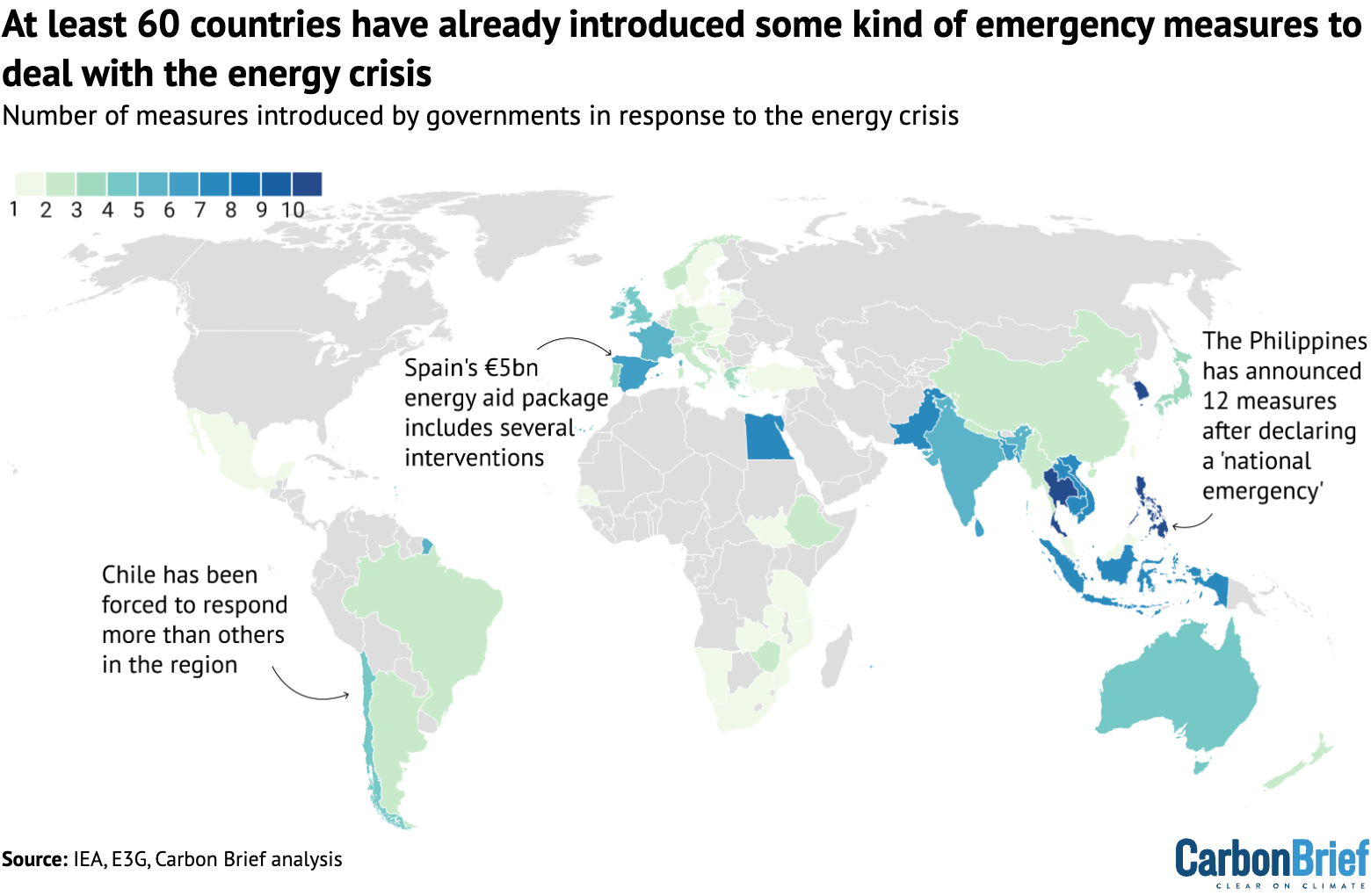
Nations including Indonesia, Japan, South Korea and India are already spending billions of dollars on fuel subsidies to protect people from rising costs.
At least 16 Asian countries are also taking drastic measures to reduce fuel consumption. For example, the Philippines has declared a “state of national emergency”, which includes limiting air conditioning in public buildings and subsidising public transport.
Other examples from the region include the government in Bangladesh asking the public and businesses to avoid unnecessary lighting, Pakistan reducing the speed limit on highways and Laos encouraging people to work from home.
Europe – which was hit hard by the 2022 energy crisis due to its reliance on Russian gas – is less immediately exposed to the current crisis than Asia. However, many nations are still heavily reliant on gas, including supplies from Qatar.
The continent is already feeling the effects of higher global energy prices as countries compete for more limited resources.
At least 18 European nations have introduced measures to help people with rising costs. Spain, which is relatively insulated from the crisis due to the high share of renewables in its electricity supply, nevertheless announced a €5bn aid package, with at least six measures to support consumers.
Many African countries, while also less reliant on direct fossil-fuel supplies via the Strait of Hormuz than Asia, are still facing the strain of higher import bills. Some, including Ethiopia, Kenya and Zambia, are also facing severe fuel shortages.
There have been fewer new policies across the Americas, which have been comparatively insulated from the energy crisis so far. One outlier is Chile, which is among the region’s biggest fuel importers and is, therefore, more exposed to global price increases.
Tax cuts
The most common types of policy response to the energy crisis so far have been efforts to protect people and businesses from the surge in fuel prices.
At least 28 nations, including Italy, Brazil and Australia, have introduced a total of 31 measures to cut taxes – and, therefore, prices – on fuel.
Even across Africa, where state revenues are already stretched, some nations – including Namibia and South Africa – are cutting fuel levies in a bid to stabilise prices.
Another 17 countries, including Mexico and Poland, have directly capped the price of fuel. Others, such as France and the UK, have opted for more targeted fuel subsidies, designed to support specific vulnerable groups and industries.
These measures are all shown in the dark blue “consumer support” bars in the chart below.
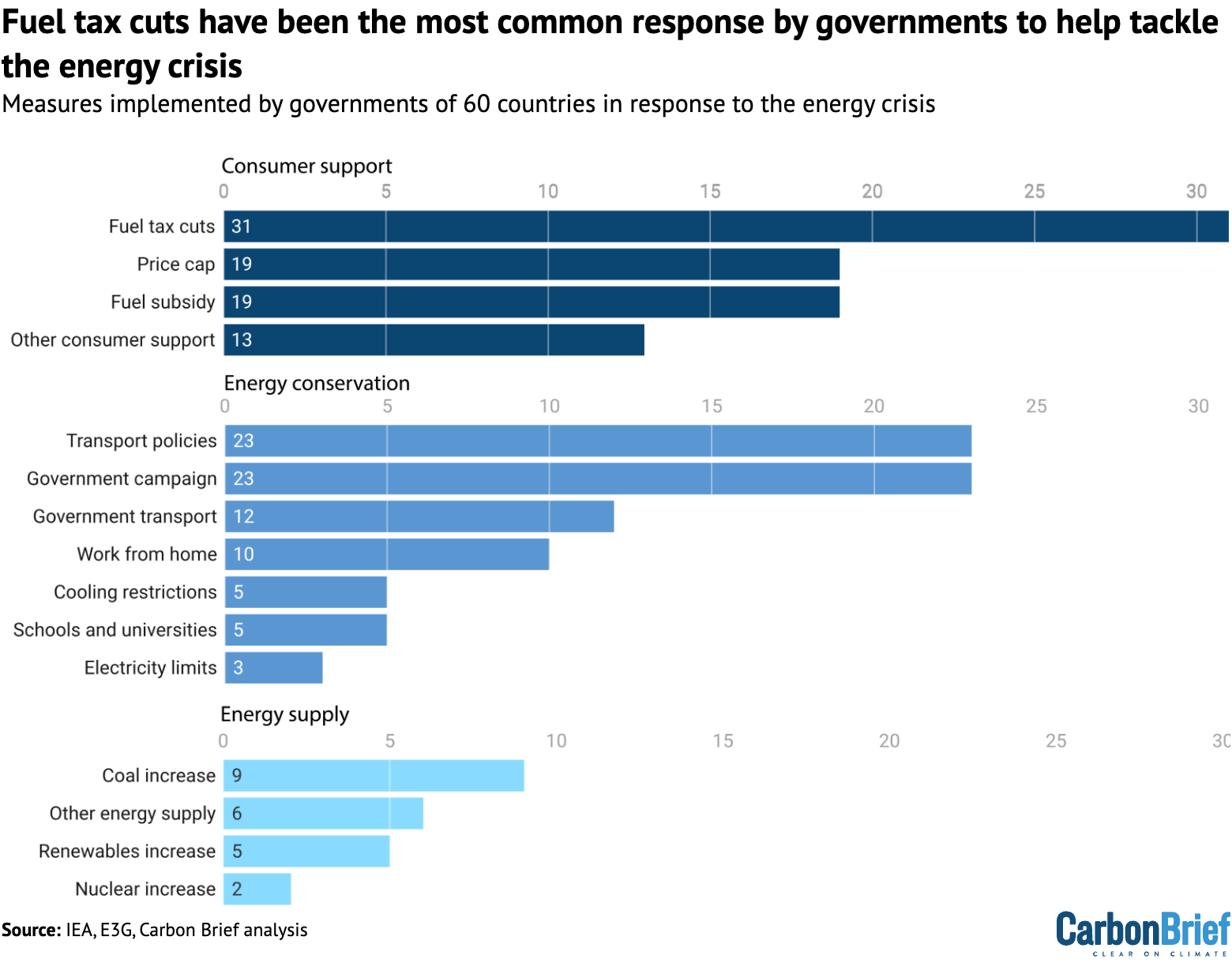
Such measures can directly help consumers, but some leaders, NGOs and financial experts have noted that there is also the risk of them driving inflation and reinforcing reliance on the existing fossil fuel-based system.
Christine Lagarde, president of the European Central Bank, spoke in favour of short-term measures to “smooth the shock”, but noted that “broad-based and open-ended measures may add excessively to demand”.
Measures to conserve energy, of the type that many developing countries in Asia have implemented extensively, have been described by the IEA as “more effective and fiscally sustainable than broad-based subsidies”.
So far, there have been at least 23 such measures introduced to limit the use of transport, particularly private cars.
These include Lithuania cutting train fares, two Australian states making public transport free and Myanmar and South Korea asking people to only drive their cars on certain days.
Clean vs coal
At least eight countries have announced plans to either increase their use of coal or review existing plans to transition away from coal, according to Carbon Brief’s analysis. These include Japan, South Korea, Bangladesh, the Philippines, Thailand, Pakistan, Germany and Italy.
These measures broadly involve delaying coal-plant closure, as in Italy, or allowing older sites to operate at higher rates, as in Japan – rather than building more coal plants.
There has been extensive coverage of how the energy crisis is “driving Asia back to coal”. However, as Bloomberg columnist David Fickling has noted, this shift is relatively small and likely to be offset by a move to cheap solar power in the longer term.
Indeed, some countries have begun to consider changes to the way they use energy going forward, amid a crisis driven by the spiralling costs of fossil-fuel imports.
Leaders in India, Barbados and the UK have explicitly stressed the importance of a structural shift to using clean power. Governments in France and the Philippines are among those linking new renewable-energy announcements with the unfolding crisis.
New renewable-energy capacity will take time to come online, albeit substantially less time than developing new fossil-fuel generation. In the meantime, some nations are also taking short-term measures to make their road transport less reliant on fossil fuels.
For example, the Chilean government has enabled taxi drivers to access preferential credit for purchasing electric vehicles (EVs). Cambodia has cut import taxes on EVs and Laos has lowered excise taxes on them.
Finally, there have been some signs that countries are reconsidering their future exposure to imported fossil fuels, given the current economics of oil and gas.
The New Zealand government has indicated that a plan to build a new LNG terminal by 2027 now faces uncertainty. Reuters reported that Vietnamese conglomerate Vingroup has told the government it wanted to abandon a plan to build a new LNG-fired power plant in Vietnam, in favour of renewables.

The post Iran war analysis: How 60 nations have responded to the global energy crisis appeared first on Carbon Brief.
Iran war analysis: How 60 nations have responded to the global energy crisis



-
Climate Change8 months ago
Guest post: Why China is still building new coal – and when it might stop
-
Greenhouse Gases8 months ago
Guest post: Why China is still building new coal – and when it might stop
-

 Greenhouse Gases2 years ago
嘉宾来稿:满足中国增长的用电需求 光伏加储能“比新建煤电更实惠”
-
Climate Change2 years ago
Bill Discounting Climate Change in Florida’s Energy Policy Awaits DeSantis’ Approval
-

 Climate Change2 years ago
嘉宾来稿:满足中国增长的用电需求 光伏加储能“比新建煤电更实惠”
-
Climate Change Videos2 years ago
The toxic gas flares fuelling Nigeria’s climate change – BBC News
-

 Renewable Energy6 months ago
Sending Progressive Philanthropist George Soros to Prison?
-

 Carbon Footprint2 years ago
US SEC’s Climate Disclosure Rules Spur Renewed Interest in Carbon Credits