A global treaty on plastics, which is being touted as the most important environmental treaty since the 2015 Paris Agreement, is set to be negotiated in South Korea over the next week.
At the fifth and final scheduled session of the UN’s Intergovernmental Negotiating Committee on Plastic Pollution (INC-5), member countries hope to finalise and approve the text of the “international legally binding instrument on plastic pollution”.
A successful treaty could have important implications for climate change.
The production, use and disposal of plastics is responsible for around 5% of global greenhouse gas emissions and they are typically made from fossil fuels. Plastics production is expected to be one of the leading drivers of oil demand growth over the coming years.
Measures to reduce plastics use will be a key part of the agenda, as around 90% of emissions from plastics come from production. The negotiations will see countries discuss setting targets, accountability and transparency measures.
Carbon Brief analysis shows that without any agreement to cut plastic production, emissions from plastics could consume half of the remaining carbon budget for limiting warming to 1.5C above pre-industrial levels.
One expert tells Carbon Brief that the best outcome possible for the negotiations is to ratify a global target to limit plastics production, coupled with legally binding national targets.
However, she warns that oil-producing countries are likely to veto any such proposal.
Below, Carbon Brief presents five key charts showing why the plastics treaty matters for climate change.
- Plastics currently cause triple the emissions of aviation
- Plastics will drive up oil demand over the coming decades
- Plastics could use up half the remaining carbon budget for 1.5C by 2050
- A plastics treaty could curb future plastics emissions
- Could the plastics sector become net-zero by 2050?
- Methodology
1. Plastics currently cause triple the emissions of aviation
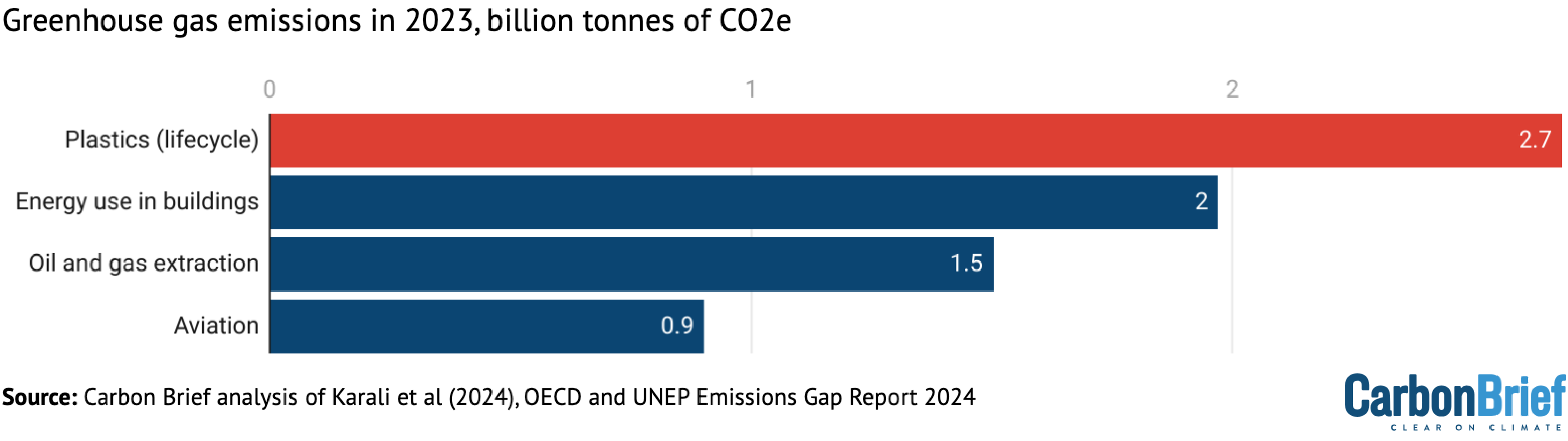
Greenhouse gas emissions in 2023, in billion tonnes of CO2e. Source: Carbon Brief analysis of Karali et al (2024), the OECD and the UNEP Emissions Gap Report (2024).
Plastics are a versatile and durable material that have revolutionised industries from fashion to medicine. However, they also cause serious environmental problems.
The most commonly discussed downside of the widespread global use of plastic is the ecosystem damage caused by waste. Even if disposed of safely, the production and disposal of plastics produce greenhouse gas emissions that contribute to global warming.
Carbon Brief calculations suggest that plastic lifecycles generated more than 2.7bn tonnes of CO2 equivalent (GtCO2e) in 2023 – around 5% of global emissions. This is roughly three times more than the emissions produced by aviation, as shown in the graphic above.
Around 90% of emissions from plastics come from production – the process of extracting fossil fuels and converting them into plastics. The world produces around 400m tonnes of plastics every year and this number is expected to grow over the coming decades.
Most plastics are made from fossil fuels, using oil, coal or gas converted into feedstock chemicals. Extracting the fossil fuels needed from underground is directly associated with greenhouse gas emissions, for example due to leaky mines, wells and pipes that contribute to rising methane emissions.
Overall, extracting oil, gas and coal from the ground accounts for around one-fifth of plastics production emissions.
The rest of the emissions associated with plastics production come from the processes required to first convert the fossil fuels into plastics. The fossil fuels are refined to produce petrochemical feedstocks, such as ethane and naphtha.
In one of the most emissions-intensive steps of the process, these feedstocks are broken apart in a high-pressure steam cracker to produce chemicals called monomers. Finally, the monomers are joined into chains called polymers, which are used to construct plastics.

The remaining plastic emissions – which account for around 10% of the total – are emitted when materials are disposed of. One study finds that in this “end-of-life” stage, only around 9% of all plastics ever have been recycled, while 79% ended up in landfill and 12% were incinerated.
2. Plastics will drive up oil demand over the coming decades

Annual growth in oil demand, in millions of barrels. Source: IEA Oil 2024 report
The world’s consumption of oil is currently around 100m barrels per day. According to an International Energy Agency (IEA) special report, around half of the oil produced globally is currently used to fuel road transport – and this is being squeezed by the rising popularity of electric vehicles (EVs).
Along with renewables substituting for oil-fired electricity generation and increasingly efficient engines, EVs are the major driver of expectations that global oil demand could soon peak.
Petrochemicals feedstocks – chemical substances derived from fossil fuels that can then be used to make products such as plastics, rubbers and fertilisers – are widely seen as the last growth market for global oil demand. As such, the future of the $700bn plastics production industry is a key concern of the fossil-fuel industry.
Currently, only 14m barrels per day are used as a petrochemical feedstock – the majority of which is used to produce plastics. But the IEA expects this to grow further in the coming years, even as demand in other sectors falls.
The figure above shows projected annual growth in oil demand from petrochemical feedstocks (red) and other sectors, such as road transport and aviation (blue), up to 2030, according to the IEA’s Oil 2024 report.
Numbers above zero indicate an increase in oil demand compared to the previous year, while numbers below zero mean a decrease.
3. Plastics could use up half the remaining carbon budget for 1.5C by 2050

Annual lifecycle greenhouse gas emission, in billions of tonnes of CO2e. Source: Carbon Brief analysis of Karali et al (2024), OECD, Cabernard et al (2021) and the UNEP Emissions Gap Report (2024).
To have a 50% chance of limiting global warming to 1.5C above pre-industrial levels, humanity can only emit a further 200bn tonnes of CO2, according to the latest estimate from the emissions gap report from the UN Environment Programme (UNEP).
Unless there is a change in current trends, plastics production is expected to use up a significant proportion of this carbon budget.
A landmark 2024 report from the Lawrence Berkeley National Laboratory (LBNL) outlines two scenarios for plastics growth between now and 2050. Under its “conservative growth scenario”, the report says that plastics production will grow by 2.5% per year, based on projections of the Organisation for Economic Co-operation and Development (OECD).
Meanwhile, an alternative scenario is defined by a much more rapid 4% per year growth scenario, based on projections from National Academies of Sciences, Engineering and Medicine (NASEM)
Carbon Brief finds that, under the conservative growth scenario, annual “lifecycle” emissions from plastics could double by 2050, reaching 5.2GtCO2e. Under this scenario, plastics production, use and disposal would cumulatively emit 104GtCO2e between 2024 and 2050, consuming more than half of the remaining carbon budget.
Under the rapid growth scenario, cumulative emissions would be 130GtCO2e – or around 65% of the remaining carbon budget.
The rise in annual emissions from plastics, including all stages from fossil-fuel extraction to plastics disposal, are shown above. The black line indicates historical emissions, while the dark blue line shows the conservative growth scenario from the LBNL report, originally taken from the OECD.
4. A treaty could curb future plastics emissions

Annual lifecycle greenhouse gas emissions, in billions of tonnes of CO2e. Source: Carbon Brief analysis of Karali et al (2024), OECD, Cabernard et al (2021) and Rwanda/Peru 40×40 proposal from INC-4 negotiations.
At the negotiations in South Korea, countries will attempt to ratify a legally binding agreement on curbing plastics pollution.
Daniela Duran Gonzalez is a senior legal campaigner focused on the plastics treaty at the Centre for International Environmental Law (CIEL). She tells Carbon Brief that when discussing emissions from plastics at INC-5, experts usually focus on limiting production because plastics production is “challenging to decarbonise”.
At the negotiations, countries will consider a global target to limit plastics production, Duran explains. She likens this to the Paris Agreement 1.5C warming limit, arguing that “it gives us a north star, but it doesn’t provide any enforceable obligation to any country to actually achieve it”.
If it is agreed, the treaty could stipulate different ways to achieve this overall target. The first option, which Duran says is “very vague”, is for countries to all work towards the target at their own discretion, without any targets set.
Another method with more accountability would be for countries to set their own voluntary, non-legally binding and non-enforceable measures – similar to the climate pledges (“nationally determined contributions”) that countries submit under the Paris Agreement.
The most enforceable method on the table would be to set legally binding targets for each country, Duran explains. She says this could work in a similar way to the Montreal Protocol, which successfully cut global emissions of substances that deplete the ozone later.
To set targets, countries would need to agree on a baseline year to measure against, a goal and a deadline for the goal to be met.
For example, at the last set of negotiations (INC-4) earlier this year in Ottawa, Rwanda and Peru put forward a global target for a 40% reduction on 2025 levels by 2040. Under this scenario, plastics would emit 52GtCO2e by 2050.
Others have suggested a cap on plastic production at 2025 levels – a scenario that would see the production, use and disposal of plastics emit 76bn tonnes of CO2e by 2050. These scenarios are shown in light blue and blue on the graph above.
In early November, Ecuadorian ambassador Luis Vayas Valdivieso – chair of the INC – developed and submitted his non-paper three to the committee for the talks. This document set out his proposed basis for the negotiations.
Under the proposal, a single party would be able to veto any decision, similar to the process under the UN climate regime. WWF warns that this “can result in a stagnant and dead treaty, incapable of adapting to changing developments and circumstances in the future”.
Developed countries have already been accused of bowing to pressure from lobbyists seeking to avoid any caps on plastics production at the international negotiations. According to CIEL analysis, at the last set of talks, 196 fossil fuel and industry lobbyists registered, up from the 143 who registered at the previous discussions in Nairobi.
Duran tells Carbon Brief that plastics production is an “existential” issue for Gulf countries, whose economies currently rely on continued oil and gas extraction.
As a result, she says that these countries likely will not be “negotiating in good faith” at the INC-5 and “will never accept a treaty that has any mention of plastic production, because it’s their lifeline”. She argues for other countries to “overcome this idea of universal ratification” to ensure a “good” treaty.
According to expert interviews conducted by the University of Portsmouth, crucial outcomes from the negotiations include deciding on a voting mechanism as a backup if consensus cannot be reached.
(The UN climate regime must take all decisions by consensus because rules on how it makes decisions – including voting – were never agreed.)
5. Could the plastics sector become net zero by 2050?

Carbon content flows for the proposed ‘circular carbon’ net-zero plastics sector pathway in the year 2050, million tonnes of carbon (MtC). TWh = terawatt hour. Source: Based on Meys et al (2021)
INC-5 negotiations could lead to a reduction in plastics production, which could be key to limiting emissions from the industry. However, decarbonising the production, use and disposal of plastics could also help to bring down the carbon footprint of the sector.
One way to reduce emissions is to recycle plastics. Only 9% of plastics that have ever been produced have been recycled. However, the present-day number is likely higher, as recycling rates around the world are rising.
A report by the IEA says that most plastics recycling today is physical or “mechanical”. This involves grinding down plastics without changing their chemical structure, but can lead to the quality of plastics degrading over time.
Meanwhile, chemical recycling is becoming more popular, it says. This involves breaking down the plastics back into small chemical sections called monomers, which can be used to make new plastics. This method generally produces a higher-quality plastic, but it can be more energy intensive, resulting in higher emissions.
Another option is to switch from using petrochemical feedstocks, which are derived from fossil fuels, to using alternative feedstocks.
Bio-based feedstocks, such as starch, can also be used to produce plastics. These biological materials draw down carbon as they grow and also do not have the emissions associated with fossil fuel extraction.
Meanwhile, carbon capture, utilisation and storage (CCUS) can be used to draw down CO2 from chemical plants before it enters the atmosphere. The captured CO2 can be combined with hydrogen to generate synthetic feedstocks. Using renewable energy to produce the hydrogen for this process can help to keep the materials’ carbon footprint low.
The IEA report says that the “use of alternative feedstocks, including bio-based feedstock, remains a niche industry due to a considerable cost gap and competing demand with other sectors”.
A 2021 study explores four pathways through which the global plastics industry could reach net-zero by 2050. These are: a recycling pathway; a CCUS pathway; a biomass pathway; and a circular carbon pathway that combines the three approaches in an “optimal” way.
The combined pathway, shown above, is the only scenario that reaches net-zero emissions.
The chart shows the flow of carbon (in million tonnes) through the full lifecycle of plastics under a net-zero scenario in the year 2050. The width of each arrow corresponds to the amount of carbon flowing. In this scenario, around 38% of plastic feedstocks would be made from biomass, 17% from synthetic feedstocks, 44% from recycling and less than 1% from fossil fuels. This scenario would require an effective recycling rate of around 61%, with only 5% of plastics going to landfill and 34% ending up in the atmosphere through incineration.
However, the authors highlight how challenging it would be to fully decarbonise plastics, if production levels continue to rise.
Cutting emissions while production increases would require a significant uptick in the rate of plastics recycling, they note – and the feasibility of fully decarbonising plastics production will be limited by the amount of renewable energy and biomass available to the sector.
In the scenario above, the plastics sector would require 9,900 terawatt hours of renewable electricity (more than global renewable generation in 2023 or 14% of renewables generation under IEA net-zero scenario in 2050), and 19.3 exajoules of biomass (11% of “untapped” biomass potential in 2050).
Duran tells Carbon Brief that, while the INC-5 can talk about limiting production levels, it has not “entered into the discussion of decarbonising the petrochemical industry”.
She says that there are many reasons for this, including political factors and the uncertainty around measures such as CCUS. However, she also says that “decarbonisation is an issue of the United Nations Framework Convention on Climate Change (UNFCCC)”.
She explains that the UNFCCC cannot make rulings on plastics production, but can set out frameworks for the transparency and reporting of greenhouse gas emissions caused by plastic production.
Methodology
The Carbon Brief analysis on the lifecycle greenhouse emissions in this article is based on using the production-related emissions figures from the LBNL study (Karali et al., 2024), and combining this with an estimate of the end of life emissions from OECD data.
In order to make these datasets compatible, it is assumed that the percentage share of emissions from end of life, calculated from OECD data, remains constant at 10.8% and then this is applied to the production-related emissions from LBNL.
Due to differences in methodology, scope and poor availability of detailed data, generally, there are varying estimates of the climate impact from plastics. This analysis uses the values from LBNL study because it is the most recent and comprehensive evaluation of the climate impact from plastics, as confirmed by an expert that Carbon Brief spoke to.
However, the emissions measured in that study are higher than commonly cited estimates from the OECD, which suggests that production emissions in 2019 are around 28% lower than the LBNL estimate. This highlights the large uncertainty in measuring the climate impact of plastic, but the LBNL study authors also note that their higher estimate is “due to the increased level of granularity in modelling production processes, technologies and routes”. Their study also has no “by-product’ assumption”, which they say leads to an underestimation of the climate impact of plastics in other studies if they do not attribute emissions by mass across all the products of a given chemical process.
Historical data for plastics emissions is taken from a combination of LBNL, OECD and Cabernard et al (2021). Due to differences in methodology and uncertainty in the data, these different datasets do not match exactly and, therefore, have been scaled based on overlapping years to ensure that they are aligned with the values from the LBNL.
In order to model future emissions in a consistent manner, a constant emissions intensity per tonne of plastic produced from the LBNL study is used (4.9tCO2e per tonne of plastic, excluding end-of-life emissions) and applied to the production projections for each of the three scenarios presented (2.5% growth, cap at 2025 levels, 40% reduction from 2025 levels by 2040).
The baseline plastics-production projections are taken from the LBNL study, which uses OECD projections of plastics demand under a 2.5% growth scenario and assumes that annual plastics production matches annual demand. The projected end-of-life emissions from plastics are then calculated by using the assumed constant percentage share of emissions (10.8%) from end of life, as per above. For the 40% reduction scenario, it is assumed that production levels continue to reduce at the same rate between 2040 and 2050.
The post Five charts: Why a UN plastics treaty matters for climate change appeared first on Carbon Brief.
Five charts: Why a UN plastics treaty matters for climate change
Greenhouse Gases
Explainer: Why gas plays a minimal role in China’s climate strategy
Ten years ago, switching from burning coal to gas was a key element of China’s policy to reduce severe air pollution.
However, while gas is seen in some countries as a “bridging” fuel to move away from coal use, rapid electrification, uncompetitiveness and supply concerns have suppressed its share in China’s energy mix.
As such, while China’s gas demand has more than doubled over the past decade, the fuel is not currently playing a decisive role in the country’s strategy to tackle climate change.
Instead, renewables are now the leading replacement for coal demand in China, with growth in solar and wind generation largely keeping emissions growth from China’s power sector flat.
While gas could play a role in decarbonising some aspects of China’s energy demand – particularly in terms of meeting power demand peaks and fuelling heavy industry – multiple factors would need to change to make it a more attractive alternative.
Small, but impactful
The share of gas in China’s primary energy demand is small and has remained relatively unchanged at around 8-9% over the past five years.
It also comprises 7% of China’s carbon dioxide (CO2) emissions from fuel combustion, according to the International Energy Agency (IEA).
Gas combustion in China added 755m tonnes of CO2 (MtCO2) into the atmosphere in 2023 – double the total amount of CO2 emitted by the UK.
However, its emissions profile in China lags well behind that of coal, which represented 79% of China’s fuel-linked CO2 emissions and was responsible for almost 9bn tonnes of CO2 emissions in 2023, according to the same IEA data.
Gas consumption continues to grow in line with an overall uptick in total energy demand. Chinese gas demand, driven by industry use, grew by around 7-8% year-on-year in 2024, according to different estimates.
This rapid growth is, nevertheless, slightly below the 9% average annual rise in China’s gas demand over the past decade, during which consumption has more than doubled overall, as shown in the figure below.

The state-run oil and gas company China National Petroleum Corporation (CNPC) forecast in 2025 that demand growth for the year may slow further to just over 6%.
The majority of China’s gas demand in 2023 was met by domestic gas supply, according to the Institute for Energy Economics and Financial Analysis (IEEFA).
Most of this supply comes from conventional gas sources. But incremental Chinese domestic gas supply in recent years has come from harder-to-extract unconventional sources, including shale gas, which accounted for as much as 45% of gas production in 2024.
Despite China’s large recoverable shale-gas resources and subsidies to encourage production, geographical and technical limitations have capped production levels relative to the US, which is the world’s largest gas producer by far.
CNPC estimates Chinese gas output will grow by just 4% in 2025, compared with 6% growth in 2024. Nevertheless, output is still expected to exceed the 230bn cubic metre national target for 2025.
Liquified natural gas (LNG) is China’s second most-common source of gas, imported via giant super-cooled tankers from countries including Australia, Qatar, Malaysia and Russia.
This is followed by pipeline imports – which are seen as cheaper, but less reliable – from Russia and central Asia.
One particularly high-profile pipeline project is the Power of Siberia 2 pipeline project. However, Beijing has yet to explicitly agree to investing in or purchasing the gas delivered by the project. Disagreements around pricing and logistics have hindered progress.
Evolving role
Beijing initially aimed for gas to displace coal as part of a broader policy to tackle air pollution.
A three-year action plan from 2018-2020, dubbed the “blue-sky campaign”, helped to accelerate gas use in the industrial and residential sectors, as gas displaced consumption of “dispersed coal” (散煤)”– referring to improperly processed coal that emits more pollutants.
Meanwhile, several cities across northern and central China were also mandated to curtail coal usage and switch to gas instead. Many of these cities were based in provinces with a strong coal mining economy or higher winter heating demand.
China’s pollution levels saw “drastic improvement” as a result, according to a report by research institute the Centre for Research on Energy and Clean Air (CREA).
(In January 2026, there were widespread media reports of households choosing not to use gas heating despite freezing temperatures, as a result of high prices following the expiry of subsidies for gas use.)
Industry remains the largest gas user in China, with “city gas” – gas delivered by pipeline to urban areas – trailing in second, as shown in the figure below. Power generation is a distant third.

Gas has never gained momentum in China’s power sector, with its share of power generation remaining at 4% while wind and solar power’s share has soared from 4% to 22% over the past decade, Yu Aiqun, a research analyst at the US-based thinktank Global Energy Monitor, tells Carbon Brief.
Yu adds that this stagnation is largely due to insufficient and unreliable gas supply, which drives up prices and makes gas less competitive compared to coal and renewables. She says:
“With the rapid expansion of renewables and ongoing geopolitical uncertainties, I don’t foresee a bright future for gas power.”
Average on-grid gas-fired power prices of 0.56-0.58 yuan per kilowatt hour (yuan/kWh) in China are far higher than that of around 0.3-0.4 yuan/kWh for coal power, according to some industry estimates. Recent auction prices for renewables are even cheaper than this.
Meanwhile, the share of renewables in China’s power capacity stood at 55% in 2024, compared with gas at around 4%.
Generation from wind and solar in particular has increased by more than 1,250 terawatt-hours (TWh) in China since 2015, while gas-fired generation has increased by just 140TWh, according to IEEFA.
As the share of coal has shrunk from 70% to 61% during this period, IEEFA suggests that renewables – rather than gas – are displacing coal’s share in the generation mix.
However, China’s gas capacity may still rise from approximately 150 gigawatts (GW) in 2025 to 200GW by 2030, Bloomberg reports.
A report by the National Energy Administration (NEA) on development of the sector notes that gas will continue to play a “critical role” in “peak shaving”, where gas turbines can be used for short periods to meet daily spikes in demand. As such, the NEA says gas will be an “important pillar” in China’s energy transition.
In 2024, a new policy on gas utilisation also “explicitly promoted” the use of gas peak-shaving power plants, according to industry outlet MySteel.
China’s current gas storage capacity is “insufficient”, according to CNPC, reducing its ability to meet peak-shaving demand. The country built 38 underground gas storage sites with peak-shaving capacity of 26.7bn cubic metres in 2024, but this accounts for just 6% of its annual gas demand.
Transport use
Gas is instead playing a bigger part in the displacement of diesel in the transport sector, due to the higher cost competitiveness of LNG as a fuel – particularly in the trucking sector.
CNPC expects that LNG displaced around 28-30m tonnes of diesel in the trucking sector in 2025, accounting for 15% of total diesel demand in China.
This is further aided by policy support from Beijing’s equipment trade-in programme, part of efforts to stimulate the economy.
However, gas is not necessarily a better option for heavy-duty, long-haul transportation, due to poorer fuel efficiency compared with electric vehicles (EVs).
In fact, “new-energy vehicles” (NEVs) – including hydrogen fuel-cell, pure-electric and hybrid-electric trucks – are displacing both LNG-fueled trucks and diesel heavy-duty vehicles (HDVs).
In the first half of 2025, battery-electric models accounted for 22% of all HDV sales, a year-on-year increase of 9%, while market share for LNG-fueled trucks fell from 30% in 2024 to 26%.
Gas can be cheaper than oil but is not competitive with EVs and – with the emergence of zero-emission fuels such as hydrogen and ammonia – gas may eventually lose even this niche market, says Yu.
Supply security
Chinese government officials frequently note that China is “rich in coal, poor in oil and short of gas” (“富煤贫油少气”). Concerns around import dependence have underpinned China’s focus on coal as a source of energy security.
However, Beijing increasingly sees electrification as a more strategic way to decarbonise its transport sector, according to some analysts.
“Overall, electrification is a clear energy security strategy to reduce exposure to global fossil fuel markets,” says Michal Meidan, head of the China energy research programme at the Oxford Institute for Energy Studies.
Chinese oil and gas production grew dramatically in the last few years under a seven-year action plan from 2019-25, as Beijing ordered its state oil firms to ramp up output to ensure energy security.
Despite this, gas import dependency still hovers at around 40% of demand. This, according to assessments in government documents, exposes the country to price shocks and geopolitical risks.
The graph below shows the share of domestically produced gas (dark blue), LNG imports (mid-blue) and pipeline imports (light blue), in China’s overall gas supply between 2017 and 2024.

“Gas use is unlikely to play a significant role in decarbonising the power system, but could be more significant in industrial decarbonisation,” Meidan tells Carbon Brief.
She estimates that if LNG prices fall to $6 per million British thermal units (btu), compared to an average of $11 in 2024-25, this could encourage fuel switching in the steel, chemical manufacturing, textiles, ceramics and food processing industries.
The chart below shows the year-on-year change in gas demand between 2001-2022.

Growth in gas demand has been decelerating in some industries in recent years, such as refining. But it also remains unclear if Beijing will adopt more aggressive policies favouring gas, Meidan adds.
A roadmap developed by the Energy Research Institute (ERI), a thinktank under the National Development and Reform Commission’s Academy of Macroeconomic Research, finds that gas only begins to play an equivalent or greater role in China’s energy mix than coal by 2050 at the earliest – 10 years ahead of China’s target for achieving carbon neutrality.
Both fossil fuels play a significantly smaller role than clean-energy sources at this point.
Wang Zhongying and Kaare Sandholt, both experts at the ERI, write in Carbon Brief:
“Gas does not play a significant role in the power sector in our scenarios, as solar and wind can provide cheaper electricity while existing coal power plants – together with scaled-up expansion of energy storage and demand-side response facilities – can provide sufficient flexibility and peak-load capacity.”
Ultimately, China’s push for gas will be contingent on its own development goals. Its next five-year plan, from 2026-2030, will build a framework for China’s shift to controlling absolute carbon emissions, rather than carbon intensity.
Recent recommendations by top Chinese policymakers on priorities for the next five-year plan did not explicitly mention gas. Instead, the government endorses “raising the level of electrification in end-use energy consumption” while also “promoting peaking of coal and oil consumption”.
The Chinese government feels that gas is “nice to have…if available and cost-competitive but is not the only avenue for China’s energy transition,” says Meidan.
The post Explainer: Why gas plays a minimal role in China’s climate strategy appeared first on Carbon Brief.
Explainer: Why gas plays a minimal role in China’s climate strategy
Greenhouse Gases
Guest post: 10 key climate science ‘insights’ from 2025
Every year, understanding of climate science grows stronger.
With each new research project and published paper, scientists learn more about how the Earth system responds to continuing greenhouse gas emissions.
But with many thousands of new studies on climate change being published every year, it can be hard to keep up with the latest developments.
Our annual “10 new insights in climate science” report offers a snapshot of key advances in the scientific understanding of the climate system.
Produced by a team of scientists from around the world, the report summarises influential, novel and policy-relevant climate research published over the previous 18 months.
The insights presented in the latest edition, published in the journal Global Sustainability, are as follows:
- Questions remain about the record warmth in 2023-24
- Unprecedented ocean surface warming and intensifying marine heatwaves are driving severe ecological losses
- The global land carbon sink is under strain
- Climate change and biodiversity loss amplify each other
- Climate change is accelerating groundwater depletion
- Climate change is driving an increase in dengue fever
- Climate change diminishes labour productivity
- Safe scale-up of carbon dioxide removal is needed
- Carbon credit markets come with serious integrity challenges
- Policy mixes outperform stand-alone measures in advancing emissions reductions
In this article, we unpack some of the key findings.
A strained climate system
The first three insights highlight how strains are growing across the climate system, from indications of an accelerating warming and record-breaking marine heatwaves, to faltering carbon sinks.
Between April 2023 and March 2024, global temperatures reached unprecedented levels – a surge that cannot be fully explained by the long-term warming trend and typical year-to-year fluctuations of the Earth’s climate. This suggests other factors are at play, such as declining sulphur emissions and shifting cloud cover.
(For more, Carbon Brief’s in-depth explainer of the drivers of recent exceptional warmth.)
Ocean heat uptake has climbed as well. This has intensified marine heatwaves, further stressing ecosystems and livelihoods that rely on fisheries and coastal resources.
The exceptional warming of the ocean has driven widespread impacts, including massive coral bleaching, fish and shellfish mortality and disruptions to marine food chains.
The map below illustrates some of the impacts of marine heatwaves from 2023-24, highlighting damage inflicted on coral reefs, fishing stocks and coastal communities.

Land “sinks” that absorb carbon – and buffer the emissions from human activity – are under increasing stress, too. Recent research shows a reduction in carbon stored in boreal forests and permafrost ecosystems.
The weakening carbon sinks means that more human-caused carbon emissions remain in the atmosphere, further driving up global temperatures and increasing the chances that warming will surpass the Paris Agreement’s 1.5C limit.
This links to the fourth insight, which shows how climate change and biodiversity loss can amplify each other by leading to a decrease in the accumulation of biomass and reduced carbon storage, creating a destabilising feedback loop that accelerates warming.
New evidence demonstrates that climate change could threaten more than 3-6 million species and, as a result, could undermine critical ecosystem functions.
For example, recent projections indicate that the loss of plant species could reduce carbon sequestration capacity in the range of 7-145bn tonnes of carbon over the coming decades. Similarly, studies show that, in tropical systems, the extinction of animals could reduce carbon storage capacity by up to 26%.
Human health and livelihoods
Growing pressure on the climate system is having cascading consequences for human societies and natural systems.
Our fifth insight highlights how groundwater supplies are increasingly at risk.
More than half the global population depends on groundwater – the second largest source of freshwater after polar ice – for survival.
But groundwater levels are in decline around the world. A 2025 Nature paper found that rapid groundwater declines, exceeding 50cm each year, have occurred in many regions in the 21st century, especially in arid areas dominated by cropland. The analysis also showed that groundwater losses accelerated over the past four decades in about 30% of regional aquifers.
Changes in rainfall patterns due to climate change, combined with increased irrigation demand for agriculture, are depleting groundwater reserves at alarming rates.
The figure below illustrates how climate-driven reductions in rainfall, combined with increased evapotranspiration, are projected to significantly reduce groundwater recharge in many arid regions – contributing to widespread groundwater-level declines.

These losses threaten food security, amplifying competition for scarce resources and undermining the resilience of entire communities.
Human health and livelihoods are also being affected by changes to the climate.
Our sixth insight spotlights the ongoing and projected expansion of the mosquito-borne disease dengue fever.
Dengue surged to the largest global outbreak on record in 2024, with the World Health Organization reporting 14.2m cases, which is an underestimate because not all cases are counted.
Rising temperatures are creating more favourable conditions for the mosquitoes that carry dengue, driving the disease’s spread and increasing its intensity.
The chart below shows the regions climatically suitable for Aedes albopictus (blue line) and Aedes aegypti (green line) – the primary mosquitoes species that carry the virus – increased by 46.3% and 10.7%, respectively, between 1951-60 and 2014-23.
The maps on the right reveal how dengue could spread by 2030 and 2050 under an emissions scenario broadly consistent with current climate policies. It shows that the climate suitable for the mosquito that spreads dengue could expand northwards in Canada, central Europe and the West Siberian Plain by 2050.

The ongoing proliferation of these mosquito species is particularly alarming given their ability to transmit the zika, chikungunya and yellow fever viruses.
Heat stress is also a growing threat to labour productivity and economic growth, which is the seventh insight in our list.
For example, an additional 1C of warming is projected to expose more than 800 million people in tropical regions to unsafe heat levels – potentially reducing working hours by up to 50%.
At 3C warming, sectors such as agriculture, where workers are outdoors and exposed to the sun, could see reductions in effective labour of 25-33% across Africa and Asia, according to a recent Nature Reviews Earth & Environment paper.
Meanwhile, sectors where workers operate in shaded or indoor settings could also face meaningful losses. This drain on productivity compounds socioeconomic issues and places a strain on households, businesses and governments.
Low-income, low-emitting regions are set to shoulder a greater relative share of the impacts of extreme heat on economic growth, exacerbating existing inequalities.
Action and policy
Our report illustrates not only the scale of the challenges facing humanity, but also some of the pathways toward solutions.
The eighth insight emphasises the critical role of carbon dioxide removal (CDR) in stabilising the climate, especially in “overshoot” scenarios where warming temporarily surpasses 1.5C and is then brought back down.
Scaling these CDR solutions responsibly presents technical, ecological, justice, equity and governance challenges.
Nature-based approaches for pulling carbon out of the air – such as afforestation, peatland rewetting and agroforestry – could have negative consequences for food security, biodiversity conservation and resource provision if deployed at scale.
Yet, research has suggested that substantially more CDR may be needed than estimated in the scenarios used in the Intergovernmental Panel on Climate Change (IPCC’s) last assessment report.
Recent findings showed that a pathway where temperatures remain below 1.5C with no overshoot would require up to 400Gt of cumulative CDR by 2100 in order to buffer against the effect of complex geophysical processes that can accelerate climate change. This figure is roughly twice the amount of CDR assessed by the IPCC.
This underscores the need for robust international coordination on the responsible scaling of CDR technologies, as a complement to ambitious efforts to reduce emissions. Transparent carbon accounting frameworks that include CDR will be required to align national pledges with international goals.
Similarly, voluntary carbon markets – where carbon “offsets” are traded by corporations, individuals and organisations that are under no legal obligation to make emission cuts – face challenges.
Our ninth insight shows how low-quality carbon credits have undermined the credibility of these largely unregulated carbon markets, limiting their effectiveness in supporting emission reductions.
However, emerging standards and integrity initiatives, such as governance and quality benchmarks developed by the Integrity Council for Voluntary Carbon Markets, could address some of the concerns and criticism associated with carbon credit projects.
High-quality carbon credits that are verified and rigorously monitored can complement direct emission reductions.
Finally, our 10th insight highlights how a mix of climate policies typically have greater success than standalone measures.
Research published in Science in 2024 shows how carefully tailored policy packages – including carbon pricing, regulations, and incentives – could consistently achieve larger and more durable emission reductions than isolated interventions.
For example, in the buildings sector, regulations that ban or phase out products or activities achieve an average effect size of 32% when included in a policy package, compared with 13% when implemented on their own.
Importantly, policy mixes that are tailored to the country context and with attention to distributional equity are more likely to gain public support.
These 10 insights in our latest edition highlight the urgent need for an integrated approach to tackling climate change.
The science is clear, the risks are escalating – but the tools to act are available.
The post Guest post: 10 key climate science ‘insights’ from 2025 appeared first on Carbon Brief.
Greenhouse Gases
Adopting low-cost ‘healthy’ diets could cut food emissions by one-third
Choosing the “least expensive” healthy food options could cut dietary emissions by one-third, according to a new study.
In addition to the lower emissions, diets composed of low-cost, healthy foods would cost roughly one-third as much as a diet of the most-consumed foods in every country.
The study, published in Nature Food, compares prices and emissions associated with 440 local food products in 171 countries.
The researchers identify some food groups that are low in both cost and emissions, including legumes, nuts and seeds, as well as oils and fats.
Some of the most widely consumed foods – such as wheat, maize, white beans, apples, onions, carrots and small fish – also fall into this category, the study says.
One of the lead authors tells Carbon Brief that while food marketing has promoted the idea that eating environmentally friendly diets is “very fancy and expensive”, the study shows that such diets are achievable through cheap, everyday foods.
Meanwhile, a separate Nature Food study found that reforming the policies that reduce taxes on meat products in the EU could decrease food-related emissions by up to 5.7%.
Costs and emissions
The study defines a healthy diet using the “healthy diet basket” (HDB), which is a standard based on nutritional guidelines that includes a range of food groups with the needed nutrients to provide long-term health.
Using both data on locally available products and food-specific emissions databases, the authors estimate the costs and greenhouse gas emissions of 440 food products needed for healthy diets in 171 countries.
They examine three different healthy diets: one using the most-consumed food products, one using the least expensive food products and one using the lowest-emitting food products.
Each of these diets is constructed for each country, based on costs, emissions, availability and consumption patterns.
The researchers find that a healthy diet comprising the most-consumed foods within each country – such as beef, chicken, pork, milk, rice and tomatoes – emits an average of 2.44 kilograms of CO2-equivalent (kgCO2e) and costs $9.96 (£7.24) in 2021 prices, per person and per day.
However, they find that a healthy diet with the least-expensive locally available foods in each country – such as bananas, carrots, small fish, eggs, lentils, chicken and cassava – emits 1.65kgCO2e and costs $3.68 (£2.68). That is approximately one-third of the emissions and one-third of the cost of the most-consumed products diet.
In comparison, a healthy diet with the lowest-emissions products – such as oats, tuna, sardines and apples – would emit just 0.67kgCO2e, but would cost nearly double the least-expensive diet, at $6.95 (£5.05).
This reveals the tradeoffs of affordability and sustainability – and shows that the least-expensive foods tend to produce lower emissions, according to the study.
Dr Elena Martínez, a food-systems researcher at Tufts University and one of the lead authors of the study, tells Carbon Brief this is generally true because lower-cost food production tends to use fewer fossil fuels and require less land-use change, which also cuts emissions.
Ignacio Drake is coordinator of the fiscal and economic policies at Colansa, an organisation promoting healthy eating and sustainable food systems in Latin America and the Caribbean.
Drake, who was not involved in the study, tells Carbon Brief that the research is a “step further” than previous work on healthy diets. He adds that the study “integrates and consolidates” previous analyses done by other groups, such as the World Bank and the UN Food and Agriculture Organization.
Food group differences
The research looks at six food groups: animal-sourced foods, oils and fats, fruits, legumes (as well as nuts and seeds), vegetables and starchy staples.
Animal-sourced foods – such as meat and dairy – are typically the most-emitting, and most-expensive, food group.
Within this group, the study finds that beef has the highest costs and emissions, while small fish, such as sardines, have the lowest emissions. Milk and poultry are amongst the least-expensive products for a healthy diet.
Starchy staple products also contribute to high emissions too, adds the study, because they make up such a large portion of most people’s calories.
Emissions from fruits, vegetables, legumes and oil are lower than those from animal-derived foods.
The following chart shows the energy contributions (top) and related emissions (bottom) from six major food groups in the three diets modelled by the study: lowest-cost (left), lowest-emission (middle) and most-common (right) food items.
The six food groups examined in the study are shown in different colours: animal-sourced foods (red), legumes, nuts and seeds (blue), oils and fats (purple), vegetables (green), fruits (orange) and starchy staples (yellow). The size of each box represents the contribution of that food to the overall dietary energy (top) and greenhouse gas emissions (bottom) of each diet.

Prof William Masters, a professor at Tufts University and author on the study, tells Carbon Brief that balancing food groups is important for human health and the environment, but local context is also important. For example, he points out that in low-income countries, some people do not get enough animal-sourced foods.
For Drake, if there are foods with the same nutritional quality, but that are cheaper and produce fewer emissions, it is logical to think that the “cost-benefit ratio [of switching] is clear”.
Other studies and reports have also modelled healthy and sustainable diets and, although they do not exclude animal-sourced foods, they do limit their consumption.
A recent study estimated that a global food system transformation – including a diet known as the “planetary health diet”, based on cutting meat, dairy and sugar and increasing plant-based foods, along with other actions – can help limit global temperature rise to 1.85C by 2050.
The latest EAT-Lancet Commission report found that a global shift to healthier diets could cut non-CO2 emissions from agriculture, such as methane and nitrous oxide, by 15%. The report recommends increasing the production of fruit, vegetable and nuts by two-thirds, while reducing livestock meat production by one-third.
Dr Sonia Rodríguez, head of the department of food, culture and environment at Mexico’s National Institute of Public Health, says that unlike earlier studies, which project ideal scenarios, this new study also evaluates real scenarios and provides a “global view” of the costs and emissions of diets in various countries.
Increasing access
The study points out that as people’s incomes increase, their consumption of expensive foods also increases. However, it adds, some people with high income that can afford healthy diets often consume other types of foods, due to reasons such as preferences, time and cooking costs.
The study stresses that nearly one-third of the world’s population – about 2.6 billion people – cannot afford sufficient food products required for a healthy diet.
In low-income countries, primarily in sub-Saharan Africa and south Asia, 75% of the population cannot afford a healthy diet, says the study.
In middle-income countries, such as China, Brazil, Mexico and Russia, more than half of the population can afford such a diet.
To improve the consumption of healthy, sustainable and affordable foods, the authors recommend changes in food policy, increasing the availability of food at the local level and substituting highly emitting products.
Martínez also suggests implementing labelling systems with information on the environmental footprint and nutritional quality of foods. She adds:
“We need strategies beyond just reducing the cost of diets to get people to eat climate-friendly foods.”
Drake notes that there are public and financial policies that can help reduce the consumption of unhealthy and unsustainable foods, such as taxes on unhealthy foods and sugary drinks. This, he adds, would lead to better health outcomes for countries and free up public resources for implementing other policies, such as subsidies for producing healthy food.
Separately, another recent Nature Food study looks at taxes specifically on meat products, which are subject to reduced value-added tax (VAT) in 22 EU member states.
It finds that taxing meat at the standard VAT rate could decrease dietary-related greenhouse gases by 3.5-5.7%. Such a levy would also have positive outcomes for water and land use, as well as biodiversity loss, according to the study.
The post Adopting low-cost ‘healthy’ diets could cut food emissions by one-third appeared first on Carbon Brief.
Adopting low-cost ‘healthy’ diets could cut food emissions by one-third
-
Greenhouse Gases5 months ago
Guest post: Why China is still building new coal – and when it might stop
-
Climate Change5 months ago
Guest post: Why China is still building new coal – and when it might stop
-
Greenhouse Gases2 years ago嘉宾来稿:满足中国增长的用电需求 光伏加储能“比新建煤电更实惠”
-
Climate Change2 years ago
Spanish-language misinformation on renewable energy spreads online, report shows
-
Climate Change2 years ago
Bill Discounting Climate Change in Florida’s Energy Policy Awaits DeSantis’ Approval
-
Climate Change Videos2 years ago
The toxic gas flares fuelling Nigeria’s climate change – BBC News
-
Climate Change2 years ago嘉宾来稿:满足中国增长的用电需求 光伏加储能“比新建煤电更实惠”
-
Carbon Footprint2 years agoUS SEC’s Climate Disclosure Rules Spur Renewed Interest in Carbon Credits