

The leader of the opposition Conservative party, Kemi Badenoch, has shattered the political consensus on climate change in a speech attacking the UK’s net-zero by 2050 target.
In a speech launching a “policy renewal programme” to shape the Conservatives’ approach to key issues, Badenoch disowned the target passed into law by her own party in 2019.
She offered no alternative to the 2050 net-zero target and failed to cite any evidence in support of her assertion that meeting it would be “impossible” without “bankrupting” the country.
As a government minister in 2022, Badenoch had touted the “opportunity” for “growth and revitalised communities” as a result of the “clean energy revolution”.
However, she then ran her leadership campaign as a “net-zero sceptic” from the home of Neil Record, the chair of the UK’s main climate-sceptic lobby group Net Zero Watch.
Her speech received widespread media coverage, including frontpage stories for the Daily Mail, the Times and the Daily Telegraph, as well as editorials from the Daily Telegraph and the Sun.
In this factcheck, Carbon Brief looks at the evidence on the UK’s net-zero target and how it contradicts the claims made by Badenoch in her speech.
- Net-zero is ‘the only way’ to stop global warming
- Net-zero by 2050 in the UK is ‘feasible’ and ‘affordable’
- The UK has a ‘delivery plan’ to meet its climate goals
- Reaching net-zero will be ‘73% cheaper than thought’
- Unchecked warming would be ‘catastrophic’ for public finances
- High gas prices are making energy bills expensive
- Net-zero will ‘make energy cheaper, not more costly’
- Net-zero makes energy ‘more secure’
- Two-thirds of UK public backs net-zero by 2050
- More than 80% of world’s population covered by net-zero targets
Net-zero is ‘the only way’ to stop global warming
In her speech, Badenoch claimed that she was committed to “safeguard[ing] the delicate balance of nature for future generations” and that she was offering “three truths” about net-zero.
Yet she also falsely claimed that “no one knows” why the UK has a net-zero by 2050 target.
The Intergovernmental Panel on Climate Change (IPCC) has detailed the extensive evidence that it will be impossible to stop global warming without reaching net-zero.
In its latest assessment report, the IPCC explained:
“Without net-zero CO2 emissions, and a decrease in the net non-CO2 forcing (or sufficient net negative CO2 emissions to offset any further warming from net non-CO2 forcing), the climate system will continue to warm.”
Speaking at the report launch, IPCC Working Group I co-chair Dr Valérie Masson-Delmotte said reaching net-zero emissions was the “only way to limit global warming”. She said:
“This report reaffirms that there is a near-linear relationship between the cumulative amount of emissions of CO2 in the atmosphere from human activities and the extent of observed and future warming. This is physics. This means that the only way to limit global warming is to reach net-zero CO2 emissions at the global scale. Every additional tonne of CO2 emissions adds to global warming.”
This is why the 2015 Paris Agreement, signed by almost every country in the world, targets a “balance” between greenhouse gas sources and the “sinks” that remove them from the atmosphere .
The IPCC also explained that limiting warming by the end of the century to less than 1.5C above pre-industrial levels would require emissions to reach net-zero globally by the “early 2050s”.
In 2019, the UK’s advisory Climate Change Committee (CCC) considered the breadth of scientific evidence, the economics of the transition, as well as societal and technological trends when it offered detailed advice – covering 277 pages – on setting a net-zero by 2050 target.
This advice formed the basis for the then-Conservative government’s decision to put the net-zero target into law, by amending the UK’s 2050 target under the 2008 Climate Change Act from an 80% reduction in emissions to a 100% goal.
With the academies of other G7 nations, the UK’s Royal Society set out the “need” for countries to “carefully design, plan and accelerate action to reach net-zero by 2050 or earlier”. It said:
“Science tells us we must act now and continue to act into the future to deliver net-zero emissions if we are to avoid unacceptable warming.”
When she signed the net-zero target into law in 2019, former Conservative prime minister Theresa May said that the goal was “a conservative mission to end our contribution to climate change and build a more prosperous and resilient economy”.
Net-zero by 2050 in the UK is ‘feasible’ and ‘affordable’
Despite the clear evidence of the need to reach net-zero emissions to stop global warming, Badenoch said in her speech that reaching the target by 2050 was “impossible”.
She did not offer any evidence to support this supposedly “unvarnished truth”.
Announcing the adoption of the target in 2019, Conservative then-secretary of state Greg Clark said that it was “necessary and feasible”, pointing to the CCC’s advice as evidence.
Indeed, the 2019 advice set out in detail how it would be “feasible” to cut UK emissions to net-zero by 2050. In its latest advice to the government, the CCC set out a “balanced pathway” to net-zero by 2050 that showed the target was “feasible and deliverable”.
Similarly, in 2024 the National Energy System Operator (NESO) published three “credible” and “affordable” pathways to net-zero by 2050, as part of its annual “future energy scenarios”. It said:
“Our net-zero pathways identify three credible, strategic routes to reach net-zero…Decisive action is needed within the next two years to deliver the fundamental change required for a fair, affordable, sustainable and secure net-zero energy system by 2050.”
A peer-reviewed research paper in 2022 identified and compared seven pathways to net-zero by 2050, published by four different organisations.
Directly contradicting Badenoch’s speech, the study concluded that “the breadth of pathways analysed in this paper has shown that there are several possible routes to net-zero”.
Moreover, the Conservative government in 2021 published its own strategy for reaching net-zero by 2050, including an entire section titled “why net-zero”.
In a foreword to the 2021 strategy, then-Conservative prime minister Boris Johson wrote that “reaching net-zero is entirely possible”.
An updated 2023 strategy published under Conservative prime minister Rishi Sunak – when Badenoch was secretary of state for business and trade – says that “the transition to net-zero will provide the economic opportunity of the 21st century”.
At a global level, the International Energy Agency (IEA) has published a pathway “for the global energy sector to achieve net-zero CO2 [carbon dioxide] emissions by 2050, with advanced economies reaching net-zero emissions in advance of others”.
In addition to meeting global climate goals, the IEA’s pathway also meets “key energy-related sustainable development goals (SDGs), in particular universal energy access by 2030 and major improvements in air quality”.
Numerous other global pathways showing how to reach net-zero emissions by or around 2050 have been published, as summarised by the IPCC’s latest assessment report.
The UK has a ‘delivery plan’ to meet its climate goals
Another of the ideas promoted in Badenoch’s speech is that there has “never, ever been a detailed plan” to reach net-zero or other UK climate goals.
This is flatly contradicted by the extensive legislative and policy framework set up around UK climate targets under the 2008 Climate Change Act.
This legislation requires the government to seek and take into account the CCC’s advice on how to reach net-zero. It also requires the government, under sections 13 and 14 of the act, to prepare and publish “proposals and policies” that “will enable” the UK’s legally binding targets to be met.
The UK’s 2021 strategy was subject to legal challenge and was subsequently ruled unlawful for failing to publicly spell out the ways it would cut UK emissions, policy by policy.
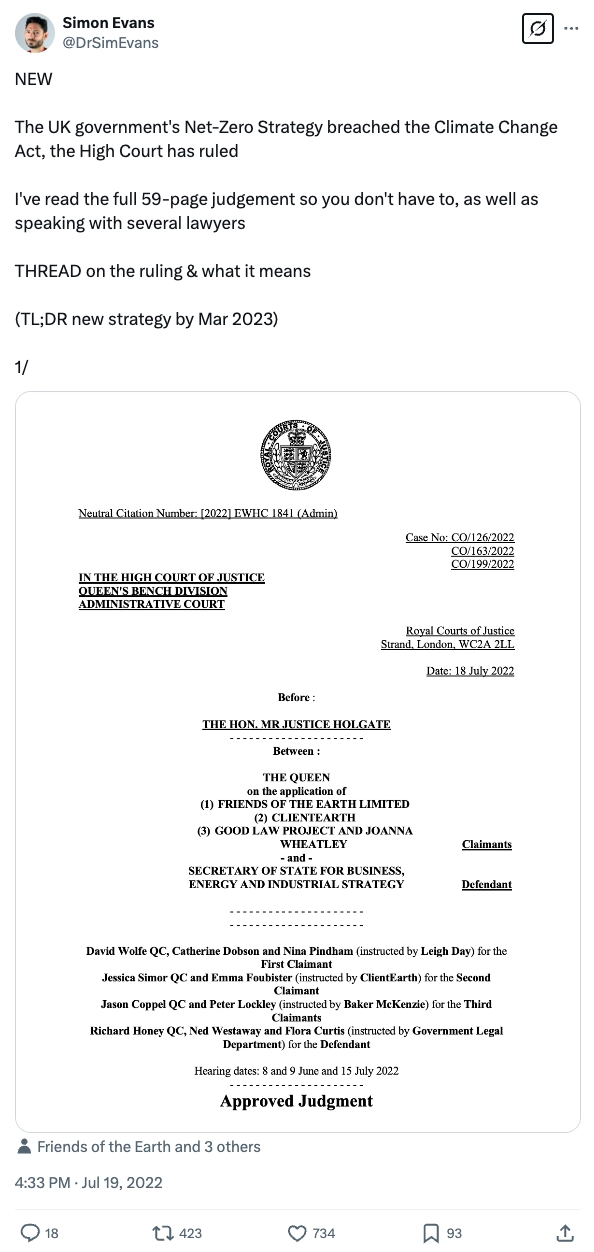
However, these numbers – quantifying the impact of each policy to cut emissions – had always been available behind the scenes. They were later published as part of a revised, highly detailed “delivery plan” for meeting the UK’s goals.
Indeed, it was published in 2023 alongside a veritable “avalanche” of plans and policies, amounting to nearly 3,000 pages of documents on how the UK was going about cutting its emissions.
While this revised strategy was later ruled unlawful once again, it is hard to argue that there has “never, ever been a detailed plan”.
The Labour government has until May 2025 to submit a revised delivery plan to the high court.
Reaching net-zero will be ‘73% cheaper than thought’
In addition to claiming that there is no plan for reaching net-zero, Badenoch claimed that this fictional absence is because it “would reveal just how catastrophic the actual costs will be for families, for businesses and for our economy”.
Badenoch also claimed falsely that reaching net-zero would be a “multi-trillion” project and that it could only be reached by “bankrupting us”. She said:
“Anyone who has done any serious analysis knows it cannot be achieved without a significant drop in our living standards or worse, by bankrupting us.”
Her speech follows a wave of “scary-sounding numbers” being thrown around the UK debate about net-zero over the past 18 months.
Invariably, these arguments – and the numbers behind them – focus on the costs of reaching net-zero without mentioning the costs of business-as-usual; look at the cost of cutting emissions, but not the benefits; or ignore the costs of failing to tackle climate change.
On the contrary, the only “serious analysis” – as Badenoch quipped – on the economic impact of the UK’s net-zero target, has found that meeting the goal will require significant, but affordable investments, which will deliver long-term savings in terms of lower bills for importing fossil fuels.
Badenoch herself, while a minister in 2022, touted the “opportunity, growth and revitalised communities” offered by “the clean energy revolution”, which she said was the “future-proofing force that will help us create a better tomorrow”.
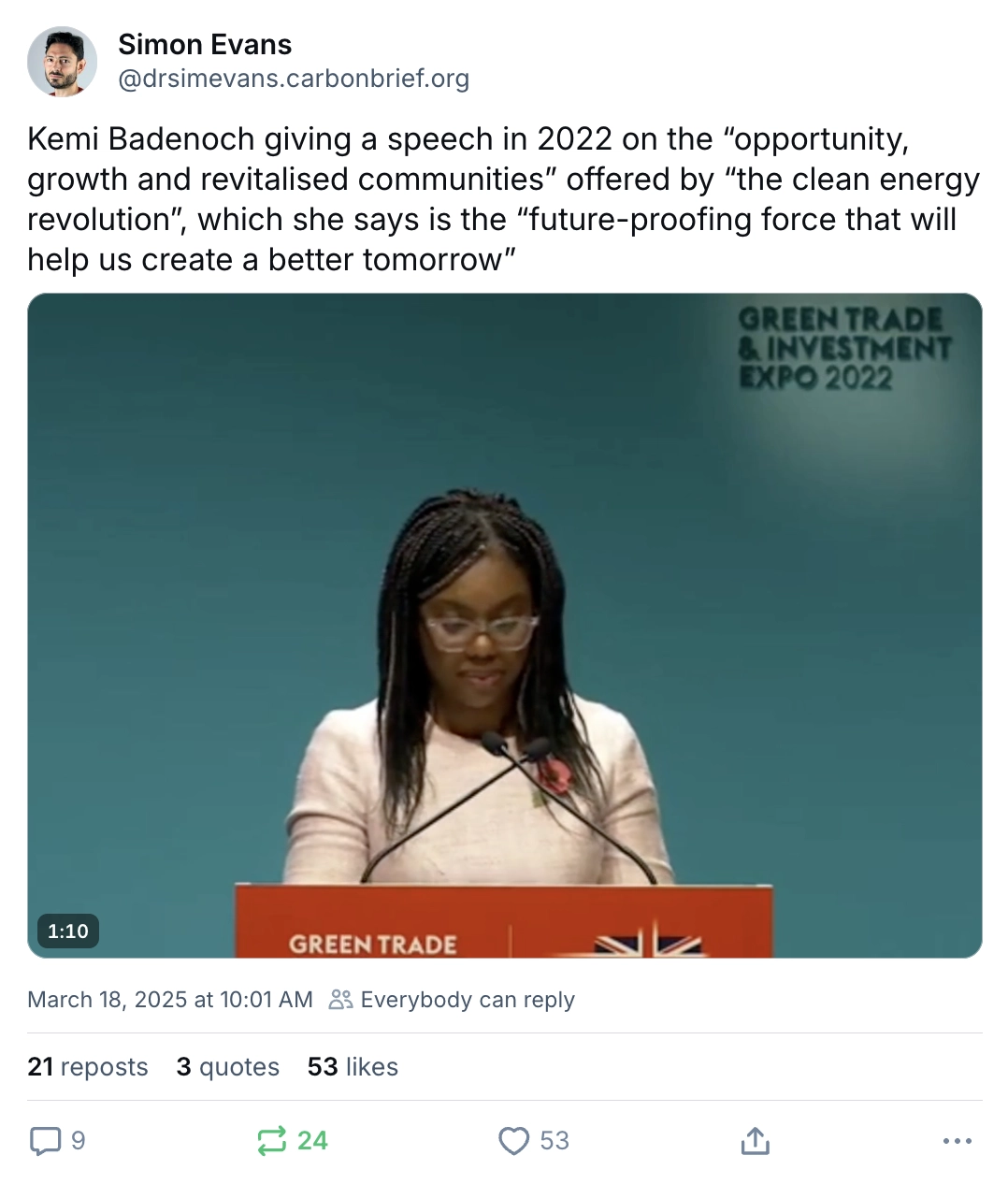
Her comments echoed the independent review commissioned by the government she was part of at the time, which concluded that net-zero was the “growth opportunity of the 21st century”.
It added that while significant investments would be needed – primarily from the private sector – the “benefits of investing in net-zero today outweigh the costs”.
Similarly, in its latest advice to the government, the CCC concluded that the UK would need to make additional investments totalling less than £700bn over the 25 years to 2050.
This was significantly lower than the £1.3tn estimate published just five years earlier and several times lower than the “multi-trillion” cost claimed by Badenoch.
Those investments would deliver almost equally large operational savings of £600bn, due to more efficient electrified heat, transport and industry needing less fossil fuel imports.
In total, the CCC therefore estimated that the net cost of reaching net-zero would amount to just over £100bn over 25 years, equivalent to £4bn per year or 0.2% of GDP.
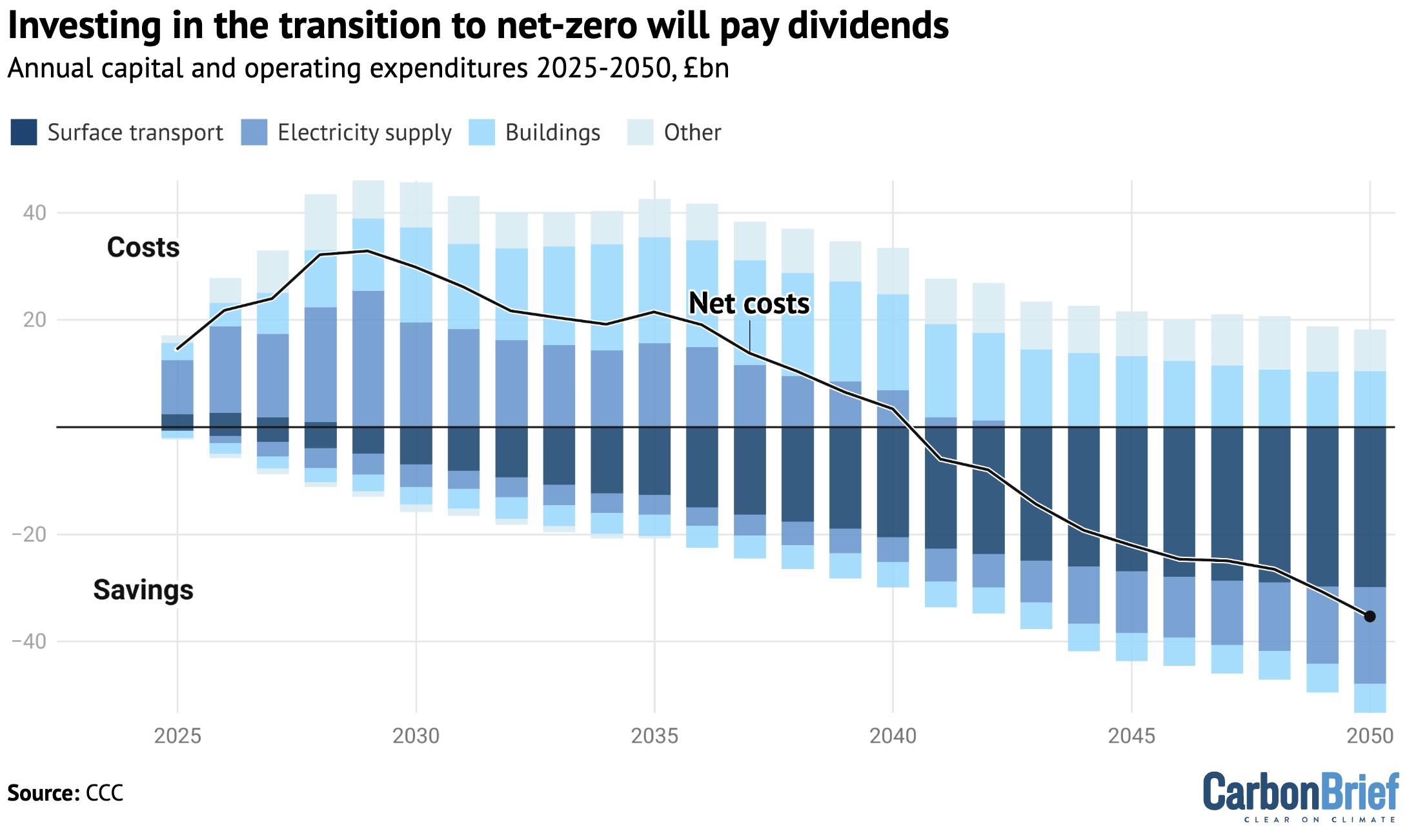
This £100bn net cost is 73% lower than the CCC’s estimate from five years earlier, Carbon Brief analysis found.
Moreover, the CCC said that the large majority of the investment required – some 65-90% – would come from the private sector, rather than from government coffers.
In a statement responding to Badenoch’s speech, Dhara Vyas, the head of Energy UK agreed on the need for “honest conversations”, but added that delaying investments “increases the eventual cost” and – as per Carbon Brief analysis – had already “added billions to bills”. She said:
“Of course we need honest conversations about how we fund the costs in a way that is fair to households and businesses – and this also needs to include a consideration of the potential price of inaction. Delaying upfront investment increases the eventual cost and rowing back on green measures added billions to bills during the gas crisis.”
Unchecked warming would be ‘catastrophic’ for public finances
Badenoch’s speech did not mention the costs of unchecked warming. Instead, she described the UK’s approach to climate policy as “fantasy politics…Promising the Earth. And costing it too.”
In contrast, the Office for Budget Responsibility (OBR) concluded in 2021: “Unmitigated climate change would ultimately have catastrophic economic and fiscal consequences.”
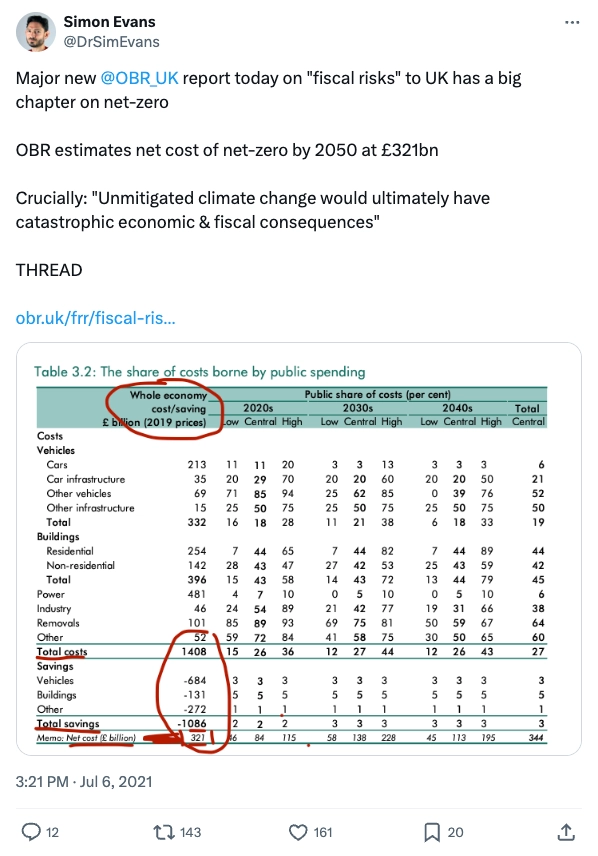
This was, in part, due to the impact of increasingly severe extreme weather events, which the OBR subsequently said might cost the UK nearly 8% of GDP by 2050.
The conclusion was also based on the fact that shifting to clean energy would reduce the UK’s exposure to volatile fossil fuel prices set by international markets. It said:
“There is a risk that the UK economy remains relatively highly dependent on imported gas…Continued dependence on gas could be as expensive fiscally as completing the transition to net-zero”.
Furthermore, the OBR found that delaying action “could double the overall cost” to the UK of cutting emissions to net-zero.
In its own 2021 review of the net-zero target, the Treasury under Rishi Sunak said that unchecked climate change would be a “significant fiscal risk” and that while the transition to net-zero would have “material fiscal consequences”, those consequences could be “managed”. It added:
“Furthermore, the increased investment required to transition to net-zero creates opportunities for growth and employment.”
This is illustrated by a February 2025 report from the Confederation for British Industry (CBI), which concluded that net-zero was making a “growing contribution” to the UK economy. It said:
“Think going green is just a nice idea? Think again. The net-zero economy has become a powerhouse of job creation and economic expansion with 10.1% growth in the total economic value supported by the net-zero economy since 2023.”
The report found that the net-zero economy was growing three times faster than other sectors. Responding to Badenoch’s speech, CBI head Rain Newton-Smith said in a statement:
“Now is not the time to step back from the opportunities of the green economy. Cross-party support for net-zero has underpinned international investors’ confidence to choose the UK for investment in the energy transition.”
High gas prices are making energy bills expensive
Part of Badenoch’s argument against the net-zero target is her claim that the UK’s current climate policies are “driving up the cost of energy”. In her speech, she said:
“The cost of electricity – far too high – much higher than nearby and comparative countries with the real possibility of it going even higher with environmental levies.”
The UK does face very high electricity prices relative to many other countries. However, contrary to Badenoch’s speech, the UK’s extreme exposure to gas prices is the main reason for this.
(As Energy UK’s Vyas notes in her statement, “it’s the volatile cost of fossil fuels and our dependence on them that have driven up energy bills for customers”.)
Indeed, the UK’s wholesale electricity prices are almost entirely dictated by the price of gas, which remains more than three times more expensive than before the global energy crisis.
This near-perfect correlation between gas and power prices is shown in the figure below. (Note that Northern Ireland is part of the separate all-Ireland electricity market.)
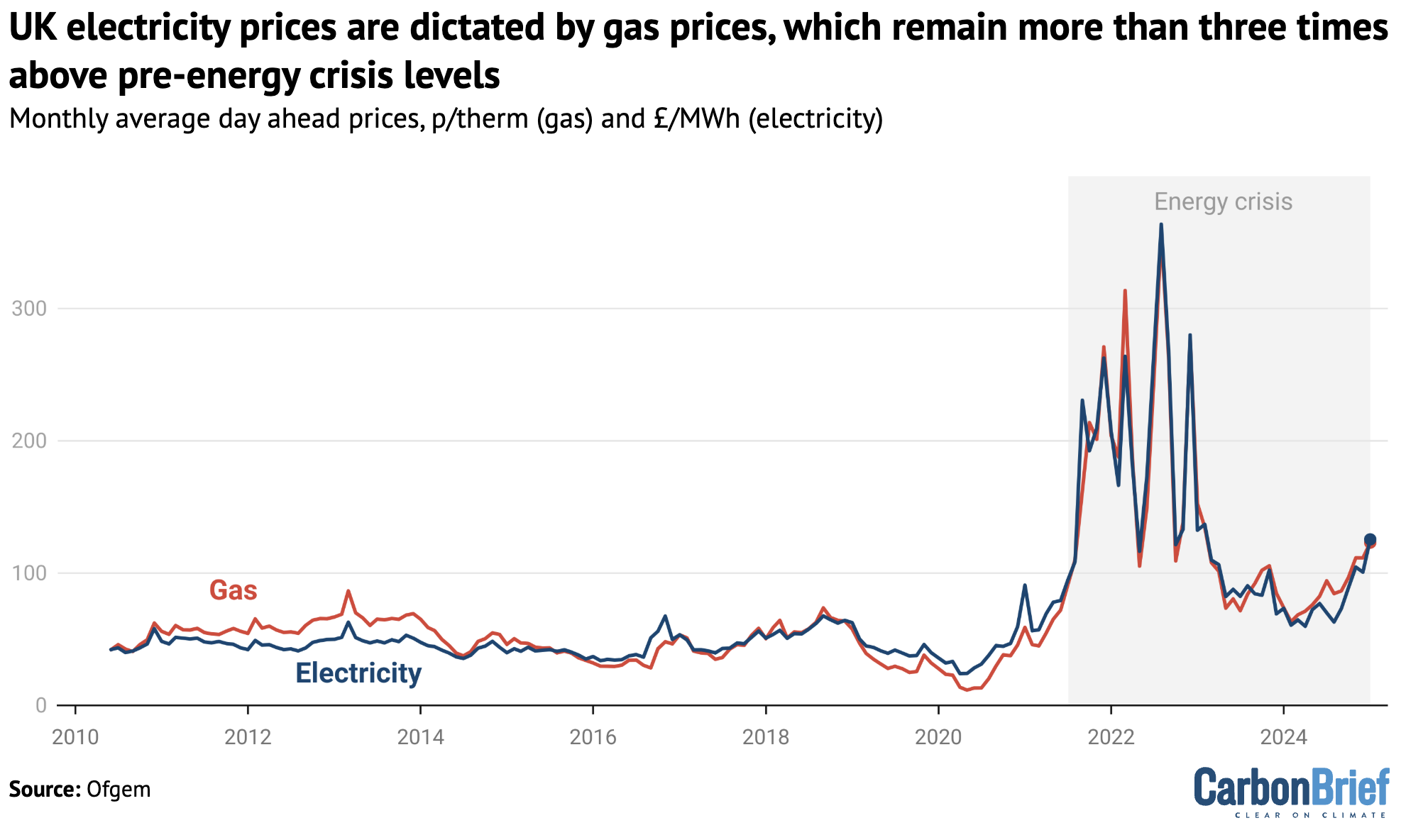
While the UK’s electricity was the “cleanest ever” in 2024, with a record-low share coming from fossil fuels, gas continues to set the price of electricity during the vast majority of hours.
This is a result of the “marginal pricing” system used in most countries around the world. Specifically, gas sets the wholesale price of electricity in the UK during 98% of hours, whereas the EU average is less than 40%, as shown in the figure below.
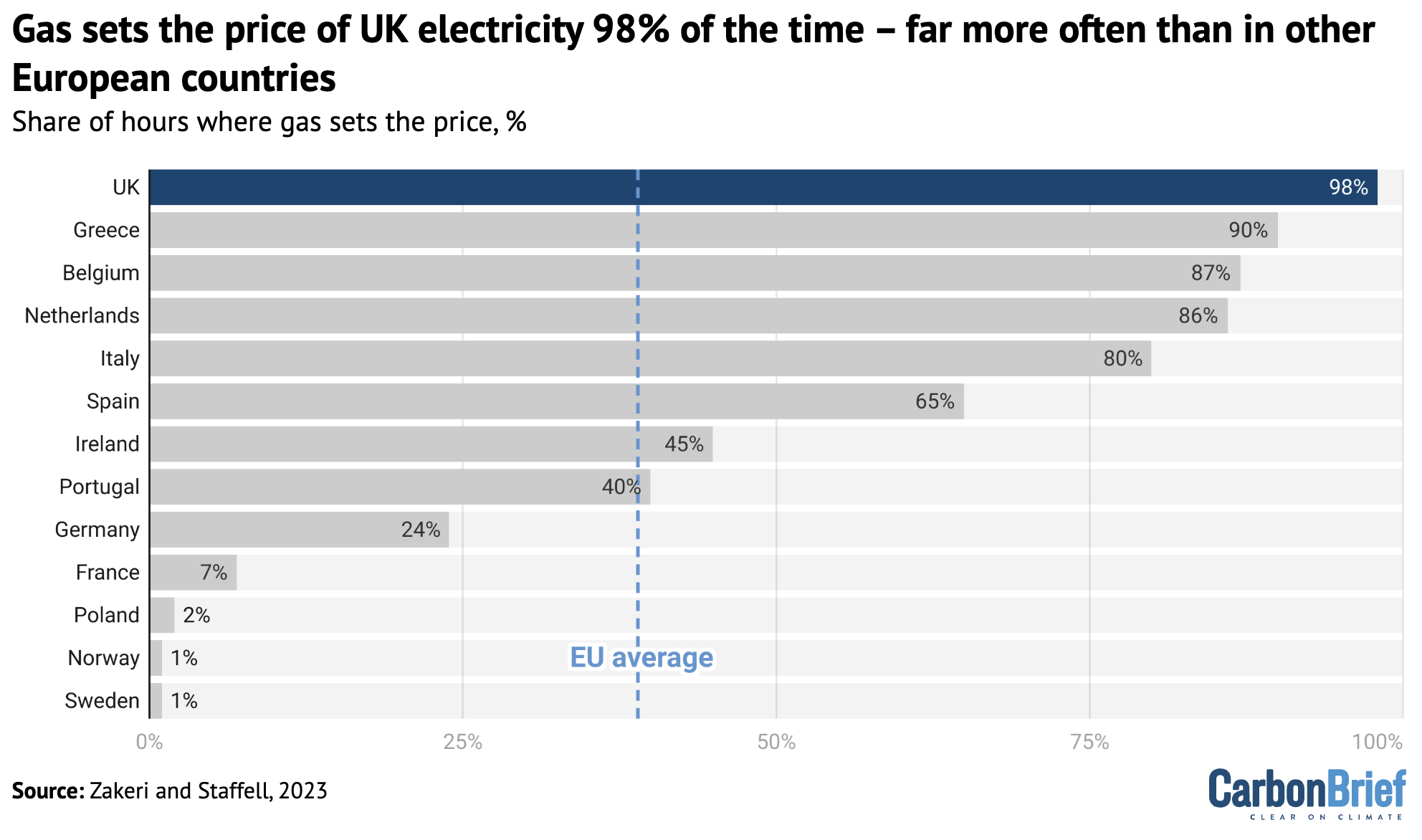
The government’s target of clean power by 2030 is expected to significantly reduce the amount of time when gas sets the price of electricity.
In one of the scenarios set out in NESO advice last autumn, gas would set the price in just 15% of hours by 2030, insulating consumers from “volatile international gas prices”.
While the UK’s high exposure to gas prices is the main reason for high electricity bills, the government is also under pressure to cut other costs, including the cost of building and operating the electricity system, as well as funding historical support for renewable projects.
A long-running government review of the way the electricity market operates is due to reach a conclusion by summer 2025. This could result in changes designed to reduce the influence of gas on electricity prices and to make the system more efficient, among other things.
In a March 2025 report, Energy UK set out a range of shorter-term options to cut the price of electricity, most prominently removing policy costs from electricity bills and paying them via gas bills or from general taxation. This shifting of costs is known as “rebalancing”.
The CCC’s recent advice to government also called for policy costs – which make up around 25% of household electricity prices – to be rebalanced onto gas bills or taxation.
Net-zero will ‘make energy cheaper, not more costly’
In the longer term – and contrary to what Badenoch implies in her speech – the transition to clean energy is widely expected to cut household energy costs.
Looking specifically at the UK, the CCC said in February 2025 that shifting towards net-zero would help cut household energy bills and motoring costs by £1,400 per year by 2050.
It said that household energy bills for heat and power would fall by £700 in 2050, compared with current levels, and that the cost of fuelling cars would fall by a similar amount.
In a pre-launch press briefing, CCC chief executive Emma Pinchbeck addressed MPs arguing against the transition to net-zero, telling journalists that their opposition amounted to being hostile to lower bills for their constituents. She said:
“If you are an elected representative who is hostile to renewables, heat pumps, electric vehicles, what our numbers say is you are also hostile to your constituents saving £700 on their energy bill and [another] £700 on their fuel bill through making those changes.”
At a global level, the IEA concluded that reaching net-zero by 2050 would “make energy cheaper, not more costly”.
Strikingly, the IEA concluded that accelerating climate action to reach net-zero emissions by 2050 would make the global energy system “more affordable and fairer”.
According to the agency, this is because higher investment costs would be more than offset by lower fuel bills, greater efficiency and reduced fossil fuel rents. It concluded:
“Energy transitions could lead to major reductions in household energy bills and accelerate progress towards universal energy access. But managing upfront costs for poorer and rural households – as well as ongoing costs – remains a key public policy challenge.”
Net-zero makes energy ‘more secure’
Another key part of Badenoch’s speech was her argument that net-zero “makes us dangerously dependent on countries who don’t share our values and it is risking our energy security”.
She did not find space in her speech to mention the UK’s current exposure to expensive fossil fuel imports, many of which come from what she refers to as “countries who don’t share our values”.
Indeed, the UK’s exposure to international gas prices, which surged following Russia’s invasion of Ukraine in 2022, left the country the “worst hit” in western Europe by the subsequent global energy crisis, according to Guardian coverage of a report from the International Monetary Fund.
The government’s target to shift to clean power by 2030 would leave the country “much less reliant on energy imports for power and far less exposed to fluctuations in international gas prices”, according to NESO advice published last November.
The wider shift away from fossil fuels, towards electrified heat and transport, would mean the UK could cut its oil imports tenfold from current levels by 2050 and its gas imports by two-thirds, according to the CCC’s recently published pathway to net-zero.
While Badenoch said that she, too, supported the shift to renewables “when they make energy cheaper and more secure”, she also claimed that they would leave the UK “heavily dependent on China”. The country currently manufactures most of the world’s solar panels and large proportions of the batteries and other clean technologies needed to decarbonise.
The shift away from fossil fuels towards clean energy will indeed reshape the geopolitics of global energy supplies. However, Badenoch omits the fundamentally different nature of buying an electric vehicle, which can be fuelled with domestically produced electricity, compared with a petrol car, for which imported fuel must be bought, burned and then bought again and again.
In its 2023 energy security strategy, the then-Conservative government said that the shift to clean energy was the “most effective route to ensuring both climate and energy security”, which would help “avoid risks associated with dependency on fossil fuels”.
Two-thirds of UK public backs net-zero by 2050
In its coverage of Badenoch’s speech, Bloomberg reports that her positioning on net-zero is an attempt to win back votes lost to the hard-right, climate-sceptic Reform UK party.
Ever since the Uxbridge byelection in July 2023, the Conservatives had been tacking away from their historical support for climate policies in general and the net-zero target in particular.
This shift saw then-prime minister Rishi Sunak make a September 2023 speech in which he abandoned or delayed key parts of the then-government’s climate strategy.
Using similar language to Badenoch’s speech, Sunak said at the time that he was adopting an “honest” approach to net-zero and that he was going to remove “unacceptable costs” from “hard-working British people”. Several of his changes would have cost consumers billions.
Many political observers noted at the time that this approach carried electoral risks for the Conservatives. Even some within the party argued that the “right lessons” needed to be drawn from the Uxbridge result. Yet Badenoch has doubled down, going even further than Sunak.
This is despite the fact that anti net-zero rhetoric from the Conservatives was reportedly at least partly to blame for their loss in last year’s general election.
Indeed, some 65%% of the UK public backs the net-zero by 2050 target, according to polling by Climate Barometer, compared with 22% who oppose it.
Moreover, 55% of Conservative voters back the target, as well as 90% of MPs.
YouGov polling released on the day of Badenoch’s speech found that 61% of people in Great Britain support net-zero and just 24% oppose it.
Among those who voted Conservative in the last election 52% support the goal and 38% oppose it, according to the YouGov results.
More than 80% of world’s population covered by net-zero targets
One final point raised by Badenoch’s speech is that even if the UK were to reach net-zero, global emissions would not be guaranteed to reach net-zero overall.
She went on to claim that “other countries are not following us”. Contrary to this claim, some 142 countries – representing more than 80% of the world’s population – are covered by net-zero targets.



The post Factcheck: Why Conservative leader Kemi Badenoch is wrong about UK’s net-zero goal appeared first on Carbon Brief.
Factcheck: Why Conservative leader Kemi Badenoch is wrong about UK’s net-zero goal

Three countries have been named by the Paris Agreement’s compliance committee for failing to submit a nationally determined contribution (NDC) and repeatedly snubbing offers of help with their climate plans.
After months of internal debate over whether to identify serial non-responders, the Paris Agreement’s Implementation and Compliance Committee (PAICC) named the three countries which have failed to engage with it over their NDCs on Friday.
It named Democratic Republic of Congo, Senegal and North Korea in a footnote of its annual report, adding that it decided to name them “with a view to facilitating engagement”, adding that representatives of