

A dozen countries ravaged by conflict and humanitarian crises have joined forces to urge the international community to deliver the funding they need to absorb and respond to worsening climate shocks, calling for a growing gap to be tackled at critical talks this year.
In a statement agreed on Monday and seen by Climate Home News, the newly created network – which includes countries such as Chad, Iraq, Somalia and Yemen – said fragile states, which are “so often forgotten by climate action”, bear the brunt of climate change despite being among the least responsible for its causes.
As “hundreds of millions of the world’s most climate vulnerable remain left behind by climate finance”, the group said it is “determined to bring this issue to the forefront and centre in climate discussions”.
A united voice
The call to action follows the network’s first meeting in Abu Dhabi last month, when fragile states discussed how to make the intersection of climate, conflict and humanitarian needs a priority in climate negotiations.
Representatives from 13 fragile nations attended the meeting, including ministers from Burundi, Chad, Somalia and Yemen and high-level officials representing Mauritania, Sierra Leone, Iraq and South Sudan.
The network, created at the COP29 climate talks in Azerbaijan last December, aims to be a diplomatic force advocating for more and better climate financing tailored to conflict and humanitarian settings.
It will allow fragile states to speak with a united voice in climate negotiations, where their experiences are “overlooked”, Liban Obsiye, executive director of Somalia’s National Climate Fund, told Climate Home.
US approves multi-billion-dollar loan for troubled Mozambique gas plant
Failure to build long-term resilience
More than half of the world’s 25 most climate-vulnerable countries are affected by armed conflict, violence or high levels of humanitarian need, according to think-tank ODI Global, which is supporting the network.
Poor governance and conflict leave people more vulnerable to climate change, with every flood, drought and storm making it more difficult to develop the ability to cope and adapt to future impacts.
Yet funding for these countries falls seriously short, amid real and perceived risks associated with working in unstable settings, including weak institutions, lack of data and limited capacity to formulate proposals and manage projects. Available funding often focuses on short-term humanitarian needs rather than longer-term climate resilience.
Between 2014 and 2021, a group of 13 states identified as “extremely fragile” by the OECD received only $2 per person in multilateral climate finance compared to $162 per person for non-fragile states, a UN study found.
“This conflict blind spot represents a damning failure at the heart of the international climate system,” said the network.
Brazil decides leaders will speak before COP30, easing logistics crunch
“Our message to all countries is clear: we can no longer afford to ignore this,” Yemen’s minister of water and environment Tawfiq al-Sharjabi told Climate Home in a statement.
“We urge governments, climate funds and international organisations to take immediate action to close this funding gap by increasing finance dedicated to climate change adaptation, simplifying bureaucratic procedures, and building capacity in developing countries,” he said.

A key issue for COP30
To make their case, the network has written to COP30 president André Aranha Corrêa do Lago urging him to keep the issue “high on the agenda” of the UN climate summit Brazil will host in November.
In a letter dated Tuesday and seen by Climate Home, countries representing the alliance called on Brazil to ensure fragile states are “kept front and centre of efforts to scale up climate finance” and to hold a thematic day on climate, relief, recovery and peace, which took place at COP28 and COP29.
“COP30 is an irreplaceable moment to bring the agenda forward, to align the needs of climate-vulnerable and conflict-affected countries with global development objectives,” the letter says.
Brazil’s COP30 president: Climate summits must move from words to real action
Setting out his vision for COP30 last week, Brazilian diplomat Corrêa do Lago, who is the country’s chief climate negotiator, emphasised the need to remove barriers for developing countries to access climate finance and to scale funding for them from all sources to at least $1.3 trillion per year by 2035 – a goal agreed at COP29 last year.
Large and growing gap
Collectively, fragile countries need an estimated $41.5 billion annually by 2030 to mitigate and adapt to climate change, nearly four times the $11 billion they received in 2022, according to forthcoming ODI analysis shared with Climate Home.
The projection is based on the needs of 37 countries on the World Bank’s 2025 fragility list (excluding Palestine and Ukraine, whose conflicts would raise it substantially) as identified in their carbon-cutting and adaptation plans submitted to the UN.
The US contributed nearly 9% of the climate finance committed by wealthy nations to fragile states in the decade to 2022 – financial flows which President Donald Trump, a climate change-sceptic, has now halted.
The US retreat and cuts to European aid budgets could further increase the existing funding gap and create more competition for already-scarce funds, said Habib Ur Rehman Mayar, deputy general secretary of the g7+ Secretariat, a grouping of conflict-affected countries.
Age of “climate whiplash” puts residents of Africa’s fast-growing cities in danger
Closing that gap will be a first step. But fragile nations’ needs will continue to grow as climate impacts intensify, said Mauricio Vazquez of ODI. “That makes it more urgent to invest in adaptation today before it becomes loss and damage. What these countries need is resilience finance to anticipate, adapt to and absorb shocks,” he told Climate Home.
Green Climate Fund invests in Somalia
The lack of funding could have catastrophic implications for countries like Somalia, which has been gripped by political instability, ethnic tensions and an Islamist insurgency. In recent years, the East African country suffered a deadly drought made more severe by rising temperatures and devastating flooding, compounding an existing humanitarian crisis.
Today, there is “an enormous gap” to finance flood defences and roll out measures to address soil erosion and curb impacts on food security and farmers’ livelihoods, said Obsiye, who heads the country’s climate fund.
Last year, the UN’s Green Climate Fund (GCF) announced plans to invest $100 million in Somalia under the first national programme of its kind. Stephanie Speck, the GCF’s head of special initiatives, told Climate Home the fund has been “laser focused“ on getting finance to under-served countries and is currently discussing how to support climate action in South Sudan.
Once disbursed, the money will partly help strengthen Somalia’s capacity to access more finance from other donors and institutions, said Obsiye. It’s a “historic” but small start to meet the country’s huge needs, which run into the billions, he added.
The post “Forgotten” fragile states unite to end climate-finance blind spot appeared first on Climate Home News.
“Forgotten” fragile states unite to end climate-finance blind spot

Three countries have been named by the Paris Agreement’s compliance committee for failing to submit a nationally determined contribution (NDC) and repeatedly snubbing offers of help with their climate plans.
After months of internal debate over whether to identify serial non-responders, the Paris Agreement’s Implementation and Compliance Committee (PAICC) named the three countries which have failed to engage with it over their NDCs on Friday.
It named Democratic Republic of Congo, Senegal and North Korea in a footnote of its annual report, adding that it decided to name them “with a view to facilitating engagement”, adding that representatives of the three nations had been invited to its meeting in early 2027 “with the purpose of identifying any challenges and constraints”.
“The Committee noted the importance of Parties engaging with the Committee in a timely manner, while noting that some delays may be due to the national capabilities and circumstances of the Parties”, the report said.
-
Under US pressure, World Bank says it will back gas “where appropriate”
The US wants the World Bank to expand its gas support while climate campaigners are pushing for it to end – its head spoke this week of limited backing for the fossil fuel -
IPCC scientists vow to press on with climate reports despite political deadlock
After governments again failed to agree a timeline, nearly 120 IPCC authors pledged to complete their assessment on time and with full scientific rigour -
Paris Agreement committee snubbed over missing NDC climate plans
Many governments have still not submitted a nationally determined contribution to the UN, breaching a key requirement of the Paris Agreement

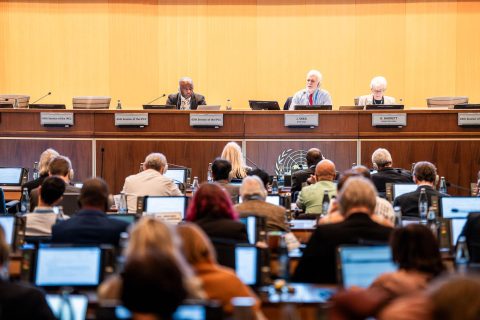

In July, PAICC said 12 countries had ignored its repeated attempts to discuss why they had not published an NDC as required every five years under the 2015 Paris accord.
Members of the committee had been divided over whether to name them, but at a September meeting decided to do so in their annual report to the annual climate COP summit.
By the time the report was published on Friday, only Congo, Senegal and North Korea “had not communicated an NDC or submitted a [Biennial Transparency Report] and had not yet responded to any of the Committee’s notifications, despite several reminders issued by the Committee in this regard”.
Rainforest and renewable energy ambitions
The silence from Congo and Senegal is notable because the former is home to much of the Congo Basin rainforest while the latter has sought billions of dollars in climate finance to support its renewable energy ambitions.
After Brazil, Congo has more rainforest than any country in the world. This forest, and the country’s peatlands, absorb huge amounts of greenhouse gas but are fast being lost to expanding farmland, charcoal production, logging and mining.
Senegal signed a Just Energy Transition Partnership with Canada and wealthy European nations in 2023, to help it meet its renewable energy targets under the-then government of Macky Sall. It was chair of the Least Developed Countries group between January 2022 and December 2023.

Tejas Rao, who is researching the PAICC as part of a doctoral thesis at Cambridge University, said the governments of the three countries should engage with the committee.
“Engagement costs these governments very little and the committee has shown it will listen,” he said.
“Silence leaves the committee with no basis to help, and it leaves the [governments] exposed to the narrative that they are simply disengaged,” he told Climate Home News.
Paris Agreement requirement
The 2015 Paris Agreement requires all parties to publish an NDC every five years outlining their emissions reduction targets, with each plan meant to be more ambitious than the country’s last NDC.
The latest set – the third round of plans, with new targets for 2035 – was due in February 2025. While most countries missed this deadline, all but around 30 – mostly small emitters but including Egypt, Vietnam and Argentina – have now submitted them.
Over the year, the PAICC – which is made up of government climate officials from developed and developing countries – has been communicating with governments that have not submitted NDCs and trying to overcome barriers to them doing so.
Some nations have cited exceptional circumstances as the reason for not submitting an NDC, a process that requires a significant amount of work in tracking emissions and consulting on how to curb them across the economy. For example, a letter from a Sudanese official to the PAICC, seen by Climate Home News, said that the country’s civil war had led to the suspension of its NDC preparation.
-
IPCC scientists vow to press on with climate reports despite political deadlock
After governments again failed to agree a timeline, nearly 120 IPCC authors pledged to complete their assessment on time and with full scientific rigour -
Under US pressure, World Bank says it will back gas “where appropriate”
The US wants the World Bank to expand its gas support while climate campaigners are pushing for it to end – its head spoke this week of limited backing for the fossil fuel -
Who shapes climate science? The equity question facing the IPCC
Early completion of the next global climate science assessment reports risks excluding research from the Global South, which is key to ensuring the findings are fair
The US and Iran are not signed up to the Paris Agreement and so do not have active NDCs, nor does Taiwan, which is not a UN member state.
Rao said that because the PAICC is “facilitative and non-punitive”, naming the countries “is meant to open a door, not close one – the invited consultation is the point”.
“In recent months, governments that explained their constraints, whether capacity, finance or domestic process, have been met with follow-up and support rather than sanction, and the number of silent governments has fallen sharply,” Rao said.
The post Paris Agreement committee names three countries snubbing it over NDCs appeared first on Climate Home News.
Paris Agreement committee names three countries snubbing it over NDCs