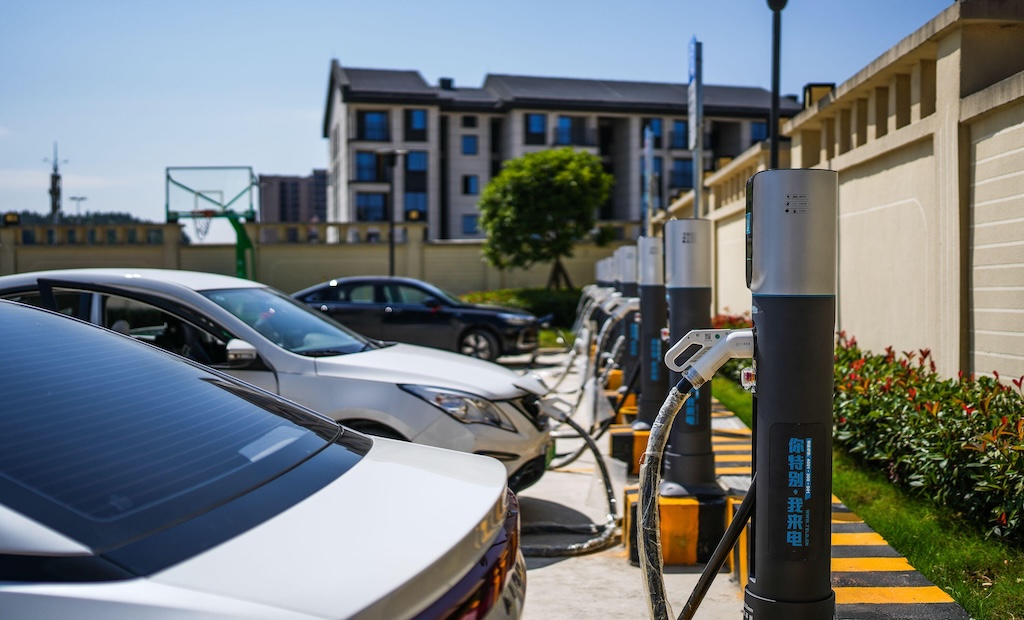
Wandering the streets of Shenzhen, a city which has earned the title of China’s “first city of ‘new-energy vehicles’” (NEVs), you will not miss the scene of numerous NEVs parking under slogans promoting “green and low carbon” lifestyles.
Shenzhen, a city of nearly 18 million people bordering Hong Kong, is known for pioneering China’s economic reforms 40 years ago.
Now, it is taking carbon mitigation measures ahead of others and acts as a “pilot” for the construction of “low-carbon cities” in China.
It is the first Chinese city that has replaced all of its buses, taxis and ride-hailing cars with electric versions, while about 77% of all new cars sold in Shenzhen were NEVs 2024 – significantly higher than the national rate of 48%.
It has also introduced a carbon emissions cap – in support of switching from the “dual control of energy” to “dual control of carbon” – ahead of the announcement of a national cap.
In addition, the Shenzhen local emissions trading system (ETS) and “green bonds” were both rolled out before the national ETS and national “green” bonds.
Despite taking steps early, some scholars tell Carbon Brief that Shenzhen’s efforts – which the local government calls the “Shenzhen model” – will be tricky to reproduce for city-level low-carbon transitions elsewhere in China.
Carbon Brief looks back at Shenzhen’s low-carbon transition efforts to date and assesses its progress on carbon mitigation.
Electric transportation
Shenzhen’s low-carbon transition did not happen overnight – it resulted from early planning, government support and market-driven solutions, Wei Fulei, director of finance, taxation, trade and the industrial development research centre at the China Development Institute (CDI), a state-sponsored thinktank based in Shenzhen, tells Carbon Brief.
The city’s low-carbon transformation kicked off in the 2000s, when the number of days with heavy air pollution peaked in Shenzhen.
A BBC News report back in 2017 said that after a decade’s work on tackling pollution, Shenzhen “reduced its average air pollution by around 50%”.
The move was largely a result of changing its “industrial base”, which made Shenzhen “one of [the] first batch of these ‘low-carbon cities’”, said the BBC News article.
During this period, the officials developed strategies for “low-carbon development”. Part of this included nourishing the growth of a number of “strategic emerging industries”, such as the “information and communications technology“, which in return provided core technology support for low-carbon industries, largely benefiting the NEV sector.
The current leading global electric vehicle (EV) giant, BYD, for example, was born in Shenzhen against this background.
“With this ‘industry gene’, Shenzhen only needs to adapt and upgrade accordingly to meet the new demands of the NEV industry [in the 2020s],” says Wei.
According to the Shenzhen government work report at the 2025 “two sessions”, the city – whose population makes up 1% of the country’s total – produced 22% of China’s NEVs in 2024.
About 100 new “climate investment and financing projects” will be launched in the year ahead, said the report, adding that another 180bn yuan ($24bn) of “green loans” will be also be issued.
Shen Xinyi, analyst and China team lead at the Centre for Research on Energy and Clean Air (CREA), tells Carbon Brief that the local government has a track record of nurturing new industries:
“Wind and solar power, along with EVs, were all emerging industries that required substantial investment and technological research 20 years ago…The risk of failure was high, but the Shenzhen government introduced innovative policies to support them.”
The quick growth of NEV companies has pushed up the share of NEVs in the local vehicle market. On top of national subsidies, the local government has also provided support for producing and purchasing NEVs.
In 2024, NEVs accounted for some 77% of new car sales in Shenzhen, significantly higher than the national share of 48%.
In addition, the city has also replaced all of its buses, taxis and ride-hailing cars with electric versions – the first city to have done so in China.
Heran Zheng, lecturer in sustainable infrastructure economics and finance at University College London (UCL), tells Carbon Brief that the “greener transport fleet” speeds up Shenzhen’s low-carbon transition, because a city’s low-carbon transition mainly requires two focuses – “transport transition” and “industry decarbonisation”.
Zheng says:
“There are limited policy efforts a city can make in carbon mitigation. It can work on greener transports. London, for example, set up the Ultra Low Emission Zone to encourage the usage of public transport and cleaner vehicles. And a city can upgrade industries and mitigate their emissions, which are harder to do because no city wants to slow down economic growth.”
Shenzhen, “different from some coal mining cities in China”, has an “advantage” in industry transition, says Zheng, which allows it to set “more ambitious” emissions targets.
Carbon control
China uses energy intensity and carbon intensity – the energy use and emissions per unit of gross domestic product (GDP) – as key metrics in its climate policies.
In addition, the country has been using the “dual control of energy” system – regulating energy intensity and energy consumption – since 2016. However, it announced plans to switch to the “dual control of carbon” in 2024.
Under the new system, a binding cap for total carbon dioxide (CO2) emissions will be set and will become the main target after 2030, while carbon intensity – the prime target before 2030 – will be gradually lowered to be the secondary target.
(Read more about the “dual control” systems in this edition of China Briefing.)
Here too, Shenzhen was an early mover. As early as 2023, it became China’s “first city to explicitly state its commitment to the ‘dual control [of carbon]’ system”, according to Dialogue Earth.
It issued two “implementation plans” towards this effort, published in 2023, as well as developing a city-level carbon emissions cap.
The plans, compared to the national ones, have more ambitious timelines. A city-level “dual control of carbon” system will be built up by 2025 and it will be “fully implemented” in 2026-30. One of the plans says:
“We will strive to achieve the goal of using a dual carbon emission control approach to carry out quota allocation in the Shenzhen carbon market [for the] manufacturing industry by 2028…and strive to achieve a significant improvement in market regulation capabilities by 2030.”
Shenzhen plans to reduce its energy intensity by 14.5% before the end of 2025, compared to 2020 levels. The national energy intensity target is 13.5% during the same period.
Zheng says that Shenzhen’s commitment “should be within its capacity”, adding:
“There are three major carbon mitigation areas [for China as a whole] – steel, cement and electricity. Shenzhen has no major steel and cement industries, so it only needs to largely focus on electricity…It is also not at the upstream of a supply chain, unlike some fossil fuel cities; it doesn’t need to worry about business, such as coal mining. Its industry structure is dominated by ‘high value-added’ industries, such as technology and NEVs, whose emissions are easier to mitigate.
“In addition, the city is a technology hub. A lot of high-emissions manufacturers have moved out of Shenzhen to its neighbouring cities, such as Shanwei. This is what we call ‘emissions outsourcing’. Shenzhen, benefiting from this, has fewer hurdles in [its] green transition.”
Last year, Zheng and colleagues published a study on this outsourcing of emissions between Chinese cities in Nature. They found that “some cities benefit from the carbon mitigation efforts of other cities more than their own” and suggested that policymakers work to acknowledge these effects.
Another “big difference” between Shenzhen and other cities is that “Shenzhen has its own nuclear power”, says Zheng, which is “important” for the city’s electricity transition – the remaining sector that Shenzhen needs to put efforts towards low-carbon transition.
Low-carbon energy
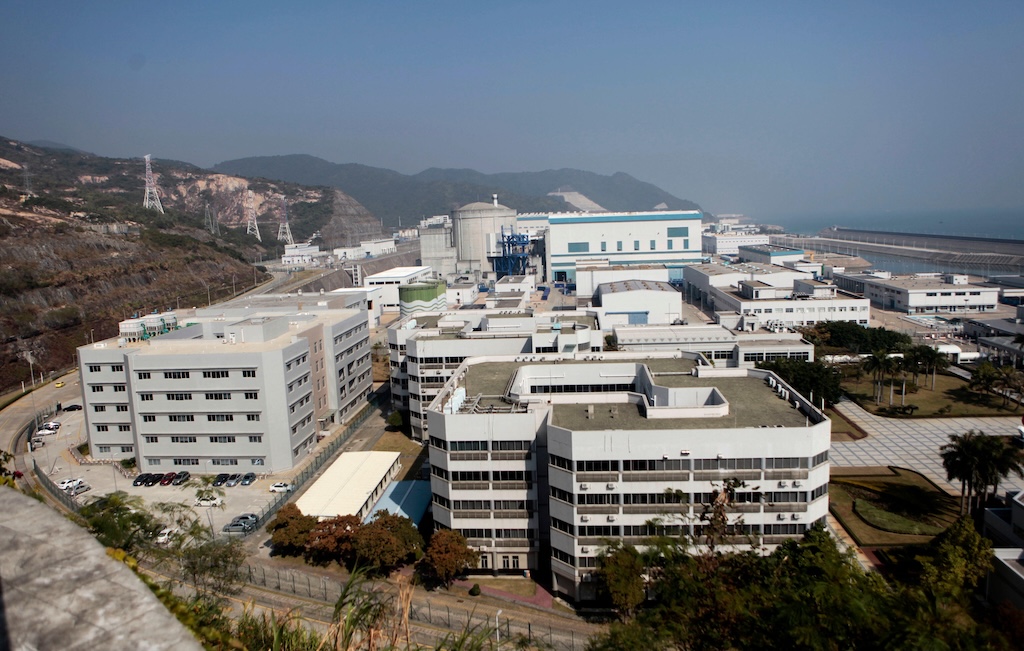
According to a 2021 report, Shenzhen’s “largest local power source” is the Daya Bay nuclear power station, with a total installed capacity of 6.1 gigawatts (GW).
Nuclear power accounted for 35% of the city’s total power generation in 2021.
It has also pushed up Shenzhen’s low-carbon energy usage – about 47% of Shenzhen’s primary energy consumption was from clean energy in 2024.
Nuclear dwarfs all the other clean energy sources feeding into the city’s grid. The Shenzhen local authority’s 2025 government work report says current solar power capacity stands at about 1GW – and it does not mention wind capacity.
Its “14th five-year plan for climate change response” says that Shenzhen’s renewable energy capacity has “little room” for future growth due to “scarce” energy resources and “limited” land for wind and solar power.
Meanwhile, Shenzhen relies heavily on imported electricity, which accounts for approximately 70% of the city’s total electricity consumption.
This reliance limits Shenzhen’s control over emissions from the sector. It also challenges the local grid’s ability to manage demand during peak usage times.
In 2024, China approved the constructions of more nuclear reactors in Shenzhen’s neighbouring city of Huizhou.
The Shenzhen government also aims to “raise the combined share of natural gas, nuclear and renewable energy to 90% in 2025, up from the current figure of 77%, which is noticeably ahead of the nationwide figure of 52%”, according to a research paper in 2022.
Zheng says that “Shenzhen is a lot like its neighbour Hong Kong, whose energy transition does not rely on solar and wind build up either”.
He adds that in order to achieve a sustainable energy transition, both Shenzhen and Hong Kong would need to utilise their advantage as “financial cities”.
‘Green finance’
Shenzhen has long been using “market forces” and has successfully “struck a balance between government support and market-driven solutions”, where enterprises “take the lead, handling 90% of the work”, while the government intervenes only when necessary, says Wei.
With little interference from the government, Shenzhen was one of the first seven cities and provinces in China that established a local “pilot” ETS in 2013, ahead of the national rollout in 2021.
Similar to China’s national scheme, the local ETS allocates emissions allowances for companies to trade on the market, based on their emissions intensity – the emissions per unit of output – rather than absolute emissions.
The Shenzhen local ETS covered 38% of the city’s carbon emissions upon launching. The figure rose to 50% in 2020 and will continue to expand, says a report by the trading forum International Carbon Action Partnership (ICPA), with a shift to an “absolute cap” for carbon emissions being announced to apply from 2027.
(For now, the national ETS does not include a cap on emissions either, although this is also set to change.)
However, Yan Qin, carbon analyst at consultancy firm ClearBlue Markets, tells Carbon Brief that despite Shenzhen ETS plans to expand its coverage, more pilot ETS are seeing their coverage “shrinking” due to enterprises leaving to join the national ETS”.
ICPA’s research also finds that electricity production was excluded from the Shenzhen ETS after 2019 when it “transitioned to the China national ETS”.
Yan says that the pilot ETS, nevertheless, “has been an important testing field, paving the way for the successful launch of national ETS eventually. [It] will continue to exist and cover the small to medium enterprises as well as sectors outside national ETS”.
The Shenzhen local ETS, as of 2022, covers water, gas, heat, manufacturing, transport and other sectors, says ICPA.
It was the biggest local ETS in China as of 2024 and maintains the highest annual trading volumes in the country for several consecutive years, says Shenzhen Business News.
In the meantime, Shenzhen has taken initiatives in “green finance”, bringing private investments into the market.
In 2021, Shenzhen issued China’s first overseas sales of “green government bonds” in Hong Kong along with China’s first local “green finance legislation”, which provides a “solid institutional guarantee” for regulating the “green market”, according to an assessment of the legislation by research institute the International Institute of Green Finance.
In contrast, China’s national sovereign bonds were only available to international buyers from April 2025.
Various other “green finance” products have also been issued. According to state-run newspaper Economic Daily, about 4.6 trillion yuan ($633bn) was traded for new energy, NEVs and other environment-related stocks at the Shanghai and Shenzhen Stock Exchange in the first half of 2024.
Nevertheless, Zheng says that the impact of the “green bonds” is “hard to evaluate”. He says: “A lot of projects, such as sewage treatment, can also fall into the category of ‘green bonds’”.
According to the state broadcaster CCTV, Shenzhen’s “green bonds” issued in 2021 covered projects including “construction of ordinary public high schools, urban rail transit and water management”.
Zheng says that although these projects are linked to energy efficiency improvements, they nonetheless make only “limited contributions” to cutting carbon emissions.
Zheng adds that market guidance is “necessary” in a city’s low-carbon transition, but “there is not yet a study on how large a green finance product can make a difference on mitigation”.
Shen says there is nevertheless an important role for “financial instruments” to support the low-carbon transition. She explains:
“Low-carbon industries generally have higher costs than fossil fuel-based industries…With policy support and financial instruments, the costs can be reduced, allowing these industries to scale up.”
‘Shenzhen model’
The local government and media outlets have touted the city’s achievements on climate as the “Shenzhen model”, implying that it could be applied elsewhere.
Xu Hua, an official from the Shenzhen Municipal Ecology and Environment Bureau, said the model “demonstrated the results to the world” at last year’s COP29:
“Firstly, Shenzhen has continuously improved its top-level design…establishing a comprehensive policy system. Secondly, the city has focused on the transformation and upgrading of key sectors…promoting strategic emerging industries such as new energy, energy conservation, and environmental protection. Thirdly, following the principle of openness…Shenzhen has been exploring new paths for green and low-carbon development.”
Xu added that the city “positions itself as a leader in green development nationwide”, as it had “significantly reduced its energy consumption, water usage and carbon emissions per 10,000 yuan of GDP to one-third, one-eighth and one-fifth of the national average, respectively” by the end of 2023.
However, not all of Shenzhen’s journey is “replicable”, says Shen, adding: “Shenzhen capitalised on the opportunities of its era.” She tells Carbon Brief:
“For example, its supply chain advantages and the skilled workforce that has settled in the city have been key enablers of its high-end manufacturing sector.”
Zheng agrees with Shen, saying that Shenzhen can only represent a certain type of city in China. He says:
“Shenzhen is China’s Silicon Valley and heavily invests in high-end technology. It can only represent a [certain] type of cities in China, the ‘top tier’, such as Beijing, Shanghai and Guangzhou. There are more than 300 cities in China, all facing unique transition situations. It is meaningless for coal-heavy industrial cities to learn from Shenzhen.”
Other cities in China, meanwhile, have also started to explore their own ways to achieve sustainable development.
The city of Suzhou has built the Suzhou Industrial Park – one of China’s first pilot low-carbon industrial parks. It has also established a “market-based carbon inclusion trading system”, which incentivises “voluntary” carbon emission trading among citizens, as well as small- and medium-sized companies.
Meanwhile, the city of Tianjin has launched a collaboration with Singapore to “explore a path for China’s urban systems to reduce carbon emissions”, according to a Xinhua report.
Other cities must “adapt strategies according to their unique conditions”, Shen adds. This sentiment is reflected in a 2023 document issued by China’s State Council – the country’s central government. The document, called “China’s green development in the new era”, says that:
“Local authorities should rely on their resource endowments, environmental conditions and industrial development foundations to fully leverage the comparative advantages.”


The post Explainer: What is China’s ‘Shenzen model’ for low-carbon transition in cities? appeared first on Carbon Brief.
Explainer: What is China’s ‘Shenzen model’ for low-carbon transition in cities?

Next week, diplomats from around the world will descend on Yerevan, Armenia, to negotiate a series of decisions under the UN Convention on Biological Diversity (CBD).
Between 19 and 30 October, 196 parties will gather to hammer out the precise wording of the dozens of legal texts that make up the decisions under the Conference of the Parties (COP) to the CBD.
This year’s summit is particularly significant, as it marks the halfway point between the agreement of the Kunming-Montreal Global Biodiversity Framework and the deadline for achieving its targets.
The CBD has found that countries are currently not on track to meet 22 out of the framework’s 23 targets.
During the fortnight, delegates will also be negotiating decisions relating to the two supplemental protocols to the CBD: the Cartagena Protocol, which covers biosafety; and the Nagoya Protocol, which covers access and benefit-sharing for the use of genetic resources.
(The Cartagena and Nagoya Protocols, which are each governed by a “meeting of the parties”, or “MOP”, have fewer parties than the CBD as a whole, with 173 and 141, respectively.)
Carbon Brief is tracking the progress of countries towards consensus on dozens of negotiating texts using the interactive table below.
The tracker includes texts from the COP, as well as the MOPs for the Cartagena and Nagoya protocols. It also includes draft decisions from the most recent subsidiary body meetings, as these form the starting point for the negotiations in Yerevan.
The CBD has three subsidiary bodies: the subsidiary body on scientific, technical and technological advice (SBSTTA), the subsidiary body on implementation (SBI) and the subsidiary body on article 8(j) and other provisions (SB8J).
SB8J focuses on issues related to the Indigenous peoples and local communities. It was established at COP16 in Cali, Colombia, in 2024.
The first two columns of the interactive tracker list the topic of each agenda item and the relevant body, with subsequent columns including dates, page counts and links to the original documents.
The table is searchable and can be sorted using the arrows in the header.
Areas of disagreement in UN draft texts are denoted by square brackets. Counting the brackets in a particular iteration of a text therefore gives a sense of how far parties are from reaching consensus.
The bracket column is colour-coded, with dark green indicating a low number of brackets and red indicating a high number of brackets remaining.
Texts can also present parties with choices using “options” or alternatives (“alt”), which are counted together in the sixth column of the table.
The key discussions in Yerevan will centre around two agenda items in particular. The first is the global review, which will assess progress towards the GBF and make recommendations for accelerating action.
The second is finance, which can be separated into two parts: resource mobilisation and the financial mechanism. On resource mobilisation, biodiverse global south countries are likely to push for an increased amount of international finance for conservation.
Disagreement over the creation of the financial mechanism led to the suspension of COP16 in Cali in October 2024, as parties failed to find agreement on the mobilisation of finance before the end of the summit.
Global south countries want the establishment of a separate financial mechanism under the control of the CBD; global north countries largely prefer to maintain the existing mechanism, which sits under the Global Environment Facility.
At the resumed session of COP16 in Rome in early 2025, countries agreed on a roadmap that would lead to the establishment of a permanent mechanism.
related