Connect with us

Published

on

尽管中国电力需求快速增长,但清洁能源发电的增长首次使该国的二氧化碳(CO2)排放量出现下降。

Carbon Brief的最新分析显示,2025年第一季度,中国的碳排放量同比下降了1.6%,过去12个月则下降了1%。

新增风电、太阳能和核电的装机容量所带来的出力,足以应对电力需求激增,从而削减燃煤发电量;而此前的排放下降则主要被归因于经济增长放缓。

这项基于官方数据和商业数据的分析显示,中国的碳排放量一年多来一直保持稳定或下降。

不过,该排放量仅比最近的峰值低1%,这意味着只要出现短期反弹,中国的碳排放就可能创下新高。

其他主要发现包括:

  • 清洁能源发电增长速度已经超过当前及长期电力需求增长平均值,从而压低了化石燃料的使用量。
  • 截至2025年3月的12个月内,电力行业的碳排放同比下降了2%。
  • 若这一趋势得以保持,意味着中国电力行业排放可能已达峰并开始持续下降。
  • 美国总统特朗普发动的“贸易战”促使中国更加努力将经济重心从出口转向内需。
  • 新出台的可再生能源电价政策催生了“抢装潮”,企业争相在政策实施前完成项目建设。
  • 如果中国要实现在《巴黎协定》下承诺的2030年排放目标,仍面临日益扩大的差距需要弥补。

上微信关注《碳简报》

如果这种因清洁能源增长而带来的电力行业碳排放下降趋势得以延续,可能预示着Carbon Brief此前在分析中预测的结构性排放下降的开始。

电力行业碳排放下降的趋势很可能在2025年继续。

然而,未来的走势在很大程度上将取决于中国即将于明年公布的下一份五年规划中所设定的清洁能源与减排目标,以及中国对特朗普政府敌对贸易政策的应对策略。

中国碳排放因清洁能源而下降

过去十年来,尽管中国化石燃料和水泥行业的碳排放量有高低起伏,但总体上升了20%。

最新数据显示,该排放量可能已经接近达峰以及趋稳,甚至正步入结构性下降的阶段。

截至2025年第一季度的最新数据显示,中国的碳排放量已经连续一年多呈现稳定或下降趋势,如下图所示。

不过,由于该排放量仅比最近的峰值低1%,这意味着其仍有可能在短期内反弹并创下新高。
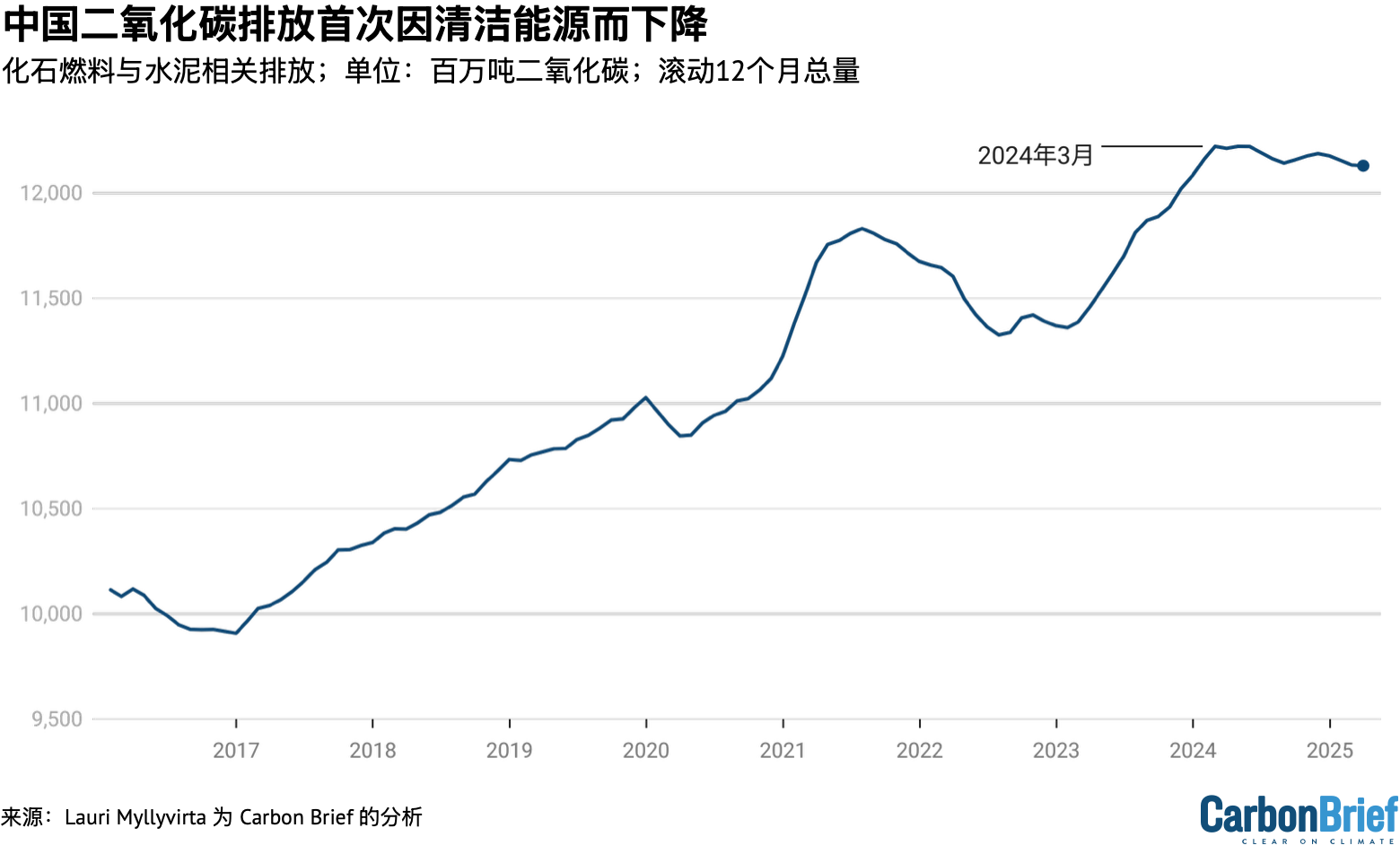
中国二氧化碳排放首次因清洁能源而下降

因此,中国未来的碳排放走向尚未确定,这取决于各经济部门的趋势,以及中国对特朗普关税政策的应对方式。

电力行业排放下降,其它行业却现反弹

2025年第一季度中国碳排放的下降主要源于电力行业排放下降了5.8%。尽管整体电力需求增长了2.5%,但火电(主要是燃煤和燃气发电)却减少了4.7%。

由于大量新建风电、太阳能和核电装机投入运行,发电量的增长足以弥补需求的增长。水电发电量也有所上升,虽然其受季节因素影响,但同样对化石能源的替代发挥了作用。

电力行业碳排放降幅超过化石能源发电量降幅,因为生物质和天然气的占比上升,同时燃煤电厂的平均能效也有所提升。

具体而言,燃煤电厂度电煤耗平均下降了0.9%。

下图底部显示了第一季度电力行业煤炭使用造成的碳排放量减少情况,该数据低于其他行业的碳排放量变化。
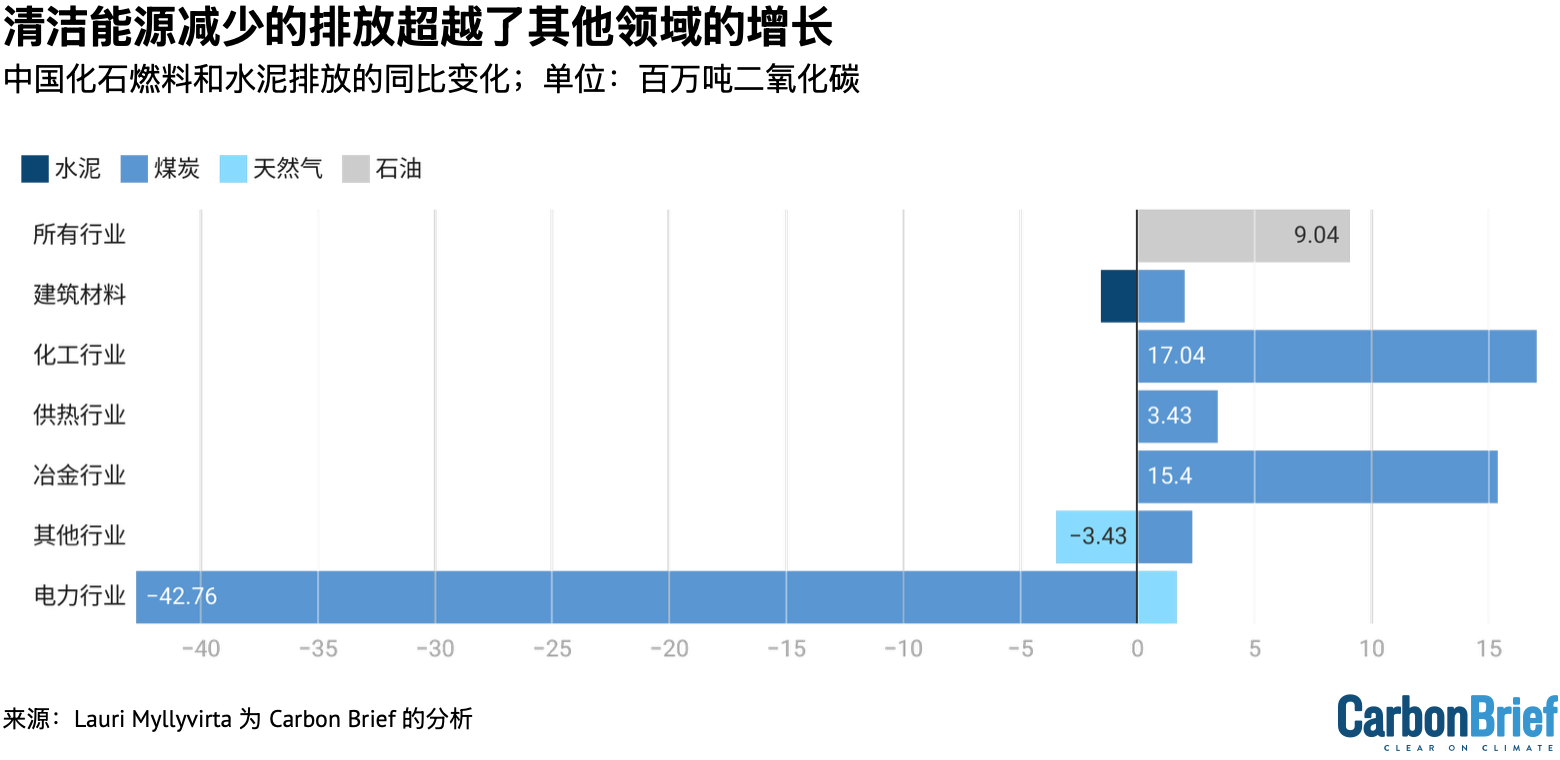
清洁能源减少的排放超越了其他领域的增长

而在电力行业之外,碳排放量增长了3.5%,其中以金属和化工行业的煤炭使用增幅最大。

煤制化工产业正在快速扩张,背后的推动力包括对进口油气依赖的担忧。2025年第一季度,由于煤价走低而油价偏高,该产业的经济性更具吸引力。

粗钢产量同比增长了0.6%,金属制品增长6%,有色金属产量增长2%。这些增长主要集中在3月份,企业赶在关税生效前集中出口,带动金属需求激增,而高产出一直持续到4月。

房地产开工量同比下降24%,新房销售下降3%,反映出建筑行业对水泥、钢材和玻璃的需求持续疲软。

相比之下,汽车和机械制造的经济产出分别增长了12%和13%,表明对金属的需求正在上升。

水泥产量同比下降1.4%,降幅低于往年,可能是由于气温偏高使得依赖天气的施工活动提前启动。

由于燃气发电装机容量增长14%,尽管燃气发电的平均利用率下降,但电力行业的天然气消费量估计增长了6%。但在其他行业,天然气消费减少,总体上抵消了电力行业天然气需求量的增长。

石油制品消费略有上升,如图中最上方所示。由于天气偏暖,依赖天气的施工和农业活动与往年相比提前开工。

然而,从结构性角度来看,汽车电动化和货运行业改用液化天然气,预示着石油需求将持续走低。

中国是否已经碳达峰?

在2025年第一季度排放量同比下降1.6%之际,中国的碳排放自2024年3月以来已连续一年多保持平稳或下降态势。

然而,截至2025年3月底的12个月内,排放量仅比近期峰值下降了1%,这意味着只要出现短期反弹,排放量就可能再创新高。

继一季度大幅下降后,电力行业过去12个月的排放量同比也出现下滑。

在过去40年里,这种情况曾经发生过四次——分别是在2009年、2012年、2015年和2022年。但此次下降首次主要得益于清洁能源发电的增长。

在电力需求激增的背景下,清洁能源增长首次削减了中国的化石燃料发电量-2

2025年一季度清洁能源发电增速不仅超过整体用电需求增长,也高于过去15年电力需求的平均增长,如上图虚线所示。

此外,过去六个月水电发电量同比保持稳定,这意味着这轮清洁能源的增长是由太阳能、风能和核电装机容量的增长所推动的,而非水电的逐年波动所致。

除发电行业外,2024年12月到2025年3月期间,各行业碳排放均有所下降,但煤化工是个例外。

要使中国整体碳排放量达峰并开始下降,各下降行业的减排总量需超过仍在增长行业的排放增量。
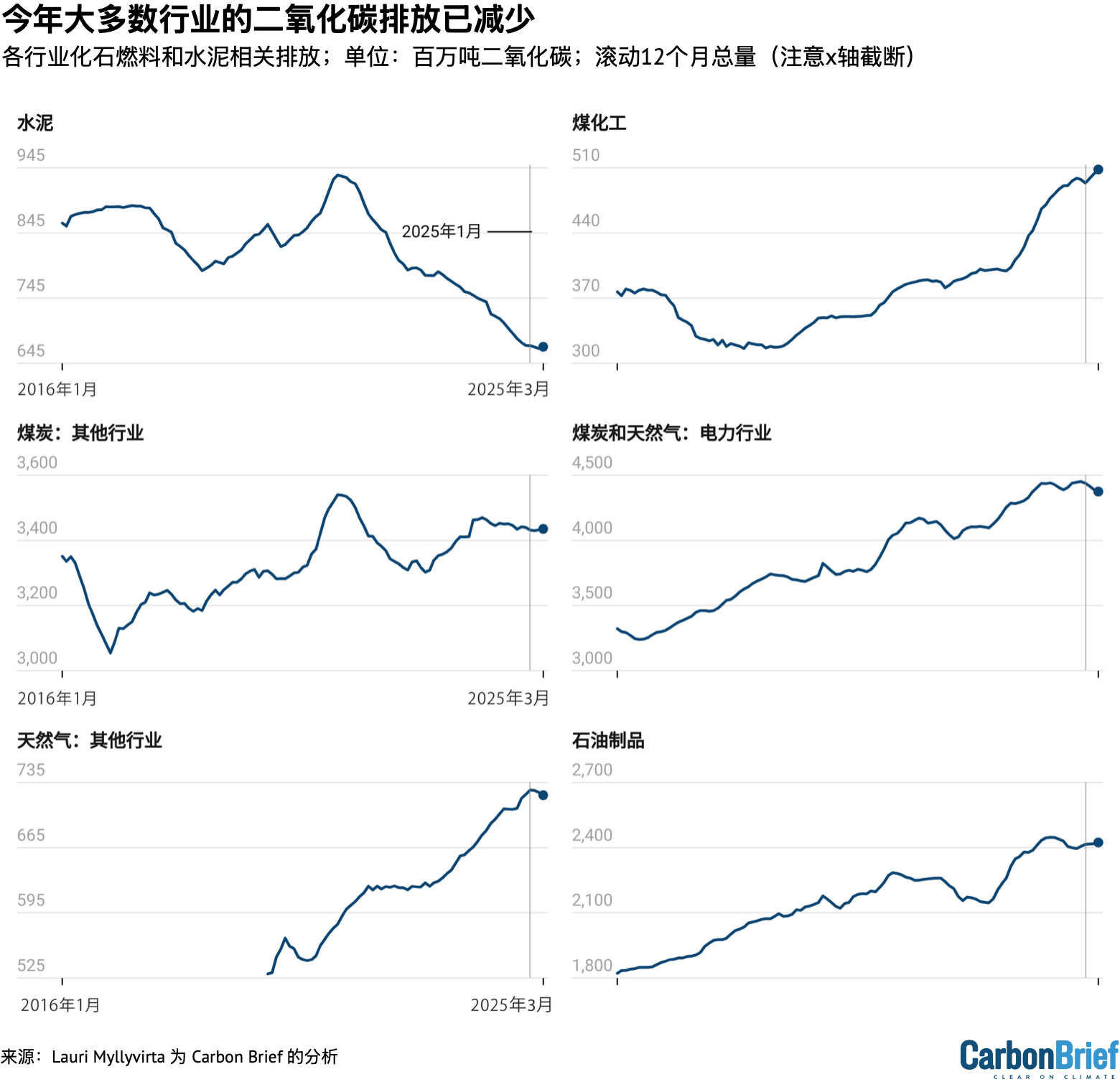
今年大多数行业的二氧化碳排放已减少

电力和化工以外的煤炭使用量与水泥行业同时达峰,但此后一直在反弹,目前已接近之前的峰值水平。

中国煤炭工业协会预计,钢铁和建材行业的煤炭使用量将下降,而化工行业的煤炭消费量将继续增长。

对煤炭未来需求增长的预期主要集中在化工行业,这也代表着煤炭从单纯的燃料向燃料和原料双重角色的转变。

该协会还认为,燃煤发电将至少在短期内恢复增长,但他们已将2025年的预测下调,与2024年底的展望相比有所保守。

“关税战”可能影响了预期。有分析指出,如果中国GDP因关税下降0.5到1个百分点,可能导致主要用于发电站的燃煤需求也出现类似的下降。

疫情后经济反弹到2024年3月结束,石油产品的消费量自此下降,较峰值减少了2%。尽管化工和航空领域的需求在上升,但由于交通运输领域电气化趋势增强,预计其长期仍呈下降趋势。

天然气的使用量近几个月有所下降,但总体趋势仍可能保持上升。

下表列出了每个行业在12 个月周期内的最高排放量,以及自最新峰值以来的减排量。
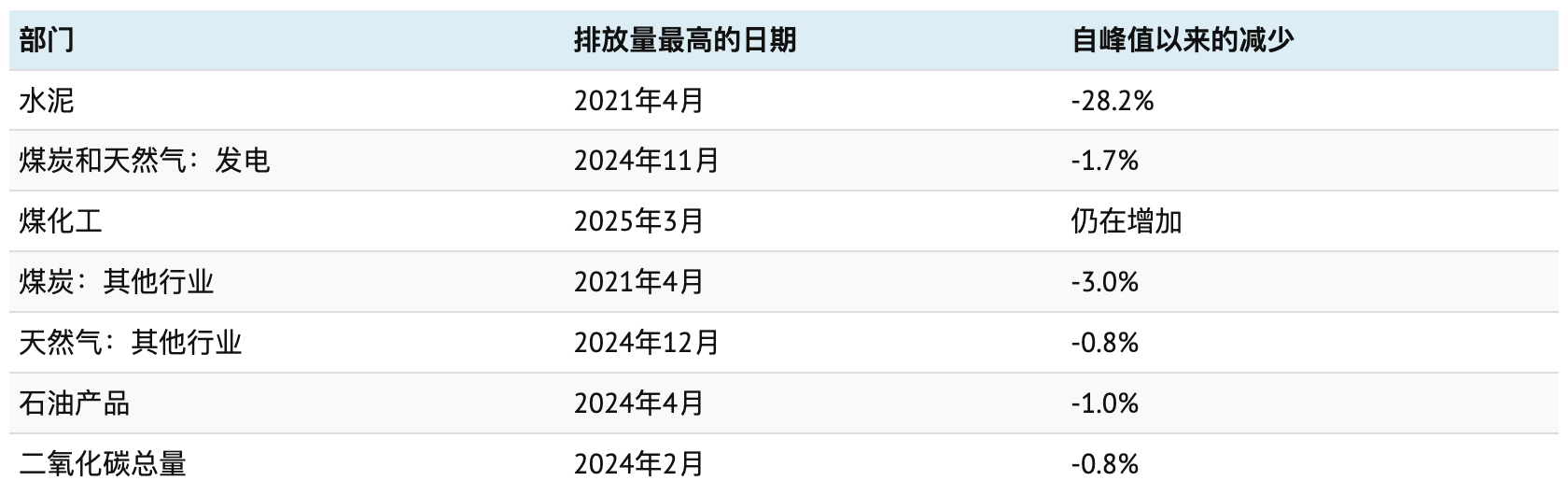
除了水泥生产之外,其他行业目前还不能明确判断是否已达排放峰值。然而,有迹象表明,其他行业的峰值也可能已经过去。

诚然,对于石油产品消费和钢铁生产而言,行业预测表明未来排放趋势可能会下降。

对于电力行业而言,只要新增清洁能源装机容量维持在当前或更高水平,就有望带来结构性的排放峰值——因为清洁能源的增长足以覆盖新增的电力需求。

这些行业碳排放量合计占全国八成以上。若这些行业均进入结构性下降阶段,那么中国碳排放总量很可能将开启持续下降通道。

中国推动内需应对美国关税

特朗普政府实施的史无前例的贸易关税政策,以及中国的反制措施,将影响今年及未来中国的经济和碳排放前景。

关税措施实施后,首当其冲的是中国沿海出口大省的工厂减产,从而导致排放下降,同时也可能波及投资和消费支出。

但因双方随后达成90天休战协议,反而刺激美国订单短期内激增,以弥补短暂的贸易放缓,并在休战结束前囤积商品。

中国对关税的反应主要集中在通过刺激措施抵消其经济影响。

虽然暂时的休战会降低出台刺激政策的紧迫性,但当前美国对中国的平均关税税率仍高达40%,远高于特朗普上台前的水平,因此中国领导层也很可能在为未来再次加征关税做好准备。

中国的重点将是为那些原本出口至美国的产品开拓国内市场。这一转向或将助力中国实现长期以来所希望推动的经济向消费驱动型增长转型,而成功实现经济再平衡,有望带来更低能耗的经济增长。

中国的应对措施还包括加大对“新质生产力”的重视,该概念强调新兴科技的发展。

这一概念涵盖了清洁能源产业,该产业如今已成为中国经济的重要引擎,因此难以在刺激计划中被忽视。

中国发改委最新公布的低碳示范项目清单,明确了清洁能源投资的重点方向。绿氢、储能、“虚拟电厂”以及基于氢能的工业脱碳是新的增长领域。

从碳排放角度来看,中国对特朗普关税的反应最关键的问题在于:针对这些优先领域(包括新兴的低碳领域及其他清洁能源产业)的刺激措施,是否足够有力。

新风光电价政策加剧不确定性

中国碳排放面临的另一个不确定性来源,是即将于今年6月生效的新可再生能源电力电价政策。

新政策取消了与煤电价格挂钩的价格保障机制,要求新的风电和太阳能发电项目与购电方直接签订电力合同。这可能导致新建风电和太阳能发电项目的售电价格下降。

不过,政策也为满足中央政府能源目标所需的新增装机容量提供了更有利的价格机制——“差价结算”。

该政策的直接影响可能是大量项目争相在6月前完成投产,以确保能够按现行政策享有机制电价。

其效果已经体现在最新数据中:仅 3 月份中国就增加了 23 吉瓦 (GW) 的太阳能和13GW的风能,比该月之前的新增太阳能和新增风能的最高记录高出80%和110%。

下图根据不同的预测显示,预计2025年和2026年新增清洁能源发电量仍将高于去年创纪录的水平。
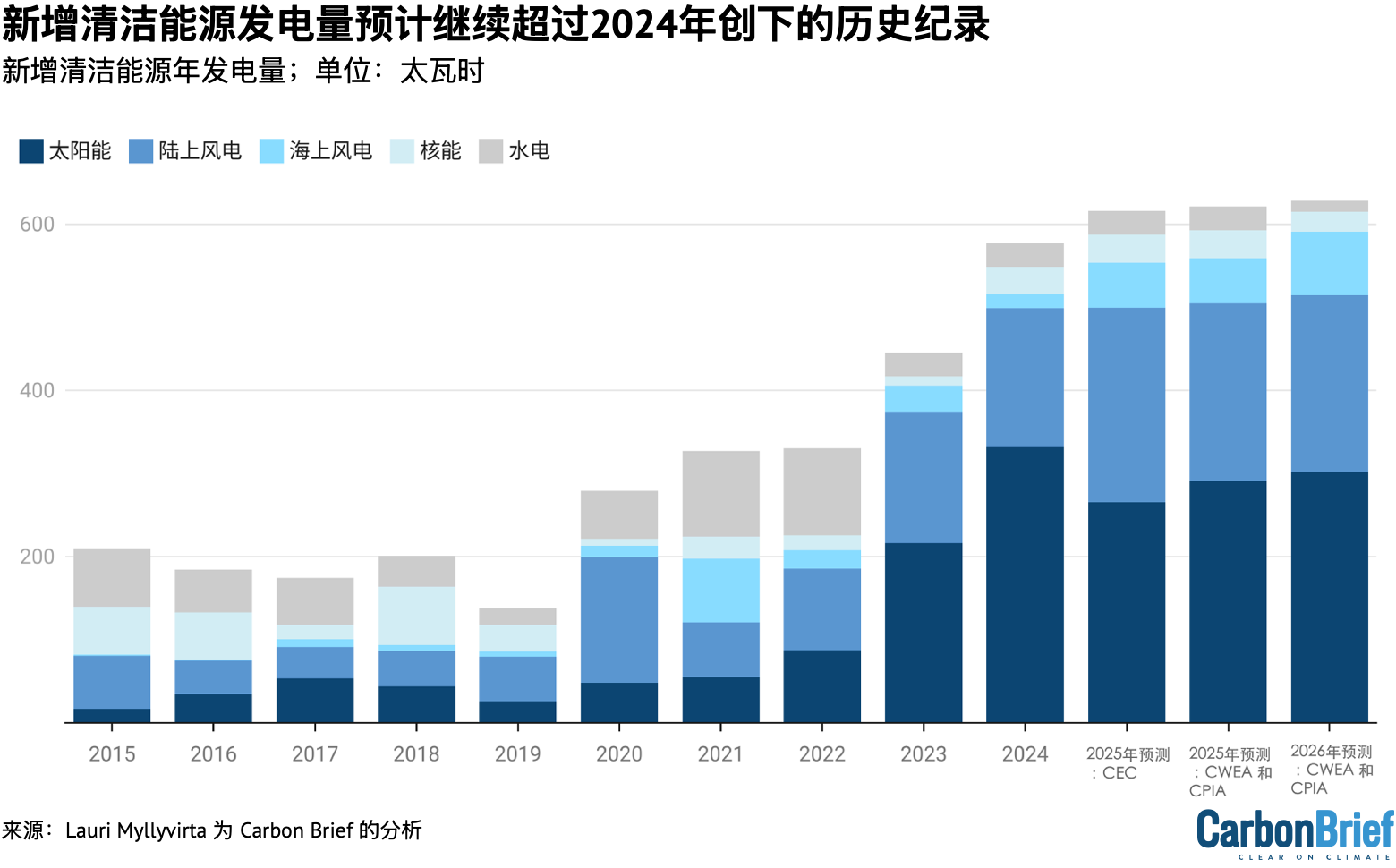
新增清洁能源发电量预计继续超过2024年创下的历史纪录

然而,这一政策也带来了更大的不确定性。一些行业,尤其是分布式光伏,将经历上半年装机量的激增而下半年放缓的艰难时期。

不确定性主要集中在两个方面。首先是地方如何执行这一政策,因为省级政府拥有相当大的回旋余地。考虑到清洁能源对许多省份经济的重要性,预计地方政府会力求以尽量不扰乱行业的方式来落实政策。

第二个不确定性来自中央政府的能源目标。新电价政策将更优惠的价格与中央政府的能源目标挂钩。而在过去几年中,清洁能源增长远远超过了官方设定的目标。

这凸显了即将出台的“十四五”规划中能源目标的关键作用。国家能源局设定的目标是“年均新增2亿千瓦(200吉瓦)以上新能源的合理消纳利用”,这一数字远低于去年实际新增的360吉瓦。

当然,电价政策的最终效果也取决于市场环境。当前中国煤电项目仍在快速上马,存在产能过剩风险。

中国与巴黎承诺之间的差距扩大

中国风电光伏发展面临的不确定性,也对该国履行《巴黎协定》下的国际气候承诺带来影响。

2020-2023年碳强度(即单位经济产出的排放量)下降进度明显滞后,中国已经明显偏离实现其2030年碳强度承诺的路径,几乎可以肯定将无法实现2025年的阶段性目标。2024年中国的碳强度下降了3.4%,未达到实现2025年和2030年目标所需的改善速度。

2025年政府工作计划中并未设定碳强度目标,仅包含单位国内生产总值能耗降幅超过3%(不包括原材料消耗)的目标。

这可以间接反映碳强度的改善幅度。2024年,中国的碳强度下降了3.4%,而化石能源使用强度下降了3.8%。如果2025年两者之间的比例相似,那么碳强度可能只能下降大约2.5%。在这种情况下,如果GDP增长达到5%的目标,碳排放量仍可能上升超过2%。

政府工作计划中没有设定碳强度目标,也没有特别强调碳强度的下降,显示出当局当前并未将实现这一目标作为优先事项。

政府工作报告中强调了“双碳”目标,即在2030年前实现碳达峰、2060年前实现碳中和。

然而,按照这些目标,2030年前碳排放仍可继续增长。这意味着到该年度,绝对排放量可能在2024年的水平上大幅增加。因此,即便“双碳”目标得以实现,也不能确保中国当前最核心的国际气候承诺——2030年碳强度目标——能够兑现。

即便今年碳排放有所下降,未来五年也需要大幅加快碳强度改善步伐,才能兑现中国2030年《巴黎协定》承诺。

如果中国仍然致力于兑现2030年承诺,那么该过程就需要体现在下一个五年规划设定的目标中。

2025年及未来展望

过去12个月可能标志着中国二氧化碳排放的一个重要转折点:清洁能源的增长首次超过电力需求增长,并在电力领域取代了化石燃料的使用。

尽管新的电价政策带来了一定的不确定性,但预计2025年仍将迎来创纪录的清洁能源新增装机容量,这表明这种趋势将在今年持续。

中国碳排放的未来长期走势将在很大程度上取决于即将出台的五年规划中设定的目标,以及北京应对美国关税和其他经济压力所采取的政策。

从短期看,美国加征关税将抑制能源需求增长和排放水平。为抵消特朗普关税影响而制定的经济政策,很可能会进一步推动清洁能源产业的发展,并可能促使经济重心转向国内消费,这意味着能源消费的增长将相对于GDP增长更少。

但另一方面,中国此前的经济刺激措施往往伴随着排放的急剧上升。中国若想转向消费和新技术驱动的刺激政策,而非高碳排的基建重工业,就必须突破传统发展模式。

电力行业的排放是否已经达峰,将取决于清洁能源供应增长与总体电力需求增长之间的竞赛。

按行业来看,除了电力行业,建筑材料、钢铁以及石油制品消费等领域的排放也可能已经达峰。

这些行业合计占中国与化石燃料相关碳排放的80%以上。然而,在所有这些行业中,都存在短期反弹的可能和不确定性。

目前仍有较大排放增长潜力的行业是煤化工。美国加征关税后国际油价的下跌将削弱该行业的盈利能力,可能导致即便新增产能增加,其工厂利用率也将下降。中国对自美国进口石化产品征收的报复性关税本可能本可能使煤化工行业受益,但这些关税据报已被豁免。

总体而言,这些因素可能推动中国未来五年排放持续下降,并有望在未来五年内实现大幅绝对减排。

然而,若政策出现转向,也同样可能导致碳排放在通往2030年的过程中继续上升。
The post 分析:清洁能源首次助力中国碳排放下降 appeared first on Carbon Brief.

https://www.carbonbrief.org/translations-analysis-clean-energy-just-put-chinas-co2-emissions-into-reverse-for-first-time/

Continue Reading

Climate Change

On the Historic Route From Selma to Montgomery, an AI Cloud Looms

Published

on

In this rural Alabama community, some residents can’t flush their toilets. Developers want to build a state-of-the-art data center next door.

HAYNEVILLE, Ala.—When Alabamians marched from Selma to Montgomery in 1965 to demand voting rights for African Americans, Highway 80 became their path toward freedom.

On the Historic Route From Selma to Montgomery, an AI Cloud Looms

Continue Reading

Climate Change

Guest post: How a record-high ‘energy imbalance’ is driving global warming

Published

on

The planet is heating up more quickly than ever before.

For decades, greenhouse gas emissions caused by human activity have been building up in the atmosphere and trapping ever-higher levels of heat.

The resulting asymmetry between incoming solar energy and energy radiated back out into space – known as “Earth’s energy imbalance” – provides a direct measure of the extent to which humans are disrupting the Earth’s climate system.

This imbalance is growing and in 2025 its 10-year average reached a record high, indicating that global temperatures could increase at even higher rates in the future.

This is among the headline findings of the latest “indicators of global climate change” (IGCC) report, published in the journal Earth System Science Data, which tracks changes in the climate system on an annual basis.

The report, now in its fourth iteration, has been produced by dozens of scientists from around the world.

Its findings are designed to fill the gap between Intergovernmental Panel on Climate Change (IPCC) science reports, which are published every 5-7 years.

In this article, we unpack the IGCC report, which explores how human activity is driving a growing energy imbalance and why monitoring systems to track global climate are so crucial.

(For more on previous IGCC reports, see Carbon Brief’s coverage in 2023, 2024 and 2025.)

Greenhouse gas emissions remain at an all-time high

Global greenhouse gas emissions are continuing to increase, mostly as a result of the use of fossil fuels. However, deforestation, agriculture and industrial processes also play an important role.

Glossary
CO2 equivalent: Greenhouse gases can be expressed in terms of carbon dioxide equivalent, or CO2e. For a given amount, different greenhouse gases trap different amounts of heat in the atmosphere, a quantity known as… Read More

Over the most recent decade (2015-24), emissions stood at the equivalent of 54.6bn tonnes of carbon dioxide equivalent (GtCO2e) per year. In 2024, the most recent year for which we have complete data, emissions reached 56.8GtCO2e.

As the chart below shows, these emissions have pushed up atmospheric levels of CO2, methane and nitrous oxide. In 2025, concentrations of these gases reached 425.6 parts per million (ppm), 1936.3 parts per billion (ppb) and 339.4ppb, respectively.

This represents a rise of 3.8%, 3.8% and 2.2%, respectively, since the 2019 levels reported in the IPCC’s sixth assessment report (AR6).

Atmospheric concentrations of CO2
Atmospheric concentrations of CO2 (yellow), methane (blue) and nitrous oxide (green) over 2000-25. The grey-shaded region represents continuing changes since AR6. Note the different vertical scales for each gas. Credit: Forster et al. (2026)

At the same time, declines in emissions of aerosols such as sulphur dioxide, partly as a result of efforts to tackle air pollution, are increasing the Earth’s energy imbalance. This is because aerosols have a cooling effect on the Earth’s climate, counteracting warming from CO2 and other greenhouse gas emissions.

(Tackling sulphur dioxide, alongside other particulate emissions, remains critical because the immediate health and environmental damage they cause far outweighs their short-term cooling effect on the climate.)

The Earth’s energy imbalance is rising rapidly

The Earth’s energy imbalance has long been recognised as a key indicator of how the climate is being affected by human activities.

However, it is only in the last few decades that scientists have been able to record temperature changes deep enough in the ocean to accurately quantify it.

Earth’s energy imbalance measures how quickly excess heat is accumulating in every part of the Earth system, primarily in the ocean, but also in land, ice and atmosphere.

Through this accumulation of heat, the energy imbalance influences the rate of sea level rise and ice melt across the world, as well as increasing the frequency and intensity of extreme weather events, such as storms, floods and droughts.

Without human influence, the Earth’s energy imbalance would be close to zero.

But, as greenhouse gas emissions have built up in the atmosphere, the imbalance has been growing since the 1970s. Recent increases to Earth’s energy imbalance have outpaced those projections made by climate models — indicating the planet could see more warming than expected in the future.

As the right-hand chart below shows, the imbalance is now at a record high, having more than doubled over the past two decades.

It has increased by around 40% since 2019, from an average 0.79 watts per square metre (Wm2) over 2006-18, according to IPCC AR6, to 1.12Wm2 over 2013-25.

The left-hand chart shows how heat is accumulating in the ocean (blues), ice (grey), land (orange) and atmosphere (purple).

 Observed changes in the Earth heat inventory
Left: Observed changes in the Earth heat inventory for the period 1971-2020. Right: Estimates of the Earth energy imbalance for successive overlapping 20-year periods and the most recent decade (right). Shaded regions indicate the very likely range (90-100 % probability), while the stars show the CERES (NASA Clouds and the Earth’s Radiant Energy System) estimates for comparison. Credit: Forster et al. (2026)

Global temperature rise

The excess heat building up in the climate system from the energy imbalance is pushing up global temperatures at a record rate of 0.27C per decade.

We estimate that human-induced warming – the amount of observed global surface

temperature increase attributable to both the direct and indirect effects of human activities – reached 1.37C in 2025. This has risen from 1.0C in 2017, as reported in IPCC AR6.

While natural variability in the climate system – such as El Niño or La Niña events – can also influence temperatures year-to-year, the upward temperature trend we are seeing is being driven by the persistent imbalance in energy.

We now expect global temperatures to exceed the Paris Agreement limit of 1.5C above pre-industrial levels around the year 2030.

This is significant because 1.5C has been identified as the critical dividing line between manageable climate risks and catastrophic, potentially irreversible damage to global ecosystems and human societies.

Heat accumulating throughout the Earth system

While heat is accumulating throughout the Earth system, it is not being distributed evenly around the globe.

Since the 1970s, around 90% of this heat has been taken up by the ocean, affecting marine ecosystems, ocean circulation patterns, sea level rise and climate extremes.

For example, the number of marine heatwave days – periods of unusually high sea surface temperatures – has more than tripled globally since the early 1990s. The year 2025 alone saw 65 days of marine heatwaves – meaning they occurred, on average, more than one day a week.

Meanwhile, the cryosphere – the portion of the Earth made up of frozen water, including glaciers, ice sheets and permafrost – is experiencing widespread ice loss and thawing in response to the growing energy imbalance. This affects ecosystems, sea level rise and infrastructure in polar and high-latitude regions.

Rapid warming has also resulted in record extreme temperatures over land, with average maximum temperatures for any single day over 2016-25 around 1.92C above pre-industrial levels). This is an increase of almost half a degree compared to the previous decade (2006-15).

Sea level rise and the energy imbalance

Sea level rise provides one of the clearest long-term signals of a changing planet.

It is closely linked to Earth’s energy imbalance. As heat accumulates in the ocean, water expands, raising sea levels. Meanwhile, a warming land and atmosphere means addition of water to the oceans through melting of glaciers and ice sheets, also adding to sea level rise.

Over the long-term, sea levels have been rising, on average, at a rate of around 1.8mm per year since 1901, totalling a record 23cm in 2025. This is increasing the risk of coastal flooding, erosion and habitat loss in many low-lying areas around the world.

This rise can be seen in the left-hand chart below, which shows observed global sea level changes from tide gauges (grey and blue dashed lines) and satellites (red dashed lines) since 1901. The solid lines indicate the average across multiple datasets.

Sea level rise is accelerating consistent with the observed increase in Earth’s energy imbalance. Over 2006-25, sea levels have risen at a rate of 3.67mm per year – more than double the rate of 1.69mm per year seen over 1976-95.

This increasing rate is shown in the right-hand figure below, which shows four successive overlapping 20-year periods and the most-recent decade.

(Last year’s transition from El Niño to weak La Niña conditions affected global rainfall patterns and led to a small and temporary fall in global average sea level in 2025. This explains the slight decrease in rate of sea level rise for the most recent decade, which is affected more than the 20-year period 2006-25.)

Global average sea level rise over 1901-2025
Left: Global average sea level rise over 1901-2025, relative to a 1995-2014 baseline. Individual timeseries are shown with dashed lines, while the black solid line shows the average (from tide gauges and satellites) used in AR6 and the solid red line shows the 1993-2025 average from satellites. Right: Global mean sea-level rates (in mm per year) for four successive overlapping 20-year periods and the most-recent decade. The shading indicates the very likely range. Credit: Forster et al. (2026)

The bigger picture

Despite greenhouse gas emissions not increasing as rapidly as in the 2000s, this year’s IGCC findings continue to show how far and how fast the climate is changing due to human activity.

A significant increase in decarbonisation efforts in the second half of this decade is required to slow down the rate of human-caused warming and limit the escalation of climate risks and impacts.

These findings, like many others produced by scientists across the globe, rely on international expertise, partnership and the maintenance and availability of global climate datasets and the global observing programmes that underpin them.

This year’s edition of IGCC used more than 40 global datasets produced by research teams around the world, including the NASA satellite record of the Earth’s energy imbalance and the ARGO deep ocean float network.

However, a number of long-term monitoring programmes could be threatened by funding decisions made by governments around the world, most notably the Trump administration in the US.

Local meteorological data and weather balloon measurement programmes in many countries have declined in recent years, especially in Africa, the west Pacific and South America. This reduces scientists’ ability to monitor and understand key indicators of climate change.

This is not just an issue for climate science. Many of these observations are key to weather forecasts and systems that provide early warning for extreme weather. For example, media reports have suggested that recent reductions in weather balloon measurements in Alaska led to a lack of warnings for a recent winter storm.

The continuity and integrity of the climate observations that scientists use to understand how the climate is changing depends on effective and sustained coordination by international organisations, such as the Global Climate Observing System, the World Meteorological Organization and World Climate Research Programme.

Without this data and its coordination, future assessments will be much more difficult at a time when urgent climate action is needed.

The post Guest post: How a record-high ‘energy imbalance’ is driving global warming appeared first on Carbon Brief.

Guest post: How a record-high ‘energy imbalance’ is driving global warming

Continue Reading

Climate Change

Across Ecosystems, Dead Organisms Help Shape the Living World

Published

on

A new paper found that the remnants of “foundation species” strongly influenced the fate of survivors.

Death casts a shadow over life, not only for people but also other animals, plants and entire ecosystems.

Across Ecosystems, Dead Organisms Help Shape the Living World

Continue Reading

Trending

Copyright © 2022 BreakingClimateChange.com