

Last year was significant for energy and climate developments in China. Carbon dioxide (CO2) emissions growth hovered close to 2023 levels throughout the year, raising the possibility of China’s CO2 emissions peaking before 2030.
China’s renewable energy buildout pushed coal to a record low share of electricity generation, while steps were taken to expand the number of industries covered by the national carbon market.
On the global stage, China played a prominent role at the COP29 UN climate talks in Baku, Azerbaijan. However, the US-China alignment that had previously boosted global climate ambition was imperiled by growing tensions over trade.
With US influence in climate negotiations expected to wane under the incoming Trump administration, China’s statements on climate ambition – such as the international climate pledge it is due to publish in 2025 – will be an important determinant of the pace of decarbonisation, both domestically and internationally.
Carbon Brief asked nine leading experts what they are watching for from China over the year ahead. Their responses have been edited for length and clarity.
 Dr Muyi Yang
Senior electricity policy analyst for China
Ember
In 2025, China will need to strike a delicate balance between sustaining economic growth and advancing its decarbonisation agenda. This balancing act will require more than just scaling up renewables such as wind, solar and energy storage – coal power, which has long been central to China’s energy security and economic activity, also requires a major transformation.
This is not simply about shuttering a handful of coal-fired power plants, but managing the broader tensions and conflicts arising from the decline of the coal-electricity ecosystem. The impacts will extend to power generators, logistics companies, mining firms, equipment manufacturers and the coal-chemical industry, along with the socio-economic systems built around them.
As China approaches a critical turning point – envisioning the start of absolute coal consumption reductions during the next five-year plan period (beginning in 2026) – it must begin planning for this transition now. Successfully navigating this complex process while safeguarding economic stability, ensuring energy security and delivering on climate commitments will be key to China’s success in 2025 and beyond.
 Prof Boqiang Lin
Dean
China Institute for Studies in Energy Policy
In 2025, China’s energy and climate developments will focus on advancing its “dual-carbon” goals through several key initiatives. The deployment of “new energy” will accelerate, with offshore wind power, distributed solar and decentralised wind power seeing significant growth. New wind and solar installations are expected to reach at least 200 gigawatts (GW). [Installations topped 300GW last year.] Nuclear power will be steadily advanced, with operational nuclear capacity projected to reach 65GW by the end of 2025. Efforts to promote the “clean and efficient use” of coal will also progress, with cleaner and more flexible coal power systems continuing to support the significant growth in wind and solar power.
Energy storage technologies and the development of smart grids will expand, facilitating large-scale integration of renewable energy into the grid, while development of virtual power plants and large-scale vehicle-to-grid pilots will enhance grid efficiency and energy interaction. The supporting infrastructure for electric vehicles (EVs) will also receive more attention to support the rapid increase in EV penetration. The carbon market is expected to expand to include more sectors, with carbon prices gradually increasing.
 Zhe Yao
Global policy advisor
Greenpeace East Asia
This year will be an important milestone. As the last year of the 14th “five-year” plan period, we will see if China can get back on track to meet its existing energy and carbon intensity targets. China’s climate plan for the next 10 years (its new nationally determined contribution), will be released and its ambition will be tested.
It is also a year in which we may confirm a structural shift in China’s energy consumption, signifying a peak in emissions. The key indicator of this trend will be whether renewable energy can meet all new electricity demand.
An even tougher test will be whether and how the climate imperative can survive geopolitical challenges. China will have to deal with a new president in the White House and growing competition from the EU in clean industries, so the relationship between China and its conventional climate partners will need to take a new shape. Hopefully, by 2025, a new climate relationship will emerge that is suited to a changing economic and geopolitical context.
 Zhibin Chen
Senior manager for carbon markets and pricing
Adelphi
Looking ahead to 2025, I see several promising aspects of the development of China’s carbon market. These include:
- Significantly expanding the coverage of the national emissions trading scheme (ETS) to officially include the steel, cement and aluminium sectors.
- Starting the issuance, trading and use of China certified emissions reduction (CCER) certificates [in the voluntary carbon market] to meet compliance obligations.
- Transitioning the structure of the national ETS from an intensity-based cap on emissions [per unit of production] to an absolute cap [in tonnes of CO2].
- Allowing traders and investors to participate in China emission allowances (CEA) market trading [within the national ETS].
Of these, the first two points are certain to occur next year and I hope they will be implemented smoothly. The latter two have been mentioned previously by the Ministry of Ecology and Environment policymakers, and I hope the government will establish a concrete timeline and implementation roadmap for them.
 Dr Ilaria Mazzocco
Deputy director and senior fellow with the trustee chair in Chinese business and economics
Center for Strategic & International Studies
What I’m looking out for is how China manages its increasingly tense external commercial relations and the growing demand internationally for Chinese foreign direct investment. Clean technologies, particularly the “new three” of solar, lithium-ion batteries and EVs, are at the heart of this tension.
The brewing global conflict over the future of climate technology manufacturing and trade will depend in no small part on developments in the industries in China, including domestic demand and profitability of Chinese firms. Just as important are the types of trade-offs and deals that China’s trade partners, including the US, will lean towards [in their China policy going forward].
 Kyle Chan
Postdoctoral researcher
Princeton University
This will be a pivotal year for Chinese EVs. Fierce competition within China’s domestic market will drive down prices, spur further innovation in features, such as advanced driver-assistance systems, and continue China’s transition from internal combustion engine vehicles (ICEs) to EVs. It will be interesting to see whether emerging trends within China will presage broader global trends, such as the popularity of extended-range [hybrid] EVs and improving battery-swapping technology.
Internationally, Chinese EV and battery makers are expanding to new markets and responding to rising trade barriers by investing heavily in overseas factories from Europe to southeast Asia. One big question is whether these bets will pay off or whether demand for EVs in these markets will be constrained by other factors, such as limited local charging infrastructure. Another big question is to what extent other countries will try to integrate with Chinese EV supply chains – or try to build around them.
 Dr Angel Hsu
Associate professor of public policy and environment, ecology and energy
University of North Carolina
I am enthusiastic about the prospects for continued subnational cooperation between China and the US in climate and energy policies, especially following the strong interest shown at COP29. The numerous technical exchanges between states such as Washington and the Chinese delegation…are promising developments. Plans are already in place to sustain this dialogue into 2025, building on the progress made this past year.
I am particularly eager to see how third-party countries and regions can serve as neutral grounds for collaboration. With the US likely stepping back from climate engagement, there’s a significant opportunity for increased alignment between China and ASEAN [the Association of Southeast Asian Nations], for example. China’s proactive approach at COP29, especially regarding voluntary climate financing, positions it well to lead in supporting south-east Asian nations in their decarbonisation efforts, creating a win-win scenario for regional sustainability.
 Shuang Liu
China finance director
World Resources Institute
With the “new collective quantified goal” on climate finance set at COP29 in Baku, China could continue its support to developing countries on their low-carbon and resilient transitions through south-south cooperation. Our research shows that China is already a significant climate-finance provider, averaging almost $4.5bn per year between 2013 and 2022.
Data shows China’s climate finance abroad dropped following the pandemic, but has been picking up slowly over the past three years. One big driver of future growth in climate finance could be how China and Chinese stakeholders sustain investment in the clean energy transition in developing countries – with a recent example being deals signed between China and Indonesia on clean energy manufacturing and infrastructure during president Prabowo Subianto’s visit to Beijing in November. Such deals can support the energy transition, create more job opportunities and help achieve other sustainable and development goals in the global south.
 Dr Christoph Nedopil
Director and professor of economics
Griffith Asia Institute
For 2025, China’s engagement in green energy will likely flourish in the Belt and Road Initiative (BRI), driven by the growing energy transition needs of partner countries. In Indonesia, for instance, president Prabowo’s accelerated green energy plan announced at the G20 meeting in December 2024 and newly signed cooperation agreements with China highlight the role of targeted collaboration [with China] in addressing local energy priorities. This includes investments not only in renewable energy systems, such as solar and wind power, but also in critical technologies such as battery manufacturing to support energy storage and grid stability.
I also hope we can make progress on three challenges: first, how can we simultaneously accelerate investment in green [energy] and phase-down of brown energy (fossil fuels); second, how can local employees benefit more from the green energy transition, particularly with more western trade restrictions on Chinese green tech products; and, third, how can we accelerate greening of industrial and captive energy in the BRI. A particular opportunity for the years ahead lies in sharing lessons from Chinese state-owned enterprises (SOEs) in the power sector to the many other energy SOEs in Asia.


The post Experts: What to expect from China on energy and climate action in 2025? appeared first on Carbon Brief.
Experts: What to expect from China on energy and climate action in 2025?

Drought and heatwaves occurring together – known as “compound” events – have “surged” across the world since the early 2000s, a new study shows.
Compound drought and heat events (CDHEs) can have devastating effects, creating the ideal conditions for intense wildfires, such as Australia’s “Black Summer” of 2019-20 where bushfires burned 24m hectares and killed 33 people.
The research, published in Science Advances, finds that the increase in CDHEs is predominantly being driven by events that start with a heatwave.
The global area affected by such “heatwave-led” compound events has more than doubled between 1980-2001 and 2002-23, the study says.
The rapid increase in these events over the last 23 years cannot be explained solely by global warming, the authors note.
Since the late 1990s, feedbacks between the land and the atmosphere have become stronger, making heatwaves more likely to trigger drought conditions, they explain.
One of the study authors tells Carbon Brief that societies must pay greater attention to compound events, which can “cause severe impacts on ecosystems, agriculture and society”.
Compound events
CDHEs are extreme weather events where drought and heatwave conditions occur simultaneously – or shortly after each other – in the same region.
These events are often triggered by large-scale weather patterns, such as “blocking” highs, which can produce “prolonged” hot and dry conditions, according to the study.
Prof Sang-Wook Yeh is one of the study authors and a professor at the Ewha Womans University in South Korea. He tells Carbon Brief:
“When heatwaves and droughts occur together, the two hazards reinforce each other through land-atmosphere interactions. This amplifies surface heating and soil moisture deficits, making compound events more intense and damaging than single hazards.”
CDHEs can begin with either a heatwave or a drought.
The sequence of these extremes is important, the study says, as they have different drivers and impacts.
For example, in a CDHE where the heatwave was the precursor, increased direct sunshine causes more moisture loss from soils and plants, leading to a drought.
Conversely, in an event where the drought was the precursor, the lack of soil moisture means that less of the sun’s energy goes into evaporation and more goes into warming the Earth’s surface. This produces favourable conditions for heatwaves.
The study shows that the majority of CDHEs globally start out as a drought.
In recent years, there has been increasing focus on these events due to the devastating impact they have on agriculture, ecosystems and public health.
In Russia in the summer of 2010, a compound drought-heatwave event – and the associated wildfires – caused the death of nearly 55,000 people, the study notes.

The record-breaking Pacific north-west “heat dome” in 2021 triggered extreme drought conditions that caused “significant declines” in wheat yields, as well as in barley, canola and fruit production in British Columbia and Alberta, Canada, says the study.
Increasing events
To assess how CDHEs are changing, the researchers use daily reanalysis data to identify droughts and heatwaves events. (Reanalysis data combines past observations with climate models to create a historical climate record.) Then, using an algorithm, they analyse how these events overlap in both time and space.
The study covers the period from 1980 to 2023 and the world’s land surface, excluding polar regions where CDHEs are rare.
The research finds that the area of land affected by CDHEs has “increased substantially” since the early 2000s.
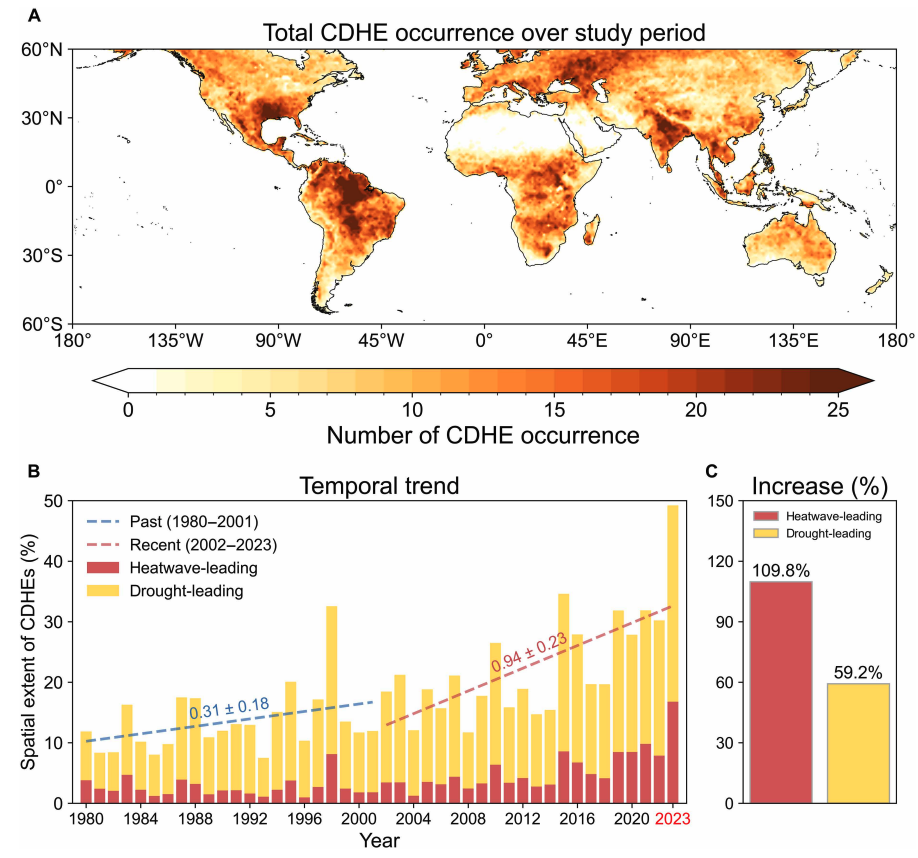
Heatwave-led events have been the main contributor to this increase, the study says, with their spatial extent rising 110% between 1980-2001 and 2002-23, compared to a 59% increase for drought-led events.
The map below shows the global distribution of CDHEs over 1980-2023. The charts show the percentage of the land surface affected by a heatwave-led CDHE (red) or a drought-led CDHE (yellow) in a given year (left) and relative increase in each CDHE type (right).
The study finds that CDHEs have occurred most frequently in northern South America, the southern US, eastern Europe, central Africa and south Asia.
Threshold passed
The authors explain that the increase in heatwave-led CDHEs is related to rising global temperatures, but that this does not tell the whole story.
In the earlier 22-year period of 1980-2001, the study finds that the spatial extent of heatwave-led CDHEs rises by 1.6% per 1C of global temperature rise. For the more-recent period of 2022-23, this increases “nearly eightfold” to 13.1%.
The change suggests that the rapid increase in the heatwave-led CDHEs occurred after the global average temperature “surpasse[d] a certain temperature threshold”, the paper says.
This threshold is an absolute global average temperature of 14.3C, the authors estimate (based on an 11-year average), which the world passed around the year 2000.
Investigating the recent surge in heatwave-leading CDHEs further, the researchers find a “regime shift” in land-atmosphere dynamics “toward a persistently intensified state after the late 1990s”.
In other words, the way that drier soils drive higher surface temperatures, and vice versa, is becoming stronger, resulting in more heatwave-led compound events.
Daily data
The research has some advantages over other previous studies, Yeh says. For instance, the new work uses daily estimations of CDHEs, compared to monthly data used in past research. This is “important for capturing the detailed occurrence” of these events, says Yeh.
He adds that another advantage of their study is that it distinguishes the sequence of droughts and heatwaves, which allows them to “better understand the differences” in the characteristics of CDHEs.
Dr Meryem Tanarhte is a climate scientist at the University Hassan II in Morocco, and Dr Ruth Cerezo Mota is a climatologist and a researcher at the National Autonomous University of Mexico. Both scientists, who were not involved in the study, agree that the daily estimations give a clearer picture of how CDHEs are changing.
Cerezo-Mota adds that another major contribution of the study is its global focus. She tells Carbon Brief that in some regions, such as Mexico and Africa, there is a lack of studies on CDHEs:
“Not because the events do not occur, but perhaps because [these regions] do not have all the data or the expertise to do so.”
However, she notes that the reanalysis data used by the study does have limitations with how it represents rainfall in some parts of the world.
Compound impacts
The study notes that if CDHEs continue to intensify – particularly events where heatwaves are the precursors – they could drive declining crop productivity, increased wildfire frequency and severe public health crises.
These impacts could be “much more rapid and severe as global warming continues”, Yeh tells Carbon Brief.
Tanarhte notes that these events can be forecasted up to 10 days ahead in many regions. Furthermore, she says, the strongest impacts can be prevented “through preparedness and adaptation”, including through “water management for agriculture, heatwave mitigation measures and wildfire mitigation”.
The study recommends reassessing current risk management strategies for these compound events. It also suggests incorporating the sequences of drought and heatwaves into compound event analysis frameworks “to enhance climate risk management”.
Cerezo-Mota says that it is clear that the world needs to be prepared for the increased occurrence of these events. She tells Carbon Brief:
“These [risk assessments and strategies] need to be carried out at the local level to understand the complexities of each region.”



The post Heatwaves driving recent ‘surge’ in compound drought and heat extremes appeared first on Carbon Brief.
Heatwaves driving recent ‘surge’ in compound drought and heat extremes
Greenhouse Gases
DeBriefed 6 March 2026: Iran energy crisis | China climate plan | Bristol’s ‘pioneering’ wind turbine