

Spiking food prices have made headlines around the world this year, from eggs in the US to vegetables in India.
The UN Food and Agriculture Organization’s Food Price Index has been slowly increasing over the past six months following declines over much of 2023.
For example, the price of orange juice concentrate in the US was 42% higher in April than it was a year ago, while the price of fresh orange juice in the UK has risen 25% over the last year.
In Greece, the price of olive oil rose by nearly 30% over 2023 and by more than 63% in April of this year.
No single factor alone can explain the rising prices.
But geopolitical conflict, extreme weather events, high input costs and increased demand are all playing a role.
The FAO’s recent Food Outlook report finds that, despite positive forecasts, “global food production systems remain vulnerable to shocks stemming from extreme weather events, geopolitical tensions, policy changes and developments in other markets”.
Carbon Brief has asked a range of scientists and policy experts from around the world what they think are the biggest factors driving spiking global food prices.
These are their responses, first as sample quotes, then, below, in full:
- Prof Elizabeth Robinson: “Whilst one can argue that food crises are not primarily caused by climate or weather, often food price spikes are due to a combination of weather and non-weather related factors.”
- Levi Sucre: “The overexploitation of agricultural lands and the intensive use of agrochemicals have led to a growing need for fertilisers to maintain production, which further increases production costs.”
- Dr Álvaro Lario: “Most food commodity markets present a stable outlook for 2024-25, which should help contain prices for consumers. However…many factors can tip the delicate demand-supply balance.”
- Siraj Hussain: “For long-term and stable food security, the yield has to go up and food losses have to come down.”
- Prof Andrew Challinor: “Put plainly, climate change is beginning to outpace us because it is interacting with our complex interrelated economic and food systems.”
- Dr Rob Vos: “Food prices in global markets are most sensitive to weather conditions and supply disruptions in major producing countries.”
- Prof Alan Matthews: “The rapid recovery of consumer demand following the disruptions caused by the measures to contain the Covid-19 pandemic, extreme weather events, animal disease outbreaks and tight global markets all contributed.”
- Xiomara Paredes: “In short, every time a new regulation is created, it increases production costs, makes market access difficult and thus makes food products more expensive.”
- Dr Manuel Otero: “Food prices have experienced significant increases due to various interrelated economic, social, environmental and political causes.”
- Dr Shouro Dasgupta: “Conflicts are one of the main reasons behind price shocks…Many of these events have also disrupted supply chains and infrastructure.”
 Prof Elizabeth Robinson
Director, Grantham Research Institute on Climate Change and the Environment.
London School of Economics and Political Science
Back in 2008, broad underinvestment in the agriculture sector, increasing demand for biofuels, changing diets and speculation – encouraged by declining global food stocks – were already putting longer-term upward pressure on food prices.
The 2008 food crisis was triggered by sequential poor wheat harvests in Australia, a breadbasket country. However, the extreme spike in wheat and rice prices was driven by a combination of export restrictions, panic buying and increased speculation, which amplified the short-term harvest shocks and the longer-term pressures.
More recently, the changing climate, the Covid-19 pandemic and Russia’s invasion of Ukraine have disrupted food production and globally integrated food supply chains, putting rapid upwards pressure on food prices. Whilst one can argue that food crises are not primarily caused by climate or weather, often food price spikes are due to a combination of weather and non-weather related factors.
Earlier this year cocoa prices rapidly increased, a consequence of extreme weather conditions, linked in part to El Niño, resulting in multiple poor harvest seasons in west Africa, combined with longer-term pressures, including disease and ageing cocoa trees, and short-term pressures, particularly speculation, exacerbating the situation further.
Given the changing climate, and in particular increasing extremes of heat and precipitation, food price spikes are likely to be an increasingly common feature of our highly integrated global food systems, in which shocks in one part of the world can relatively easily be amplified and transmitted around the globe.
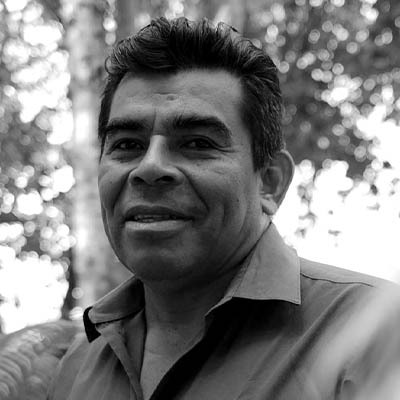 Levi Sucre
Coordinator
Mesoamerican Alliance of Peoples and Forests
There are several factors causing the increase in food prices worldwide.
Firstly, the high dependency on oil, whose price keeps rising, drives up the costs of food production and transportation. Agricultural machinery, fertilisers and product transportation rely heavily on oil, so any increase in its price directly affects the final cost of food.
Additionally, the overexploitation of agricultural lands and the intensive use of agrochemicals have led to a growing need for fertilisers to maintain production, which further increases production costs.
Monocultures are also degrading the soil, reducing its capacity to produce food sustainably. The lack of crop rotation depletes soil nutrients, diminishing its fertility and forcing farmers to use more fertilisers and pesticides. This not only increases costs but also has negative effects on the environment and health.
The effects of climate change are impacting agricultural production; for example, rising temperatures are disrupting previously predictable agricultural seasons, making crop production more difficult. High temperatures in Mesoamerica continue to destroy crops and reduce food reserves, worsening shortages and driving up prices, affecting nearly 8 million people in El Salvador, Guatemala, Honduras and Nicaragua.
Furthermore, economic injustice, inequality and lack of equity exacerbate the situation. The people with the least resources are the most affected by rising food prices, putting their food security at risk. On the other hand, small-scale producers, who do not use harmful soil practices, do not receive the necessary support to increase their production. These farmers cannot compete with large companies that dominate the market with their monocultures.
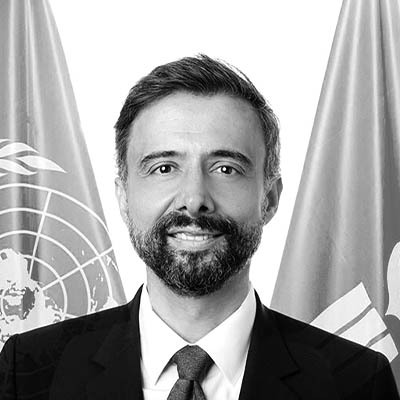 Dr Álvaro Lario
President
International Fund for Agricultural Development
International food prices have declined since their historic peak after the start of the war in Ukraine. According to the recently released biennial FAO Food Outlook, most food commodity markets present a stable outlook for 2024-25, which should help contain prices for consumers. But as the report reminds us, many factors can tip the delicate demand-supply balance, impacting food prices and global food security.
The drop in global food prices does not automatically mean that prices have decreased in real terms in local markets, especially considering the strong depreciation of local currencies in most low- and middle-income countries against a robust US dollar.
This is also true for rural communities in these countries, where 80% of the world’s poorest live. In these areas, people can spend up to 70% of their income on food, leaving them with no capacity to absorb any price hikes and pushing them into poverty and hunger. Since Covid-19 emerged, we have seen multiple crises, such as climate change, conflict and record-high food prices, have compounded to push 122 million more people into hunger.
And, despite the current trend, we must remember how fragile our food systems are. They are increasingly threatened by more frequent and intense weather extremes, and volatile geopolitics. Our food systems are overly concentrated on a few crops, countries and producers, and are inefficient, with significant food losses along the value chain and high levels of food waste at the consumer level.
 Siraj Hussain
India’s former agricultural secretary. Trustee.
World Food Programme Trust for India
Food inflation has been a source of major concern for a vast majority of Indians.
It is quite an enigma that even cereals, in which India is surplus, have seen double-digit inflation in the last year. Despite the erratic monsoon in 2023, India produced 137m tonnes of rice. Yet in every month since April 2023, the consumer price index inflation for rice was 11-13%.
In the case of wheat, inflation was more than 12% from April to July 2023. The Indian government released 10m tonnes of wheat under an open market sales scheme to cool down wheat prices and the intervention was quite successful as inflation has come down to about 3-7% since July 2023.
The reasons behind inflation in basic cereals of wheat and rice are not well understood. Despite low monsoon rains in 2023-24 due to El Niño, the production of both was not too low in 2023-24. As per the Indian government, wheat production was 113m tonnes.
The real concern in the basket of food inflation comes from vegetables, where inflation in the last year has reached more than 25%. This is attributed to losses in the supply chain from harvesting to marketing. India’s food surpluses are quite small except for rice and sugar. For long-term and stable food security, the yield has to go up and food losses have to come down.
 Prof Andy Challinor
Professor of Climate Impacts.
University of Leeds
Every five years, the UK is mandated to report on climate change risks. The scientific evidence for the second of these reports was published in 2017. It highlighted risks from weather-related shocks to international food production and trade as a key risk.
The final report, which is the responsibility of the government, not scientists, endorsed all the conclusions of the evidence report “with the exception of some of those on food security”. The reason? It said: “The government takes a more optimistic view of the levels of resilience that are achieved through functioning markets and diverse sources of supply.”
In the same month that the government response was written, reports of a UK courgette deficit, resulting from climate extremes abroad, soon deepened into wider concerns across a range of vegetables and rationing was commonplace across supermarkets. The World Economic Forum’s 2017 report on global risks identified extreme weather events – already ranked as the most likely global risk in every WEF report since 2014 – as both the most likely and most impactful risk, after weapons of mass destruction.
Skip forward to 2022, when the evidence for the new UK assessment was published. Amongst other additions, an increased underlying vulnerability to climate risk was identified along with a new specific risk of “risk amplification from the interactions and cascades of named risks across systems and geographies”.
The way we as a society (consumers, citizens, government, businesses) choose to set up our food systems has huge implications for stability and resilience – or lack thereof. The 2022 report makes clear that the UK is struggling to keep pace with climate change impacts because of both the pace of change and the way in which the many potential risks to food systems interact with each other.
Put plainly, climate change is beginning to outpace us because it is interacting with our complex interrelated economic and food systems. Until we find ourselves able to look at the big picture and adjust accordingly, we can expect more of the same.
 Dr Rob Vos
Director for Markets, Trade and Institutions.
International Food Policy Research Institute
The war in Ukraine caused world market prices for staple foods, especially wheat and vegetable oils, to skyrocket in the first half of 2022. Since then, however, those world market prices have come down to pre-war levels.
At the same time, consumers around the world have felt soaring domestic food price inflation well into 2023. People in some low- and middle-income countries, such as in Argentina, Egypt, Ethiopia, Gaza, Haiti, Sudan, Ukraine and Venezuela, are still seeing the cost of their daily bread and meals going up at high rates today.
What is driving these price fluctuations in global food markets and why are consumer prices not following the same pattern?
Food prices in global markets are most sensitive to weather conditions and supply disruptions in major producing countries. For instance, floods in India caused by the El Niño phenomenon disrupted rice production in India during 2023, pushing up rice prices worldwide.
The war in Ukraine caused shortages in global wheat, maize, sunflower seeds and fertiliser supplies as both Russia and Ukraine are major producers, pushing up wheat, vegetable oil and fertiliser prices.
I should add that the Ukraine war was not the only factor and, in fact, just exacerbated the surge in international food and fertiliser prices induced by the global economic recovery from the Covid-19 recession and the supply chain disruptions (recall the containership pile-up at harbours) that sent oil prices and shipping costs soaring and increasing the cost of farming and food trade worldwide.
Global market prices are further sensitive to misguided policy responses. Governments often respond to expected food supply shortages and price surges by imposing restrictions on exports (such as India’s bans on rice exports in 2023) or lowering import restrictions (as many rice-importing countries did in 2023). While trying to protect their consumers, these “insulation” measures end up just magnifying the price increase.
Why do domestic food prices not necessarily follow the same pattern?
In fact, most countries are relatively insulated from global price shocks as they rely predominantly on their own food production to feed their populations; typically, only 10-15% or less of food consumption is imported.
Domestic conditions for food production and distribution systems thus matter more than global prices. These conditions vary across countries, but countries with the highest rates of consumer price inflation have seen food systems disrupted by intensified conflict (as in Ethiopia, Gaza, Haiti and Sudan, for instance) and those suffering macroeconomic constraints and weak currencies that have kept both general and food price inflation high (e.g. Argentina, Venezuela, Turkey, and many highly indebted low-income countries).
 Prof Alan Matthews
Professor Emeritus of European Agricultural Policy
University of Dublin Trinity College
Food prices in the EU rose dramatically in 2022 and 2023. EU food prices were 41% higher in May 2023 relative to the price level in 2015, while the overall price level rose by just 26% during this period. The monthly annual rate of food price inflation peaked at 19.2% in the EU in March 2023.
Even higher rates were recorded in central and eastern Europe, with Hungary a particular outlier, with food price inflation of 46% in February 2023. Since then, food prices have not fallen, but are now increasing at a rate below the general inflation rate for the first time in two years.
There have been multiple drivers of this food price inflation. The rapid recovery of consumer demand following the disruptions caused by the measures to contain the Covid-19 pandemic, extreme weather events, animal disease outbreaks and tight global markets all contributed.
For Europe, the impact of the Russian invasion of Ukraine has been particularly important. There was a direct impact through the increased price of energy, and thus fertilisers and fuel, given the EU’s dependence on imports particularly of Russian gas, but also an indirect impact through the knock-on effect of higher world market crop prices due to the subsequent curtailment of Ukrainian exports to the world market.
Extreme weather events have contributed to food price increases. High temperatures and drought badly affected olive oil production in 2022-23 as well as production of cereals in southern Europe, while heavy rains and wet weather have delayed planting and harvests and damaged fruit quality in northern Europe.
Despite these production losses, a March 2024 study in Communications Earth & Environment estimated that the 2022 extreme summer heat had increased food inflation in Europe by 0.43-0.93 percentage points – so making a relatively minor contribution to the overall 19% increase in food prices at that time. Nonetheless, in more normal times that would cause a more noticeable uptick in food prices, and the authors suggest that the warming projected for 2035 could amplify these numbers by 30-50%.
Xiomara Paredes
Executive Director, Latin American and Caribbean Coordinating Association of Small Fair Trade Producers and Workers
The new regulations that the EU has recently implemented, such as the deforestation-free regulation, changes in organic regulation, human rights and environmental due diligence, entail the investment of additional resources, thus raising production costs.
For example, to comply with the deforestation-free regulation, producers must first invest in geolocation equipment and have technical staff who can survey the points or polygons on the plots of each producer member of the organisation. Geolocating all the producers’ plots also takes time and effort that must be diluted in the installed capacity of the producer organisations.
In short, every time a new regulation is created, it increases production costs, makes market access difficult and thus makes food products more expensive.
 Dr Shouro Dasgupta
Environmental Economist
Fondazione CMCC
Visiting Senior Fellow
Grantham Research Institute, LSE
The issue of increasing food prices is multifaceted and is due to a complex set of reasons including conflicts, climate change and supply chain disruptions.
Conflicts are one of the main reasons behind price shocks. For instance, Russia’s invasion of Ukraine, known as the breadbasket of Europe, has substantially reduced exports of wheat, maize and sunflower, resulting in food price fluctuations. While global food prices have decreased from their peak levels at the onset of the conflict, they remain higher than the pre-conflict levels.
Climate change, manifested by increasing temperatures and the increasing intensity and frequency of extreme events such as heatwaves, droughts and floods, has led to crop failures and reduced yields in many parts of the world. This, in turn, has pushed up food prices through supply shocks.
Many of these events have also disrupted supply chains and infrastructure, such as roads, and lowered water levels of major rivers such as the Rhine. Whether due to conflicts or climate change, several countries have imposed export bans on major agricultural commodities (for example, India, Myanmar and Russia on rice; Thailand on sugar; Argentina on beef). These restrictions affect countries that are highly dependent on imports the most.
Several policy failures in the global food system also contribute to food inflation. One such issue is the inadequacy of storage facilities, especially in low- and middle-income countries. Another is the concentration of food production in certain regions and on selected crops (60% of the plant-based calorie intake is provided by rice, wheat and maize) and the fact that global food chains are dominated by a small number of multinational corporations.
Dr Manuel Otero
Director-general, Inter-American Institute for Cooperation on Agriculture
In recent years, food prices have experienced significant increases due to various interrelated economic, social, environmental and political causes. Armed conflicts have disrupted supply chains and food production and distribution, exacerbating shortages and driving up prices. These conflicts have also displaced millions of people, affecting their ability to produce and access food.
Economic shocks, such as the Covid-19 pandemic and its repercussions, plus the slowdown of economies, have reduced consumers’ purchasing power, decreasing incomes and increasing unemployment, which has raised relative demand and prices.
Extreme weather events, such as droughts and storms, have affected agricultural production, reducing supply and increasing production costs, resulting in higher prices for consumers. Volatility in fertiliser markets, driven by trade restrictions and armed conflict, has also increased agricultural production costs, reflected in higher prices for food products.
Trade restrictions, such as export bans, have exacerbated the global food crisis, limiting international food trade and further driving up prices in global markets. According to our Observatory of Public Policies for Agrifood Systems tool, since the pandemic, food inflation has reached 28% annually on a global average – compared to a general inflation of 19% annually.
This is despite the fact that international food prices fell 9% annually for the same comparison period, suggesting that other economic, political and environmental factors contribute to food inflation.
Latin America and the Caribbean is home to 16 net-exporting and 16 net-food-importing countries, so the region has benefited from the increase in international food prices, but has also been one of the most affected by food insecurity due to factors such as increasing poverty.


The post Experts: What is causing food prices to spike around the world? appeared first on Carbon Brief.
Experts: What is causing food prices to spike around the world?

Amy Youngman is a legal and policy specialist at the campaigning group Environmental Investigation Agency (EIA).
The chair’s August Aid to Negotiations is being sold as a pragmatic way to rescue the global plastics treaty. However, the text is starting to resemble the architecture of a Paris Agreement-style framework: a patchwork of vague commitments, nationally determined action and reporting, with the hardest substantive decisions left to a future that, my experience following these negotiations tells me, would never arrive.
In March 2022, governments adopted UNEA Resolution 5/14 by consensus, launching negotiations for a legally binding international instrument to end plastic pollution. I joined the global plastics treaty process in Paris in 2023, where hopes of drafting a treaty capable of confronting one of the defining environmental and human health threats of our time were first derailed by procedural warfare.
-
“We’ve gone backwards” – new plastics treaty text dims hopes for production curbs
During troubled talks, fossil fuel-producing nations have pushed for a global pact to tackle only plastic waste rather than reducing the size of the problem -
Why we couldn’t agree on a plastics treaty in Geneva – and what might happen next
Switzerland’s lead negotiator at INC-5.2 reflects on why the talks didn’t succeed – and the options now for getting an effective agreement

Five months later, in Nairobi, I watched the chair close a meeting while delegates still negotiated -allegedly to catch a flight. In 2024 and 2025, in Ottawa, Busan and Geneva, the same small group of blocking states grew bolder, cloaking opposition in language about defending the vulnerable while subsidising a system that fuels the pollution crisis. Offended by ambition, ashamed of nothing.
A year after the last formal attempt to negotiate a treaty, we are tasked with protecting a fragile process. And despite long-standing support, including legal, policy and technical expertise from my own Environmental Investigation Agency, the chair has excluded observers from the rooms where the treaty’s fate is being decided.
In that orchestrated quiet, the loudest proposal emerged: the suggestion that the instrument be a “framework convention.” The new Aid, intended to shape the late-September Heads of Delegation meeting, never uses the word “framework”. It does not need to. It strips back substantive obligations and presupposes future action.
A framework is no match for this crisis
Framework conventions outline broad principles and leave each country to develop its own plan, often delaying tough decisions to future negotiations that may never happen. This tactic is a political shell game: persuading states that want action now to give up meaningful, binding measures to reach agreement.
The Chair’s Aid arrives at a framework by subtraction rather than by proposal, which makes it harder to name and potentially easier to accept. Using the Aid, effectively the rejected text from Geneva, as a basis for the next informal meeting in Bangkok will be sold as a way to preserve a distressed UN system and reach consensus in a fractured geopolitical environment.
This is diplomacy drowning in wishful thinking that the countries fighting binding rules today will approve tougher ones tomorrow. Four years of negotiations and decades of climate diplomacy taught us that this is not a bridge to ambition – this is how ambition dies.

Production is driven by global oil, gas and chemical markets, while products and waste travel across borders. No singular government can regulate its way out of a problem created and amplified by a globalised system.
Countries have tried, and production kept rising. Now there is plastic everywhere we look, and the cost falls hardest on the people least responsible.
That failure is why there was consensus to negotiate a treaty, because this crisis requires global action. The purpose was never to list national efforts and call that progress but to create common global rules to address pollution.
The most politically sensitive issues cannot simply be postponed. How much plastic is produced, which toxic chemicals are allowed in it, which throwaway products are banned, and how future decisions are made are precisely the issues that require global answers. An instrument that refuses to negotiate them will be easier to adopt but useless on arrival.
Learn from climate governance
Supporters of a framework approach may point to the ozone treaty as proof that it can work. But the Vienna Convention succeeded for one reason: governments quickly adopted binding upstream controls on ozone-depleting substances.
Climate offers the opposite warning: a framework followed by contested, delayed and insufficient measures, while emissions keep rising.
The new chair not only deleted a direct reference to “production and consumption” and bracketed similar preambular language copied from the original mandate. The article on reporting borrows language from the Paris Agreement. Another summer of record heat, fires and floods offers a glimpse of how well that model is working.
Nothing suggests that the states blocking binding rules today will suddenly accept them tomorrow, and the exponential rise in unchecked plastic production will not pause while governments wait for courage. Blockage is not being resolved, but just pushed forward.
A framework would lock in the wrong response: unlimited upstream growth with waste management attempting to handle it downstream. No waste system can keep pace with a material engineered for endless growth.
Keeping to 1.5C of warming is no longer possible – but we must still limit the overshoot
After four years of INC negotiations, governments know this. States must reject the false choice that the only path to agreement is an instrument too weak to solve the problem it was created to address. Compromise is part of diplomacy. Surrender is not.
And if the UN keeps pushing that choice, the countries prepared to act must be willing to pursue alternative pathways. Groups of willing governments have built effective agreements before, and existing environmental regimes can deliver new rules without inventing a new empty instrument.
This process was never meant to find a lowest common denominator. It was to create the rules necessary to change our direction. Bangkok in September will be where the second iteration of this text is shaped. If ambitious countries do not push back, the argument about a framework convention will already be lost by default.
Negotiations cannot end with governments accepting the crisis rather than solving it. The science is clear and the damage is accelerating. The world does not need another promise to act later. It needs the treaty governments promised to deliver in 2022.
The post The world doesn’t need a Paris Agreement for plastics appeared first on Climate Home News.
Climate Change
As science comes under attack at UN talks, climate movement splits over how to respond
With June’s UN climate talks inching towards gridlock, a group of diplomats calling themselves “Friends of Science” issued a stark warning: climate science was under attack in Bonn.
The coalition, spanning the world’s richest to its most vulnerable nations, pointed the finger primarily at those who think “science threatens their economic prospects” – a thinly-veiled reference to fossil fuel-dependent states accused of casting doubt on long-held scientific tenets in the UN climate process.
Fiji’s lead negotiator, Sivendra Michael, went still further. He denounced what he called “a very polluted narrative” taking hold outside the negotiating rooms and singled out ECO, a daily newsletter on the talks produced by Climate Action Network (CAN) International, for overlooking the issue.
“They are representing developing countries, but they are not representing us,” Michael said. His words hinted at how a rift between governments over the science of global warming has created tensions inside the climate movement.
Watchers of the UN climate talks have told Climate Home News there is growing unease over where the world’s most influential coalition of climate NGOs stands in an increasingly heated debate about how scientific messages produced by the Intergovernmental Panel on Climate Change (IPCC) are crafted and turned into global climate policy.
UN sets out narrow path back to 1.5C warming after inevitable overshoot
CAN’s international leadership has publicly backed a line of argument, championed by some big emerging economies including India, that questions how fair and equitable the models underpinning the work of the IPCC – the UN’s climate science body – are because they are dominated by research from the Global North.
But some climate activists, including from nations on the frontline of the climate crisis in the Pacific, are increasingly disappointed by CAN’s silence in a connected row over whether the IPCC’s forthcoming assessment report should be finished in time to inform the next UN scorecard of global climate action.
Over the last two years, India, Saudi Arabia, China, Russia and Kenya have pushed back against attempts by a large coalition of nations to align the IPCC’s AR7 report timeline with the second stocktake of national climate plans under the UN climate process. They claim this would put a burden on developing countries with limited resources and restrict their ability to provide scientific input into the process.
India flags bias in IPCC assumptions
CAN International Executive Director Tasneem Essop spoke at an online event last month in which panelists challenged the “Friends of Science” campaign launched at the Bonn talks.
During the webinar, an Indian scientist and government negotiator set out her view that the IPCC’s way of working and scientific assumptions perpetuate inequity between developed and developing countries – and yet its reports have come to be treated as “scripture” that cannot be questioned.
In her intervention, Essop did not comment directly on the Bonn science campaign nor on the IPCC timeline issue. But the participation of CAN’s leadership in an event where such criticism of the IPCC was aired has sparked concern in some parts of the NGO community.
“The way in which CAN International is playing into what could be the destruction of the IPCC inputs into the climate process is very concerning,” said Bill Hare, who was involved in CAN’s establishment nearly four decades ago and now runs think-tank Climate Analytics.
Science ‘under attack’ from fossil fuel interests at UN climate talks
He added that it was a mistake for CAN International to align itself with arguments made by India and Saudi Arabia, when those countries are blocking the conclusion of the IPCC’s next key report on cutting emissions in time for it to feed into the next global stocktake, which is due to conclude in 2028.
Like other insiders Climate Home News spoke to, the veteran Australian climate scientist fears these tensions could hamper CAN’s widely recognised power to influence the talks.
“The CAN International voice has been very, very important in the process. That voice doesn’t need to be diluted at this moment in history – that would be a really bad move,” Hare said.
Dialogue to reconcile differing views
Over the last decade, CAN has been working to transform itself into an organisation that is more representative of, and responsive to, voices and needs in the Global South. In 2019, it appointed Essop – a South African expert on climate, energy, poverty and social justice – as executive director, shifting further away from its European and North American roots.
CAN International, which functions as the broader network’s secretariat, says it is discussing how to reconcile varying views on the IPCC and the science and equity question among its hundreds of member groups spread across 130 countries.
“We acknowledge that there are different perspectives within a global network of over 2,000 members on these issues,” CAN International’s Essop said in response to questions from Climate Home News. “Given this diversity, we have democratic processes to build internal agreements.”
“Science and equity are both fundamental principles for effective climate action and are firmly embedded in CAN’s work,” she added in a written statement. “Putting these principles into practice in a painfully unjust world is not always straightforward, which is why we need continued dialogue across the network.”
Calls for “fair share” approach
The webinar in late August – which aimed to untangle what organisers described as “a growing narrative” that “treats science and equity as opposing priorities” – opened with a presentation by Tejal Kanitkar, a prominent Indian climate scientist who also serves on her government’s delegations at the IPCC and UN climate talks.
Outlining the findings of a paper she co-authored, Kanitkar argued that the IPCC had used scenarios for future emission reduction trajectories based primarily on assumptions put forward by Global North researchers that are skewed against the world’s poorest nations. These, she noted, were then incorporated into the first UN review of global climate action in 2023 and turned into widely cited emissions-cutting targets for limiting warming to 1.5C – a goal the UN has now conceded will be breached, at least temporarily.
Kanitkar said the “Friends of Science” group included “some of the people who have over-consumed the carbon budget and now use science as a slogan”. When Climate Home News raised the participation of diplomats from vulnerable countries, she said they should be asked why they “accept outcomes that burden the poorest the most”.
Commenting on Kanitkar’s presentation, CAN’s Essop said everyone knows that “imbalances of power dictate who sits at the table, who designs the models and who determines the assumptions underlying them”.
Her wider intervention focused more generally on the need to ensure that emissions-reduction pathways follow an equitable approach and account for the “fair share” of action countries need to take based on their historical responsibilities for climate change.
IPCC working to update models
Hare later acknowledged that most of the IPCC models used for 1.5C scenarios fail to account for the higher cost of capital and transition financing faced by developing countries. But as this is a “well-known” limitation, the IPCC gives a nuanced reading of the scenarios, and the next generation of models it uses is expected to include more consideration of equity, he added.
Echoing this, a climate scientist from a developing country currently involved in the IPCC process, who did not want to be identified, told Climate Home News that economic models inevitably contain biases and IPCC authors are already working to identify and correct them.
-
UN sets out narrow path back to 1.5C warming after inevitable overshoot
Leading scientists say warming must peak at 1.8C to be able to reverse course this century, but current government climate policies are way off track -
Keeping to 1.5C of warming is no longer possible – but we must still limit the overshoot
We need a strategy for navigating the huge risks to ecosystems and societies

Despite criticisms of how IPCC scientific reports have been produced, all governments must sign off on every line of a key “summary for policy-makers” at a dedicated meeting. In 2023, the approved summary included the emissions reduction figures in question that informed the UN’s first global stocktake.
Irrespective of this wider debate, Hare said the “Friends of Science” campaign, which he supports, is focused on the timing of the IPCC’s next assessment cycle rather than the equity of its models.
Unresolved row over IPCC report timeline
A political battle over that time-frame has dragged on for more than two years at successive meetings of the science panel, with governments repeatedly failing to find a solution.
A large majority of nations have been pushing for a timeline that would ensure the next round of AR7 reports can feed into the UN’s global stocktake. But a group of countries, including Saudi Arabia, India, China, Russia and Kenya, have said at previous IPCC meetings that this would put a burden on developing countries with limited resources and have lobbied for a longer process.
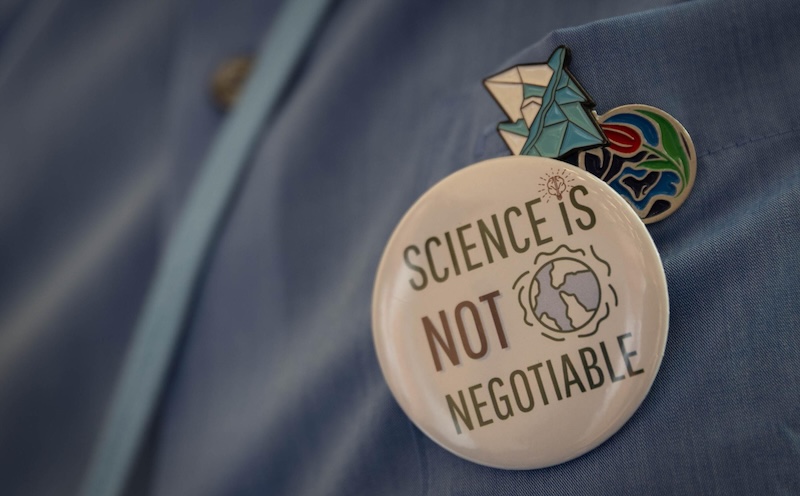
In Bonn this summer, the coalition that wants to align AR7 with the 2028 stocktake – which includes diplomats from Fiji, Nepal, the European Union, Switzerland, Sierra Leone and Panama – vowed to ensure that decision-making in the UN climate process remains based on the “best available science”, including the IPCC assessment reports.
They pointed the finger at “the usual suspects” but stopped short of singling out any countries at the public press conference. Discussions in the previous week had seen Saudi Arabia and India play down the centrality of IPCC reports in the UN stocktake and oppose calls in draft texts to encourage scientific work on scenarios to limit an overshoot of the 1.5C warming goal.
Bonn upset fuels further tension
A campaigner with knowledge of internal discussions told Climate Home News that many civil society groups from some of the world’s most vulnerable nations, including the Pacific islands, had expected CAN International to back calls in Bonn defending the centrality of the IPCC in UN climate policy-making.
Despite this, a day before the “Friends of Science” press conference, CAN published an ECO newsletter that did not mention the issue. Instead, it voiced surprise over the claims of an attack on science happening in the negotiations and accused some of the IPCC’s loudest-defending governments of hypocrisy for continuing to expand fossil fuels and not delivering “fair shares” of emissions cuts and finance to the developing world.
“We were really shocked we could not find a common position and then this jarring narrative was being pushed,” the campaigner added.
After divisions hardened in Bonn, Hare said his organisation was approached by “very upset” CAN members from various regions about the stance taken by the network’s international leadership on the issue.
Industry and NGOs lobby to weaken UN carbon credit rules in “coordinated” push
While Climate Home News understands that internal discussions have continued during the summer, including at a CAN leadership meeting in Nairobi in recent days, the campaigner said that CAN International’s endorsement of the recent webinar that directly challenged the “Friends of Science” coalition did not send a reassuring signal.
Some observers said they feared it would inflame tensions over how climate science is defined and utilised for policy purposes, with consequences reaching well beyond Bonn.
In a statement to Climate Home News, Essop said that “at a time when communities are experiencing the most horrific impacts of climate chaos, our collective energy must turn to solutions such as filling the Loss and Damage Fund, the phasing out of fossil fuels led by the Global North, and justice for people who are least responsible for this climate emergency”.
The post As science comes under attack at UN talks, climate movement splits over how to respond appeared first on Climate Home News.
As science comes under attack at UN talks, climate movement splits over how to respond
Climate Change
Q&A: What can – and cannot – be said about global warming’s role in the 2026 Himalayan floods
On the morning of 26 August, flash floods surged through a Himalayan border region of Nepal and the Chinese region of Tibet, killing more than 1,300 people, with thousands still missing.
In the days since the floods, scientists have examined satellite imagery, drone footage and seismic data in order to understand and explain the forces behind the event.
While initial theories pinned the flood on a glacial collapse, scientists now understand the event as a “multi-hazard cascade”, which began with a bedrock collapse.
Some climate sceptics have tried to use this to falsely claim that human-caused climate change had no impact on the event.
Yet, scientists have noted that, while no formal attribution study has been carried out thus far, warming is making such ice-rock avalanches in the region more likely.
Researchers have highlighted how rapid warming is dramatically reshaping Asia’s high-mountain region – and identified rising temperatures, glacier retreat and permafrost thaw as factors that may have all contributed to the disaster.
Balendra Shah, Nepal’s prime minister, has called the floods a “serious signal that…the risks we must bear in the Himalayan region are increasing” due to climate change.
Here, Carbon Brief unpacks what scientists currently know about the causes of the catastrophic event and what they can – and cannot – say about the role of climate change.
What happened?
A report published on 28 August by the HiRisk scientific consortium of high mountain experts detailed the events that led to the flash floods.
It said that events were set in motion on 26 August when a mass of bedrock, as well as the glacier ice on top of it, broke off a slope of Langtang-Lirung mountain in the Nepalese Himalaya, plunging from approximately 5,200 metres above sea level to the valley floor at 3,000 metres.
The landslide shook the ground hard enough that, at 8:37am Nepal local time, the US Geological Survey (USGS) initially reported a magnitude 4.4 earthquake. Later that day, it clarified the shaking was caused by glacier collapse and debris flow, equivalent to a magnitude 5.2 earthquake.
On the valley floor, the melting ice, water and debris slammed into the Lhende Khola river, a high-altitude river that runs along Nepal’s border with China.
Known downstream as the Bhote Koshi river in Nepal and the Poiqu or Poqu in China, the Lhende Khole feeds a network of rivers across Nepal and the Chinese region of Tibet, including the Trishuli river. (In China, the Lhende Khola is known as the Donglin Tsangpo.)
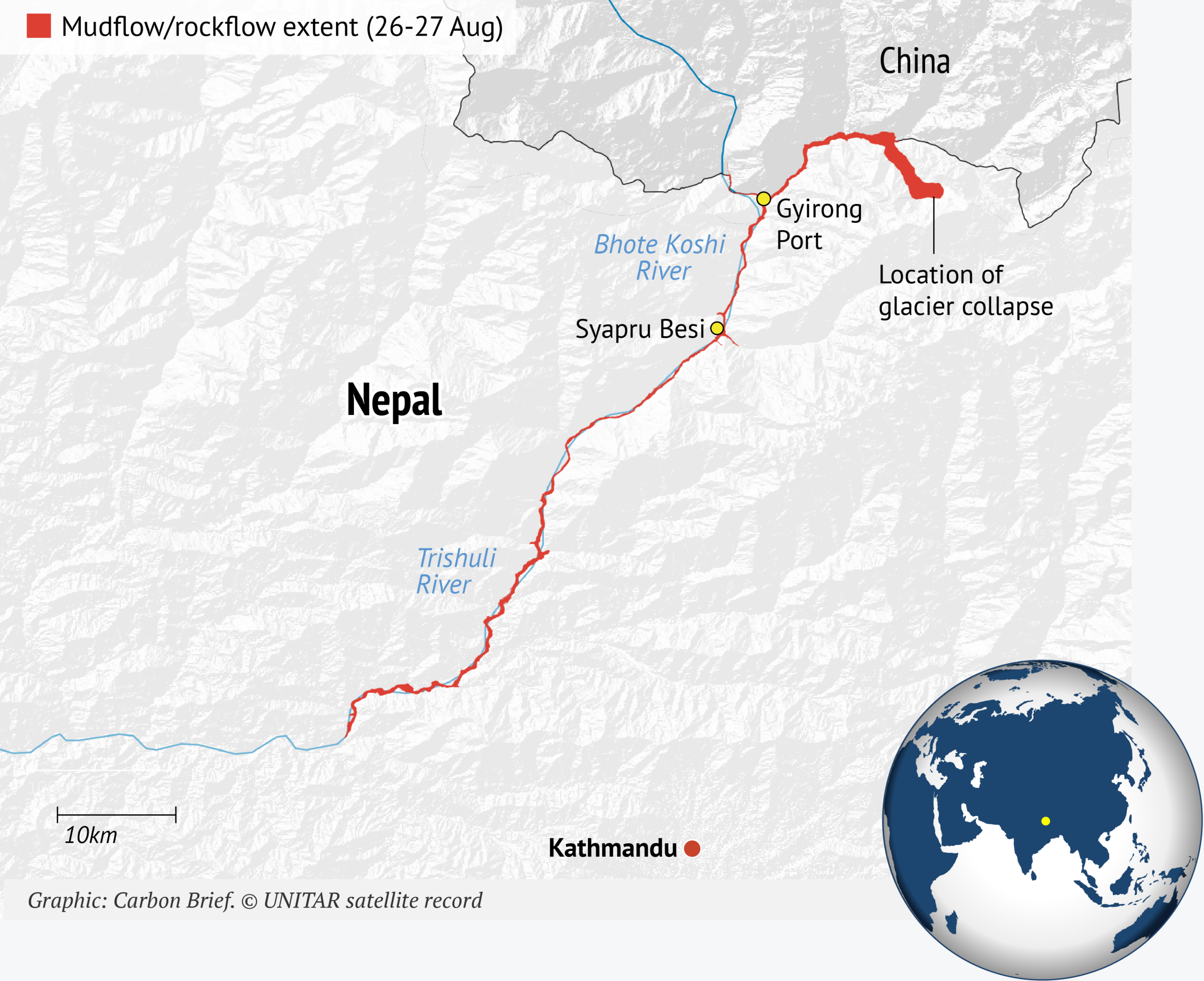
A large “debris” lake was briefly formed on the valley floor. When this lake burst, a wall of water and rock travelled downstream, killing more than a thousand people and destroying settlements, roads, bridges, hydropower plants and border posts across Nepal and Tibet.
HiRisk said that the floodwave travelled down rivers as fast as 30km an hour (around 19 miles per hour) and reached Mugling – a Nepalese town more than 130km downstream – at around 1pm local time.
A separate report from the Center for Land Surface Hazards in the US noted that the flood moved “exceptionally fast, was sediment-laden and extreme in scale”. For example, in the Nepalese municipality of Galchhi, the Trishuli river rose by nine metres in 30 minutes, it said.
Writing in the Conversation, Dr Umesh Haritashya, a glaciologist at the University of Dayton in Ohio, explained that the disaster “wasn’t finished when the first wall of water passed [on 26 August]”.
He continued that a new “barrier lake” – estimated to hold a few million cubic metres of water – had developed in a location where two rivers meet in Tibet before crossing into Nepal. This lake burst on 28 August and the river rose again, he said.
On 4 September, the chief of Nepal’s National Disaster Risk Reduction and Management Authority, told Reuters that property and infrastructure worth “at least” $2.5bn (£1.9bn) had been lost. Dharma Raj Upreti estimated the cost to build roads and temporary shelters, provide drinking water and restore power would be around $53m (£39m).
How did bedrock collapse trigger the flash floods?
In the immediate aftermath of the floods, initial reports suggested that the trigger was a collapsing glacier or earthquake in the high mountains of Nepal.
After confirming that a seismic tremor was as a result of falling rock and ice, the USGS said the trigger was likely a “glacial collapse and debris flow”. This was widely picked up by the media.
Subsequently, satellite imagery revealed that an “enormous chunk of the mountainous bedrock” beneath the glacier had also given way, reported the New York Times.
Dr Kristen Cook, a geomorphologist at the Université Grenoble Alpes in France, told the newspaper:
“The rock that the glacier was sitting on collapsed…It was a much larger collapse than we were initially able to see in the satellite imagery.”
The result was a “deluge of rock and ice, which pulverized into mud and water as it surged down the mountainside”, the newspaper said.
Dr Jakob Steiner a geoscientist at the University of Graz in Austria, tells Carbon Brief:
“It was not a glacier that collapsed. It was the mountain below the glacier that collapsed and the glacier had no other chance but to go with it because it was sitting on top of it.
“The trigger for that is something that we are not 100% certain about, but, in the end, it very much looks like simply a mechanical failure of the rock material because of stressors that have built up over a long period of time.”
Failures of “bedrock” – the hard, solid rock that sits below looser rocks and soil – are an “increasingly common occurrence”, says Prof Bethan Davies, a professor of glaciology at Newcastle University. She tells Carbon Brief:
“These massive landslides occur in mountain regions, commonly following rapid deglacierisation [the melting away of a glacier]. Similar events happened in the Chamoli event in 2021 [in the Indian Himalaya] and in the Blatten landslide last year in Switzerland. They’ve also occurred recently in Alaska.”
With a shift in focus from the failure of a glacier to the bedrock underneath, some climate sceptics seized on the development to falsely claim that climate change had not played any role in the disaster.
These include Dr Matthew Wielicki, recently appointed by the Trump administration to lead the US Global Change Research Program, on Twitter, as well as former Conservative peer and climate-sceptic commentator Matt Ridley in the Spectator.
However, scientists have highlighted the likely contribution of rapid warming in the region. These factors include the thawing of permafrost and glacier retreat. (For more, see sections below).
Fundamentally, “this would have been a much less significant tragedy if it had been just a rock-slope failure”, notes Davies.
The initial landslide took a mixture of rock and ice into a valley that “contains buried ice” as well, she says, providing the water that “resulted in the hyperconcentrated flow, which took so many lives”.
How have temperatures risen in the affected region?
Global temperatures have risen by roughly 1.4C since the pre-industrial period. However, this increase is not uniform across the planet, with some regions warming faster than others.
A study published in Global and Planetary Change in June 2026 investigated changes in the Langtang catchment – a river basin in central Nepal, in which the Langtang-Lirung mountain is located, which eventually drains into the Ganges. Around one-quarter of the area is made up of glaciers.
The paper found that glacial areas of the catchment – found at 4,000 metres above sea level – warmed at 0.31C per decade over 1960-2023. This was “more than three times” the rate observed at a lower elevation weather station, the authors said.
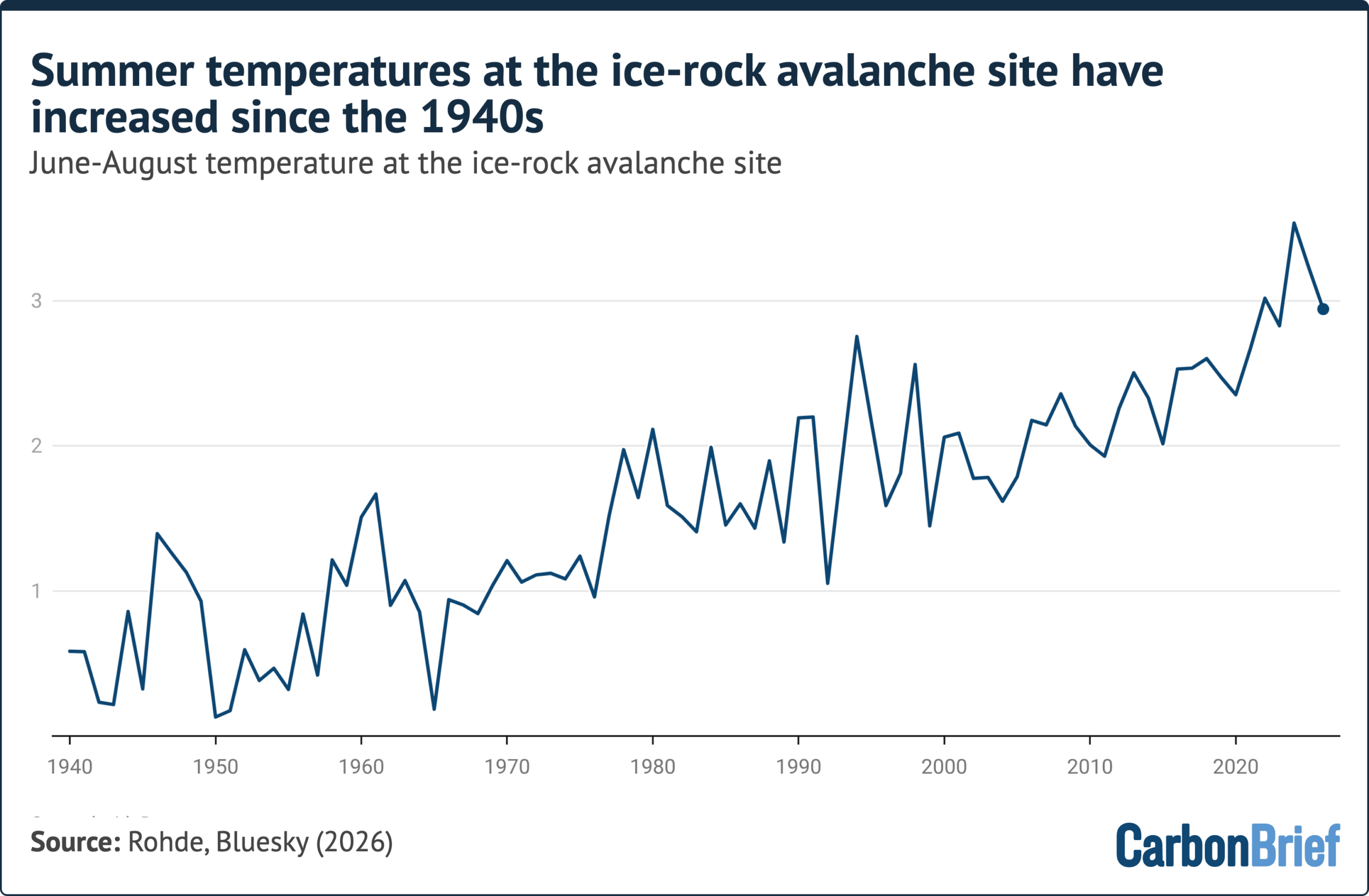
Looking in more detail at the site of the glacial collapse, Dr Robert Rohde, chief scientist for Berkeley Earth, used ERA5 reanalysis data to show how temperature has changed at the 5,200-metre elevation site where the mass of ice and rock broke loose.
Rohde’s analysis found that June-to-August temperatures have been rising at the site of the glacier collapse since the year 1940, with 2026’s summer the fourth warmest on record, behind 2024, 2025 and 2022. This is shown in the graph below.
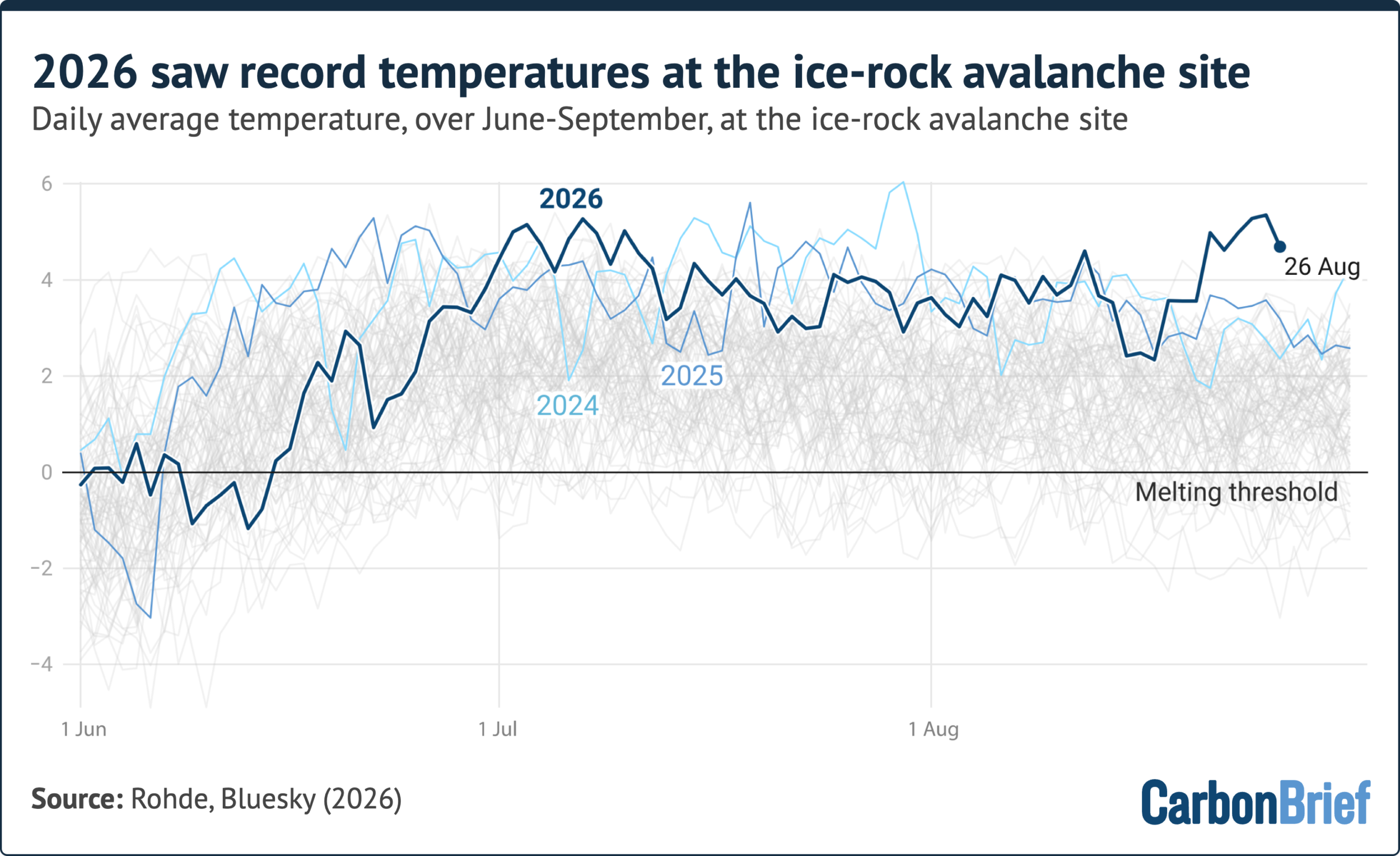
Rohde also found that the days leading up to the disaster recorded the hottest August temperatures ever experienced at the site. This is shown in the graph below.
On social media, Rohde stated:
“Given the warming trend, this Nepali glacier had probably been thinning and weakening for years, or even decades. But it ultimately failed during the warmest week in one of its warmest years on record. It would be a hell of a coincidence if global warming wasn’t at least partially to blame.”
How have rising temperatures affected mountain stability?
Many experts have linked warming temperatures in the region to thawing permafrost – ground that has been frozen for at least two consecutive years, whose thickness ranges from less than one metre to more than a kilometre.
Steiner is part of a research team that has been using sensors to monitor permafrost in the region since 2014. He tells Carbon Brief that it is “pretty clear” the permafrost has been thawing “very actively” at elevations as high as 5,200 metres above sea level “for many years”. He adds:
“This means that the ground has, over the last decades, moved from being in a solid state into – at least, periodically during the warm season – patchy ground where some is frozen and some isn’t…
“If you have frozen ground next to non-frozen ground, you have dynamics happening between that because there are different densities and there’s movement happening, which is conducive to interventional failure – and that we know from many other cases.”
Davies also points to the “degradation” of perennially frozen ground as a factor in the disaster:
“This permafrost acts as a glue to hold together the rocks and, as it melts, the rock can become weakened.”
Permafrost thaw can also result in saturated ground, says Davies, which adds “pressure in the joints” of rock and can “facilitate” failure. She continues:
“Sources of the water include melting permafrost and meltwater from the overlying glacier. We know that this event happened during a period of warmth, but in the absence of heavy precipitation, pointing to ice melt as the source of water.”
A 2025 study of rock and ice avalanches in High Mountain Asia found that more than two-thirds started in areas “where permafrost is probable”.
How have glaciers retreated in the affected region?
Glaciers – frozen rivers of ice holding three-quarters of the global freshwater supply – are extremely vulnerable to climate change.
In the Himalaya, the rate of glacier retreat has doubled since the late 20th century, according to a 2019 study in Science Advances.
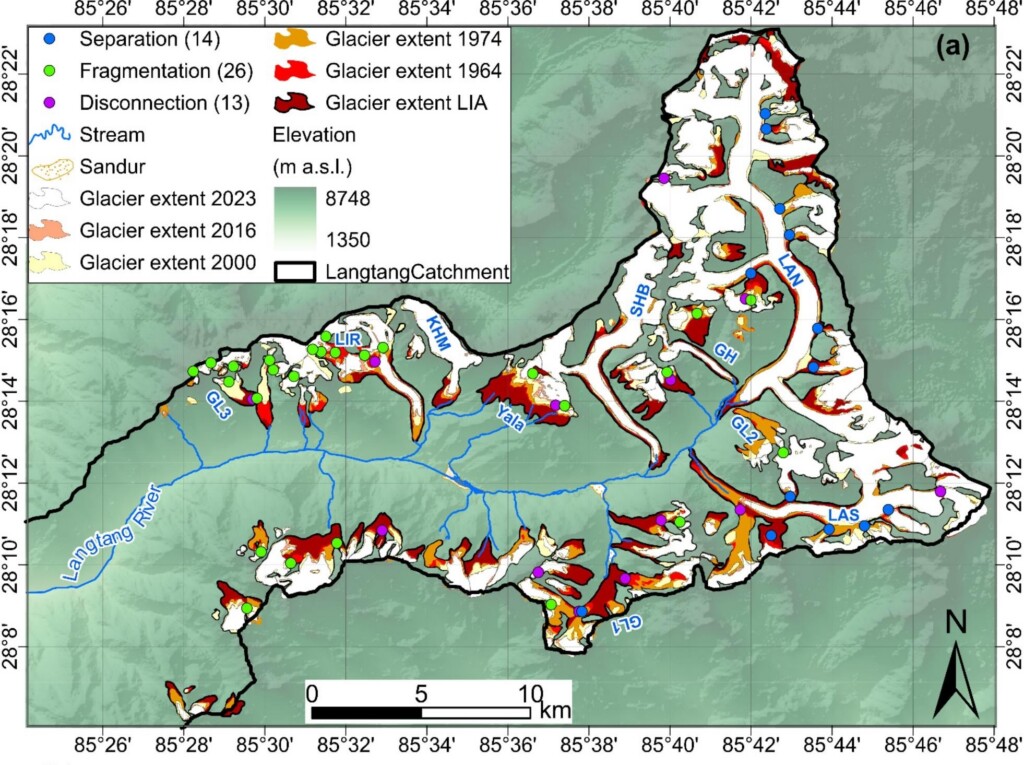
The Global and Planetary Change study found that glacier area loss rates in the Langtang catchment increased more than fourfold from 1964 to 2023 – with melting accelerating after 2000.
It added that glaciers in the region also experienced “fragmentation” and “widespread thinning” over this period.
The study noted that this loss “coincided with elevation dependent warming”.
The figure below provides an overview of glacier loss in the Langtang catchment over 1964-2023, with orange, red and dark red indicating areas of retreat.
In addition, green dots note points of glacier fragmentation, while blue dots show separation and pink show disconnection.
In comments released by the University of Reading, Prof Maria Shahgedanova, a climate scientist researching climate impacts on mountain glaciers, said that the glacier involved in the floods had “retreated by approximately 450 metres between 1990 and 2020”.
She adds that this “potentially reduce[d] the mechanical support provided by the glacier to the underlying rock slope”.
Speaking to Carbon Brief, Davies reiterates that the retreat of the glacier is “potentially a contributing factor” to the bedrock collapse and subsequent disaster.
This is because the removal of the glacier from the lower slopes leaves the “upper rock slopes less stable”, she says.
The most recent assessment by the International Centre for Integrated Mountain Development said that glaciers in the Hindu Kush Himalaya region are “rapidly shrinking” as a result of climate change. (This region extends 3,500km over Afghanistan, Bangladesh, Bhutan, China, India, Myanmar, Nepal and Pakistan.)
It said this loss is threatening the safety of the nearly two billion people, including by increasing the risk of “glacial lake outburst floods” (GLOFs). A GLOF is a sudden and catastrophic release of meltwater from a glacial lake.
Although this disaster was not caused by a GLOF, it is known that climate change is making such events more likely.
Can the event be attributed to climate change?
In the wake of the flash floods, climate campaigners, media outlets and Nepalese politicians have linked them to human-caused climate change.
However, many climate scientists have cautioned that it is too early to say precisely how climate change impacted the disaster.
Davies tells Carbon Brief:
“These events happen so quickly that the exact causes and drivers can take a little time to uncover, especially if the event was a surprise and there had been no monitoring system in place.”
When trying to determine the role human-caused climate change played in the intensity or likelihood of extreme weather, scientists turn to the field of “attribution science”.
To date, no formal rapid attribution study has been produced that attempts to quantify whether – and how – climate change contributed to the event.
Scientists have noted that climate attribution of ice-rock avalanches – which are typically driven by a variety of factors – remains limited, in part because of the lack of a long-term observational record of previous collapses in high mountain areas.
Meanwhile, the studies that do exist stop short of directly linking such disasters to climate change. For example, the authors of a 2021 study into the Chamoli ice-rock avalanche concluded that “we cannot attribute this individual disaster specifically to climate change”.
However, they added, the “possibly increasing frequency of high-mountain slope instabilities can likely be related to observed atmospheric warming and corresponding long-term changes in cryospheric conditions (glaciers and permafrost)”.
In the aftermath of the disaster, many researchers have similarly highlighted that climate change could not be singled out as the cause of the disaster, even if warming likely increased the probability of its occurrence.
On the Climate Brink substack, Carbon Brief’s climate science contributor Dr Zeke Hausfather noted that a “definitive single-event attribution” of the more recent disaster “may never be possible” due to the “messy causality of rock-ice avalanches”.
However, he added that both the existing scientific literature and “essentially every scientist working on these hazards point in the same direction” – namely, that warming is making such events more likely in the Himalaya.
Steiner tells Carbon Brief it might be possible to attribute different factors that played a role in the disasters to climate change – for instance, the recession of the glacier – but it would be more difficult to do so for the event as a whole.
Part of the reason for this, he says, is that rock failures in this region of the Himalaya have occurred for millennia, well before humans started altering the climate.
However, he continues:
“The physics of it is not something that has been made possible by climate change. This could have happened without it. But the chance of it happening – and the likelihood of it happening five years after a previous, similar event [in Chamoli] – we, as the scientific community, can be pretty confident about that [being increased because of a changing climate].
“This is because so many of the changes that we know are related to climate change can potentially drive the build-up to eventual failure.”
Ultimately, says Davies, a “careful attribution study is needed, but it is hard to argue that the rapidly warming climate is not having an effect in these regions”. She adds:
“A single event may have multiple drivers, but we are seeing an increase in these events and are likely to see more as the permafrost and glacier melt continues.”
Related
Explainer: The CMIP7 emissions scenarios – and how they explore future climate change

Climate change exposes 580 million children to 20 extra ‘heat-stress days’ every year
Explainer: How the ‘super El Niño’ will reshape the world’s weather
Analysis: The two largest reservoirs in the US have hit record-low levels
The post Q&A: What can – and cannot – be said about global warming’s role in the 2026 Himalayan floods appeared first on Carbon Brief.
Q&A: What can – and cannot – be said about global warming’s role in the 2026 Himalayan floods



-
Climate Change1 year ago
Guest post: Why China is still building new coal – and when it might stop
-

 Greenhouse Gases2 years ago
嘉宾来稿:满足中国增长的用电需求 光伏加储能“比新建煤电更实惠”
-
Greenhouse Gases1 year ago
Guest post: Why China is still building new coal – and when it might stop
-

 Climate Change2 years ago
嘉宾来稿:满足中国增长的用电需求 光伏加储能“比新建煤电更实惠”
-

 Renewable Energy11 months ago
Sending Progressive Philanthropist George Soros to Prison?
-
Climate Change2 years ago
Bill Discounting Climate Change in Florida’s Energy Policy Awaits DeSantis’ Approval
-
Greenhouse Gases1 year ago
嘉宾来稿:探究火山喷发如何影响气候预测
-

 Carbon Footprint2 years ago
US SEC’s Climate Disclosure Rules Spur Renewed Interest in Carbon Credits