

Environment ministers representing the European Union’s 27 member states failed to agree emissions reduction targets for 2035 and 2040 in Brussels on Thursday, instead asking their countries’ leaders to weigh in when they meet next month.
With several primarily Eastern European nations opposed – and others wavering – ministers agreed to ask their leaders to consider the key climate goals at a European Council meeting in October, in the hope of agreeing targets before the COP30 climate summit in November.
This means that the EU will not submit its 2035 target in time for it to factor into the UN’s annual synthesis report of national climate plans, due in late October, which will analyse governments’ climate commitments and estimate how far off the Paris climate agreement’s temperature targets they are.
It also means that EU officials will head to the United Nations General Assembly in New York next week without new targets to offer. Instead, they will just have what the Danish minister chairing the talks called a “statement of intent” to reduce emissions by between 66.25% and 72.5% below 1990 levels by 2035.
Some ministers that want stronger targets warned the delay could lead to the emissions cuts being watered down. A decision by environment ministers on the 2040 target can be made through qualified majority voting. But EU leaders will decide on the basis of unanimity, allowing climate laggards to block ambition. It is not clear if EU leaders will decide on the target at their next meeting or just debate it.
Ahead of today’s Environment Council meeting, the environment minister of Sweden – which supports the European Commission’s proposed target to cut emissions 90% between 1990 and 2040 – walked up to waiting journalists and said unprompted that “hesitation is a luxury that we cannot afford”.
Romina Pourmokhtari added that she was “quite disappointed at recent developments”, adding that her message to “all countries but particularly Germany and France” – which have pushed for a delay so leaders can contribute – is that “I and Sweden do not believe that it will become a better product by prolonging this process. This will not create a better outcome”.
But Elisa Giannelli, E3G lead on climate governance and European politics, was positive. She told Climate Home News that “we’ve heard enough member states being quite positive about the commission’s proposal today”, adding “it will eventually be down to France to swing over to the “supportive camp” once leaders have “provided the reassurance and guidance they are calling for”. France is widely regarded as the swing vote.
At the meeting, representatives from Czechia, Slovakia, Poland and Hungary opposed the 90% proposal. Krzysztof Bolesta, from the Polish environment ministry, said an 83% target is “at very, very high cost, maximum we can do”.
Slovakia’s environment minister Tomáš Taraba said “it would be good to start with a lower target and – if necessary and feasible – we can increase in the next revision”, a position supported by Hungary’s Anikó Raisz.
On the other side, representatives of the Netherlands, Spain, Germany, Luxembourg and Austria supported the 90% proposal. Spain’s Sara Aagesen Munoz said it was “science-based” and the Dutch representative called it “feasible” and “the most logical way towards climate neutrality in 2050”.

Missing UN deadlines
Simon Stiell, executive secretary of the UN convention on climate change, welcomed the EU’s statement of intent despite the bloc’s failure to announce a target in time for the UN systhesis report of climate plans. Stiell urged European leaders to aim for the top of the proposed range.
“If these targets are met with speed and at scale, the EU has so much to gain,” Stiell said in a statement. “It won’t just be a global leader on climate change and clean energy, the more action it takes, the more the continent stands to benefit, with stronger economic growth and thriving new industries powered by cheaper and cleaner energy.”
On his way into the meeting, the German environment ministry’s state secretary Jochen Flasbarth blamed the European Commission for the “loss of time”. “If the Commission would have provided the dossier earlier then we would be in a different situation,” he told reporters.
EU Climate Commissioner Wopke Hoekstra told the ministers that he had hoped the targets would be decided today but the delay “could also be useful to ensure the broadest possible political support”.

Asked ahead of today’s meeting what message missing the UN’s end-of-September deadline for 2035 NDCs will send, Finland’s environment minister Sari Multala said it is “hard for us to require the others – our international partners to do the same if we don’t deliver ourselves”.
According to the UN, 36 nations have already submitted their 2035 targets – known in UN jargon as nationally determined contributions (NDC). Australia today promised to cut emissions 62-70% between 2005 and 2035. China is expected to announce its target this week or next and many other nations will launch their targets at a UN summit in New York on Wednesday.
Losing climate leadership?
Asked if China will take over the EU’s climate leadership on the international stage, Hoekstra said “it would be fantastic if they would outperform our NDC”. Separately, Poland’s Bolesta told a reporter, “I don’t know why you would say we are worse than China” as “it’s not about who is faster, it’s about who is more robust and more credible.”
-
EU’s record wildfire emissions highlight threat to forest carbon sinks
As carbon emissions from forest fires spike in Europe, experts warn that wildfires pose a growing risk to national efforts to meet climate goals -
EU Commission proposes allowing carbon offsets to help meet 2040 climate goal
Campaigners accuse the European Commission of adding “loopholes” and “distractions” to the 90% emissions reduction target -
COP30 president prepares for clash of views on how to respond to NDCs
With most countries yet to submit new emissions-cutting plans due by the end of next month, Brazil will launch consultations on how to tackle an expected shortfall in ambition


Hungary’s environment minister Anikó Raisz said “those from the EU going to New York, we have nothing to hide” as the EU is a “leading example”. Hoekstra said the EU’s NDC would be among the most ambitious in the world along with “our friends from Great Britain and a couple of other places”.
Speaking yesterday, the chair of the Alliance of Small Island States negotiating group, Ilana Seid from Palau, said she was “putting pressure” on the EU to “step up” because “their NDC announcement would really change the momentum and the kind of ambition heading into the COP”.
The timeline for deciding the two official EU targets is now unclear, but is likely to involve a specially-convened European Council leaders’ meeting and then another environment ministers meeting.
Danish environment minister Lars Aagaard said he hoped the targets would be adopted ahead of COP30 “as this would send a strong signal to the world – but ultimately we are, of course, in the hands of states and governments”.
This story was edited to include comments from Simon Stiell, executive secretary of the UN Framework Convention on Climate Change (UNFCCC).
The post EU ministers fail to agree climate targets, raising risk leaders will weaken them appeared first on Climate Home News.
EU ministers fail to agree climate targets, raising risk leaders will weaken them

Three countries have been named by the Paris Agreement’s compliance committee for failing to submit a nationally determined contribution (NDC) and repeatedly snubbing offers of help with their climate plans.
After months of internal debate over whether to identify serial non-responders, the Paris Agreement’s Implementation and Compliance Committee (PAICC) named the three countries which have failed to engage with it over their NDCs on Friday.
It named Democratic Republic of Congo, Senegal and North Korea in a footnote of its annual report, adding that it decided to name them “with a view to facilitating engagement”, adding that representatives of the three nations had been invited to its meeting in early 2027 “with the purpose of identifying any challenges and constraints”.
“The Committee noted the importance of Parties engaging with the Committee in a timely manner, while noting that some delays may be due to the national capabilities and circumstances of the Parties”, the report said.
-
Under US pressure, World Bank says it will back gas “where appropriate”
The US wants the World Bank to expand its gas support while climate campaigners are pushing for it to end – its head spoke this week of limited backing for the fossil fuel -
IPCC scientists vow to press on with climate reports despite political deadlock
After governments again failed to agree a timeline, nearly 120 IPCC authors pledged to complete their assessment on time and with full scientific rigour -
Paris Agreement committee snubbed over missing NDC climate plans
Many governments have still not submitted a nationally determined contribution to the UN, breaching a key requirement of the Paris Agreement

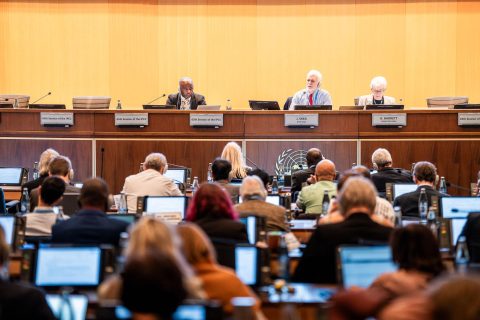

In July, PAICC said 12 countries had ignored its repeated attempts to discuss why they had not published an NDC as required every five years under the 2015 Paris accord.
Members of the committee had been divided over whether to name them, but at a September meeting decided to do so in their annual report to the annual climate COP summit.
By the time the report was published on Friday, only Congo, Senegal and North Korea “had not communicated an NDC or submitted a [Biennial Transparency Report] and had not yet responded to any of the Committee’s notifications, despite several reminders issued by the Committee in this regard”.
Rainforest and renewable energy ambitions
The silence from Congo and Senegal is notable because the former is home to much of the Congo Basin rainforest while the latter has sought billions of dollars in climate finance to support its renewable energy ambitions.
After Brazil, Congo has more rainforest than any country in the world. This forest, and the country’s peatlands, absorb huge amounts of greenhouse gas but are fast being lost to expanding farmland, charcoal production, logging and mining.
Senegal signed a Just Energy Transition Partnership with Canada and wealthy European nations in 2023, to help it meet its renewable energy targets under the-then government of Macky Sall. It was chair of the Least Developed Countries group between January 2022 and December 2023.

Tejas Rao, who is researching the PAICC as part of a doctoral thesis at Cambridge University, said the governments of the three countries should engage with the committee.
“Engagement costs these governments very little and the committee has shown it will listen,” he said.
“Silence leaves the committee with no basis to help, and it leaves the [governments] exposed to the narrative that they are simply disengaged,” he told Climate Home News.
Paris Agreement requirement
The 2015 Paris Agreement requires all parties to publish an NDC every five years outlining their emissions reduction targets, with each plan meant to be more ambitious than the country’s last NDC.
The latest set – the third round of plans, with new targets for 2035 – was due in February 2025. While most countries missed this deadline, all but around 30 – mostly small emitters but including Egypt, Vietnam and Argentina – have now submitted them.
Over the year, the PAICC – which is made up of government climate officials from developed and developing countries – has been communicating with governments that have not submitted NDCs and trying to overcome barriers to them doing so.
Some nations have cited exceptional circumstances as the reason for not submitting an NDC, a process that requires a significant amount of work in tracking emissions and consulting on how to curb them across the economy. For example, a letter from a Sudanese official to the PAICC, seen by Climate Home News, said that the country’s civil war had led to the suspension of its NDC preparation.
-
IPCC scientists vow to press on with climate reports despite political deadlock
After governments again failed to agree a timeline, nearly 120 IPCC authors pledged to complete their assessment on time and with full scientific rigour -
Under US pressure, World Bank says it will back gas “where appropriate”
The US wants the World Bank to expand its gas support while climate campaigners are pushing for it to end – its head spoke this week of limited backing for the fossil fuel -
Who shapes climate science? The equity question facing the IPCC
Early completion of the next global climate science assessment reports risks excluding research from the Global South, which is key to ensuring the findings are fair
The US and Iran are not signed up to the Paris Agreement and so do not have active NDCs, nor does Taiwan, which is not a UN member state.
Rao said that because the PAICC is “facilitative and non-punitive”, naming the countries “is meant to open a door, not close one – the invited consultation is the point”.
“In recent months, governments that explained their constraints, whether capacity, finance or domestic process, have been met with follow-up and support rather than sanction, and the number of silent governments has fallen sharply,” Rao said.
The post Paris Agreement committee names three countries snubbing it over NDCs appeared first on Climate Home News.
Paris Agreement committee names three countries snubbing it over NDCs