Indigenous peoples have converged on Belém to participate in the COP30 UN climate summit, which opened on Monday – yet many of them will not be able to enter the part of the conference where governments make key decisions.
According to The Coalition of Indigenous Peoples of Brazil (APIB), about 2,500 Indigenous representatives – the most ever at a COP – are expected to attend. Yet only 14% of those from Brazil (360 individuals) have secured accreditation for the Blue Zone, the restricted area for official negotiations.
The previous record for Indigenous participation was set in Paris in 2015 and matched in Dubai in 2023, with about 350 Indigenous attendees each, according to COP30 organizers.
This broader turnout results from Brazilian initiatives to include as many peoples as possible in climate discussions. These include the Peoples’ Circle – an umbrella group for Afro-Brazilian, Indigenous and traditional communities – a dedicated pavilion in the Green Zone, and the COP Village, a camp welcoming participants from Tuesday this week.
Indigenous participants from Brazil attend as part of the party overflow category, which lets the country include additional representatives beyond its official UN delegation. The 360 credentials were transferred to APIB, which gathered nominations from regional organizations and submitted the final roster to Itamaraty, Brazil’s Ministry of Foreign Affairs.
Holders of this credential can enter negotiating areas but cannot contribute to discussions, vote or join closed meetings. Still, they can follow delegations closely, so they can interact with national experts, participate in side events and share their perspectives on negotiation priorities.
Blue Zone/Green Zone separatism
However, Indigenous people who took part in a demonstration that turned violent at the entrance to the Blue Zone on Tuesday said they wanted to catch the attention of the UN and the Brazilian government regarding their inability to participate in the proceedings.
They are critical of the Green Zone/Blue Zone division established by the UN, which separates most civil society from the spaces where countries’ negotiators and official delegations circulate.
The protest at COP30 took place in the evening, when a group of unaccredited demonstrators entered the restricted area and clashed with security guards. Videos recorded the moment when the group pushed doors and ran into the area.
Indigenous leader Gilson Tupinambá, from Papagayo village in the Tapajós Arapiuns Extractive Reserve area, explained that it was a way to take a stance against the UN framework. “Reflecting on this separatism, this ‘apartheid’, we don’t want this Blue Zone/Green Zone separatism,” he said.
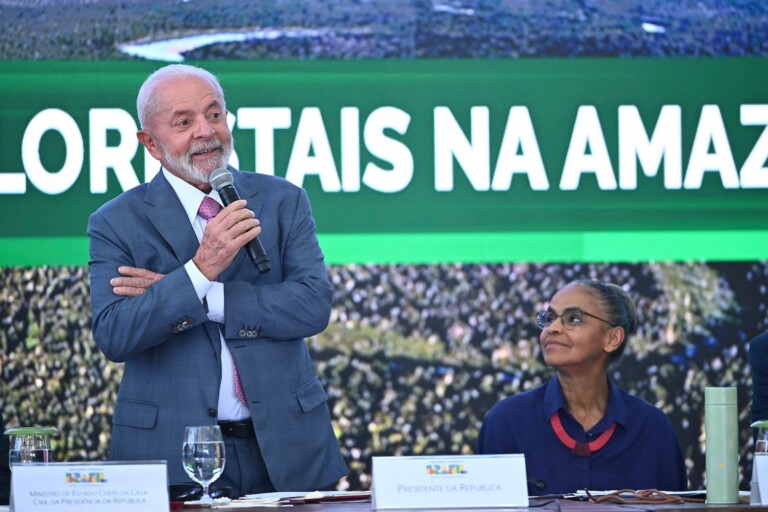
In an interview with InfoAmazonia, Brazil’s Minister of Indigenous Peoples Sonia Guajajara said she regretted what happened: “I’m deeply sorry about that because, if the idea was to guarantee participation, this COP already has the largest indigenous participation in the history of COPs.”
Toya Manchineri, coordinator of the Coordination of Indigenous Organizations of the Brazilian Amazon (Coiab), believes participation is still insufficient. Indigenous leaders want to be included in Brazil’s official delegation, he said.
“Ideally, we would participate as negotiators within the official country delegation, right? That would make a real difference. In a conversation with [Indigenous Peoples] Minister Sônia [Guajajara], I told her: ‘Minister, let’s work together so the Brazilian government considers Indigenous leaders as part of the official delegations for negotiations.’ It would make this a different COP,” he said.
Dredging for minerals in the Amazon
Lucas Tupinambá, a young Indigenous leader from the Tapajós-Arapiuns Indigenous Council and resident of Santo Amaro village along the Tapajós River, spent two days traveling by boat to reach COP30.
He attended the opening plenary session on Monday, where he denounced the presence of dredgers – vessels extracting minerals from the river – around the Tapajós and demanded climate mitigation and adaptation measures.
At first, Lucas was struck by the COP30 venue but criticized its separation from the local community. “To be here, you need accreditation, and in my region, only two people received it. The process is also expensive. They are not interested in hearing from those who truly need to be heard,” he said.
He is particularly concerned about the oil agenda and resource exploitation in the Amazon. “We have to stay alert, because many events take place throughout the day. As a social movement, we must constantly monitor where these discussions are happening. Before any talks about oil, dredging Amazonian rivers, privatization or any measure that could harm the rights of Amazonian peoples, they must listen to us,” he said.


Land demarcation as climate policy
APIB, Brazil’s leading Indigenous organization, has a clear goal for the conference: to make Indigenous land demarcation an official climate policy, enshrined in the country’s Nationally Determined Contribution (NDC).
This push, underway for two years, is led by the ‘We Are the Answer’ campaign, which has reached Indigenous communities worldwide. “Our core message is that demarcation and territorial protection are policies for facing the climate emergency. This needs not just to be acknowledged, but also implemented by global leaders – and in our case, above all, by Brazil,” says Kleber Karipuna, APIB’s executive coordinator.
APIB has championed this agenda at major events, including the Pre-COP in Brasília and Climate Week in New York. It was also presented during the COParente Cycle, an initiative under the Peoples’ Circle led by the Ministry of Indigenous Peoples (MPI) and the National Foundation for Indigenous Peoples (FUNAI), which took place in various territories.
At COP30, roadmap away from fossil fuels gains ground – but next step unclear
At the opening plenary on Monday, President Luiz Inácio Lula da Silva echoed APIB’s call, urging the international community to “recognize the role of Indigenous territories and traditional communities in mitigation efforts.”
His remarks suggest possible paths forward. For Toya Manchineri, the challenge now is persuading all participating countries to include this measure in the final COP30 agreement. “For us, it’s already a victory that the president recognizes this need. Now we’ll see if he can persuade other heads of state,” he said.
Indigenous programming
At COP conferences, Indigenous organizations participate in plenary sessions, debating issues such as territorial protection, extreme weather impacts, mining, adaptation strategies and health, among other topics.
For COP30, the presidency established the Peoples’ Circle, led by Minister Sônia Guajajara. This forum includes two main bodies: the International Indigenous Commission, with Indigenous representatives worldwide, and the International Commission of Traditional Communities, Afro-descendants and Family Farmers, bringing together delegates from 16 Latin American countries.
The Peoples’ Circle has its own pavilion at the conference, serving as a venue for climate justice debates and amplifying grassroots civil society voices who share insights from their territories.
In addition on Monday, the assembly of the COP Village, a camp at the Federal University of Pará (UFPA), supported by the Ministry of Indigenous Peoples (MPI), began. There, plenary debates on climate change and its impact on Indigenous lands are being held. The Ministry of Indigenous Peoples (MPI) expects 3,000 attendees from Brazil and abroad.
“We worked closely with the COP presidency to ensure this level of participation and visibility for Indigenous peoples. I believe this will leave a legacy that extends beyond mere participation,” said APIB leader Kleber Karipuna. Securing such a large Indigenous presence at COP30 in Brazil is unprecedented—a historic achievement, both in the Blue Zone and other venues.”
This report was produced by InfoAmazonia as part of the COP30 Socio-Environmental Collaborative Coverage initiative. Read the original report here (this is an updated version): https://infoamazonia.org/2025/11/10/mesmo-com-presenca-recorde-apenas-14-dos-indigenas-brasileiros-devem-acessar-espaco-de-decisao-na-cop30/
The post Despite record turnout, only 14% of Indigenous Brazilians get access to COP30 decision-making spaces appeared first on Climate Home News.
Despite record turnout, only 14% of Indigenous Brazilians get access to COP30 decision-making spaces
Climate Change
Africa can lead the Age of Electrification
Mohamed Adow is the founder and director of Power Shift Africa.
At London Climate Action Week, electrification moved from the margins of climate policy to the centre of the road to COP31. The launch of the Electrify Now campaign gave fresh momentum to a target floated at the Bonn climate talks: by 2035, electricity should provide 35% of the world’s final energy consumption, up from just over 20% today.
That makes electrification one of the defining tests for this year’s climate summit in Türkiye. If COP31 is to be more than another exercise in negotiating text, it must show how the world can replace fossil fuels in transport, heating, industry and everyday life with clean electricity.
For Africa, this agenda presents both an extraordinary opportunity and an immense challenge.
For decades, the continent has been viewed primarily through the lens of energy poverty. More than 600 million Africans still lack access to electricity. Yet that very deficit also means many African countries are not locked into ageing fossil-fuel infrastructure in the way industrialised economies are. They have the chance to build cleaner energy systems from the outset.
The case for electrification is compelling. Transport, industry and heating account for much of the world’s fossil-fuel consumption. Replacing combustion engines with electric vehicles, diesel generators with renewable power and fossil-fuel heating with electric alternatives is one of the fastest ways to cut emissions while improving energy security. Electric technologies are also far more efficient, and renewable electricity is now the cheapest source of new power across much of the world.
Africa also possesses one of the greatest renewable energy endowments on Earth. The continent possesses some of the world’s best solar resources. Vast wind corridors stretch across North, East and Southern Africa. Geothermal energy is already powering much of Kenya’s electricity system. Hydropower resources remain significant in several regions.
But potential is not the same as progress.
The biggest obstacle is not a lack of sunshine or wind. It is a shortage of investment.
Financial barriers
African countries pay some of the highest borrowing costs in the world despite contributing the least to climate change. Projects that would be commercially viable elsewhere become prohibitively expensive because of high interest rates and perceptions of financial risk. Until the cost of capital falls, many countries will struggle to build the renewable power stations, transmission lines and battery storage needed to electrify their economies.
The electricity itself is another challenge. It is difficult to persuade people to buy electric vehicles or industries to electrify production if power supplies remain unreliable. Many national grids require major investment to expand access, improve reliability and accommodate growing volumes of renewable energy. In rural areas, decentralised solar and battery systems will often provide the quickest route to universal electricity access, but they too require finance and supportive policy frameworks.
Industrial policy matters just as much.
Africa is rich in many of the minerals needed for batteries and clean technologies, yet too often it exports raw materials and imports finished products. If electrification simply creates new markets for imported batteries, electric vehicles and solar equipment, much of the economic opportunity will be lost. The transition should also become a strategy for building African manufacturing, creating skilled jobs and capturing more value from the continent’s own resources.
There are encouraging signs. Ethiopia has pushed aggressively to promote electric mobility while seeking to reduce its dependence on imported oil. Kenya has become a global leader in geothermal electricity and is seeing rapid growth in electric motorcycles. Morocco is building an industrial base around renewable energy and battery supply chains.
Electrification is happening
These examples show that electrification is no longer a distant prospect. But they also remain outliers rather than the norm. For most African countries, unreliable grids, high borrowing costs and limited access to finance still stand in the way of a much broader transformation. That is precisely why the emerging electrification agenda matters.
If the world wants electricity to account for 35% of final energy demand by 2035, then success cannot be measured simply by announcing a global target. It must be measured by whether developing countries have the finance, technology and policy support to make that transition possible.
For Africa, electrification is not only about reducing emissions. It is about determining what kind of development path the world’s youngest and fastest-growing continent will follow.
More than a billion people live in Africa today. By mid-century, that number will be closer to 2.5 billion. This is a continent on the cusp of sweeping economic transformation, with cities expanding, industries growing and hundreds of millions of people rightly demanding the energy, mobility and prosperity long enjoyed elsewhere.
Campaigners oppose Dangote’s planned Kenya refinery over climate and ecological risks
That development will require vast amounts of power. The question is whether it will be delivered through the old fossil-fuel model of imported oil, gas infrastructure and polluting combustion, or through clean electricity generated from Africa’s own renewable resources.
This matters for Africa. But it also matters for the world. A global transition to electrification cannot succeed if a continent of this scale is locked into a new generation of fossil-fuel dependence. Nor can it be just if Africa is told to decarbonise without being given the finance and technology to build something better.
The choice facing COP31 is therefore not simply whether electrification will happen. It is whether Africa is helped to become an electro-state continent, powering its development through clean electricity, or pushed by neglect into repeating the fossil-fuel pathway that has already destabilised the climate.
For the age of electrification to be a success, COP31 needs to ensure Africa is equipped to shape and accelerate it. If Africa is left behind, the global energy transition will fall behind with it.
The post Africa can lead the Age of Electrification appeared first on Climate Home News.
Climate Change
UK withdraws millions in funding from world’s second-largest rainforest in Congo
The UK has abandoned projects worth tens of millions of pounds that were meant to help protect Congo rainforests and support local people.
Together, these initiatives would have made up around half of the £200m that the UK pledged to support conservation in the Congo basin – the world’s second-largest rainforest.
When it hosted COP26 in Glasgow, the UK led a new initiative to end forest loss, which included a collective pledge by 12 donors of “at least” $1.5bn (£1.1bn) for Congo rainforest nations by 2025.
Development minister Jenny Chapman revealed last week that, as of 2024, the UK had only provided £39.8m towards this goal.
Alongside the US and much of Europe, the UK has significantly cut its aid budget in recent years, leading to much of its Congo rainforest spending being cancelled or reappraised.
The government says it still plans to “prioritise” rainforest regions, including the Congo basin, but civil society groups and MPs are concerned about the lack of “ring-fenced” forest funding in the UK’s new aid strategy.
COP pledge
At COP26, the UK – led by then prime minister Boris Johnson – launched the “Glasgow leaders’ declaration”, with a goal to “halt and reverse forest loss” by 2030. This was backed by more than 140 nations.
The UK also made various funding pledges, including £200m to protect the Congo basin, £350m for tropical forests in Indonesia and “up to £300m” for the Amazon.
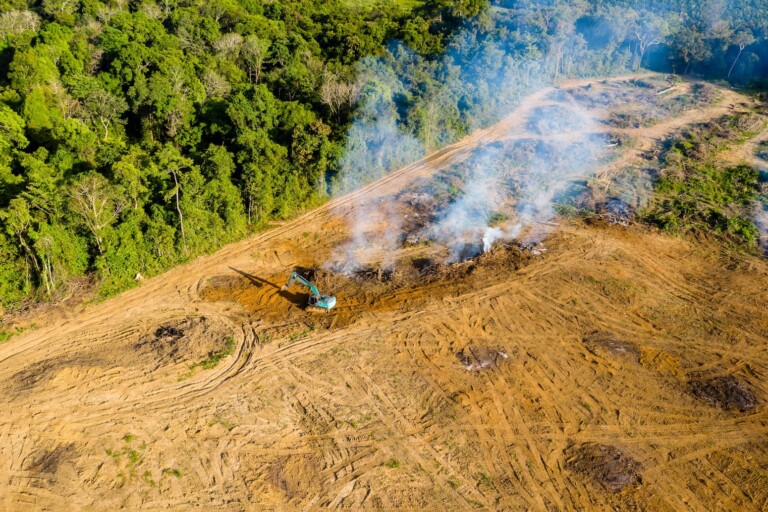
These commitments target the world’s three largest rainforests, all of which face major forest loss due to threats such as agriculture, logging and climate change.
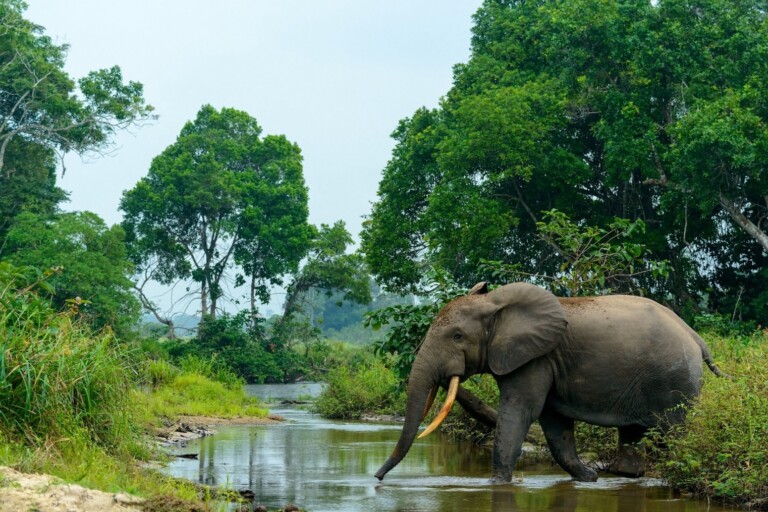
The Congo basin is the planet’s largest forested carbon sink. Yet, its six host nations are among the poorest in the world and face significant funding barriers.
This has global ramifications. An official UK assessment warned that “degradation or collapse” of the Amazon or Congo rainforests “threaten UK national security and prosperity”.
Forest cuts
Following successive aid cuts introduced by both the Conservative and then Labour governments – tracking a global trend – the UK’s Congo funding is under threat.
The Congo basin forest action programme (CBFA) was launched by the UK at COP27. It was explicitly set up to provide “roughly half” of the UK’s £200m Congo pledge.
CBFA set out to “empower central African nations”, such as the Democratic Republic of the Congo (DRC), with support for “community forests” and other measures to curb forest loss.
Now, after reporting delays, the UK has slashed the CBFA as part of the Labour government’s recent aid cuts, intended to free up money for defence spending.
Its original £90m budget has now been reduced to £18.8m. Government data shows that £15m of this has already been spent.
This is not the only Congo project that has been dropped due to this latest round of aid cuts.
The Congo part of the biodiverse landscapes fund – championed by the previous government and worth at least £12.3m – has been closed, just two years into its seven-year schedule.
Government documents reveal more Congo forest funding is at risk as the UK scales back its aid budget, including the UK’s two largest remaining projects in the region.
One initiative, intended to “incubate forest-friendly enterprises” in DRC, faces “reduc[ed] budgets”. Officials working on the other, while more optimistic, reported that the project may be forced to operate in fewer countries as the cuts set in.
Documents also reveal the difficulties that come when operating in the Congo, including “complex political economies” and, in Gabon, a military coup – which “complicated matters”.
‘Breaking promises’
Damian Fleming, a senior director of forests at WWF International tells Carbon Brief:
“Tropical forest countries are making long-term policy and development choices in expectation that international partners will honour their commitments.”
In a series of recent parliamentary responses, Chapman revealed that the UK had only spent £39.8m on Congo forest finance, as of 2024. (She declined to provide any information on the Indonesia and Amazon regional goals.)
Despite being presented as the UK’s “contribution” to the £1.1bn-by-2025 global goal agreed at COP26, the £200m target has a deadline of 2029.
Therefore, while the collective goal has been met, the UK’s contribution so far has been relatively small.
Zac Goldsmith, a former Conservative minister who oversaw the forest targets at COP26, tells Carbon Brief that, in his view, the UK has “discarded” its regional pledges:
“We have gone from being perhaps the leader on protecting nature internationally to breaking promises to countries around the world for whom the environment is an existential issue.”
Future targets
The Labour government says it has met the five-year “climate finance” target of £11.6bn that expires this year.
Ministers also say the government has met “and exceeded” the £3bn and £1.5bn sub-goals for “preserving nature” and forests, respectively, within the £11.6bn. These are the funding streams that include support for the Congo basin and other rainforests.
The UK has funded a variety of projects in line with its forest goals, including mangrove restoration in Indonesia, support for carbon-offsetting projects in Brazil and promoting “forest stewardship” among farmers in Cameroon.
Chapman has stated that the UK will continue to “prioritise” the Congo rainforest, in line with its new plan for aid spending in Africa. The UK even helped to launch a new “call to action” for Congo basin funding at COP30 last year.
The UK government also says it supported the creation of Brazil’s flagship “Tropical Forest Forever Facility” (TFFF). However, so far it has not provided any funding for the facility.
When the government announced a new climate finance pledge for 2026 onwards, it stressed that nature would still be a “focus” and said it would also generate billions in “climate and nature positive investments”. Nevertheless, it dropped the “ring-fenced” amounts for nature and forests that had appeared in its previous pledge.
The UK, alongside other developed countries, has pledged to provide biodiversity finance to developing countries, under the Kunming-Montreal Global Biodiversity Framework (GBF) – a non-binding global pact to halt and reverse nature loss by 2030.
Sarah Champion, chair of the international development committee of MPs, says “sub-pledges” for nature and forests are a “cost-effective and impactful” way to ensure this finance is provided, alongside climate finance. She tells Carbon Brief that she was “concerned” about the move away from this approach:
“When the minister recently appeared before the international development committee, I was concerned to hear her characterise this shift as a ‘gamble’.”
A government spokesperson tells Carbon Brief:
“We remain committed to providing finance for forests, including in the Congo basin, as a core element of our overall climate funding.”
A shorter version of this article was first published in Cropped, Carbon Brief’s fortnightly newsletter that provides a digest of food, land and nature news, on 15 July 2026. Subscribe for free.
The post UK withdraws millions in funding from world’s second-largest rainforest in Congo appeared first on Carbon Brief.
UK withdraws millions in funding from world’s second-largest rainforest in Congo
Climate Change
Cropped 15 July 2026: Uganda starves | Trump opens endangered habitats | UK cuts rainforest aid
We handpick and explain the most important stories at the intersection of climate, land, food and nature over the past fortnight.
This is an online version of Carbon Brief’s fortnightly Cropped email newsletter.
Subscribe for free here.
Key developments
Global drought and heat
DRY THEN WET: A recent heatwave and months of low rainfall has led to a prolonged drought for Uganda, resulting in at least 16 deaths from hunger and significant crop losses, reported BBC News. Bastille Post Global suggested that “a developing El Niño later this year could bring heavier rainfall to parts of the region, raising the risk of flooding in areas now struggling with drought”.
FUNDING FOOD: The UN Food and Agriculture Organization (FAO) and the World Food Programme (WFP) have appealed for $200m in funding to help African nations deal with the impact of El Niño, stated Deutsche Welle. This would target 22 high-risk countries with measures, including “cash transfers, climate-resilient seeds, livestock protection and flood control.” The Guardian explained how El Niño could still “cause a severe shock to global food prices lasting into 2028”.
FARMING FEARS: Extreme weather has devastated agriculture across the world. India saw its driest June in 12 years, reported BBC News, and France has had a “double-digit production” decline, according to Le Monde. The Financial Times reported that farmers in the UK are mitigating the impacts of extreme heat by eliminating “chemicals and intensive ploughing to improve soil quality so it retains water”.
EURO FIRES: Wildfires have spread across Europe, with Spain reporting at least 12 deaths so far, according to the Guardian, and France experiencing road closures, said Reuters. Wildfire Today reported that the most extreme conditions are “across France, Spain and northern Portugal, the Alpine arc extending into northern Italy, the south of the UK and south-east Ireland”. CNN explained how “the climate crisis is driving hotter, drier weather, which is setting the stage for fiercer fire seasons”.
Endangering species
REDEFINING HARM: The Trump administration “reversed decades of longstanding environmental law protecting endangered species…opening up sensitive habitats…to drilling, mining, farming and real estate development”, reported CNN. According to the story, the change “redefines what constitutes ‘harm’” to endangered species, which historically prohibited habitat modification or degradation. Agence France-Presse reported that US environmental groups sued the Trump government over the move, arguing that it had violated “common sense, biological science and federal law”.
OPEN SEASON: Reuters reported that the change “limits the reach of the 50-year-old Endangered Species Act” (ESA), which is a “key regulatory consideration” when granting permits for “oil and gas, mining, electric transmission and other operations on federal lands and water”. Legal scholars told the New York Times the US government “was acting without conducting scientific research into the impact” of the change, while the National Mining Association “applauded the announcement”.
News and views
- INTERNATIONAL WATERS: After a significant delay, the UK ratified the Biodiversity Beyond National Jurisdiction Agreement (BBNJ), also known as the High Seas Treaty. Oceanographic detailed how this will allow for “marine protected areas across international waters for the first time”, but also stressed that the “hard part” starts now.
- SCOPE-FREE: The world’s largest meat supplier JBS “scrapped a key climate goal” in its net-zero plan that accounts for its suppliers’ emissions, “which make up the vast bulk of the company’s environmental footprint”, reported the Financial Times. The company told the paper it was difficult to control these “indirect” emissions.
- DEEP TROUBLE: Pacific gray whales are facing a “catastrophic die-off” as sea-ice loss threatens their food sources, said the Guardian. Separately, conservationists warned that more than half of all molluscs that “cluster around underwater vents” could face extinction from deep-sea mining, reported Reuters.
- ETHANOL PUSHBACK: India’s new rules to promote 100% ethanol fuel and make ethanol-blended fuel mandatory at pumps “triggered a political row”, reported the Times of India. While the Indian government defended the push to automobile owners, a Hindu editorial and an Indian Express comment warned against incentivising fuels made from “water-intensive” sugarcane and rice.
- AMAZON ACTION: Deforestation in the Brazilian Amazon fell to its lowest level in a decade, but president Lula’s plans to “end illegal deforestation by 2030” could be hampered if he is not re-elected, reported Al Jazeera. Meanwhile, Colombia’s outgoing environment minister warned of greater environmental and climate risk under the incoming government, said the Associated Press.
- WAR WORRIES: The International Energy Agency (IEA) warned of the impact of the Iran war on Africa’s clean cooking efforts as disruption in the strait of Hormuz has stunted supplies and increased prices of liquefied petroleum gas (LPG), explained Climate Home News.
Spotlight
UK ‘discards’ Congo rainforest funding
Amid worldwide cuts to aid spending, Carbon Brief explores how the UK is backtracking on funding for the Congo basin – the world’s second-largest rainforest.
The UK has abandoned projects worth tens of millions of pounds that were meant to help protect Congo rainforests and support local people.
Together, these initiatives would have made up half of the £200m that the UK pledged to support forest conservation in the Congo basin.
When it hosted COP26 in Glasgow, the UK led a new initiative to end forest loss, which included a collective pledge of “at least” $1.5bn (£1.1bn) for Congo rainforest nations by 2025.
Development minister Jenny Chapman revealed last week that, as of 2024, the UK had only provided £39.8m towards this goal.
COP pledge
At COP26, the UK – led by then prime minister Boris Johnson – launched the “Glasgow leaders’ declaration”, with a goal to “halt and reverse forest loss” by 2030.
The UK also made various regional funding pledges, including £200m for the Congo basin, £350m for tropical forests in Indonesia and “up to £300m” for the Amazon.
All of these rainforests face major forest loss. The Congo basin is the planet’s largest forested carbon sink, but its six host nations are among the poorest in the world and face significant funding barriers.
This has global ramifications. An official UK assessment warned that “degradation or collapse” of the Amazon or Congo rainforests “threaten UK national security and prosperity”.

Forest cuts
Following successive aid cuts introduced by both Conservative and Labour governments – tracking a global trend – the UK’s Congo funding is under threat.
The Congo basin forest action programme (CBFA) was explicitly set up to provide “roughly half” of the UK’s £200m Congo pledge.
Now, after reporting delays, the UK has slashed the CBFA as part of the Labour government’s aid cuts. Its £90m budget has been “quietly reduced by 79% to £18.8m”, according to the Times.
This is not the only Congo project that has been dropped due to aid cuts. The Congo part of the biodiverse landscapes fund – worth at least £12.3m – has closed five years early.
Official documents reveal more Congo forest funding is at risk, including the UK’s two largest remaining projects in the region. One initiative, intended to “incubate forest-friendly enterprises” in DRC, faces “reduc[ed] budgets”.
Documents also show the difficulties operating in the Congo, including “complex political economies” and, in Gabon, a military coup – which “complicated matters”.
‘Breaking promises’
Damian Fleming, a senior forests director at WWF International told Carbon Brief:
“Tropical forest countries are making long-term policy and development choices in expectation that international partners will honour their commitments.”
In a parliamentary response, Chapman said that the UK had spent £39.8m towards its £200m Congo target, as of 2024.
Despite being described as the UK’s contribution to the £1.1bn-by-2025 global goal agreed at COP26, the £200m target has a deadline of 2029. Therefore, while the collective goal has been met, the UK’s contribution was relatively small.
Zac Goldsmith, a former Conservative minister who oversaw the forest targets at COP26, told Carbon Brief that, in his view, the UK has “discarded” its regional pledges:
“We have gone from being perhaps the leader on protecting nature internationally to breaking promises to countries around the world.”
The Labour government says it has met its overarching “climate finance” goals and still intends to “prioritise” the Congo rainforest.
However, civil society groups and MPs are concerned about the lack of “ring-fenced” forest funding in the UK’s new aid strategy.
Watch, read, listen
TOXIC TROUBLES: DeSmog unpacked a new report that said Northern Ireland is being turned into a “toxic” pig and poultry farming “sacrifice zone” to satiate the UK’s meat appetite.
NEED TO NOAA: Laid-off scientists from the US’s National Oceanic and Atmospheric Administration (NOAA) launched Climate.Us – an independent, public-backed version of the climate information website shut down by Trump last year.
DRY FRUIT: A Dialogue Earth long read looked at how climate change is impacting apricot harvests in the “stark, high-altitude desert” region of Ladakh, India.
READING ALOUD: A London Review of Books podcast discussed Robin Wall Kimmerer’s influential book “Braiding Sweetgrass”, weighing its compelling themes and where it veers into “scientific overreach”.
New science
- Climate change could cause Indigenous peoples in the Amazon to lose 28-34% of their plant species and 18-23% of their associated services | Nature
- Biodiversity in forests can act as a “buffer” against compound extreme weather events | Nature Communications
- Zero-deforestation commitments in Indonesia’s palm oil sector have had “no additional impacts” on reducing forest loss | Proceedings of the National Academy of Sciences
In the diary
- 7-15 July: High-level political forum on sustainable development | New York City
- 13-31 July: Meeting of the International Seabed Authority assembly and council | Kingston, Jamaica
- 16 July: International Energy Agency critical minerals outlook 2026, online
- 27 July-1 August: Scientific and technical subsidiary body meeting of the UN Convention on Biological Diversity | Nairobi, Kenya
This edition of Cropped was written by Jess Milligan, Josh Gabbatiss and Aruna Chandrasekhar. Cropped is edited by Dr Giuliana Viglione. This edition was edited by Daisy Dunne. Please send tips and feedback to cropped@carbonbrief.org.
The post Cropped 15 July 2026: Uganda starves | Trump opens endangered habitats | UK cuts rainforest aid appeared first on Carbon Brief.
Cropped 15 July 2026: Uganda starves | Trump opens endangered habitats | UK cuts rainforest aid
-
Greenhouse Gases11 months ago
Guest post: Why China is still building new coal – and when it might stop
-
Climate Change11 months ago
Guest post: Why China is still building new coal – and when it might stop
-
Greenhouse Gases2 years ago嘉宾来稿:满足中国增长的用电需求 光伏加储能“比新建煤电更实惠”
-
Climate Change2 years ago嘉宾来稿:满足中国增长的用电需求 光伏加储能“比新建煤电更实惠”
-
Climate Change2 years ago
Bill Discounting Climate Change in Florida’s Energy Policy Awaits DeSantis’ Approval
-
Renewable Energy9 months agoSending Progressive Philanthropist George Soros to Prison?
-
Carbon Footprint2 years agoUS SEC’s Climate Disclosure Rules Spur Renewed Interest in Carbon Credits
-
Greenhouse Gases1 year ago
嘉宾来稿:探究火山喷发如何影响气候预测