

Welcome to Carbon Brief’s DeBriefed.
An essential guide to the week’s key developments relating to climate change.
This week
Coral mass bleaching
FOURTH MASS BLEACHING: US government scientists confirmed that the world is facing its fourth mass coral bleaching event, which is on track to be the “most extensive on record”, the Guardian reported. Mass coral bleaching is a phenomenon of the climate change era, first occurring in 1998, the story said. It added that 54% of ocean waters with coral reefs have experienced heat stress high enough for bleaching.
BARRIER BREACHED: The Great Barrier Reef – the world’s largest coral reef – has been through its most acute and widespread heat stress event ever, Coral Reef Watch confirmed to the Guardian. Coral reef scientist Prof Terry Hughes told the New York Times that the “levels of heat stress measured in Florida, across the entire Caribbean, and now on the Great Barrier Reef are off the charts”.
THE BIG DRY: Meanwhile, scientists in the Conversation explained the causes of a mass vegetation “die-off” in Western Australia’s forests and shrublands in February 2024, as the region “sweltered” through its hottest summer on record. “Just like a coral bleaching event, plants are responding to the cumulative stress of the unusually long, hot and dry summer,” the authors wrote.
World Bank spring meetings
BETTER HAVE BILLIONS: All eyes were on the World Bank and International Monetary Fund (IMF) spring meetings in Washington DC this week. As civil society and economists said wealthy nations must pledge billions more in aid through the bank to tackle climate change, president Ajay Banga told journalists at the meeting “the climate crisis would be a priority” for the bank going forward, the Guardian reported. Experts quoted by the newspaper, however, questioned the bank’s willingness to reform “in a race against time”.
DEBT TRAP: While the “long-simmering theme” of who should pay for climate damages raised its head again, debt was at front and centre at the meetings, the Financial Times reported. A report quoted in a Climate Home News comment by Asian debt activist Lidy Nacpil warned that 47 developing countries could go bankrupt from climate spending, but cancelling fossil fuel debts could free up the money needed.
LUXURY LOANS: Elsewhere, a Climate Home News investigation found that the World Bank counted support for five-star luxury hotels in Senegal as climate finance. Fishermen told the publication that the hotels had “exacerbated erosion” in their area.
Dubai floods
DUBAI FLOODS: The UAE was hit by an intense storm, with almost a year and a half’s worth of rain pummeling the capital of Dubai on Tuesday, the Independent reported. The country experienced its heaviest rains in 75 years, said national meteorological authorities quoted in the Financial Times. The newspaper added that more than a dozen people were killed in neighbouring Oman. The rains were likely exacerbated by climate change, reported Reuters.
SEEDING DOUBT: While a Bloomberg article citing one person initially blamed “cloud-seeding” for the extreme rainfall, multiple meteorologists quoted in different outlets including the Guardian and the Associated Press debunked such claims. “You can’t create rain out of thin air per se and get six inches of water,” meteorologist Ryan Maue told AP.
DEJA VU DISASTER: Flash floods, lightning and heavy rain also claimed 63 lives in Pakistan, with the northwestern province of Khyber Pakhtunkhwa recording the most fatalities, the Associated Press reported. In Baluchistan, authorities declared a state of emergency, with more rains expected amid rescue and relief operations.
Around the world
- INDIA VOTES: The first phase of voting in India’s general elections began today, as millions queued in scorching summer temperatures. Carbon Brief mapped where key national parties stood on climate change in their election manifestos.
- DEFORESTATION DROPS: Deforestation on Indigenous lands across the Amazon has declined by 42% since last year and dropped to a six-year record low, according to a report by Brazilian research institute Imazon cited by O Globo.
- ECUADOR ENERGY EMERGENCY: On Tuesday, Ecuadorian president Daniel Noboa declared an “energy emergency”, after an El Niño-driven drought hit hydropower production and led to country-wide power cuts, Reuters reported.
- MORE FOOTWORK, MORE ENERGY: Scientist and Mexico’s election frontrunner Claudia Sheinbaum unveiled a $13.6bn investment plan for solar, wind, hydro and gas projects, Reuters reported, calling it a “significant shift” from the current president’s oil-first priorities.
- SCOTLAND SETBACK: The first country in the world to declare a “climate emergency” is “ditching” its ambitious target of reducing emissions by 75% by 2030, BBC News reported, after failing to meet eight of its 12 last annual targets.
- SBTi CONTROVERSY: The Science Based Targets initiative, the leading arbiter of corporate climate targets, said there was “no change” to its standards, after an earlier suggestion that companies might be able to use carbon offsets to meet their goals led to a staff revolt, the Financial Times reported.
$38 trillion
The annual cost of rising temperatures, heavier rainfall and more frequent and intense extreme weather by 2049, under a medium emissions scenario, according to a new study by Germany’s Potsdam Institute for Climate Impact Research.
Latest climate research
- The Atlantic hurricane season could increase by well over a month (between 27 to 41 days) in the future because of the combined impact of climate change and natural climate variability, according to new research in Geophysical Research Letters.
- Marine animals seeking cooler temperatures as oceans warm could end up in areas where they will be exposed to deadly cold snaps, new research found. Carbon Brief had all the details.
- A new World Weather Attribution study found that El Niño was a “key driver” of a current severe drought in southern African countries, while climate change did not play as significant a role. A second WWA study found that an extreme heatwave striking the Sahel region between the end of March and the beginning of April would have been impossible without climate change.
(For more, see Carbon Brief’s in-depth daily summaries of the top climate news stories on Monday, Tuesday, Wednesday, Thursday and Friday.)
Captured

New documents obtained by Carbon Brief as part of a freedom-of-information (FOI) request revealed that the UK government reclassified nearly £500m in humanitarian aid meant for war-torn nations as climate finance, in a bid to help meet its pledges under the Paris Agreement. According to Carbon Brief analysis, the humanitarian projects in nations such as Afghanistan, Yemen and Somalia being “double-counted” as climate finance have no explicit link to climate action. While the UK was previously viewed as setting higher standards than other countries on climate finance, experts told Carbon Brief that the government’s new approach of repackaging development and humanitarian aid instead of providing new money “risks breeding cynicism and mistrust”.
Spotlight
Elections in India’s coal and elephant country
On the eve of India’s general elections, Carbon Brief travels to the central Indian state of Chhattisgarh to speak to Indigenous communities protesting against coal mining in their sacred Hasdeo Arand forest.

On the winding hill road to the Hasdeo Arand forest, I was told by Indigenous activists to not get my hopes up for what I would – and would not – get to see. “Things are tense,” said an anxious Ramlal Kariyam on the phone to me. A thatched forest camp on the edge of the Parsa East Kete Basan (PEKB) coal mine was burned to the ground at 2am on 25 March, days before my visit. Police are still investigating the incident.
The camp was the epicentre of two-year-long relay protests to save one of India’s last contiguous tracts of dense sal forest from being clear-felled for coal. I had hoped to see the PEKB mine’s expansion and signs of rapid deforestation, but did not want to put villagers at risk. What I did not count on seeing through the sal trees on the side of the road was an elephant.
For years, India’s forest and state authorities ignored and concealed the presence of an elephant corridor in Hasdeo Arand, as they approved further fragmentation of what was once a “no-go” forest for coal mining. Even a spanner-like verdict in 2014 from India’s top environmental court acknowledging elephant presence and cancelling forest permits could not pause the excavators: its judgement remains stayed by India’s supreme court.
Mining in Hasdeo Arand began with the Bharatiya Janata Party (BJP) in power at the state level and the Congress party at the centre. But it gained pace after Modi assumed power at the national level in 2014. In 2018, voters in these districts gave Congress its most comprehensive victory in Chhattisgarh, after giving assurances that it would put Indigenous rights first. Instead, Congress greenlit the clearing of even more tracts of forest for coal and was voted out last December.
“There’s no relief for us in coal areas…In 2014, we passed resolutions in all our villages saying that there is very dense forest here that should never be bartered for coal, but the government has continued auctioning our lands based on falsified consent,” alleged Umeshwar Singh Armo, the 43-year-old chief of the village of Paturia, speaking to Carbon Brief in the spartan mud office of the Save Hasdeo Movement (pictured above). “We’ve tried every democratic, peaceful means to talk to the government, but nothing has happened.”
While mining was slow to first begin, its reserves have been exhausted faster than expected. “Brother, how much coal do you want? They’re mining with such speed that they can finish a place’s wealth in five years,” said Ramlal. “When I’m sitting alone, I often think to myself: Will we be able to save this place? When we’re displaced, what will happen to all the other creatures here? The state is extinguishing so many lives and species for just one man.”
The only thing that has been able to significantly stop more coal blocks from going under the hammer? Elephants.
In 2021, the state cabinet agreed to establish the stalled Lemru elephant reserve. In 2022, Chhattisgarh’s then-chief minister from the Congress party told the Modi government’s coal ministry that two coal blocks – including Gidhmuri-Paturia where Singh lives – should not be mined because they fall within the elephant reserve’s boundaries.
“Both [Congress and BJP] governments [state and national] work for the benefit of mining companies, but at least the Congress listens to democratic movements like ours that oppose mining,” said Singh. “The BJP, it doesn’t have that. If forests are finished, villages are finished, other species are finished, it makes no difference to them. The many laws that exist are all broken and made subservient to coal, they can magically turn dense forests into scrub forests when it suits them.”
As of last week, the movement has rebuilt its protest camp and is considering supporting Indigenous-led parties. Singh is defiant. He concluded:
“For the longest time, it’s just these two parties that called the shots, and yet both parties lost when they failed to keep our movements in mind. If you want to take our forest land from us, the very least you can do is to talk to us about it.”
Watch, read, listen
SWISS PRECEDENT: A podcast by the Guardian spoke to 76-year-old Elisabeth Stern, part of a 2,400-strong group of senior Swiss women who won a landmark climate case last week in the European court for human rights.
LOST SHEIN: A new longread in n+1 reviewed the strange, online universe of fast fashion’s “worst offender” Shein and the material costs of throwaway textile retail.
EV MYTHS BUSTED: Carbon Brief’s Dr Simon Evans busted electric vehicle myths on the Canadian podcast Buzzkill.
Coming up
- 15-20 April: World Bank and International Monetary Fund Spring Meetings, Washington DC
- 19 April: First phase of voting in India’s general election begins
- 23 April: IEA’s Global EV Outlook 2024 report launch, Paris
- 23-29 April: Fourth session of intergovernmental negotiations to develop a binding plastics treaty, Ottawa, Canada
Pick of the jobs
- Nature Communications, associate or senior editor (physical oceanography and climate sciences) | Salary: $74,000 or $91,000. Location: Shanghai, Beijing, Nanjing, New York, Washington, Jersey City or Pune (hybrid)
- Mongabay, staff writer – west and central Africa | Salary: Unknown. Location: Must be based in any part of west or central Africa
- Loss and Damage Research Observatory, scholars for the Saleemul Huq Memorial Scholarship | Scholarship amount: $5,000, with an additional $1,000 towards travel and research expenses. Location: Hybrid, researchers and local organisations from Least Developed Countries (LDCs) and Small Island Developing States (SIDS)
DeBriefed is edited by Daisy Dunne. Please send any tips or feedback to debriefed@carbonbrief.org.
This is an online version of Carbon Brief’s weekly DeBriefed email newsletter. Subscribe for free here.


The post DeBriefed 19 April 2024: ‘Most extensive’ global coral bleaching; World Bank spring meetings; India’s election kicks off appeared first on Carbon Brief.

Scientists have vowed to keep working on the next flagship set of reports for the Intergovernmental Panel on Climate Change (IPCC), after a political row over the timeline for their release saw its latest session suspended on Friday evening without agreement.
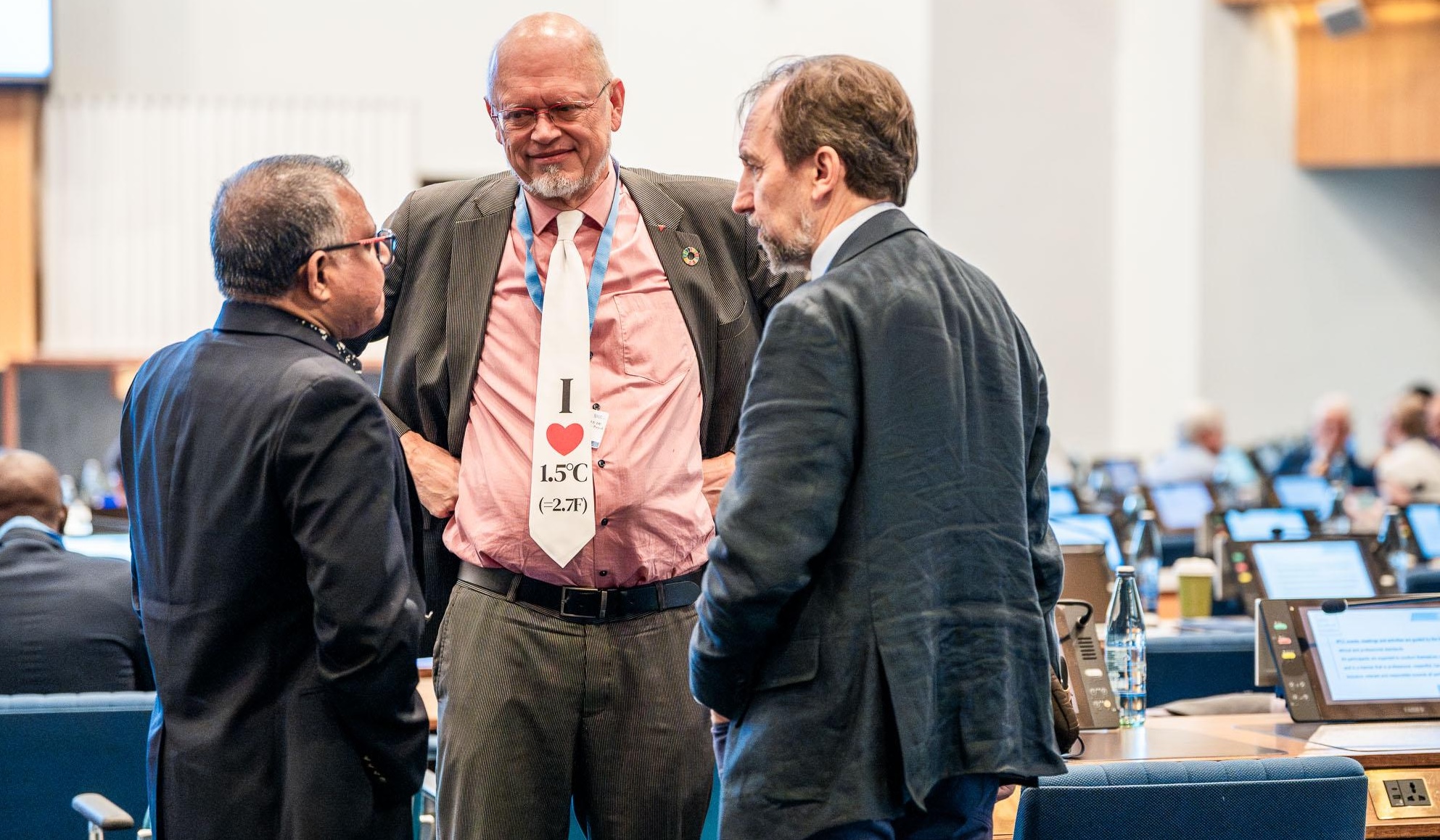
During the weekend, government officials and scientists alike expressed disappointment over the inability to reach a compromise before some delegates from developing countries and small island states had to leave the week-long meeting in Ethiopia to catch flights home.
The disagreement – which has persisted since early 2024 – turns on whether the three key parts of the AR7 assessment should all be published before the conclusion of the UN’s next Global Stocktake of global climate action, which is due to be completed in late 2028.
The IPCC issued a statement after the close of the session, saying that “key agenda items” – the timelines for the three AR7 reports, as well as the IPCC budget – remain open and under discussion. It said the IPCC’s plenary session and its deliberations on the pending agenda “will resume at the earliest opportunity”, giving no further details of when.
IPCC Chair Jim Skea told delegates in closing remarks that recent months had been some of the most turbulent for the climate science panel and that, if there were stronger words than “profound disappointment” he would use them, according to a summary published by the Earth Negotiators Bulletin (ENB). IPCC discussions happen behind closed doors.
IPCC scientists remained committed
In an open letter, issued on Monday, a group of nearly 120 scientists – from a total of 664 AR7 authors – said they “stand committed to continue working to deliver the AR7 reports in a manner that is rigorous, timely and inclusive, in line with our mandate to be policy-relevant”.
“An assessment that arrives after the decisions it is meant to inform cannot serve its purpose,” they emphasised. “The second Global Stocktake in 2028 is such a decision point, and the world should not have to face it without the IPCCʼs latest assessment.”
Europe, small islands and the least developed countries, plus many Latin American and developed nations, want the IPCC to meet this deadline, arguing that the findings from the UN climate science body are irreplaceable in the UN climate policy-making process.
However, around a dozen developing countries plus Russia have argued that the reports should come later in order to allow for greater research input from the Global South – something that, in their view, would make the findings fairer. They also claim that a shorter timeline would put excessive pressure on experts.
-
Who shapes climate science? The equity question facing the IPCC
Early completion of the next global climate science assessment reports risks excluding research from the Global South, which is key to ensuring the findings are fair -
Governments that support climate science must stand firm against naysayers
The IPCC is meeting to decide the timing of its next major report, as some countries try to delay it and weaken the case for faster emissions cuts


The most vocal of this group at last week’s meeting were India and Saudi Arabia, according to the ENB summary and a developed country diplomat. Critics see this push for a longer timeline as an excuse to deprive government decision-makers of the latest science and ease pressure on emerging economies to raise their ambition, particularly on cutting emissions.
Commenting on last week’s meeting, France’s ambassador for climate negotiations Benoît Faraco said a broad coalition of developed and developing countries from all five continents, “united in their support for science and the timeline proposed by scientists”, had withstood pressure “from a few countries” seeking to slow down the process of adopting the IPCC reports.
He added that France would not back down and would “continue to fight tirelessly for science, protect the integrity of information, and convince our partners that without the best available scientific data, we will be less effective in tackling climate change and protecting our populations”.
Inclusivity proposal stalled
In a bid to unlock a solution for the AR7 timeline, countries discussed ways to improve the inclusivity of the IPCC’s work. One option put on the table was for the IPCC to expand its funding for delegates from developing countries to attend some or all of its sessions from one to two participants, according to the ENB summary and a delegate speaking to Climate Home News.
That would increase the costs for the IPCC to complete AR7 by up to a quarter, according to an assessment shared by the secretariat. The panel’s budget is under severe strain and its officials have warned that, without additional voluntary contributions, it risks running out of money before it can deliver on this assessment cycle.
Climate Home News understands that some of the IPCC’s traditional donors – which mainly include European countries, Japan and Australia – indicated a willingness to support funding for an additional developing country participant. But without an agreement over the budget or the timeline for the reports, that option was ultimately not adopted.
‘Disappointed and worried’
The three reports are managed by working groups that collate and draw overall findings from the latest scientific studies and data on the physical effects of global warming around the world, how to adapt to it, and pathways for cutting planet-heating emissions in order to meet the temperature goals of the Paris Agreement.
Winston Chow, an urban climate professor at Singapore Management University who co-chairs Working Group II on adaptation, wrote in a LinkedIn post that he was “disappointed and worried” for the IPCC authors who have worked “extraordinarily hard” to assess the relevant climate science over the past two years.
He said he shared their concern that “the rigour, time and goodwill they’ve invested are now being put at risk by the Panel’s stalemate”.
As science comes under attack at UN talks, climate movement splits over how to respond
For Working Group II, a meeting for 250 experts writing that report is scheduled for January 2027, followed by the approval of a special report on cities and climate change in Singapore next March.
But because the IPCC’s budget has not been confirmed due to uncertainty about the AR7 schedule, travel support for those researchers is at risk, wrote Chow. “If they cannot participate, our assessments will lose vital expertise, perspectives and scientific breadth, and the collective effort of our authors will be undermined,” he warned.
Scientific work continues
Despite the political holdups, he – together with French climate scientist Robert Vautard, co-chair of Working Group 1 – agreed with IPCC head Skea who told the IPCC’s closing session on Friday: “The engine room of the IPCC is working, and it’s healthy.”
Vautard commented in a separate post on LinkedIn after it ended: “The boat is at full steam.” Working groups I and II are due to start revising the first drafts of their reports, while Working Group III on reducing emissions is finalising its first draft which will be out soon, he wrote.
“The most exciting two years of the cycle are ahead, for the authors. The momentum in the engine room is here and now. Trust the engine room!” he added.
The IPCC and some scientists report that progress has been made towards achieving an equitable balance of authors from the Global North and the Global South.
The group of researchers who signed the open letter on Monday noted that “inclusivity is at the heart of how we work”, with author teams bringing together experts from developed and developing countries with diverse backgrounds and at different stages of their careers.
Plea to overcome political differences
The signatories include several scientists from some of the countries opposed to the alignment of all IPCC reports with the Global Stocktake.
“We are committed to an assessment in which the knowledge, experience and priorities of every region are fully reflected, a commitment we share with the leadership of the IPCC.
Equity is built into how our assessment is being drafted,” they added.
They appealed to governments that make up the IPCC “to overcome their political differences and work together as we do as a global scientific community, so that we can deliver the IPCC reports the world needs to hear”.
In a statement published on Monday, IPCC chair Skea said reaching consensus on the schedule for the reports is “vital”. He added that the assessments provide authoritative scientific evidence to inform national climate policies, strengthen adaptation and resilience and support access to climate finance, as well as helping communicate the scale of the climate crisis and the urgency of efforts to tackle it.
The post IPCC scientists vow to press on with climate reports despite political deadlock appeared first on Climate Home News.
IPCC scientists vow to press on with climate reports despite political deadlock