

Welcome to Carbon Brief’s DeBriefed.
An essential guide to the week’s key developments relating to climate change.
This is an online version of Carbon Brief’s weekly DeBriefed email newsletter. Subscribe for free here.
This week
2023 ‘smashes’ records
RECORD-SHATTERING: 2023 “smashed” the record for the hottest year by a large margin, reported the Guardian. The newspaper said on Tuesday that, according to the EU’s Copernicus Climate Change Service, 2023 was 1.48C hotter than pre-industrial times. This is 0.17C higher than the last record set in 2016 – “marking a very large increase in climate terms”, according to the Guardian. And today the record was confirmed by the UN’s World Meteorological Organization, which has just published the findings of six leading climate datasets.
CHARTING CHANGE: In its coverage of the data, BBC News produced a number of charts and figures illustrating the path of global warming. Its analysis showed that almost every day since July has seen a new global air temperature high for the time of year. Meanwhile, the Independent published a feature examining whether 2024 could be even hotter than 2023.
STATE OF THE CLIMATE: Carbon Brief has just published the last of its quarterly state of the climate updates for 2023. It explains that 2023 was the warmest year “by a large margin”, at between 1.34C and 1.54C above pre-industrial levels across different datasets. Last year was also the warmest on record for ocean heat content, which increased notably between 2022 and 2023.
UK MP quits over fossil fuels
‘TRAGEDY’: The UK’s former energy minister Chris Skidmore quit as an MP in protest at the government’s plans to drill for more oil and gas in the North Sea, the Financial Times reported. In his resignation letter, Skidmore said it was “a tragedy that the UK has been allowed to lose its climate leadership” under prime minister Rishi Sunak, according to the newspaper.
BILL DELAYED: Skidmore quit over the government’s offshore petroleum licensing bill, which aims to “maximise” new oil and gas production, the FT said. The bill was due to be read in the House of Commons this week, but ended up being postponed, the Times reported. BBC News reported that Sir Alok Sharma, the Conservative MP and COP26 president, said he would vote against the bill, calling it “a total distraction” which reinforces the idea the UK is “not serious” about tackling climate change.
Renewables on the rise
RECORD RENEWABLES: A boom in Chinese solar power drove another record-breaking year of renewables growth in 2023, according to a new International Energy Agency (IEA) report covered by Carbon Brief. The world is now on track to build enough solar, wind and other renewables over the next five years to power the equivalent of the US and Canada combined, according to Carbon Brief’s analysis of the findings.
UK SOLAR: Along with the increase in global renewable capacity, there has been continued growth in low-carbon upgrades on UK homes, with solar and heat pumps driving record installations in 2023, according to separate Carbon Brief analysis.
Around the world
- US COAL DROP: US emissions fell by 1.9% in 2023, largely due to coal declining to its lowest level in 50 years, the New York Times reported. By contrast, US oil and gas production is set to hit a record in 2024 and 2025, said the Financial Times.
- ‘A LA CARTE’: Saudi Arabia’s energy minister has claimed that the headline COP28 agreement to transition away from fossil fuels is just one of several “choices” on an “a la carte menu”, reported Climate Home News.
- WAR EMISSIONS: Israel’s assault on Gaza since 7 October has produced more greenhouse gas emissions than 20 of the world’s most climate-vulnerable countries create in a year, according to new analysis covered by the Guardian.
- GERMANY PROTESTS: Farmers took to the streets of Berlin to protest against the German government’s decision to cut agricultural subsidies, Deutsche Welle reported.
- DEEP SEA MINING: Norway has become the first nation to approve commercial deep-sea mining, opening up a vast area of the Arctic to the extractive practice despite warnings from scientists, Mongabay reported.
- OFFSETS CONTROVERSY: The first-ever carbon-offset exchange under a new Paris Agreement mechanism, involving Switzerland buying credits for the rollout of electric buses in Thailand, is facing integrity questions, Climate Home News said.
40%
The proportion of North Sea oil and gas licences in UK waters owned by foreign companies and investors, according to EnergyMonitor.
Latest climate research
- A new research paper in Nature Climate Change presented a “conceptual framework” for considering the role of justice within climate research.
- The presence of urban green space is associated with “significantly lower rates of violent crime committed outside”, according to an International Journal of Biometeorology study conducted in Australia.
- A pair of studies in the Journal of Climate delved into an “exceptional heatwave” in east Antarctica in 2022, which brought “widespread 30-40C temperature anomalies across the ice sheet”.
(For more, see Carbon Brief’s in-depth daily summaries of the top climate news stories on Monday, Tuesday, Wednesday, Thursday and Friday.)
Captured

A record 42 editorials opposing action to tackle climate change were published by UK newspapers in 2023, according to new Carbon Brief analysis. Written almost exclusively by right-leaning papers, these editorials called for delays to UK bans on the sale of fossil fuel-powered cars and boilers, as well as for more oil-and-gas production in the North Sea, according to the findings. In response to such demands, prime minister Rishi Sunak performed a “U-turn” in September on some of his government’s major net-zero policies.
Spotlight
Investigating Antarctica’s colossal icebergs
This week, Carbon Brief speaks to Dr Oliver Marsh, a glaciologist who is principal investigator of a British Antarctic Survey (BAS) mission currently studying iceberg calving events at Antarctica’s Brunt ice shelf (pictured).

Carbon Brief: Can you please explain what fieldwork you are currently working on?
Dr Oliver Marsh: We are drilling ice cores to collect ice samples from the Brunt ice shelf. These will be brought back to Cambridge [where BAS is located] and University College London (UCL) in order to test their physical and chemical properties. We are also setting up seismic and GPS equipment to monitor fracture growth and strain rates on the ice shelf. We will then link the properties of the ice to the behaviour of the fractures.
CB: What do you hope to find out by conducting this fieldwork?
OM: We are interested in the mechanism and timing of crack growth leading to iceberg calving [where chunks of ice break off from the front of a glacier]. In particular, we want to understand how changes in ice properties change calving rates. The ice shelf we are working on has a well-documented history of crack growth, with two large calving events in the last three years, and the new information we gain from precise laboratory measurements will help us to understand how – and under what conditions – fractures occur in the lead-up to these calving events.
CB: What are the biggest hazards with conducting fieldwork on the Brunt ice shelf?
OM: The Brunt ice shelf is a good location to monitor fracture growth due to its dynamic behaviour. This means there are rifts and other cracks in the ice that can be hazardous for travel. These cracks are heavily monitored with a suite of geophysical instruments, including ground-penetrating radar, GPS and satellite data, and precautions are taken when moving around. Fieldwork in Antarctica also has significant hazards associated with the weather, for example, strong winds and wind chill.
CB: How is climate change affecting iceberg calving events in Antarctica?
OM: Calving occurs as a normal process of ice loss from the continent. But, as it occurs in discrete events and very infrequently for some ice shelves, it is difficult to determine whether rates are changing from a short satellite record. Other fracturing processes, such as hydrofracture and ice shelf collapse, are linked to both ocean and atmospheric warming, so it is possible that calving rates may increase in the future.
CB: What would be the implications of accelerated iceberg calving for the climate and ecosystems?
OM: Increased calving is likely to weaken ice shelves that fringe the continent and support the glaciers inland. This can help to speed up glacier flow and ice loss to the ocean, contributing to sea level rise. An increase in the volume of icebergs may also cause issues for ecosystems, particularly in areas where icebergs ground on the ocean floor, blocking foraging routes for penguins and seals, for instance.
Watch, read, listen
IDAI AFTERMATH: An audio documentary from the BBC World Service explored how communities in Beira, Mozambique are still reeling five years after Cyclone Idai.
PEOPLE FIRST: Context spoke to a range of experts about how the deal to transition away from fossil fuels agreed at COP28 can be achieved in a way that prioritises people’s needs.
INFLECTION POINTS: Robinson Meyer, founding editor of the climate publication Heatmap, appeared on the Chris Hayes Podcast to talk about rising fossil fuels and falling low-carbon technology prices.
Coming up
- 13 January: Taiwan presidential and parliamentary elections
- 15-19 January: World Economic Forum, Davos, Switzerland
- 16-19 January: 60th session of the Intergovernmental Panel on Climate Change, Istanbul, Turkey
- 17-18 January: G20 women’s sustainability working group meeting, Vila do Conde, Brazil
Pick of the jobs
- Global Forest Coalition, director | Salary: €32.50 per hour. Location: Remote
- The New York Times, Climate Forward editor | Salary: $170,000-180,000. Location: New York
- Department for Energy Security and Net Zero, deputy director, strategy development | Salary: £75,000. Location: Choice of various UK cities
DeBriefed is edited by Daisy Dunne. Please send any tips or feedback to debriefed@carbonbrief.org
The post DeBriefed 12 January: 2023 ‘smashes’ global heat record; UK MP quits over oil and gas; Studying Antarctica’s mammoth icebergs appeared first on Carbon Brief.

Drought and heatwaves occurring together – known as “compound” events – have “surged” across the world since the early 2000s, a new study shows.
Compound drought and heat events (CDHEs) can have devastating effects, creating the ideal conditions for intense wildfires, such as Australia’s “Black Summer” of 2019-20 where bushfires burned 24m hectares and killed 33 people.
The research, published in Science Advances, finds that the increase in CDHEs is predominantly being driven by events that start with a heatwave.
The global area affected by such “heatwave-led” compound events has more than doubled between 1980-2001 and 2002-23, the study says.
The rapid increase in these events over the last 23 years cannot be explained solely by global warming, the authors note.
Since the late 1990s, feedbacks between the land and the atmosphere have become stronger, making heatwaves more likely to trigger drought conditions, they explain.
One of the study authors tells Carbon Brief that societies must pay greater attention to compound events, which can “cause severe impacts on ecosystems, agriculture and society”.
Compound events
CDHEs are extreme weather events where drought and heatwave conditions occur simultaneously – or shortly after each other – in the same region.
These events are often triggered by large-scale weather patterns, such as “blocking” highs, which can produce “prolonged” hot and dry conditions, according to the study.
Prof Sang-Wook Yeh is one of the study authors and a professor at the Ewha Womans University in South Korea. He tells Carbon Brief:
“When heatwaves and droughts occur together, the two hazards reinforce each other through land-atmosphere interactions. This amplifies surface heating and soil moisture deficits, making compound events more intense and damaging than single hazards.”
CDHEs can begin with either a heatwave or a drought.
The sequence of these extremes is important, the study says, as they have different drivers and impacts.
For example, in a CDHE where the heatwave was the precursor, increased direct sunshine causes more moisture loss from soils and plants, leading to a drought.
Conversely, in an event where the drought was the precursor, the lack of soil moisture means that less of the sun’s energy goes into evaporation and more goes into warming the Earth’s surface. This produces favourable conditions for heatwaves.
The study shows that the majority of CDHEs globally start out as a drought.
In recent years, there has been increasing focus on these events due to the devastating impact they have on agriculture, ecosystems and public health.
In Russia in the summer of 2010, a compound drought-heatwave event – and the associated wildfires – caused the death of nearly 55,000 people, the study notes.

The record-breaking Pacific north-west “heat dome” in 2021 triggered extreme drought conditions that caused “significant declines” in wheat yields, as well as in barley, canola and fruit production in British Columbia and Alberta, Canada, says the study.
Increasing events
To assess how CDHEs are changing, the researchers use daily reanalysis data to identify droughts and heatwaves events. (Reanalysis data combines past observations with climate models to create a historical climate record.) Then, using an algorithm, they analyse how these events overlap in both time and space.
The study covers the period from 1980 to 2023 and the world’s land surface, excluding polar regions where CDHEs are rare.
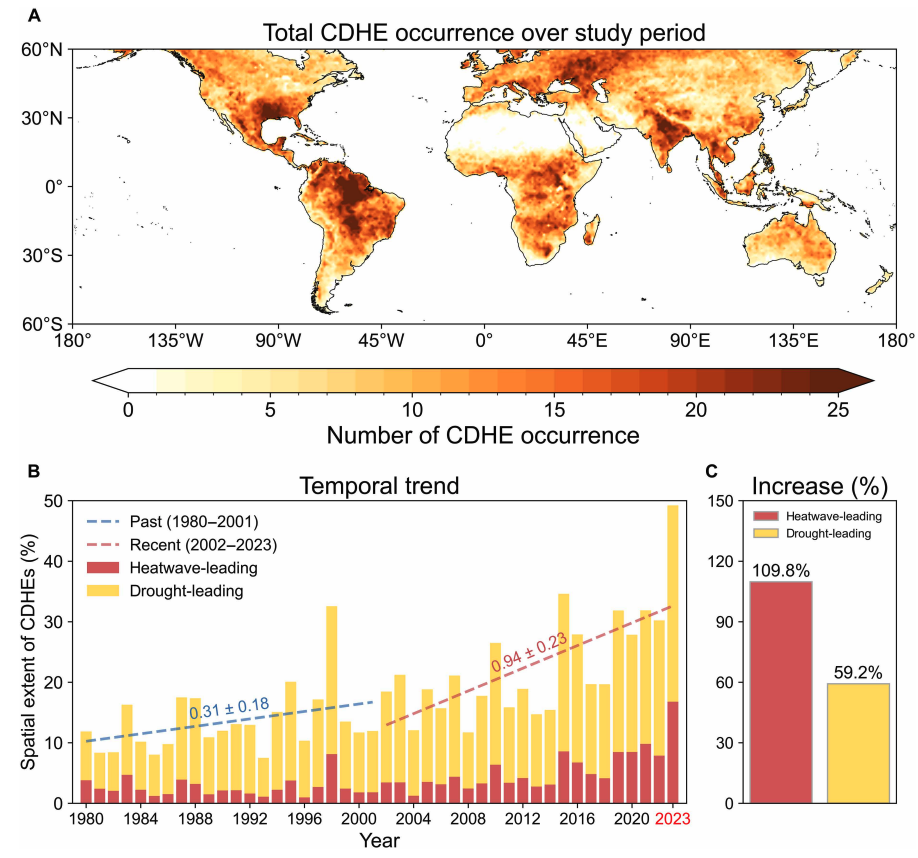
The research finds that the area of land affected by CDHEs has “increased substantially” since the early 2000s.
Heatwave-led events have been the main contributor to this increase, the study says, with their spatial extent rising 110% between 1980-2001 and 2002-23, compared to a 59% increase for drought-led events.
The map below shows the global distribution of CDHEs over 1980-2023. The charts show the percentage of the land surface affected by a heatwave-led CDHE (red) or a drought-led CDHE (yellow) in a given year (left) and relative increase in each CDHE type (right).
The study finds that CDHEs have occurred most frequently in northern South America, the southern US, eastern Europe, central Africa and south Asia.
Threshold passed
The authors explain that the increase in heatwave-led CDHEs is related to rising global temperatures, but that this does not tell the whole story.
In the earlier 22-year period of 1980-2001, the study finds that the spatial extent of heatwave-led CDHEs rises by 1.6% per 1C of global temperature rise. For the more-recent period of 2022-23, this increases “nearly eightfold” to 13.1%.
The change suggests that the rapid increase in the heatwave-led CDHEs occurred after the global average temperature “surpasse[d] a certain temperature threshold”, the paper says.
This threshold is an absolute global average temperature of 14.3C, the authors estimate (based on an 11-year average), which the world passed around the year 2000.
Investigating the recent surge in heatwave-leading CDHEs further, the researchers find a “regime shift” in land-atmosphere dynamics “toward a persistently intensified state after the late 1990s”.
In other words, the way that drier soils drive higher surface temperatures, and vice versa, is becoming stronger, resulting in more heatwave-led compound events.
Daily data
The research has some advantages over other previous studies, Yeh says. For instance, the new work uses daily estimations of CDHEs, compared to monthly data used in past research. This is “important for capturing the detailed occurrence” of these events, says Yeh.
He adds that another advantage of their study is that it distinguishes the sequence of droughts and heatwaves, which allows them to “better understand the differences” in the characteristics of CDHEs.
Dr Meryem Tanarhte is a climate scientist at the University Hassan II in Morocco, and Dr Ruth Cerezo Mota is a climatologist and a researcher at the National Autonomous University of Mexico. Both scientists, who were not involved in the study, agree that the daily estimations give a clearer picture of how CDHEs are changing.
Cerezo-Mota adds that another major contribution of the study is its global focus. She tells Carbon Brief that in some regions, such as Mexico and Africa, there is a lack of studies on CDHEs:
“Not because the events do not occur, but perhaps because [these regions] do not have all the data or the expertise to do so.”
However, she notes that the reanalysis data used by the study does have limitations with how it represents rainfall in some parts of the world.
Compound impacts
The study notes that if CDHEs continue to intensify – particularly events where heatwaves are the precursors – they could drive declining crop productivity, increased wildfire frequency and severe public health crises.
These impacts could be “much more rapid and severe as global warming continues”, Yeh tells Carbon Brief.
Tanarhte notes that these events can be forecasted up to 10 days ahead in many regions. Furthermore, she says, the strongest impacts can be prevented “through preparedness and adaptation”, including through “water management for agriculture, heatwave mitigation measures and wildfire mitigation”.
The study recommends reassessing current risk management strategies for these compound events. It also suggests incorporating the sequences of drought and heatwaves into compound event analysis frameworks “to enhance climate risk management”.
Cerezo-Mota says that it is clear that the world needs to be prepared for the increased occurrence of these events. She tells Carbon Brief:
“These [risk assessments and strategies] need to be carried out at the local level to understand the complexities of each region.”



The post Heatwaves driving recent ‘surge’ in compound drought and heat extremes appeared first on Carbon Brief.
Heatwaves driving recent ‘surge’ in compound drought and heat extremes
Greenhouse Gases
DeBriefed 6 March 2026: Iran energy crisis | China climate plan | Bristol’s ‘pioneering’ wind turbine
Welcome to Carbon Brief’s DeBriefed.
An essential guide to the week’s key developments relating to climate change.
This week
Energy crisis
ENERGY SPIKE: US-Israeli attacks on Iran and subsequent counterattacks across the Middle East have sent energy prices “soaring”, according to Reuters. The newswire reported that the region “accounts for just under a third of global oil production and almost a fifth of gas”. The Guardian noted that shipping traffic through the strait of Hormuz, which normally ferries 20% of the world’s oil, “all but ground to a halt”. The Financial Times reported that attacks by Iran on Middle East energy facilities – notably in Qatar – triggered the “biggest rise in gas prices since Russia’s full-scale invasion of Ukraine”.
‘RISK’ AND ‘BENEFITS’: Bloomberg reported on increases in diesel prices in Europe and the US, speculating that rising fuel costs could be “a risk for president Donald Trump”. US gas producers are “poised to benefit from the big disruption in global supply”, according to CNBC. Indian government sources told the Economic Times that Russia is prepared to “fulfil India’s energy demands”. China Daily quoted experts who said “China’s energy security remains fundamentally unshaken”, thanks to “emergency stockpiles and a wide array of import channels”.
‘ESSENTIAL’ RENEWABLES: Energy analysts said governments should cut their fossil-fuel reliance by investing in renewables, “rather than just seeking non-Gulf oil and gas suppliers”, reported Climate Home News. This message was echoed by UK business secretary Peter Kyle, who said “doubling down on renewables” was “essential” amid “regional instability”, according to the Daily Telegraph.
China’s climate plan
PEAK COAL?: China has set out its next “five-year plan” at the annual “two sessions” meeting of the National People’s Congress, including its climate strategy out to 2030, according to the Hong Kong-based South China Morning Post. The plan called for China to cut its carbon emissions per unit of gross domestic product (GDP) by 17% from 2026 to 2030, which “may allow for continued increase in emissions given the rate of GDP growth”, reported Reuters. The newswire added that the plan also had targets to reach peak coal in the next five years and replace 30m tonnes per year of coal with renewables.
ACTIVE YET PRUDENT: Bloomberg described the new plan as “cautious”, stating that it “frustrat[es] hopes for tighter policy that would drive the nation to peak carbon emissions well before president Xi Jinping’s 2030 deadline”. Carbon Brief has just published an in-depth analysis of the plan. China Daily reported that the strategy “highlights measures to promote the climate targets of peaking carbon dioxide emissions before 2030”, which China said it would work towards “actively yet prudently”.
Around the world
- EU RULES: The European Commission has proposed new “made in Europe” rules to support domestic low-carbon industries, “against fierce competition from China”, reported Agence France-Presse. Carbon Brief examined what it means for climate efforts.
- RECORD HEAT: The US National Oceanic and Atmospheric Administration has said there is a 50-60% chance that the El Niño weather pattern could return this year, amplifying the effect of global warming and potentially driving temperatures to “record highs”, according to Euronews.
- FLAGSHIP FUND: The African Development Bank’s “flagship clean energy fund” plans to more than double its financing to $2.5bn for African renewables over the next two years, reported the Associated Press.
- NO WITHDRAWAL: Vanuatu has defied US efforts to force the Pacific-island nation to drop a UN draft resolution calling on the world to implement a landmark International Court of Justice (ICJ) ruling on climate, according to the Guardian.
98
The number of nations that submitted their national reports on tackling nature loss to the UN on time – just half of the 196 countries that are part of the UN biodiversity treaty – according to analysis by Carbon Brief.
Latest climate research
- Sea levels are already “much higher than assumed” in most assessments of the threat posed by sea-level rise, due to “inadequate” modelling assumptions | Nature
- Accelerating human-caused global warming could see the Paris Agreement’s 1.5C limit crossed before 2