Connect with us

Published

on

Welcome to Carbon Brief’s DeBriefed.
An essential guide to the week’s key developments relating to climate change.

This week

Trump to overturn ‘endangerment finding’

EPA OVERTURNING: The Trump administration announced its plan to overturn the 2009 finding that has been the “central basis” for US action to regulate greenhouse gas emissions, the Associated Press reported. A new Environmental Protection Agency proposal would rescind the “endangerment finding”, which determined that carbon dioxide and other greenhouse gases endanger public health and welfare, according to the newswire. If the finding is repealed, it would “erase current limits” on greenhouse gas pollution from cars, factories and power plants, AP said.

‘MISLEADING’ REPORT: The proposal is supported by a new Department of Energy report that uses “misleading and inaccurate” statements to argue that climate science has “overstated” the risks of a warming planet, Politico reported. The report, which also argues that climate science is “underestimating” the societal benefits of burning fossil fuels, was written by five scientists who “are known” for “denying accepted climate science”, the outlet added.

‘WINDMILL DISGRACE’: Wind development on federal lands and waters may be halted by the Trump administration, Bloomberg reported. Interior secretary Doug Burgum ordered a comprehensive review of the agency’s approval process, it said. According to Renewable Energy News, the department said more than 3.5m acres offshore were designated as “wind energy areas” by the last administration and that “terminating” these areas is “safeguarding” local environments and economies from “unchecked development”. This followed from Trump’s recent comment that “windmills are a disgrace”, the publication added.

Floods and heatwaves

SEVERE FLOODING: Torrential rains triggered a devastating flood in northern Nigeria, leaving at least 23 people dead, Deutsche Welle reported. The flooding has displaced 5,560 people and left dozens injured, according to the National Emergency Management Agency. More than 200 people have been killed in floods in Nigeria since the start of the rainy season in May this year, according to DW. The outlet reported that scientists have said climate change is fuelling many of these extreme weather occurrences.

BEIJING RAINS: China faced “another deadly rainy season” after 60 people were killed following days of torrential rain in Northern Beijing, reported Reuters. The outlet said climate change has made extreme weather “more frequent and intense”. Elsewhere, floodwaters from the Indus and Chenab rivers have “inundated” more than a dozen villages across Pakistan’s Punjab province, said India’s Tribune.

RECORD TEMPERATURE: Japan recorded its hottest day on record as temperatures reached 41.2C in southwest Tokyo, Al Jazeera reported. There were 16 heat-related deaths and more than 10,800 people were hospitalised with heatstroke last week, the outlet said. Meanwhile, the Iraqi government issued an official holiday in seven of its provinces as temperatures topped 50C, said Gulf News.

‘MILLIONS’ INSIDE: Temperatures soaring in the US have led to “millions” of Americans being warned to stay inside as some areas reach 48.8C, noted Newsweek. Heat warnings and advisories have been issued by the National Weather Service, according to the outlet.

Around the world

  • ENERGY PLEDGE: The European Union has pledged to buy $750bn of energy from the US in exchange for a lower tariff rate under its trade deal with Trump. “Significant purchases” of US oil, liquified natural gas and nuclear fuel to replace Russian fossil fuels are included in the deal, CNBC reported. The Financial Times quoted energy experts saying the deal is a “pie in the sky” given that “US fossil fuel supplies [in 2024] to the bloc accounted for just $75bn”.
  • COP30 COSTS: The UN held an “urgent meeting” over “sky-high” accommodation costs ahead of the COP30 climate summit in Brazil, Reuters reported. Meanwhile, the last US climate negotiators have been fired by the Trump administration, leaving the nation with “no official presence” at the summit, said CNN.
  • ‘MELTING RAPIDLY’: Glaciers in Turkey’s southeast are melting rapidly due to rising global temperatures “amid human-caused climate change”, Al Jazeera reported.
  • ‘SEWAGE CRISIS’: The US and Mexico have signed a deal to end the Tijuana “sewage crisis”, committing to update outdated wastewater infrastructure to handle higher flows triggered by worse flooding, said Inside Climate News.
  • RENEWABLE ENERGY: Australia’s government has pledged to “substantially increase” its renewable energy underwriting scheme following concerns the nation will struggle to meet its 2030 power target, noted the Guardian. Meanwhile, New Zealand’s government has voted to resume gas and oil drilling despite an “outcry” from the opposition and environmental groups, reported the New Zealand Herald.
  • ‘UNHELPFUL TUSSEL’: UN climate chief Simon Stiell paid a visit to Australia and urged the nation and Turkey to resolve their “long-running tussle” over who will host the COP31 summit, calling the delay “unhelpful and unnecessary”, Reuters reported.

66.8 million

The hectares of intact tropical forest that overlaps with oil blocks in the Democratic Republic of Congo, according to Earth Insight.


Latest climate research

  • Climate change could make ‘droughts’ for wind power 15% longer | Carbon Brief
  • A study of urban construction workers in Taiwan found that heat stress imposes “substantial economic burden” and results in productivity losses in the range of 29-41% | Nature Cities
  • Drought will increasingly contribute to the collapse of many bird species that live in highly arid regions of the US | Biological Conservation

(For more, see Carbon Brief’s in-depth daily summaries of the top climate news stories on Monday, Tuesday, Wednesday, Thursday and Friday.)

Captured
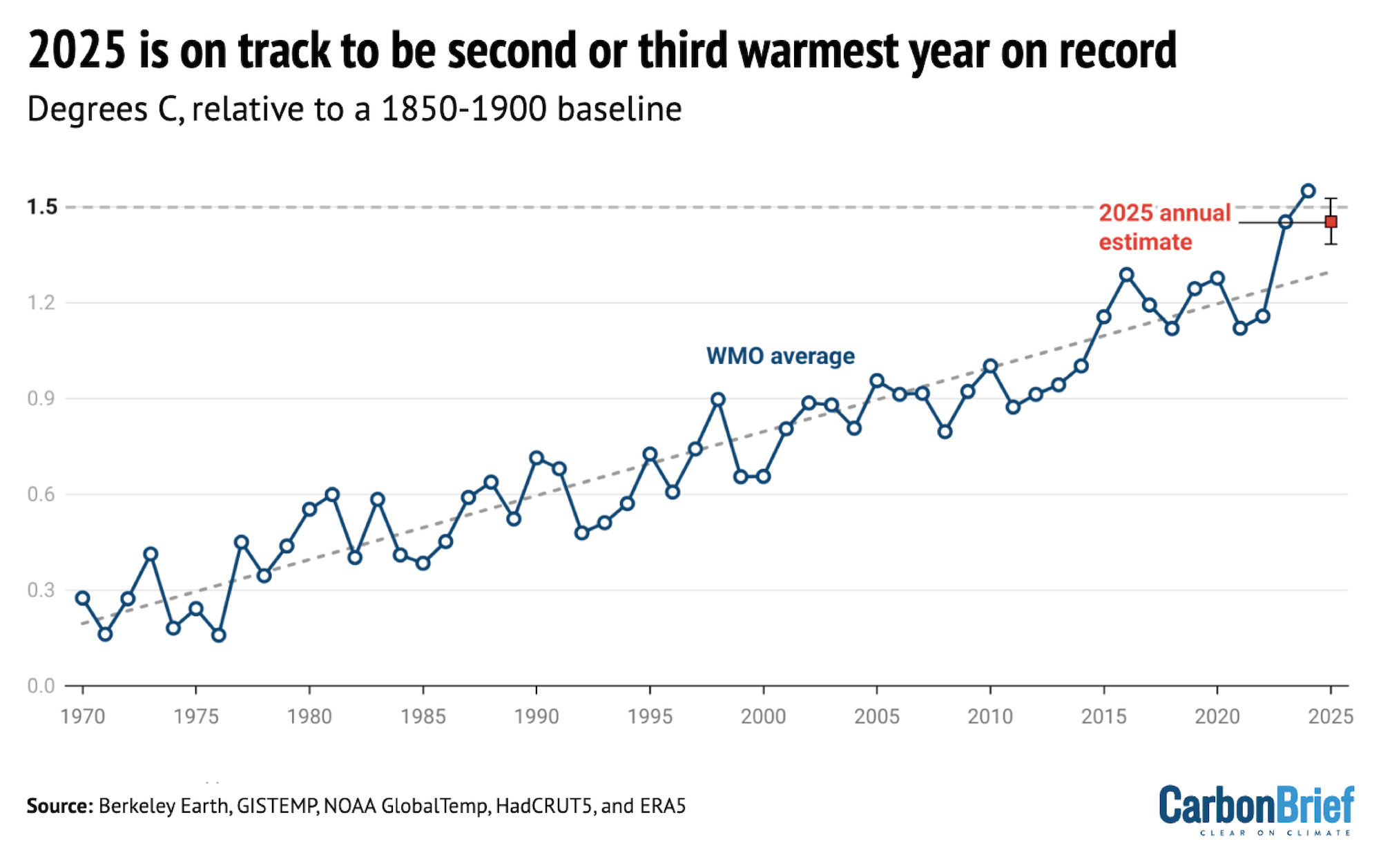
Line chart show that 2025 is on track to be second or third warmest year on record

New analysis by Carbon Brief this week revealed that 2025 is on track to be the second or third hottest year on record. The chart above draws on data from five different research groups that report global surface temperature records to illustrate how 2025 saw the second-hottest first half of the year on record.

Spotlight

‘Thirst’ exhibition maps the water crisis

This week, Carbon Brief visits a London exhibition exploring the world’s worsening water crisis.

Intricate ink drawings on cotton paper explore interconnected issues in Nepal.

Global warming has melted glaciers in the region, causing flooding and infectious diseases, displacing human and non-human life.

Yet, through his drawings, Nepalese artist Karan Shrestha has created a mosaic of the Himalayan region that shows water as a signifier of extreme weather and a life-giving source to be shared.

Shrestha’s installation calls into question “views on water as a resource for human gain” and, for artist M’hammed Kilito, oases offer an ecological defence against desertification. Credit: Svetlana Onye

His piece, “Water-giver, memory-keeper and the shifting forces”, is displayed at the Wellcome Collection for its “Thirst: In Search of Freshwater” exhibition.

Brought together by Wellcome curator and lecturer Janice Li, it features 125 objects that showcase the impact of climate change on water and its role in shaping health and ecosystems.

Li’s research into the etymology of “thirst” unravelled a global interpretation of water, reflecting the exhibition’s geographical breadth. She told Carbon Brief:

“Humans have faced really brutal and critical environmental crises and have, through a really deep innate knowledge of their own specific land, been able to devise monumental infrastructure to combat the crises they face.”

Just before Shrestha’s art in the exhibition are photographs taken by M’hammed Kilito.

In one picture, Kilito’s guide, Mustapha, looks into a dried-up well in a Moroccan oasis.

Climate change and human activities have resulted in the loss of two-thirds of oases in the country, according to information displayed at the exhibition.

Speaking about the photograph, Kilito told the Guardian that it looked like Mustapha was “praying for the return of something essential: water”.

Water adopts multiple faces in the exhibition: a vital yet scarce resource in certain pieces, a spiritual entity in others – and a destructive force.

Nothing makes the latter as clear as Deluge by photojournalist Gideon Mendel. Five screens display footage of the aftermath of severe floods around the world, captured by Mendel over 17 years.
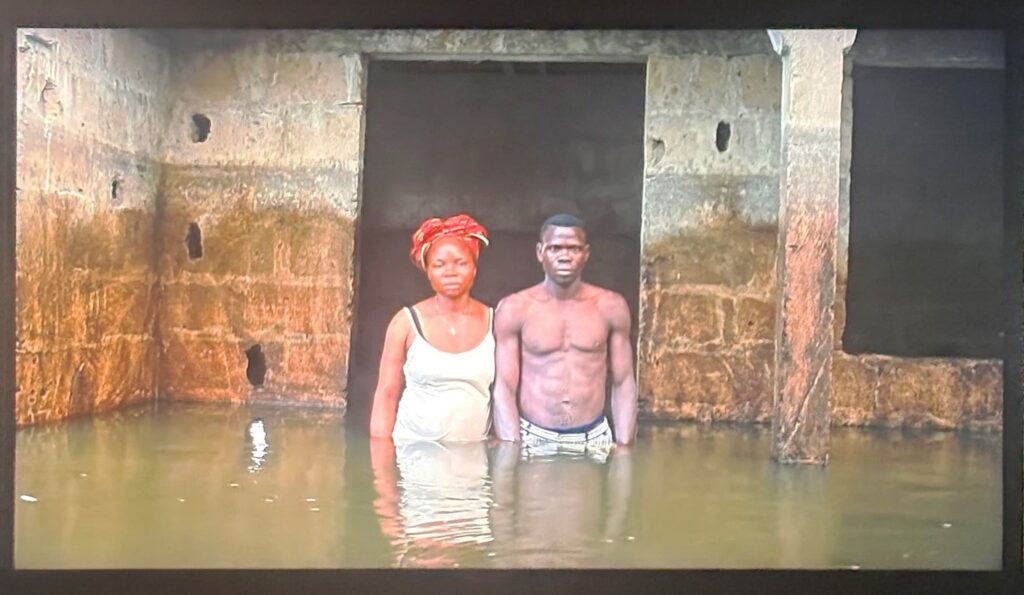
Mendel’s installation captures flood victims' “dignity and resilience” as they stand in the liquid landscape. Credit: Svetlana Onye
Mendel’s installation captures flood victims’ “dignity and resilience” as they stand in the liquid landscape. Credit: Svetlana Onye

Li told Carbon Brief:

“[Gideon] told me that, in the last two years, there’s always been a flood of that magnitude happening somewhere. He didn’t imagine that one day it would get to a point where he would have to choose which one to go to.”

Next to “Deluge” is a dome-like space where visitors can sit on bean bags and listen to glaciers melting in the Himalayas.

Though the exhibition confronts global water challenges, Li hopes it also reminds visitors of the resource’s beauty:

“Quite a few people told me they sit in the listening room for half an hour, really enjoying themselves and then guilt hits them because they’ve forgotten they’re listening to melting ice. But, this is the beauty of art, and a lot of beauty has come out of decay, destruction and deterioration because it also, sometimes, signals rebirth.”

Watch, read, listen

YAK HERDERS STRUGGLE: The Associated Press featured the stories of yak herders in India’s Himalayan mountains as climate change threatens their way of life.

PILOT ANXIETY: A Guardian documentary followed two airline pilots grappling with the climate impacts of their jobs.
‘IS DECARBONISATION DEAD?’: New York Times columnist Ezra Klein invited climate experts onto his podcast to discuss the future of renewable energy in the US.

Coming up

Pick of the jobs

DeBriefed is edited by Daisy Dunne. Please send any tips or feedback to debriefed@carbonbrief.org.

This is an online version of Carbon Brief’s weekly DeBriefed email newsletter. Subscribe for free here.


The post DeBriefed 1 August 2025: Trump targets ‘endangerment finding’; Floods and heatwaves; ‘Thirst’ exhibition appeared first on Carbon Brief.

DeBriefed 1 August 2025: Trump targets ‘endangerment finding’; Floods and heatwaves; ‘Thirst’ exhibition

Continue Reading

Greenhouse Gases

COP30: Carbon Brief’s second ‘ask us anything’ webinar

Published

on

As COP30 reaches its midway point in the Brazilian city of Belém, Carbon Brief has hosted its second “ask us anything” webinar to exclusively answer questions submitted by holders of the Insider Pass.

The webinar kicked off with an overview of where the negotiations are on Day 8, plus what it was like to be among the 70,000-strong “people’s march” on Saturday.

At present, there are 44 agreed texts at COP30, with many negotiating streams remaining highly contested, as shown by Carbon Brief’s live text tracker.

Topics discussed during the webinar included the potential of a “cover text” at COP30, plus updates on negotiations such as the global goal on adaptation and the just-transition work programme.

Journalists also answered questions on the potential for a “fossil-fuel phaseout roadmap”, the impact of finance – including the Baku to Belém roadmap, which was released the week before COP30 – and Article 6.

The webinar was moderated by Carbon Brief’s director and editor, Leo Hickman, and featured six of our journalists – half of them on the ground in Belém – covering all elements of the summit:

  • Dr Simon Evans – deputy editor and senior policy editor
  • Daisy Dunne – associate editor
  • Josh Gabbatiss – policy correspondent
  • Orla Dwyer – food, land and nature reporter
  • Aruna Chandrasekhar – land, food systems and nature journalist
  • Molly Lempriere – policy section editor

A recording of the webinar (below) is now available to watch on YouTube.

Watch Carbon Brief’s first COP30 “ask us anything” webinar here.

The post COP30: Carbon Brief’s second ‘ask us anything’ webinar appeared first on Carbon Brief.

COP30: Carbon Brief’s second ‘ask us anything’ webinar

Continue Reading

Greenhouse Gases

DeBriefed 14 November 2025: COP30 DeBriefed: Finance and 1.5C loom large at talks; China’s emissions dip; Negotiations explained

Published

on

Welcome to Carbon Brief’s DeBriefed.
An essential guide to the week’s key developments relating to climate change.

This week

Finance and 1.5C dominate talks

AGENDA ADOPTED: Negotiations at the COP30 UN climate talks began in the Brazilian city of Belém this week, attended in person by Carbon Brief’s Daisy Dunne, Josh Gabbatiss and Anika Patel. The Brazilian hosts scored an unexpected early win by dodging an “agenda fight” over proposals to add various contentious issues to the official docket. Despite the neat footwork, four issues kept off the agreed agenda – climate finance; emissions reporting; trade measures; ambition and 1.5C – still loom large, having merely been diverted into “presidency consultations”.

COP30 Insider Pass

A two-week, all-access package designed for those who need much more than headlines.

PRESIDENCY PROMISES: By Wednesday, the presidency was promising “good news” at a plenary later that day, which had been due to offer an update on progress with the four extra items. Instead, it ended abruptly, with COP30 president André Corrêa do Lago promising to say more at another plenary scheduled for tomorrow. It remains unclear how the presidency intends to deal with these thorny issues, leaving the COP rumour-mill in full swing.

MINISTERIAL MAGIC: Aside from the extra issues, the official agenda at COP30 already has more than 100 items to contend with, including how to track progress on adaptation and how to ensure a “just transition” as emissions-cutting measures are implemented. (You can follow them all via the Carbon Brief text tracker.) While draft texts have started to emerge, many items remain stalled, with persistent divisions along familiar lines (see below). Negotiators will be hoping that ministers arriving over the weekend are primed to unlock progress. Brazil has appointed pairs of these politicians to push for deals in key areas.

Around the world

  • Ethiopia has said it will host COP32 after beating out a bid from Nigeria, Reuters reported. Turkey and Australia are still in deadlock over who should host COP31, with a decision due by the end of these talks, BBC News reported. 
  • China will not contribute to Brazil’s Tropical Forest Forever Facility, Bloomberg reported, while Devex said two multilateral development banks are considering paying in. More than $5.5bn has been pledged so far, which BusinessGreen noted is “well short” of a $25bn target. The fund was labelled a “false solution” by some Indigenous and civil society groups.
  • After Brazilian president Luiz Inácio Lula da Silva called for a “roadmap” away from fossil fuels ahead of COP’s opening, rumours are swirling over how this might take shape. A new declaration spearheaded by Colombia and a roadmap with backing from a number of countries, including Denmark, the UK, France, Kenya and Germany, are being floated as possible options.
  • China is currently among the countries pushing for “provision of finance from rich countries and unilateral trade measures” to be included on the agenda, reported Climate Home News. Chinese delegation head Li Gao told Agence France-Presse it is “crucial” for developed countries to fulfil their $300bn commitment.
  • Dozens of Indigenous protesters forced their way into COP’s blue zone on Tuesday night, expressing anger at a lack of access to the negotiations, Reuters said. On Friday, a peaceful protest blocked the entrance to the blue zone, causing lengthy queues as delegates were forced to use a side door.

344%

The rise in the global use of solar from 2024 to 2035 under “stated policies”, according to Carbon Brief’s analysis of the latest World Energy Outlook from the International Energy Agency.


Latest climate research

  • The 2025 Global Carbon Budget, covered in detail by Carbon Brief, finds that CO2 emissions from fossil fuels and cement will rise 1.1% in 2025 | Earth System Science Data
  • In its November 2025 update, Climate Action Tracker says that its projections of global warming by 2100 have “barely moved” in four years | Climate Action Tracker
  • The AI server industry in the US is unlikely to meet its 2030 net-zero goals “without substantial reliance on highly uncertain” carbon offsets | Nature Sustainability

(For more, see Carbon Brief’s in-depth daily summaries of the top climate news stories on Monday, Tuesday, Wednesday, Thursday and Friday.)

Captured

China’s carbon dioxide emissions have “now been flat or falling for 18 months” since March 2024, analysis for Carbon Brief has found, due, in particular, to the transport, cement and steel sectors. The analysis has been covered widely in publications including China’s Global Times, the New York Times, Financial Times, Reuters, Bloomberg and on the frontpage of the Guardian.

Spotlight

What to expect from COP30 talks

This week, Carbon Brief’s expert team walk through what is happening with the biggest issues being negotiated at COP30.

‘Cover text’

Can you judge a COP by its cover text? At COP, the presidency has the option to pull together a new negotiated “cover text”​​, an overarching political overview of decisions agreed at the summit, along with other issues not on the agenda that it wants to draw attention to.

COP30 president André Corrêa do Lago might have dismissed a catch-all “cover decision” as a “last-minute solution” ahead of COP and dodged the question since, but other parties have been less shy in hinting that a cover text is, indeed, coming.

Cover decisions are often the product of fraught negotiations, high stakes, too little time and too many parties to accommodate.

This year, there is added pressure to address what is happening in the wider world outside the “negotiations” and to politically signal that the UN climate process is alive and making progress, despite the withdrawal of the US.

What elements could go into it? As a member of the “BASIC” group of nations comprising Brazil, South Africa, India and China, trade measures could find a place. But ideas pushed by Brazilian president Lula for new “roadmaps” away from fossil fuels and deforestation might find a place. Finance, however, could be much trickier to fit in.

Adaptation

One of the key expected outcomes of COP30 is agreement on a list of 100 indicators that can be used to measure progress under the “global goal on adaptation” (GGA). After two years of work by experts, negotiations got underway with a suggested list that had been whittled down from nearly 10,000 possible indicators.

Despite the focus on the GGA by the COP30 presidency and others, division has quickly emerged around the timeline for the adoption of the indicators. The African Group has notably requested a two-year work programme to further refine the list, while other parties are pushing for the indicators to be adopted in Belém as planned.

On Wednesday, an informal note was published that compiled elements for a draft decision. Significantly, for the first time under the GGA, this included a call for developed countries to “at least triple their collective provision” of adaptation finance by 2030, with a target to reach $120bn. This echoed a suggested target originally set out by the negotiating group of least developed countries (LDCs), supported by the African Group, Arab Group and the Association of Latin America and the Caribbean (AILAC) countries.

Just transition and mitigation work programmes

Over the past year, civil society groups have been calling for the establishment of a mechanism to enact the agreed UNFCCC principles of a “just transition”. This gained momentum on Wednesday within negotiations of the just transition work programme (JTWP), when the G77 and China called for the development of the “Belem Action Mechanism” (BAM).

Chile, the Alliance of Small Island States (AOSIS), India and other developing countries supported the mechanism. However, Norway, the UK, Australia and Japan pushed back. Other long-standing points of contention have also raised their heads, including around unilateral trade measures and references to fossil fuels and aligning to global temperature goals.

Within the mitigation work programme (MWP) talks, negotiators are looking to build on two dialogues held this year. The main themes at COP30 are the links between the MWP and the global stocktake (see below) and the future of the programme itself.

Old divisions have emerged in negotiations, focused predominantly on the mandate of the MWP and the potential development of a digital platform as part of its continuation.

UAE dialogue

The landmark outcome of the first “global stocktake”, agreed at COP28 in Dubai, called on all countries to contribute to a “transition away from fossil fuels”. It also mandated a “UAE dialogue” on “implementing the global stocktake outcomes”.

Two years later, countries remain deadlocked over what this dialogue should discuss. Many want it to cover all parts of the stocktake, including the energy transition, while others want an exclusive focus on climate finance. They also disagree on whether the dialogue should have substantive outcomes, including a formal process to keep discussing the issues raised.

Having failed to reach agreement at COP29 last year, the latest draft text shows parties are just as far apart in Belém, nearly halfway into the summit.

Finance

Climate finance for developing countries does not occupy a high-profile position in the formal COP30 negotiations. Yet, as demonstrated by its role in adaptation talks and the agenda dispute, finance still has the potential to derail proceedings.

Ahead of the conference, the COP30 and COP29 presidencies released their “Baku to Belém roadmap”, exploring how finance could be ramped up to $1.3tn by 2035.

An influential group of experts also released new analysis showing a “feasible path” to this goal, leaning on private finance. They said this work would provide a “valuable signal” to those in the finance sector.

However, with no position in the Belém negotiations, it was unclear how – or whether – the roadmap would be taken forward by governments beyond COP30.

Instead, finance negotiators have been occupied with technical matters, but these still show signs of division. For example, some developing-party groups have pushed back against an EU priority goal to extend a “dialogue” about “making finance flows consistent” with climate objectives.

Watch, read, listen

UNDER THREAT: The Bureau of Investigative Journalism told the story of Kim Rebholz – an environmentalist who was threatened for his work curbing illegal logging in Democratic Republic of Congo’s mangrove parks.

SPOTLIGHT ON STARMER: YouTuber Simon Clark has published a video of himself interviewing prime minister Keir Starmer about the UK’s actions on climate and nature, at COP30 and domestically.
INSIDE COP:Outrage and Optimism is running a “special edition” podcast series in partnership with the COP30 presidency, bringing “exclusive, behind-the-scenes access” to the conference.

Coming up

  • 14-21 November: UN Climate Change conference (COP30) heads into its crucial second week in Belém
  • 15 November: Informal stocktaking plenary of COP30 talks by the Brazilian presidency
  • 17 November: Launch of the Global Methane Status Report

Pick of the jobs

DeBriefed is edited by Daisy Dunne. Please send any tips or feedback to debriefed@carbonbrief.org.

This is an online version of Carbon Brief’s weekly DeBriefed email newsletter. Subscribe for free here.

The post DeBriefed 14 November 2025: COP30 DeBriefed: Finance and 1.5C loom large at talks; China’s emissions dip; Negotiations explained appeared first on Carbon Brief.

DeBriefed 14 November 2025: COP30 DeBriefed: Finance and 1.5C loom large at talks; China’s emissions dip; Negotiations explained

Continue Reading

Greenhouse Gases

Analysis: Seven charts showing how the $100bn climate-finance goal was met

Published

on

Developed countries have poured billions of dollars into railways across Asia, solar projects in Africa and thousands of other climate-related initiatives overseas, according to a joint investigation by Carbon Brief and the Guardian.

A group of nations, including much of Europe, the US and Japan, is obliged under the Paris Agreement to provide international “climate finance” to developing countries.

This financial support can come in forms such as grants and loans from various sources, including aid budgets, multilateral development banks (MDBs) and private investments.

The flagship climate-finance target for more than a decade was to hit “$100bn a year” by 2020, which developed countries met – albeit two years late – in 2022.

Carbon Brief and the Guardian have analysed data across more than 20,000 global climate projects funded using public money from developed nations, including official 2021 and 2022 figures, which have only just been published.

The data provides a detailed insight into how the $100bn goal was reached, including funding for everything from sustainable farming in Niger to electricity projects in the United Arab Emirates (UAE).

With developed countries now pledging to ramp up climate finance further, the analysis also shows how donors often rely on loans and private finance to meet their obligations.

COP30 Insider Pass

A two-week, all-access package designed for those who need much more than headlines.

The $100bn target was reached in 2022, boosted by private finance and the US

A small handful of countries have consistently been the top climate-finance donors. This remained the case in 2021 and 2022, with just four countries – Japan, Germany, France and the US – responsible for half of all climate finance, the analysis shows.

Not only was 2022 the first year in which the $100bn goal was achieved, it also saw the largest ever single-year increase in climate finance – a rise of $26.3bn, or 29%, according to the Organisation for Economic Cooperation and Development (OECD).

(It is worth noting that while OECD figures are often referenced as the most “official” climate-finance totals, they are contested.)

Half of this increase came from a $12.6bn rise in support from MDBs – financial institutions that are owned and funded by member states. The rest can be attributed to two main factors.

First, while several donors ramped up spending, the US drove by far the biggest increase in “bilateral” finance, provided directly by the country itself.

After years of stalling during the first Donald Trump presidency, when Joe Biden took office in 2021, the nation’s bilateral climate aid more than tripled between that year and the next.

Meanwhile, after years of “stagnating” at around $15bn, the amount of private investments “mobilised” in developing countries by developed-country spending surged to around $22bn in 2022, according to OECD estimates.

As the chart below shows, the combination of increased US contributions and higher private investments pushed climate finance up by nearly $14bn in 2022, helping it to reach $115.9bn in total.

Annual climate finance provided and mobilised by developed countries.
Annual climate finance provided and mobilised by developed countries. Country shares include bilateral finance and multilateral finance shares from MDBs or funds that can be attributed to individual countries. “Export credits and other” includes “other” multilateral climate finance that could not be assigned to developed countries. Source: Analysis of BTRs and OECD data by Carbon Brief and the Guardian, OECD data for private finance, export credits and other finance.

Both of these trends are still pertinent in 2025, following a new pledge made at COP29 by developed countries to ramp up climate finance to “at least” $300bn a year by 2035.

After years of increasing rapidly under Biden, US bilateral climate finance for developing countries has been effectively eliminated during Trump’s second presidential term. Other major donors, including Germany, France and the UK, have also cut their aid budgets.

This means there will be more pressure on other sources of climate finance in the coming years. In particular, developed countries hope that private finance can help to raise finance into the trillions of dollars required to achieve developing countries’ climate goals.

Back to top

Some higher-income countries – including China and the UAE – were major recipients

The greatest beneficiaries of international climate finance tend to be large, middle-income countries, such as Egypt, the Philippines and Brazil, according to the analysis.

(The World Bank classifies countries as being low-, lower-middle, upper-middle or high-income, according to their gross national income per person.)

Lower-middle income India received $14.1bn in 2021 and 2022 – nearly all as loans – making it by far the largest recipient, as the chart below shows.

Most of India’s top projects were metro and rail lines in cities, such as Delhi and Mumbai, which accounted for 46% of its total climate finance in those years, Carbon Brief analysis shows. (See: A tenth of all direct climate finance went to Japan-backed rail projects.)

The top 15 recipients of climate finance in 2021 and 2022, via bilateral and multilateral channels.
The top 15 recipients of climate finance in 2021 and 2022, via bilateral and multilateral channels. This ranking does not include funding for projects that targeted multiple countries, which could not be disaggregated. Source: Carbon Brief and Guardian analysis.

As the world’s second-largest economy and a major funder of energy projects overseas, China – classified as upper-middle income by the World Bank – has faced mounting pressure to start officially providing climate finance. At the same time, the nation received more than $3bn of climate finance over this period, as it is still classed as a developing country under the UN climate system.

High-income Gulf petrostates are also among the countries receiving funds. For example, the UAE received Japanese finance of $1.3bn for an electricity transmission project and a waste-to-energy project.

To some extent, such large shares simply reflect the size of many middle-income countries. India received 9% of all bilateral and multilateral climate finance, but it is home to 18% of the global population.

The focus on these nations also reflects the kind of big-budget infrastructure that is being funded.

“Middle-income economies tend to have the financial and institutional capacity to design, appraise and deliver large-scale projects,” Sarah Colenbrander, climate programme director at global affairs thinktank ODI, tells Carbon Brief.

Donors might focus on relatively higher-income or powerful nations out of self-interest, for example, to align with geopolitical, trade or commercial interests. But, as Colenbrander tells Carbon Brief, there are also plenty of “high-minded” reasons to do so, not least the opportunity to help curb their relatively high emissions.

Back to top

A tenth of all direct climate finance went to Japan-backed rail projects

Japan is the largest climate-finance donor, accounting for a fifth of all bilateral and multilateral finance in 2021 and 2022, the analysis shows.

Of the 20 largest bilateral projects, 13 were Japanese. These include $7.6bn of loans for eight rail and metro systems in major cities across India, Bangladesh and the Philippines.

In fact, Japan’s funding for rail projects was so substantial that it made up 11% of all bilateral finance. This amounts to 4% of climate finance from all sources.

Bilateral finance provided by Japan for metro and rail projects, compared to total bilateral finance in 2021 and 2022.
Bilateral finance provided by Japan for metro and rail projects, compared to total bilateral finance in 2021 and 2022. Source: Carbon Brief and Guardian analysis.

While these rail projects are likely to provide benefits to developing countries, they also highlight some of the issues identified by aid experts with Japan’s climate-finance practices.

As was the case for more than 80% of Japan’s climate finance, all of these projects were funded with loans, which must be paid back. Nearly a fifth of Japan’s total loans were described as “non-concessional”, meaning they were offered on terms equivalent to those offered on the open market, rather than at more favourable rates.

Many Japan-backed projects also stipulate that Japanese companies and workers must be hired to work on them, reflecting the government’s policies to “proactively support” and “facilitate” the overseas expansion of Japanese business using aid.

Documents show that rail projects in India and the Philippines were granted on this basis.

This practice can be beneficial, especially in sectors such as rail infrastructure, where Japanese companies have considerable expertise. Yet, analysts have questioned Japan’s approach, which they argue can disproportionately benefit the donor itself.

“Counting these loans as climate finance presents a moral hazard…And such loans tied to Japanese businesses make it worse,” Yuri Onodera, a climate specialist at Friends of the Earth Japan, tells Carbon Brief.

Back to top

There was funding for more than 500 clean-power projects in African countries

Around 730 million people still lack access to electricity, with roughly 80% of those people living in sub-Saharan Africa.

As part of their climate-finance pledges, donor countries often support renewable projects, transmission lines and other initiatives that can provide clean power to those in need.

Carbon Brief and the Guardian have identified funding for more than 500 clean-power and transmission projects in African countries that lack universal electricity access. In total, these funds amounted to $7.6bn over the two years 2021-22.

Among them was support for Chad’s first-ever solar project, a new hydropower plant in Mozambique and the expansion of electricity grids in Nigeria.

The distribution of funds across the continent – excluding multi-country programmes – can be seen in the map below.

Climate finance for clean-power projects, 2021 and 2022, in African nations that have less than 100% electricity access, according to World Bank figures.
Climate finance for clean-power projects, 2021 and 2022, in African nations that have less than 100% electricity access, according to World Bank figures. Source: Carbon Brief and Guardian analysis.

A lack of clear rules about what can be classified as “climate finance” in the UN climate process means donors sometimes include support for fossil fuels – particularly gas power – in their totals.

For example, Japan counted an $18m loan to a Japanese liquified natural gas (LNG) company in Senegal and roughly $1m for gas projects in Tanzania.

However, such funding accounted for a tiny fraction of sub-Saharan Africa’s climate finance overall, amounting to less than 1% of all power-sector funding across the region, based on the projects identified in this analysis.

Back to top

Some ‘least developed’ countries relied heavily on loans

One of the most persistent criticisms levelled at climate finance by developing-country governments and civil society groups is that so much of it is provided in the form of loans.

While loans are commonly used to fund major projects, they are sometimes offered on unfavourable terms and add to the burden of countries that are already struggling with debt.

The International Institute for Environment and Development (IIED) has shown that the 44 “least developed countries” (LDCs) spend twice as much servicing debts as they receive in climate finance.

Developed nations pledged $33.4bn in 2021 and 2022 to the 44 LDCs to help them finance climate projects. In total, $17.2bn – more than half of the funding – was provided as loans, primarily from Japan, France and development banks.

The chart below shows how, for a number of LDCs, loans continue to be the main way in which they receive international climate funds.

For example, Angola received $216.7m in loans from France – primarily to support its water infrastructure – and $571.6m in loans from various multilateral institutions, together amounting to nearly all the nation’s climate finance over this period.

Share of 2021 and 2022 climate finance provided as loans and grants, in the LDCs most heavily-reliant on loans.
Share of 2021 and 2022 climate finance provided as loans and grants, in the LDCs most heavily-reliant on loans. Source: Carbon Brief and Guardian analysis.

Oxfam, which describes developed countries as “unjustly indebting poor countries” via loans, estimates that the “true value” of climate finance in 2022 was $28-35bn, roughly a quarter of the OECD’s estimate. This is largely due to Oxfam discounting much of the value of loans.

However, Jan Kowalzig, a senior policy adviser at Oxfam Germany, tells Carbon Brief that, “generally, LDCs receive loans at better conditions” than they would have been able to secure on the open market, sometimes referred to as “concessional” loans.

Back to top

US shares in development banks significantly raised its total contribution

The US has been one of the world’s top climate-finance providers, accounting for around 15% of all bilateral and multilateral contributions in 2021 and 2022.

Despite this, US contributions have consistently been viewed as relatively low when considering the nation’s wealth and historical role in driving climate change.

Moreover, much of the climate finance that can be attributed to the US comes from its MDB shareholdings, rather than direct contributions from its aid budget.

These banks are owned by member countries and the US is a dominant shareholder in many of them.

The analysis reveals that around three-quarters of US climate finance provided in 2021-22 came via multilateral sources, particularly the World Bank. (For information on how this analysis attributes multilateral funding to donors, see Methodology.)

Among other major donors – specifically Japan, France and Germany – only a third of their finance was channelled through multilateral institutions. As the chart below shows, multilateral contributions lifted the US from being the fifth-largest donor to the third-largest.

Climate finance provided through bilateral and multilateral channels by the top climate finance donors in 2021 and 2022.
Climate finance provided through bilateral and multilateral channels by the top climate finance donors in 2021 and 2022. Source: Carbon Brief and Guardian analysis.

While the Trump administration has cut virtually all overseas climate funding and broadly rejected multilateral institutions, the US has not yet abandoned its influential stake in MDBs.

Prior to COP29 in 2024, only MDB funds that could be attributed to developed country inputs were counted towards the $100bn goal, as part of those nations’ Paris Agreement duties.

However, countries have now agreed that “all climate-related outflows” from MDBs – no matter which donor country they are attributed to – will count towards the new $300bn goal.

This means that, as long as MDBs continue extensively funding climate projects, there will still be a large slice of climate finance that can be attributed to the US, even as it exits the Paris Agreement.

Back to top

Adaptation finance still lags, but climate-vulnerable countries received more

Under the Paris Agreement, developed countries committed to achieving “a balance between adaptation and mitigation” in their climate finance.

The idea is that, while it is important to focus on mitigation – or cutting emissions – by supporting projects such as clean energy, there is also a need to help developing countries prepare for the threat of climate change.

Generally, adaptation projects are less likely to provide a return on investment and are, therefore, more reliant on grant-based finance.

In practice, a “balance” between adaptation and mitigation has never been reached. Over the period of this analysis, 58% of climate finance was for mitigation, 33% was for adaptation and the remainder was for projects that contributed to both goals.

This reflects a preference for mitigation-based financing via loans among some major donors, particularly Japan and France. Both countries provided just a third of their finance for adaptation projects in 2021 and 2022.

However, among some of the most climate-vulnerable countries – including land-locked parts of Africa and small islands – most funding was for adaptation, as the chart below shows.

Share of 2021 and 2022 climate finance provided for adaptation and mitigation in the 15 most climate-vulnerable nations, based on the ND-GAIN index.
Share of 2021 and 2022 climate finance provided for adaptation and mitigation in the 15 most climate-vulnerable nations, based on the ND-GAIN index. The countries are listed according to the share of adaptation in their climate-finance total. This excludes “cross-cutting” finance that targets both objectives. Source: Carbon Brief and Guardian analysis.

Among the projects receiving climate-adaptation funds were those supporting sustainable agriculture in Niger, improving disaster resilience in Micronesia and helping those in Somalia who have been internally displaced by “climate change and food crises”.

Back to top

Methodology

The joint Guardian and Carbon Brief analysis of climate finance includes the bilateral and multilateral public finance that developed countries pledged for climate projects in developing countries. It covers the years 2021 and 2022.

(These “developed” countries are the 23 “Annex II” nations, plus the EU, that are obliged to provide climate finance under the Paris Agreement.)

The analysis excludes other types of funding that contribute to the $100bn climate-finance target for climate projects, such as export credits and private finance “mobilised” by public investments. Where these have been referenced, the figures are OECD estimates. They are excluded from the analysis because export credits are a small fraction of the total, while private finance mobilised cannot be attributed to specific donor countries.

Data for bilateral funding comes from the biennial transparency reports (BTRs) each country submits to the UNFCCC. The lag in official reporting means the most recent figures – published around the end of 2024 and start of 2025 – only go up to 2022.

Many of the bilateral projects recorded by countries do not specify single recipients, but instead mention several countries. These projects have not been included when calculating the amount of finance individual developing countries received, but they are included in the total figures.

The multilateral funding, including projects funded by MDBs and multilateral climate funds, comes from the OECD. Many countries – including developing countries – pay into these institutions, which then use their money to fund climate projects and, in the case of MDBs, raise additional finance from capital markets.

This analysis calculated the shares of the “outflows” from multilateral institutions that can be attributed to developed countries. It adapts the approach used by the OECD to calculate these attributable shares for developed countries as a whole group.

As the OECD does not publish individual donor country shares that make up the total developed-country contribution, this analysis calculated each country’s attributable shares based on shareholdings in MDBs and cumulative contributions to multilateral funds. This was based on a methodology used by analysts at the World Resources Institute and ODI. There were some multilateral funds that could not be assigned using this methodology, which are therefore not captured in each country’s multilateral contribution.

Back to top

The post Analysis: Seven charts showing how the $100bn climate-finance goal was met appeared first on Carbon Brief.

Analysis: Seven charts showing how the $100bn climate-finance goal was met

Continue Reading

Trending

Copyright © 2022 BreakingClimateChange.com