

The recent rains that washed through West Africa didn’t fall just on one country. They caused severe flooding and fatalities across Nigeria, Cameroon, Chad, Mali and Niger.
The drought that came before this latest disaster didn’t single out one place either. Farmers across the region were faced with destitution from crop losses.
Extreme weather fuelled by climate change does not respect national borders or geographical boundaries. This simple fact has multiple knock-on effects and dictates how we should respond to such crises – including through international coordination.
In September, Nigeria’s Alau Dam collapsed as a result of floods in the country’s northeastern region, killing up to 1,000 people and displacing a million. The rupture of the dam was mainly due to poor maintenance over the years – and a government failure to heed warnings of danger.
A week later, across the border in Cameroon, the government there decided to release water from the Lagdo dam, after the same bout of heavy rainfall had increased levels. This put added pressure on 11 states downstream in the part of Nigeria that was already scrambling to deal with the crisis – although the water releases were regulated, and alerts were issued.
Nepal says China withholds “essential” info on bursting Himalayan glacial lakes
South Asia is also grappling with cross-border river-related threats. Izabella Koziell, deputy director general of ICIMOD, a Nepal-based research centre working to protect the Hindu Kush Himalaya, said the mountain region is “falling under increasing risk from the triple planetary crisis of climate change, biodiversity loss and air pollution”.
“Each of these risks are mobile and not limited by national borders,” she said. The region extends over 3,500 kilometres from Afghanistan to Myanmar, making cooperation between countries essential, she added. “Over two billion people living within the mountains and downstream will be affected by changes that happen here.”
Shared prosperity
Climate change is fuelling new and complex risks that require countries – and the international community – to look beyond their own borders and siloes. But that is not how governments and their partners have typically responded to the threats.
“Adaptation is still very much seen as a local to national issue. Thinking more broadly and working regionally is challenging. We saw this with the COVID-19 pandemic – just how difficult it was to get coordinated regional and global responses on something which affected everyone,” said Sarah Opitz-Stapleton, a senior research fellow at ODI Global, a London-based think-tank.
Opitz-Stapleton has been working with a research programme called “Supporting Pastoralism and Agriculture in Recurrent and Protracted Crises” (SPARC) to help policymakers better understand and manage transboundary climate risks, including in Africa.
She told Climate Home: “Countries tend to think first about their own sovereignty and protecting their own populations. This is understandable – but when we are facing challenges like this, everyone going in on their own is insufficient.”
Food and finance
People’s livelihoods and future prosperity are dependent on a globalised economy and shared resources, with flows of trade and finance binding countries together across continents. And it is becoming increasingly how clear how climate change – which affects the whole planet – can hijack development efforts in an interconnected world.
A simple example of this is food. In Senegal, changing dietary habits have led to a sudden surge in imports of rice from Southeast Asia. This now makes Senegal’s food security dependent on countries far away that are facing their own severe climate risks – because how they adapt to those risks will influence rice supplies to West Africa.
In 2022, India temporarily banned wheat exports after a severe heatwave jeopardised its own domestic supplies. The move led to a sudden jump in the price of this crucial commodity, impacting countries in Africa, such as Kenya, which rely on imports.
Transboundary climate risks come in many guises – from shared ecosystems to migration patterns, infectious diseases and ocean resources.
Finance is one example where the risks and impacts can be indirect and not always immediately clear. Financial firms are often greatly exposed to climate-related risks through investments in sectors from energy to mining.
When a gold mine is hit by drought or flooding, for example, this can lead to plant shutdowns, lower production and a higher probability of debt default.
Money is as transboundary as the climate. Banks that fail to carry out climate risk assessments across whole supply chains could be creating the conditions for stranded assets in the future.
Adaptation winners and losers
By focusing solely on how to adapt to issues within borders the problem is pushed into someone else’s backyard – the adaptation equivalent of whack-a-mole.
“The problem is the way we crafted the policy,” said George Wamukoya, team lead at AGNES, a non-profit which advises African governments on climate issues.
“We focused on ‘national’ adaptation plans and commitments which leads people to think inward. There is competition among neighbouring countries who don’t want to share resources or investment. This is despite the need for regional and global support to achieve these plans. We need to be alive to these facts,” he added.
Examples abound of so-called “maladaptation”. This can occur when a country seeks to control coastal erosion and flooding by building protective infrastructure but ends up pushing the problem to shorelines further away where the impacts might be worse. Or switching to climate-resilient crops can reduce harvests – and increase prices – for more mainstream varieties.
Global adaptation goal
On the other hand, done right, adaptation can lead to shared resilience between neighbours and strengthen global supply chains. Instead of redistributing the risk, the idea is to confront it with collaboration.
As the world kicks off two weeks of climate negotiations in Baku next week, campaigners are hoping that transboundary risks are higher on the agenda.
Last year’s UN climate summit, COP28, made only two references to transboundary issues in its final decision text. New work on adaptation did come out of the Dubai talks, including a programme to develop indicators to measure progress on targets under the Global Goal on Adaptation.
So far, the two-year initiative – called the UAE-Belem work programme – has led to over 5,000 indicators being submitted for consideration. Yet only 22 of these are related to transboundary climate risks.
This speaks to a lack of awareness among states of the shared risks they face and the dangers of ignoring them. Both Kenya and Ethiopia – which share a border that is porous especially for pastoralist communities – failed to mention cross-border risks in their national adaptation plans (NAPs) submitted to the UN.
Ensuring that transboundary risks are included in the UAE-Belem work programme is seen as crucial, as its results will dictate how adaptation policy and finance are set in the future. “If we don’t have these indicators, then it becomes very hard to track these particular risks,” said Wamukoya.
COP29 and beyond
Experts agree that national and local governments need to do a better job of assessing cross-border risks and working with their neighbours to understand how to collectively address them. To date, they feel that not enough work has been done to research transboundary risks and work out strategies for tackling them.
“We need to demystify the issue for countries and convince them that, when you include transboundary issues, this will not limit access to resources. We also need to show how and where these risks are occurring within the five subregions of Africa, because some places will be more exposed than others,” adds Wamukoya.
COP29 offers a unique forum to address transboundary risks that are global in nature – and this perspective also needs to be applied to finance for adaptation projects, where multiple countries are involved, Wamukoya said. COP29 is tasked with agreeing a new global goal for climate finance, he noted.
Rich nations “on track” to double adaptation finance but huge gap persists
To date, adaptation financing typically goes to a single country, and there are few mechanisms for allowing funding to be split across states – although the Green Climate Fund has taken a regional approach in some of its projects.
Opitz-Stapleton – who is helping organise several COP29 events on transboundary climate risks at the Climate, Peace and Transboundary Climate Pavilion, the first such COP pavilion – noted that awareness of the issue has grown.
But, she said, “many countries are not adequately assessing these risks and there isn’t capacity to manage them”. “They need to be incorporated within a country’s adaptation plans and actually acted on,” she emphasised.
Sponsored by ODI Global. See our supporters page for what this means.
Adam Wentworth is a freelance writer based in Brighton, UK.
The Climate, Peace and Transboundary Resilience Pavilion at COP29 will host 30 events with world-leading experts, including heads of state and other leading representatives from governments, climate funds, aid agencies, civil society organisations, and more. All events will be livestreamed. For more information visit the Pavilion page here.
The post Cross-border climate risks can’t be solved in isolation appeared first on Climate Home News.

N.C. Gov. Josh Stein wants state lawmakers to rethink tax breaks for data centers. The industry’s opacity makes it difficult to evaluate costs and benefits.
Tax breaks for data centers in North Carolina keep as much as $57 million each year into from state and local government coffers, state figures show, an amount that could balloon to billions of dollars if all the proposed projects are built.
The Global Environment Facility (GEF), a multilateral fund that provides climate and nature finance to developing countries, has raised $3.9 billion from donor governments in its last pledging session ahead of a key fundraising deadline at the end of May.
The amount, which is meant to cover the fund’s activities for the next four years (July 2026-June 2030), falls significantly short of the previous four-year cycle for which the GEF managed to raise $5.3bn from governments. Since then, military and other political priorities have squeezed rich nations’ budgets for climate and development aid.
The facility said in a statement that it expects more pledges ahead of the final replenishment package, which is set for approval at the next GEF Council meeting from May 31 to June 3.
Claude Gascon, interim CEO of the GEF, said that “donor countries have risen to the challenge and made bold commitments towards a more positive future for the planet”. He added that the pledges send a message that “the world is not giving up on nature even in a time of competing priorities”.
-
UK imports of “green” jet fuel linked to Amazon deforestation
A Texas refinery shipping sustainable aviation fuel to Europe has sourced beef tallow with links to a meatpacking firm fined over illegal cattle purchases -
Italy pushes coal exit back after gas prices rise
Analysts say the move sends a negative signal, but its impact will be limited given coal’s marginal role in Italy’s energy mix


Donors under pressure
But Brian O’Donnell, director of the environmental non-profit Campaign for Nature, said the announcement shows “an alarming trend” of donor governments cutting public finance for climate and nature.
“Wealthy nations pledged to increase international nature finance, and yet we are seeing cuts and lower contributions. Investing in nature prevents extinctions and supports livelihoods, security, health, food, clean water and climate,” he said. “Failing to safeguard nature now will result in much larger costs later.”
At COP29 in Baku, developed countries pledged to mobilise $300bn a year in public climate finance by 2035, while at UN biodiversity talks they have also pledged to raise $30bn per year by 2030. Yet several wealthy governments have announced cuts to green finance to increase defense spending, among them most recently the UK.
As for the US, despite Trump’s cuts to international climate finance, Congress approved a $150 million increase in its contribution to the GEF after what was described as the organisation’s “refocus on non-climate priorities like biodiversity, plastics and ocean ecosystems, per US Treasury guidance”.
The facility will only reveal how much each country has pledged when its assembly of 186 member countries meets in early June. The last period’s largest donors were Germany ($575 million), Japan ($451 million), and the US ($425 million).
The GEF has also gone through a change in leadership halfway through its fundraising cycle. Last December, the GEF Council asked former CEO Carlos Manuel Rodriguez to step down effective immediately and appointed Gascon as interim CEO.
Santa Marta conference: fossil fuel transition in an unstable world
New guidelines
As part of the upcoming funding cycle, the GEF has approved a set of guidelines for spending the $3.9bn raised so far, which include allocating 35% of resources for least developed countries and small island states, as well as 20% of the money going to Indigenous people and communities.
Its programs will help countries shift five key systems – nature, food, urban, energy and health – from models that drive degradation to alternatives that protect the planet and support human well-being by integrating the value of nature into production and consumption systems.
The new priorities also include a target to allocate 25% of the GEF’s budget for mobilising private funds through blended finance. This aligns with efforts by wealthy countries to increase contributions from the private sector to international climate finance.
Niels Annen, Germany’s State Secretary for Economic Cooperation and Development, said in a statement that the country’s priorities are “very well reflected” in the GEF’s new spending guidelines, including on “innovative finance for nature and people, better cooperation with the private sector, and stable resources for the most vulnerable countries”.
Aliou Mustafa, of the GEF Indigenous Peoples Advisory Group (IPAG), also welcomed the announcement, adding that “the GEF is strengthening trust and meaningful partnerships with Indigenous Peoples and local communities” by placing them at the “centre of decision-making”.
The post GEF raises $3.9bn ahead of funding deadline, $1bn below previous budget appeared first on Climate Home News.
GEF raises $3.9bn ahead of funding deadline, $1bn below previous budget
Tropical cyclones that rapidly intensify when passing over marine heatwaves can become “supercharged”, increasing the likelihood of high economic losses, a new study finds.
Such storms also have higher rates of rainfall and higher maximum windspeeds, according to the research.
The study, published in Science Advances, looks at the economic damages caused by nearly 800 tropical cyclones that occurred around the world between 1981 and 2023.
It finds that rapidly intensifying tropical cyclones that pass near abnormally warm parts of the ocean produce nearly double – 93% – the economic damages as storms that do not, even when levels of coastal development are taken into account.
One researcher, who was not involved in the study, tells Carbon Brief that the new analysis is a “step forward in understanding how we can better refine our predictions of what might happen in the future” in an increasingly warm world.
As marine heatwaves are projected to become more frequent under future climate change, the authors say that the interactions between storms and these heatwaves “should be given greater consideration in future strategies for climate adaptation and climate preparedness”.
‘Rapid intensification’
Tropical cyclones are rapidly rotating storm systems that form over warm ocean waters, characterised by low pressure at their cores and sustained winds that can reach more than 120 kilometres per hour.
The term “tropical cyclones” encompasses hurricanes, cyclones and typhoons, which are named as such depending on which ocean basin they occur in.
When they make landfall, these storms can cause major damage. They accounted for six of the top 10 disasters between 1900 and 2024 in terms of economic loss, according to the insurance company Aon’s 2025 climate catastrophe insight report.
These economic losses are largely caused by high wind speeds, large amounts of rainfall and damaging storm surges.
Storms can become particularly dangerous through a process called “rapid intensification”.
Rapid intensification is when a storm strengthens considerably in a short period of time. It is defined as an increase in sustained wind speed of at least 30 knots (around 55 kilometres per hour) in a 24-hour period.
There are several factors that can lead to rapid intensification, including warm ocean temperatures, high humidity and low vertical “wind shear” – meaning that the wind speeds higher up in the atmosphere are very similar to the wind speeds near the surface.
Rapid intensification has become more common since the 1980s and is projected to become even more frequent in the future with continued warming. (Although there is uncertainty as to how climate change will impact the frequency of tropical cyclones, the increase in strength and intensification is more clear.)
Marine heatwaves are another type of extreme event that are becoming more frequent due to recent warming. Like their atmospheric counterparts, marine heatwaves are periods of abnormally high ocean temperatures.
Previous research has shown that these marine heatwaves can contribute to a cyclone undergoing rapid intensification. This is because the warm ocean water acts as a “fuel” for a storm, says Dr Hamed Moftakhari, an associate professor of civil engineering at the University of Alabama who was one of the authors of the new study. He explains:
“The entire strength of the tropical cyclone [depends on] how hot the [ocean] surface is. Marine heatwave means we have an abundance of hot water that is like a gas [petrol] station. As you move over that, it’s going to supercharge you.”
However, the authors say, there is no global assessment of how rapid intensification and marine heatwaves interact – or how they contribute to economic damages.
Using the International Best Track Archive for Climate Stewardship (IBTrACS) – a database of tropical cyclone paths and intensities – the researchers identify 1,600 storms that made landfall during the 1981-2023 period, out of a total of 3,464 events.
Of these 1,600 storms, they were able to match 789 individual, land-falling cyclones with economic loss data from the Emergency Events Database (EM-DAT) and other official sources.
Then, using the IBTrACS storm data and ocean-temperature data from the European Centre for Medium-Range Weather Forecasts, the researchers classify each cyclone by whether or not it underwent rapid intensification and if it passed near a recent marine heatwave event before making landfall.
The researchers find that there is a “modest” rise in the number of marine heatwave-influenced tropical cyclones globally since 1981, but with significant regional variations. In particular, they say, there are “clear” upward trends in the north Atlantic Ocean, the north Indian Ocean and the northern hemisphere basin of the eastern Pacific Ocean.
‘Storm characteristics’
The researchers find substantial differences in the characteristics of tropical cyclones that experience rapid intensification and those that do not, as well as between rapidly intensifying storms that occur with marine heatwaves and those that occur without them.
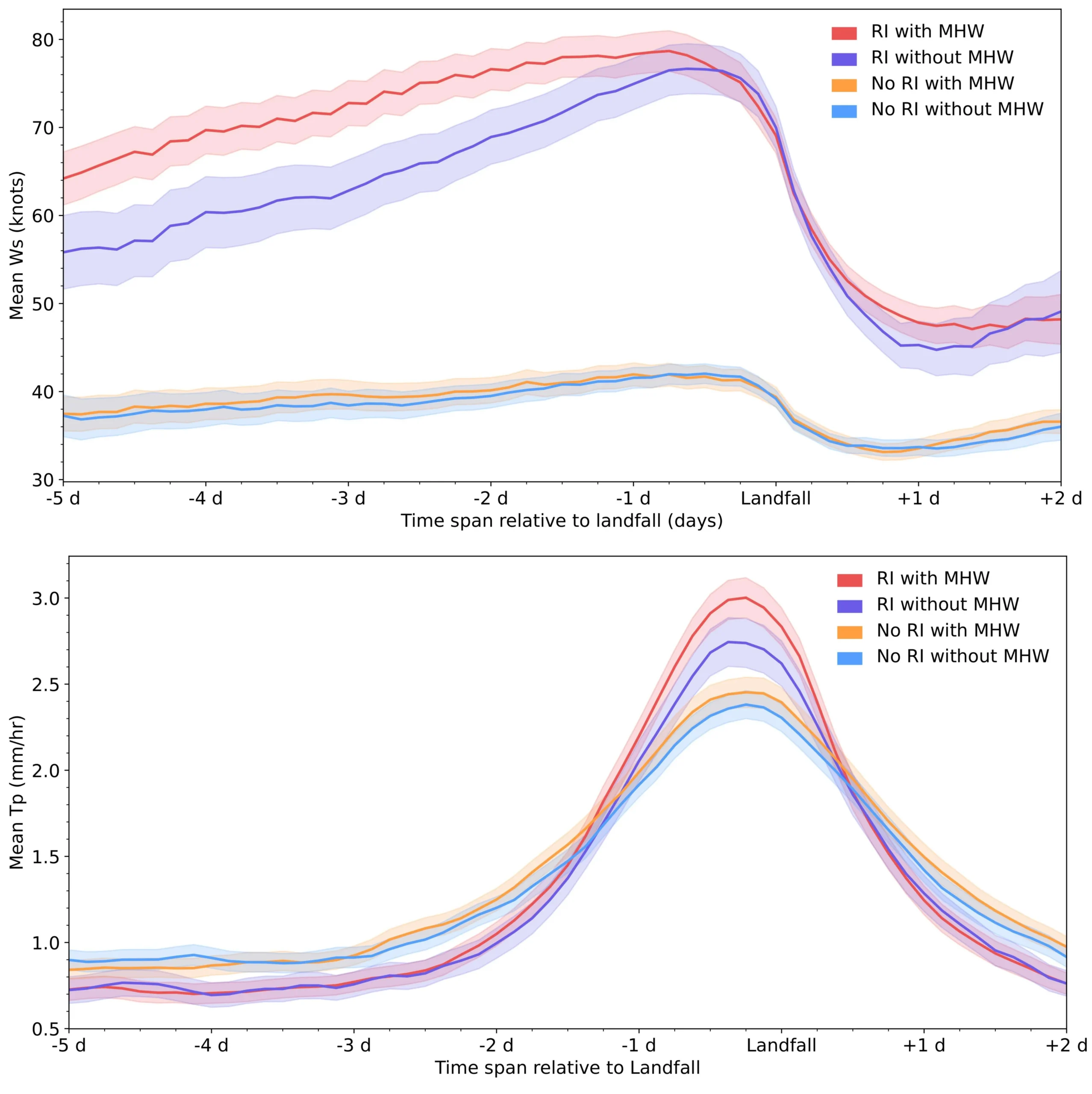
For example, tropical cyclones that do not experience rapid intensification have, on average, maximum wind speeds of around 40 knots (74km/hr), whereas storms that rapidly intensify have an average maximum wind speed of nearly 80 knots (148km/hr).
Of the rapidly intensifying storms, those that are influenced by marine heatwaves maintain higher wind speeds during the days leading up to landfall.
Although the wind speeds are very similar between the two groups once the storms make landfall, the pre-landfall difference still has an impact on a storm’s destructiveness, says Dr Soheil Radfar, a hurricane-hazard modeller at Princeton University. Radfar, who is the lead author of the new study, tells Carbon Brief:
“Hurricane damage starts days before the landfall…Four or five days before a hurricane making landfall, we expect to have high wind speeds and, because of that high wind speed, we expect to have storm surges that impact coastal communities.”
They also find that rapidly intensifying storms have higher peak rainfall than non-rapidly intensifying storms, with marine heatwave-influenced, rapidly intensifying storms exhibiting the highest average rainfall at landfall.
The charts below show the mean sustained wind speed in knots (top) and the mean rainfall in millimetres per hour (bottom) for the tropical cyclones analysed in the study in the five days leading up to and two days following a storm making landfall.
The four lines show storms that: rapidly intensified with the influence of marine heatwaves (red); those that rapidly intensified without marine heatwaves (purple); those that experienced marine heatwaves, but did not rapidly intensify (orange); and those that neither rapidly intensified nor experienced a marine heatwave (blue).
Dr Daneeja Mawren, an ocean and climate consultant at the Mauritius-based Mascarene Environmental Consulting who was not involved in the study, tells Carbon Brief that the new study “helps clarify how marine heatwaves amplify storm characteristics”, such as stronger winds and heavier rainfall. She notes that this “has not been done on a global scale before”.
However, Mawren adds that other factors not considered in the analysis can “make a huge difference” in the rapid intensification of tropical cyclones, including subsurface marine heatwaves and eddies – circular, spinning ocean currents that can trap warm water.
Dr Jonathan Lin, an atmospheric scientist at Cornell University who was also not involved in the study, tells Carbon Brief that, while the intensification found by the study “makes physical sense”, it is inherently limited by the relatively small number of storms that occur. He adds:
“There’s not that many storms, to tease out the physical mechanisms and observational data. So being able to reproduce this kind of work in a physical model would be really important.”
Economic costs
Storm intensity is not the only factor that determines how destructive a given cyclone can be – the economic damages also depend strongly on the population density and the amount of infrastructure development where a storm hits. The study explains:
“A high storm surge in a sparsely populated area may cause less economic damage than a smaller surge in a densely populated, economically important region.”
To account for the differences in development, the researchers use a type of data called “built-up volume”, from the Global Human Settlement Layer. Built-up volume is a quantity derived from satellite data and other high-resolution imagery that combines measurements of building area and average building height in a given area. This can be used as a proxy for the level of development, the authors explain.
By comparing different cyclones that impacted areas with similar built-up volumes, the researchers can analyse how rapid intensification and marine heatwaves contribute to the overall economic damages of a storm.
They find that, even when controlling for levels of coastal development, storms that pass through a marine heatwave during their rapid intensification cause 93% higher economic damages than storms that do not.
They identify 71 marine heatwave-influenced storms that cause more than $1bn (inflation-adjusted across the dataset) in damages, compared to 45 storms that cause those levels of damage without the influence of marine heatwaves.
This quantification of the cyclones’ economic impact is one of the study’s most “important contributions”, says Mawren.
The authors also note that the continued development in coastal regions may increase the likelihood of tropical cyclone damages over time.
Towards forecasting
The study notes that the increased damages caused by marine heatwave-influenced tropical cyclones, along with the projected increases in marine heatwaves, means such storms “should be given greater consideration” in planning for future climate change.
For Radfar and Moftakhari, the new study emphasises the importance of understanding the interactions between extreme events, such as tropical cyclones and marine heatwaves.
Moftakhari notes that extreme events in the future are expected to become both more intense and more complex. This becomes a problem for climate resilience because “we basically design in the future based on what we’ve observed in the past”, he says. This may lead to underestimating potential hazards, he adds.
Mawren agrees, telling Carbon Brief that, in order to “fully capture the intensification potential”, future forecasts and risk assessments must account for marine heatwaves and other ocean phenomena, such as subsurface heat.
Lin adds that the actions needed to reduce storm damages “take on the order of decades to do right”. He tells Carbon Brief:
“All these [planning] decisions have to come by understanding the future uncertainty and so this research is a step forward in understanding how we can better refine our predictions of what might happen in the future.”


The post Marine heatwaves ‘nearly double’ the economic damage caused by tropical cyclones appeared first on Carbon Brief.
Marine heatwaves ‘nearly double’ the economic damage caused by tropical cyclones



-
Climate Change8 months ago
Guest post: Why China is still building new coal – and when it might stop
-
Greenhouse Gases8 months ago
Guest post: Why China is still building new coal – and when it might stop
-

 Greenhouse Gases2 years ago
嘉宾来稿:满足中国增长的用电需求 光伏加储能“比新建煤电更实惠”
-
Climate Change2 years ago
Bill Discounting Climate Change in Florida’s Energy Policy Awaits DeSantis’ Approval
-

 Climate Change2 years ago
嘉宾来稿:满足中国增长的用电需求 光伏加储能“比新建煤电更实惠”
-
Climate Change Videos2 years ago
The toxic gas flares fuelling Nigeria’s climate change – BBC News
-

 Renewable Energy6 months ago
Sending Progressive Philanthropist George Soros to Prison?
-

 Carbon Footprint2 years ago
US SEC’s Climate Disclosure Rules Spur Renewed Interest in Carbon Credits