

We handpick and explain the most important stories at the intersection of climate, land, food and nature over the past fortnight.
This is an online version of Carbon Brief’s fortnightly Cropped email newsletter. Subscribe for free here.
Key developments
COP30 build-up
FOREST FIX: In the run-up to COP30, Brazil announced that deforestation in the Brazilian Amazon dropped by 11% between August 2024 and July 2025, the Associated Press reported. Data showed that almost 5,800km2 of forest was cleared during this time, the outlet said – a “significant drop from the previous year and the lowest level in nearly a decade”. Mongabay noted that deforestation also fell by around 11% in the Cerrado ecosystem in the past year. The Times, meanwhile, assessed global progress on a pledge to halt and reverse deforestation by 2030.
AIMS AND AMBITION: Malaysia and Indonesia, two of the world’s most biodiverse countries, announced updated climate targets ahead of COP30, according to Eco-Business. Malaysia’s new pledge outlined that its greenhouse gas emissions will peak between 2029-34, the outlet reported, while Indonesia’s pledge detailed plans to hit peak emissions by 2030. Antara reported that Indonesia’s environment minister, Hanif Faisol Nurofiq, said “large-scale reforestation” in the land-use sector will be key to achieving these targets.
NATURE TALKS: Elsewhere, intersessional talks for UN biodiversity negotiations failed to agree on a “clear set of recommendations” for the next major round of discussions, to be held in October 2026, Down to Earth reported. Countries focused on a number of topics, including the first global report on progress towards meeting 2030 nature targets. Another Down to Earth article reported on the outcomes of the first meeting of the permanent body for Indigenous peoples, which “ended with recommendations for how this new body will function”, the outlet said. These will be put forward to countries at the COP17 summit in Armenia next year.
Deadly cyclones damage crops
‘HEAVY BLOW’: Hurricane Melissa – “one of the strongest landfalling Atlantic hurricanes ever recorded” – tore through several Caribbean nations and dealt a “heavy blow” to fisherfolk and farmers in Jamaica, the Associated Press reported. The island is still recovering from last year’s Hurricane Beryl, causing farmers to “warn of food shortages”, according to the Guardian. The Gleaner, a Jamaican newspaper, wrote that fisherfolk in the country’s largest parish, St. Ann, “credited early and proactive preparations” for averting the loss of “boats, equipment and livelihoods”.
AG SECTOR SUFFERS: The same week, Cyclone Montha “battered” the eastern coast of India, “bringing heavy rain and gusty winds that damaged crops”, Reuters said. It added that the storm killed 120 animals in the southern state of Andhra Pradesh and that the agricultural sector “suffered the highest losses”. According to the Press Trust of India, nearly 80,000 farmers in the state were affected by flooding and damaged crops. One farmer died by suicide “after his cotton and maize crops were damaged” by the storm, Telangana Today reported.
-
Sign up to Carbon Brief’s free “Cropped” email newsletter. A fortnightly digest of food, land and nature news and views. Sent to your inbox every other Wednesday.
‘RUN OF DISASTERS’: Earlier this week, Typhoon Kalmaegi killed 66 people in the Philippines, the Guardian reported. Al Jazeera said that the country is still “recovering from a run of disasters, including earthquakes and severe weather events, in recent months”. In the Philippine Daily Inquirer, retired scientist Prof Teodoro Mendoza wrote that the country is “at a crossroads of food fragility and food security”. He called for “rooting strategies in local knowledge, climate adaptation and food sovereignty”.
News and views
CARBON COMMITMENT: Nigeria approved a “new national carbon market framework”, with an aim to “unlock up to $3bn annually in carbon finance”, Carbon Pulse reported. The Premium Times noted that, in addition to the framework, the country approved the operationalisation of a national climate change fund and reinstated funding for the National Council on Climate Change. The newspaper added that Nigerian president Bola Tinubu had “reaffirmed his administration’s commitment to mainstreaming climate action into national development”.
DEGRADATION TRENDS: Around 1.7 billion people worldwide are living in places where human-driven land degradation is leading to falling crop yields, representing a “growing threat to agricultural productivity and food security”, according to a new report from the UN Food and Agriculture Organization. The annual “state of food and agriculture” report said the large-scale degradation was a “troubling pattern” that “may drive further agricultural expansion into fragile ecosystems” – with implications for climate change and biodiversity loss.
‘DECISIVE WIN’: Argentine president Javier Milei’s La Libertad Avanza party secured a “decisive win” in the country’s midterm elections, Reuters said. Before the vote, Reuters reported that farmers were “renewing their vote of confidence” in Milei for “lowering unpopular export taxes”. In September, Reuters reported that these lowered taxes were increasing soya bean exports to China, particularly in the face of “Washington’s trade war with Beijing”.
LICENCE TO KRILL: Russia “spark[ed a] diplomatic row” after illegally detaining a Ukrainian biologist, the Guardian reported. Russia has accused Dr Leonid Pshenichnov of “high treason” by encouraging restrictions to krill harvesting around Antarctica, which “would harm the economic interests of Russia”, according to arrest documents seen by the newspaper. It added: “This year, for the first time, the amount of krill fished in Antarctic waters reached what scientists believe is an unsustainable level.”
JUST CAUSE: American pop star Billie Eilish announced that she will be donating $11.5m of the proceeds from her upcoming tour to “causes dedicated to food equity, climate justice and reducing carbon pollution”, CBS News reported. Eilish also called for the world’s “ultra-wealthy” to donate more of their money to helping others, the outlet added. Meanwhile, Sir David Attenborough has “urged” people to support an effort to raise £30m to purchase the Rothbury Estate in north-east England, “with plans to boost wildlife, restore bogs and promote nature-friendly farming”, BBC News said.
EEL-EGAL TRADE: Eel trafficking is “Europe’s biggest wildlife crime” – an industry worth about €2.5bn annually – and, combined with “habitat loss, pollution and the climate crisis”, is driving the slippery fish towards extinction, the Guardian said. The newspaper noted that despite international policing efforts – including a European ban on eel exports 15 years ago – the “fish are still ending up on plates around the globe”. In a separate piece, the Guardian reported on “mounting pressure” in Britain to ban mercury dental fillings. The mercury in fillings can be released into the environment after death and subsequently builds up in wildlife, causing detrimental effects.
Spotlight
Betting on trees
This week, Cropped examines Brazil’s flagship new forest fund and what COP30 could mean for nature and climate finance.
The COP30 UN climate talks begin in the heart of the Amazon rainforest next week, but they are not taking place in a vacuum.
The talks in Belém, Brazil come after a year of aid cuts and the fallout from finance negotiations in Baku last year.
The Brazilian COP presidency’s most high-profile solution to address the funding gap has been a new funding mechanism: the Tropical Forest Forever Facility (TFFF).
Through the TFFF, Brazil hopes to raise $125bn from donor countries, philanthropists and private investors, reassuring them of returns, while “rewarding” up to 74 tropical forest countries that sufficiently protect their forests.
However, days before the summit, Bloomberg reported that the UK would not be investing in the TFFF and Brazil’s finance minister was quoted saying the fund “could raise $10bn by next year”, less than half the original target.
While 20% of funds raised are supposed to go to Indigenous peoples and local communities, critics warn that TFFF puts investor returns first, with uncertain rewards going to countries and those tasked with preserving forests.
Another concern is that the TFFF is not designed to serve as an official fund for any of the UN’s three treaties – climate, biodiversity and land degradation – forged in Brazil at the historic “Earth Summit” in 1992.
Forest ecologists, meanwhile, worry that the low threshold for defining intact forests is “not scientifically credible” and “would allow payments even where industrial logging is occurring in primary forests”. Others deem the proposed $4 per hectare in rewards as “ridiculous” and not enough to displace intensive agriculture in these forests.
However, TFFF argues that “including forest areas with lower canopy cover does provide an incentive for maintaining these areas”.
But that is not all.
Just as COP28 pushed to include a goal to “triple renewable capacity”, Brazil – the world’s second largest biofuels producer – could ask countries to “quadruple the global use of ‘sustainable fuels’, including controversial biofuels”, reported the Guardian
(For more on biofuels and their climate impacts, see Carbon Brief’s explainer.)
At the same time, biodiversity offsets and carbon credit markets are seeing an additional boost in time for COP30.
Carbon Pulse reported that nine states in the Brazilian Amazon are set to launch a unified biodiversity crediting scheme, while Nigeria has greenlighted its national carbon market framework.
So far, only a third of all countries have submitted new climate pledges for 2035, despite a deadline well in advance of COP30 (although more pledges may roll in at the summit).
Liane Schalatek, a climate finance expert at German policy thinktank Heinrich-Böll-Stiftung tells Carbon Brief that 10 years after the Paris Agreement, “all of the discourse” about finance from developed countries is now around private sector involvement, instead of their legal obligations. She says:
“Seen in this context, [the TFFF] is weakening [the official funds that] we already have. And we’re doing that right at COP30, when we know that not only are NDCs too weak, but even for what developing countries have [pledged so far], they are not going to see the funding. It’s just sad.”
To Frederic Hache, co-founder of the Green Finance Observatory thinktank, the “funding gap narrative is basically a lot of political choices” that avoid tackling the “root drivers” of tropical forest loss. Hache tells Carbon Brief:
“If you say the issue is a lack of funding and the government is powerless, you empower private finance to say they hold a solution, [that] we need to cajole them so that they very kindly agree to participate and help and save us.
“But change diets, shift harmful subsidies and – boom – [this results in] less deforestation for agriculture that is not used to feed humans. That would be a serious political commitment and unlock serious grant money for countries to have the right incentives.”
Watch, read, listen
GREENWASHING GLOSSARY: With agriculture high on the COP30 agenda, DeSmog published a list of “big agwashing” buzzwords to watch out for.
TALKING TRAFFICKING: The Hindu’s In Focus podcast spoke with Vivek Menon – the new chair of the IUCN species survival commission – about the rise of online wildlife trafficking.
SULAWESI POSTCARD: A New York Times interactive feature offered a glimpse into life in the rainforests and reefs of Sulawesi island, off the eastern coast of Borneo.
LOGGING OFF: A Veza News longread looked at logging activities threatening “Nigeria’s last rainforest”.
New science
- Expanding irrigation “substantially decreases” net flows of water from the atmosphere to the land, leading to “enlarged” rates of depletion of terrestrial water and “further aggravating the existing drying trends caused by climate change” | Nature Water
- A literature review found “substantial limitations” in current research surrounding the environmental impacts of farming insects for human or animal consumption | Biological Reviews
- Ammonia emissions – largely resulting from farming – can significantly increase the formation of aerosols in the upper atmosphere, “with potential implications for climate” | Proceedings of the National Academy of Sciences
In the diary
- 10-21 November: COP30 UN climate talks | Belém, Brazil
- 24-29 November: Eleventh session of plant treaty negotiations | Lima, Peru
- 24 November-5 December: COP20 UN talks on the international trade of endangered species | Samarkand, Uzbekistan
Cropped is researched and written by Dr Giuliana Viglione, Aruna Chandrasekhar, Daisy Dunne, Orla Dwyer and Yanine Quiroz. Please send tips and feedback to cropped@carbonbrief.org
The post Cropped 5 November 2025: Nature finance at COP30; Storms devastate crops; Brazilian deforestation decline appeared first on Carbon Brief.

Israel’s bombardment of Gaza during the conflict that broke out in October 2023 has wrecked progress towards adapting the enclave to climate change and left two million Gazans vulnerable to heatwaves, drought and disease, the Palestinian Authority (PA) said in a new climate plan submitted to the United Nations.
Palestine’s third nationally determined contribution (NDC), uploaded to the UN climate body’s website this week, says that while “the aggression on the Gaza Strip did not make the climate worse”, “it removed the housing, water and sanitation systems, health facilities, energy networks, roads and livelihoods through which people absorb a climate they were already struggling with.”
The 91-page document lists the types of infrastructure it says Israel has destroyed and notes how the destruction will worsen the impacts of climate change. It says the bombing of hospitals and rising hunger have make it harder for Gazans to cope with the health impacts of climate-driven heatwaves and waterborne diseases.
The destruction of water tanks, boreholes and desalination plants, meanwhile, have left Gazans struggling with the effects of water shortages and drought, while mass unemployment reduces people’s ability to afford climate-driven price rises. The erasure of most of the Strip’s homes makes it more difficult for people to avoid the sun’s increasing heat, the NDC said.
Many Gazans are now living in the ruins of collapsed buildings or in makeshift shelters and tents that offer little or no protection from high temperatures.
Palestine’s previous goals to cut emissions and adapt to climate change in Gaza, expressed in its last NDC five years ago, were based on a pre-war baseline that “no longer describes anything that exists”, the NDC says. Progress made since 2021 has now been destroyed, it adds.
Green reconstruction of Gaza
Instead of continuing to aim for these adaptation and emissions-reduction goals, the PA is now calling for the green reconstruction of Gaza. It says buildings should be constructed again in an energy-efficient manner with solar panels and served with modern water, waste and transport systems.
While the PA, controlled by the Fatah political party, continues to claim legitimate control of Gaza, the strip was effectively governed by Fatah’s rival Hamas between 2007 and the recent war. Control is now split between Israel and the political wing of Islamist militant group Hamas, after a US-backed ceasefire took effect in October 2025, although a UN-backed committee plans to take over.
-
Germany uses funding to pressure climate groups on Israel-Gaza war
Many Global South climate groups are funded by the German government, a political ally of Israel, and feel unable to criticise Israel’s military action in Gaza -
Loss and damage fund urged to hold crisis meeting on Nepal
The new fund is coming under pressure from developing nations to respond quickly to climate disasters rather than just financing longer-term projects -
More support needed to power Africa’s food systems with renewables, experts say
Renewable energy could help African food businesses boost productivity and competitiveness, but the upfront cost, fragmented markets and limited financing stand in the way

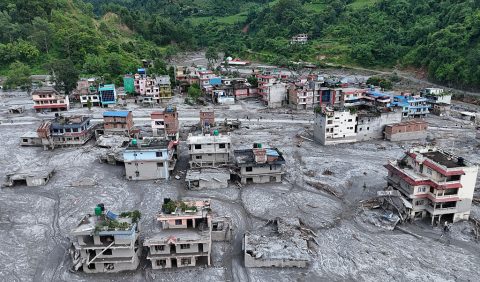

The United Nations, European Union and World Bank have jointly estimated that Gaza needs $71.4 billion of investment in the next two years to recover and build back. This process should be Palestinian-led, they said in April.
But US President Donald Trump has said the US should “take over” and “own” Gaza and redevelop it as the “Riviera of the Middle East”. Israel’s right-wing prime minister Benjamin Netanyahu has said that Israel should control the territory with civil administration managed by Palestinians favourable to Israel.
With occupation, targets conditional
In the other part of Palestine, the West Bank, the Palestinian Authority carries out some government functions, but ultimate control rests with Israel, which has occupied the West Bank since 1967.
Because Israel controls planning in most of the West Bank, the NDC argues that the PA cannot pursue all the climate projects it wants. In addition, Israel restricts the movement of PA officials, making data collection difficult, and controls the West Bank’s electricity supply meaning that the PA cannot control whether it comes from dirty or clean sources of energy.
Given this situation, the NDC says that all of Palestine’s new climate targets are conditional but it will aim to reduce emissions 12.8% below a business-as-usual baseline by 2035 and 17.1% by 2040. If the Israeli occupation ends and Palestine regains full sovereignty over its land and resources, it will aim for reductions of 15.1% and 19.1% by 2035 and 2040 respectively under an “independence pathway”.
That could allow, for example, for greater electrification and reducing emissions per unit of growth, the document said.
To achieve the 2035 emissions-reduction target and adapt to the impacts of climate change, the PA says it needs $8.6 billion in total. This funding would be spent on measures like encouraging solar farms and rooftop solar and scaling up solar water heating to cover four-fifths of households. To complement the planned increase in solar power, the authority wants to modernise the electricity grid and install battery storage.
In the transport sector, it aims to promote the uptake of electric vehicles, develop bus rapid transit corridors and scrap old polluting trucks and buses. In Gaza in particular, it wants to deploy 66 electric buses when the conflict ends.

To adapt to climate-driven drought, the NDC includes initiatives to reuse wastewater through treatment plants, build desalination plants in Gaza to remove salt from seawater, and promote irrigation for farmers.
The new climate plan was prepared by Palestine’s Environment Quality Authority, with support from the United Nations Development Programme and the governments of Britain and Spain.
The United Nations recognised Palestine’s statehood in 2012 and it joined the UN’s climate convention and signed the Paris climate agreement – which requires countries to submit more ambitious NDCs every five years – in 2016.
The Israeli foreign ministry did not respond to a request for comment. But in late 2024, then Israeli climate envoy Gideon Behar told Climate Home News that the war and the resulting environmental destruction in Gaza was the fault of Hamas.
The post Palestine: Israel’s bombing has left Gaza vulnerable to climate change appeared first on Climate Home News.
Palestine: Israel’s bombing has left Gaza vulnerable to climate change
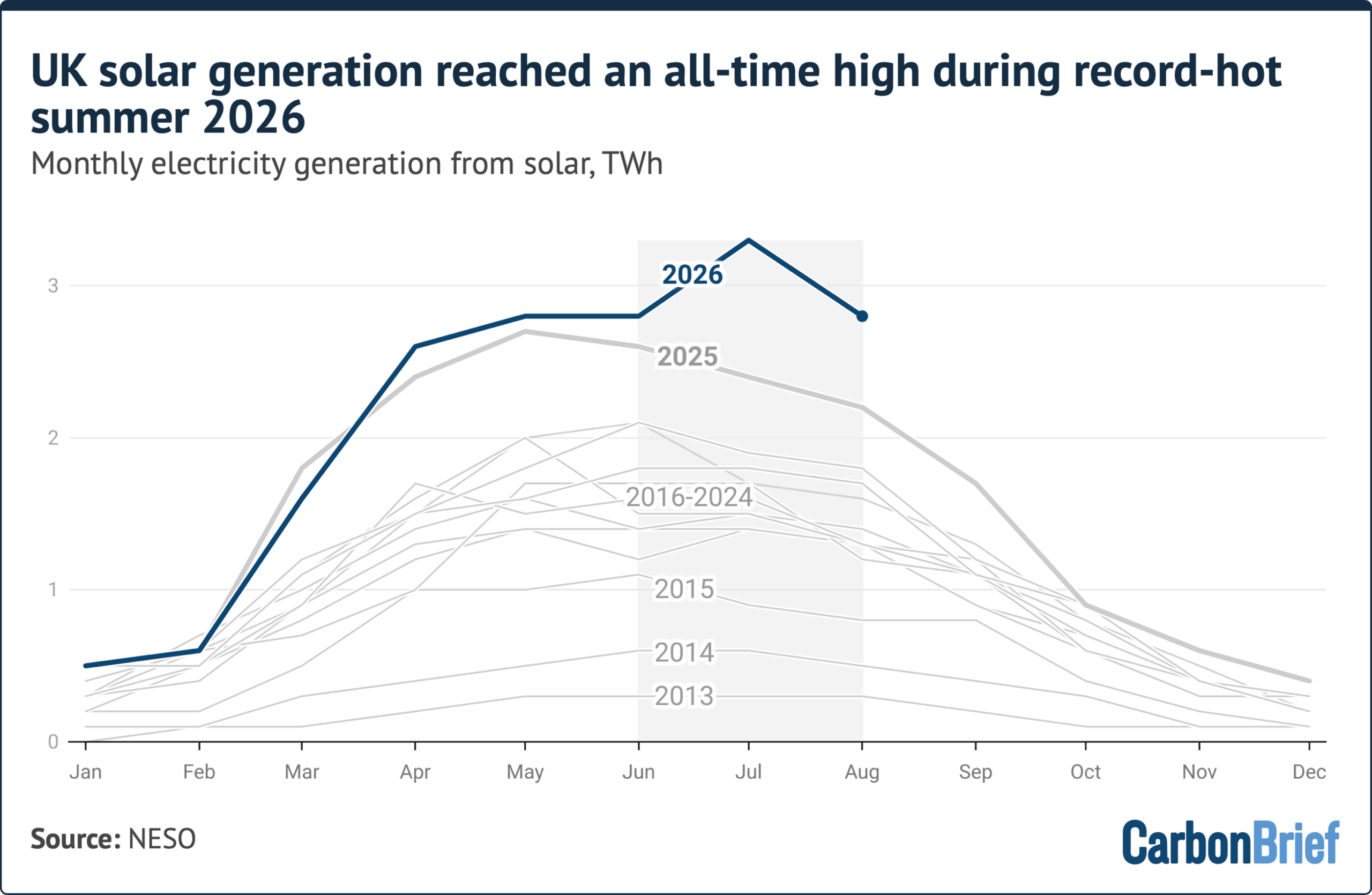
Solar power generation in the UK reached a new record over the summer of 2026, as temperatures across the nation soared, according to new analysis by Carbon Brief.
Collectively over June, July and August, solar farms and rooftops generated 8.8 terawatt-hours (TWh) of electricity in the UK*, as shown in the chart below.
Speaking to Carbon Brief, Chris Hewett, chief executive of trade association Solar Energy UK welcomed the new record, adding that it was driven by “clear skies and continued growth in deployment”.
This surge in generation took place amid the hottest summer on record in the UK, with five heatwaves between May and August.
Summer 2026 was the sixth sunniest on record, with more than 620 hours of sunshine, according to the Met Office. England and Wales – which experienced the most extreme heat – saw their second-sunniest summers on record.
June 2026 was the hottest June in England since records began in 1884, according to Met Office data, while Wales and the UK as a whole experienced their second-warmest June.
It was the driest July for England and Wales since records began in 1836, with some parts of London seeing no rain at all in the month, while Wisley in Surrey had no rain for 62 days.
In England, temperatures peaked at 38.1C at Kew Gardens in London on 13 August.
According to the Met Office, this summer’s record mean temperature was made 130 times more likely by climate change.
Amid these hot and sunny months, solar power generation increased 23% from the same period in 2025. This is double the level of solar generation over the summer of 2021, according to Carbon Brief analysis.
While solar panels can be affected by periods of extreme heat, the longer hours of daylight and higher levels of irradiation over the summer more than offset any efficiency losses.
June, July and August all saw solar set new monthly records for solar generation – July saw the highest solar generation in a calendar month ever, with 3.3TWh meeting 15% of overall electricity demand for the month.
As of the end of August, the total UK solar generation in 2026 stood at 17TWh – 13% higher than the same point in 2025.
The number of solar farms and rooftop installations has grown substantially in recent years, helping to boost generation. Domestic rooftop solar accounts for around 29% of total capacity.
In 2025, the UK’s solar capacity reached 21 gigawatts (GW) by the third quarter of the year, according to UK government figures. This is a jump of 3GW, or 18%, year-on-year, as Carbon Brief reported in January.
(Capacity is the maximum output possible from an electricity generation, whereas generation is what was produced over a certain time period, such as a day, month or year.)
According to the University of Sheffield, the installed solar capacity is now nearly 24GW.
This includes nearly 172,000 solar installations that have been fitted across the UK since the start of 2026, according to recent government figures. In July alone, more than 19,800 rooftop solar panels were installed – the equivalent of one installation every two minutes.
In total, nearly 1.7m households in the UK now have solar panels installed.
Over 26 heatwave days this summer – periods of at least three days when temperatures exceed the Met Office’s county-level heatwave temperature threshold – UK households with rooftop solar panels avoided an estimated £86.7m in electricity costs, according to analysis by Utility Bidder.
Talking about the surge in solar generation this summer, Hewett says:
“[It] not only kept bills down for people with solar and batteries in their homes, but helped keep overall power prices much lower than they would have been if Britain had been relying on more gas generation during the day”.
Despite the record generation, no new half-hourly solar power output record was set in the summer of 2026. This still stands at 15.2 megawatts (MW) on 23 April 2026.
* This article refers to the UK throughout, but strictly relates to the island of Great Britain, made up of England, Scotland and Wales. Northern Ireland is part of the separate, all-Ireland electricity system.
related
Factcheck: 10 flaws in the Conservative report on ‘cheap power’
Q&A: What is ‘long-duration energy storage’ – and why does the UK need it?
Q&A: What does China’s 15th ‘five-year plan’ for renewables mean for climate change?
Analysis: Wind and solar power overtake fossil fuels in Germany for first time ever
The post Analysis: UK solar power hits record high over summer 2026 appeared first on Carbon Brief.
Farmers around Europe are dealing with the aftermath of a summer of extreme heat, drought and wildfires that were exacerbated by climate change.
Human-caused climate change is increasing the severity and likelihood of many extreme weather events around the world, which is increasing volatility for food producers.
This summer resulted in, for example, shrunken potatoes in the Netherlands, reduced carrot harvests in France, dried-up rice fields in Italy and scorched olive groves in parts of the Mediterranean region.
Global food prices are currently at their highest level since early 2023 due to “heatwaves and energy price dynamics”, according to the UN Food and Agriculture Organization.
Other factors such as blocked fertiliser supplies in the Strait of Hormuz and high fuel costs have also played a role in this year’s agricultural outputs.
In the six charts below, Carbon Brief provides a snapshot of the impact this summer’s extremes are considered to have had on crop production and yields across Europe.
1. Most EU countries expect to see declines in cereal production this year
2. Most countries are recording reduced crop yields
3. Around €2bn worth of cereal losses after June heatwave
4. UK yields of wheat, barley and oats are all due to drop in 2026
5. Maize production in France is due to hit a four-decade low
1. Most EU countries expect to see declines in cereal production this year
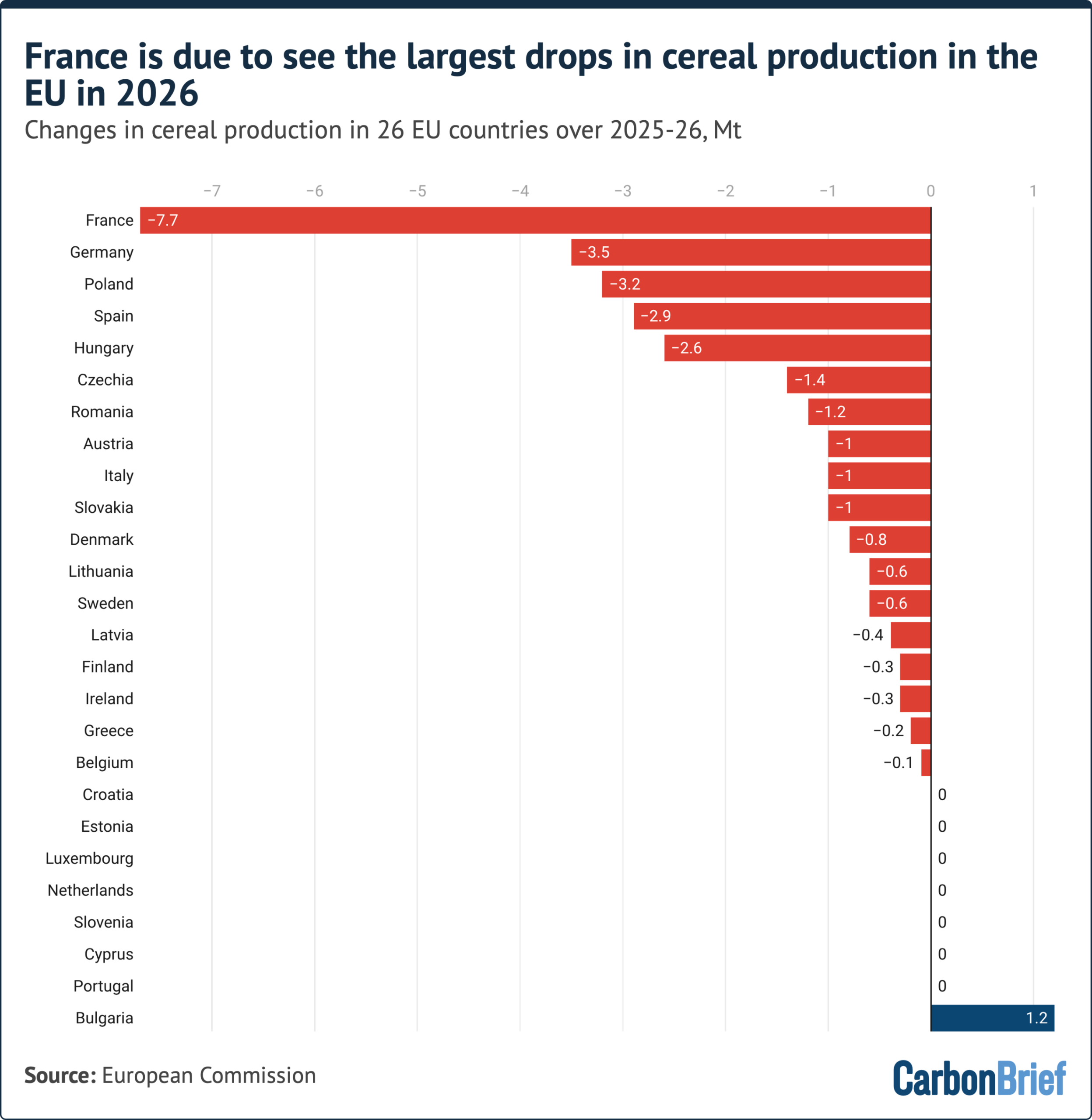
France, in particular, will see heavy losses in the amount of cereals – such as wheat, barley and oats – it produces this year, according to European Commission data.
French cereal production is expected to drop by almost 8 megatonnes (Mt) in 2026, compared to 2025.
The chart above shows that most European countries, aside from Bulgaria, will also see production losses this year.
Germany is due to see the second-largest losses in production, dropping by almost 4Mt compared to 2025.
Prof Til Feike, a cropping systems expert at the Julius Kühn-Institut, says many areas in Germany and Austria, as with other parts of Europe, have been “hit hard by a long-lasting dry period in combination with record-high heatwaves”.
This has resulted in dry grassland for animals and lower yields of maize, which is a “key fodder crop” for livestock. He tells Carbon Brief:
“In the long run, farming must adapt better to more extreme weather conditions, not only heat and drought, but also prolonged wet periods. So, there is no one-fits-all solution for climate change adaptation.”
2. Most countries are recording reduced crop yields
Heat and a lack of water have “substantially worsened” crop expectations this summer in western and most of central Europe, according to a recent bulletin from the EU Joint Research Centre.
Yields are expected to be “significantly reduced”, with local crop failures “likely” in areas such as France, southern Germany, northern and central Italy, and Hungary, it added.
The chart below shows that yields of cereal grains – which, here, refers to the tonnes of a grain grown per hectare of land – are expected to fall in most EU countries in 2026.
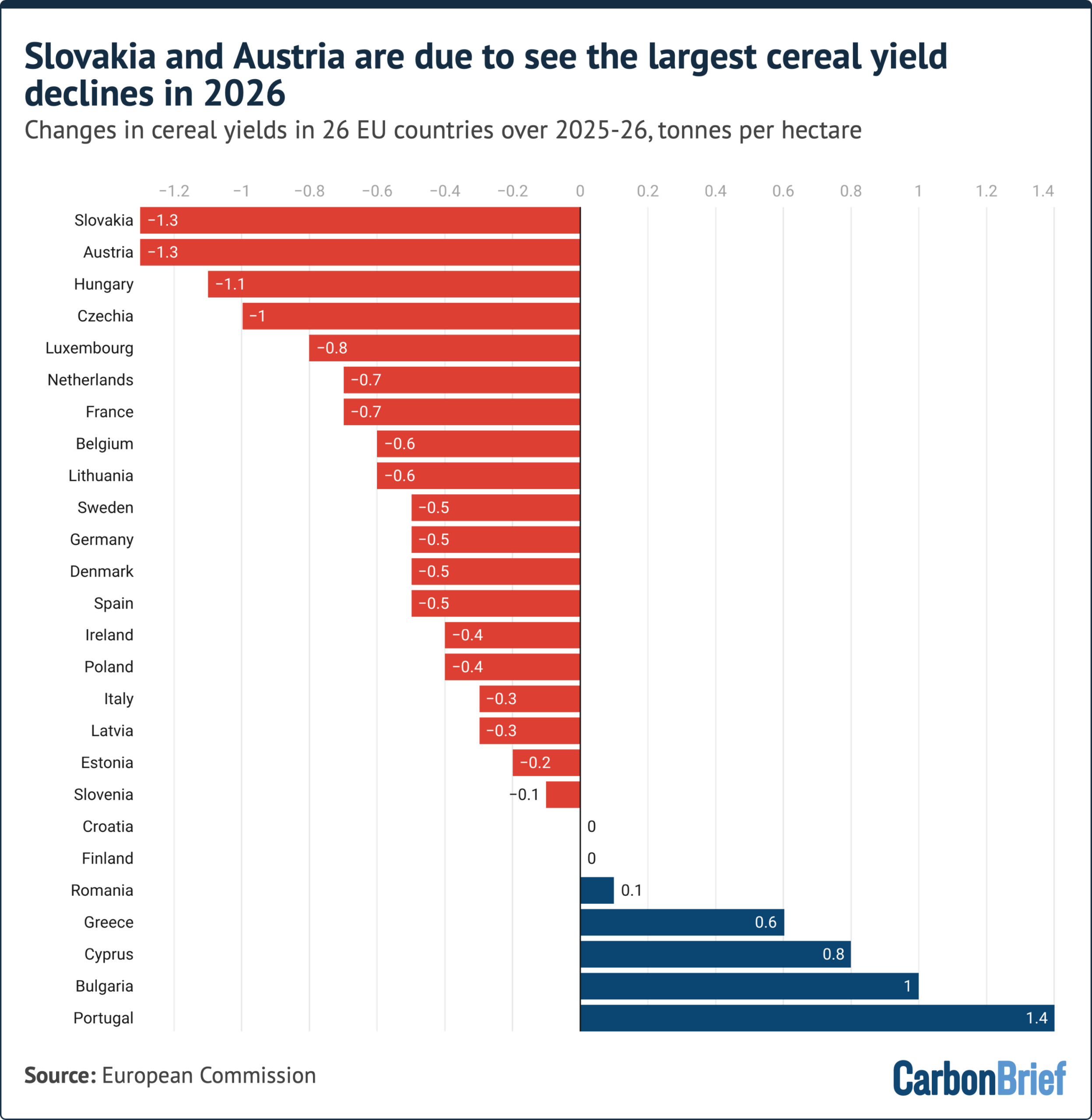
Slovakia, Austria and Hungary are expected to see the largest declines in cereal yields, reducing by more than one tonne per hectare in 2026 compared to 2025.
The recent EU bulletin noted that irrigated crops performed well in Portugal this summer – the country with the largest yield increases. Other crops relying on rainfall showed growing signs of heat stress, it added.
3. Around €2bn worth of cereal losses after June heatwave
The record heatwave that hit many parts of Europe in June contributed to an estimated €2-2.3bn in cumulative grain production losses, as shown in the chart below.
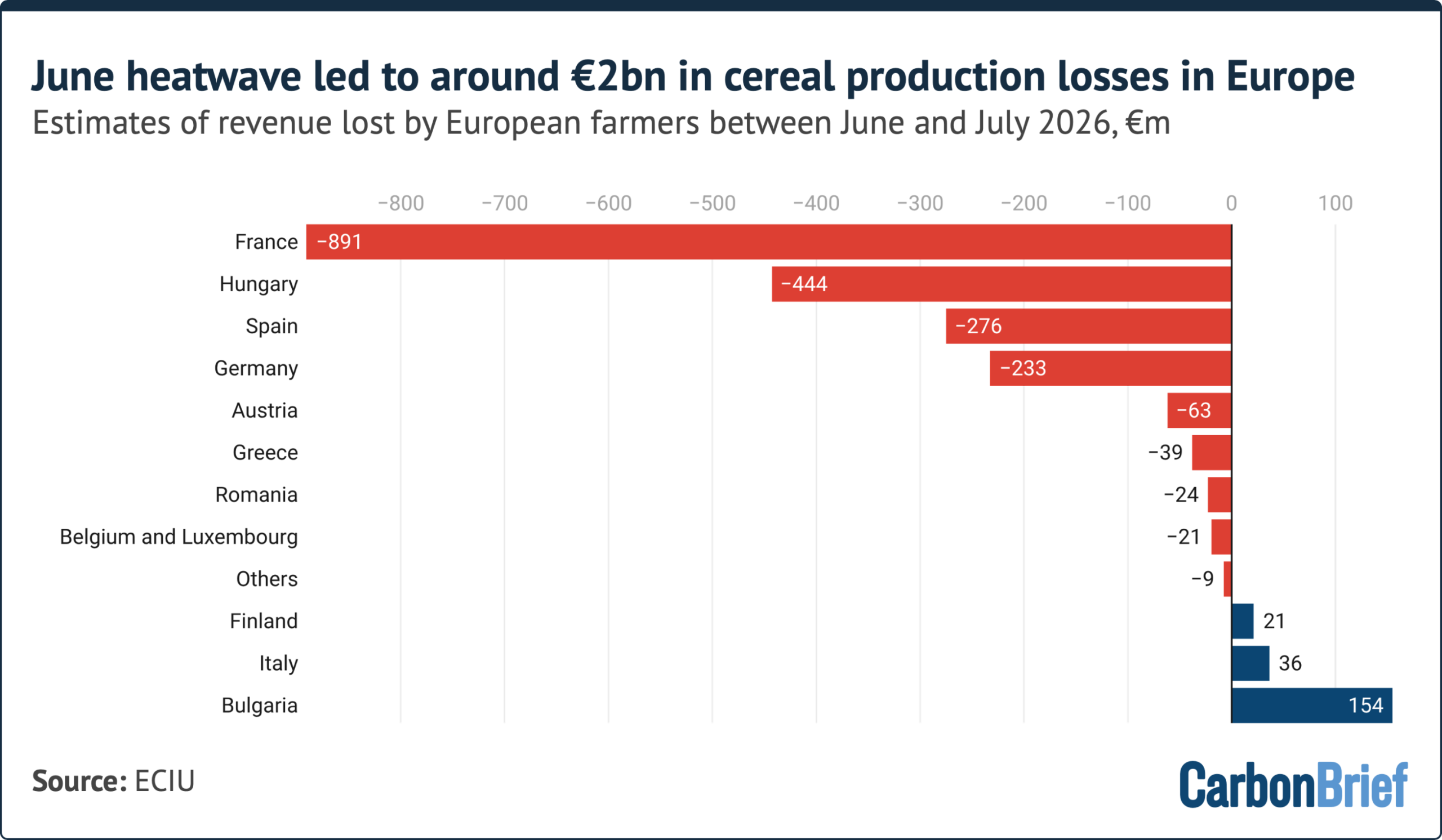
The intense June heat in western Europe would have been “virtually impossible” just 50 years ago, according to a rapid climate attribution study. It was the region’s hottest June on record.
The Energy & Climate Intelligence Unit (ECIU) thinktank analysed June and July 2026 grain forecasts from Coceral, a European grain traders association.
ECIU estimated lost supply by multiplying the change in tonnes of grains between these two months by prices for harvest delivery in 28 European countries.
Major grain producers France, Germany, Hungary and Spain accounted for 86% of the lost revenue, according to the ECIU.
Extreme heat is also expected to have a wider economic impact across the continent. Analysis from Triodos Bank found that this summer’s extreme weather could reduce the EU’s gross domestic product (GDP) by around 1% this year, or around €180bn.
4. UK yields of wheat, barley and oats are all due to drop in 2026
If current trends continue, the average yields for cereals and oilseeds will result in the UK’s worst harvest since detailed records began in 1984, according to ECIU.
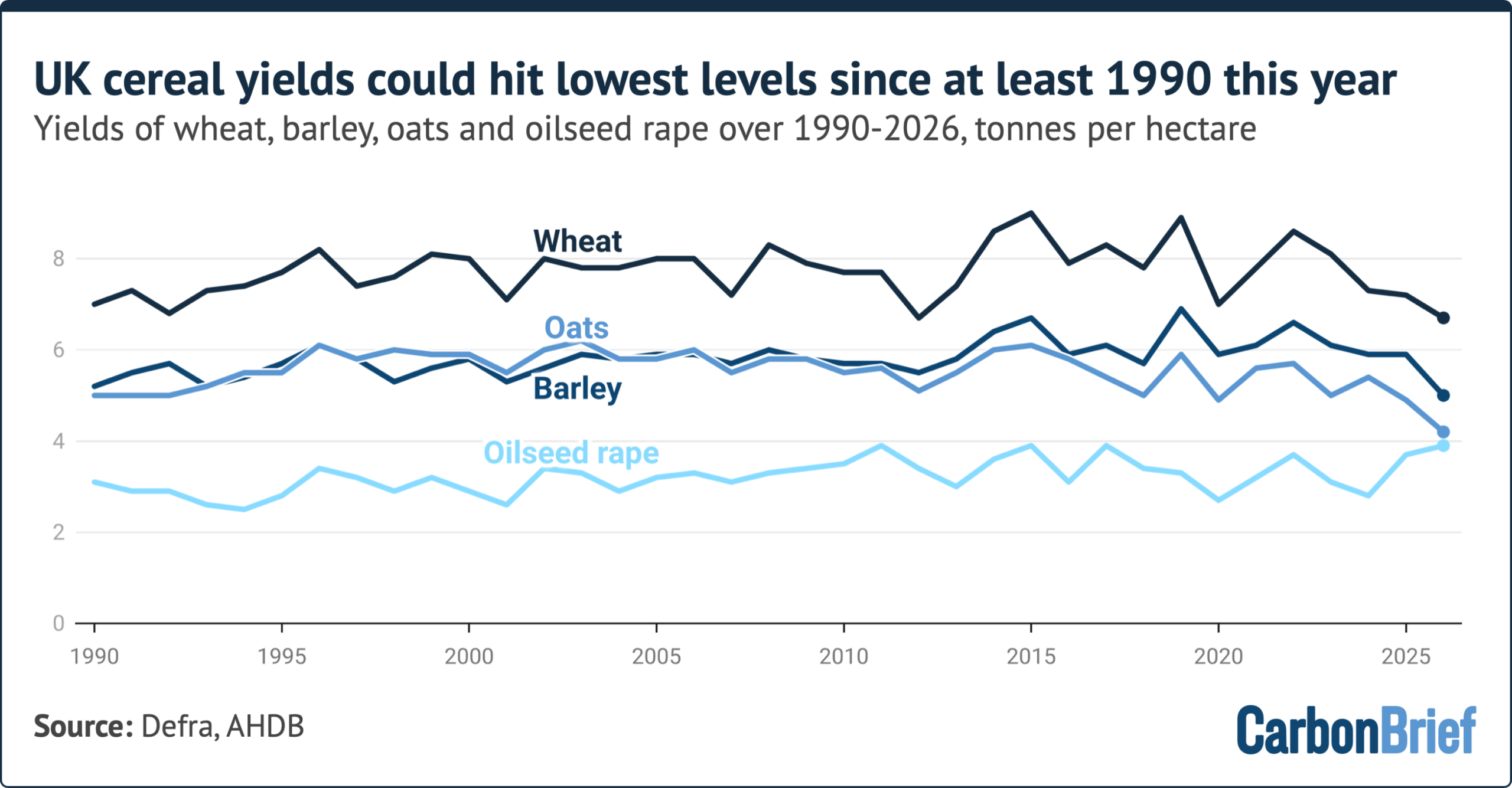
Barley yields could fall by 15%, oats by 14% and wheat yields by 6% year-on-year, according to 2026 harvest surveys from the Agriculture and Horticulture Development Board, a non-departmental public body that provides agricultural data to the UK government.
ECIU said that, even if the situation improves, this year is still expected to be one of the five worst harvests on record. This means that four of the five worst harvests in the UK have occurred in the past decade.
Consumers will likely see higher prices and/or smaller vegetables in supermarkets as a result, Tim O’Malley, chairman of UK company Nationwide Produce, told BBC News in August.
Other crops, such as berries, have grown successfully in the extreme heat. But the Guardian noted fears this could dip later this year “as plants become exhausted from heavy cropping during the heatwave”.
5. Maize production in France is due to hit a four-decade low
France has been acutely affected by this summer’s extreme weather, with more than 7,300 excess deaths during heatwaves and a record number of weather stations recording temperatures of above 40C.
The country is the EU’s largest agricultural producer, but heat, drought and wildfires have affected many crops.
The chart below shows that maize production is set to drop by more than one-third (35%) year-on-year.
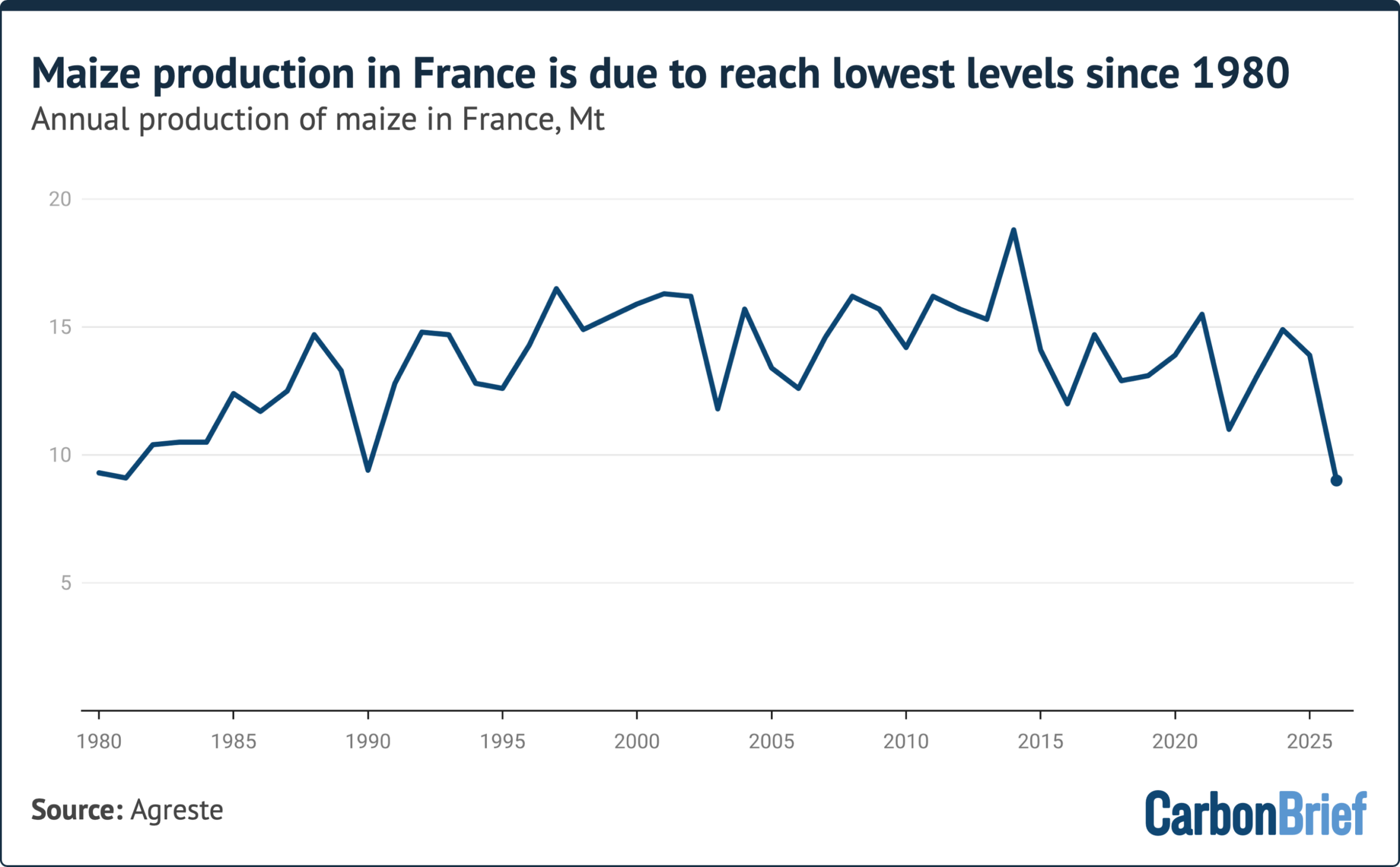
This could result in France’s lowest maize production since 1980, according to data from Agreste, the country’s agriculture ministry’s statistics service.
Due to the heat, “record-early” grape harvests have also been recorded in various parts of the nation since mid-July, reported Le Monde. In some cases, this means “smaller, less juicy grapes, which will yield less wine”, explained the newspaper.
6. Declines in EU grains since 2025
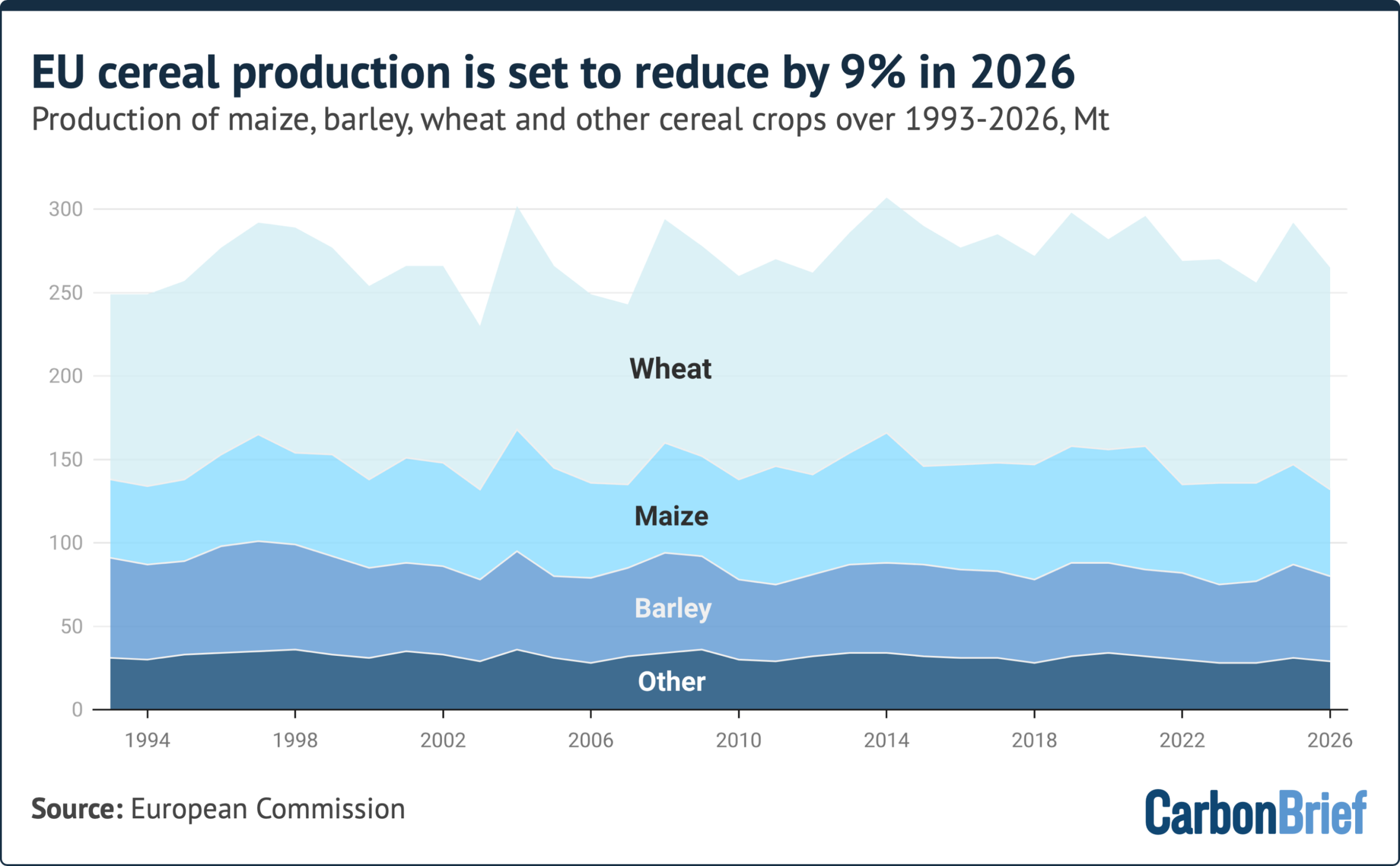
Overall in the EU, data and projections indicate declines in the output of cereal grains this year.
Cereal production is set to fall by 9% compared to 2025, according to the European Commission.
Just one year in the past decade – 2024 – recorded lower production levels.
Maize production is set to be particularly affected, with projections indicating a 13% drop, to 52Mt – the lowest level in the EU since 2007.
The post How this summer’s heat and drought impacted crops in Europe – in six charts appeared first on Carbon Brief.
How this summer’s heat and drought impacted crops in Europe – in six charts



-
Climate Change1 year ago
Guest post: Why China is still building new coal – and when it might stop
-

 Greenhouse Gases2 years ago
嘉宾来稿:满足中国增长的用电需求 光伏加储能“比新建煤电更实惠”
-
Greenhouse Gases1 year ago
Guest post: Why China is still building new coal – and when it might stop
-

 Climate Change2 years ago
嘉宾来稿:满足中国增长的用电需求 光伏加储能“比新建煤电更实惠”
-
Climate Change2 years ago
Bill Discounting Climate Change in Florida’s Energy Policy Awaits DeSantis’ Approval
-

 Renewable Energy11 months ago
Sending Progressive Philanthropist George Soros to Prison?
-
Greenhouse Gases1 year ago
嘉宾来稿:探究火山喷发如何影响气候预测
-

 Carbon Footprint2 years ago
US SEC’s Climate Disclosure Rules Spur Renewed Interest in Carbon Credits