Connect with us

Published

on

Billed as the “Amazon COP”, the UN climate talks will see the debut of Brazil’s flagship fund to “reward” tropical countries for keeping their forests intact.

The Tropical Forest Forever Facility (TFFF) will be launched at the COP30 leaders’ summit on 6 November.

The fund aims to raise and invest $125bn from a range of sources, with excess returns channelled to up to 74 developing countries that sufficiently protect their forests.

This, according to Brazil, would make it one of the biggest multilateral investment funds for nature.

(For comparison, the Green Climate Fund’s portfolio is around $18bn.)

While Brazil expects TFFF to “transform the world’s approach to environmental conservation”, many critics remain unconvinced.

They argue that conservation funding for climate-critical forests should not depend on “betting on stock market prices” and instead call for new biodiversity finance.

Here, Carbon Brief takes a closer look at where the fund came from, how it will be set up and how it is supposed to work.

What is the Tropical Forest Forever Facility?

First officially proposed by Brazil at COP28 in Dubai in 2023, the Tropical Forest Forever Facility aims to pay up to 74 developing tropical forest countries for keeping their existing old-growth forests intact.

It plans to do this by raising $25bn in capital from wealthy “sponsor” governments and philanthropies, which – it hopes – will attract an additional $100bn in private investment.

Returns on these investments will go towards paying back investors and making “forest payments” to countries that increase or maintain their forest cover.

On 4 November, Brazil’s finance minister Fernando Haddad told Bloomberg that “he believed the fund could raise $10bn by next year”, less than half the original target.

While the facility’s official launch is slated for COP30, its rules are still being finalised after several iterations of “concept notes” and consultations.

However, the idea that underpins the fund is not new.

Former World Bank treasurer Kenneth Lay first floated the idea of a Tropical Forest Finance Facility around 15 years ago.

Lay and others later envisioned the TFFF as a “pay-for-performance” sovereign wealth fund for forests. In their design of the TFFF, loans from developed countries and private investors would have been invested in the debt markets of tropical forest countries, with excess returns being allocated annually as “rainforest rewards”.

In their thinking, TFFF offered a “highly-visible, large-scale reward for successfully tackling deforestation without increasing funding demands” on developed countries, according to a 2018 article for the Center for Global Development.
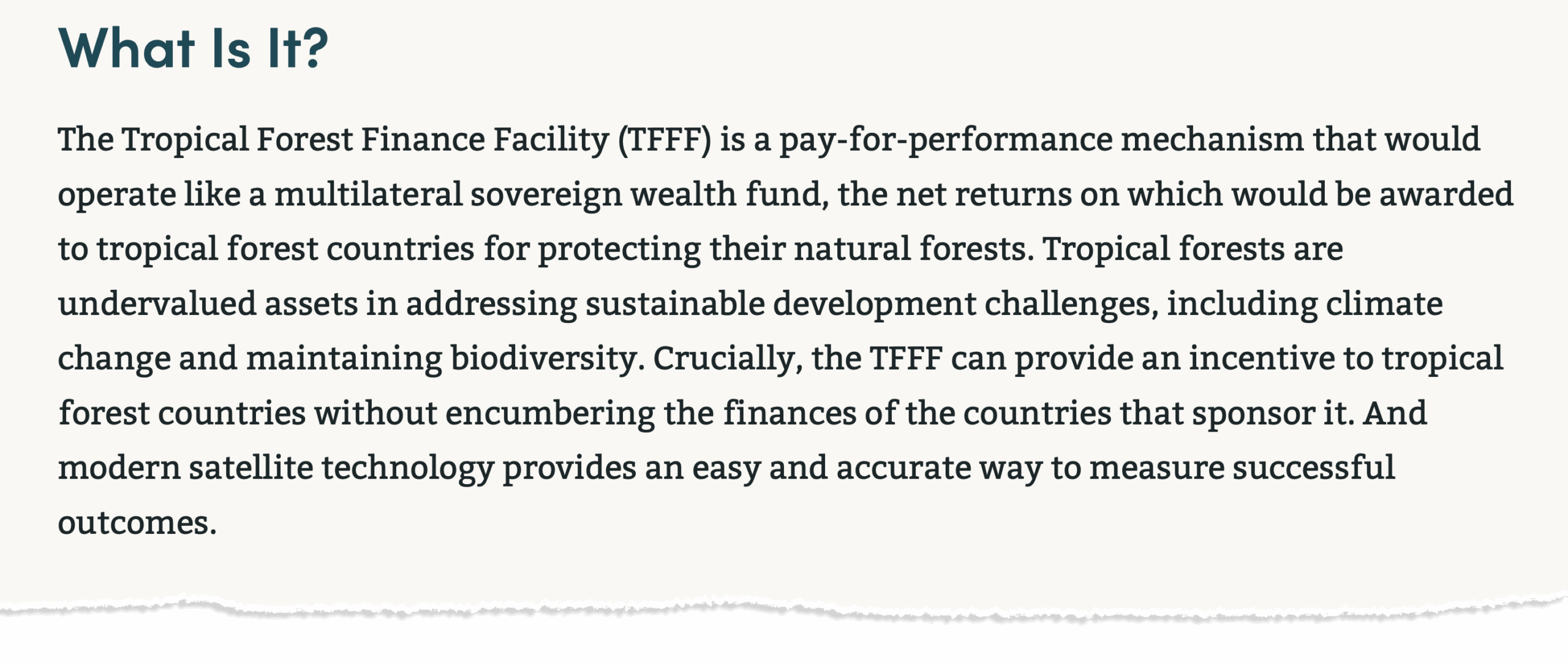
Definition of the Tropical Forest Finance Facility, taken from its website: "What Is It? The Tropical Forest Finance Facility (TFFF) is a pay-for-performance mechanism that would operate like a multilateral sovereign wealth fund, the net returns on which would be awarded to tropical forest countries for protecting their natural forests. Tropical forests are undervalued assets in addressing sustainable development challenges, including climate change and maintaining biodiversity. Crucially, the TFFF can provide an incentive to tropical forest countries without encumbering the finances of the countries that sponsor it. And modern satellite technology provides an easy and accurate way to measure successful outcomes."
The Tropical Forest Finance Facility, as defined in a 2018 article. Source: Center for Global Development (2018)

Others central to the TFFF’s current design are Christopher Egerton-Warburton – founder of London-based Lion’s Head Global Partners, who is credited with engineering the facility’s financial structure – and Garo Batmanian, director of Brazil’s forestry service.

What is it designed to achieve?

The ultimate goal of the TFFF is to pay for the conservation of the world’s major rainforests, which provide a range of ecosystem services, including carbon storage.

In a statement from the COP30 presidency, André Aquino, special advisor on economy and environment at Brazil’s ministry of environment, said:

“What the TFFF seeks is for the world to remunerate part of these services. It is to remunerate forests as the basis of life, as the basis of the economy, for our well-being.”

On the ground, this mechanism could help landowners to conserve trees and forests by ensuring that the value they bring as standing forests is higher than from cutting them down.

The facility also intends to finance long-term objectives for forest conservation, including policies and programmes for sustainable use and restoration.

More than 70 developing countries that are home to more than 1bn hectares of tropical and sub-tropical forests could be potential recipients from this facility. These countries span the Amazon, Congo and Mekong basins, as well as many other regions.

The following map shows the countries that host tropical rainforests and are potentially eligible to receive funds from the TFFF.
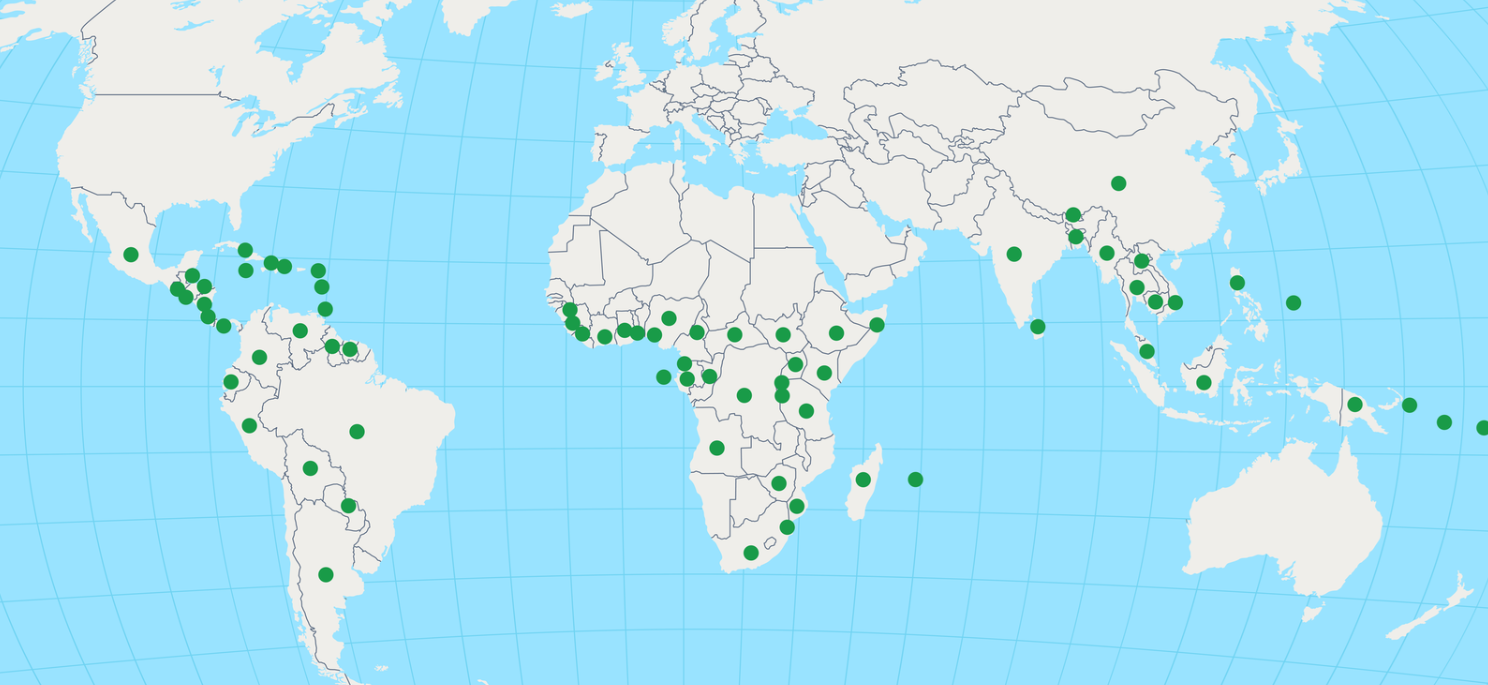
Global map showing around 74 countries with tropical rainforests marked with green dots are potential recipients of the TFFF. Source: COP30 official website.
Around 74 countries with tropical rainforests marked with green dots are potential recipients of the TFFF. Source: COP30 official website.

To be selected as beneficiaries, countries will require transparent financial management systems and must commit to allocating 20% of the funds to Indigenous peoples and traditional communities, according to the draft rules.

These countries would need to have a deforestation rate – averaged over the previous three years – of no more than 0.5% of their total forested area, with standing forest areas having a canopy cover of at least 20-30% in each hectare to be eligible for payments.

The TFFF’s third concept note says that areas that transition from above to below this 20-30% threshold would be “considered deforested”.

In a recent Yale Environment 360 article, forest ecologists warned that the low level of this threshold – for what counts as a forested area – is “not scientifically credible” and “would allow payments even where industrial logging is occurring in primary forests”.

However, TFFF argues that “including forest areas with lower canopy cover does provide an incentive for maintaining these areas”.

Additionally, payments would be reduced for each hectare of forest loss and for each hectare degraded by fire.

The funds for Indigenous peoples would be “put aside in a different account, following different rules”, Aquino said during a press briefing attended by Carbon Brief.

Brazil’s ministry of environment and climate change invited five countries with rainforests to support the creation of the fund: Colombia, the Democratic Republic of Congo, Ghana, Indonesia and Malaysia.

Individual national governments that are beneficiaries of the scheme would be free to define how and where the generated funds would be distributed.

How will the fund work?

The TFFF is split into two entities, with a secretariat to coordinate between them.

The facility is the first of these. It is tasked with setting up the rewards system, eligibility criteria, monitoring methodologies and disbursement rules, as well as engaging with participating recipient countries.

The other is the TFFF’s main financial arm, the Tropical Forest Investment Fund (TFIF) – responsible for raising and managing the TFFF’s resources.

So far, five potential sponsor countries have shown interest in supporting the fund: France, Germany, Norway, the United Arab Emirates and the UK.

These countries, along with five potential recipient countries – Brazil, Colombia, the DRC, Ghana, Indonesia and Malaysia – formed an interim steering committee to shape TFFF’s development.
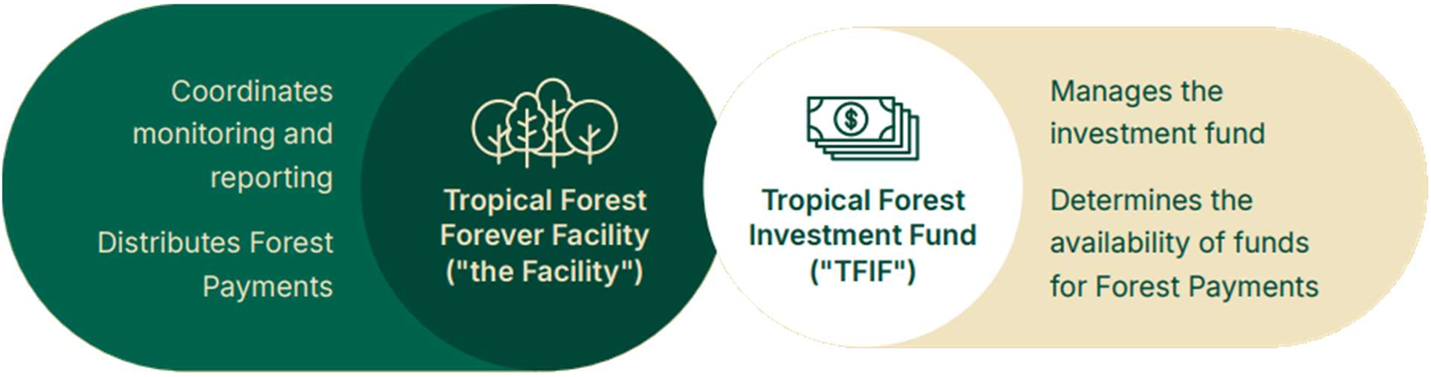
Graphic showing the TFFF governance scheme
The TFFF’s governance structure, according to an August concept note. Source: TFFF (2025)

According to its third concept note, published in October, the TFIF would be a “blended finance vehicle”, pooling public, philanthropic and private funding.

The TFIF is split into two tranches. The first is a “sponsor” tranche, where donor countries and philanthropies are invited to contribute long-term, low-cost capital investment to the tune of $25bn, either from long-term loans, guarantees or outright grants.

So far, Brazil’s initial pledge of $1bn to the facility is the only such pledge. Other governments, such as the UK, have played an “active part” in establishing the TFFF.

(Five days before COP30 kicked off, Bloomberg reported that the UK would not be investing in the TFFF, after the government’s treasury department warned that the investment is “not something the UK can afford at a time when it’s trying to tackle its surging debt burden”.)

This $25bn from sponsor countries, in turn, would be expected to absorb risk, cover losses and serve as a catalyst to raise $100bn from institutional investors in the global bond market.

(This sum raised from private investors is described as the “senior market debt” tranche of investment: if the markets see a downturn, private investors are protected first, making their interests “senior” to donor and recipient countries.)

TFIF and its asset managers then invest this $125bn of capital into a mixed portfolio of investments, including public and corporate market bonds, but excluding those with a significant environmental impact. (In a joint letter, issued in October, advocacy and research groups called for a more detailed exclusion criteria.)

Income from these investments, in turn, will be used to pay investors first, then interest to donor countries and, finally, to pay participating forest countries. The payments to participating countries will be roughly $4 per hectare of standing forest (subject to annual adjustment for inflation), as verified by satellite imagery.

The World Bank confirmed in September 2025 that it will serve as a trustee to the facility and host its interim secretariat.
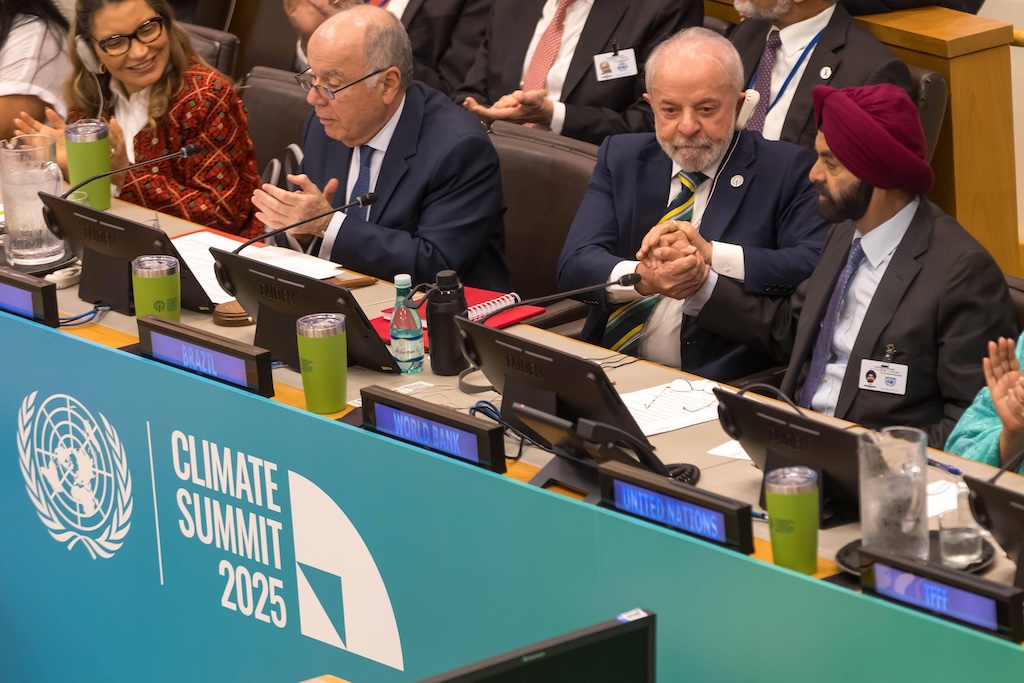
Brazilian president Lula da Silva shakes hands with the World Bank’s Ajay Banga at a high-level dialogue on the TFFF in the UN General Assembly in September 2025.
Brazilian president Lula da Silva shakes hands with the World Bank’s Ajay Banga at a high-level dialogue on the TFFF in the UN General Assembly in September 2025. Credit: William Volcov / Alamy Stock Photo

Liane Schalatek, a climate finance expert and associate director of German policy thinktank Heinrich-Böll-Stiftung’s Washington office, tells Carbon Brief:

“It’s a very clear hierarchy: you serve the money raised on the market and capital investors first before you go to the intended purpose of the fund – and that is compensating countries for basically leaving their tropical forest standing. To me, it seems that the focus is on the money, not necessarily on the outcome. That is really worrisome.”

While sponsor countries are guaranteed their money back over a 40-year period, payouts to forest countries depend on investment returns. These are subject to market risks and volatility and, therefore, are not guaranteed.

According to Frederic Hache, co-founder of the EU Green Finance Observatory thinktank, payouts promised by the TFFF are “really not appropriate to the emergency of the [biodiversity and climate] crises” and do not address their “root drivers”. Hache tells Carbon Brief:

“Even if you meet the very hard criteria as a country to get this money, obtaining this conservation funding is conditional upon financial market conditions and the skill of an asset manager. That’s not very generous and that’s not very appropriate.”

Hache warns that if the fund does not make enough money or experiences losses, the “first thing that is impacted is the forest payment”, which could be put on hold, while “sponsor capital protects private investors with taxpayer money”.

What issues might the fund face?

Civil-society organisations and climate finance experts have warned of several risks and gaps within the facility.

Finance fragmentation

Experts who spoke to Carbon Brief expressed concerns that TFFF could erode the legitimacy of existing, but under-resourced, multilateral funds for climate and biodiversity, as well as dilute the legal obligations of developed countries to pay their “fair share” of nature finance.

While the TFFF hopes to contribute to the goals of all three UN conventions – climate, biodiversity and land degradation – the fund is not officially part of any of the three treaties.

To Schalatek, the fact that the “biggest thing that is going to come out of COP30” is “outside” the UN Framework Convention on Climate Change (UNFCCC) and depends to a large extent on private investment is cause for disappointment.

A keenly awaited report ahead of COP30 is a roadmap towards a wider climate finance target of $1.3tn a year, which could include various sources beyond the jurisdiction of the UN climate process.

Schalatek tells Carbon Brief:

“While we’re trying to have a discussion about protecting the provision of public finance from developed to developing countries [after Baku and amid aid cuts], TFFF is almost contributing to a further undermining of the financial mechanism of the UNFCCC and the Paris Agreement.”

Sarah Colenbrander, director of the climate and sustainability programme at the UK-based global development thinktank ODI, tells Carbon Brief:

“The creation of the Tropical Forest Forever Facility risks not increasing total resources for climate and biodiversity finance, but rather fragmenting the funds already available.”

Potential financial risk

Given the fund’s long-term horizon, a significant challenge is managing financial risk down the line.

This could take the form of a debt crisis in emerging markets, which could “wipe out” sponsor capital and “halt rainforest flows, possibly before they even begin”, economists Max Alexander Matthey and Prof Aidan Hollis wrote in a Substack post in September.

Higher return rates for investors – as mentioned in the third draft of TFFF’s concept note – in combination with high financial fees and operational costs, have left several experts questioning what remains in the way of “rewards” to rainforest countries.

Hache tells Carbon Brief that the TFFF might be “fantastic” for investors who get a “AAA-rated investment without sacrificing any returns”, but real risk is borne by tropical forest countries.

In addition, the mooted payments of $4 a hectare is “ridiculous and not enough to displace alternatives” such as growing cash crops for export, he says, adding:

“$125bn sounds much better than, ‘Oh, we put $2.5bn on the table conditionally’. While there is very little political appetite for giving grant money, this is one of these mechanisms where innovation can obfuscate the lack of ambition and generosity by global-north countries.”

Commodification and transparency

Other experts fear that the new facility could contribute to the commodification of forests and a possible lack of adequate accountability.

The Global Forest Coalition (GFC), an alliance of not-for-profit organisations and Indigenous groups working on forest issues worldwide, have urged countries, Indigenous peoples and civil society to reject the TFFF.

In a press release in October, the GFC said that the TFFF views forests as “financial assets” and warned that the fund is “subject to investment returns, liquidation risks and payouts that are not even guaranteed”.

The press release quotes Mary Louise Malig, policy director at the GFC, who said:

“This is not about conserving forests; it is about conserving the power of elites over forests. It is the continuation of a free market model dressed up as climate finance.”

Information on transparency and governance of the TFFF is unavailable at the moment, says Tyala Ifwanga, forest governance campaigner at Fern, a civil-society organisation that works to protect forest people’s rights in the EU. She tells Carbon Brief that this makes it difficult to assess whether the facility can ensure payments meet the fund’s objectives, adding:

“Corruption is not the only issue we should have in mind here. Some tropical forest countries have autocratic regimes and very limited civic space.”

Pablo Solón, executive director of the Solón Foundation, is also quoted in the GFC press release. He warned:

“The TFFF is a distraction that diverts attention and resources from real solutions like regulation, corporate accountability and direct financing for Indigenous and local initiatives.”

Low Indigenous involvement

Another concern highlighted by the GFC is that while Indigenous peoples and local communities are expected to have “consultative roles”, the “decision-making power rests with governments and financial institutions”.

According to Fern’s Ifwanga, the Global Alliance for Territorial Community – a political platform bringing together coalitions of Indigenous peoples and local communities for defending nature – was involved in developing the TFFF concept notes related to Indigenous peoples and local communities.

She says that although the alliance agrees with the facility, “they are very aware that a lot of work remains to be done to ensure that their voices are heard at every level of the mechanism”.

She also encourages countries to increase direct access to funds for Indigenous communities.

Schalatek says that it is “sinister” that forest communities are being asked to “provide continued stewardship” and preserve forests “without any predictability on how much they’re going to receive for it”, while fund managers can get their money back. She concludes:

“This [TFFF] is exactly the kind of vehicle that gives developed countries the sick leave to not contribute to the GCF [Green Climate Fund], not contribute to the Adaptation Fund…We all know the world has changed, but that doesn’t apply to legal obligations you have signed on to.

“One could probably argue that the Brazilians put a lot more effort into the TFFF than in, for example, thinking about how to deal with the finance agenda within COP30.”
The post COP30: Could Brazil’s ‘Tropical Forest Forever’ fund help tackle climate change? appeared first on Carbon Brief.

COP30: Could Brazil’s ‘Tropical Forest Forever’ fund help tackle climate change?

Continue Reading

Climate Change

Q&A: How the UK government aims to ‘break link between gas and electricity prices’

Published

on

The UK government has announced a series of measures to “double down on clean power” in response to the energy crisis sparked by the Iran war.

The conflict has caused a spike in fossil-fuel prices – and the high cost of gas is already causing electricity prices to increase, particularly in countries such as the UK.

In response, alongside plans to speed the expansion of renewables and electric vehicles, the UK government says it will “move…to break [the] link between gas and electricity prices”.

Ahead of the announcement, there had been speculation that this could mean a radical change to the way the UK electricity market operates, such as moving gas plants into a strategic reserve.

However, the government is taking a more measured approach with two steps that will weaken – but not completely sever – the link between gas and electricity prices.

  • From 1 July 2026, the government will increase the “electricity generator levy”, a windfall tax on older renewable energy and nuclear plants, using part of the revenue to limit energy bills.
  • The government will encourage older renewable projects to sign fixed-price contracts, which it says will “help protect families and businesses from higher bills when gas prices spike”.

There has been a cautious response to the plans, with one researcher telling Carbon Brief that it is a “big step in the right direction in policy terms”, but that the impact might be “relatively modest”.

Another says that, while the headlines around the government plans “suggest a decisive shift” in terms of “breaking the link” between gas and power, “the reality is more incremental”.

Why are electricity prices linked to gas?

The price of electricity is usually set by the price of gas-fired power plants in the UK, Italy and many other European markets.

This is due to the “marginal pricing” system used in most electricity markets globally.

(For more details of what “marginal pricing” means and how it works, see the recent Carbon Brief explainer on why gas usually sets the price of electricity and what the alternatives are.)

As a result, whenever there is a spike in the cost of gas, electricity prices go up too.

This has been illustrated twice in recent years: during the global energy crisis after Russia invaded Ukraine in 2022; and since the US and Israel attacked Iran in February 2026.

Notably, however, the expansion of clean energy is already weakening the link between gas and electricity, a trend that will strengthen as more renewables and nuclear plants are built.

The figure below shows that recent UK wholesale electricity prices have been lower than those in Italy, as a result of the expansion of renewable sources.

The contrast with prices in Spain is even larger, where thinktank Ember says “strong solar and wind growth [has] reduced the influence of expensive coal and gas power”.

Chart showing that renewables are 'decoupling' power prices from gas in some countries
Wholesale electricity prices in the UK, Spain and Italy, € per megawatt hour. Source: Ember.

The share of hours where gas sets the price of power on the island of Great Britain (namely, England, Scotland and Wales) has fallen from more than 90% in 2021 to around 60% today, according to the Department of Energy Security and Net Zero (DESNZ). (Northern Ireland is part of the separate grid on the island of Ireland.)

This is largely because an increasing share of generation is coming from renewables with “contracts for difference” (CfDs), which offer a fixed price for each unit of electricity.

CfD projects are paid this fixed price for the electricity they generate, regardless of the wholesale price of power. As such, they dilute the impact of gas on consumer bills.

The rise of CfD projects means that the weeks since the Iran war broke out have coincided with the first-ever extended periods without gas-fired power stations in the wholesale market.

This shows how, in the longer term, the shift to clean energy backed by fixed-price CfDs will almost completely sever the link between gas and electricity prices.

The National Energy System Operator (NESO) estimated that the government’s target for clean power by 2030 could see the share of hours with prices set by gas falling to just 15%.

What is the government proposing?

For now, however, about one-third of UK electricity generation comes from renewable projects with an older type of contract under the “renewables obligation” scheme (RO).

It is these projects that the new government proposals are targeting.

The government hopes to move some of these projects onto fixed-price contracts, which would no longer be tied to gas prices, further weakening the link between gas and electricity prices overall.

When RO projects generate electricity, they earn the wholesale price, which is usually set by gas power. In addition, they are paid a fixed subsidy via “renewable obligation certificates” (ROCs).

This means that the cost of a significant proportion of renewable electricity is linked to gas prices. Moreover, it means that, when gas prices are high, these projects earn windfall profits.

In recognition of this, the Conservative government introduced the “electricity generator levy” (EGL) in 2022. Under the EGL, certain generators pay a 45% tax on earnings above a benchmark price, which rises with inflation and currently sits at £82 per megawatt hour (MWh).

The tax applies to renewables obligation projects and to old nuclear plants.

The current government will now increase the rate of the windfall tax to 55% from 1 July 2026, as well as extending the levy beyond its previously planned end date in 2028.

It says it will use some of the additional revenue to “support businesses and households with the impacts of the conflict in the Middle East on the cost of living”. Chancellor Rachel Reeves said:

“This ensures that a larger proportion of any exceptional revenues from high gas prices are passed back to government, providing a vital revenue stream so that money is available for government to support businesses and families with the impacts of the conflict in the Middle East.”

The increase in the windfall tax may also help to achieve the government’s second aim, which is to persuade older renewable projects to accept new fixed-price contracts.

Simon Evans on Bluesky: Details of UK govt plans to break influence of gas on electricity prices

Reeves made this aim explicit in her comments to MPs, saying the higher levy “will encourage older, low-carbon electricity generators, which supply about a third of our power, to move from market pricing to fixed-price contracts for difference”.

(This is an adaptation of a proposal for “pot zero” fixed-price contracts, made by the UK Energy Research Centre (UKERC) in 2022, see below for more details.)

As with traditional CfDs, the new fixed-price contracts would not be tied to the price of gas power. Instead of earning money on the wholesale electricity market, these generators would take a fixed-price “wholesale CfD”. In addition, they would be exempted from the windfall tax and would continue to receive their fixed subsidy via ROCs.

The government says this will be voluntary. It will offer further details “in due course” and will then consult on the plans “later this year”, with a view to running an auction for such contracts next year.

It adds: “Government will only offer contracts to electricity generators where it represents clear value for money for consumers.”

Leo Hickman on Bluesky: UK energy secretary Ed Miliband appearing on BBC Breakfast

(It is currently unclear if the proposals for new fixed-price contracts would also apply to older nuclear plants. Last month, the government said it intended to “enable existing nuclear generating stations to become eligible for CfD support for lifetime-extension activities”.)

What is not being proposed?

Contrary to speculation ahead of today’s announcement, the government is not taking forward any of the more radical ideas for breaking the link between gas and electricity prices.

Many of these ideas had already been considered in detail – and rejected – during the government’s “review of electricity market arrangements” (REMA) process.

This includes the idea of creating two separate markets, one “green power pool” for renewables and another for conventional sources of electricity.

It also includes the idea of operating the market under “pay as bid” pricing. This has been promoted as a way to ensure that each power plant is only paid the amount that it bid to supply electricity, rather than the higher price of the “marginal” unit, which is usually gas.

However, “pay as bid” would have been expected to change bidding behaviour rather than cutting bills, with generators guessing what the marginal unit would have been and bidding at that level.

Finally, the government has also not taken forward the idea of putting gas-fired power stations in a strategic reserve that sits outside the electricity market.

Last year, this had been proposed jointly by consultancy Stonehaven and NGO Greenpeace. In March, they shared updated figures with Carbon Brief showing that – according to their analysis – this could have cut bills by a total of around £6bn per year, or about £80 per household.

However, some analysts argued that it would have distorted the electricity market, removing incentives to build batteries and for consumers to use power more flexibly.

What will the impact be?

The government’s plan for voluntary fixed-price contracts has received a cautious response.

UKERC had put forward a similar proposal in 2022, under which older nuclear and renewable projects would have received a fixed-price “pot zero” CfD.

(This name refers to the fact that CfDs are given to new onshore wind and solar under “pot one”, with technologies such as offshore wind bidding into a separate “pot two”.)

In April 2026, UKERC published updated analysis suggesting that its “pot zero” reforms could have saved consumers as much as £10bn a year – roughly £120 per household.

Callum McIver, research fellow at the University of Strathclyde and a member of the UKERC, tells Carbon Brief that the government proposals are a “big step in the right direction in policy terms”.

However, he says the “bill impact potential is lower” than UKERC’s “pot zero” idea, because it would leave renewables obligation projects still earning their top-up subsidy via ROCs.

As such, McIver tells Carbon Brief that, in his view, the near-term impact “could be relatively modest”. Still, he says that the idea could “insulate electricity prices” from gas:

“The measures are very welcome and, with good take-up, they have the potential to insulate electricity prices further from the impact of continued or future gas price shocks, which should be regarded as a win in its own right.”

In a statement, UKERC said the government plan “stops short of the full pot-zero proposal, since it will leave the RO subsidy in place”. It adds:

“This makes the potential savings smaller, but it will break the link with gas prices. The devil will be in the detail, but provided the majority of generators join the scheme, most of the UK’s power generation fleet will have a price that is not related to the global price of gas.”

Marc Hedin, head of research for Western Europe and Africa at consultancy Aurora Energy Research, tells Carbon Brief that, while the headlines “suggest a decisive shift” in terms of “breaking the link” between gas and power, “the reality is more incremental”. He adds:

“In principle, moving a larger share of generation onto fixed prices would reduce consumers’ exposure to gas‑driven price spikes and aligns well with the direction already taken for new build [generators receiving a CfD].”

However, he cautioned that “poorly calibrated [fixed] prices would transfer value to generators at consumers’ expense, while overly aggressive pricing could result in low participation”.

In an emailed statement, Sam Hollister, head of UK market strategy for consultancy LCP, says that the principle of the government’s approach is to “bring stability to the wholesale market and avoid some of the disruption that a more radical break might have caused”.

However, he adds that the reforms will not “fundamentally reduce residential energy bills today”.

Johnny Gowdy, a director of thinktank Regen, writes in a response to the plans that while both the increased windfall tax and the fixed-price contracts “have merit and could save consumers money”, there were also “pitfalls and risks” that the government will need to consider.

These include that a higher windfall tax could “spook investors”. He writes:

“A challenge for policymakers is that, while the EGL carries an investment risk downside, unless there is a very significant increase in wholesale prices, the tax revenue made by the current EGL could be quite modest.”

Gowdy says that the proposed fixed-price contracts for older renewables “is not a new idea, but its time may have come”. He writes:

“It would offer a practical way to hedge consumers and generators against volatile wholesale prices. The key challenge, however, is to come up with a strike price that is fair for consumers and does not lock future consumers into higher prices, given that we expect wholesale prices to fall over the coming decade.”

Gowdy adds that it might be possible to use the scheme as a way to support “repowering”, where old windfarms replace ageing equipment with new turbines.

On LinkedIn, Adam Bell, partner at Stonehaven and former head of government energy policy, welcomes the principle of the government’s approach, saying: “The right response to yet another fossil fuel crisis is to make our economy less dependent on fossil fuels.”
However, he adds on Bluesky that the proposals were “unlikely to reduce consumer bills”. He says this is because they offered a weak incentive for generators to accept fixed-price contracts.

The post Q&A: How the UK government aims to ‘break link between gas and electricity prices’ appeared first on Carbon Brief.

Q&A: How the UK government aims to ‘break link between gas and electricity prices’

Continue Reading

Climate Change

Record-Low Snowpack and Historic Heat Threaten New Mexico’s Time-Honored Irrigation Canals

Published

on

As the Rio Grande dries out months early, water managers look to blessings, prayers and groundwater to save the acequias that have spread water, history and culture to farmers and families since the 16th century.

ALBUQUERQUE, N.M.—On a sunny spring morning at the end of March, a woman raised her little girl above an irrigation ditch that runs just west of the Rio Grande in Albuquerque’s South Valley. The toddler, with a braided head piece crowning her long, brown hair and artificial flowers around her neck, enthusiastically tossed an assortment of colored petals into the water below as a small crowd cheered. 

Record-Low Snowpack and Historic Heat Threaten New Mexico’s Time-Honored Irrigation Canals

Continue Reading

Climate Change

State of the climate: Strong El Niño puts 2026 on track for second-warmest year

Published

on

The first three months of 2026 have been the fourth warmest on record, with each successive month surpassing historical averages by a greater margin.

While weak La Niña conditions pushed down temperatures at the start of the year, scientists expect the development of a strong – and potentially “super” – El Niño event by early autumn.

El Niño and La Niña are the warm and cool phases of the El Niño-Southern Oscillation (ENSO), a recurring climate pattern in the tropical Pacific that shapes global weather patterns.

Based on temperature datasets from five different research groups, Carbon Brief predicts that 2026 is likely to be the second-warmest year on record.

The year is virtually certain to be one of the four warmest on record and, currently, has a 19% chance of surpassing 2024 as the warmest year on record.

However, the development of a strong El Niño event later this year would substantially increase the chance that 2027 will be the warmest year on record.

In addition to near-record warmth, the start of 2026 has seen record-low sea ice cover in the Arctic, with the year tying with 2025 for the lowest winter peak in the satellite record.

Fourth-warmest start to the year

In this latest quarterly state of the climate assessment, Carbon Brief analyses records from five different research groups that report global surface temperature records: NASA, NOAA, Met Office Hadley Centre/UEA, Berkeley Earth and Copernicus/ECMWF.

The figure below shows the annual temperatures from each of these groups since 1970, along with the average over the first three months of 2026.

Chart showing global surface temperature records from 1970-2025 and 2026 to date
Annual global average surface temperatures from NASA GISTEMP, NOAA GlobalTemp, Hadley/UEA HadCRUT5, Berkeley Earth and Copernicus/ECMWF’s ERA5 (lines), along with 2026 temperatures so far (January-March, coloured dots). Anomalies plotted with respect to the 1981-2010 period and shown relative to pre-industrial based on the average pre-industrial temperatures in the Hadley/UEA, NOAA and Berkeley datasets that extend back to 1850.

(It is worth noting that warming in the first three months may not be representative of the year as a whole, as temperatures relative to pre-industrial levels tend to be larger in the northern hemispheric winter months of December, January and February.)

Carbon Brief provides a best estimate of global temperatures by averaging the different records using a common 1981-2010 baseline period and then adding in the average warming since the pre-industrial period (1850-1900) across the datasets – NOAA, Hadley and Berkeley – that extend back to 1850. (This follows the approach taken by the World Meteorological Organization in its state of the climate reports.)

The figure below shows how global temperature so far in 2026 (black line) compares to each month in different years since 1940 (lines coloured by the decade in which they occurred).

Chart showing monthly global temperature anomalies
Temperatures for each month from 1940 to 2026 from the Carbon Brief average of temperature records. Anomalies plotted with respect to a 1850-1900 baseline.

The first three months of 2026 have been relatively warm, coming in in the top-five warmest on record across all the different scientific groups that report on global surface temperatures. This is despite the presence of weak La Niña conditions in the tropical Pacific at the start of the year, which typically suppress global temperatures.

January 2026 was the fourth- or fifth-warmest January on record across all the groups, February was the fourth- to sixth-warmest and March was between the second and fourth warmest.

Dataset January February March
HadCRUT5 5th 6th Yet To Report
NOAA 5th 5th 2nd
GISTEMP 5th 4th 4th
Berkeley Earth 4th 4th 4th
Copernicus ERA5 5th 5th 4th

Global temperature anomalies have been steadily increasing since their low point in January, as La Niña conditions have faded.

When combined, the first three months of the year in 2026 were the fourth-warmest in the historical record, below only 2024, 2025 and 2016.

Chart showing that 2026 was the forth-hottest start to a year on record
Quarter one temperature anomalies from 1850 through 2026 from Carbon Brief’s average of temperature records. Anomalies plotted with respect to a 1850-1900 baseline.

A potential ‘super’ El Niño

There is reason to expect that global temperatures will continue to increase over the remainder of the year, as a strong – or even “super” – El Niño event is expected to develop later in the year.

Since the start of April, 13 different modelling groups have published estimates of future El Niño strength through at least September. These, in turn, contain 637 different model runs, as each model is run multiple times to better characterise the range of potential El Niño development.

There are a number of different ways to assess the strength of an El Niño or La Niña event.

The most common is the temperature anomaly in the “Niño3.4” region of the tropical Pacific. In addition, these temperatures have the human warming signal removed from changes over time in that part of the Pacific.

There are other approaches to assessing the strength of El Niño, including the newly released relative Oceanic Niño Index (RONI), which may be more accurate. However, RONI data is not readily available from all models today.

The figure below shows a distribution of Niño3.4 temperature anomalies across all of the runs of all of the models (top panel), as well as the range of runs across each of the individual models (bottom panel). Sustained sea surface temperatures in excess of 0.5C indicate an El Niño event, temperatures above 1.5C represent a strong El Niño event and above 2C is often referred to as a “super” El Niño event.

Charts showing the ENSO forecast for September 2026 from 13 modelling groups
Nino3.4 region temperature anomaly forecasts for September 2026 from 637 model runs by 13 modelling groups. The top panel shows a model-weighted density of estimates, where each model is given equal weight regardless of the number of ensemble members. The bottom panel shows the median and ensemble range for each individual model. Data obtained from Copernicus C3S, NOAA’s CFSv2, CanSIPS and NMME.

The latest climate models give a central (median) estimate of 2.2C warming by September – a scenario which would put the world firmly in “super” El Niño territory.

Warming would likely strengthen after September, as El Niño conditions generally peak between November and January.

However, there is still a wide spread among models, with some, such as CanESM5 and DWD, only showing a weak-to-moderate El Niño.

Historically, it has been hard to accurately forecast the development of El Niño during early spring, so it will be a few more months before scientists can be confident that a strong or super El Niño will develop.

Exceptional regional warmth

There were many regions of the planet that saw exceptional warmth in the first quarter of 2026. This includes much of the western US, western China and eastern Russia.

The figure below shows the temperature anomaly in the ERA5 dataset, relative to a more recent 1981-2010 baseline period. (ERA5 does not provide gridded data back to the pre-industrial era.)

Map showing global surface temperature anomalies
Global surface temperature anomalies in ERA5 over the January-March period, relative to a 1981-2010 baseline period.

In addition to temperature anomalies, it is useful to look at where new records have been set. The figure below shows each grid cell that saw one of the top-five warmest first-quarter periods on record, as well as the top-five coolest.

Map showing global temperature records
Global surface temperature records (top five and bottom five) in ERA5 over the January-March period over the 1940-2026 period covered by the dataset.

During the first quarter of 2026, 5.2% of the globe saw record warm temperatures, while virtually no place on earth had record cool temperatures. In addition, 24.3% of the globe was in the top-five warmest on record, whereas only 0.1% was in the bottom-five coolest on record.

On track to be second-warmest year on record

Carbon Brief estimates that the global average temperature in 2026 will be between 1.37C and 1.58C, with a best estimate 1.47C. This puts 2026 on track to likely be the second warmest year on record, though it could potentially be as high as the warmest or as low as the fourth warmest.

This is based on the relationship between the first three months and the annual temperatures for every year since 1970. The estimate also accounts for El Niño and La Niña conditions seen in the first three months of 2026, as well as how El Niño conditions are projected to develop across the rest of the year.

The analysis includes a wide range of possible outcomes in 2026, given that temperatures from only the first quarter of the year are available so far.

The chart below shows the expected range of 2026 temperatures using the Carbon Brief average of groups – including a best-estimate (red) and year-to-date value (yellow). Temperatures are shown with respect to the pre-industrial baseline period (1850-1900).

Chart showing that 2026 is on track to be the second-warmest year
Annual global average surface temperature anomalies from the WMO aggregate plotted with respect to a 1850-1900 baseline. To-date 2026 values include January-March. The estimated 2026 annual value is based on the relationship between the January-March temperatures and annual temperatures between 1970 and 2025. Chart by Carbon Brief.

Carbon Brief’s projection suggests that 2026 is virtually certain to be one of the top-four warmest years, with a best-estimate – a 62% chance – that it ends up between 2024 and 2023 as the second-warmest year on record.

However, there remains a 19% chance that 2026 will be the warmest year on record – beating the prior record set in 2024. There is also a 19% chance that it will end up as the third- or fourth-warmest year.

The chances of a record-breaking year depends on the strength of El Niño, as well as how rapidly global temperatures warm up as El Niño develops.

There is also a roughly 30% chance that 2026 will be the second year that exceeds 1.5C above pre-industrial levels.

While the development of a strong or “super” El Niño will give a boost to 2026 temperatures in the latter part of the year, its largest effects will likely be felt in 2027.

Historically, the year where El Niño develops has been warmer than usual, but the year that follows the phenomenon’s winter peak – for example, in 1998, 2016 and 2024 – is record-setting.

This is because there is an approximately three-month lag between the peak of El Niño conditions in the tropical Pacific and the maximum global surface temperature response. If a super El Niño develops this year, it is likely that 2027 will set a new record.

Record-low winter Arctic sea ice

Earlier this year, Arctic sea ice saw the joint-smallest winter peak in a satellite record going back almost half a century.

Sea ice extent peaked for 2026 at 14.29m square kilometres (km2) on 15 March, marking a “statistical tie” with a record low recorded the year before, according to the US National Snow and Ice Data Center (NSIDC).

The figure below shows both Arctic and Antarctic sea ice extent in 2026 (solid red and blue lines), the historical range in the record between 1979 and 2010 (shaded areas) and the record lows (dotted black line).

(Unlike global temperature records, which only report monthly averages, sea ice data is collected and updated on a daily basis, allowing sea ice extent to be viewed up to the present.)

Chart showing the Artic and Antarctic sea ice in 2026
Arctic and Antarctic daily sea ice extent from the NSIDC. The bold lines show daily 2026 values, the shaded area indicates the two standard deviation range in historical values between 1979 and 2010. The dotted black lines show the record lows for each pole.

Arctic sea ice set new record daily low values during periods of January, March and early April. Antarctic sea ice did not set any new records so far in 2026, but remains on the low end of the historical (1979-2010) range.

The post State of the climate: Strong El Niño puts 2026 on track for second-warmest year appeared first on Carbon Brief.

State of the climate: Strong El Niño puts 2026 on track for second-warmest year

Continue Reading

Trending

Copyright © 2022 BreakingClimateChange.com