

Welcome to Carbon Brief’s Cropped.
We handpick and explain the most important stories at the intersection of climate, land, food and nature over the past fortnight.
This is an online version of Carbon Brief’s fortnightly Cropped email newsletter. Subscribe for free here.
Key developments
Food systems on the menu at COP29
MITIGATING METHANE: Yesterday was “food, agriculture and water day” at COP29, with a number of new initiatives and updates to existing initiatives announced. Down to Earth reported that more than 30 countries had endorsed the COP29 Declaration on Reducing Methane from Organic Waste, which includes a commitment to including sectoral targets in countries’ climate pledges. It added that the European Commission “welcomed the declaration, but did not endorse the pledge” due to a lack of time to consult with all member states.
PEACE AND HARMONIYA: The COP29 presidency also announced the Baku Harmoniya Climate Initiative for Farmers on Tuesday, in partnership with the UN Food and Agriculture Organization. The Harmoniya initiative has three stated priorities: creating a “streamlined knowledge hub” for improving collaboration and knowledge-sharing; making investment in food systems more attractive to both public and private investors; and empowering women and youth farmers to adapt to climate change. The declaration said: “Given the multitude of initiatives, there is a need for coherence, alignment and sharing of lessons learned to deliver greater impact.” No new commitments or funding accompanied Harmoniya’s release.
CHAMPIONING CHANGE: Food day also delivered an update on one of the key food-systems announcements from last year’s summit, the Alliance of Champions for Food Systems Transformation (ACF) – a group of six countries that had committed to taking stronger action on transforming food systems. During the summit, the ACF released a “progress snapshot” highlighting actions and policies each country had taken towards the priority action areas defined by the ACF. Tanzania confirmed its intention to join the coalition, the Guardian said. Vietnam also reportedly expressed their interest in joining.
AIM FOR THE SKY: Devex reported that the Agriculture Innovation Mechanism for Scale (AIM for Scale) initiative “has introduced its first package of investments”, which amounts to $1bn to strengthen weather forecasting for farmers. This “includes both new and existing investments from a consortium of global partners”, such as the World Bank, the US Agency for International Development and NASA. According to Emirates News Agency, investments in “climate-smart agriculture and food systems innovation” through the wider AIM for Climate initiative total $29.2bn to date. DeSmog previously reported concerns that the solutions pushed by AIM for Climate “are not the kinds of technology that will benefit small-scale farmers in Africa”.
‘Big ag’ in Baku
COP LOBBYING: Hundreds of “lobbyists for industrial farming” attended COP29, analysis from DeSmog and the Guardian found, with more than 200 delegates from agriculture companies and trade groups at the talks. Nearly 40% travelled with delegations of countries, such as Brazil, “giving them privileged access to diplomatic negotiations”, the Guardian noted. The number of industrial agriculture attendees dropped from “record highs” of 340 at last year’s summit, the newspaper said. They represent “some of the world’s largest agribusiness companies, including the Brazilian meatpacker JBS, the animal pharmaceuticals company Elanco and the food giant PepsiCo”, the Guardian said. DeSmog and the Guardian also revealed that a “record” 1,261 business and industry delegates registered to attend last month’s COP16 biodiversity summit.
OFFSET ADVICE: The UK released new guidelines for voluntary carbon and nature markets in Baku, BusinessGreen reported. These aim to give “clearer guidelines to companies involved in the purchase, sale and development of carbon offsets and nature credits”, the outlet said. One of the guidelines advises that credits should “complement” emissions-cutting and other climate action, not replace them. These represent a “vote of confidence in a largely experimental financial product that’s intended to protect biodiversity”, Bloomberg said. (Read Carbon Brief’s Q&A on biodiversity offsets.) Meanwhile, Brazil’s Congress signed off on a bill setting rules for a national carbon market, according to Reuters.
FARMER FUNDS: New analysis released during COP29 found that 14% of global public climate finance for agriculture and land use went to activities relevant to small-scale farmers in 2021-22. This is a small portion given that these farmers produce 70-80% of the food eaten in Africa and Asia, according to advisory company Climate Focus, which completed the analysis. Covering the report, Bloomberg spoke to Esther Penunia, secretary general of the Asian Farmers Association, who said: “[Climate change is] affecting our crops, our yields and therefore our incomes.” The Associated Press spoke to Penunia and others about climate finance for small farmers. Elsewhere, a policy paper found that “regenerative farming” has “shown promising results” in Africa and India, First Post said.
Spotlight
The ups and downs of Brazil’s new climate pledge
Brazil released its new climate pledge at COP29 last week, committing to cut greenhouse gas emissions by 59-67% by 2035. Here, Carbon Brief speaks to two Brazilian experts about the implications of the new nationally determined contribution (NDC).
Dr Ane Alencar is the director of science at the Amazon Environmental Research Institute. Claudio Angelo is the coordinator of international policy at Observatório do Clima, a Brazilian network of civil-society organisations. The interviews have been edited for length and clarity.
For more on Brazil’s NDC, see Carbon Brief’s just-published article on the five key takeaways.
Carbon Brief: What is your opinion on Brazil’s new NDC?
Ane Alencar: Even with all the difficulties we have in Brazil, there is a commitment of the government to actually move forward and be more ambitious [on climate change]. I think they did that…even though I think it could be a little bit more. But I think this is an important step.
Claudio Angelo: Policy-wise, it’s a pretty good NDC…We can say that the NDC reflects a shift of gear for Brazil and that’s important. But, again, we’re talking about policies. We’re not talking about the target. And the target of the NDC is very weak. You can’t say it is 1.5-aligned…There are things Brazil is already doing, such as tackling deforestation in the Amazon…So, I would say [the] direction of travel is right, but the speed is totally wrong.
CB: How does the NDC compare to previous pledges made by the Brazilian government?
CA: If you look at what Brazil has already committed to doing – for instance, zero deforestation, the methane pledge, [which is a] 30% reduction in methane, just the sheer pace of increase of renewable energies in the energy mix…There’s a new sustainable fuels legislation that was just passed this year. If you put all those things together, Brazil could aim much higher than the current limits…We’re hoping to get an increased ambition ahead of COP30. I think there’s [a] margin for that in the NDC. We will certainly push for [the new NDC] to be the ambition floor, not the ambition ceiling.
CB: Are the NDC promises to combat deforestation strong enough?
AA: The government has done a very good job in the past to reach that important reduction of deforestation…However, we do have to deal with the fact that there are people who still can deforest legally. And what would be the incentives for these people to not deforest? The incentives that exist today seem not to be enough.
CB: Are pledges to boost “sustainable agriculture” sufficient to meet climate goals?
AA: I think the agriculture sector is one that can provide lots of contribution, by improving their practices, investing in technologies to reduce the cattle contributions and also with soil management…If the Brazilian agriculture sector really goes in the direction of sustainability, then I think it’s possible to actually fulfil the NDC targets.
News and views
G20 TALKS: At the G20 summit, Brazil’s president, Luiz Inácio Lula da Silva, presented a new “alliance” to tackle poverty and hunger, Al Jazeera reported. It added that 81 countries signed the initiative. Before the summit, Joe Biden became the first US president to visit the Amazon rainforest, the Associated Press reported. In his speech, he said that the incoming administration of president-elect Donald Trump would not be able to halt his country’s progress on clean energy, the newswire added. Meanwhile, Mexico’s president, Claudia Sheinbaum, proposed allocating 1% of military expenditure to fund a global reforestation programme, which could free up $24bn annually to support 6m farmers to plant 15m hectares of trees.
‘GROUNDBREAKING’ DISCOVERY: The world’s largest coral, measuring more than 34 metres wide and 32 metres long, was discovered by a team of scientists in the Solomon Islands, Pasifika Environews reported. The outlet dubbed the discovery “groundbreaking” and noted that the coral structure is between 300 and 500 years old. It quoted Enric Sala, executive director of National Geographic’s Pristine Seas project, who stressed the urgency “for rich countries to invest significantly in reducing carbon emissions to combat threats like ocean warming and acidification” as negotiations at COP29 continue. Elsewhere, a “graveyard of corals” was found off an island on the Great Barrier Reef after months of extreme weather, the Guardian said.
AIRBORNE TOXIC EVENT: Air pollution in Delhi “hit 50 times the safe limit” this week, due in part to “farmers burn]ing] crop residue in agricultural areas”, according to the Associated Press. In response, the government has started enacting strict control measures, including banning most trucks from entering the city and moving school classes online. According to the Times of India, more than 1,250 agricultural fires were recorded in the state of Punjab on Monday, “the highest single-day tally of the season”. Delhi’s environment minister, Gopal Rai, said “the time has come for artificial rain to remove this smog cover and provide relief to the people”.
FARMER FURY: Thousands of farmers “descended” on Westminster in London to “protest a tax hike they say will deal a ‘hammer blow’ to struggling family farms”, the Associated Press reported. The UK government recently announced plans to get rid of a tax break that would introduce a 20% inheritance tax for farms worth more than £1m from 2026. (BBC News factchecked how many farms this might affect.) “Everyone’s mad” at this change, the co-organiser of the protest, Olly Harrison, told AP, adding that many “want to take to the streets and block roads and go full French”. (Farmers held a so-called “siege of Paris” earlier this year amid widespread EU farmer protests.) In ongoing farmer protests across the Channel, French farmers and their tractors blocked roads around the country to protest a trade deal between the EU and Mercosur countries in South America, according to Le Monde.
PUSHBACK: European lawmakers voted to “water down” and delay the EU’s anti-deforestation law, Reuters reported. The European Commission recently proposed a one-year delay for the law, which was due to take effect this December. This delay was backed by the European parliament in a 14 November vote, the newswire said, adding that politicians also voted to “add a new ‘no risk’ category of countries with far lighter controls”. This would “severely weaken” the law, BirdLife said in a statement, “making it inadequate to address global deforestation”. Elsewhere, BBC News said that Denmark signed off on the finer details of its world-first tax on farming emissions. (See Carbon Brief’s Q&A on the Danish plan.)
HIDDEN COSTS: Agrifood systems contain “hidden costs” – such as unaccounted for impacts on health and the environment – totalling around $12tn annually, the latest State of Food and Agriculture report from the UN Food and Agriculture Organization found. More than 70% of the costs stem from unhealthy dietary patterns and are linked to non-communicable diseases, such as heart disease and diabetes. The hidden environmental costs outlined in the report included emissions of greenhouse gases, nitrogen run-off and water pollution.
Watch, read, listen
GOING GREEN: Yale Environment 360 explored Brazil’s “bioeconomy”, which the country’s president hopes can act as a guide for other governments.
KITTENS CORRIDORS: A Mongabay podcast addressed why biological corridors are important for feline species in Latin America, such as puma, ocelot and jaguar.
PROMPTING TRANSITION: An NBC video showed how a nonprofit organisation helps farmers in North Carolina transition from traditional livestock to sustainable agriculture.
GO FISH: Scientists thought the Mekong giant salmon carp was extinct. But one scientist kept looking – and recently published evidence of its survival, the New York Times reported.
New science
- New research in Ecological Economics found that climate change-induced migration of Nigerian herders seeking new grazing sites is a “key driver” of conflict between the herders and farmers. However, the study added, respondents who understood climate as the driving factor behind the migration were more likely to support policies that integrated herders into their community.
- In the 2019-20 Australian “megafires”, plants and animals were worst affected in areas that were frequently burned or had recently burned in the past, according to a new Nature study. The “unprecedented” fires had a small, but overall negative impact on the abundance and occurrence of species, the researchers found.
- Reduced deforestation brings health benefits to Amazon populations, according to new research in Communications Earth and Environment. The study found that reduced deforestation pressure lowers the incidence of forest fires, lowering particulate matter concentrations and decreasing respiratory health problems for local communities.
In the diary
- 28 November: [Lecture] Towards a liveable planet: land, energy and food system transitions | Oxford, UK and Online
- 25 November-1 December: 5th session of the Intergovernmental Negotiating Committee on Plastic Pollution | Busan, South Korea
- 5 December: World Soil Day
- 2-13 December: COP16 of the UN Convention to Combat Desertification | Riyadh, Saudi Arabia
Cropped is researched and written by Dr Giuliana Viglione, Aruna Chandrasekhar, Daisy Dunne, Orla Dwyer and Yanine Quiroz. Please send tips and feedback to cropped@carbonbrief.org.

The post Cropped 20 November 2024: Food at COP29; ‘Big ag’ in Baku; Brazil’s new climate pledge appeared first on Carbon Brief.
Cropped 20 November 2024: Food at COP29; ‘Big ag’ in Baku; Brazil’s new climate pledge

Drought and heatwaves occurring together – known as “compound” events – have “surged” across the world since the early 2000s, a new study shows.
Compound drought and heat events (CDHEs) can have devastating effects, creating the ideal conditions for intense wildfires, such as Australia’s “Black Summer” of 2019-20 where bushfires burned 24m hectares and killed 33 people.
The research, published in Science Advances, finds that the increase in CDHEs is predominantly being driven by events that start with a heatwave.
The global area affected by such “heatwave-led” compound events has more than doubled between 1980-2001 and 2002-23, the study says.
The rapid increase in these events over the last 23 years cannot be explained solely by global warming, the authors note.
Since the late 1990s, feedbacks between the land and the atmosphere have become stronger, making heatwaves more likely to trigger drought conditions, they explain.
One of the study authors tells Carbon Brief that societies must pay greater attention to compound events, which can “cause severe impacts on ecosystems, agriculture and society”.
Compound events
CDHEs are extreme weather events where drought and heatwave conditions occur simultaneously – or shortly after each other – in the same region.
These events are often triggered by large-scale weather patterns, such as “blocking” highs, which can produce “prolonged” hot and dry conditions, according to the study.
Prof Sang-Wook Yeh is one of the study authors and a professor at the Ewha Womans University in South Korea. He tells Carbon Brief:
“When heatwaves and droughts occur together, the two hazards reinforce each other through land-atmosphere interactions. This amplifies surface heating and soil moisture deficits, making compound events more intense and damaging than single hazards.”
CDHEs can begin with either a heatwave or a drought.
The sequence of these extremes is important, the study says, as they have different drivers and impacts.
For example, in a CDHE where the heatwave was the precursor, increased direct sunshine causes more moisture loss from soils and plants, leading to a drought.
Conversely, in an event where the drought was the precursor, the lack of soil moisture means that less of the sun’s energy goes into evaporation and more goes into warming the Earth’s surface. This produces favourable conditions for heatwaves.
The study shows that the majority of CDHEs globally start out as a drought.
In recent years, there has been increasing focus on these events due to the devastating impact they have on agriculture, ecosystems and public health.
In Russia in the summer of 2010, a compound drought-heatwave event – and the associated wildfires – caused the death of nearly 55,000 people, the study notes.

The record-breaking Pacific north-west “heat dome” in 2021 triggered extreme drought conditions that caused “significant declines” in wheat yields, as well as in barley, canola and fruit production in British Columbia and Alberta, Canada, says the study.
Increasing events
To assess how CDHEs are changing, the researchers use daily reanalysis data to identify droughts and heatwaves events. (Reanalysis data combines past observations with climate models to create a historical climate record.) Then, using an algorithm, they analyse how these events overlap in both time and space.
The study covers the period from 1980 to 2023 and the world’s land surface, excluding polar regions where CDHEs are rare.
The research finds that the area of land affected by CDHEs has “increased substantially” since the early 2000s.
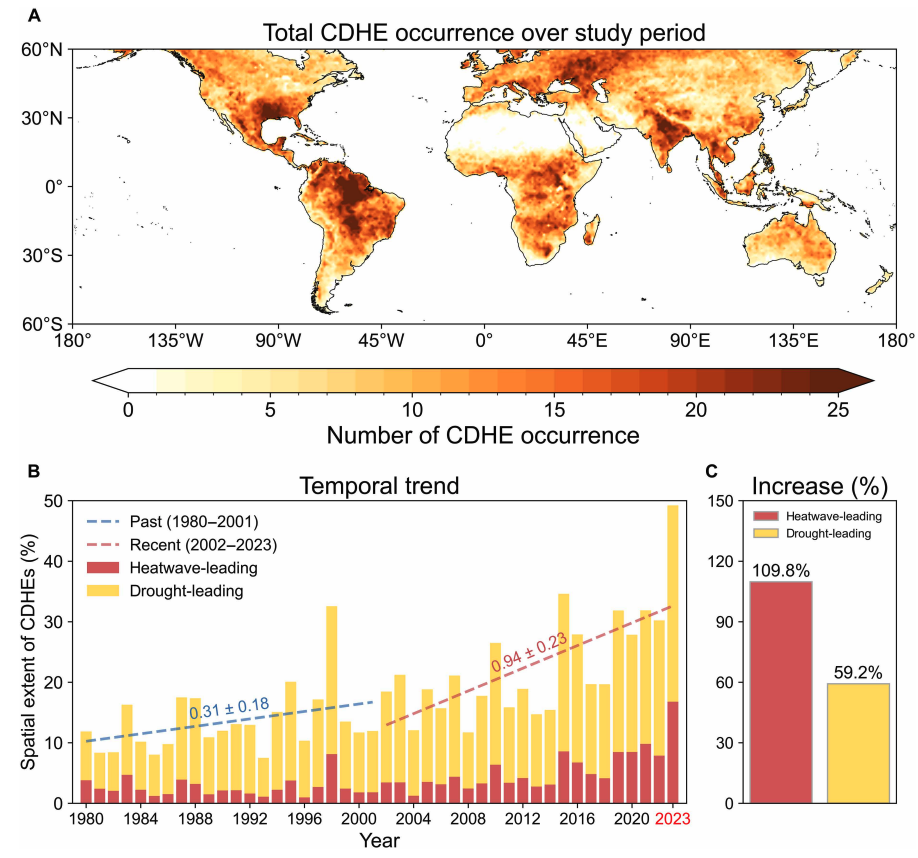
Heatwave-led events have been the main contributor to this increase, the study says, with their spatial extent rising 110% between 1980-2001 and 2002-23, compared to a 59% increase for drought-led events.
The map below shows the global distribution of CDHEs over 1980-2023. The charts show the percentage of the land surface affected by a heatwave-led CDHE (red) or a drought-led CDHE (yellow) in a given year (left) and relative increase in each CDHE type (right).
The study finds that CDHEs have occurred most frequently in northern South America, the southern US, eastern Europe, central Africa and south Asia.
Threshold passed
The authors explain that the increase in heatwave-led CDHEs is related to rising global temperatures, but that this does not tell the whole story.
In the earlier 22-year period of 1980-2001, the study finds that the spatial extent of heatwave-led CDHEs rises by 1.6% per 1C of global temperature rise. For the more-recent period of 2022-23, this increases “nearly eightfold” to 13.1%.
The change suggests that the rapid increase in the heatwave-led CDHEs occurred after the global average temperature “surpasse[d] a certain temperature threshold”, the paper says.
This threshold is an absolute global average temperature of 14.3C, the authors estimate (based on an 11-year average), which the world passed around the year 2000.
Investigating the recent surge in heatwave-leading CDHEs further, the researchers find a “regime shift” in land-atmosphere dynamics “toward a persistently intensified state after the late 1990s”.
In other words, the way that drier soils drive higher surface temperatures, and vice versa, is becoming stronger, resulting in more heatwave-led compound events.
Daily data
The research has some advantages over other previous studies, Yeh says. For instance, the new work uses daily estimations of CDHEs, compared to monthly data used in past research. This is “important for capturing the detailed occurrence” of these events, says Yeh.
He adds that another advantage of their study is that it distinguishes the sequence of droughts and heatwaves, which allows them to “better understand the differences” in the characteristics of CDHEs.
Dr Meryem Tanarhte is a climate scientist at the University Hassan II in Morocco, and Dr Ruth Cerezo Mota is a climatologist and a researcher at the National Autonomous University of Mexico. Both scientists, who were not involved in the study, agree that the daily estimations give a clearer picture of how CDHEs are changing.
Cerezo-Mota adds that another major contribution of the study is its global focus. She tells Carbon Brief that in some regions, such as Mexico and Africa, there is a lack of studies on CDHEs:
“Not because the events do not occur, but perhaps because [these regions] do not have all the data or the expertise to do so.”
However, she notes that the reanalysis data used by the study does have limitations with how it represents rainfall in some parts of the world.
Compound impacts
The study notes that if CDHEs continue to intensify – particularly events where heatwaves are the precursors – they could drive declining crop productivity, increased wildfire frequency and severe public health crises.
These impacts could be “much more rapid and severe as global warming continues”, Yeh tells Carbon Brief.
Tanarhte notes that these events can be forecasted up to 10 days ahead in many regions. Furthermore, she says, the strongest impacts can be prevented “through preparedness and adaptation”, including through “water management for agriculture, heatwave mitigation measures and wildfire mitigation”.
The study recommends reassessing current risk management strategies for these compound events. It also suggests incorporating the sequences of drought and heatwaves into compound event analysis frameworks “to enhance climate risk management”.
Cerezo-Mota says that it is clear that the world needs to be prepared for the increased occurrence of these events. She tells Carbon Brief:
“These [risk assessments and strategies] need to be carried out at the local level to understand the complexities of each region.”



The post Heatwaves driving recent ‘surge’ in compound drought and heat extremes appeared first on Carbon Brief.
Heatwaves driving recent ‘surge’ in compound drought and heat extremes
Greenhouse Gases
DeBriefed 6 March 2026: Iran energy crisis | China climate plan | Bristol’s ‘pioneering’ wind turbine
Welcome to Carbon Brief’s DeBriefed.
An essential guide to the week’s key developments relating to climate change.
This week
Energy crisis
ENERGY SPIKE: US-Israeli attacks on Iran and subsequent counterattacks across the Middle East have sent energy prices “soaring”, according to Reuters. The newswire reported that the region “accounts for just under a third of global oil production and almost a fifth of gas”. The Guardian noted that shipping traffic through the strait of Hormuz, which normally ferries 20% of the world’s oil, “all but ground to a halt”. The Financial Times reported that attacks by Iran on Middle East energy facilities – notably in Qatar – triggered the “biggest rise in gas prices since Russia’s full-scale invasion of Ukraine”.
‘RISK’ AND ‘BENEFITS’: Bloomberg reported on increases in diesel prices in Europe and the US, speculating that rising fuel costs could be “a risk for president Donald Trump”. US gas producers are “poised to benefit from the big disruption in global supply”, according to CNBC. Indian government sources told the