

Welcome to Carbon Brief’s Cropped.
We handpick and explain the most important stories at the intersection of climate, land, food and nature over the past fortnight.
This is an online version of Carbon Brief’s fortnightly Cropped email newsletter. Subscribe for free here.
Key developments
Amazon feels the heat
DOLPHIN DEATHS: More than 150 endangered pink river dolphins have washed up in recent days in the Brazilian Amazon, the Washington Post reported. It said: “The cause is unknown, but scientists say the likeliest culprit is extreme heat and drought, possibly linked to climate change and the El Niño phenomenon.” Water temperatures in a lake in the Amazonas state reached 39C recently, possibly leaving dolphins “disoriented”, a scientist told the publication. “The loss of oxygen triggers an increase in their cell metabolism, and they die of asphyxia [complete loss of oxygen],” it added.
CLIMATE’S ROLE: The deaths come during an extended period of unusual heat across several South American countries. A new analysis from climate scientists at the World Weather Attribution group released this week found that extreme September temperatures in Brazil and Paraguay were made at least 100 times more likely by human-caused climate change. It added that the temperatures were 1.4-4.3C hotter than they would have been in a world without global warming. Meanwhile, Carbon Brief covered new research finding that recent drying over the Amazon could be the “first warning signal” that the rainforest is approaching a tipping point.
RAINFOREST ROAD: Climate Home News reported that Brazilian government officials are considering using the Amazon Fund, a major source of international finance aimed at protecting the rainforest, to pay for a “controversial road project”. According to the publication, officials have a plan for “a road that cuts through the Amazon forest and connects two major cities in the north of Brazil – Manaus and Porto Velho”. Environmentalists and scientists in Brazil told Climate Home News that they disagreed with using the Amazon Fund for such a project. One of the fund’s creators, forest scientist Tasso Azevedo, told the publication: “I don’t think it makes any sense. This project does not fit into any of the fund’s planned support lines.”
EU agri round-up
LOBBY MEET-UPS: Agricultural lobby groups and six “influential” European politicians held “an average of over two meetings a week” in recent years, according to DeSmog. The outlet found that between January 2020 and July 2023, more than 400 meetings took place between six members of the European parliament (MEPs) and agri-industry representatives. The lawmakers met industry-linked groups “eight times as often as [they met] non-governmental groups representing public interests”, the outlet said. The politicians are all members of the centre-right European People’s Party, which was at the heart of climate and nature policy controversies earlier this year (see previous editions of Cropped). One of the MEPs said he does not take orders from industry groups, and the other five politicians involved did not respond to DeSmog’s request for comment.
TILLAGE V DAIRY: “Unbridled support” of the Irish dairy sector has “pushed tillage [crop farming] aside and left it struggling to survive”, according to Noteworthy. The Irish investigative outlet looked at high rental costs and other issues affecting grain growers across the country who say they feel “squeezed out”. In a separate piece, Noteworthy analysis found that around 50m tonnes of animal feed – largely maize and soya – have been imported to Ireland since 2012. The country has “never produced enough cereals – wheat, barley and oats – to meet livestock needs”, the piece added, with imports “only going in one direction – up”. Also in Ireland, the government announced a €3bn “war chest” for climate action and nature regeneration as part of the country’s annual budget, the Irish Independent reported.
OILY ISSUES: Meanwhile, the Guardian said that Europe has “almost run out of local olive oil supplies and is set for more shortages”. Extreme weather has “damaged harvests” for the second year in a row in key producer countries such as Spain, leaving Europe to import supplies from South America to meet demand, the outlet said. Rafa Guzmán, an olive grower in Jaén, “the cradle of Spain’s olive production”, told the Guardian: “It’s just awful for people down here. There’s always been the odd bad harvest, like last year. But two bad harvests in a row? I can’t remember any – and I’m 50 and have been working the trees with my dad since I was a kid.”
Spotlight
Offsets or exploitation?
In the fortnight since Carbon Brief’s week-long special, carbon-offset projects have come under further scrutiny. Bloomberg reported that Dubai-based Blue Carbon signed a deal to generate carbon credits from about a fifth of Zimbabwe’s landmass. Separately, a joint Climate Home News and Unearthed investigation found that projects in Cambodia and Brazil were “selling carbon offsets…despite an uptick in deforestation”.
India is the world’s second-largest source of carbon credits in the voluntary carbon market (VCM). For a new report, magazine outlet Down to Earth and India’s Centre for Science and Environment (CSE) analysed hundreds of offset projects and visited 40 project sites in India – from afforestation projects to paddy fields and villages enlisted in clean cookstove schemes. Carbon Brief spoke to CSE’s Trishant Dev and Avantika Goswami about their findings.
CARBON BRIEF: Perhaps the most worrying takeaway from your report is on farmers rights, especially in afforestation projects in the Araku coffee belt that you say companies such as Evian are using to claim carbon-neutrality. Did Indigenous farmers know what they were signing over? What did they get for their services, other than coffee earnings?
TRISHANT DEV: Just saplings and training [on how to care for them]. This is something that the developer also says: they will not give back incentives from offsetting to communities. When we spoke to farmers, they did not know what a carbon credit is or what rights they have given up…They only know they have signed a document through which they will be given something.
AVANTIKA GOSWAMI: Even if [developers] say they have ownership of the carbon stored in the trees, how you manage those trees and what trees you plant will determine how much carbon is stored in them. So, effectively, developers are controlling their farming methods and their practices by simply controlling the carbon in them. On what grounds does a foreign entity get to have this say over Indigenous communities in India?
The additionality question or the climate benefit was always suspect and we found that in our research. But the bigger finding is about financial benefit-sharing. You have tribal farmers putting in the labour, but earning none of the millions. You have rural households paying for an improved cookstove, which is also generating carbon credits and also earning revenue in the VCM, but the households do not earn that revenue. Our conclusion is that the poor are essentially subsidising or labouring for the emission reductions of the rich.
CB: You mention that all the projects you investigated were “cloaked in secrecy”. How open or transparent were developers in letting you visit sites and verify their claims? How do we know these credits will not be counted twice?
TD: First, we were not allowed to visit the project sites. We were told: “We have non-disclosure agreements with our clients, so we cannot take you [there].” Then we were told: “We cannot disclose the price [of credits] because we have competitors in the market.” Some developers even asked us to sign non-disclosure agreements with their clients, which we didn’t. The whole ecosystem is like a black box.
AG: If companies abroad are claiming the carbon sequestration from the Araku Valley’s coffee forests, what happens to [India’s carbon sink target] in its [Paris Agreement pledge]? Are these forests getting double-counted? Secondly, the VCM functions on a least-cost principle. So as a result, the cheaper mitigation options are essentially being sold off to foreign entities and we are left with the tougher, more expensive options. [India] cannot claim the cheaper methods – transitioning from biomass to include cookstoves or more afforestation – because, technically, if you want to avoid double counting, you have to exclude that from your own balance sheet, while rich countries continue to pollute and have taken our cheaper emission options.
News and views
PLANTATION THREAT: Writing in Trends in Ecology & Evolution, ecologists warned that monoculture tree-planting projects “are threatening tropical biodiversity while only offering modest climate benefit”, the Guardian reported. The popularity of carbon-offsetting plantations is having consequences such as “drying out native ecosystems, acidifying soils, crowding out native plants and turbocharging wildfires”, the story added. The University of Oxford researchers warned against “using carbon as the sole metric for a forest ecosystem’s importance” and argued that afforestation projects “need to encompass ecosystem restoration and biodiversity conservation”, Inside Climate News reported. Political scientist Dr Arun Agrawal, who was not involved in the paper, told the outlet: “Forests do many things, so to focus on any single metric is really to replicate how colonial governments saw forests, which is just as a source of timber.”
SMOG WARS: Indonesia’s firefighters “are rushing to extinguish” fires in southern Sumatra, Jambi and Central Kalimantan, Bloomberg reported. With no recent rainfall, national authorities warned that the fires are likely to persist, while the government is implementing “cloud seeding to induce rain that can keep the peat wet and fill reservoirs”, it added. According to Bloomberg, Malaysia blamed the fires in Indonesia for worsening air quality in its western cities, but Indonesia’s environment minister, Siti Nurbaya Bakar, denied the claims. More than 267,900 hectares of forest have burned so far this year – an area bigger than the area burned in all of 2022, Reuters reported. The haze has now hit Singapore, Reuters reported in another story.
BEDBUGS TAKE PARIS: Reports of a “plague of bedbugs” in Paris and other French cities have provoked “panic” and “insectophobia”, according to BBC News. The number of bedbug sightings have increased in recent weeks, but the upward trend dates back “several years”, the broadcaster said. The broadcaster said climate change “can be ruled out” as a contributing factor, but Prof James Logan from the London School of Hygiene and Tropical Medicine told Vice: “Most insects breed better when it’s warmer, so if there are more months of the year that are warmer, then there’s more chance of insects breeding quicker.”
BIDEN’S BORDER WALLS: In “a marked departure from…efforts to be seen as a climate champion”, the Biden administration waived environmental, health and cultural protections to build 20 new miles of a border wall in Texas, the Guardian reported. The wall will cut through fields where “the Carrizo/Comecrudo Tribe and other tribes source peyote for sacramental use”. The wall threatens to “set back the recovery” of endangered species and has “enraged environmentalists and Indigenous leaders in the Rio Grande valley”, who liken it in the story to “being stabbed in the back”. When asked if he thought the border wall was effective, President Biden responded “no” and pointed to how funds for the wall were allocated during the Trump regime, but hadn’t been cancelled by Congress, the Hill reported.
SYCAMORE STUMP: The Sycamore Gap tree, a hugely popular landmark in England sited next to Hadrian’s Wall in Northumberland, has been cut down – sparking an unusual police investigation, BBC News said. Forensic officers were sent to the site after the tree – once a place for weddings, funerals and the scattering of ashes – was felled on 28 September, BBC News reported, with one remarking: “In 31 years of forensics I’ve never examined a tree.” A 16-year-old boy and a man in his 60s were arrested on suspicion of causing criminal damage, but the investigation is still ongoing, according to the outlet.
Watch, read, listen
REVOLUTION RETROSPECTIVE: A new piece by environmental anthropologist Prof Glenn Davis Stone in the Conversation examined the legacy of Asia’s Green Revolution and the cautionary lessons it holds for Africa.
SAINATH ON SWAMINATHAN: In the Wire, P Sainath looked back on the legacy of MS Swaminathan – the “father” of the Green Revolution in India – and why he will be remembered “in the hearts of millions of peasants”.
LIVING WITH RATS: Can rats, long vilified as plague-spreaders and invasives, co-exist with humans and other species? This longread by JB MacKinnon in Hakai Magazine weighed the evidence, with illustrations by Sarah Gilman.
FOOD LOCALISM: In a new episode of BBC’s The Food Programme, host Sheila Dillon spoke to small farmers, economists and campaigners about what is needed to strengthen local food networks.
New science
Countries’ vulnerability to food supply disruptions caused by the Russia-Ukraine war from a trade dependency perspective
Scientific Reports
A new study found that food supplies in 24 countries – particularly Georgia, Armenia, Kazakhstan, Azerbaijan and Mongolia – were among the most affected by the Russia-Ukraine war, because “they depend almost entirely” on food imports from both countries. Researchers evaluated the impacts of supply disruptions on six crops and three types of fertilisers. Access to fertilisers was particularly affected in Estonia, Mongolia, Kazakhstan, Brazil, the US, China and India, the study found. Its results indicated that the Democratic Republic of Congo, Ethiopia, Egypt and Pakistan are “most vulnerable to such supply disruptions”, based on their populations, import types and purchasing power per capita.
Lessons from COP15 on effective scientific engagement in biodiversity policy processes
Conservation Biology
Scientists can boost the “effectiveness” of global agreements by focusing more on communication and engagement, a new paper found. The researchers looked at challenges limiting scientist involvement in the policy process behind the Kunming-Montreal Global Biodiversity Framework, which was agreed at the COP15 biodiversity summit last year. They drew parallels with similar challenges in global climate negotiations and compared the development of two targets – those focused on genetic diversity and protected areas – under the framework. The analysis showed that scientists can make global agreements more effective and address challenges by prioritising communications, consensus-building and being engaged with the policymaking process.
River interlinking alters land-atmosphere feedback and changes the Indian summer monsoon
Nature Communications
Proposed river “interlinking” projects in India, meant to counter the impact of increasing droughts and floods, could cause average September rainfall to drop by up to 12%, according to a new study. The authors used a coupled regional climate model and multiple datasets to show land-atmosphere feedbacks between river basins in India. They found that increased irrigation from such water transfers would increase the pressure on areas that are already water-stressed. The study’s results showed that reduced rains in September as a result of these projects “can dry rivers post-monsoon, augmenting water stress across the country and rendering interlinking dysfunctional”.
In the diary
- 8-12 October: UNFCCC Middle East and North Africa Climate Week | Riyadh
- 9 October: Deadline for expert comments on the next revision to the System of National Accounts | Online
- 14 October: Australia Indigenous rights referendum
- 14 October: New Zealand general election
- 15-19 October: CBD 25th Meeting of the Subsidiary Body on Scientific, Technical, and Technological Advice (SBSTTA 25) | Nairobi
- 16 October: FAO World Food Day
- 19-20 October: CBD resumed second part of COP15 | Nairobi
Cropped is researched and written by Dr Giuliana Viglione, Aruna Chandrasekhar, Daisy Dunne, Orla Dwyer and Yanine Quiroz. Please send tips and feedback to cropped@carbonbrief.org
The post Cropped 11 October 2023: Amazon dolphin deaths; EU agri round-up; ‘Exploitative’ carbon offsets appeared first on Carbon Brief.
Cropped 11 October 2023: Amazon dolphin deaths; EU agri round-up; ‘Exploitative’ carbon offsets

The launch of the Africa Energy Bank (AEB) has been put back yet again, raising doubts about the institution’s future ability to finance fossil fuel projects – its main objective – as global lenders retreat from such investments over climate concerns, experts told Climate Home News.
The bank, which had been billed to launch in September after a series of delays, is now scheduled to begin operations in November, according to the head of the African Energy Chamber, an advocacy body for the continent’s oil and gas sector.
Even as the world aims to transition away from fossil fuels, many African leaders have made clear they want to continue exploring and extracting the continent’s large oil and gas deposits – estimated at around 125 billion barrels of crude and over 600 trillion cubic feet of gas – to boost economic development.
As a group, Africa sided with a number of powerful oil-and-gas producing nations in blocking progress on negotiations to craft a global roadmap to transition away from fossil fuels at last year’s UN COP30 climate talks, although some countries did individually support the proposal.
-
Campaigners oppose Dangote’s planned Kenya refinery over climate and ecological risks
Plans to build Africa’s second largest oil refinery in ecologically sensitive region criticised as “environmental recklessness” -
Tanzania pushed African nations to oppose fossil fuel transition at COP30
While chairing the African group at the summit, the gas-dependent nation advised the continent’s ministers to block language on transitioning away from fossil fuels


Meanwhile, major projects under development across the continent – including the 1,443-km East African Crude Oil Pipeline (EACOP) and Dangote’s 700,000-barrel-per-day Kenyan refinery – show that African governments see oil and gas as playing a significant role in meeting their energy and economic needs for many years to come.
In 2022, at a gathering of the African Petroleum Producers’ Organization (APPO) in oil-rich Angola, ministers from its member states adopted a resolution to create the Africa Energy Bank to finance projects for the production, use and trade of oil, gas and broader energy sources.
African control over energy resources
An article on the APPO website explains that the bank was conceived as a way to overcome “disenchantment” with fossil fuels among “the international community” which it said had crystallised around the “energy transition” concept.
“If Western countries, after having long taken advantage of the energy sources they now revile to develop, can afford the luxury of abandoning them, this is not the case in Africa,” it adds, noting that many of the continent’s economies are still largely dependent on oil and gas revenues.
A separate web page about the bank, also hosted on APPO’s website, says its objectives include financing the exploration, production and refining of oil and gas, as well as supporting member states in transitioning from fossil fuels to cleaner energy sources “while ensuring energy security”.
Said Addi, a former executive with Shell and energy commodities trading house Gunvor, said the new bank was judged necessary because financing for hydrocarbons from many traditional international lenders has become constrained.
In trying to fill this financing gap, Africa is not simply setting up another fund to support oil and gas, he added. “It is also an attempt to give African countries greater control over how their energy resources and infrastructure are financed,” he explained.
Nigeria to host the AEB
The energy bank – a joint initiative of APPO and the African Export–Import Bank (Afreximbank) – has so far suffered several delays and is almost two years behind schedule. The initial plan was to start operations in January 2025, with Nigeria as the host country, but the bank’s opening was delayed to June of that year to allow Nigeria time to finalise the construction of the bank’s headquarters in Abuja.
After the government announced the completion of the offices in late November 2025, a new launch date was set for January 2026, which was moved back to April, June and then September. Now it has shifted again to November, raising concerns that the institution may be losing momentum.
Former Shell executive Addi said that if the capital is eventually paid in, the bank becomes operational and its first projects are commercially credible, then the delays will be regarded as normal teething troubles in setting up a multilateral institution. But, he added, scepticism will be justified if it continues to stall.
Uganda may see lower oil revenues than expected as costs rise and demand falls
Baron Lamarré, an oil and gas expert and former Petronas oil trader, said that missing “three deadlines in a row is not normal”, and warned that if the timeline slips again, “the story flips from ‘ambitious institution finding its footing’ to ‘good idea that lost momentum before it found any’.”
The Nigerian government, APPO and Afreximbank did not respond to requests for comment by the time of publication.
The funding challenge
The Africa Energy Bank is targeting base capital of $5 billion, with plans to scale up to $120 billion within five years by mobilising private-sector funds. However, it is expected to start operations with initial seed capital of $500 million.
The funding plan is to have the 18 member countries of the APPO contribute $83 million each to the bank as equity for a combined $1.5 billion. Afreximbank, other non-APPO African countries and investors outside the continent are expected to provide the remaining $3.5 billion.
But even the initial $500 million has not been easy to mobilise. In May, APPO Secretary-General Farid Ghezali called on members to deliver on their pledges towards the startup goal before the end of June. But the delays suggest this may not have been met, with experts saying Africa may be finding it difficult to self-fund its oil and gas projects in the absence of international capital.
Lamarré said every extension of the deadline points to the fact that “raising fossil fuel capital in Africa without the majors and their financing networks is brutally hard”.
Why the global electrification agenda misses the point on Africa’s energy crisis
Since 2020, Western lenders, export credit agencies and insurers have been in steady retreat from African hydrocarbons, he said, while oil majors are divesting their African assets, handing over fields to smaller local operators whose credit ratings are not high enough to borrow cheaply.
Even capital from China and the Gulf, which has partially filled the gap, cannot match the volume, tenor or pricing that Western investors once offered, Lamarré argued.
“If mobilising the first $500 million of seed capital [for the AEB] has taken this long, that’s the clearest signal yet of how steep the climb to $120 billion looks,” he said, noting that the continent’s energy financing gap is as large as $30 billion-$45 billion per year.
Africa’s investment landscape, meanwhile, has been shifting. While foreign direct investment dropped from a 2024 peak, inflows remained roughly one-third above the continent’s long-term average in 2025, according to the 2026 World Investment Report from UN Trade and Development (UNCTAD). They are concentrated in a few sectors including critical minerals needed for renewable energy technologies, battery manufacturing and advanced industrial production.
At the same time, data on global energy investment from the International Energy Agency (IEA) shows that fossil fuel investment in Africa has declined over the last decade.

“Trojan horse” for fossil fuels
While the Africa Energy Bank struggles to get off the ground, climate campaigners have criticised its primary aim of financing oil and gas on the continent at a time when the world is starting to move away from high-carbon fuels to cleaner alternatives.
Bhekumuzi Dean Bhebhe, founder of Africa Change Lab, described the bank as a “Trojan horse”, arguing that its focus on fossil fuel financing runs counter to the global energy transition and the African Union’s Agenda 2063 goals of sustainable development and inclusive growth.
The energy bank, he warned, “risks locking Africa into a new cycle of debt, dependency and fossil fuel entrenchment”, adding that its financing blueprint does not pave the way for a climate-resilient future. “In truth, it is to deepen the same extractive, carbon-heavy pathways that the continent should be moving away from,” he added.
Ugandan farmers use British court to try to stop East Africa oil pipeline
Kenya-based climate and energy expert Joab Okanda said the AEB’s plan to finance oil and gas is “a misplaced priority” and it should instead back clean energy in line with the policies of some of Africa’s major export markets like Europe.
In addition, the new bank could struggle to mobilise enough resources to advance large-scale oil and gas projects, he added, noting that its proposed $5-billion initial capital is equivalent to the cost of the East African Crude Oil Pipeline alone.
The AEB’s aim of backing more fossil fuels should be flipped “to support countries that are oil-dependent to start working on their transition plans”, Okanda said.
The post Launch of Africa Energy Bank delayed again in blow to oil and gas hopes appeared first on Climate Home News.
Launch of Africa Energy Bank delayed again in blow to oil and gas hopes
A booklet published by the UK’s opposition Conservative party includes a “cost of net-zero” that appears to have been doubled by a spreadsheet error.
The “common sense” policy document argues that “what people ultimately want is a government competent enough to solve the problems for which it takes responsibility”.
In a section that says “sophisticat[ed]…modelling” should not be a substitute for “political judgement”, the “Right Way” document disparages various estimates of the cost of net-zero.
The Conservative document then claims – incorrectly – that the government’s official adviser, the Climate Change Committee (CCC), had put the cost of net-zero at close to £1tn. It says:
“In 2020, the CCC estimated that its route to net-zero would cost £957bn.”
In fact, the CCC’s 2020 estimate was exactly half this amount – £478bn – and last year it published a revised figure of £108bn, largely as a result of the falling cost of electric vehicles (EVs).
Spreadsheet error
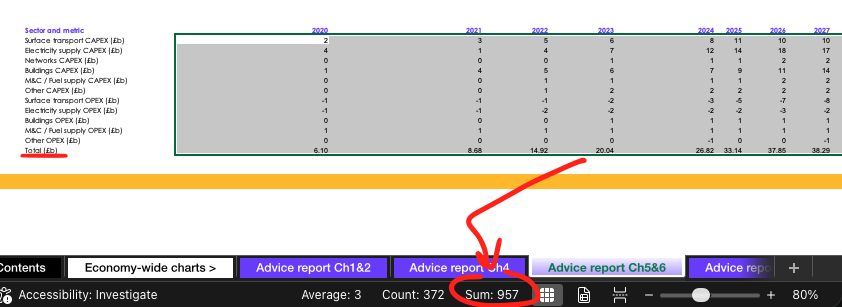
The Conservative party’s erroneous claim appears to stem from another report that had accidentally added up numbers twice, using a spreadsheet published by the CCC in 2020.
The 2020 spreadsheet contains a table listing the additional investments that would be needed to build a net-zero economy, from low-carbon electricity generation through to heat pumps and EVs.
These extra capital expenditures, listed as “CAPEX”, add up to a total of £1.38tn over the 30 years of 2020-50. They are set against operational savings, listed as “OPEX”, of £0.90tn.
Added up over 2020-50, the combined CAPEX and OPEX figures come to a total of £478bn.
In addition to the annual sectoral CAPEX and OPEX figures, the CCC’s 2020 spreadsheet also has a line giving combined totals for each year. It appears that someone has added all of these numbers together, resulting in the savings and costs being counted twice.
This double-counted total for the cost of net-zero amounts to £957bn – as shown in the image below – and it appears to be the source of the claim in the Conservative booklet.
At the time of publication in 2020, the CCC said that the £478bn net cost of net-zero amounted to less than 1% of GDP over 30 years – and that the large investment needed would not only result in savings due to lower fossil-fuel imports, but that it would boost GDP overall, by around 2%.
In 2025, the CCC revised its estimates for investment costs and operating savings to £670bn and £562bn respectively, giving a net total of £108bn over 2025-50, or less than 0.2% of GDP.
Earlier this year, the committee said that cutting emissions to net-zero would cost less than a single fossil-fuel price shock and that doing so would have benefits worth £110bn per year.
Paper trail
The erroneous claim in the Conservative document is referenced to the CCC’s 2020 advice on the UK’s sixth “carbon budget”, which, as explained, does not contain the £957bn figure.
The earliest online use