

Andreas Sieber is head of political strategy at 350.org. Shady Khalil is a senior global policy strategist at Oil Change International.
COP31 will take place in the context of what Fatih Birol, the head of the International Energy Agency, has called the “biggest energy crisis in history” – an extraordinary warning from a typically measured leader. A UN climate summit that fails to address fossil fuel dependency, energy affordability and energy access will not only fail politically; it will fail economically and socially too.
The last COP in Belém created several important building blocks: a Global Implementation Accelerator, a Just Transition Mechanism, the climate finance work programme, an expanded Action Agenda linked to the first Global Stocktake (GST1), and the Presidency-led Belém Roadmaps on forests and transitioning away from fossil fuels (TAFF).
But COP31 will need to move from frameworks to delivery. The historic first international conference on the transition away from fossil fuels in Santa Marta, Colombia, in April added further momentum to this agenda.
Development hit to importing nations
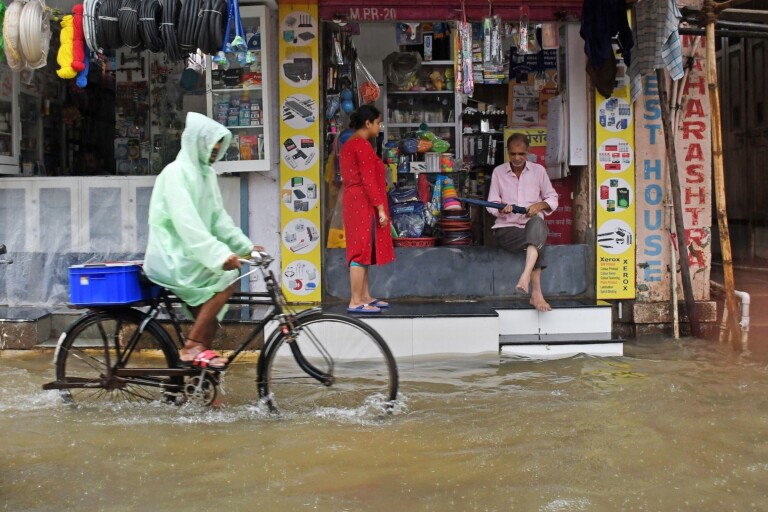
The countries paying the highest price for fossil fuel volatility are not the richest countries. The cost of dependency on fossil fuels is hitting importing low-income countries the hardest. Over three-quarters of the world’s population lives in countries that are net importers of fossil fuels. High energy prices push up food costs. Inflation fuels political instability. Debt burdens deepen. The fossil fuel crisis has become a development crisis. That is why COP31 matters.
The Presidency-led Belém Roadmaps on forests and TAFF are expected to be presented at COP31. The next step should be obvious: countries need domestic roadmaps showing how they will actually implement the transition at home.
-
El Niño expected to bring next record-hot year as soon as 2027
With El Niño set to return, the World Meteorological Organization has raised its predictions for another record-breaking hot year -
UN General Assembly backs “climate obligations” set by world’s top court
A UN resolution endorses a landmark climate ruling by the International Court of Justice that states should reduce fossil fuels and repair the damage from global warming


A growing number are expected to develop such plans. COP31 should encourage them to put together domestic implementation roadmaps for shifting off fossil fuels that have concrete milestones, sectoral targets, investment strategies and policy measures.
At the same time, these processes must recognise that countries do not share the same starting points, capacities or development needs. For some, this may take the form of comprehensive roadmaps to phase out production and consumption, while for others the priority may be economic diversification, industrial transformation or expanding energy access and energy sovereignty.
Risk of disorderly transition
Without credible planning and international cooperation, the transition risks being too slow and increasingly chaotic, with fossil fuel demand destruction occurring through rationing, price shocks and de-industrialisation rather than through a managed socially just transformation.
This stands in direct contrast to the GST commitment to an “orderly” transition away from fossil fuels. Domestic roadmaps can help chart more stable coordinated pathways that reduce social disruption while contributing to geopolitical and economic stability.
Türkiye and Australia should show leadership as the upcoming COP hosts. For Türkiye, this is particularly urgent given the absence of a coal phase-out date. Price spikes for oil and gas have siphoned around $3 billion from ordinary people and businesses in Türkiye in the first two months of the current crisis alone, calculations by 350.org show.
Australia faces a different credibility challenge. While positioning itself as a renewable energy powerhouse, it also remains one of the world’s largest fossil fuel expanders and is facing calls to tax its fossil fuel exports.
Watch CHN’s webinar: From Santa Marta to Bonn – where next for the fossil fuel transition?
According to Oil Change International, four Global North countries — the US, Canada, Norway and Australia — are responsible for nearly 70% of projected new oil and gas expansion between 2025 and 2035, equivalent to around three times the annual emissions of all coal-fired power plants worldwide.
Paragraph 36 of the Mutirão decision agreed at COP30 already invites governments to submit implementation and investment plans for their national NDC climate plans. Domestic TAFF roadmaps could become a practical way to operationalise that commitment, while also creating space for countries to define national pathways aligned with their own development priorities and constraints.
This matters because some of the most politically difficult elements of the first Global Stocktake in 2023 — especially the transition away from fossil fuels and halting deforestation — are where implementation lags furthest behind rhetoric. Governments continue to endorse transition goals but must more seriously address the harder questions: how workers are protected, how grids are modernised, how industries adapt, and how countries finance the shift while maintaining economic development and energy access.
Roadmaps for coordination and clarity
Domestic TAFF roadmaps can help answer those questions. They allow governments to coordinate internally across ministries and externally with investors, development banks and international partners. They can provide clarity on timelines, infrastructure needs, financing gaps, industrial strategy and social protection. Most importantly, they can help ensure the transition is not only fast, but fair.
The first countries willing to develop credible transition roadmaps could also help rebuild international trust. They would demonstrate that a managed phase-out of fossil fuels can support economic development, create jobs, improve energy security and expand energy access rather than undermine them. That’s the spirit of the Santa Marta conference that now needs to be emulated.
This is also becoming a geo-economic issue. In a world increasingly shaped by bilateral deals, industrial competition and fragmented trade relations, countries with credible transition plans will be more insulated from global fossil fuel shocks, far better positioned to negotiate on debt restructure and cancellation, climate finance, technology transfer and industrial policy. Governments that know where they are going can shape the transition to their advantage.

Leaders’ support needed
COP31 also presents Türkiye and President Recep Tayyip Erdoğan with a rare diplomatic opportunity. At a moment of growing fragmentation between North and South — and between East and West — Türkiye could utilise its role as a middle power and serve as a bridge-builder capable of restoring high-level political momentum to the climate process and convene a leaders summit with wide attendance.
Leaders attending COP31 should help countries agree that TAFF roadmaps are a practical way to turn climate promises into real action. These roadmaps would reflect national realities while identifying needs for international and regional cooperation, including on financing and barriers to transition such as debt burdens, technology access and trade rules.
Ultimately, roadmaps for transitioning away from fossil fuels are roadmaps for economic resilience, energy security, and political stability in a far more volatile world.
The post COP31 must persuade countries to make fossil fuel transition plans appeared first on Climate Home News.
COP31 must persuade countries to make fossil fuel transition plans

In recent days, prominent climate sceptics and rightwing commentators have shared charts on social media incorrectly implying that Europe is having its “quietest” year for wildfires in 2026.
These include Dr Matthew Wielicki, a former University of Alabama geochemist and self-described “professor in exile”, who was recently appointed by the Trump administration to lead the US Global Change Research Program.
However, these charts paint a misleading picture as they are skewed by encompassing the entirety of Russia in the data – including the vast plains of Siberia.
These charts also use data that include fires that are deliberately lit to manage cropland, which is a declining practice across much of Europe.
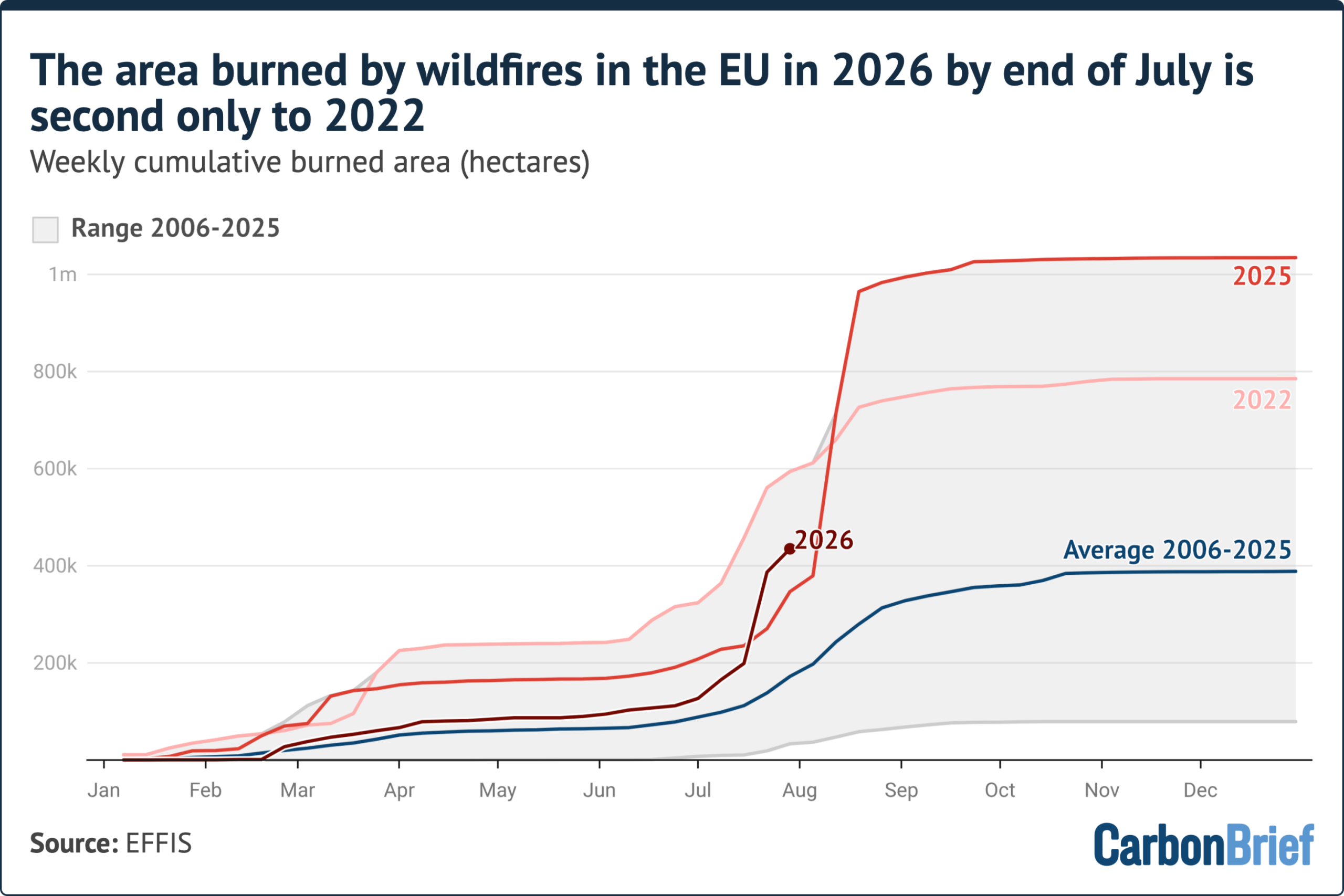
In this factcheck, Carbon Brief shows that the area burned by wildfires across the European Union in 2026 is second only to 2022 for this time of year.
The latest data from the European Forest Fire Information System (EFFIS) also shows that France has set a new modern record for area burned and Spain’s wildfire season is among the worst on record.
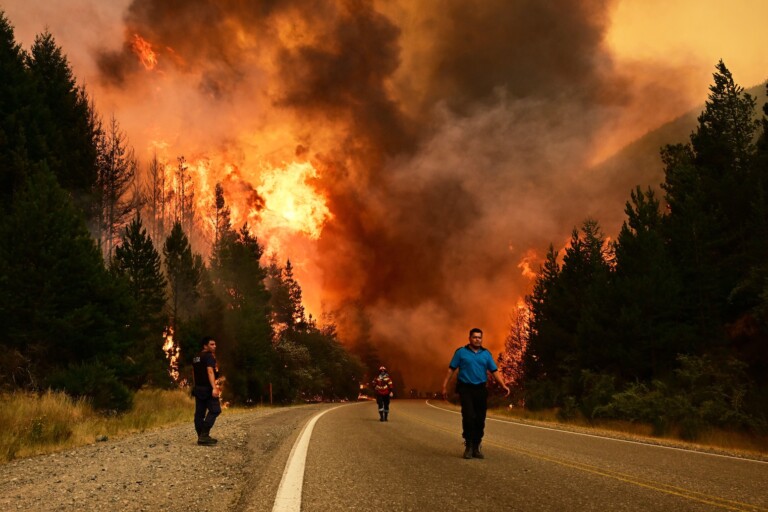
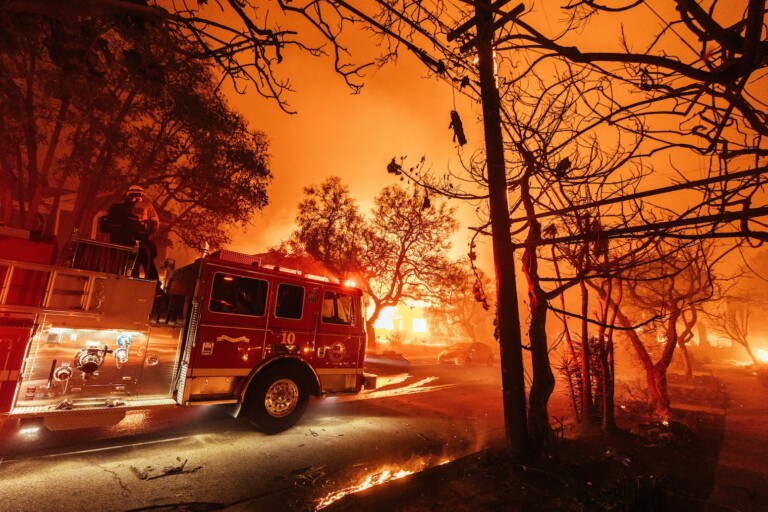
The fires have displaced more than a third of a million people across south-western Europe, while an impending heatwave has also raised fears of the fires worsening in the coming days.
‘Quietest year’
On 27 July, as wildfires raged across multiple European countries, former Conservative peer and climate-sceptic commentator Matt Ridley posted on Twitter that “2026 is the quietest year for wildfires in Europe by some distance”.
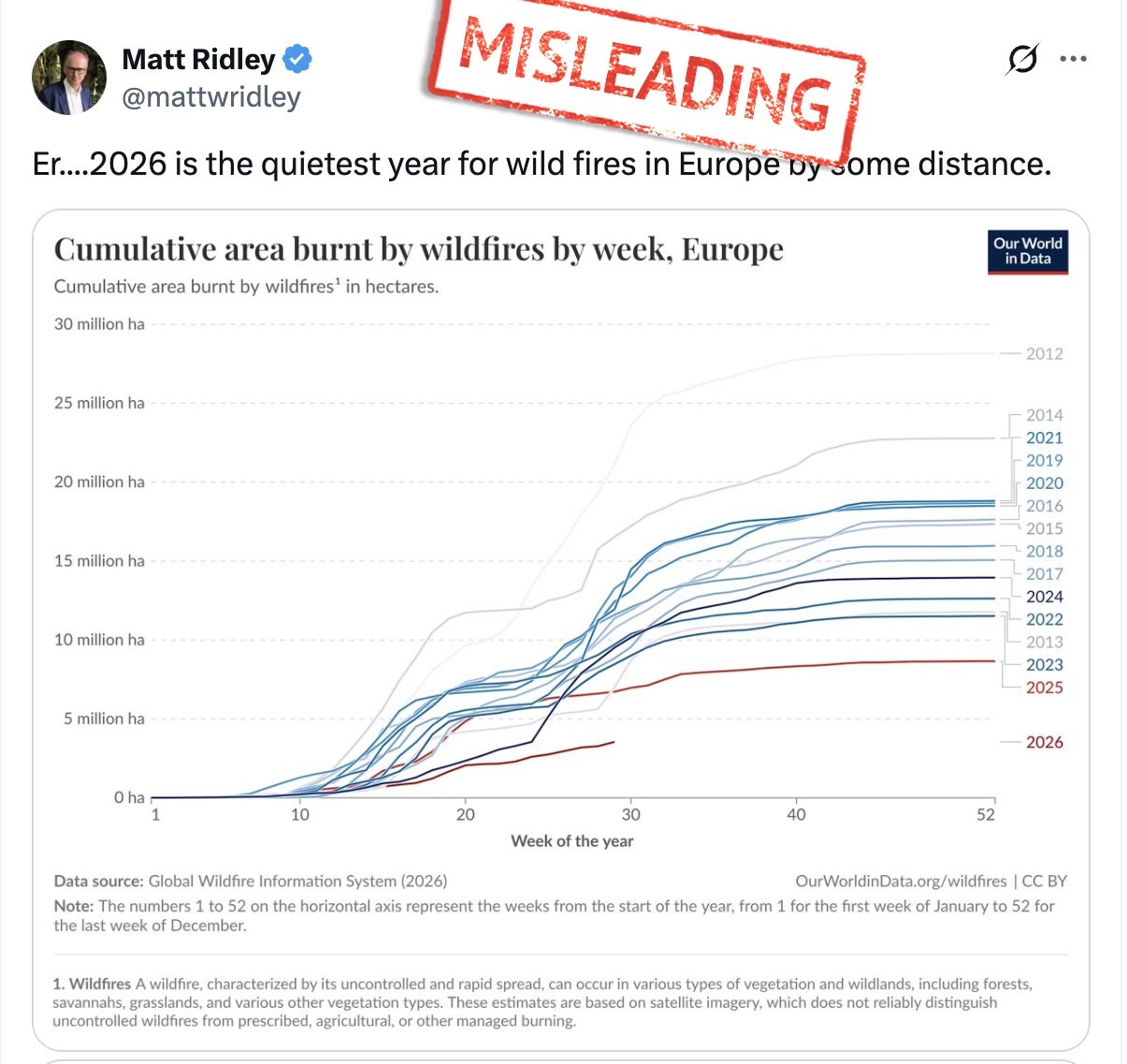
Ridley, who sits on the academic advisory council of the Global Warming Policy Foundation (GWPF), a UK-based climate-sceptic lobby group that refuses to reveal the sources of its funding, was responding to an article by Daily Telegraph columnist Tim Stanley.
Stanley’s column, headlined: “Climate change is real – and the right needs to get serious about it”, warned:
“This is no longer a matter of speculation: the wildfires of Europe, pitiless and persistent, are the way we live now.”
Ridley included a chart from Our World In Data, showing the cumulative area burned by wildfires by week for Europe. The chart puts 2026 as having the smallest area for this time of year in a dataset going back to 2012.
Ridley’s post was widely shared by prominent rightwing figures – including Richard Tice, deputy leader of the hard-right, climate-sceptic Reform UK party, former Conservative cabinet minister Jacob Rees-Mogg and multiple commentators.
Separately, Wielicki also shared a chart on Twitter to imply that wildfires in Europe are declining. Wielicki has previously claimed that the “science is not settled on climate change”.
The charts posted by Ridley and Wielicki both use data from the Global Wildfire Information System (GWIS). The GWIS category for “Europe” encompasses all the countries on the continent and includes the whole of Russia.
As a result, Russia accounts for about 74% of the area included in the GWIS definition of “Europe”.
Wildfires in Russia typically account for 80-90% of the burned area in the GWIS Europe dataset. In 2026, fires in Russia are substantially below average. Therefore, including Russia in this comparison creates the false impression that wildfire activity across Europe is unusually low.
Dr Calum Cunningham, a research fellow at the University of Tasmania’s Fire Centre, says that such claims are “highly misleading”, noting that “they rely on aggregating fire activity across an enormous and climatically diverse region”. He tells Carbon Brief:
“A relatively quiet season in Russia can easily mask an exceptionally active season in France or Spain. If the analysis is focused on the regions actually experiencing the current fires, the picture is very different.
“The reality is that western Europe has experienced an extraordinary sequence of climate conditions this year.”
In contrast, the EFFIS provides a subset of wildfire data specifically for the area covered by the 27 nations of the EU, which, therefore, excludes Russia.
Another difference between the two datasets is that GWIS monitors all fires – including those on agricultural land that are intentionally set alight. The burned area as measured by GWIS contains significant cropland area.
By contrast, EFFIS uses land-cover data and other information to filter specifically for forest fires.
Looking at the EU-only data from EFFIS reveals that Europe is far from having its “quietest” year. The bloc’s burned area, as of 29 July, is almost 435,000 hectares (ha) – second only to 2022 for this time of year.
Notably, Wielicki has actually continued to post charts based on GWIS data, even after acknowledging that “includ[ing] all of Russia, including vast areas of Siberia…isn’t a good proxy for Europe”.
French fires
Even looking at EU-wide data misses the scale of this year’s wildfires for some individual countries.
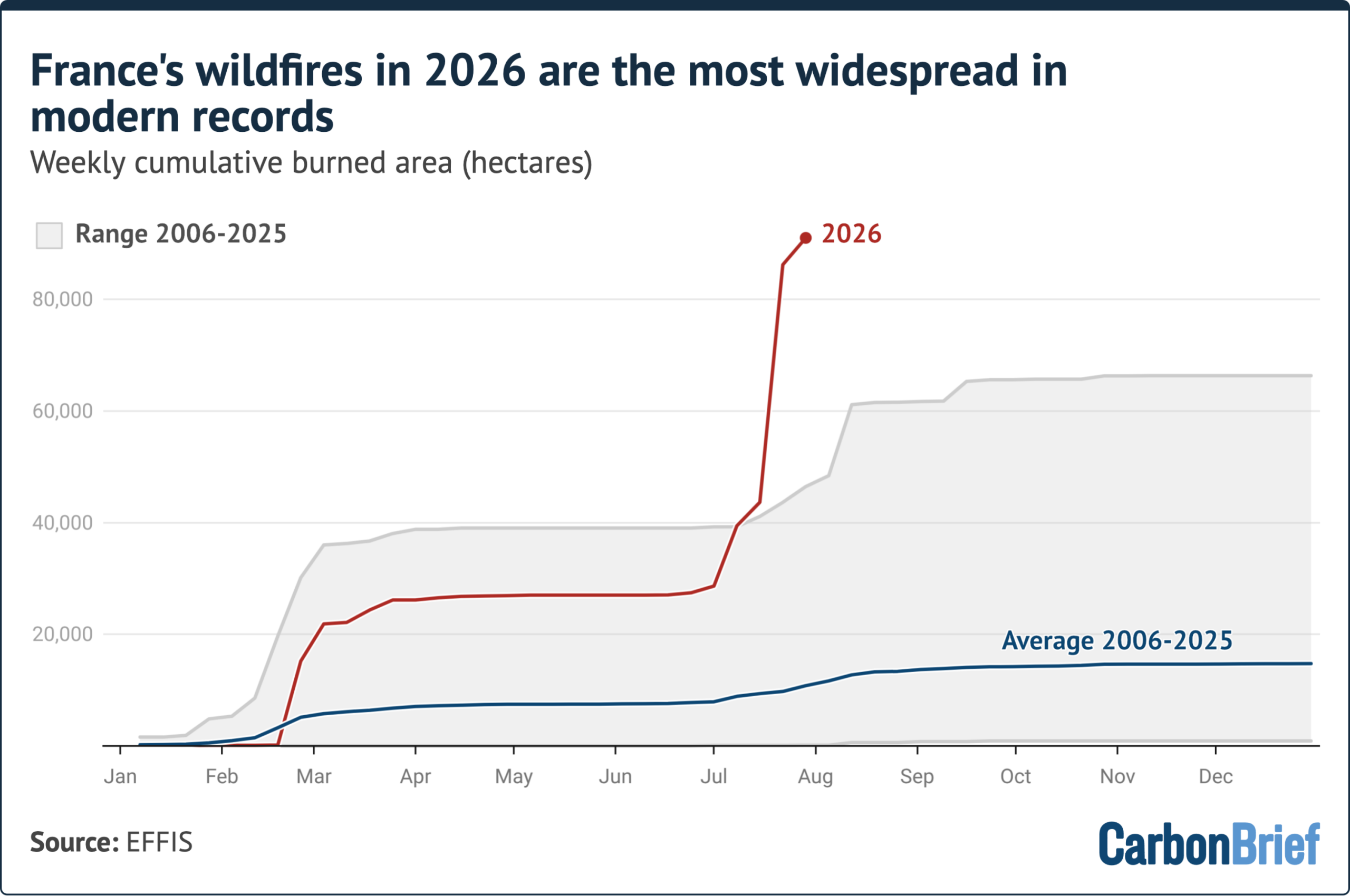
The chart below shows the surge in burned area in France since mid-July.
For much of the first half of the year, the country was having a wildfire season that was only slightly above average in terms of total burned area. However, a notable uptick began in the first week of July.
The third week of the month saw France break its previous cumulative annual record by more than 19,000ha. That gap has widened as the fires continue to burn; as of 29 July, the cumulative burned area in France during 2026 was nearly 24,700ha above the previous record.
The fires in France follow a record-breaking June heatwave that “dried out vegetation across the region, allowing fires to spread quickly”, wrote the New York Times.
On 27 July, French president Emmanuel Macron called a “crisis cabinet meeting” in order to address the fires “ravaging several areas of south-west France”, said France 24.
More than 220,000 people have been evacuated due to the Gironde fire, west of Bordeaux, in “what may be France’s largest peacetime evacuation”, reported the Associated Press.
In the Conversation, Cunningham and two other University of Tasmania researchers write that evacuation orders “protec[t] human lives, but makes it more likely houses and other structures will burn if there’s no one to defend them”. They add:
“There is little doubt climate change has made France and Spain’s wildfires worse. They represent yet another reason to redouble our efforts to tackle climate change and stabilise our climate.”
Central Spain scorched
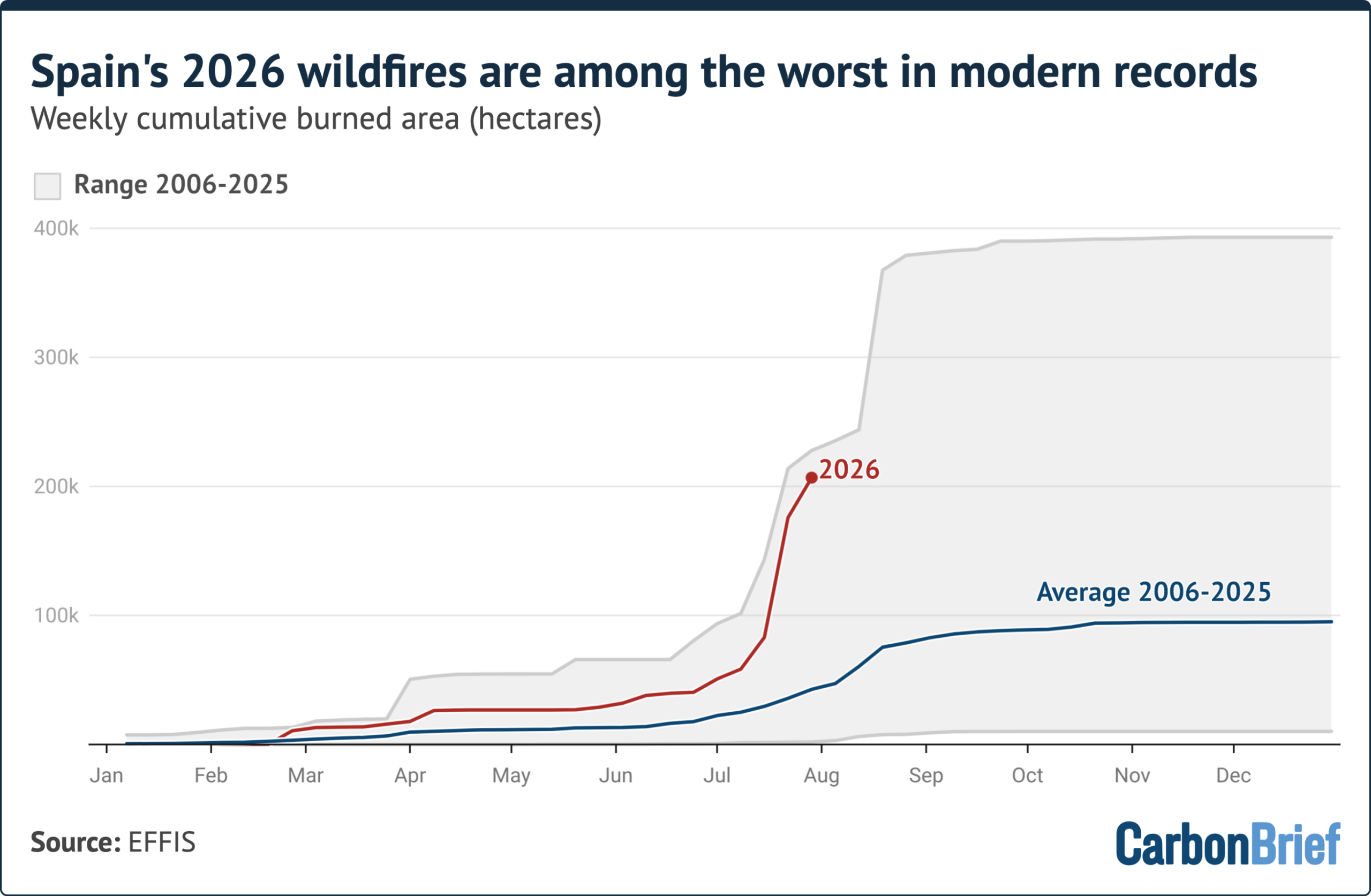
While Spain’s fire season has not broken records in the same way that France’s has, it is on track to be among the worst since EFFIS began reporting data in 2006.
The chart below shows the rapid increase in burned area in Spain since 8 July. The latest data from EFFIS reveal that, as of 29 July, Spain has almost matched its previous record at this point in the year. It is also nearly five times the average area burned for this time of year.
In Spain, the wildfires have been concentrated in the central part of the country, near Madrid.
BBC News reported that the fires outside the capital have burned “an area more than twice as large as the city itself”.
Nearly 90,000 people were forced from their homes in central Spain by the fires, said the Associated Press.
Pedro Sánchez, Spain’s prime minister, called the fires a “painful expression” of climate change.
Meanwhile, the UK, French and Spanish governments have issued joint statements this week in response to the fires. The UK/Spain statement begins:
“This summer’s wildfires demonstrated that climate change was now a national security emergency facing Europe and threatening our way of life.”
Related

The post Factcheck: No, Europe is not having its ‘quietest’ year for wildfires appeared first on Carbon Brief.
Factcheck: No, Europe is not having its ‘quietest’ year for wildfires
The general public often underestimate support for climate action, while overestimating the real-world actions taken by other people to address the problem, according to new research.
The study, published in Nature Climate Change, explores the differences between people’s support for climate change, their behaviour and their assumptions about other people’s behaviour.
It is based on multiple surveys of more than 5,000 people across Germany and the US.
The study expands on previous research on how the general public systematically underestimate the climate commitment of their peers.
The difference between actual and perceived support for climate action among the public is sometimes known as a “perception gap”.
The surveys tested how people’s perceptions of climate attitudes and behaviours relate to their own willingness to contribute and undertake “climate-friendly” actions.
One of the authors tells Carbon Brief that this perception gap is not due to “ignorance or bias”, but because “people are just not good at making good estimations”.
The research also reveals that people’s opinions and behaviours are more “nuanced than previously assumed” and suggests that simply “correcting misperceptions” does not automatically lead to greater climate action.
Measuring climate actions
The study notes that correcting the perception gap is often seen as a “cost-effective” way to promote public engagement and drive action to reduce the intensification and impacts of climate change.
Most studies that explore the perception gap have primarily focused on surveys that have asked people to report their willingness to support climate change.
In other words, researchers have relied upon people saying they would support efforts to tackle climate change, rather than measuring people’s real-world actions, such as financial donations, attending protests or changing their behaviour.
To fill this gap, the researchers behind the new study surveyed a total of more than 5,000 people in Germany and the US over 2024-25. Surveys were split across five different experiments, each focused on public perceptions of climate attitudes and how they relate to individuals’ actual behaviour:
| Experiment | What they did |
| Survey one | Participants were asked if they were willing to donate 1% of their household income to WWF – and then were given the chance to do so. Follow-up questions asked participants to predict how many of their peers said “yes” and how many actually donated to the charity. |
| Survey two | Participants read a constitutional complaint against the German government, led by Greenpeace, which demands for stricter climate policies. They were asked if they were willing to participate as a claimant and/or donate to the cause – and then were given the chance to do so. Follow-up questions asked participants to predict how many of their peers said “yes” and how many went on to support the complaint. |
| Survey three | Participants were requested to complete an online “work for environmental protection task” where the more “pages” they completed resulted in more donations to WWF. They then predicted how many pages their peers completed. Participants also rated their individual behaviours and support for eight climate policies and then estimated the same for other people. |
| Surveys four and five | Participants were split into three groups that were either informed that 4% of participants had donated 1% of their household income to WWF, that “68% were willing to contribute” or given no information. They then had to state whether they were willing to support WWF and then were given the opportunity to do so. |
The authors note that Germany and the US are two of the “top 10 CO2 emitters” and are places where climate action is “especially necessary”. However, they add that the two countries are not reflective of “diverse cultural contexts” and further research is needed across the world.
The perception gap
The researchers find that most of their participants supported climate action, but much fewer actually performed verifiable behaviours.
For example, survey one finds that 37% of participants said they were willing to donate to WWF, yet just 4% did when given the opportunity.
Participants generally overestimated the climate actions of their peers, predicting that 23% of other people donated. Willingness, on the other hand, was slightly underestimated with respondents averaging around 34%.
The results from survey three suggest that this perception gap is likely due to general cognitive processes within the human brain that make accurate estimations about large groups difficult, say the authors.
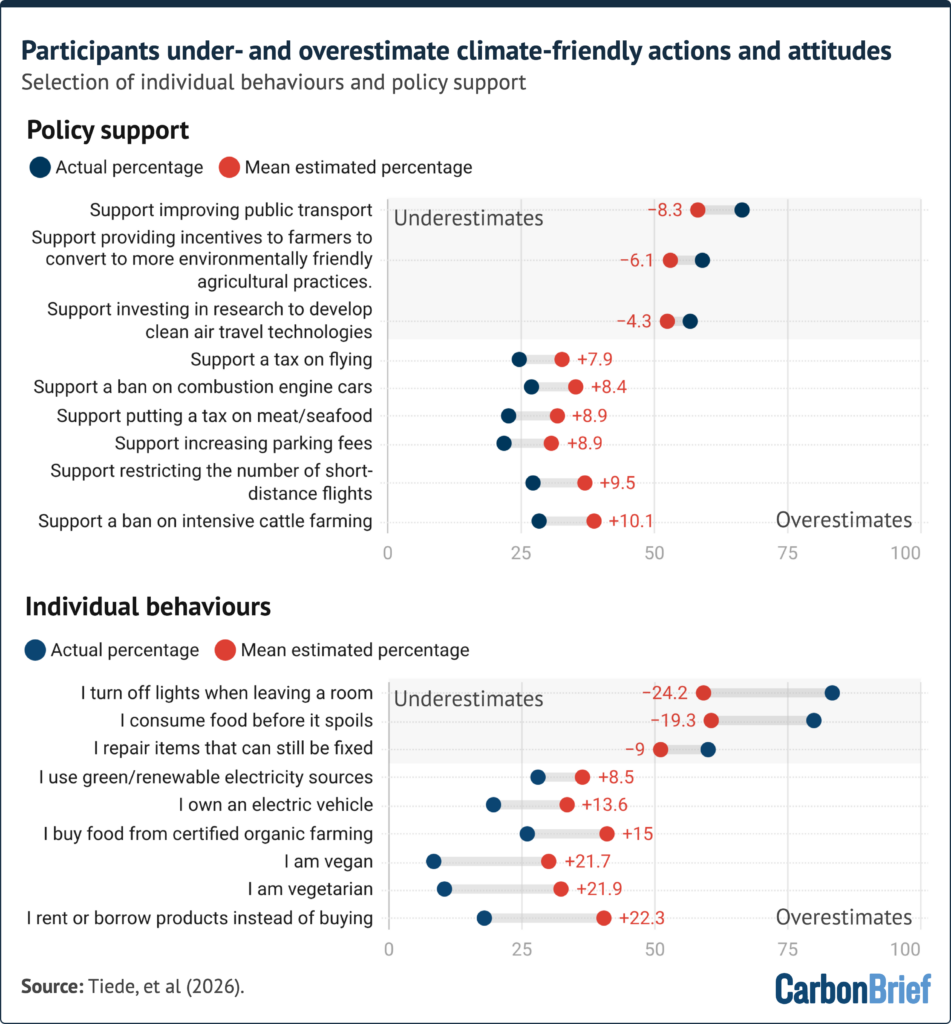
The chart below shows the actual percentage of people who supported different environmental policies and performed climate-friendly behaviours (blue dots) compared to average predictions from the surveys (red dots).
They reveal a “consistent pattern” where “small proportions were overestimated and large ones were underestimated”, the authors say, driving predictions towards the middle. This phenomenon is known as “regression to the mean”.
In other words, where public support for a policy was high, participants in the survey estimated it was lower than it was. When the support was lower, estimates would be higher.
The study finds that individual and environmental factors played a role in shaping people’s perceptions of their peers’ climate actions, which were distinct from general misestimations.
For example, people who were already involved in climate action, had more frequent climate discussions and consumed more climate-focused news and media predicted a higher proportion of climate support “across the board”.
The results from the fourth and fifth surveys show that knowing the context of other people’s beliefs and behaviour in surveys can impact the attitudes of participants.
Participants that were told that 68% of people were willing to donate 1% of their household income to the WWF were more willing to donate.
In contrast, participants that were told that 4% of people actually donated did not report more willingness to “discuss climate change, sign petitions or donate” than the control group.
However, there was no obvious impact on actual donations for any of the three groups, the study notes.
Lead study author Dr Kevin Tiede, scientific managing director of the Institute for Planetary Health Behaviour at the University of Erfurt, tells Carbon Brief that the findings suggest that “just telling people how many people support climate action is likely not enough to really change something”.
However, Tiede adds that “direct comparability” between people saying they would donate and actually donating is “limited” and that giving people more time to answer and autonomy over where to donate might result in more people taking action.
‘Pluralistic ignorance’
Tiede explains that the study findings demonstrate the existence of “pluralistic ignorance”, where a person believes their own views differ from the majority.
For climate change, this means that the “vast majority of people around the world support climate action, but people considerably underestimate the extent of this support”, the study says.
However, the surveys reveal that pluralistic ignorance “in the climate domain” is more nuanced than previously thought, say the authors.
Prof Madalina Vascleanu, an assistant professor at Stanford University’s Doerr School of Sustainability, who was not involved in the study, tells Carbon Brief that encouraging climate action is complex.
It may take multiple and repeated “attempts” at effective communication, or for people to directly “experience” the “norm” that climate change is widely supported, she says, rather than simply being told.
“Observable” behaviours, such as “identity signalling” – which could involve anything from protesting to vegetarianism – might have more of an impact on encouraging climate action among peers than “private behaviours like donations”, she adds.
The study is a “great addition to the literature”, Vascleanu says, because “correcting” the perception gap did not have an effect on climate-friendly behaviour, as “scholars had previously assumed”. She adds that it has “sparked several new hypotheses” that her “lab is now working on”.
Prof Mauro Bertolotti, associate professor of social psychology at the Università Cattolica del Sacro Cuore, explains that the “attitude-behaviour gap” revealed by the research is a “rather common finding”.
However, he is “sceptical” of the “simplified and abstract” measures, warning that experiment environments often come with “assumptions and expectations” that are different from real life.
As a result, they might not “replicate” the process people go through when choosing to “make a donation to an environmental cause”, he says.
‘Targeted’ communication strategies
The researchers argue that it is more effective to focus on “targeted” communication strategies – encouraging climate-friendly behaviours that aim to reach the majority who already support climate action, rather than trying to convert climate sceptics.
They call for attention to be paid to the attitude-behaviour gap between people saying they support efforts to tackle climate change and following up with real-world climate actions.
The study suggests strategies for decision-makers to reduce the attitude-behaviour gap, such as “facilitating climate-friendly behaviour” with “convenience and subsidies”. They also recommend ensuring environmental policy prioritises fairness to gain visible and widespread public support.
They add that the public would benefit from understanding the “effectiveness and co-benefits” of climate action.
Tiede, K.E. et al. (2026) People systematically under- and overestimate public engagement in climate action, Nature Climate Change, https://doi.org/10.1038/s41558-026-02668-z
Related
Scientists are ‘most trusted’ source of climate information in global-south survey

Survey: ‘Very few’ Africans place responsibility for climate action on ‘rich nations’
Guest post: How public attitudes towards ‘CO2 removal’ differ in the UK and US

Guest post: How ‘discourses of delay’ are used to slow climate action
The post Correcting climate ‘misperceptions’ may not boost climate action appeared first on Carbon Brief.
Correcting climate ‘misperceptions’ may not boost climate action
The spiking price of oil helped increase global sales of electric cars in the second quarter of 2026 despite total car sales falling, a new International Energy Agency (IEA) report shows.
The IEA’s latest update on the market for electric cars said sales increased by 4% in the second quarter, after the war between the US, Israel and Iran disrupted oil supplies around the world and caused oil prices to jump at the end of February.
The increase in electric car sales was achieved despite customers buying fewer vehicles in total due to economic problems and, in China, a reduction in government subsidies for cheap cars. Total car sales fell 5% globally in the first half of 2026.
“While a lag in consumer responses and policy implementation means the full effects will take time to materialise, the crisis has clearly reinforced the case for [electric vehicles] as a way to address energy security and fuel cost concerns,” the IEA’s report said.
-
Chinese EV brands woo Yemen’s wealthy elite as war prompts solar boom
For the well-off few, buying an EV is the next step in a solar revolution that has helped Yemenis weather years of power outages and high fuel prices -
Charging worries, high prices put brakes on EV growth in Bangladesh
Sales of e-bikes and rickshaws are up amid queues at fuel stations, but a lack of charging infrastructure and high prices still deter many Bangladeshis from going electric -
Nepal’s EV revolution pays off as oil crisis causes pain at the pumps
Import subsidies, abundant hydropower and charging investments have spurred EV adoption, with electric vehicles now making up about three-quarters of new car sales


The IEA predicts that sales of electric cars will speed up in the second half of the year, increasing by 10% for 2026 in total compared to 2025. Electric car sales will be 29% of total car sales over the full year, it forecasts, up from 24% in the first half.
The IEA expects sales of fossil fuel-reliant internal combustion engine vehicles to continue declining, as they have been doing for a decade because of economic shocks like the COVID-19 pandemic and, since around 2020, the rise of electric cars.
Road transport – which also includes two- and three-wheeled vehicles like scooters and rickshaws – currently accounts for half of global oil use. The oil industry has been trying to expand markets in newer, growing sectors like plastic to replace its declining business in petrol and diesel for road transport.
Pro-EV policies
As well as the higher oil price, the IEA said this year’s electric car boom is being driven in some countries – particularly in Europe and Southeast Asia – by government policies that have been put in place since the Iran war blocked shipping of oil and other commodities through the Strait of Hormuz.
It highlighted the Netherlands and Ireland, which have both announced subsidies for scrapping old internal combustion engine cars and replacing them with electric ones.
Australia, Spain, Chile, Vietnam and the US state of California have introduced, or are introducing, tax benefits for electric cars.
Australia, the UK and Hungary have announced funding or support for charging infrastructure, while Cambodia, Brazil and Kenya have reduced taxes on imports of electric vehicles.
Growth in electric car sales was particularly strong in Europe, Brazil, Australia, India, South Korea, Vietnam, Colombia, South Africa and New Zealand.
On the other hand, electric car sales fell 16% in China – the world’s biggest electric car-buying country – in the second quarter. This was driven by a decline in total car sales, which was more extreme for internal combustion engine cars than electric ones.
In the US, electric car sales rose 20% in the second quarter compared with the first quarter of 2026. But this was about 25% less than in the same period of 2025, when Americans were taking advantage of expiring Biden-era federal tax credits.
These statistics back up Climate Home News’ reporting from the ground since the oil price spiked. As we reported from Yemen in May, the IEA data shows Chinese electric car companies are having success in the Middle East.
And as our correspondents found in Nepal and Bangladesh, there has been a surge of interest in electric vehicles across Asian countries outside of China. Yet while EV adoption in Nepal has been enabled by investments in charging and import subsidies, drivers in Bangladesh have been put off by a lack of chargers and high prices for electric two-wheelers.
The post Hormuz crisis speeds up transition to electric cars, IEA data shows appeared first on Climate Home News.
Hormuz crisis speeds up transition to electric cars, IEA data shows



-
Greenhouse Gases12 months ago
Guest post: Why China is still building new coal – and when it might stop
-
Climate Change12 months ago
Guest post: Why China is still building new coal – and when it might stop
-

 Greenhouse Gases2 years ago
嘉宾来稿:满足中国增长的用电需求 光伏加储能“比新建煤电更实惠”
-

 Climate Change2 years ago
嘉宾来稿:满足中国增长的用电需求 光伏加储能“比新建煤电更实惠”
-
Climate Change2 years ago
Bill Discounting Climate Change in Florida’s Energy Policy Awaits DeSantis’ Approval
-

 Renewable Energy9 months ago
Sending Progressive Philanthropist George Soros to Prison?
-

 Carbon Footprint2 years ago
US SEC’s Climate Disclosure Rules Spur Renewed Interest in Carbon Credits
-
Greenhouse Gases1 year ago
嘉宾来稿:探究火山喷发如何影响气候预测