The COP30 climate summit – held in the city of Belém, on the edge of the Amazon rainforest – saw the Brazilian presidency launch a new forest fund and promise a “roadmap” to put an end to deforestation.
Almost every country in the world signed off on a final COP30 package called the “global mutirão” – meaning “collective efforts” – after two weeks of talks ran into overtime amid deepening divisions, compromises and even a fire in the conference venue.
Countries also agreed on a set of indicators for countries to track their efforts on climate adaptation, including within the food and agriculture sectors.
Brazil’s much-anticipated tropical forest fund, launched just before COP30 officially began, raised $6.6bn, more than half of which will come from Norway and Germany.
In the second week of the negotiations, dozens of countries backed plans to agree on roadmaps to guide the move away from fossil fuels and deforestation.
Although these roadmaps did not make it into the final negotiated text, COP30 president André Corrêa do Lago said they will be developed outside the formal UN process.
The final mutirão text mentioned biodiversity loss, land rights and deforestation, but did not feature food – which disappointed some observers, including one expert who said food systems had been “erased” from COP30.
Meanwhile, the formal agriculture negotiations ended without a substantive outcome and talks are expected to continue next year.
Indigenous peoples featured strongly at COP30 and attended the summit in larger numbers than ever before. During the talks, $1.8bn was pledged for land rights and Brazil announced new Indigenous territories.
Below, Carbon Brief breaks down the main COP30 outcomes on food, forests, land and nature.
(See Carbon Brief’s coverage of key outcomes for food, forests, land and nature from COP29, COP28, COP27 and COP26.)
‘Global mutirão’
COP30 saw countries agree to a new “global mutirão” decision, a text calling for a tripling of adaptation finance by 2035 (later than some hoped), a new “Belem mission” to increase collective actions to cut emissions and – to the disappoint of many countries – no new “roadmaps” on transitioning away from fossil fuels and reversing deforestation. (See Carbon Brief’s snap analysis.)
“Mutirão” is a Portuguese word originating in the Indigenous Tupi-Guarani language that refers to people working together towards a common aim with a community spirit – something the COP30 presidency was keen to emphasise.
The presidency was also keen to stress that the mutirão text was not a cover text (sometimes referred to as a “cover decision”). However, like a cover text, it sought to bring together important issues that were not on the formal agenda with negotiated targets, acting as the key agreement from COP30.
The first draft of the mutirão put forward by the Brazilian presidency on 18 November included optional text to create a “high-level ministerial round table”, aimed at supporting countries to develop their own national roadmaps on transitioning away from fossil fuels and halting and reversing deforestation. (See: Deforestation roadmap.)
The language around this was criticised as weak by some observers, but its inclusion was widely welcomed.
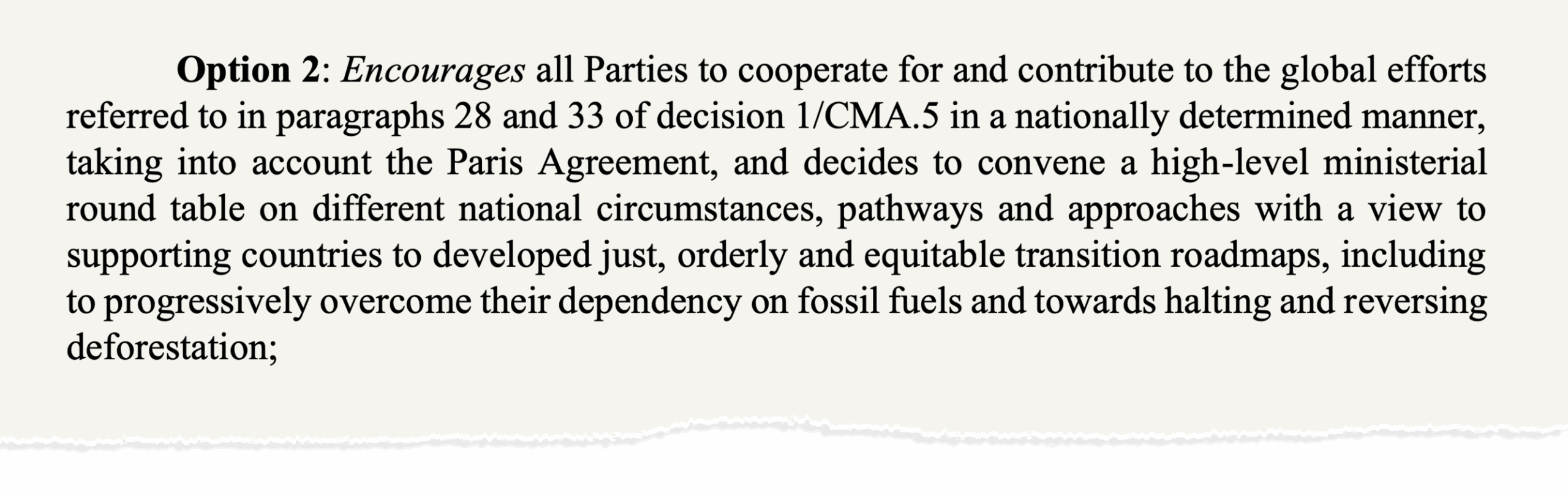
The final mutirão decision did not mention fossil fuel or deforestation roadmaps. It did mention deforestation once, “emphasising” the importance of boosting efforts to halt and reverse deforestation by 2030 to help achieve the Paris temperature goal.
It noted that this is “in accordance with Article 5 of the Paris Agreement”, which is a section of the landmark climate deal that calls for strengthening of the world’s carbon sinks, including forests. (Carbon Brief understands that a large group of rainforest nations, called the Coalition of Rainforest Nations, were particularly keen to have Article 5 referenced in the final mutirão decision.)
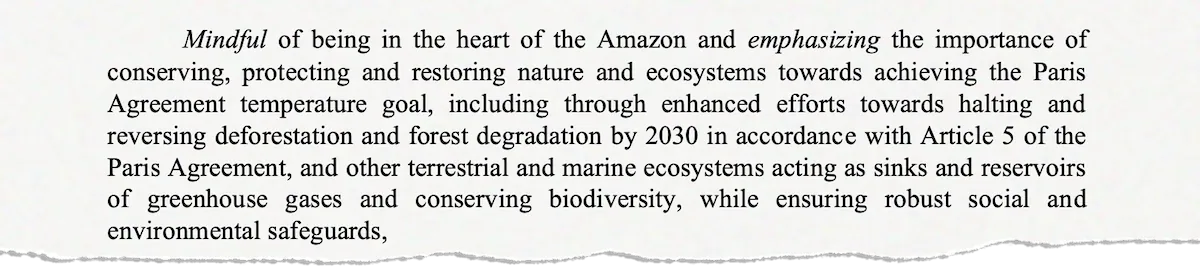
The final mutirão decision makes multiple brief mentions of nature and the need to tackle climate change and biodiversity loss in a synergistic way.
Paragraph two of the agreement, in the section sometimes called the “preamble”, “emphasises” the importance of “conserving, protecting and restoring nature and ecosystem”.
Further down, in a section “recalling” the first global stocktake of climate action conducted at COP28 in Dubai in 2023, the text “underlines” the “urgent need to address, in a comprehensive and synergetic manner, the interlinked global crises of climate change, biodiversity loss, and land and ocean degradation in the broader context of achieving sustainable development”.
This inclusion likely reflects the presidency’s keenness to prioritise “synergies” between climate change, biodiversity loss and land degradation. (See: Climate and nature ‘synergies’.)
While the mutirão text included references to safeguarding Indigenous rights, conserving biodiversity and maintaining nature-based stores of carbon, no mention of food or agriculture appeared in any draft of the text.
Prof Raj Patel, a member of the International Panel of Experts on Sustainable Food Systems (IPES-Food), said in a statement that it was as if food systems were “erased” from the negotiations, adding:
“Two years ago, 160 countries signed a Declaration on Sustainable Agriculture with great ceremony. Today, they cannot bring themselves to mention the word ‘food’ in the mutirão decision.”
Adaptation
One of the major negotiated outcomes of the Belém summit was the agreement of a set of indicators for countries to measure their progress towards the global goal on adaptation (GGA).
The GGA, agreed at COP28 in Dubai, sets out 10 targets for countries to measure their progress towards, including targets on water scarcity, climate-resilient food systems and reducing climate impacts on ecosystems.
The initial list of indicators for these targets numbered 10,000. These had been whittled down by experts since COP28 and, at COP30, negotiators were tasked with agreeing on just 100 for countries to use.
Divisions were apparent from the first day of COP30, with the African group and Arab group proposing a two-year period for refining the GGA indicators before formally adopting them in 2027, according to the Earth Negotiations Bulletin. This move was opposed by several other blocs, including the Independent Alliance of Latin America and the Caribbean (AILAC) and the EU.
Disagreements arose between countries on the need for finance in order to implement the GGA, whether indicators infringed on countries’ sovereignty and indicators around domestic financing.
Richard Muyungi, African group chair, told Carbon Brief in the first week:
“We need to put guardrails or caveats on the adoption [of the indicators]. For example…the indicators should not infringe on the sovereignty of countries, asking countries to change their laws, their strategies. I mean, you cannot ask my country to change laws, because they want to address the global goal.”
Ultimately, countries adopted a set of 59 indicators and agreed to a two-year work programme “aimed at developing guidance for operationalising the Belém adaptation indicators”.
The set included five indicators on assessing progress towards climate-resilient and sustainable food systems.
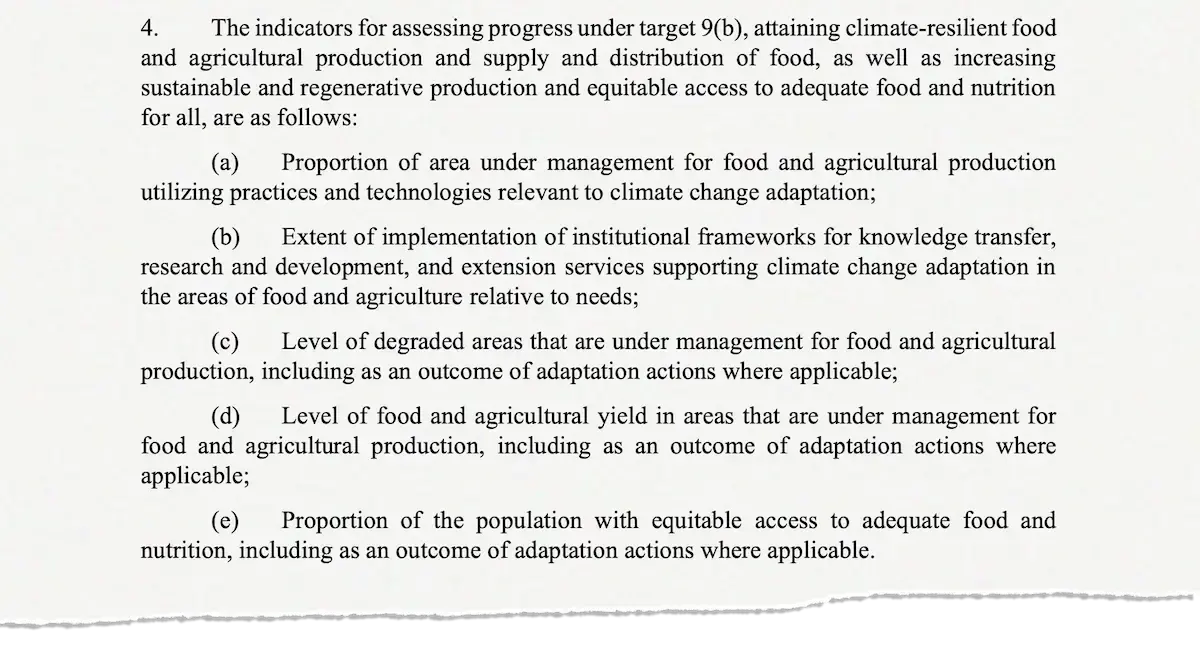
The indicators on ecosystems and biodiversity included measuring the proportion of ecosystems “providing services to populations that depend on them”, the level of adaptive capacity due to the implementation of nature-based solutions and the levels of threat status of ecosystems and species.
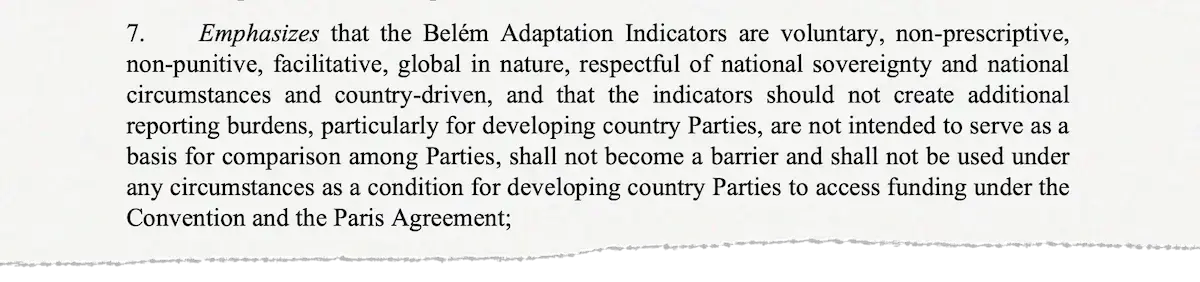
However, observers noted that the indicators were heavily caveated, with the introductory text of the agreement “emphasis[ing]” their voluntary nature.
(For more on adaptation and the GGA, see Carbon Brief’s explainer of COP30’s key outcomes.)
Tropical Forest Forever Facility and other forest pledges
At the COP30 leaders’ summit, Brazil officially launched the Tropical Forest Forever Fund to “reward” countries that conserve their tropical forests.
During the negotiations, the facility raised $6.6bn and had the support of 53 countries, including countries with tropical forests and those that will act as investors.
This instrument is intended to be a financial vehicle to raise $125bn from countries, philanthropy and private investors, which will then be invested in the global bond market. It is intended to be able to support up to 74 countries that have tropical forests across many regions, such as the Amazon and the Congo Basin.
The TFFF has been described as “the largest forest-finance mechanism ever created” and praised by Brazil’s finance minister, Fernando Haddad, as “innovative” for combining public and private financing.
However, it has also received criticism.
As Carbon Brief has previously reported, experts have concerns around fragmenting existing climate finance and inadequate accountability. Other criticisms have focused on worries that the fund could benefit investors over forest countries and that 20% of the funds being directed to Indigenous peoples is insufficient.
For Sandra Guzmán, founder and general director of the Climate Finance Group for Latin America and the Caribbean (GFLAC), the Brazilian government focused on moving forward with the TFFF and neglected other aspects of financing, such as the Baku to Belém roadmap to mobilise $1.3tn per year in climate finance by 2035. She told Carbon Brief:
“The TFFF is not a mechanism that has been agreed upon multilaterally. [If the fund fails in its mission], it would only confirm that Brazil could have [capitalised] on other funds that are within the [UN climate] convention and do have a future.”
After the launch of the TFFF, it was rejected by 150 civil society groups and Indigenous peoples’ organisations, who said the fund “does not seek to address the true structural causes of forest destruction” and “does not prioritise Indigenous peoples and local communities”.
The COP30 presidency stated that, in the second week of negotiations, governments, multilateral funds and Indigenous leaders met to discuss how an Indigenous governance model – known as Dedicated Grant Mechanism (DGM) – can “inform and strengthen the emerging generation of climate finance facilities”.
Analysis by the civil society organisation Leave it in the Ground (LINGO), presented at COP30, suggested that not extracting fossil fuels beneath forests eligible for the TFFF would prevent 4.6tn tonnes of CO2 from being released.
These emissions would be saved if countries “were to adopt a pledge of no fossil-fuel extraction in its forests”, the report said.
Kjell Kǘhne, director of LINGO, said in a press conference attended by Carbon Brief that while restrictions on fossil fuels are not part of the scope of the discussions of the TFFF, this would make it “even stronger”.
Other forest funds
Elsewhere at COP30, countries renewed their COP26 commitment to help protect rainforests in the Congo Basin, which contains the world’s second-largest area of tropical forest.
A Belém “call to action” pledged to raise more than $2.5bn for the cause over the next five years. This was put forward by Gabon and France and signed by Germany, Belgium, Norway and the UK, alongside development banks and other groups.
A new pledge of $1.8bn was put forward from more than 35 governments and philanthropic organisations to help secure land rights across forests and other ecosystems for Indigenous peoples, local communities and Afro-descendent communities, according to the Forest & Climate Leaders’ Partnership. (See: Indigenous representation.)
The UK also announced almost £17m in funding for the Accelerating Innovative Monitoring for Forests (AIM4Forests) programme, a cooperation between the UN Food and Agriculture Organization (FAO) and the UK that supports countries in monitoring and reporting on forests.
Meanwhile, Brazilian development bank BNDES approved R$250m (£35m) for ecological restoration and tree-management projects in parts of the Amazon and Atlantic forests, Brazilian outlet InfoMoney reported, adding that the funding will help to recover up to 19,000 hectares of forest land.
On 17 November, when forests featured as one of the COP30 themes of the day, more than 70 civil-society groups called on governments to set up forest “fossil-free zones” – areas where oil, coal and gas are not extracted – to protect forests and the rights of Indigenous peoples and local communities.
Earlier that week, Colombia said it was the first Amazonian nation to keep its entire Amazon forest area “free from oil and mining activities”, InfoAmazonia reported.
Countries that hold the Amazon rainforest, including Brazil, Peru and Colombia, also launched an initiative, called Amazonia Forever, to gather more than $1bn to invest in Amazonian infrastructure and cities.
Brazil’s planning and budget minister, Simone Tebet, said this programme for cities and resilient infrastructure would “enable us to take action not only on forest and water resources, but also on urban challenges”.
Agriculture and food security
With agribusiness giant Brazil hosting this year’s summit, many expected COP30 to have a stronger focus on agriculture and food than previous years.
Formal negotiations for agriculture and food systems under the UN climate convention fall under the Sharm el-Sheikh joint work on the implementation of climate action on agriculture and food security (SJWA). COP30 ended without a substantive outcome for the SJWA.
The current four-year mandate of SJWA – which runs workshops, is developing an online portal and prepares an annual synthesis report of agriculture-relevant work undertaken by UN climate convention bodies – began in 2022 and runs out at COP31 next year.
At COP30, the main points of discussion for countries were a consideration of the outcomes of a workshop on “systemic and holistic approaches” to implementing climate action on food and agriculture, as well as countries weighing in on a special forum of the standing committee on finance (SCF) on financing for sustainable food systems and agriculture.
As the summit got underway in Belém, several parties began pushing the idea of capturing key messages from the workshop and forum into a formal SJWA decision.
Observers told Carbon Brief that Argentina, the African group and the least-developed countries (LDCs) wanted “means of implementation” – shorthand for finance – added to the text, while the EU opposed references to “Article 9.1” in the agriculture workstream. (See: Climate finance in Carbon Brief’s main COP30 outcomes piece.)
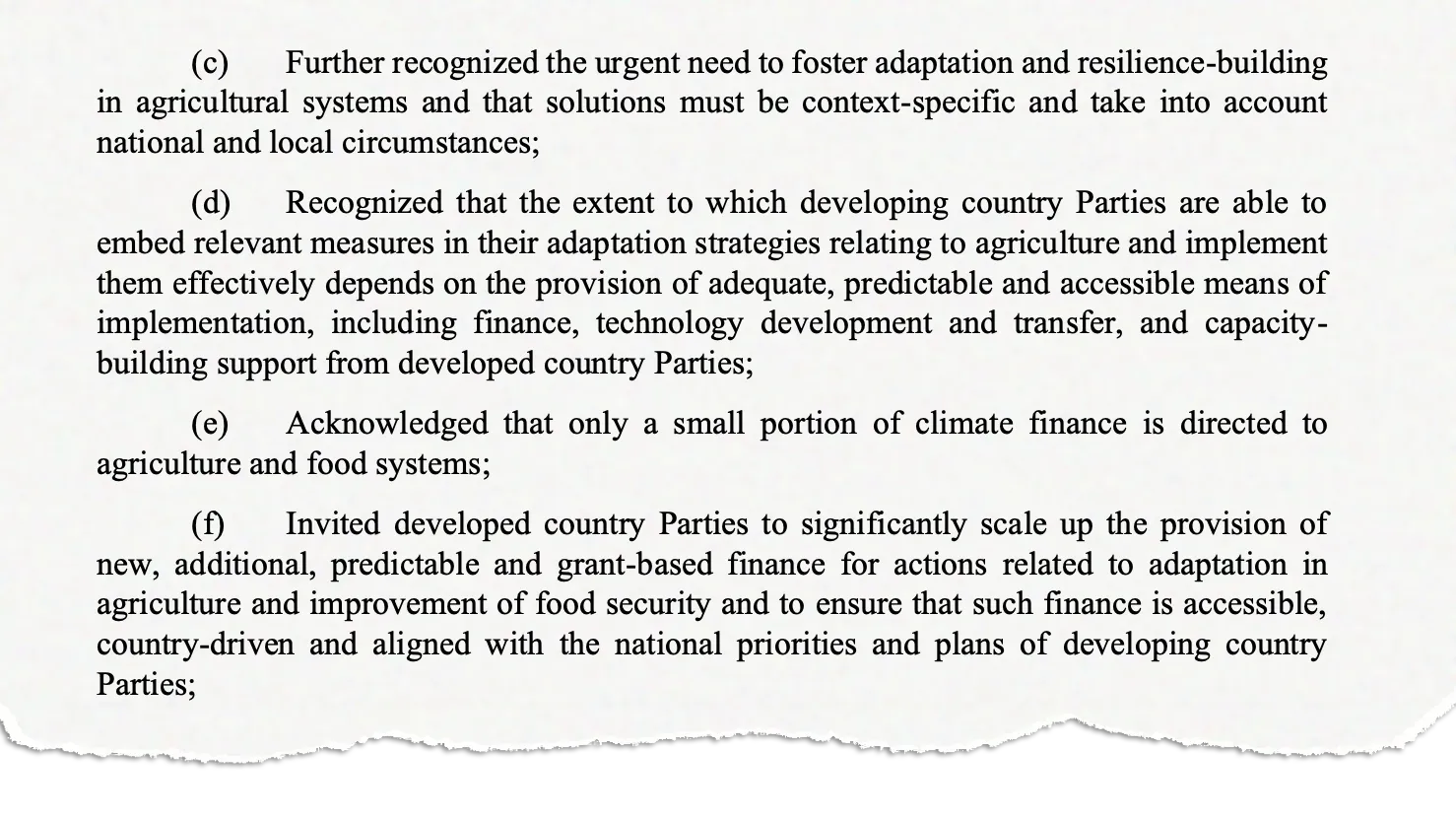
The next day, various blocs circulated text proposals on recognising the workshop outcome. These texts, seen by Carbon Brief, included proposals from the EU and the Environmental Integrity Group (EIG) on food systems “which span the entire value chain”, links to biodiversity, “precision agriculture” and market-based rewards for farmers.
G77 and China, meanwhile, flagged 13 points for inclusion in the draft text, including recognising the “fundamental priority of ending hunger” and a call for developed countries to “significantly scale up…grant-based finance for adaptation actions in agriculture”.
Language from all of these proposals was incorporated into a draft text released on the first Thursday of COP30.
This draft – with 23 square brackets, indicating text not yet agreed – included many references, ranging from agroecology to AI-farming and using “high-integrity carbon-market approaches under Article 6” to reward farmers.
It also recognised that the World Trade Organization (WTO) “can be useful in ensuring a stable, predictable global agricultural trade underpinned by rules” that support climate action.
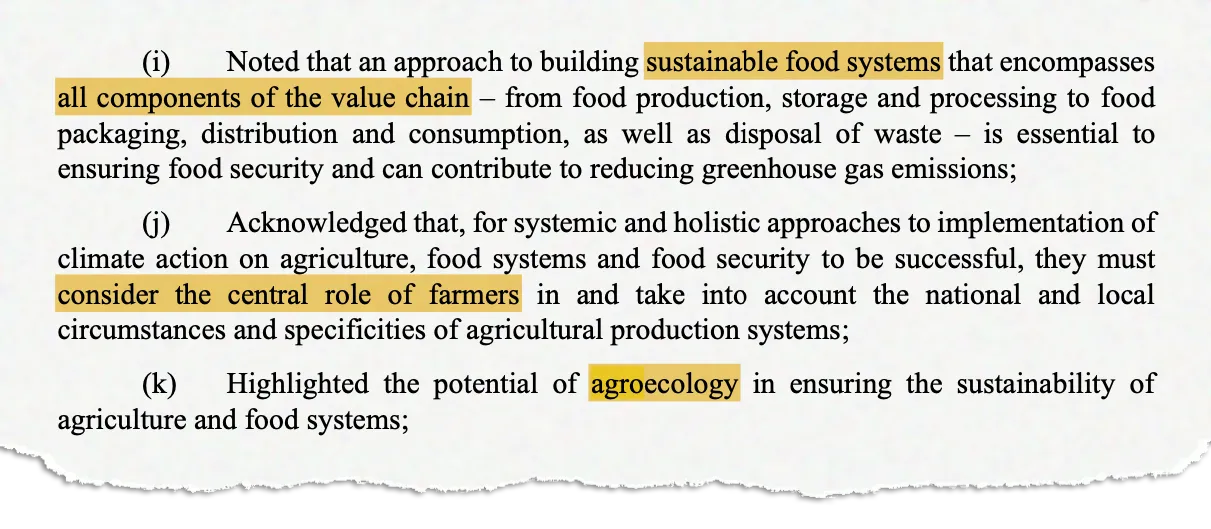
Five hours later, this was replaced by a brief draft, which postponed further discussions until June next year, taking into account the earlier text.
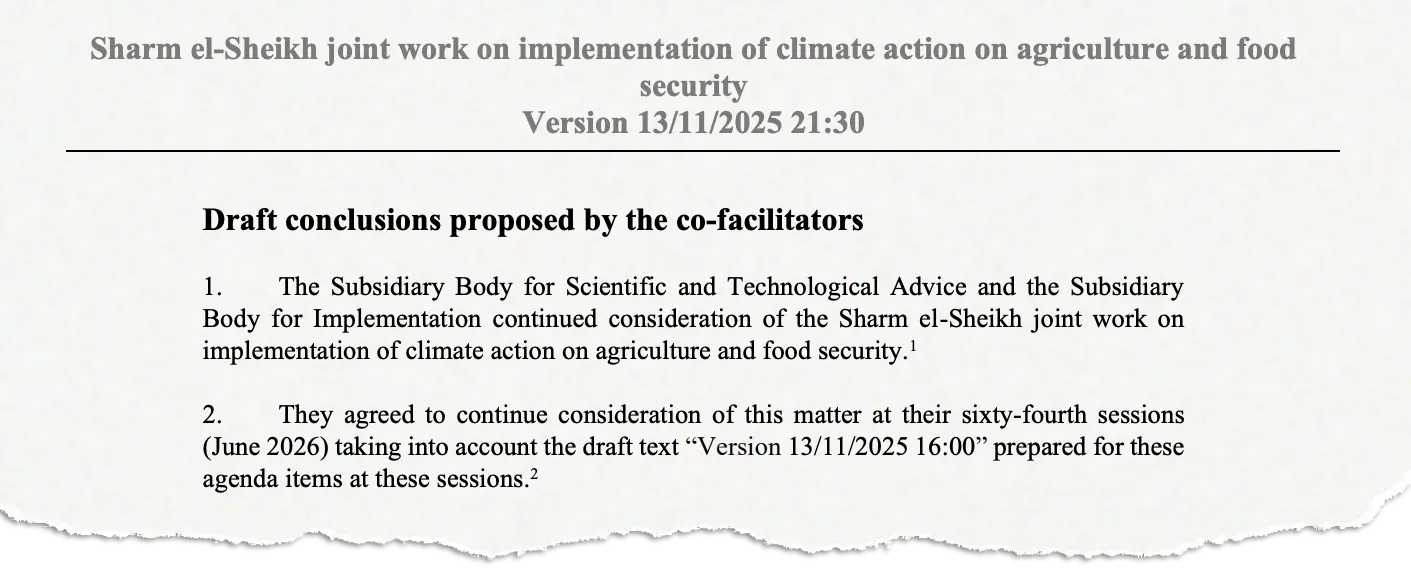
Many observers expressed their dismay at negotiations finishing so abruptly, before the end of week one and without a substantive outcome.
Teresa Anderson, global climate justice lead at Action Aid International, told Carbon Brief that negotiations “took a turn for the worse” after Australia and the EIG “pushed for dodgy language” on what could be considered “systemic” and “holistic”. Anderson said:
“In June, many countries talked about agroecology. And yet here in the COP, Australia and others just submitted language on precision agriculture, on AI and just basically a lot of corporate greenwash…Countries weren’t able to agree on [this] because there was just too much new nonsense in there.”
The final draft conclusions “recognised that progress was made at these sessions” and “noted that more time is needed to conclude the discussions thereon”.
Article 6
Carbon markets – particularly relating to forests – were expected to be a key priority for the Brazilian presidency at COP30.
On 7 November, the Brazilian presidency launched a global coalition on “compliance carbon markets”, endorsed by 18 countries.
The voluntary initiative said it is designed to allow members to “share experiences and learn from each other”. It also said the coalition will “explore options to promote interoperability of compliance carbon markets in the long term”.
Finally, it mentioned information exchange on the “potential use of high-integrity offsets”, referencing a sector that has faced intense scrutiny in recent years.
The same day, Honduras and Suriname announced a deal to issue “high-integrity rainforest carbon credits” in partnership with Deutsche Bank, German agrochemical giant Bayer and the Coalition for Rainforest Nations (CfRN).

Formal negotiations on carbon trading under Article 6 of the Paris Agreement were expected to be somewhat muted, but ended up being rather complicated.
In Baku last year, countries had finally agreed on the rules for country-to-country carbon trading under Article 6.2 and for a new international Paris Agreement carbon market under Article 6.4, bringing a decade of negotiations to a close. Countries also agreed to undertake a review of these rules in 2028.
Within the Article 6.4 market, key tools for “nature-based” removals and rights safeguards were still being developed after COP29 by the “supervisory body” in charge of standards.
At COP30, negotiations focused on the annual report of this body, which had been given autonomy to set these standards at COP29.
The supervisory body had recently adopted a standard on non-permanence on 10 October, which had been the subject of heated debate in the sector.
The standard describes how to handle the risk of someone selling carbon credits for a project that removes CO2 from the atmosphere, only for this stored carbon to be released back into the atmosphere. This is a phenomenon known as “reversal” and is particularly pertinent for tree-planting projects, which may be at risk from wildfires and drought.
In a joint letter published on 12 November, a group of NGOs and carbon-trading advocates said this and other standards “could exclude all land-based activities”, such as forests, from the Article 6.4 market.
They called for new guidance to be given to the supervisory body to prevent this from happening. Their recommendations on amending the rules around reversal risk to give more scope to include nature-based projects – which were opposed by some scientists and other NGOs – were picked up and reflected in an early draft text at COP30.
This text, published on 14 November, asked the market’s supervisory body to “consider carbon market forecasts” and revise its standards so as not to “discourage the development” of nature-based solutions.
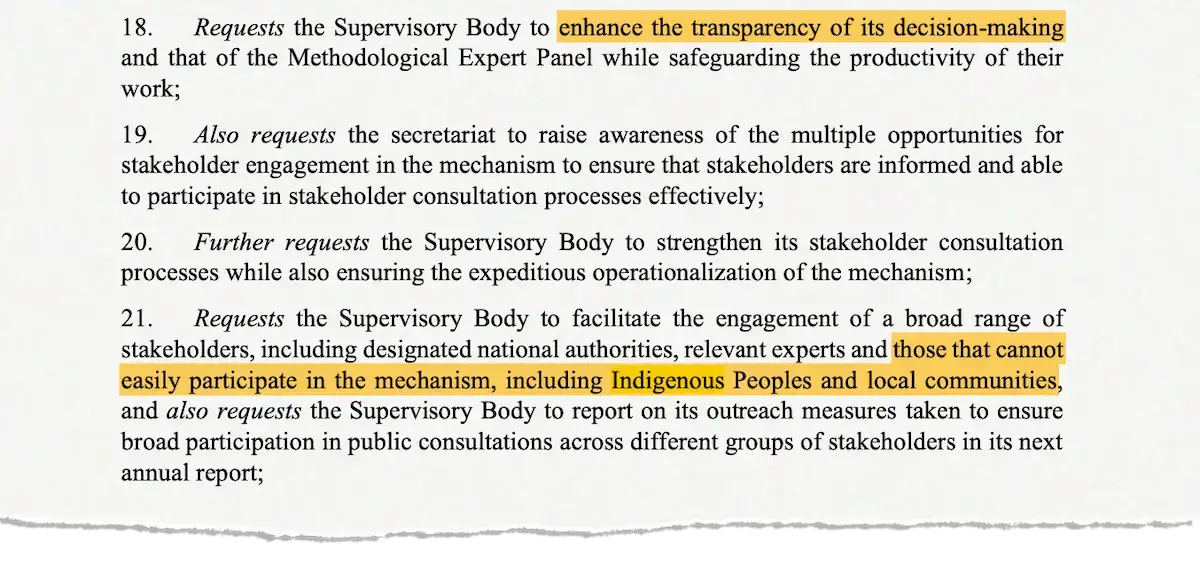
At the same time, text options “urging” the body to make its decisions more transparent and “minimise time in closed-door sessions” were heavily bracketed.

In response to this draft text, Isa Mulder of Carbon Market Watch told Carbon Brief:
“All of the pro-market flexibility in there [would] completely undermin[e] the Paris Agreement.”
On 15 November, Climate Action Network awarded Indonesia its “Fossil of the Day” for repeating “lobbyists’ talking points” surrounding weaker rules on the permanence of nature-based credits – “sometimes verbatim” – in its intervention in Article 6.4 negotiations.
While explicit references to nature and nature-based carbon crediting projects were removed in a second draft issued late on 15 November, the text still asked the body to apply a “tailored approach” and weigh the “economic feasibility” of its standards.
In the end, references to these two terms were also dropped. Many countries saw the effort to give detailed guidance to the supervisory body as an attempt to “micro-manage” its work, creating uncertainty for market actors.
The final decision on Article 6.4 gave carbon-credit projects registered under the “clean development mechanism” (CDM) a six-month deadline extension, until June 2026, to “transition” into the Paris Agreement’s new carbon market.
In theory, this could allow up to another 760m tonnes of CO2-equivalent of credits to enter the Paris Agreement regime.
The final Article 6.4 decision “averted disaster” and could potentially make the UN-backed carbon market “marginally” more inclusive, according to Carbon Market Watch, which added that these improvements “do little to change the rather worrying course that Article 6 seems to be on”.
The decision “reiterates” that supervisory body members should not have “any financial or other interests” that could affect – or be seen to affect – their impartiality.
It also “requests” that the body strengthen its consultation processes by informing, reaching out to and including Indigenous peoples, local communities and others who “cannot easily participate” in the complex mechanism.
While there are fewer rules that govern country-to-country carbon trading under Article 6.2, countries were supposed to submit “initial reports” of these bilateral carbon-trading deals for review by technical experts ahead of COP30.
The first six reviews – including a Swiss-supported project to promote “climate-smart” rice cultivation in Ghana and sustainable forest management in Guyana and Suriname – were completed ahead of the summit.
A particular issue being considered at COP30 was the fact that, to date, “all trades” under Article 6.2 so far have been flagged with “inconsistencies” during expert review.
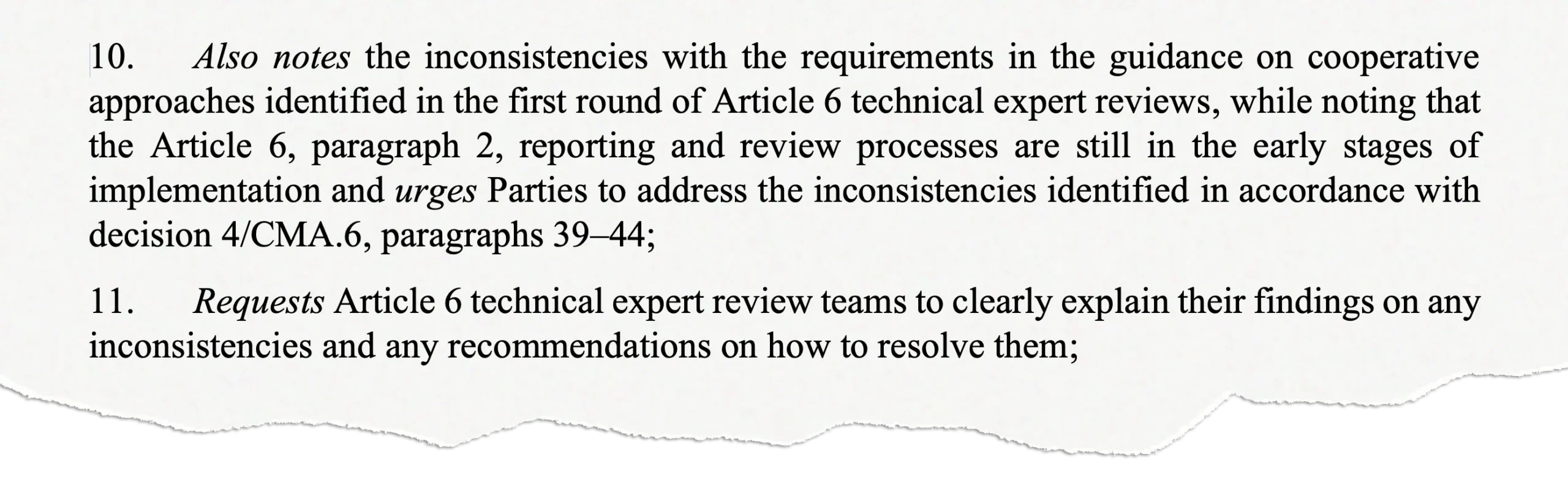
The COP30 Article 6.2 decision simply “notes” these inconsistencies and “urges” countries to sort them out, while adding that the reporting and review process is still “in the early stages”. It also asks reviewers to “clearly explain” any issues they find and how to resolve them.
Deforestation roadmap
During the Belém talks, momentum began to build around agreeing a roadmap to end deforestation, although it was largely overshadowed by the push for a similar fossil-fuel phase-out plan.
At COP26, more than 130 countries had signed on to a non-binding pledge to halt and reverse deforestation by 2030. This pledge was formally recognised in the global stocktake agreed at COP28. Although the rate of deforestation is decreasing, countries are off track to meet this goal.
A roadmap aimed to help achieve this deforestation target did not appear in the final mutirão decision agreed at COP30. However, in the closing plenary of the summit, Corrêa do Lago said the Brazilian presidency would work to create deforestation and fossil-fuel roadmaps outside the COP negotiation process.
In a speech at the opening of the leaders’ summit before COP30 began, Lula had called for roadmaps to “reverse deforestation, overcome dependence on fossil fuels and mobilise the resources required to achieve these goals in a fair and planned manner”.
By the second week of negotiations, around 45 countries backed a deforestation roadmap, including Brazil, Colombia, Mexico, the EU and the Democratic Republic of the Congo, according to a Carbon Brief tracker. This increased to at least 92 countries by Friday 21 November, after a large group of more than 50 rainforest nations got behind the proposal.
WWF and Greenpeace had urged countries to adopt the deforestation roadmap “as a formal outcome at COP30”, while Colombia’s environment minister, Irene Vélez-Torres, wrote in Backchannel, a climate commentary platform:
“We need to see the global north come behind a roadmap – and quickly.”
However, the final text signed off on 22 November did not include mentions of either roadmap. (See: ‘Global mutirão’.)
Although more than 90 countries backed the deforestation roadmap, “wider political will to secure this in Belém was lacking”, WWF said in a statement.
Carolina Pasquali, executive director of Greenpeace Brazil, said that Lula’s government had “set the bar high” in calling for deforestation and fossil-fuel roadmaps, but the “divided multilateral landscape was unable to hurdle it”.
After the talks ended, Prof Nathalie Seddon, the director of the nature-based solutions initiative at the University of Oxford, said in a statement:
“Until we have coupled roadmaps for ending deforestation and phasing out fossil fuels, grounded in rights and direct finance for those who safeguard ecosystems, we will remain off track for a safe and just future.”
‘Unilateral trade measures’
After several failed attempts to bring climate-related “unilateral trade measures”, such as the EU’s deforestation regulation, onto the agenda at previous COPs, the issue was taken up in Belém as part of presidency-led discussions and reflected in the key outcome of the summit, the “global mutirão”.
This decision creates three annual “dialogues” on trade, to be held at the Bonn intersessional meetings in 2026, 2027 and 2028. It also “reaffirms” that climate measures, “including unilateral ones, should not constitute” trade restrictions that are “arbitrary” or “discriminat[ory]”.
This is the first-ever mention of trade measures in a COP cover decision.
While the issue of trade has received a significant level of attention at recent summits, it is not a new one for the UN climate regime. The text agreed in Belém, below, precisely repeats the language in article 3.5 of the 1992 UN climate convention.

In Belém, the issue of such measures had once again been raised by Bolivia on behalf of the like-minded developing countries (LMDCs, a group that includes China, India and others).
Within the presidency-led consultations, the LMDCs called for a recurring agenda item on trade, Tuvalu supported a dialogue and the African group proposed a system for countries to report new trade measures to the UN climate convention, according to the Earth Negotiations Bulletin.
On Sunday in the middle of COP, the presidency published a summary of its consultations, containing five options for a decision on trade measures, including dialogues, roundtables or the creation of a platform.

David Waskow, director of the international climate initiative at the World Resources Institute thinktank, told a media briefing that trade is a “real issue” for some countries and not just a “bargaining tactic or some sort of chit that’s being put on the table”.
He added that the EU “feels strongly” about the ways trade measures support climate action, but developing countries have “real concerns” about how those measures play out.
Avantika Goswami, climate-policy lead at Delhi-based thinktank the the Centre for Science and Environment, told Carbon Brief that, while it is “not ideal to not have a formal agenda item” on unilateral trade measures, the reference to the UN climate convention in the text “is welcomed”, as well as the dialogues that will take place over the next three years. Goswami added:
“At the very least, this will elevate the issue of unilateral trade measures to be more high-profile within the COP space and will provide a forum for countries to discuss their concerns and challenges, as well as possible solutions for the way forward.”
Alongside the discussions under the presidency, these measures continued to crop up within different negotiation streams, including on just transition, “response measures” and technology.
The final decision on the just transition work programme removed all references to trade, although it recognised the role of smallholder farmers and food production.

Anderson, from ActionAid, told Carbon Brief that civil society had “fought hard” to make sure food and farmers were included in the just transition discussion. She told Carbon Brief:
“We’ve been calling for a just transition in agriculture because agriculture is the [second biggest] polluter after fossil fuels, and the [biggest] employer in the world.
“We know we need to transition in agriculture, but it has to be fair to protect jobs, livelihoods, families, communities and global food security. That is really, really important, because we know there’s a lot to learn from many years of climate action that hasn’t always put rural communities, who are often marginalised, first in the conversation.”
Biofuels

On 14 October, at the pre-COP in Brasilia, the Brazilian presidency launched the Belém 4x pledge, which aimed to gather high-level support to quadruple the production and use of “sustainable fuels” – such as hydrogen and biofuels – by 2035, as compared to 2024 levels.

The pledge was co-sponsored by Italy and Japan, supported by India and has been backed by 23 countries so far, including Canada and the Netherlands. On 14 November, Brazil announced a partnership with the Clean Energy Ministerial to “advance Belem 4x”.
However, the pledge was “rejected” by some NGOs, including Climate Action Network and Greenpeace, who criticised the environmental, social and food security impacts of biofuels.
Hikmat Soeriatanuwijay at Oil Change International said in a statement:
“The Belém 4x pledge uses the language of sustainability to justify continued fossil-fuel use. The [Intergovernmental Panel on Climate Change] states that forest protection will have the highest mitigation value; however, exploitation of natural forests and cropland for bioenergy undermines this priority.”
The 4x pledge was based on the International Energy Agency’s report on “delivering” sustainable fuels, which included “woody biomass” being converted into biofuels.
However, the IEA report also warned that, for fuels to be considered sustainable, they “need to comply” with other criteria, “such as preservation of biodiversity, sustainable water management and compliance with social safeguards”.
In a statement from the Climate Land Ambition and Rights Alliance (CLARA), former Tasmanian Greens leader Peg Putt from the Biomass Action Network called the pledge’s promotion of liquid and gaseous fuels derived from wood a “dangerous distraction”. Putt said:
“The combustion of wood for bioenergy releases massive amounts of stored greenhouse gases immediately and the myth of its carbon neutrality is based on flawed accounting that ignores the decades forests need to regrow, if they ever do. The true carbon cost rarely appears on any national balance sheet.”
Many observers feared that biofuels would be included in the negotiations or in COP30’s cover decision.
As of an 18 November informal note, elements for a decision on the just transition work programme still referred to the role of “transitional fuels”.
That term has no officially agreed definition, although many states believe that it covers bioenergy and biofuels.

This option was deleted from draft text published on 21 November, and is not reflected in the final just transition work programme decision.
The final global mutirão decision also had no explicit mention of biofuels, transitional fuels or sustainable fuels.
Food systems and water
Transforming food systems and agriculture was one of the six “pillars” on the COP30 “action agenda”, but many observers were disappointed with the outcomes on food in Belém.
Food solutions were “on display” at COP30 – in the form of local dishes served to delegates and new pledges announced – but “none of this made it into the negotiating rooms or the final agreement”, said Dr Elisabette Recine, a member of the International Panel of Experts on Sustainable Food Systems (IPES-Food). She added in a statement:
“Despite all the talk, negotiators failed to act, and the lived realities of those most affected by hunger, poverty and climate shocks went unheard.”
Outside the formal negotiations, a number of new pledges were announced, including the Belém declaration on hunger, poverty and human-centered climate action, which aims to address the “unequal distribution of climate impacts”.
This was adopted by 43 countries and the EU and focused on a number of actions, including supporting climate adaptation for small farmers and expanding social-protection systems, such as government unemployment and illness pay. The German cooperation and development minister described it as a “pioneering step in linking climate action, social protection and food security”.
The UN Environment Programme (UNEP) launched a food waste initiative to help halve food waste by 2030 and also target a reduction in methane emissions of up to 7%, as food waste is a source of the potent greenhouse gas. (See: Methane.)
The food waste pledge was backed by Brazil, Japan and the UK, alongside several cities and private companies, and included goals for governments to integrate food waste into climate and biodiversity plans.

The thematic days for food and agriculture on 19 and 20 November saw a raft of other new announcements, including Brazil launching the resilient agriculture investment for net-zero land degradation (RAIZ).
This initiative is aimed at bringing together governments and investors to restore degraded farmland. It was backed by 10 countries, including the UK, Australia and Saudi Arabia.
An FAO press release said RAIZ will help governments to attract more funding and allocate investment towards restoring agricultural land. No specific financial goal was mentioned, but Bruno Brasil from Brazil’s ministry of agriculture said in a statement that it could “unlock billions globally to restore degraded farmland, protect biodiversity and ensure food security”.
Brazil and the UK also put forward a declaration to spur action around reducing the environmental impact of fertilisers. This expressed “intent” to prioritise sustainable production of fertilisers and improved nutrient management, alongside recognising that improper use of fertilisers “threaten[s] our ecosystems and food systems”.
Additionally, some initiatives launched at previous COPs were updated in Belém. Colombia, Italy and Vietnam joined the Alliance of Champions for Food Systems Transformation – a coalition of countries pledging to take strong action on transforming food systems that was first launched at COP28.
A number of reports released during the talks looked at how food systems were included in countries’ climate plans, called “nationally determined contributions”, or NDCs. A report from WWF and Climate Focus found that 93% of new NDCs included at least one measure around agriculture or food systems, an increase from 86% of previous pledges.
Another NGO assessment of how food systems were incorporated into 10 NDCs found that pledges from Somalia and Switzerland were “very strong” in this regard and included actions from across the entire food system. Climate pledges from Brazil and New Zealand, on the other hand, were ranked as “weak”, the report said.
Sebastian Osborn from Mercy for Animals, one of the organisations involved in the assessment, told a press conference:
“Overall, countries are not fully embracing the potential benefits of incorporating food systems into their climate policies.”
Elsewhere, the Gates Foundation put forward $1.4bn for smallerholder farmer climate adaptation in sub-Saharan Africa and south Asia. The Rockefeller Foundation announced more than $5.4m to “strengthen the resilience” of food systems and provide children’s school meals.
In terms of water and ocean outcomes, six more countries joined the “blue NDC challenge”, an initiative launched by Brazil and France earlier this year that encourages nations to integrate ocean measures into their climate pledges.
Finally, analysis from the World Resources Institute, Ocean & Climate Platform and Ocean Conservancy found that more than 90% of new NDCs submitted by coastal and island countries included ocean-based climate actions, an increase from 73% in 2022.
Climate and nature ‘synergies’
Some hoped that a first-of-its-kind outcome on jointly addressing climate change, biodiversity loss and land degradation could emerge from COP30.
However, in the end, pushback from some nations scuppered plans for a new “synergies” agreement.
At the Rio Earth summit in 1992, the world decided to address Earth’s most pressing environmental problems under three separate conventions: one on climate change, one on biodiversity and the final one on land desertification.
But, for the past few years, a growing number of scientists, politicians and diplomats have questioned whether tackling these issues separately is the right approach.
And, at the most recent biodiversity and land desertification COPs, countries agreed to new texts calling for closer cooperation between the three Rio conventions.
Speaking at a side event on nature at COP30, Juan Carlos Monterrey, Panama’s hat-sporting special climate envoy, said that countries committed a “big sin” when they decided to “decided to split the environment into three different structures”.
(Panama has plans to be the first country to publish one document that will function as both its climate plan – known as a “nationally determined contribution” (NDC) – and its nature plan – known as a “national biodiversity strategy and action plan” (NBSAP).)
After pledging to make COP30 a “nature COP”, the presidency held consultations on an agenda item called “cooperation with other international organisations”, with the hopes of producing the first substantive outcome on addressing climate change, biodiversity loss and land degradation together.
A draft “areas of interest” text linked to the issue spoke of “creat[ing] a space for continuous discussions to enhance cooperation among the Rio conventions” and the “establishment of a process to come up with a set of recommendations on how to enhance cooperation and policy coherence”.
However, several nations, including Saudi Arabia, vocally opposed the progression of a substantive outcome – and the final version of the “synergies” text is just five paragraphs long, containing little that is new.
Observers pointed out to Carbon Brief that Saudi Arabia’s opposition was particularly puzzling, given it currently holds the presidency for the desertification COP.
In an interview with Carbon Brief, Dr Osama Faqeeha, deputy environment minister for Saudi Arabia and chief adviser to the COP16 desertification presidency, said that the nation did not support any action that might lead to “dissolving the conventions”.
When pressed on whether, as the COP16 desertification presidency, it should be prioritising more “synergistic” work between the three Rio conventions, Faqeeha added:
“We have to realise the convention is about land. Preventing land degradation and combating drought. These are the two major challenges.”
Bethan Laughlin, a senior policy specialist at the Zoological Society of London, said the final synergies text “fell short of the high ambition championed by many countries and civil society”, but does offer some hope for future collaboration. She told Carbon Brief:
“This agenda item may not have had a substantive outcome in the text, but it also did not fail. Countries have committed to continued dialogue and collaboration, moving [the agenda item] beyond its previous relegation as a brief annual intersessional discussion – towards meaningful political engagement.”
Indigenous representation
COP30 achieved several milestones for Indigenous peoples, including securing recognition of their land rights in the mutirão decision and agreeing on a just transition mechanism that ensures that Indigenous peoples rights are included.
Belém’s climate summit was attended by more than 3,000 representatives of Indigenous peoples, making it the largest participation of Indigenous peoples in the history of COPs.
However, Cultural Survival – a not-for-profit organisation that supports Indigenous rights worldwide – said in a statement that this COP was “one of the most frustrating and disappointing” for Indigenous peoples. It noted that only 14% of 2,500 Indigenous representatives from Brazil received accreditation to access the official negotiations area.
Fany Kuiru, general coordinator of the Coordinator of Indigenous Organisations of the Amazon Basin (COICA), told Carbon Brief that some Indigenous representatives felt discontent due to a lack of “full and effective” participation.
On the second day of COP30, dozens of Indigenous protesters clashed with security guards in order to enter the negotiations and demand climate action and forest protection.
Emil Gualinga, a member of the Kichwa Peoples of Sarayaku, in Ecuador, said in a press release that Indigenous peoples continue to be excluded from negotiation rooms and most of their proposals were not incorporated into final decisions.
In Belém, Brazil’s minister of Indigenous peoples, Sonia Guajajara called for the mutirão text to integrate the demarcation of Indigenous lands as a climate policy.
Indigenous peoples viewed this statement as “quite positive”, Toya Manchineri, general coordinator of the Coordination of Indigenous Organisations of the Brazilian Amazon (COIAB), said at a press conference attended by Carbon Brief.
Currently, few countries’ climate plans recognise the territorial rights of Indigenous peoples as climate instruments, according to a recent report that analysed the NDCs of 15 countries in Latin America, Africa and Asia.
One of the major outcomes of COP30 for Indigenous peoples was the commitment to allocate $1.8bn to support Indigenous peoples and Afrodescendants’ tenure rights from 2026 to 2030 as part of the Forest and Land Tenure Pledge. Another finance-related outcome was the establishment of the Tropical Forest Forever Facility, which guarantees that 20% of its funds will go to Indigenous groups. (See: Tropical Forest Forever Facility and other forest pledges.)
Additionally, 15 countries committed to a collective target to recognise and secure land tenure of 160m hectares by 2030 for Indigenous peoples and Afro-descendant communities. Brazil announced the demarcation of 10 new Indigenous territories and acknowledged that 59m hectares must be secured over the next five years.
The preamble of the mutirão decision also recognised Indigenous rights, including their land rights and traditional knowledge.

Gualinga, the Ecuadorean Indigenous leader, said in a press release that this recognition was an “important step forward and it gives us tools to continue advocating for our rights in future decisions”.
However, he noted that Indigenous groups had proposed more robust language in the mutirão text, such as including their full and effective participation in the development and implementation of NDCs, as well as direct access to financing.
Indigenous peoples also demanded that the climate finance received by countries must include their traditional knowledge and “explicit guarantees” of principles such as free, prior and informed consent, legal security of land, Indigenous land tenure and complaint mechanisms, Kuiru told Carbon Brief.
She added that Indigenous communities have their own mechanisms for managing funds and that “have already demonstrated to be efficient”, which is why they advocate for direct funding to Indigenous peoples.
Indigenous peoples around the world have struggled to receive such funding directly. Only 0.7% of climate finance provided to developing countries mentions the word “Indigenous”, a new study by the International Institute for Environment and Development (IIED) found.
The mutirão decision ultimately did not include direct access to climate finance for Indigenous peoples.
Methane
Methane – the potent greenhouse gas that is the second-biggest contributor to global warming, after CO2 – featured in several COP30 pledges and announcements, but overall did not make major waves in Belém.
A UNEP report released during the summit looked at countries’ progress towards meeting the voluntary global pledge to reduce methane emissions by 30% by 2030, which has been backed by almost 160 countries since its launch at COP26.
The report found that while progress has been made on the extent of the increase in methane, emissions are still rising each year. Based on current government pledges, methane emissions will reduce by 8% by 2030, but they could reduce by 32% with more ambition and “full implementation of existing technically feasible reductions”, the report found.
Martin Krause, the director of the climate-change division at UNEP, said at the report’s launch that drastically cutting methane is “like pulling the climate emergency brake”, saying countries should “pull that brake hard and fast”.
Caitlin Smith at the Changing Markets Foundation campaign group said in a statement that to make progress on cutting methane, governments must “ramp up action on agriculture – the biggest source of methane, yet a blind spot for most rich countries”.
Research from thinktank Planet Tracker – released just before COP30 – found that 52 of the world’s largest meat, dairy and rice companies emit a combined 22m tonnes of methane every year.
The report also found that only seven of these 52 companies directly report the distribution and scale of their methane emissions and just one – Danone – has a specific methane-reduction target.
Also during the talks, the Changing Markets Foundation launched an interactive tool tracking agricultural methane emissions from companies and countries around the world.
Meanwhile, Farmers Weekly reported that the UK government “quietly shelved” plans to announce a national pledge to cut livestock methane emissions by 30% by 2030.
The UK, Brazil and China hosted a methane summit on the weekend before talks officially began. During this event, the Climate and Clean Air Coalition launched an “action accelerator” to help governments in developing countries cut emissions from super pollutants, including methane.
Brazil, Cambodia, Nigeria and four other countries have been initially chosen for this initiative and will receive a combined $25m to “advance their efforts in this area. The plan aims to work with up to 30 countries by 2030 and gather around $150m in funds. Additionally, 11 countries signed a statement committing to “drastically reducing” fossil methane emissions.
Other measures were announced in Belém, including a joint strategy to boost methane reductions across the agriculture, energy and waste sectors in developing countries, launched by the Global Methane Hub and the Global Green Growth Institute.
This initiative will focus on Mexico, Nigeria and Senegal, a statement said.
On 19 November, a scheme to boost efforts to cut methane and nitrous oxide emissions from agriculture was launched. The farmers’ initiative for resilient and sustainable transformations (FIRST) aims to help countries in Latin America, Africa and Asia share “practical, low-cost solutions that cut emissions, strengthen food security and improve resilience”, a statement from the Climate and Clean Air Coalition said.
Some funding was also put forward for tackling methane, with businessman Mike Bloomberg announcing $100m in investment towards methane-cutting efforts, such as satellite monitoring of leaks of the gas.
Bloomberg told a press briefing attended by Carbon Brief that methane is an “extremely important part of the climate puzzle”.
Agricultural greenwashing
Brazil is a major producer of soya beans, beef, rice, biofuels and many other agricultural products. As a result, observers and media outlets were keenly watching out for any instances of agribusiness-related greenwashing or lobbying at COP30.
Before the negotiations began, DeSmog published a list of eight “big ag greenwashing terms” to watch out for in Belém. These included phrases such as regenerative agriculture, as well as arguments around fossil fuels and ways of measuring methane emissions.
The outlet published a number of other articles during the talks, reporting (alongside the Guardian) that more than 300 agricultural lobbyists attended COP30, mapping out the food and farming companies and trade groups at COP30 and detailing the social media influencers “enlisted” by agribusiness companies ahead of the talks.
“Sustainable” claims around biofuels also came under scrutiny in Belém. DeSmog identified nearly 60 events on the benefits of biofuels at COP30, led by both industry groups and related companies.
These included a “high-level event on the critical role of biofuels” and a “sustainable biofuels” section in the summit’s action agenda.
Unearthed reported that a COP30 sustainable agriculture pavilion, located around 2km outside the official “blue zone” where negotiations took place, was “sponsored by agribiz interests linked to deforestation and anti-conservation lobbying”.
Campaigners protested against “big agriculture lobbyists” outside this “AgriZone” pavilion during the negotiations, the Grocer said.
The Associated Press said the pavilion sought to “spread a message of lower-carbon agriculture possibilities”, but added that “industrial agriculture retains a big influence at the climate talks”.

Brazilian outlet Agência Pública, meanwhile, reported that Brazil placed the “billionaire brothers” who own JBS, the world’s largest beef producer, on a “VIP list” at COP30.
The Changing Markets Foundation also published a report looking at COP30 events led by the agriculture industry and assessing Brazil’s “agricultural methane blind spot”.
Teresa Anderson, global climate justice lead at Action Aid, told Carbon Brief that agribusiness was the “elephant in the room” at COP30. She added:
“We’ve had this COP set in the Amazon, with the Brazilian presidency, talking a big game on forests, but absolute crickets when it comes to naming the biggest threat to forests, which is big industrial agriculture.”
The post COP30: Key outcomes for food, forests, land and nature at the UN climate talks in Belém appeared first on Carbon Brief.
COP30: Key outcomes for food, forests, land and nature at the UN climate talks in Belém
Climate Change
Analysis: China’s new carbon metric leaves Germany-sized gap in its emissions
A major change in the way that China measures its core climate goal has effectively halved the growth in the country’s carbon dioxide (CO2) emissions over the past five years.
The revised measure of “carbon intensity”, the amount of CO2 per unit of economic output, implies that China’s emissions have only gone up by 7% from 2020-2025.
This is just half of the 14% rise indicated by previous official statistics.
On paper, the revision creates a gap of 700m tonnes of CO2 (MtCO2) per year, equivalent to the total emissions of Germany or South Korea.
While China has never officially defined how it measures carbon intensity, it has now made what appears to be a retrospective change, with the effect of making targets easier to meet.
The shift means that China officially came close to meeting its carbon-intensity target for 2020-2025, whereas official statistics had previously pointed towards falling well short.
The new definition of carbon intensity has not been made public, but plausible approaches to calculating the metric do not seem to be sufficient to explain the Germany-sized gap.
The apparent gaps or inconsistencies in China’s new carbon accounting also mean that China could meet its international climate pledges for 2030, even if its emissions go up, whereas the previous measure would have required them to fall.
This article explains how the metric appears to have shifted, what changes might potentially explain the revision and what the revised measure implies for China’s climate goals.
Measuring carbon intensity
Reducing carbon intensity – CO2 emissions per unit of GDP – has been China’s key climate commitment since the Copenhagen climate conference in 2009.
At that time, the country pledged to cut its carbon intensity to 48% below 2005 levels by 2020. This was followed up by a 2030 target of a 60-65% reduction, announced in 2014, which was then upgraded to more than 65% in 2021.
Since carbon intensity was made a key progress indicator in China’s 14th five-year plan for 2021-25, the country has reported reductions in carbon intensity every year in its statistical communique, issued at the end of February.
Neither China’s international climate pledges (its nationally determined contributions, NDCs) nor other official documents have ever set out a definition of carbon intensity, despite it being a cornerstone of the country’s climate commitments.
However, until this year, it was possible to closely reproduce the reported numbers, based on a straightforward interpretation of what carbon intensity means.
But the types of emissions that are included in the carbon-intensity metric have now changed.
Previously, it was possible to reproduce the reported carbon-intensity data by combining official GDP data with estimates of emissions from the use of fossil fuels. The latter could be estimated based on the officially reported consumption of coal, oil and gas, multiplied by China’s official emissions factors for the CO2 per unit of energy from each fuel.
The previous carbon-intensity measure apparently included emissions from the use of fossil fuels to generate energy, as well as their use as chemical feedstocks, so-called “non-energy uses”. However, it did not include non-fossil fuel CO2 emissions from industrial processes, such as the production of cement, as shown by the “old scope” in the figure below left.

Based on the annually reported progress against this old scope, China’s carbon intensity had fallen by a total of 12.4% from 2020-2025.
This was well short of the 18% target set for these years under the 14th five-year plan.
In September 2025, Huang Runqiu, head of the Ministry of Ecology and Environment, acknowledged this gap, saying that meeting China’s carbon-intensity targets had become “more challenging” due to the effects of the Covid-19 pandemic and trade tensions.
Yet the 15th five-year plan, published in March 2026, reported that China had cut its carbon intensity by 17.7% over the same period – just shy of the 18% target.
As such, it is clear that there has been a major shift in the way that China measures its carbon intensity, specifically in terms of which types of emissions are included.
Moreover, the revised numbers imply that – rather than missing it by a large margin – China officially came close to meeting its carbon-intensity target for the 14th five-year plan.
A footnote in China’s latest statistical communique offers a brief description of carbon intensity as relating to the CO2 emissions from “energy activities and industrial production”.
This indicates that the carbon-intensity calculation now includes industrial process emissions and excludes non-energy uses of fossil fuels, shown by the “new scope” in the figure above.
In comments sought by Carbon Brief, Ryna Cui, associate research professor at the University of Maryland School of Public Policy, who was not involved in the analysis, agrees that the changes to the carbon-intensity methodology are “unclear”. However, she notes that “limited data” makes it challenging to fully verify the nature and impact of the changes.
The revision mirrors a recent change made to the way that China measures its “energy intensity”, the energy use per unit of economic output. In 2024, energy intensity was changed to exclude non-energy use of fossil fuels and energy use from non-fossil fuels.
This exclusion also created a major incentive for expanding the chemical industry and the non-energy use of fossil fuels.
As for the change in carbon-intensity metric, this follows the highly energy-intensive pattern of economic growth during and after the Covid-19 pandemic and China’s “zero-Covid” policy.
Germany-sized gap
The shift in the way that China is measuring its carbon intensity has implications for estimates of the country’s emissions, which are only reported officially some years later.
Changes in carbon intensity and GDP are reported far more quickly – and can be used to estimate changes in China’s CO2 emissions.
China’s total emissions from energy and industrial processes were 11.2bn tonnes of CO2 (GtCO2) in 2020. Based on the originally reported changes in carbon intensity and GDP, its fossil-fuel CO2 emissions had grown 14% by 2024, an increase of 1,430m tonnes (MtCO2).
In contrast, the newly reported carbon-intensity figures imply that China’s CO2 emissions only grew by 7% between 2020 and 2025, up just 690MtCO2, as shown by the figure below.
The gap between these figures amounts to 730m tonnes of CO2 (MtCO2), equivalent to the annual emissions of Germany or South Korea.

On paper, therefore, the change in the carbon-intensity metric effectively halves the rate of growth in China’s CO2 emissions over the past five years.
Decoding the new carbon-intensity methodology
The change in the carbon-intensity metric could have other significant implications, explored below, making it important to understand how it is being calculated.
Yet, while there are some indications of what the new approach entails, these changes do not seem to account for the magnitude of the revision.
The new scope includes industrial-process emissions. One of the largest sources of these emissions, the cement industry, has been contracting due to a slowdown in real estate and infrastructure construction.
This reduction in emissions is one reason why China’s carbon intensity has improved more quickly under the new scope than under the old one.
In addition, the new scope excludes non-energy use of fossil fuels – largely relating to the chemicals industry – where there has been rapid growth over the past five years.
This is another factor in carbon intensity improving faster under the new scope.
Indeed, China’s chemicals industry drove more than half of the growth in its total fossil-fuel use in the past five years, including 40% of coal use and all of oil use. As a result, non-energy use reached 13% of the total consumption of fossil fuels in 2025, up from 7% in 2020, after growing at an average annual rate of 13%.
The figure below illustrates the impact of these changes in scope. It shows the change in China’s emissions from 2020-2025 due to the use of fossil fuels for energy, its industrial-process emissions and non-energy use of fossil fuels.
The first few rows show changes based on the consumption of fossil fuels overall, amounting to a combined 1,430MtCO2 rise in emissions.
This compares with the 690MtCO2 rise implied by the new carbon-intensity metric, leaving that Germany-sized 730MtcO2 gap in emissions. The new scope explains some of this gap.
In terms of industrial processes, the 30% fall in cement production could account for a 300MtCO2 fall in China’s CO2 emissions. In addition, the amount of carbon stored in products, such as plastics, asphalt and rubber, could account for an estimated 100MtCO2 fall in emissions.
On the other hand, emissions from the incineration of plastics increased by an estimated 40% and from metals industry processes by 10%, with aluminium production having expanded by 21%. Together, these would have increased emissions by an estimated 60MtCO2.
In total, the changes in emissions from fossil-fuel use, industrial processes, carbon retained in products and waste incineration add up to a combined 1,070MtCO2 rise from 2020-2025, shown in the penultimate row of the figure below.
Again, this revised total – based on the change in scope of the carbon-intensity metric – goes some way to explaining the Germany-sized gap in China’s CO2 emissions.
However, the new carbon-intensity figures imply that China’s CO2 emissions only increased by 690MtCO2, as shown in the final row of the figure below. This leaves a residual gap of around 380MtCO2, which does not appear to be accounted for by the data available.

One way to make the numbers add up would be to assume that the amount of carbon embedded in chemical-industry products has increased by the equivalent of 500MtCO2.
However, the reported output of major chemical-industry products cannot account for this level of embedded carbon. The figure below shows that the increase in output of major chemical products only explains around a 110MtCO2 increase in retained carbon.
Much of the increase in the production of plastics was cancelled out by a contraction in the use of bitumen for asphalt, due to lower road-building activity.

Furthermore, the 14th five-year plan for 2021-25 had a target of raising the share of waste incineration to 65% of urban residential waste treatment capacity, up from 45% in 2020.
So, while plastics production did go up, resulting in increased amounts of retained carbon, a larger share of this retained carbon was being incinerated, meaning its carbon would quickly be released back into the atmosphere.
One reason why carbon retained in products has grown more slowly than the amount of fossil fuels used in chemicals production is that the fastest growth has been in the coal-based chemicals industry.
Coal-based processes have a much lower conversion efficiency than oil- and gas-based production, with process emissions that are typically multiple times as high.
For example, these emissions are 10 times as high for the production of olefins – a key plastics feedstock – from coal as compared with oil or gas. The process is reported to require 3.75 tonnes of standard coal per tonne of product. This implies that only 30% of the carbon in the coal is retained in the product, with the other 70% being emitted in the process.
There are also chemical processes that use fossil fuels as a feedstock, but where the end product does not contain carbon. One example is ammonia, a key building block for fertiliser, where production grew by 52% from 2020 to 2025.
Neither the change in scope of the carbon-intensity calculation, nor the change in the amount of carbon retained in products, is sufficient to explain the size of the revision in the newly reported numbers. There must be another explanation.
There are two options. Either the new scope broadly aligns with what is outlined above, but also excludes a subset of the CO2 emissions. Or the scope does not exclude any of the CO2, but there are gaps in the monitoring of some energy or industrial-process emissions.
Either explanation would mean that China is not accounting for some of its CO2 emissions. It would also mean that the improvement in carbon intensity for 2020-2025 is over-reported.
China’s latest officially reported emissions inventories reinforce the second of the two options above, namely, that there are gaps in emissions reporting from the chemical industry.
From 2018 to 2021, the latest year for which China has reported on its emissions, the CO2 output of chemical-industry processes only increased by 13%. Over the same period, non-energy use of fossil fuels increased by 29%, according to data reported to the International Energy Agency by the Chinese government.
One factor in these apparent gaps could be that China’s National Bureau of Statistics (NBS) is required to publish data on carbon intensity very quickly, since it is a key indicator in the country’s five-year plans.
On the other hand, detailed greenhouse gas emissions inventories and energy statistics are only published years later, by the environment ministry and NBS, respectively.
What the change means for China’s targets
The change in the definition of carbon intensity has the effect of weakening China’s climate targets and introducing more uncertainty into tracking progress.
On the basis of China’s new numbers, it will require less effort to hit the 2030 target for a 65% reduction in carbon intensity on 2005 levels, as per China’s Paris pledge.
This target can now be met even if CO2 emissions go up between 2025 and 2030, whereas the previous metric would have required a reduction.
It will also require less effort to hit the 17% target in the 15th five-year plan.
The apparent gaps in the CO2 emissions numbers for 2025 could affect the delivery of China’s other key climate pledges, such as the commitment to peak CO2 emissions before 2030. They could also allow the chemical industry’s CO2 emissions to continue climbing rapidly, while still officially meeting the 2030 goals for CO2 intensity.
Moreover, the apparent gaps or inconsistencies in China’s new carbon accounting also mean that China would be able to officially meet its target to peak its CO2 emissions by 2030, even if its overall CO2 emissions do not actually reach a peak.
The apparent gaps could also affect the delivery of China’s newer target to cut its greenhouse gas emissions to 7-10% below peak levels by 2035 and beyond.
Nevertheless, researchers and analysts can still monitor progress by calculating China’s CO2 emissions independently.
China’s reporting on fossil-fuel consumption, the output of plastics and other carbon-containing products, as well as manufacturing of commodities with substantial process emissions, provides a basis for tracking emissions under the new scope.
While under the UN’s climate framework China is free to use any definition it wants to meet its own nationally determined climate pledges, retrospective changes to methodology or inconsistent accounting could erode the value of the country’s commitments.
Moreover, it will, ultimately, have to close any gaps in its emissions data and reporting, under the transparency rules of the Paris Agreement.
China’s next transparency report to the UN, due by the end of this year, should also provide more clarity on the methodology and data underlying the revised numbers.
This underscores the importance of monitoring, reporting and verification for industrial process emissions. “Mass balances” based on fossil-fuel consumption and product output could be used as a check on CO2 emissions reporting. Finally, China’s emissions data could also be made more granular and clearly defined.
Carbon Brief has approached the National Bureau of Statistics and Ministry of Ecology and Environment for comment.
The University of Maryland’s Cui tells Carbon Brief that in general, China’s climate goals are “improv[ing]” in terms of their coverage and scope. However, she adds:
“The issue is…the ambiguity and inconsistency in the coverage, definition and method between target setting and progress tracking, which can lead to large uncertainties and room for manipulation. It highlights the importance of transparency in national climate targets, following the UNFCCC’s international transparency framework, which should also be applied as best practices for domestic targets.”
About the data
The calculations in this analysis are based on China’s total coal, oil and gas consumption from energy statistical yearbooks covering the years until 2023, with data for 2024 and 2025 taken from the latest statistical communiques.
“Originally reported” CO2 emissions were back-calculated from carbon-intensity reductions and GDP growth given in annual statistical communiques. The revised emissions for 2020, 2024 and 2025 are similarly back-calculated from the reductions in carbon intensity from 2020 to 2025 and from 2024 to 2025, as reported in the 15th five-year plan outline and the 2025 statistical communique, respectively, combined with annually reported GDP growth.
Cement process emissions up to 2024 are from Robbie Andrews’ estimates, scaled to 2025 based on year-on-year change in total cement output.
Process emissions from the metals industry are based on calculating emissions for aluminium, silicon, lead, zinc and crude steel from the bottom-up, using industrial output data and IPCC default emission factors scaled to the reported total in 2021. For steel, the calculations are based on typical quicklime use in basic-oxygen and electric-arc furnaces.
Emissions from the incineration of plastics are based on a peer-reviewed estimate of plastics incineration in 2022, combined with growth rates in the overall power generation from waste-to-energy plants. The analysis assumes that the share of plastics in the energy content of the incinerated waste stayed constant over this period, which is a conservative assumption given the rapid rise in plastics production.
Total non-energy use of fossil fuels in 2020, 2024 and 2025 is available from an NEA data release, with data for 2021-2023 found in the China energy statistical yearbook 2025.
The mix of coal, oil and gas within non-energy use is based on the energy statistical yearbook data up to 2023, with the increase in coal in 2024 and 2025 based on Wind Financial Terminal data on coal consumption in the chemical industry. Gas use, which is relatively minor, is assumed to have grown on trend and oil is calculated as the residual.
Primary plastics, rubber, and urea output data are from NBS industrial statistics. The production of solvents, lubricants and waxes, as well as the use of bitumen in construction, is from energy statistical yearbooks. The analysis assumes no change in output from 2023 to 2025, given the lack of clear trends.
The post Analysis: China’s new carbon metric leaves Germany-sized gap in its emissions appeared first on Carbon Brief.
Analysis: China’s new carbon metric leaves Germany-sized gap in its emissions
Climate Change
Revealed: Floods have forced at least 67 closures at NHS hospitals since 2021
At least 67 NHS hospital wards, departments and other sites across the UK have been forced to temporarily close or relocate due to weather-related flooding over the past five years, a Carbon Brief investigation reveals.
Maternity centres, surgical theatres, a neonatal intensive-care unit and even entire hospital buildings have been disrupted by heavy rainfall or encroaching floodwaters.
Carbon Brief submitted freedom-of-information (FOI) requests to 162 NHS trusts, which show that while many flood-related shutdowns were brief, some lasted for weeks or months.
In total, 148 trusts responded to these requests with reports of 67 flood-related shutdowns, giving detailed data for 30 incidents that resulted in a total of 3,000 days of closures.
Reports of flooding at NHS sites have been on the rise, according to NHS England data.
This comes as the UK experiences wetter winters, with periods of extreme rainfall that are increasingly linked to human-caused climate change.
These floods can exacerbate existing problems in a healthcare system that is already struggling with insufficient funding, old hospital buildings and a backlog of maintenance work.
Indeed, while there have been efforts to make UK hospitals more resilient to extreme weather, one expert tells Carbon Brief that such measures are difficult to implement when these institutions are struggling to keep their “heads above water”.
Rising floods
Floods pose a threat to people’s health, but they also threaten the UK’s healthcare infrastructure. Water can enter hospitals, paralyse ambulance services and damage equipment, placing strain on an already stretched NHS.
NHS records show that the number of flood incidents “caused by external weather events” in facilities across England has doubled since 2021, reaching nearly 400 in 2024-25.
Equivalent data is not available for Scotland, Wales and Northern Ireland, although there have been reports of floods disrupting services across the whole UK.
As global temperatures rise and the atmosphere holds more moisture, UK winters are getting wetter. Attribution studies show climate change has increased the severity of recent rainfall and flooding events – including Storm Eunice in 2022 and Storm Babet in 2023.
There is also a risk of increased flooding when heavy rain hits after periods of intense drought, of the kind seen in recent years.
Environment Agency modelling suggests that a rising share of medical facilities in England will be at risk of flooding due to climate change. It says the share of sites at risk will increase from a quarter in 2024 to a third by the middle of the century.
Despite this apparent threat facing the UK’s healthcare system, there is limited information about the extent to which these floods are already disrupting NHS services.
Closed services
To build a fuller picture of NHS-wide flooding, Carbon Brief sent FOI requests to 162 trusts and health boards – the organisations in charge of health services – across England, Scotland, Wales and Northern Ireland.
They were asked for details of wards, departments or services that had been temporarily or permanently closed due to weather-related flooding, such as river floods or heavy rainfall, between 2021-22 and the start of 2026.
In total, 148 of these bodies responded with details of 67 incidents in which weather-related floods have triggered closures. The map below shows where these incidents were located, from hospital wards in Scotland to an eye unit on the south coast of England.

The 67 flooding-related disruptions reported by NHS trusts and health boards is likely an underestimate. Many trusts told Carbon Brief they did not record such detailed information or that collating it would be too time-consuming.
Nevertheless, the results provide an insight into the kind of risks facing NHS services as weather gets more extreme.
Among the closures were 13 accident and emergency (A&E) departments, urgent treatment centres and minor injuries units. There were also 10 hospital wards, 10 surgical theatres, five maternity units and a neonatal intensive-care unit affected by flooding.
Many trusts did not provide information about how long each closure lasted. However, the 30 incidents where timespans were provided add up to the equivalent of more than 3,000 days – or eight years – of closures across NHS sites.
The infographic below provides a snapshot of some notable closures from the dataset.


The entire Buckland Hospital site in Dover closed for two days in 2025 amid “exceptional rainfall” and flash floods. People seeking radiology, maternity and urgent-care services were told not to visit over the weekend and various clinical services were delayed or cancelled.
The NHS declared a “major incident” in 2021 when flood waters “caused power outages impacting multiple areas” at Whipps Cross Hospital in north-east London – including its maternity service – for four days. Neighbouring hospitals also flooded.
Some closures lasted far longer. In Stroud General Hospital, a surgical theatre was closed for two weeks and an X-ray facility for around two months after storm water overflowed into the building in 2023.
Several NHS trusts stressed that the flooding incidents they reported were localised – often resulting from roof leaks exacerbated by heavy rain – and resulted in minimal disruption. Sometimes, as with a cardiology suite in Cannock Chase Hospital, the service was moved and the trust says patient care was not disrupted.
However, the responses also showed the breadth of damage such events can cause, including rainwater “pouring onto expensive equipment” and floods triggering the long-term relocation of services.
For example, Orchard Cottage, a site that provided care for adults with learning disabilities in Derbyshire, experienced major flooding during Storm Babet in 2023 and was permanently shut down as a result.
Adaptation needs
The UK Health Alliance on Climate Change, a group of UK health organisations, concluded in a report in 2025 that, with flood risks projected to grow, there is an “urgent need for adaptation measures” across the nation’s healthcare facilities.
Government advisors at the Climate Change Committee have highlighted the need for flood resilience in UK hospitals, including flood barriers, waterproofed electricals and built-in redundancy for critical areas, such as theatres, labs and IT equipment.
There have been various measures at both government and NHS level intended to improve the resilience of medical facilities to climate-related hazards.
The UK’s national adaptation programme sets out expectations for NHS England to “adapt NHS infrastructure to extreme weather events”. All trusts must have “green plans” in place, which require climate change to be factored into infrastructure decisions, for example, through the creation of drainage systems or green spaces.
Yet, as it stands, three-quarters of UK doctors say their workplaces are not prepared for the impact of extreme weather and nearly half of healthcare workers report that extreme weather has disrupted NHS services in the past five years.
Many hospitals have outdated infrastructure – often predating the founding of the NHS – which was not designed to cope with climate change. Prof Hugh Montgomery, chair of intensive-care medicine at University College London, tells Carbon Brief:
“The hospitals themselves weren’t built for this weather any more than anything else is really – and of course it’s going to get worse, in an exponential function.”
Many of the FOI responses provided to Carbon Brief identified specific building defects, such as roof leaks, which led to the flooding incidents during periods of heavy rainfall. There is a huge – and growing – backlog of maintenance work at NHS hospitals that was estimated in 2024-25 to need repairs costing £15.9bn.
Chris Naylor, a senior fellow at the King’s Fund, a thinktank focusing on health policy, tells Carbon Brief:
“Dealing with some of the backlog maintenance would probably help with climate adaptation as well, because of leaky roofs and all the rest of it. But we do also need to be thinking specifically about climate adaptation within the NHS and making sure there is funding for that.”
Montgomery points out that with trusts “mostly bankrupt” and most hospitals running a deficit, the question remains how to fund such interventions. “They’re struggling to keep their heads above water and they’re losing money,” he says.
Dr Mark Harber, a consultant nephrologist and special adviser on climate change at the Royal College of Physicians, tells Carbon Brief that hospitals at least need to make plans for extreme weather. This is particularly important for patients in need of time-dependent and life-saving treatments, such as kidney dialysis and chemotherapy.
Harber notes that hospitals, supply chains and transport could all be disrupted by floods:
“You have to have plans in place to deal with that, even if the NHS can’t deal with the flooding risk per se.”
Carbon Brief asked NHS England – which is responsible for the majority of the trusts that reported flooding disruption – for comment, but had not received a response at the time of publication.
Methodology
The list of incidents reported by trusts can be viewed here.
Carbon Brief sent FOI requests to 120 English NHS trusts that have reported any incidents of flooding since 2021 in NHS England’s Estates Returns Information Collection (ERIC) dataset. This covers around 60% of all English NHS trusts.
Carbon Brief also filed FOI requests with all 42 of the health boards and trusts in Scotland, Wales and Northern Ireland, which are equivalent to English NHS trusts.
All trusts and health boards were asked for details of wards, departments or services that have been temporarily or permanently closed due to weather-related flooding, such as river flooding or heavy rainfall.
This matches the wording used to describe a flooding event in the ERIC system, which requires the reporting of all flood events “caused by external weather events” that trigger a risk assessment by staff. Such external events are distinct from floods caused by other issues that are not related to the weather, such as burst pipes.
In total, 14 trusts did not respond and many more said they did not hold the data requested. Some trusts provided data, but on further questioning stated that the data they provided covered all flooding events and it was not possible to say which were related to weather conditions. These cases have not been included in the final dataset.
The post Revealed: Floods have forced at least 67 closures at NHS hospitals since 2021 appeared first on Carbon Brief.
Revealed: Floods have forced at least 67 closures at NHS hospitals since 2021
Climate Change
Nature cannot be ignored by Europe’s next big budget
Adeline Rochet is a programme manager for the Corporate Leaders Group Europe, a business coalition driving the transition to a sustainable, competitive, and resilient economy convened by the University of Cambridge Institute for Sustainability Leadership (CISL).
Europe’s economy depends on the natural world functioning as it should, but the effects of climate change risk undermining increasingly delicate ecosystems. Talks about the European Union’s next long-term budget miss this fact.
Climate-related losses in the EU have already reached €822 billion since 1980, with a quarter of that damage concentrated in just the past four years. Ecosystems are under increasing pressure: more than 80% of protected habitats are in poor condition, soils are degrading and water stress is rising across the continent.
The latest state of the climate report by the EU’s Earth monitoring service Copernicus confirms this worrying state of affairs: 95% of Europe experienced above-average temperatures in 2025.
Economic exposure to nature-related risk is also growing. Businesses, banks and insurers are beginning to reflect this in their risk assessments.
So, will the policymakers in charge of developing the European Union’s next big budget integrate this vision? We are in the midst of finding out.
Every seven years, the EU must negotiate a new budget that will help fund priorities over a seven-year-long period. The current one, which runs out next year, is worth more than a trillion euros.
Talks about the next multiannual financial framework (MFF) for 2028-2034 are now getting serious and the initial outline of this new budget shows it will focus on competitiveness, resilience and prosperity.
But, as the European Parliament adopted its negotiating position for the crunch budget talks and EU member states shape their approach ahead of a Council meeting on May 26, it is clear that the positioning of nature within this framework is strategically underestimated.
Why nature impacts economic growth
Back in 2022, France’s nuclear power output was severely affected when heatwaves drove up the temperature of the rivers used to cool atomic reactors, impacting other European countries too. This was particularly poor timing given the energy price crisis triggered earlier that year by Russia’s illegal invasion of Ukraine.
Low river levels caused by drought have also heavily impacted economic activity and growth in countries like Germany, due to the negative effect on inland trade, while degraded fields in the Netherlands combined with heavy rainfall have ruined potato harvests.
These examples show that we cannot detach the health of the European economy from the good functioning of nature.
UN General Assembly backs “climate obligations” set by world’s top court
Nearly three-quarters of businesses in the eurozone rely directly on ecosystem services such as clean water, fertile soils and pollination. That dependency extends into the financial system, where around 75% of bank lending is exposed to companies dependent on these natural assets.
They entirely underpin supply chains and financial stability across the European economy. If load-bearing ecosystems collapse, businesses not only face disruption in their own operations, but they will also be exposed to failures from suppliers and customers.
This is not just a risk for individual companies, it is a threat for the whole system.
A budget that looks greener than it is
According to the latest proposals for the next MFF, a single 35% climate and environmental target will replace priorities that used to have distinct funding. As it stands, biodiversity has a 10% target, yet spending has struggled to reach even 8%, already showing how easily it is put to one side in practice.
In the new framework, biodiversity is absorbed into a broader category with no separate tracking or visibility. Dedicated instruments are folded into larger funding envelopes, and nature-based investments are placed in direct and distorted competition with industrial projects.
These are often faster to deploy and easier to measure, making them more attractive.
Headline figures reinforce some appearance of ambition, with €587–635 billion allocated to climate and environmental objectives. But since these are aggregated numbers, they do not show how much will reach ecosystem conservation or restoration.
Less visibility, weaker accountability
Biodiversity funding also remains structurally fragile, with around 80% concentrated in agriculture policy rather than supported by a diversified investment strategy.
This shift is structural: nature has been relegated from a defined priority to a mere discretionary allocation, and the governance model reinforces this dynamic.
Webinar: From Santa Marta to Bonn – where next for the fossil fuel transition?
Greater reliance on National and Regional Partnership Plans (NRPPs) moves decision-making into national spending choices, where fiscal and domestic political pressure will likely mean long-term ecosystem investments struggle to compete with short-term economic demands.
The current MFF paints a worrying picture of structural triple risk for nature: reduced visibility, increased competition for funding and weaker accountability.
Nature is critical infrastructure
It is a point worth reiterating: investment in nature offers clear economic returns. Healthy ecosystems drive resilience by reducing exposure to climate damage and supporting local economic activity.
Public finance plays a decisive role in enabling these investments at scale, making budget design a question of risk management and capital allocation.
Nature-based solutions already perform essential economic functions. They regulate water systems, restore carbon sinks, provide a buffer against extreme weather events and support agricultural productivity.
These are characteristics of infrastructure. Energy systems, transport networks and digital capacity are treated as strategic investments because they underpin competitiveness.
Natural systems play the exact same role, so why does the current budget plan not reflect this?
The next EU budget will shape investment for the decade ahead. Its structure will determine how risks are managed and where capital flows. Nature cannot be erased in favour of competing short-term priorities.
In the upcoming negotiations, European leaders still have the option to treat nature as a structural objective and a core asset, supporting Europe’s resilience and long-term competitiveness. But they must act now, before it’s too late.
The post Nature cannot be ignored by Europe’s next big budget appeared first on Climate Home News.
https://www.climatechangenews.com/2026/05/25/nature-cannot-be-ignored-by-europes-next-big-budget/
-
Greenhouse Gases10 months ago
Guest post: Why China is still building new coal – and when it might stop
-
Climate Change10 months ago
Guest post: Why China is still building new coal – and when it might stop
-
Greenhouse Gases2 years ago嘉宾来稿:满足中国增长的用电需求 光伏加储能“比新建煤电更实惠”
-
Climate Change2 years ago嘉宾来稿:满足中国增长的用电需求 光伏加储能“比新建煤电更实惠”
-
Climate Change2 years ago
Bill Discounting Climate Change in Florida’s Energy Policy Awaits DeSantis’ Approval
-
Renewable Energy7 months agoSending Progressive Philanthropist George Soros to Prison?
-
Carbon Footprint2 years agoUS SEC’s Climate Disclosure Rules Spur Renewed Interest in Carbon Credits
-
Greenhouse Gases10 months ago
嘉宾来稿:探究火山喷发如何影响气候预测


