

- What timeline options were delegates debating?
- How did the timeline discussions unfold?
- What were the main points of disagreement?
- Why is the IPCC in a ‘serious funding crisis’?
- How have scientists reacted?
- What other issues remain unresolved?
- How are the IPCC AR7 reports progressing?
- How might the IPCC use AI and enhance gender inclusivity?

If I had to sum up the first week of Cop28 in a word, I’d say… quiet?
Perhaps it’s inevitable that as Cops get bigger, the action is spread thinner.
It’s not just that the official negotiating agenda, since Paris, is increasingly dwarfed by the trade show.
On the sidelines too, there are only so many sectors you can announce new initiatives for. Only so many net zero targets. At this point, you get to the messy business of implementing them.
The global climate movement has come more single-minded than ever in its focus on a fast and fair fossil fuel phase-out. And it’s getting somewhere. A draft compromise text, for all its caveats, sticks with “phase out” not “phase down”.
But in the vast expanse of the Dubai Expo, that sense of purpose risks evaporating under the harsh desert sun. In a consensus-based process, petrostates could veto language that threatens their core business.
It might not matter if the deals being done on the sidelines were shifting the trillions of dollars needed into renewables and resilience. And maybe they are – not every transaction is press released.
It hardly looks that way from the UAE’s official – and therefore generous – estimate of funds mobilised though: $83 billion.
For context, that’s just over half of the $150bn Adnoc is forecast to invest in oil and gas production this decade, according to Global Witness. Adnoc disputed the analysis, but has never denied it is increasing production. And it’s just one of many oil majors.
Saudi Arabia, meanwhile, is promoting oil-guzzling vehicles across Africa, to prop up future demand.
To make phase-out stick, money needs to flow in the right direction. As ministers arrive to narrow down some 90 options in the global stocktake text, that is fundamental.
The latest headlines
- As fossil fuel phase-out gathers steam, resistance builds
- Don’t be fooled: CCS is no solution to oil and gas emissions – Laurence Tubiana and Emmanuel Guerin, European Climate Foundation
- Vietnam charts uncertain coal path as finance falls short
In brief
Another petrostate Cop? – Armenia said today that it would support Azerbaijan’s bid to host Cop29, as part of peace talks between the two enemies. That removes the major block to Azerbaijan’s candidacy. Azerbaijan gets two-thirds of its revenue from oil and gas, has a bad human rights record and has used expensive PR firms to weaponise environmental issues in its conflict with Armenia.
Putin in parallel – Russian president Vladimir Putin visited the UAE to talk trade and oil with Mohamed bin Zayed. His motorcade and cavalry escort stayed well clear of Cop28. The International Criminal Court has an arrest warrant for Putin over alleged war crimes but the UAE does not recognise its jurisdiction.
You raise me up – Ten multilateral development banks announced they will work together to support country platforms. These coordinate private and public finance around nationally-led investment programmes, for example coal-to-clean plans. This ODI blog explains.
Joined-up diplomacy – The German government has adopted its first strategy on climate foreign policy, aiming to bring trade and economic diplomacy in line with a 1.5C global warming pathway. It will expand a network of core climate embassies and hold regular coordinating meetings between ministers.
Mind the policy gap – UK is set to cut emissions 59% by 2030 from 1990 levels, according to policy analysis by Friends of the Earth, falling short of its 68% target. The gap between target and delivery has widened under the current government, they found.
Oil before zero – Uganda unveiled a net-zero by 2065 plan, advised by the International Energy Agency. The plan also foresees the expansion of oil production, which is set to begin in 2025. The country wants to end energy poverty by 2030.
The post Cop28 bulletin: Ministers arrive to narrow down 90 options appeared first on Climate Home News.
Continue Reading
Countries have failed – for the sixth time running – to agree on the timeline for publishing the Intergovernmental Panel on Climate Change’s (IPCC) next set of influential reports.
The IPCC’s 65th session (IPCC-65) was seen by many to be the final opportunity for countries to agree on a schedule where its seventh assessment report (AR7) would be published in time for the UN’s second “global stocktake” of climate action.
Before last week’s meeting in Addis Ababa, Ethiopia, IPCC chair Prof Sir Jim Skea had warned that releasing the reports in time for the stocktake in 2028 would depend on a timelines being agreed by the end of 2026.
But the week-long meeting descended into fraught disagreements between governments, resulting in Skea “suspending” the talks on Friday evening with no decision made.
Countries were also unable to agree on the IPCC’s budget for the rest of the AR7 cycle, leaving the body with a “serious funding crisis”.
The IPCC has pledged to reconvene the meeting at the “earliest opportunity”; however, it has not yet given an indication of when this will be.
In his concluding remarks, Skea described the Addis Ababa summit as a “profound disappointment” and “among the most difficult IPCC meetings”, according to reporting from the Earth Negotiations Bulletin (ENB).
Some countries have reacted with dismay to the breakdown of negotiations, warning that a failure to have the IPCC’s latest assessments on climate adaptation and mitigation ready for the UN stocktaking exercise would undermine global climate action.
A climate envoy from a Pacific island state said it was a “travesty that a handful of countries continue to delay the IPCC’s reports – the science we need back home to help us save lives and livelihoods”.
Below, Carbon Brief explores the key developments, debates and disagreements at the IPCC meeting.
- What timeline options were delegates debating?
- How did the timeline discussions unfold?
- What were the main points of disagreement?
- Why is the IPCC in a ‘serious funding crisis’?
- How have scientists reacted?
- What other issues remain unresolved?
- How are the IPCC AR7 reports progressing?
- How might the IPCC use AI and enhance gender inclusivity?
What timeline options were delegates debating?
Top of the agenda during the Addis Ababa meeting was a decision on the timeline of the publication of AR7’s three working group reports – also known as the “work plan”. The three reports cover climate science (WG1), impacts and adaptation (WG2) and mitigation (WG3).
Countries failed to reach a resolution on the scheduling of the influential reports at five consecutive IPCC meetings since 2024 – despite drafting being well underway.
(For more, see Carbon Brief’s write-up of discussions in Istanbul, Sofia, Hangzhou, Lima and Bangkok.)
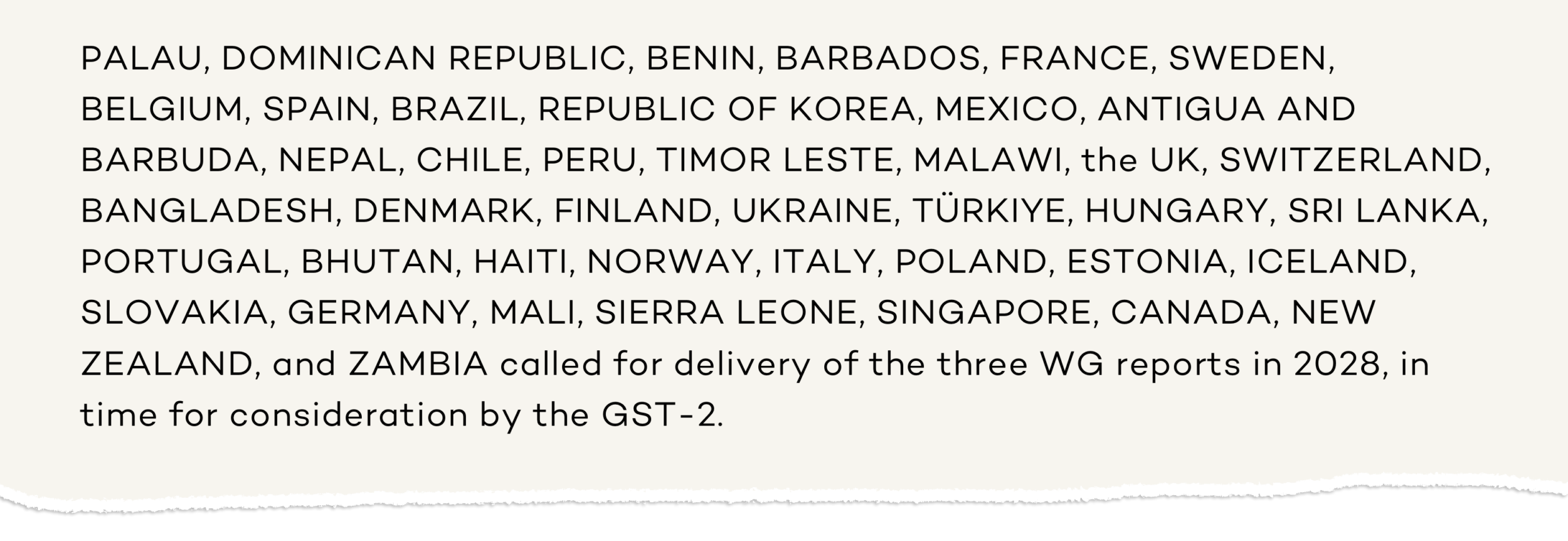
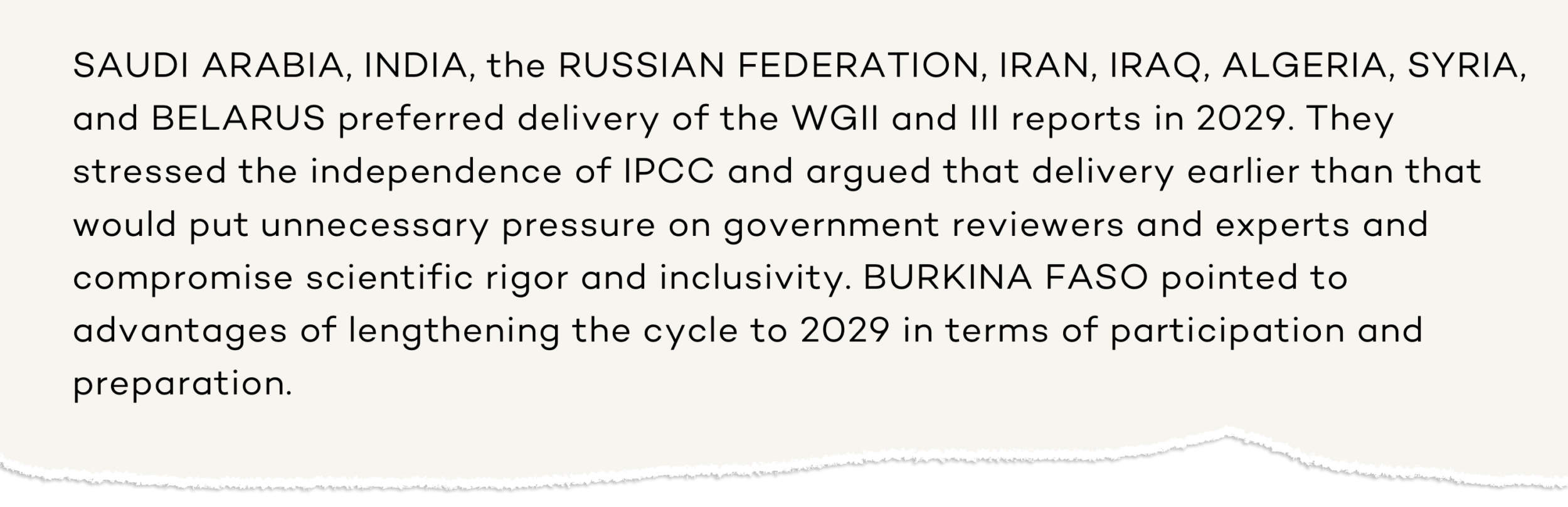
Reporting from the ENB from inside these meetings has highlighted that countries are split, broadly, into two groups – those that want all three reports to be published in time for the UN’s second “global stocktake” in 2028, and those that one, or more, to be published afterwards.
A key pillar of the Paris Agreement, the global stocktake is a formal assessment of the world’s collective progress on tackling climate change. The exercise is designed to guide future global climate action, including decisions on national emissions targets and climate finance.
The second global stocktake is due to culminate in late 2028 at the COP33 climate summit.
The Addis Ababa meeting was the final IPCC plenary where countries would be able to agree on a stocktake-aligned timeline. In April, Skea told Carbon Brief that publishing reports by the end of 2028 would only be possible if a decision was taken before the end of 2026.
India, Kenya, Russia and Saudi Arabia have emerged as among the loudest voices calling for a timeline where the IPCC’s latest assessment of climate impacts and mitigation are published after the stocktake. They have argued that developing countries need more time to prepare, review and approve working group reports.
A coalition of developed nations and small-island developing states, meanwhile, have argued in favour of all three reports being published in time for the stocktake, so that the latest climate science can inform future climate action.
(For more on the standoff around the reports and why it matters for climate action, read Carbon Brief’s explainer.)
Ahead of the Addis Ababa meeting, the IPCC’s secretariat, on behalf of Skea, published a document setting out three options for a timeline for the working group reports. These are summarised below.
| Option 1 | Option 2 | Option 3 | ||||
| Proposal set out by working group co-chairs at IPCC-61 in Sofia. | Revisited proposal presented by working-group co-chairs at IPCC-63 in Lima. | Submissions by India and Saudi Arabia to a survey sent out by IPCC in 2026. | ||||
| Report approval | Plenary | Proposed month of approval | Plenary | Proposed month of approval | Plenary | Proposed month of approval |
| Working Group 1 | IPCC-69 | May 2028 | IPCC-69 | May 2028 | IPCC-69 | May 2028 |
| Working Group 2 | IPCC-70 | June 2028 | IPCC-70 | July 2028 | IPCC-71 | April 2029 |
| Working Group 3 | IPCC-71 | July 2028 | IPCC-71 | Sept 2028 | IPCC-72 | July 2029 |
Source: Table 1 and Appendix A in “Work plan of the IPCC seventh assessment report”, IPCC.
Over several days of fraught talks in Addis Ababa, the number of timeline options in contention ballooned to seven – before being reduced down to four.
How did the timeline discussions unfold?
On Monday, Skea established a “contact group”, chaired by Brazil and Ireland, to focus on the timeline issue.
By Friday morning, the group reported back to the plenary that they were still a “long way from consensus”, according to the ENB.
By that afternoon, four options still remained – the three set out by the IPCC ahead of the meeting and a fourth, proposed by Haiti, which would see WG1 approval in April 2028, WG2 in July 2028 and WG3 in October 2028.
The IPCC’s secretariat subsequently presented a “draft decision” for the timeline issue to plenary, informed by the contact group’s work. The text did not establish a formal decision on the timeline, but presented a number of options for how the IPCC could move forward on the issue, as well as proposals for addressing inclusivity concerns.
Two out of three options suggested that IPCC co-chairs to continue work on reports in 2027 “without prejudging the panel’s agreement on the timing of the respective approval sessions” and for timeline discussions to be continued at a future session.
Another suggestion was that the IPCC fund a second delegate for developing countries and “economies in transition” for future approval sessions.
After one delegation said they were uncertain how to engage with the draft text, Skea clarified the text had three elements – a preamble, the timeline and a section on inclusivity and avenues for providing input.
He said that “it was clear the panel would not be able to take a decision on the timeline at IPCC-65” and explained the idea was to include the four timeline options that emerged from the contact group in an annex “in order to capture progress made during IPCC-65”.
After countries were not able to agree on the draft decision, Skea suspended the meeting at 8:29pm on Friday.
He noted that it would no longer be inclusive for the meeting to continue, given that a number of delegations from developing countries had left.
Earlier in the plenary, Antigua and Barbuda’s delegation had emphasised that 6pm was its deadline and noted that representatives of other small-island developing states had departed. Nepal’s negotiating team had also stated it was leaving.
What were the main points of disagreement?
The ENB’s report details how the five-day meet was beset by disagreements between country delegations on the timeline issue.
As proceedings kicked off on Monday, a significant number of countries set out their position on whether publication of the reports should occur before, or after, the global stocktake.
Both camps cited inclusivity concerns. Those in favour of a stocktake-aligned timeline said that “inclusivity is a priority and shoul