Back in 2021, the CEO of BlackRock – which manages $10 trillion of assets – took to a stage in Riyadh to predict that the next 1,000 billion-dollar startups would not be media companies or search engines but businesses developing “green hydrogen, green agriculture, green steel and green cement”.
Fast forward four years, and Larry Fink has changed his tune, telling an audience of oil and gas executives in Houston last week: “Everyone talks about the opportunity with hydrogen. Well, we can have green hydrogen and blue hydrogen, but is anybody willing to pay the cost?”
Other speakers at the “CERAWeek by S&P Global” conference in Texas were similarly down on the prospects for clean hydrogen, a gas that can replace fossil fuels in sectors that are hard to otherwise clean up, like shipping, aviation, chemicals, steel and cement.
The CEO of oil company Saudi Aramco, Amin Nasser, pointed to the high cost of green hydrogen compared to fossil fuels as a demonstration of “the fiction that critical transition technologies are genuinely competitive and being rapidly deployed”.
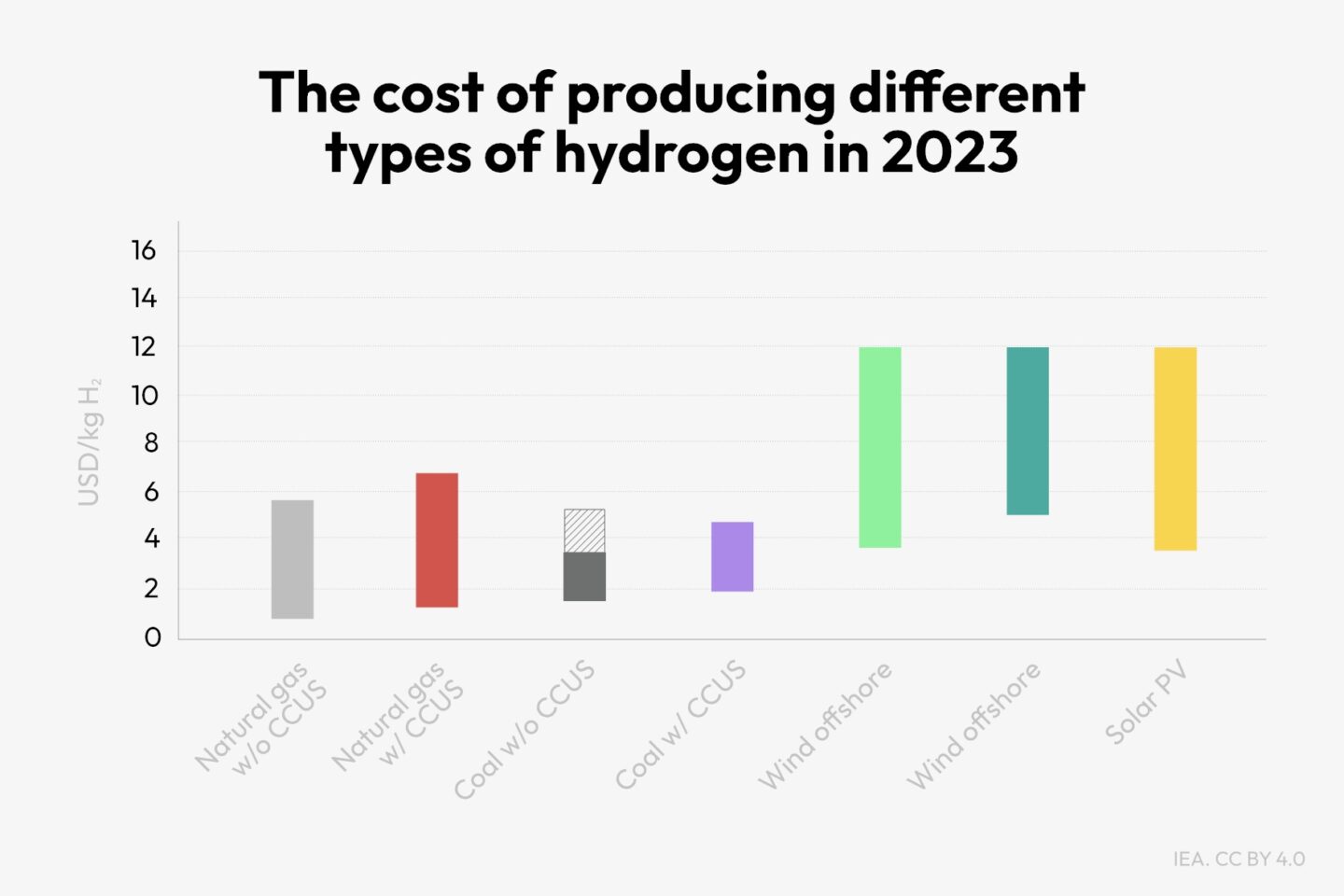
“Many were aiming for $1 per kilogram [for green hydrogen] by 2030. Yet production costs alone currently range wildly from almost $4 per kilogram to $12,” he said, comparing International Energy Agency (IEA) figures on the cost today with the Biden administration’s targeted cost for 2030.
Even sellers of clean hydrogen accepted that mood has shifted down a gear. David Burns, vice-president of global clean energy at industrial gases multinational Linde, said there’s now “more a sense of realism, a more kind of pragmatic approach to what’s going to work”. But, he added, viable projects which “meet the willingness to pay for customers in different sectors” are still moving forward.
Green hydrogen costs more
According to the IEA, producing green hydrogen – which is made with renewable energy – is between 1.5 and 6 times more expensive than the traditional, most common and polluting way of making it, with unabated fossil fuels.
But this could change, the IEA says. The price of fossil gas could rise or carbon pricing could make fossil fuel-based hydrogen more expensive. Or large-scale deployment of green hydrogen could bring the cost per kilo down from the $4-$12 Aramco’s Nasser cited to $2-$9 by 2030. It could go even lower in parts of China, the IEA says, where abundant solar meets cheaper electrolysers – the equipment that turns water into hydrogen.
Carbon colonialism? Malaysia and Indonesia plan storage hubs for Asian emissions
“The future cost evolution will depend on numerous factors, such as technology development, and particularly on the level and pace of deployment,” the IEA said in its latest global hydrogen review.
But as BlackRock’s Fink noted, high prices are proving a barrier to deployment. Companies like BP and Ørsted have cancelled or delayed green hydrogen production projects in recent months, citing unfavourable economics.
Governments boost hydrogen demand
Some governments have stepped in to try and increase demand. The European Union, for example, has set a mandate that synthetic fuels, including those based on green hydrogen, must make up 1.2% of all the plane fuel at its airports by 2030 and 35% by 2050.
The EU has similar measures for shipping, while a German government programme aims to cover the extra cost of buying clean hydrogen in industries like steel, cement, paper and glass, so that it is not a financial risk.
Canada’s new leader culls carbon tax seen as burden on voters
These policies have helped, the IEA says – but “the overall scale of these efforts remains inadequate for hydrogen to contribute to meeting climate goals”. In October, the Paris-based analysts revised their forecast for 2030 hydrogen demand down by about a fifth compared to the previous year.
Green hydrogen’s supply problems
Estimates of supplies of green hydrogen also look likely to have been overstated. Experts told Climate Home recently that a planned pipeline to bring hydrogen from North Africa to Europe will struggle to deliver the quantities the European Union is hoping for.
Adrian Odenweller, a researcher at the Potsdam Institute for Climate Impact Research (PIK), warned that the EU should “certainly not count on the delivery” of green hydrogen from Algeria and Tunisia any time soon.
“Green hydrogen production projects have a poor track record and often get delayed. I would expect this to be even worse for massive infrastructure projects such as pipelines that require international coordination,” he said.
The SoutH2 pipeline and production facilities face opposition from campaigners too. Shereen Talaat, director of MENAFem Movement, a North African feminist justice network, said in a statement by nearly 90 NGOs criticising the huge project that it “exploits African land, water, and labour to feed Europe’s energy needs, while women – especially in rural and frontline communities – bear the brunt of water scarcity, land dispossession, and energy poverty”.
EU backs North Africa hydrogen pipeline, but is it a green dream?
Green hydrogen projects require land to build facilities and water and renewable electricity to produce the hydrogen. Areas with a lot of sun – which helps produce green hydrogen cheaply – often don’t have much water. The IEA says that 40% of green hydrogen projects are in water-stressed areas like those around the Mediterranean, Mexico and Northern India.
To address this issue, many developers in dry countries like Saudi Arabia, Australia and Mauritania are developing desalination plants to supply their green hydrogen facilities with water so they do not take it away from locals.
For all its challenges, Wood Mackenzie analyst Hector Arreola believes clean hydrogen is the “most viable pathway to deep decarbonisation” in steel, cement, chemicals and heavy transport – and the only green solution for emissions of ammonia, methanol and refining.
“While hydrogen’s broader adoption may take longer to materialise due to current cost barriers, the path to cost reduction is well-established,” he said. “As technology scales, electrolyser efficiency improves, and renewable energy costs continue to fall, production costs are expected to decline – following a trajectory similar to that of solar and wind.”
The post Clean hydrogen hype fades as high costs dampen demand appeared first on Climate Home News.
Climate Change
World leaders invited to see Pacific climate destruction before COP31
The leaders and climate ministers of governments around the world will be invited to meetings on the Pacific islands of Fiji, Palau and Tuvalu in the months leading up to the COP31 climate summit in November.
Under a deal struck between Pacific nations, Fiji will host the official annual pre-COP meeting, at which climate ministers and negotiators discuss contentious issues with the COP Presidency to help make the climate summit smoother.
This pre-COP, expected to be held in early October, will include a “special leaders’ component” hosted in neighbouring Tuvalu – 2.5-hour flight north – according to a statement issued by the Australian COP31 President of Negotiations Chris Bowen on LinkedIn on Thursday.
Bowen said this “will bring a global focus to the most pressing challenges facing our region and support investment in solutions which are fit for purpose for our region.” Australia will provide operational and logistical support for the event, he said.
Like many Pacific island nations, Tuvalu, which is home to around 10,000 people, is threatened by rising sea levels, as salt water and waves damage homes, water supplies, farms and infrastructure.
Dozens of heads of state and government usually attend COP summits, but only a handful take part in pre-COP meetings. COP31 will be held in the Turkish city of Antalya in November, after an unusual compromise deal struck between Australia and Türkiye.
In addition, Pacific country Palau will host a climate event as part of the annual Pacific Islands Forum (PIF) – which convenes 18 Pacific nations – in August.
Palau’s President Surangel Whipps Jr told the Australian Broadcasting Corporation (ABC) that this meeting would be a “launching board” to build momentum for COP31 and would draw new commitments from other countries to help Pacific nations cut emissions and adapt to climate change.
“At the PIF our priorities are going to be 100 per cent renewables, the ocean-climate nexus and … accelerating investments that build resilience from climate change,” he told ABC.
The post World leaders invited to see Pacific climate destruction before COP31 appeared first on Climate Home News.
World leaders invited to see Pacific climate destruction before COP31
Climate Change
There is hope for Venezuela’s future – and it isn’t based on oil
Alejandro Álvarez Iragorry is a Venezuelan ecologist and coordinator of Clima 21, an environmental NGO. Cat Rainsford is a transition minerals investigator for Global Witness and former Venezuela analyst for a Latin American think tank.
In 1975, former Venezuelan oil minister Juan Pablo Pérez Alfonzo gave a now infamous warning.
“Oil will bring us ruin,” he declared. “It is the devil’s excrement. We are drowning in the devil’s excrement.”
At the time, his words seemed excessively gloomy to many Venezuelans. The country was in a period of rapid modernisation, fuelled by its booming oil economy. Caracas was a thriving cultural hotspot. Everything seemed good. But history proved Pérez right.
Over the following decades, Venezuela’s oil dependence came to seem like a curse. After the 1980s oil price crash, political turmoil paved the way for the election of populist Hugo Chávez, who built a socialist state on oil money, only for falling prices and corruption to drive it into ruin.
By 2025, poverty and growing repression under Chávez’s successor Nicolás Maduro had forced nearly 8 million Venezuelans to leave the country.
Venezuela is now at a crossroads. Since the US abducted Maduro on January 3 and seized control of the country’s oil revenues in a nakedly imperial act, all attention has been on getting the country’s dilapidated oil infrastructure pumping again.
But Venezuelans deserve more than plunder and fighting over a planet-wrecking resource that has fostered chronic instability and dispossession. Right now, 80% of Venezuelans live below the poverty line. Venezuelans are desperate for jobs, income and change.
Real change, though, won’t come through more oil dependency or profiteering by foreign elites. Instead, it is renewable energy that offers a pathway forward, towards sovereignty, stability and peace.
Guri Dam and Venezuela’s hydropower decline
Venezuela boasts some of the strongest potential for renewable energy generation in the region. Two-thirds of the country’s own electricity comes from hydropower, mostly from the massive Guri Dam in the southern state of Bolívar. This is one of the largest dams in Latin America with a capacity of over 10 gigawatts, even providing power to parts of Colombia and Brazil.
Guri has become another symbol of Venezuela’s mismanagement. Lack of diversification caused over-reliance on Guri for domestic power, making the system vulnerable to droughts. Poor maintenance reduced Guri’s capacity and planned supporting projects such as the Tocoma Dam were bled dry by corruption. The country was left plagued by blackouts and increasingly turned to dirty thermoelectric plants and petrol generators for power.
Today, industry analysis suggests that Venezuela is producing at about 30% of its hydropower capacity. Rehabilitating this neglected infrastructure could re-establish clean power as the backbone of domestic industry, while the country’s abundant river system offers numerous opportunities for smaller, sustainable hydro projects that promote rural electrification.


Venezuela also has huge, untapped promise in wind power that could provide vital diversification from hydropower. The coastal states of Zulia and Falcón boast wind speeds in the ideal range for electricity generation, with potential to add up to 12 gigawatts to the grid. Yet planned projects in both states have stalled, leaving abandoned turbines rusting in fields and millions of dollars unaccounted for.
Solar power is more neglected. One announced solar plant on the island of Los Roques remains non-functional a decade later, and a Chávez-era programme to supply solar panels to rural households ground to a halt when oil prices fell. Yet nearly a fifth of the country receives levels of solar radiation that rival leading regions such as northern Chile.
Developing Venezuela’s renewables potential would be a massive undertaking. Investment would be needed, local concerns around a just and equitable transition would have to be navigated and infrastructure development carefully managed.
Rebuilding Venezuela with a climate-driven energy transition
A shift in political vision would be needed to ensure that Venezuela’s renewable energy was not used to simply free up more oil for export, as in the past, but to power a diversified domestic economy free from oil-driven cycles of boom and bust.
Ultimately, these decisions must be taken by democratically elected leaders. But to date, no timeline for elections has been set, and Venezuela’s future hangs in the balance. Supporting the country to make this shift is in all of our interests.
What’s clear is that Venezuela’s energy future should not lie in oil. Fossil fuel majors have not leapt to commit the estimated $100 billion needed to revitalise the sector, with ExxonMobil declaring Venezuela “uninvestable”. The issues are not only political. Venezuela’s heavy, sour crude is expensive to refine, making it dubious whether many projects would reach break-even margins.
Behind it all looms the spectre of climate change. The world must urgently move away from fossil fuels. Beyond environmental concerns, it’s simply good economics.


Recent analysis by the International Renewable Energy Agency finds that 91% of new renewable energy projects are now cheaper than their fossil fuel alternatives. China, the world’s leading oil buyer, is among the most rapid adopters.
Tethering Venezuela’s future to an outdated commodity leaves the country in a lose-lose situation. Either oil demand drops and Venezuela is left with nothing. Or climate change runs rampant, devastating vulnerable communities with coastal loss, flooding, fires and heatwaves. Meanwhile, Venezuela remains locked in the same destructive economic swings that once led to dictatorship and mass emigration. There is another way.
Venezuelans rightfully demand a political transition, with their own chosen leaders. But to ensure this transition is lasting and stable, Venezuela needs more – it needs an energy transition.
The post There is hope for Venezuela’s future – and it isn’t based on oil appeared first on Climate Home News.
There is hope for Venezuela’s future – and it isn’t based on oil
Climate Change
UN’s new carbon market delivers first credits through Myanmar cookstove project
A cleaner cooking initiative in Myanmar is set to generate the first-ever batch of carbon credits under the new UN carbon market, more than a decade after the mechanism was first envisioned in the Paris Agreement.
The Article 6.4 Supervisory Body has approved the issuance of 60,000 credits, which correspond to tonnes of carbon dioxide equivalent reduced by distributing more efficient cookstoves that need less firewood and, therefore, ease pressure on carbon-storing forests, the project developers say. The approval of the credit issuance will become effective after a 28‑day appeal and grievance period.
The programme started in 2019 under the previous UN-run carbon offsetting scheme – the Clean Development Mechanism (CDM) – and is being implemented by a South Korean NGO with investment from private South Korean firms.
The credits are expected to be used primarily by major South Korean polluters to meet obligations under the country’s emissions trading system – a move that will also enable the government to count those units toward emissions reduction targets in its nationally determined contribution (NDC), the UN climate body told Climate Home News.
Myanmar will use the remaining credits to achieve in part the goals of its national climate plan.
Making ‘a big difference’
The approval of the credits issuance represents a major milestone for the UN carbon market established under article 6.4 of the Paris Agreement. By generating carbon credits that both governments and private firms can use, the mechanism aims to accelerate global climate action and channel additional finance to developing nations.
UNFCCC chief Simon Stiell said the approval of the first credits from a clean cooking project shows “how this mechanism can support solutions that make a big difference in people’s daily lives, as well as channeling finance to where it delivers real-life benefits on the ground”.
“Over two billion people globally are without access to clean cooking, which kills millions every year. Clean cooking protects health, saves forests, cuts emissions and helps empower women and girls, who are typically hardest hit by household air pollution,” he added in a statement.
Concerns over clean cookstove credits
Carbon markets are seen as an important channel to raise money to help low-income communities in developing countries switch to less polluting cooking methods. Proceeds from the sale of carbon credits made up 35% of the revenue generated by for-profit clean cooking companies in 2023, according to a report by the Clean Cooking Initiative.
But many cookstove offsetting projects have faced significant criticism from researchers and campaigners who argue that climate benefits are often exaggerated and weak monitoring can undermine claims of real emission reductions. Their main criticism is that the rules allow project developers to overestimate the impact of fuel collection on deforestation, while relying on surveys to track stove usage that are prone to bias and can further inflate reported impacts.
As Louisiana bets big on ‘blue ammonia’, communities brace for air pollution
The project in Myanmar follows a contested methodology developed under the Kyoto Protocol that was rejected last year by The Integrity Council for the Voluntary Carbon Market (ICVCM), a watchdog that issues quality labels to carbon credit types, because it is “insufficiently rigorous”.
An analysis conducted last year by Brussels-based NGO Carbon Market Watch claimed that the project would generate 26 times more credits than it should, when comparing its calculations with values from peer-reviewed scientific literature.
‘Conservative’ values cut credit volume
But, after transitioning from the CDM to the new mechanism, the project applied updated values and “more conservative” assumptions to calculate emission reductions, according to the UNFCCC, which added that this resulted in 40% fewer credits being issued than would have been the case in the CDM.
“The result is consistent with environmental integrity requirements and ensures that each credited tonne genuinely represents a tonne reduced and contributes to the goals of the Paris Agreement,” said Mkhuthazi Steleki, the South African chair of article 6.4 Supervisory Body, which oversees the mechanism.
Over 1,500 projects originally developed under the CDM requested the transition to the new mechanism, including controversial schemes subsidising fossil gas-powered plants in China and India. But, so far, the transfer of only 165 of all those projects has been approved by their respective host nations, which have until the end of June to make a final decision.
The UN climate body said this means that “a wide variety of real-world climate projects are already in line to follow” in sectors such as renewable energy, waste management and agriculture. But the transfer of old programmes from the CDM has long been contested with critics arguing that weak and discredited rules allow projects to overestimate emission reductions.
Genuinely new projects unrelated to the CDM are expected to start operating under the Paris Agreement mechanism once the Supervisory Body approves the first custom-made methodologies.
The post UN’s new carbon market delivers first credits through Myanmar cookstove project appeared first on Climate Home News.
UN’s new carbon market delivers first credits through Myanmar cookstove project
-
Greenhouse Gases7 months ago
Guest post: Why China is still building new coal – and when it might stop
-
Climate Change7 months ago
Guest post: Why China is still building new coal – and when it might stop
-
Greenhouse Gases2 years ago嘉宾来稿:满足中国增长的用电需求 光伏加储能“比新建煤电更实惠”
-
Climate Change2 years ago
Bill Discounting Climate Change in Florida’s Energy Policy Awaits DeSantis’ Approval
-
Climate Change2 years ago
Spanish-language misinformation on renewable energy spreads online, report shows
-
Climate Change2 years ago嘉宾来稿:满足中国增长的用电需求 光伏加储能“比新建煤电更实惠”
-
Climate Change Videos2 years ago
The toxic gas flares fuelling Nigeria’s climate change – BBC News
-

Carbon Footprint2 years agoUS SEC’s Climate Disclosure Rules Spur Renewed Interest in Carbon Credits


