Climate Change
Clean energy pushes fossil-fuel power into reverse for ‘first time ever’
Renewable energy has overtaken coal to become the world’s largest source of electricity in 2025, according to thinktank Ember.
The growth of solar and wind meant that, for the first time since 1919, the share of coal power was lower than that of renewables.
Fossil-fuel generation fell by 0.2% in 2025, the thinktank’s latest annual review says, with wind and solar alone meeting 99% of the growth in electricity demand last year.
While generation from fossil fuels has occasionally fallen year-on-year in the past, Ember says this is the first time it has happened due to the structural shift towards clean power, rather than due to economic crises or other one-off events
Record solar generation was key to pushing fossil fuels into reverse, increasing 30% year-on-year – meaning it met 75% of global electricity demand growth in 2025 alone.
Other findings include:
- Solar power generation grew by a record 636 terawatt hours (TWh) in 2025. This exceeded the electricity that could be generated from all liquid natural gas (LNG) exports through the strait of Hormuz.
- Wind saw the second-largest increase in generation, growing 205TWh.
- Coal power continued to fall, meaning, for the first time in history, it accounted for less than a third of global electricity generation.
- The global electric vehicle (EV) fleet continued to grow, displacing 1.8m barrels per day (mbpd) of oil demand in 2025. New EVs alone in 2025 displaced 0.5mbpd.
Record renewables
In 2025, both solar and wind power generation continued their recent rapid growth, according to Ember.
Solar saw a record increase, with global generation growing by 636 terawatt hours (TWh) – double the total annual electricity demand of the UK. This was 33% higher than the previous solar record growth, set just the year before (479TWh).
Global solar growth in 2025 alone exceeded the electricity that could be generated from all liquid natural gas (LNG) exports through the strait of Hormuz that year, Ember notes. This amounted to 81m tonnes (Mt) or around 550TWh of gas-fired electricity.
Solar in 2025 represented the largest annual increase of any individual electricity source ever, Ember says, with the exception of the rebound in coal generation after the Covid-19 pandemic in 2021 (719TWh).
The continued growth of solar generation last year reflects structural capacity expansion rather than fluctuations in demand. Moreover, 2025 was the fourth year in a row that solar recorded the largest absolute growth of any electricity source.
Solar capacity grew by a record 647 gigawatts (GW) in 2025. This suggests that the technology will continue to dominate generation growth in the coming years, says Ember.
Wind saw the second-largest increase in generation, growing 205TWh (8.2%) in 2025. This was the same rate as seen in 2024, but fell slightly below the record absolute increase seen in 2021 of 265TWh.
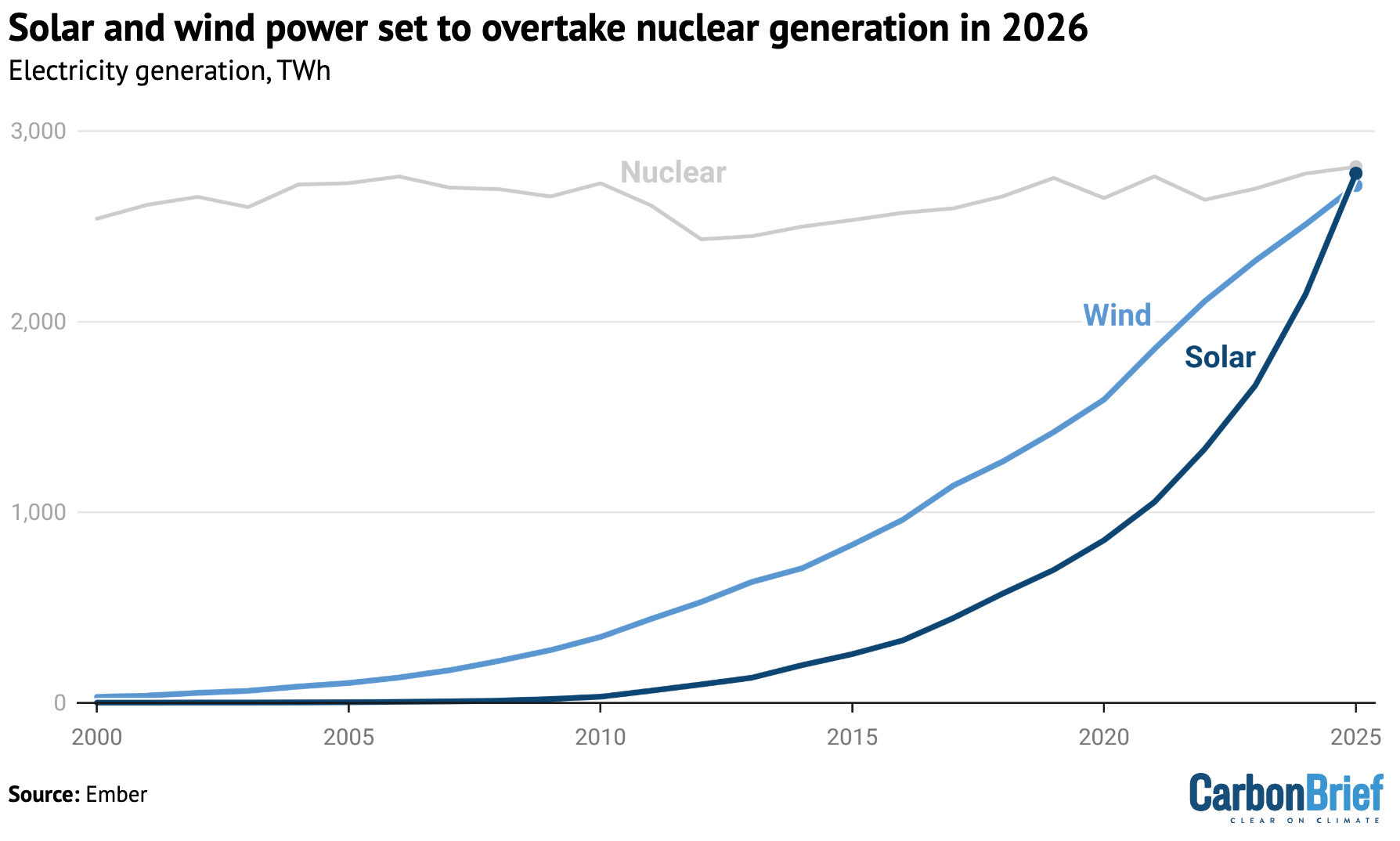
Nuclear rose moderately by 35TWh (1.3%), bringing it to an all-time high of 2,812TWh. This was driven by reactors coming online in China (37TWh), as well as increased output in France (12TWh) and Japan (9TWh), which balanced out reductions elsewhere.
However, despite nuclear generation growth, both solar and wind are expected to overtake the technology in 2026, as shown in the chart below.

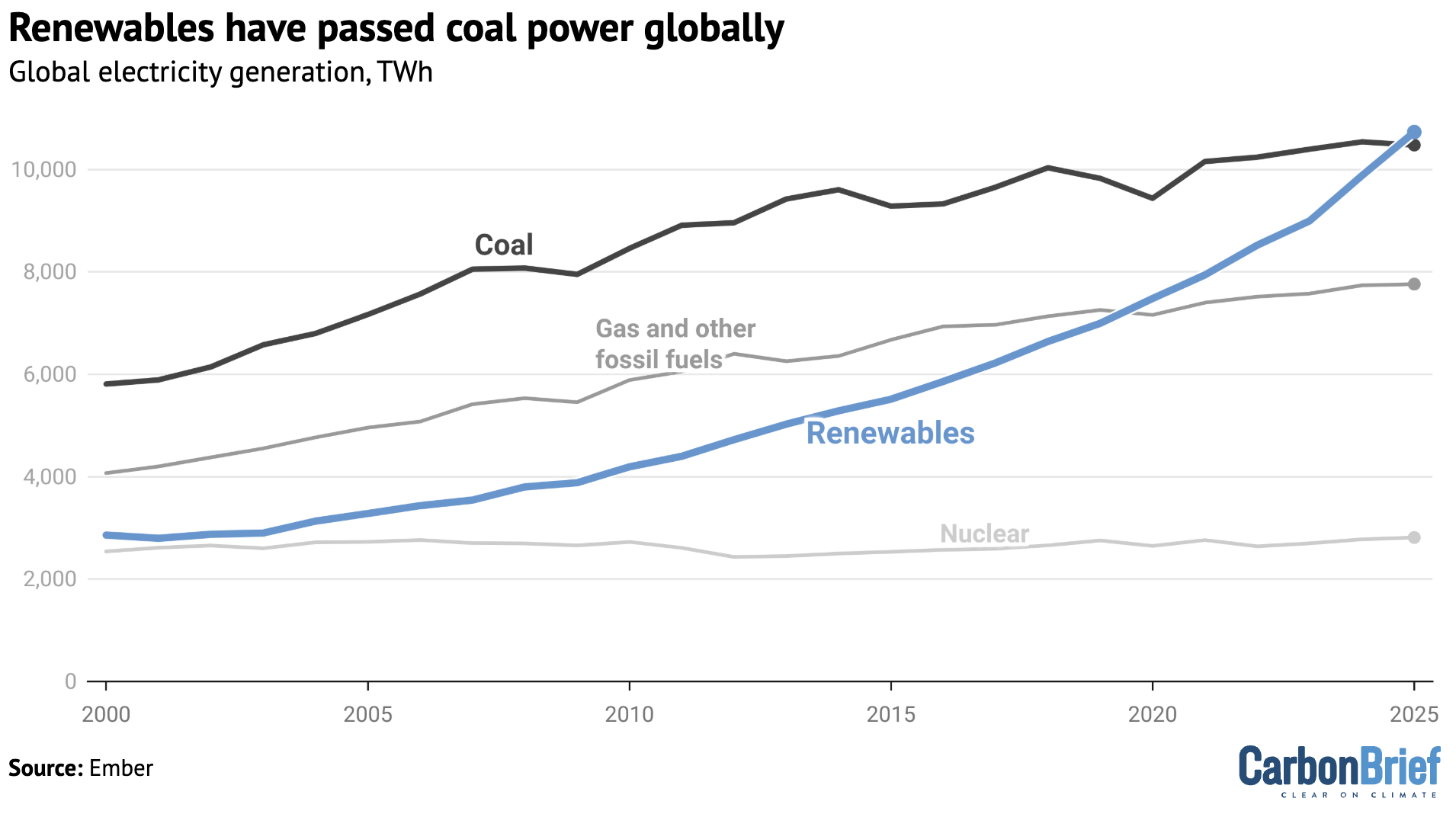
Increasingly, solar and wind are dominating the electricity generation mix. This allowed renewable technologies, collectively, to surpass coal in the first six months of 2025, before successfully overtaking it across the whole year, as shown in Ember’s report.
This marks the first time in history that coal power accounted for less than a third of global electricity generation, it says.
In addition, for the first time, the growth of clean-power sources has pushed fossil-fuel generation into reverse, as shown in the chart below.

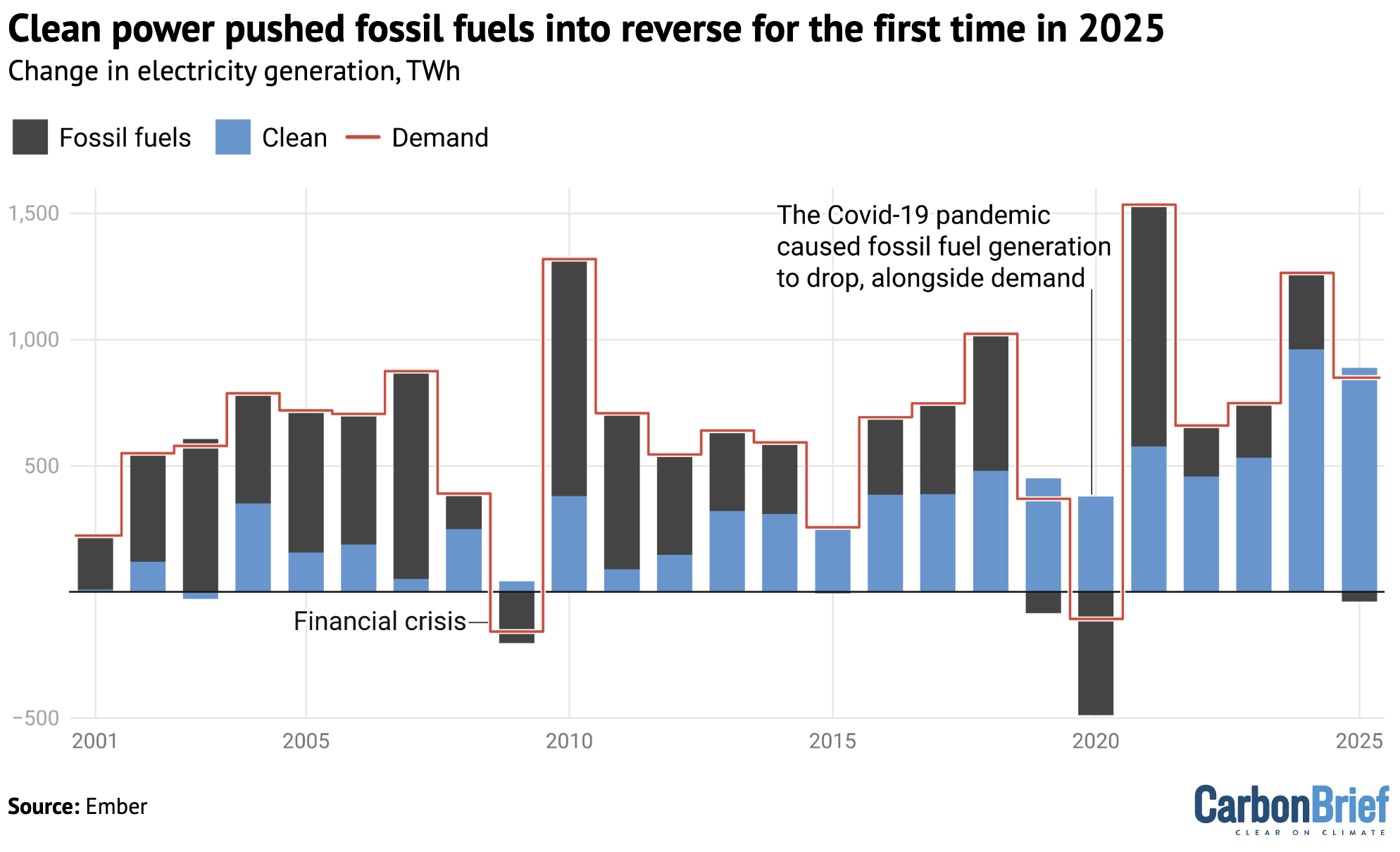
While there have been annual declines in fossil-fuel generation in the past, these were all caused by economic crises or other one-off shocks, such as the global financial crisis in 2008-9 or the coronavirus pandemic in 2020.
Tipping points
The share of wind and solar power in the global electricity mix has risen by more than 10 percentage points over the past decade, from 23% to 33.8%, according to Ember. Over the same time period, the share of coal has dropped from 38.7% to 33.0% in 2025.
Indeed, 81% of all wind and solar generation growth since 2000 occurred over the past 10 years. In contrast, only 27% of fossil-fuel growth since 2000 happened over the past 10 years, as the balance continues to tip towards renewables.
Had wind and solar not grown since 2000, electricity generation from fossil fuels would have been 30% higher in 2025 and emissions 28% higher, Ember says, adding 4,065Mt of carbon dioxide equivalent (CO2e) annually.
It says that the expected growth in clean power will tip fossil-fuel use in the power sector firmly into decline, as well as “aiding decarbonisation in other sectors”.
Renewables have overtaken coal in every region of the world, except Asia. Coal power fell by 63TWh (-0.6%) in 2025. However, at 10,476TWh, coal remained the largest single source of electricity globally.
Gas generation saw a small increase of 36TWh (0.5%) to 6,919TWh in 2025.
Despite Asia being the only region where coal generation has not been overtaken by renewables, two of the world’s biggest emitters on the continent did see fossil-fuel generation fall.
Fossil generation fell in both China (-56TWh/-0.9%) and India (-52TWh/-3.3%) due to rapid clean-power deployment and moderate demand growth, according to Ember.
This is in line with analysis for Carbon Brief earlier this year, which also found that coal power fell in China and India concurrently for the first time in 52 years.
Combined, China and India made up 42% of global fossil-fuel generation in 2025, according to Ember, offsetting a small increase in the US, EU and other economies.
In 1919, when electricity demand was 300 times smaller than in 2025, renewables – mostly hydropower – briefly exceeded coal power.
Over the following 100 years, coal power remained the largest power source globally. Its share in the power mix was around 40% from the 1970s through to the mid-2010s.
The chart below shows the growth of renewables since 2000, has allowed the technologies to overtake coal generation in 2025.

Emissions impact
The growth of clean power generation has helped to decouple demand growth from emissions growth, according to Ember’s report.
Global electricity demand grew by 2.8% (849TWh) in 2025. While this was significantly below the 4.3% growth seen in 2024, it was broadly in line with the 10-year average annual increase of 2.7%.
Last year’s increase still represents the sixth-largest absolute annual rise ever recorded.
Ember analysis suggests that if demand and clean electricity growth continue at their recent pace, then fossil-fuel generation will plateau before starting to decline consistently from the early 2030s.
With renewable energy growth pushing fossil fuels down in 2025, however, power-sector emissions fell slightly despite the increase in demand.
In 2025, the average kilowatt hour produced globally resulted in emissions of 458gCO2e, some 2.7% less than in 2024 (471gCO2e) and down 16% from 2005 (543gCO2e).
Electrification of key sectors is expected to add to rising electricity demand in the coming years, Ember notes, pointing to transport and data centres.
(Note that while demand from electric vehicles and data centres is rising quickly, they are still “relatively slim” in terms of their contribution to overall growth, according to the International Energy Agency. Industry and buildings are the largest sources of growth.)
In 2025, electric vehicle (EV) sales reached more than 25% of the global car market. As a result, Ember says that EVs are becoming a “structural driver of electricity demand growth”, accounting for about 8% (66TWh) of the 849TWh rise in global electricity demand in 2025. This is up from 36TWh in 2024.
In addition, the global EV fleet displaced 1.8m barrels per day (mbpd) of oil demand in 2025. New EVs alone in 2025 displaced 0.5mbpd.
The oil demand displaced through additional transport electrification in 2025 will avoid roughly 80MtCO2e emissions annually, more than the annual power sector emissions of the UK, it says.
Further expansion of renewables to help meet growing demand from sectors such as transport is being supported by the rollout of storage technologies.
Falling battery prices are driving a rapid scale-up in deployments. Battery pack prices for stationary storage applications fell to a record low of $70/kWh in 2025, Ember says – a 45% drop from 2024.
Global battery storage capacity additions reached an estimated 247 gigawatt hours (GWh), up 46% year-on-year. This would be enough to shift about 14% of daily solar generation to other hours, up from 13% in 2024 and just 5% in 2022, according to Ember.
The post Clean energy pushes fossil-fuel power into reverse for ‘first time ever’ appeared first on Carbon Brief.
Clean energy pushes fossil-fuel power into reverse for ‘first time ever’