

Welcome to Carbon Brief’s China Briefing.
Carbon Brief handpicks and explains the most important climate and energy stories from China over the past fortnight. Subscribe for free here.
Key developments
China restricts exports of key electric vehicle battery component
GRAPHITE CURBED: China placed export controls on graphite, requiring “special export permits” for three forms of the mineral, which is commonly used to manufacture electric vehicle (EV) batteries, the Financial Times reported. The decision was made in response to the US’s tightened controls on exports of cutting-edge artificial intelligence chips to China, the outlet added. Finance newspaper Yicai quoted a Chinese ministry of commerce spokesperson saying that China “does not target any specific country or region, nor any specific industry” with the restrictions.
UNCERTAIN IMPACT: Reuters stated that the move has “fuelled uncertainty” in the EV sector. It added that Chinese manufacturers with overseas plants “expect limited impact” as they largely use synthetic graphite. Foreign manufacturers, who largely have not made the shift to synthetic graphite, will be disproportionately affected, the newswire added. However, the restricted items had already been subject to “temporary controls”, another Reuters article explained, quoting an expert as saying these temporary controls had “no significant impact on any industry”.
NEXT FRONTIER? Meanwhile, China is boosting its strategic reserves of cobalt, another important mineral in EV production, according to Bloomberg. The outlet noted that China agreed to buy 3,000 tonnes of cobalt at a recent meeting in Beijing between government officials and representatives from five producers and traders.
California governor meets Chinese leadership to talk climate
CALIFORNIA DREAMIN’: California governor Gavin Newsom met a series of top Chinese policymakers, most notably president Xi Jinping, in a trip “to promote climate cooperation”, NBC reported, adding that Newsom “received an unusually warm welcome”. State news agency Xinhua announced that Xi told Newsom that “China and the [US] have great potential for cooperation in…green development and combating climate change, and both sides are well positioned to…turn [this] into a new bright spot” of bilateral cooperation.
BRASS TACKS: Newsom also met environment minister Huang Runqiu at a climate dialogue, another NBC article said, adding that Huang pledged to uphold a China-California memorandum of understanding (MOU) on carbon markets, adaptation and other climate policy. Communist party-backed news outlet the People’s Daily also reported on the event, stating that several provincial leaders expressed their desire “to strengthen exchanges and cooperation with the California government in…clean energy”. Bloomberg reported that Newsom’s visit concluded in Shanghai with the signing of an MOU “on matters including environmental protection and combating climate change” with mayor Gong Zheng – and a visit to Tesla’s gigafactory.
SUNNY SIDE UP: Politico noted that Newsom announced Chinese and US climate envoys Xie Zhenhua and John Kerry would meet this week at the Sunnylands estate in California. China watchers noted this as the location of Xi’s first meeting with former US president Barack Obama in 2013, ahead of their joint climate pledge in 2014. (For more, see Carbon Brief’s “Nine key moments that changed China’s mind about climate change”.) Greenpeace’s Li Shuo said the return would “pave the ground for the Xi-Biden summit at APEC [Asia-Pacific Economic Cooperation]”, which is due to take place in San Francisco later this month. The Communist party-affiliated newspaper People’s Daily published a commentary by Zhong Sheng – a nom de plume of the party leadership – that called for the US and China to improve ties and continue the type of cooperation that “[led] the way to the Paris agreement”.
EU DEALS: Meanwhile, Euronews reported that the EU has announced a “raft of new investment agreements” in the global south as part of its “global gateway” program, in areas including critical raw materials and green hydrogen. At the same time, the EU also “launched a wind power package…to counter the growing influence of China and spur its own industry”, Bloomberg said. Financial news outlet Yicai covered the official response from ministry of commerce (MOFCOM), which argued that “wind power products produced by Chinese enterprises have played an important role in accelerating the green transformation of the EU” and that it “firmly opposes” the EU’s “protectionist” behaviour. India is also “investigating 40 Chinese solar companies”, another Yicai article reported, which links the move to India’s desire to protect its solar industry from “dumping” – although an article in energy newspaper IN-EN.com pointed out that other countries’ solar companies were also being investigated.
China’s veteran climate envoy ‘set to retire’
XIE OUT: China’s climate change envoy Xie Zhenhua “is set to retire…at the end of this year’s COP28 climate talks”, according to Reuters. Both Reuters and a separate article by Bloomberg revealed that his replacement may be veteran diplomat Liu Zhenmin, a former vice minister for foreign affairs and UN under-secretary-general who “has been involved in past UN climate talks, taking part in Kyoto Protocol and Paris Agreement negotiations”. In a recent speech by Liu, he emphasised the need to “prioritise practical actions on climate change” and for developed countries to better support developing countries in their energy transitions. (See more below.)
XIA IN: Online newspaper the Paper reported that the ministry of ecology and environment (MEE) appointed a new director for its climate change department, Xia Yingxian. Xia previously “served as deputy permanent representative of China to the United Nations Environment Program” and “won international awards for his notable contributions to protecting the ozone layer and phasing out ozone depleting substances”, the newspaper explained. Xia replaced Li Gao, who was transferred to the environment and resources protection committee of the National People’s Congress, according to economic newspaper Jiemian. State-run newspaper the China Daily also covered the press conference, noting that Xia said that COP28 should assess “the gap in developed nations’ implementation of the Paris treaty and whether they had taken the lead in cutting carbon emissions and fulfilled their obligations to support developing countries”.
China releases report on its progress addressing climate change
PROGRESS REPORT: Xia’s climate change department at the MEE also released its annual report on China’s policies and actions to address climate change, said the People’s Daily. The report revealed that carbon emission intensity levels between 2005 and 2022 dropped by more than 51%, that non-fossil energy was contributing 17.5% of China’s consumption at the end of 2022 and that, as of mid-2023, “new energy” vehicle ownership reached 16.2m units, “accounting for more than half of the world”, the news outlet said. A separate press conference by the national energy administration (NEA) announced that China had added 172GW of installed renewable capacity between January and September 2023, an increase of 93% year-on-year, according to power news outlet China Electricity News, which explained that the NEA pledged to plan and maintain the supply of power over the winter peak period.
SOUTH-SOUTH SOLIDARITY: China has also “signed 48 memorandums of understanding on “south-south” cooperation on climate change” and “implemented 75 projects on climate change mitigation and adaptation” with developing countries as of September 2023, the report continued. The outlet also included comments from Xia’s press conference (see above) that COP28 should include “a comprehensive and balanced assessment of the progress and gaps in the global implementation of the Paris Agreement”, mobilisation of the $100bn climate finance pledged to developing countries, development of a loss and damages fund and promotion of “a just and green transition”.
Spotlight
Why China’s slowdown could drive a peak in fossil fuels and emissions
China’s economic slowdown will have major implications for global energy and emissions trends, according to the International Energy Agency (IEA) World Energy Outlook 2023. In this issue, Carbon Brief looks at what is changing in China – and what it means for the world.
What does the World Energy Outlook say about China?
Every year, Carbon Brief takes a deep dive into the latest IEA World Energy Outlook, producing in-depth coverage of the key findings – and the ways the outlook has shifted.
This year, the IEA highlights the impact of structural shifts in China, with knock-on implications for the whole world due to its “outsize influence on global energy trends”.
As IEA executive director Dr Fatih Birol told Carbon Brief in September, China was responsible for about two-thirds of global oil demand growth over the past decade, one-third of gas growth, more than 90% of coal demand growth and 85% of the rise in CO2 emissions.
The country’s “epoch-making” economic expansion over the past few decades has “changed the energy world”, the IEA says, but now “China is changing”. The report explains:
“China, which has an outsize influence on global energy trends, is undergoing a major shift as its economy slows and undergoes structural changes.”
China already has “world-class infrastructure”, narrowing the scope for further growth in physical assets – even before the ongoing strains in the country’s property sector. Moreover, China’s working-age population peaked in 2015 and is expected to fall 20% by 2050.
As a result, China’s economic growth is slowing and shifting towards less carbon-intensive sectors. The IEA reflects these changing expectations by cutting the outlook for average GDP growth to 3.9% per year until 2030, some 0.8 points lower than expected last year.
What does China’s slowdown mean for energy use and emissions?
These economic changes will have major implications for China’s energy demand and emissions.
To date, the expansion of low-carbon energy sources has been too slow to keep pace with rising demand for energy overall, with fossil fuels picking up the slack.
Now, decades of rapid energy demand growth are coming to an end, with the IEA pointing to a peak in China’s energy demand “around the middle of this decade”. Last year it had said a peak in energy demand – and CO2 emissions – would not come until “just before 2030”.
With China continuing to see “dynamic growth in clean energy”, its demand for fossil fuels is set to peak in 2024 and then enter structural decline, according to the outlook.
(Carbon Brief’s next quarterly analysis of trends in China’s energy use and emissions – as well as their near-term prospects – will feature in the 16 November issue of China Briefing.)
The decline in China’s fossil fuel demand will be driven by lower coal use. The IEA sees China’s coal demand falling nearly as quickly over the rest of this decade – by an average of 53m tonnes of coal equivalent (Mtce) per year – as it grew in the last (61Mtce per year).
By 2030, the IEA expects Chinese coal use to fall by 422Mtce, which is roughly equivalent to twice the current demand of the EU. This would leave China’s coal use in 2030 some 13% below 2022 levels – and nearly 100Mtce lower than the agency expected last year.
While China’s gas use would continue climbing – and its oil demand would only peak later this decade – coal would send China’s total fossil fuel use and CO2 emissions into decline.
What would happen if China builds more solar than expected?
Much of the expected drop in China’s coal use is concentrated in the electricity sector, where demand is set to fall 16% by 2030. China’s coal-fired electricity generation would fall by 874 terawatt hours (TWh), roughly equivalent to the total output of the US coal fleet.
The decline is expected to be steeper than the IEA thought just a year ago. This is despite the electrification of China’s economy going faster, with two out of every three cars sold in 2030 set to be electric rather than the one out of two expected last year.
The IEA now sees China generating an extra 820TWh of electricity from solar in 2030 – up 56% on last year’s estimate – and an extra 420TWh from wind (+27%).
These changes would be sufficient to push China’s CO2 emissions down to 11.3bn tonnes of CO2 (GtCO2) by 2030, 7% below 2022 levels, whereas last year it only saw a 2% cut.
Yet the IEA notes that these shifts could happen even more quickly than it expects in its main “stated policies scenario” (STEPS), reflecting current government policy settings.
China’s solar manufacturing sector is surging, it notes, creating potential for even faster solar growth. This could see China building 400GW of solar per year by 2030, instead of 270GW.
If this extra solar can be integrated into the grid, it would cut China’s coal generation in 2030 by a further 20%, the IEA says, shaving another US-sized coal fleet off global demand.
Another case explored by the IEA is if China’s economic slowdown goes more quickly, with “slower but ultimately ‘higher quality’ growth”. In this “low” case, China’s emissions would fall a further 0.8bn tonnes of CO2 (GtCO2) in 2030 to 10.5GtCO2, to 15% below 2022 levels.
Coal use would fall by an amount equal to Europe’s total, oil imports would fall by 5% and liquified natural gas (LNG) by 20%, with “major implications for global [trade] balances”.
In a “high” economic growth case, China’s emissions would still peak by 2030 – but 0.8GtCO2 higher than in the central scenario, mainly due to stronger coal demand.
Watch, read, listen
CLIMATE TALK: The Center for China and Globalization published remarks from climate envoy Xie Zhenhua’s possible successor, Liu Zhenmin, as well as the US, EU and UAE ambassadors to China, on multilateral climate cooperation.
RED LINES: The China Stories podcast narrated an article from the China Project exploring the potential and limitations of China’s use of “ecological conservation red lines” to protect local ecosystems.
CBAM: Envision CEO and wind energy billionaire Zhang Lei spoke in Ordos about how the EU’s carbon border adjustment mechanism and other policies created “invisible carbon barriers” to trade, and how China should develop zero carbon industrial parks to circumvent these barriers.
EXTREME WEATHER: State-run newspaper the China Daily published a short video interviewing top scientists on the link between climate change and extreme weather.
New science
Atmospheric Environment
A new study found that, according to 2015 data, emissions of sulphur dioxide, nitric oxide and black carbon from coal sources accounted for more than half of the total anthropogenic emissions in China. The researchers added that the phase-out of coal use could lead to the concentrations of sulphur dioxide, nitrogen oxides, carbon monoxide and fine particulate matter decreasing by approximately 30-50%.
Sustainability
New research explored the effect of ESG disclosure mechanisms on corporate carbon performance. Using data from heavily polluting companies in China, they found that corporate carbon performance increased by 1.2% for each level of ESG disclosure enacted.
China Briefing is compiled by Anika Patel and edited by Wanyuan Song and Simon Evans. Please send tips and feedback to china@carbonbrief.org.
The post China Briefing 2 November: Fossil fuel peak in 2024; Graphite curbs; Xie to ‘retire’ appeared first on Carbon Brief.
China Briefing 2 November: Fossil fuel peak in 2024; Graphite curbs; Xie to ‘retire’

After witnessing and hearing stories of Pacific islands’ vulnerability to climate change, senior climate officials have promised to strengthen efforts to limit global warming to 1.5C, despite an expected overshoot, and to help the region adapt to rising seas and other impacts.
More than 30 world leaders, ministers, climate negotiators and international development bankers travelled to the sinking atoll nation of Tuvalu on Tuesday before attending the pre-COP31 talks in Fiji, where schoolchildren told them about the effects warming-driven droughts, heatwaves and storms are having on their education.
Australia and the Pacific nations hoped to use the pre-COP to reinforce the urgency of tackling climate change to the officials from around 50 countries who travelled to the region. Fiji’s climate minister, Lynda Tabuya, told a closing press conference on Thursday they had wanted to “bring decision-makers to the climate frontlines”.
Many of those decision-makers said they had been moved by what they had seen and heard this week, and their speeches emphasised the importance of limiting global warming to 1.5C above pre-industrial levels, a key goal of the 2015 Paris climate agreement.
-
Pacific leaders rail at climate finance failures after pre-COP trip to Tuvalu
Island nations seek invest in their own Pacific Resilience Facility, as they struggle with the red-tape of international climate funds -
New Zealand accused of breaching EU trade deal over climate rollbacks
The EU’s climate trade rules face their first major test after a green group alleged New Zealand violated binding environmental provisions under its trade deal with the bloc

In September, a UN report acknowledged that the 1.5C threshold will be breached but said temperatures could still be brought back down to that level by the end of the century with stepped-up climate action.
A month ago, Türkiye‘s COP31 President Murat Kurum told a press conference in the northern Turkish city of Trabzon that limiting global warming to 1.5C “does not really look possible”, adding that “around 1.5C, that will be a success”.
But after seeing the “anxiety” of children and mothers in Tuvalu caused by rising sea levels, Kurum told reporters in Fiji that 1.5C is a “matter of survival – the survival of cultures, history, memories, your homeland, your homes – it’s that important.”
“The 1.5C target is in jeopardy and we do not have a single minute, a single day to lose,” he added through an interpreter.
Jacobo Ocharan, head of political strategies at Climate Action Network International, warned that “words of concern will not protect anyone”. “The Pacific has shown the world what is at stake. Now governments must show they are ready to act,” he said. “[COP31 in] Antalya must deliver decisions that change people’s lives for the better.”
$1.5 billion for 1.5C
In Fiji, Kurum echoed the call of Australia and Pacific nations for contributions to the fledgling Pacific Resilience Facility (PRF), which aims to use the returns on its investments to fund community climate adaptation projects like water storage, building sea walls and protecting homes from storms. “$1.5 billion for 1.5 degrees will save the Pacific,” he said. “It’s that easy. Life will continue in Tuvalu. Children will be smiling again.”
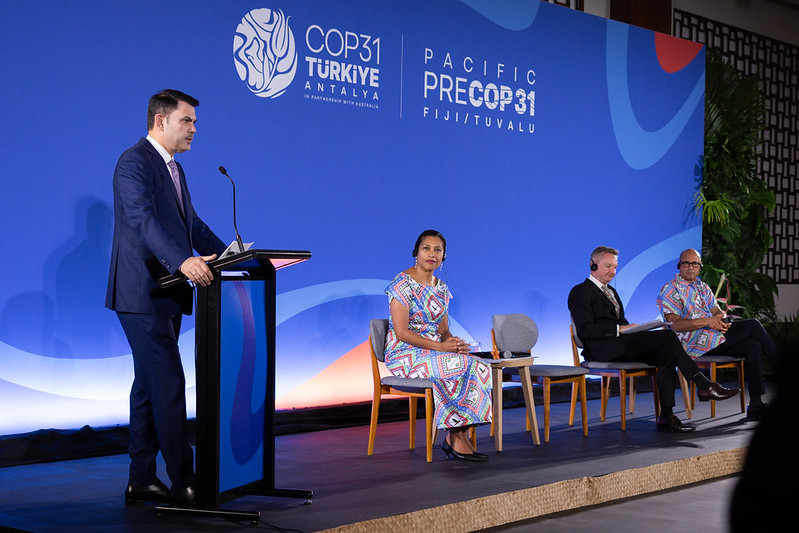
Sitting next to him, Fiji’s Tabuya said she was “encouraged” by his words. “$1.5 billion for 1.5. We will hold COP 31 to that,” she said. The PRF has been promised just under $200 million so far – including about $15 million pledged by European and Pacific governments at pre-COP – and is aiming for $500 million by COP31. It has a longer-term target of mobilising $1.5 billion in capital.
After Pacific leaders on Tuesday aired a litany of concerns about the barriers to accessing the global climate finance system, Kurum joined in at Thursday’s press conference. “Justice in climate finance is essential,” he said. “Resources must reach those in need in a timely and accessible manner, not through a lot of red-tape, and we cannot accept that the same countries should always bear the burden.”
Plan for easier access to climate finance
Australian climate and energy minister Chris Bowen, who is COP31’s president of negotiations, also lamented that “the countries that need the finance the most get it the least”. He said he would ask governments and multilateral development banks to support an access to finance plan for small island states and the world’s poorest nations, launched by Australia on Thursday.
The plan says that while there has been progress in making it easier and quicker to obtain international climate funding, “multiple persistent challenges have continued to limit access to climate finance for developing countries”.
It adds that the amounts available are insufficient to meet climate goals and stresses the need for “grant-based and highly concessional financing”, especially for adaptation and responding to loss and damage. The plan proposes an annual high-level forum on climate finance access to track implementation.
The pre-COP summit closed with an emotional plea from Fiji’s host minister Tabuya. Fighting back tears before finally succumbing, she asked delegates to “carry something of the Pacific with you”.
“Remember the people you met, the stories you heard and why we gathered. This pre-COP draws to a close tonight. Our responsibility does not,” she said to applause.
The post Pre-COP draws attention to Pacific’s climate plight and 1.5C goal appeared first on Climate Home News.
Pre-COP draws attention to Pacific’s climate plight and 1.5C goal
Climate Change
Australia’s climate credibility tested at Pacific Pre-COP talks, as High Court fossil fuel ruling puts government on notice
NADI, FIJI Thursday 8 October 2026 — As the Pacific Pre-COP talks wrap up and Australia prepares to take the reins of COP31 Negotiations in Türkiye next month, Greenpeace Australia Pacific says the government is on notice over fossil fuel expansion and exports, and must accelerate action to align with a 1.5°C pathway.
Following yesterday’s landmark High Court ruling that the climate impacts of coal and gas exports must be considered by New South Wales planning authorities, Greenpeace Australia Pacific is calling on the Albanese government to find the “courage, leadership and grit” to chart a new course away from fossil fuels.
High res images and video from yesterday’s ‘Keep 1.5C Alive’ flotilla in Nadi can be found here
Speaking from Nadi, Shiva Gounden, Head of Pacific at Greenpeace Australia Pacific, said:
“The outcomes of this week’s talks are a drop in the ocean given the scale of need, and urgency of the crisis our communities are facing. It is like taking a glass of water to a burning house if we do not urgently act to address the root cause of the existential threat facing Tuvalu, Fiji and all Pacific countries: fossil fuel expansion.
“The Electrification Pledge must end fossil fuel dependence, not be an end in itself — its ultimate success depends on ensuring electricity comes from renewable sources that displace fossil fuels and align with a 1.5°C pathway. It must be underpinned by justice and backed by finance flowing from polluters to communities.
“Limiting global warming to 1.5°C is a non-negotiable survival line for humanity and Australia must act. The landmark climate advisory ruling from the ICJ is clear — 1.5°C is the moral, the scientific and the legal limit. Continuing down the fossil fuel path, and failing to align efforts with limiting warming to 1.5°C, is a breach of our international legal obligations, and risks making Australia liable for future reparations from climate-vulnerable nations.”
Also in Nadi, Dr Simon Bradshaw, COP31 Lead and climate expert at Greenpeace Australia Pacific, said: “The Pacific was never going to be a mere backdrop for Australia in its role as incoming chair of the COP31 climate talks, but where its credibility and commitment to climate leadership would be tested.
“Here we see communities fighting for their survival and doing everything possible to hold the line on returning warming to 1.5°C. When governments profess to take their concerns seriously, only to then throw more fuel on the fire, the pain and sadness is visceral.
“This week the High Court of Australia recognised what the Federal Government refuses to — that Australia is responsible for the climate damage of our fossil fuel exports and if governments don’t act, the courts will intervene. The message is simple: this is not someone else’s problem, it is ours.
“We must now follow other countries in developing a national roadmap away from fossil fuels that ensures a managed wind-down of fossil fuel production, including exports, in line with our legal obligation to help return warming to 1.5°C.”
ENDS
Media contact: Kate O’Callaghan in Nadi on +61 406 231 892 (Whatsapp/Signal)
A Dutch NGO has filed the first climate complaint under the European Union’s trade rules, arguing that New Zealand violated the environmental provisions of its free trade agreement with the bloc by weakening its climate regulations.
The case will test whether binding climate provisions in the EU’s free trade deals can be enforced to hold governments accountable to their climate obligations, experts told Climate Home News.
The EU-New Zealand free trade agreement, which came into force in 2024, was the first in the world to include legally-binding climate provisions and possible sanctions for violating them, as the EU seeks to use its trade partnerships to advance greater environmental protection.
Under the deal, both parties committed not to weaken their environmental law to promote trade or investment and to “refrain from any action or omission that materially defeats the object and purpose of the Paris Agreement”.