

Welcome to Carbon Brief’s China Briefing.
China Briefing handpicks and explains the most important climate and energy stories from China over the past fortnight. Subscribe for free here.
Key developments
New export controls
‘SWEEPING’ CURBS: The Chinese government issued “sweeping export controls on rare earths and related technologies”, the Financial Times reported, with the set of new rules tightening restrictions on exports of rare earths, permanent magnets and batteries and battery components, as well as related processing technologies. Manufacturers will need licences to export any of these products that contain “even trace amounts” of China-sourced materials, it added. The move “underscores how rare earths – vital to high-performance magnets, electric vehicles [EVs], wind turbines and precision weaponry – have become a powerful geopolitical tool”, finance news outlet Caixin reported.
BATTERY BLOCKAGES?: The restrictions on batteries with an energy density higher than 300 watt-hours per kilogram, as well as a variety of battery components, “show China is keen to protect its innovations” and complicate efforts to diversify supply chains, Bloomberg reported. Caixin cited multiple analysts saying the battery threshold “primarily targets high-end nickel-manganese-cobalt (NMC) batteries used in aviation and defense, rather than lithium iron phosphate (LFP) batteries common in mass-market EVs”, noting that the “controls focus on ‘next-generation’ batteries [such as solid-state batteries]”. But Cory Combs, associate director at consultancy Trivium China, told Carbon Brief that the controls are cause for “concern”, as they “target nearly all the key components, production tools and associated tech” that newer consumer electronics, including EVs, are expected to be using. There are “open questions” on how this could affect Chinese battery manufacturers’ overseas investments and partnerships, he said, although he expected “Beijing will continue to strongly encourage battery exports and overseas investments in general”.

OPEN QUESTIONS: The restrictions give China leverage in the US-China trade dispute “ahead of a scheduled face-to-face meeting” between presidents Xi Jinping and Donald Trump at the end of October, Reuters said. In response to the restrictions, US treasury secretary Scott Bessent “accused China of trying to hurt the world’s economy”, the Financial Times reported, adding that in contrast, “China has blamed Washington for the escalation”. Economic news outlet Jiemian said that Europe may also be affected by the curbs, as its EV industry has “high demand for premium rare earth grades” – although it added that “specific impacts” may only become visible by early 2026. Combs told Carbon Brief that he does not think China has a “strategic interest in cutting off EU or Asian companies” from clean-energy technologies, given that it already has a competitive advantage in their manufacture. He added that the move could lead to “frictions and delays”, but “shouldn’t affect the broader EV or [wind] turbine industries too much”.
IEA revised China renewables outlook down
REFORM REVISIONS: The International Energy Agency (IEA) revised its outlook for China’s wind and solar buildout down by about 5% in its Renewables 2025 report, which the agency attributed to the country’s “shift from fixed tariffs [for wind and solar power] to competitive auctions”, Reuters said. Energy news outlet International Energy Net also covered the report, which “notes that…the financial sustainability of [wind and solar] manufacturers remains a major concern”.
EARLY ACHIEVEMENT: Jeremy Wallace, professor of China studies at Johns Hopkins School of Advanced International Studies, wrote on LinkedIn that, despite the 5% revision, the IEA’s “main case estimate [for China] has about 2,100 gigawatts (GW) of renewables added from 2026-2030”, which would put the country “way ahead” of its new target for 3,600GW of wind and solar by 2035. Indeed, the IEA report said that China “continues to account for nearly 60% of global renewable capacity growth and is on track to reach [its 2035 target for renewable energy] five years ahead of schedule”.
-
Sign up to Carbon Brief’s free “China Briefing” email newsletter. All you need to know about the latest developments relating to China and climate change. Sent to your inbox every Thursday.
RECORD EXPORTS: Meanwhile, thinktank Ember released a report finding that China’s exports of clean-energy technology “hit a record in August, with $20bn in products shipped globally”, Bloomberg reported. Al Jazeera quoted the report saying: “Within China there is a realisation that the old development paradigm centred on fossil fuels has run its course and is not fit for 21st century realities.” State broadcaster CGTN said the findings “confirm China’s role as the primary driver of the transition” towards clean energy.
China issued draft expanding renewable quotas
BEYOND POWER: Energy news outlet BJX News reported that the Chinese government has published new draft rules to expand China’s renewable portfolio standard (RPS) – provincial quotas for consuming renewable electricity – to also cover energy demand outside the power sector. It said the draft rules divide the RPS targets into two categories: minimum renewable electricity consumption targets, covering “all types of renewable power generation”; and minimum non-electricity consumption targets, including “renewable energy applications such as heating and cooling, production of ‘green’ hydrogen, ammonia and alcohol, as well as biofuels”. The move comes as China’s RPS grows from covering power and aluminium to also include the cement, polysilicon and iron and steel sectors, as well as certain types of data centres.
FINANCE PLANS: China also plans to refine how it invests in “energy conservation and carbon reduction”, BJX News said, to better integrate “hard investments” with “soft infrastructure development”. Another BJX News report elaborated that supported projects under this programme include low-carbon projects in sectors such as power, steel, chemicals and building materials. It added that “clean coal” and coal-chemical projects, clean-energy alternatives for “coal-fired boilers and industrial kilns” and “geothermal and biomass” clean heating solutions, would also receive support.
Carbon prices hit a two-year low
CREDIT OVERSUPPLY: Carbon prices in China’s national carbon market reached the “lowest level in more than two years as the nation’s carryover rules triggered a sell-off”, with prices hitting a low of 58.8 yuan ($8.25), according to Bloomberg. It added that “prices are down almost 40% since the start of the year, weighed by a persistent oversupply and lagging demand”.
EV PRESSURES: Meanwhile, EV sales in China “hit an all-time high” in September, the Hong Kong-based South China Morning Post (SCMP) reported, citing data from the China Passenger Car Association (CPCA), with a rush in purchases ahead of the expiration of EV tax breaks and consumer subsidies. A total of 826,000 EVs were sold last month, it said, up 29% from the previous year and breaking the previous record set in December 2024. State news agency Xinhua reported that sales of “new-energy vehicles”, a category including EVs, rose 35% year-on-year to 11m from January to September 2025. Bloomberg quoted CPCA secretary general Cui Dongshu saying that car dealerships urgently need financial assistance as overcapacity and intense competition pushes them to “operat[e] at cash flow negative”. Meanwhile, China plans to double EV charging capacity by 2027, “building 28m facilities nationwide”, another SCMP article said.
OVERCAPACITY ORDERS: Finally, the government has announced new measures on governing “disorderly price competition”, BJX News reported, including guiding industry associations to suggest reference costs to help “operators to set reasonable prices” and penalising companies it identifies as repeatedly violating orders. Reuters said that a state-run financial news outlet “reported…relevant authorities may release a notice on strengthening the regulation and control of solar production capacity”, adding that the article in question “did not contain further details”.
Spotlight
Only half of Chinese provinces finalise key ‘Document 136’ renewable rules
Only half of China’s provinces have finalised new rules for pricing wind and solar power, according to Carbon Brief analysis.
Local governments are required to have published final plans to reform the way wind and solar power is priced in their jurisdiction before the end of this year, following the release of “Document 136” (136号文).
Carbon Brief examines China’s progress on developing the new rules. The full article, including an interactive tracker of which provinces have released their plans, is available on Carbon Brief’s website.
Central direction, local rules
In February this year, China’s central government issued a notice on “deepening market-based reform of feed-in tariffs for new energy”, also known as “Document 136”.
The document called on local governments to develop plans for new pricing mechanisms for wind and solar power. A key feature of this will be the “sustainable new-energy pricing mechanism” (新能源可持续发展价格结算机制), in which they only offer a fixed price to a set amount of new wind and solar capacity each year.
Any additional wind and solar projects would need to find buyers for their electricity on the open market.
The move is part of wider efforts to shift China’s giant electricity system towards more market-based operation.
When the policy was first released, analysts expected the rules and subsequent low auction prices to have a chilling effect on wind and solar in the short term.
But some believe that “Document 136” may strengthen China’s clean-energy industries in the long term, by forcing companies to become more innovative and competitive.
New territory
So far, Carbon Brief finds, only 18 provinces have issued finalised plans. Collectively, these provinces account for 61% of China’s energy-related emissions.
Another 10, representing 31% of emissions, have published draft plans, while Jiangsu, Tianjin and Tibet – the final 8% – have yet to publish anything.
A few provinces published finalised rules in early June, including renewable-power heavyweights Shandong and Inner Mongolia.
In a nationwide conference call at the end of August, National Energy Administration officials urged provinces to “promptly promote” concrete plans.
Eleven provinces have published finalised rules since then, with a further eight publishing draft rules, according to Carbon Brief calculations.
The delay can be attributed to the fact that local policymakers are trying to establish a completely new system of pricing power from scratch, said David Fishman, principal at energy consultancy the Lantau Group.
He told Carbon Brief that “fairly meaningful differences” can be found between the final version and earlier drafts for some provinces, indicating a high level of debate.
In September, Shandong province became the first to hold auctions for solar and wind power under the new rules.
While prices secured by the wind industry are seen as high enough to be relatively acceptable to project developers, the solar price is below the level thought to be needed to finance such developments. As such, it could “discourage” further solar investment in the province, Reuters reported.
Future additions
Analysts disagree about what impact the “Document 136” policy will have on the pace of China’s clean-energy additions.
Dr Muyi Yang, senior energy analyst for Asia at thinktank Ember, told Carbon Brief that he does not see the pricing reforms as a “signal of a structural slowdown in clean capacity [additions]”.
But Fishman noted that the pricing reforms could make it “challenging” for China to hit Xi’s new 2035 target.
The International Energy Agency (IEA) shaved 5% – or 129 gigawatts (GW) – off its outlook for China’s wind and solar growth by 2030, which it attributed to the pricing reforms.
Nevertheless, it added, China is still projected to add “nearly 2,660GW” of new renewable capacity between 2025 and 2030, reaching its 2035 wind and solar target “five years ahead of schedule”.
Watch, read, listen
AFRICAN ENERGY: The China Global South Project hosted a discussion on China’s role in shaping Africa’s energy landscape and how African governments are responding.
GENDER LENS: The Climate Watch podcast spoke with Wang Binbin, associate research professor at Peking University’s Institute for Carbon Neutrality, on intersections between climate action and gender in China.
LEADING TOGETHER?: Economic policy thinktank Bruegel published an analysis arguing that broader EU-China tensions “should not be allowed to derail joint work to cut emissions”.
ARCTIC SHIPPING: CNN examined how melting polar sea ice is “altering the map” in a way that could bring “big economic and geopolitical rewards” for China’s plans to establish shipping routes through the Arctic.
218 billion yuan
Or $30.5bn, the value of economic losses caused by “natural disasters” in the first three quarters of 2025, Jiemian reported, in coverage of a press conference by the Ministry of Emergency Management (MEM). These disasters, which included “intense” rainfall, heat and typhoons, caused 742 people to be reported dead or missing, it added. Climate change was not mentioned during the press conference.
New science
Future warming exacerbates heatwave-ozone compound extremes in China
npj Climate and Atmospheric Science
Human exposure due to “heatwave-ozone compound events” will double across by the middle of the century under “high-emissions scenario”, causing an additional 61,600 deaths nationwide, according to new research. The authors used climate models to estimate excess deaths due to heatwave-ozone compound extremes from climate change under a range of future emissions scenarios. They projected that the number of ozone pollution events in China will grow by 58% by the middle of the century, “half of which are also heatwave days”.
Nature Communications
A new study on electric vehicle charging stations found that, without policy regulation, “large-scale deployment of ultra-fast charging stations with energy storage could raise peak loads by over 70-85% by 2030 and multiply them by up to 7.5 times by 2050”. The authors used real-world charging data from a number of Chinese cities to develop simulations of various scenarios. They found that “deploying 2,000 ultra-fast charging stations in a city may increase the peak-to-valley differences of the public charging load by up to 32% daily relative to baseline cases”.
China Briefing is compiled by Wanyuan Song and Anika Patel. It is edited by Wanyuan Song and Dr Simon Evans. Please send tips and feedback to china@carbonbrief.org
The post China Briefing 16 October 2025: New export controls; IEA China projections; Provincial ‘Doc 136’ progress appeared first on Carbon Brief.

Three countries have been named by the Paris Agreement’s compliance committee for failing to submit a nationally determined contribution (NDC) and repeatedly snubbing offers of help with their climate plans.
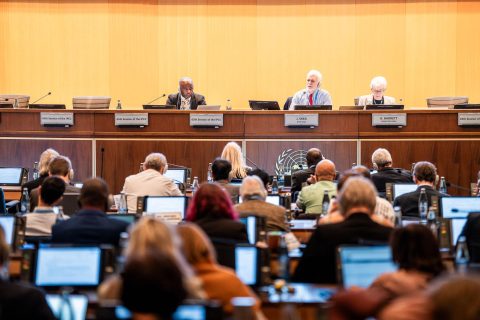
After months of internal debate over whether to identify serial non-responders, the Paris Agreement’s Implementation and Compliance Committee (PAICC) named the three countries which have failed to engage with it over their NDCs on Friday.
It named Democratic Republic of Congo, Senegal and North Korea in a footnote of its annual report, adding that it decided to name them “with a view to facilitating engagement”, adding that representatives of the three nations had been invited to its meeting in early 2027 “with the purpose of identifying any challenges and constraints”.
“The Committee noted the importance of Parties engaging with the Committee in a timely manner, while noting that some delays may be due to the national capabilities and circumstances of the Parties”, the report said.
-
Under US pressure, World Bank says it will back gas “where appropriate”
The US wants the World Bank to expand its gas support while climate campaigners are pushing for it to end – its head spoke this week of limited backing for the fossil fuel -
IPCC scientists vow to press on with climate reports despite political deadlock
After governments again failed to agree a timeline, nearly 120 IPCC authors pledged to complete their assessment on time and with full scientific rigour -
Paris Agreement committee snubbed over missing NDC climate plans
Many governments have still not submitted a nationally determined contribution to the UN, breaching a key requirement of the Paris Agreement


In July, PAICC said 12 countries had ignored its repeated attempts to discuss why they had not published an NDC as required every five years under the 2015 Paris accord.
Members of the committee had been divided over whether to name them, but at a September meeting decided to do so in their annual report to the annual climate COP summit.
By the time the report was published on Friday, only Congo, Senegal and North Korea “had not communicated an NDC or submitted a [Biennial Transparency Report] and had not yet responded to any of the Committee’s notifications, despite several reminders issued by the Committee in this regard”.
Rainforest and renewable energy ambitions
The silence from Congo and Senegal is notable because the former is home to much of the Congo Basin rainforest while the latter has sought billions of dollars in climate finance to support its renewable energy ambitions.
After Brazil, Congo has more rainforest than any country in the world. This forest, and the country’s peatlands, absorb huge amounts of greenhouse gas but are fast being lost to expanding farmland, charcoal production, logging and mining.
Senegal signed a Just Energy Transition Partnership with Canada and wealthy European nations in 2023, to help it meet its renewable energy targets under the-then government of Macky Sall. It was chair of the Least Developed Countries group between January 2022 and December 2023.

Tejas Rao, who is researching the PAICC as part of a doctoral thesis at Cambridge University, said the governments of the three countries should engage with the committee.
“Engagement costs these governments very little and the committee has shown it will listen,” he said.
“Silence leaves the committee with no basis to help, and it leaves the [governments] exposed to the narrative that they are simply disengaged,” he told Climate Home News.
Paris Agreement requirement
The 2015 Paris Agreement requires all parties to publish an NDC every five years outlining their emissions reduction targets, with each plan meant to be more ambitious than the country’s last NDC.
The latest set – the third round of plans, with new targets for 2035 – was due in February 2025. While most countries missed this deadline, all but around 30 – mostly small emitters but including Egypt, Vietnam and Argentina – have now submitted them.
Over the year, the PAICC – which is made up of government climate officials from developed and developing countries – has been communicating with governments that have not submitted NDCs and trying to overcome barriers to them doing so.
Some nations have cited exceptional circumstances as the reason for not submitting an NDC, a process that requires a significant amount of work in tracking emissions and consulting on how to curb them across the economy. For example, a letter from a Sudanese official to the PAICC, seen by Climate Home News, said that the country’s civil war had led to the suspension of its NDC preparation.
-
IPCC scientists vow to press on with climate reports despite political deadlock
After governments again failed to agree a timeline, nearly 120 IPCC authors pledged to complete their assessment on time and with full scientific rigour -