

Welcome to Carbon Brief’s China Briefing.
China Briefing handpicks and explains the most important climate and energy stories from China over the past fortnight. Subscribe for free here.
Key developments
New sector targets in renewable portfolio standard
NEW QUOTAS: China has published the 2025-2026 provincial quotas for renewable energy consumption, which for the first time included sectoral targets for iron and steel, cement, polysilicon and certain types of data centres, industry news outlet BJX News reported, as well as updates to the aluminium sector targets established last year. Bloomberg said that the steel, cement and polysilicon sectors will need to use low-carbon energy to “meet between 25% and 70% of their demand” under the policy. Energy news outlet International Energy Net noted that Sichuan, Yunnan and Qinghai provinces faced the “highest quotas”, at 70%. (For comparison, the average provincial quota is 38%, Carbon Brief calculated. A separate quota for these three provinces that does not include hydropower is much closer to the national average.)

POWER RUSH: In contrast to expectations that renewable installations in China would slow for the rest of 2025, the state-run thinktank State Grid Energy Research Institute estimated that 380 gigawatts (GW) of solar, 140GW of wind power and 120GW of thermal power (likely mostly coal) will be added this year, Bloomberg reported. It noted that the solar figure is “more than 50% higher than forecasts from the leading solar industrial group”. According to NEA data, the estimate implies China will add 182GW in solar, 94GW in wind and 102GW in thermal power between June and December.
MANAGING THE INCREASE: Li Chao, spokesperson for the National Development and Reform Commission (NDRC), told reporters that “large-scale xiaona (消纳) consumption of renewable energy is critical” given rapid capacity growth, according to industry outlet China Energy News, adding that consumption rates continue to exceed 90% – meaning no more than 10% of potential output is being wasted, according to government calculations. However, separate outlet China Energy Net reported that wind and solar utilisation rates (利用率) in some provinces fell below the government-set red line of 90%, due to rapid growth. Dr Muyi Yang, senior energy analyst for Asia at thinktank Ember, told Carbon Brief: “The recent dip in utilisation rates in the western regions is an early warning that [investment in the grid] needs to speed up.”
OPEN ARMS?: Coal power still has “room to grow” during the fifteenth five-year plan period (2026-2030) despite market challenges, China Electricity Council chief expert Chen Zongfa told BJX News. Chen said this was due to the changing “attitude of the government”, which “no longer demonises coal”. The influential State-owned Assets Supervision and Administration Commission of the State Council (SASAC) pledged to “speed up the construction of thermal power projects” and “ensure the safe and stable supply of coal”, according to China Energy News. Another China Energy News article quoted an NDRC official saying China needed to “ensure the stability of coal supply”. Meanwhile, in a visit to Shanxi, President Xi Jinping told local policymakers to transform the coal industry “from low-end to high-end” while also developing clean-energy, Xinhua said.
Floods and heatwaves
‘INTENSE’ RAINS: Several regions in China, including the southern Henan, Guizhou and Hubei provinces, were hit by “intense rainfall” throughout late June and early July, causing “severe flooding” and several deaths, Bloomberg reported, in an article noting that climate change is “fuelling” extreme weather events. Meanwhile, high temperatures “enveloped China’s eastern seaboard…raising fears of droughts and economic losses”, Reuters said, adding that “extreme heat, which meteorologists link to climate change, has emerged as a major challenge for Chinese policymakers”.
-
Sign up to Carbon Brief’s free “China Briefing” email newsletter. All you need to know about the latest developments relating to China and climate change. Sent to your inbox every Thursday.
NEW WARNINGS: At the launch of the China Blue Book on Climate Change 2025 – a document outlining global and China-specific impacts of climate change – National Climate Center deputy director Xiao Chan stated that the “national average temperature in June was 21.1C”, marking the hottest June since records began, according to business news outlet 21st Century Business Herald. State news agency Xinhua quoted Chen Min, vice-minister of the Ministry of Water Resources, telling reporters that 329 rivers had flooded “above warning levels” as of 4 July. Meanwhile, the government established a new heat-health warning system, which “aims to strengthen public health preparedness amid growing climate challenges”, the state-run newspaper China Daily said.
GRID PRESSURES: Linked to high temperatures along the east coast, the National Energy Administration (NEA) revealed that China’s maximum power demand reached a “record high” of 1,465GW on 4 July, finance news outlet Yicai reported, adding that air-conditioning load “accounted for about 37%” of the peak power grid load in eastern China. Bloomberg said that the grid is “in better shape to take on peak summer demand this year”, following preparations to avoid previous blackouts.
Setting the tone on ‘overcapacity’
MIIT HAUL-UP: In a meeting with solar industry representatives, Ministry of Industry and Information Technology (MIIT) head Li Lecheng said MIIT “will further increase macro-guidance and governance of the industry” in the face of “low-price disorderly competition”, BJX News reported. The Hong Kong-based South China Morning Post (SCMP) noted that Li also said companies should be “guided” to phase out “outdated production capacity”. In its coverage, Bloomberg noted that it was “unclear” what impact the meeting would have, but that it “highlight[ed] the seriousness with which Beijing views” the issue.
CLEAR SIGNALS: The meeting followed days of signalling from China on the need to crack down on industrial overcapacity, which has been blamed for “flood[ing trading] partners’ markets with artificially low-cost goods”, according to the Financial Times. In late June, the front page of the party-affiliated newspaper People’s Daily carried an article under the byline Jin Sheping – used to signal the thoughts of party leadership on economic matters – stating that “rat race competition”, a term linked to overcapacity, would “destroy” industries such as solar, lithium-ion batteries and new-energy vehicles (NEVs). At an economic policy meeting, Xi said China must “govern low-price and disorderly competition…and promote the orderly withdrawal of outdated production capacity”, BJX News said. (He also noted the need to develop more “offshore wind power” and a “unified national market”.) On the same day, ideological journal Qiushi also published an article criticising “rat race competition”. Meanwhile, the Associated Press reported, China also “shows signs of tackling” similar overcapacity issues in the NEV industry.
EUROPE UNHAPPY: European policymakers appear unconvinced, however, with top EU diplomat Kaja Kallas telling her Chinese counterpart Wang Yi that China must “put an end to its distortive practices…which pose significant risks to European companies and endanger the reliability of global supply chains”, according to Reuters. It added that the remarks came during meetings aiming to “lay the groundwork for a summit between EU and Chinese leaders” set to take place on 24 July. Meanwhile, the EU is refusing to consider publishing a joint EU-China climate declaration at the leaders’ summit “unless China pledged greater efforts to cut its greenhouse gas emissions”, the Financial Times reported.
BRICS message on climate finance
MITIGATION FUND: The heads of the BRICS nations, a grouping of China and several other global south countries, “demand[ed] that wealthy nations fund mitigation of greenhouse gas emissions in poorer nations” at a leaders summit in early July, Reuters said. It added that, while Brazil “urged a global transition away from fossil fuels”, the resulting joint statement “argued that petroleum will continue to play an important role in the global energy mix, particularly in developing economies”. Reacting to the summit, the campaign group WWF said in a press release: “When it comes to climate, the message falls short.”
GLOBAL SOUTH VOICE: The Guardian noted that “Brazilian diplomats see the BRICS alliance as part of an emerging new world order”, noting that the summit featured “pushback against the EU” over “discriminatory protectionist measures under the pretext of environmental concerns”. Brazil also used the summit to ask “China and BRICS member states in the Middle East to be among the seed funders” for long-term financing for conservation, the newspaper said, adding that this did not seem to have been successful. The absence of Xi from the meeting, in a first at a BRICS leaders summit, sparked significant speculation around how valuable China saw the block as being.
Spotlight
Key takeaways from China’s latest climate adaptation progress report
China’s Ministry of Ecology and the Environment (MEE) recently published a report outlining China’s progress last year in adapting to climate change. In this issue, Carbon Brief outlines three key messages from the assessment.
Extreme weather events are becoming more severe
China’s climate was “relatively poor” (偏差) in 2024, the MEE report stated, with several “record-breaking or severely disastrous” extreme weather events.
These include extreme heat and cold, rainfall, typhoons, flooding and severe convective weather.
Weather events have generally worsened year-on-year, the report said. In 2024, China’s average temperature stood at 10.9C – the warmest since modern records began.
Similarly, national average rainfall totalled almost 698 millimetres, up 9% year-on-year. More typhoons made landfall in China in 2024 compared to 2023, of which several had “large disaster impacts”, according to the report.
It added that these events had “serious adverse” socio-economic impacts, noting that extreme weather led to at least 500 deaths or disappearances in 2024. (Statistics for deaths and disappearances were not included in the 2023 edition of the report.)
In 2024, the central government spent more than 2.5bn yuan ($350m) on “natural disaster relief funds”, covering flooding, drought and extreme cold.
Climate-resilient infrastructure still a main focus
Extreme weather is also increasingly damaging infrastructure, the report noted. For example, more than 29m users lost power due to extreme weather.
Much of the report is dedicated to describing China’s efforts to develop infrastructure that can resist or help mitigate the effects of extreme weather events.
Managing “water resources” and water conservation continued to receive a strong focus in the report, which added that, in 2024, “major water conservancy projects continued to be developed to a high quality”.
It also noted that this infrastructure buildout “played a key role” in mitigating the impact of floods in 2024, with thousands of reservoirs nationwide being used to store floodwater.
This, it said, “reduced” the impact of 26 floods on 2,300 cities and towns and 17m mu [slightly more than 1m hectares] of arable land”.
The country is also strengthening its ability to predict future extreme weather events, building more than 10,000 new monitoring and early-warning stations in 2024.
Cities are being encouraged to become more “climate resilient”, with 39 authorised to develop pilot programmes exploring possible solutions.
The report noted that, in 2024, 60 cities were developing “sponge city” projects, using nature-based solutions to absorb, collect or reuse floodwater.
Liu Junyan, project lead for the climate risk project at campaign group Greenpeace East Asia, told Carbon Brief that sponge-city solutions did seem to play a beneficial role during the deadly Henan floods in 2021, where floodwaters receded more quickly in Zhengzhou city than other areas.
“But sponge-city methods are not made to handle the extreme rainfall caused by climate change,” she added.
China’s response is relatively ‘holistic’, but disconnects remain
The MEE report emphasised that China’s overarching climate adaptation strategy covers a broad range of socio-economic impacts.
For example, it mentioned efforts in 2024 to prepare technical guidelines for assessing climate change impacts and risks. Carbon Brief understands that the aim of these efforts is to help provincial governments use more standardised, science-based assessments of climate risk, as well as how they should respond.
The report also noted efforts to develop climate-conscious behaviours, such as campaigns encouraging farmers to use “water-saving” irrigation technologies and guidelines to “enhance public awareness” of potential climate-related health risks.
Liu said China’s approach to adaptation is “holistic”, but added that it remains “top-down”, sometimes causing local needs to go unmet.
Furthermore, the report said China needs to further develop strategies for climate impacts on “urban and rural habitats” and “sensitive” industries such as finance, tourism and energy.
Watch, read, listen
HAWKS AND DOVES: The European Parliament broadcasted a debate on EU-China relations ahead of the upcoming leaders’ summit, in which European Commission president Ursula von der Leyen spoke on electric vehicles, rare earths and overcapacity.
DEFINING MOMENT: Shanghai-based news outlet the Paper interviewed former UN secretary-general Ban Ki-moon on China’s role in accelerating climate ambition this year.
CLIMATE PATH: Analysts at the Asia Society Policy Institute’s China climate hub spoke on Environment China about China’s latest emissions, clean-energy and climate diplomacy trends.
STUNTING GROWTH: The US-based National Public Radio explored how climate change is affecting China’s tea-growers, with crops “stunted” and farmers struggling with “changing rhythms”.
6%
The electrification rate of China’s transport sector – well below the economy-wide figure of close to 30% – despite the rapid adoption of NEVs, Chen Ji, executive director at China International Capital Corporation, said at the China launch of the International Energy Agency’s World Energy Investment 2025 report, attended by Carbon Brief. Chen added that the low figure was due to the lack of progress in electrifying aviation and heavy-duty trucks.
New science
Increased socioeconomic impacts with future intensifying flash droughts in China
Geophysical Research Letters
A new paper found that “China will experience longer and more severe droughts, exposing 33% of the population and 35% of gross domestic product to risks under a medium-emission scenario”. The authors analysed economic and soil moisture data over 2000-22 to quantify past changes in “flash droughts”, using models to assess future changes under different climate scenarios. The paper found that “droughts are becoming more frequent in some areas, with a twofold increase in frequency in approximately 32% of these areas by the century’s end”. It added that wealthier regions will face greater economic losses due to flash droughts.
Communications Earth & Environment
Rice cultivation in China’s Sanjiang Plain has expanded northeast by more than two million hectares between 2000 and 2020, driving up irrigation demand by 6bn tonnes, according to a new study. The authors analysed data on “rice migration”, finding that rice expansion drove up irrigation by 122% over 2000-20, while an increase in rainfall due to climate change reduced irrigation demand by 22%. The authors said their findings “highlight the urgent need to make integrated strategies balancing crop migration [with] climate change and water resource conservation”.
Climate Change Research
The poorest counties in China are much more likely to experience record-breaking extreme weather events, which may push them “back to poverty”, according to new research published in a Chinese academic journal. The study combines more than twenty models with eight extreme weather indices to assess “patterns of extreme weather across 832 poverty-alleviated counties [as well as] other counties in China”. The authors recommend actions covering “water infrastructure; disaster mitigation; catastrophe insurance; and public awareness and education” to support climate adaptation in these areas.
China Briefing is compiled by Wanyuan Song and Anika Patel. It is edited by Wanyuan Song and Dr Simon Evans. Please send tips and feedback to china@carbonbrief.org

The post China Briefing 10 July 2025: New sector targets; Overcapacity dressing-down; Adaptation scorecard appeared first on Carbon Brief.
China Briefing 10 July 2025: New sector targets; Overcapacity dressing-down; Adaptation scorecard

Drought and heatwaves occurring together – known as “compound” events – have “surged” across the world since the early 2000s, a new study shows.
Compound drought and heat events (CDHEs) can have devastating effects, creating the ideal conditions for intense wildfires, such as Australia’s “Black Summer” of 2019-20 where bushfires burned 24m hectares and killed 33 people.
The research, published in Science Advances, finds that the increase in CDHEs is predominantly being driven by events that start with a heatwave.
The global area affected by such “heatwave-led” compound events has more than doubled between 1980-2001 and 2002-23, the study says.
The rapid increase in these events over the last 23 years cannot be explained solely by global warming, the authors note.
Since the late 1990s, feedbacks between the land and the atmosphere have become stronger, making heatwaves more likely to trigger drought conditions, they explain.
One of the study authors tells Carbon Brief that societies must pay greater attention to compound events, which can “cause severe impacts on ecosystems, agriculture and society”.
Compound events
CDHEs are extreme weather events where drought and heatwave conditions occur simultaneously – or shortly after each other – in the same region.
These events are often triggered by large-scale weather patterns, such as “blocking” highs, which can produce “prolonged” hot and dry conditions, according to the study.
Prof Sang-Wook Yeh is one of the study authors and a professor at the Ewha Womans University in South Korea. He tells Carbon Brief:
“When heatwaves and droughts occur together, the two hazards reinforce each other through land-atmosphere interactions. This amplifies surface heating and soil moisture deficits, making compound events more intense and damaging than single hazards.”
CDHEs can begin with either a heatwave or a drought.
The sequence of these extremes is important, the study says, as they have different drivers and impacts.
For example, in a CDHE where the heatwave was the precursor, increased direct sunshine causes more moisture loss from soils and plants, leading to a drought.
Conversely, in an event where the drought was the precursor, the lack of soil moisture means that less of the sun’s energy goes into evaporation and more goes into warming the Earth’s surface. This produces favourable conditions for heatwaves.
The study shows that the majority of CDHEs globally start out as a drought.
In recent years, there has been increasing focus on these events due to the devastating impact they have on agriculture, ecosystems and public health.
In Russia in the summer of 2010, a compound drought-heatwave event – and the associated wildfires – caused the death of nearly 55,000 people, the study notes.

The record-breaking Pacific north-west “heat dome” in 2021 triggered extreme drought conditions that caused “significant declines” in wheat yields, as well as in barley, canola and fruit production in British Columbia and Alberta, Canada, says the study.
Increasing events
To assess how CDHEs are changing, the researchers use daily reanalysis data to identify droughts and heatwaves events. (Reanalysis data combines past observations with climate models to create a historical climate record.) Then, using an algorithm, they analyse how these events overlap in both time and space.
The study covers the period from 1980 to 2023 and the world’s land surface, excluding polar regions where CDHEs are rare.
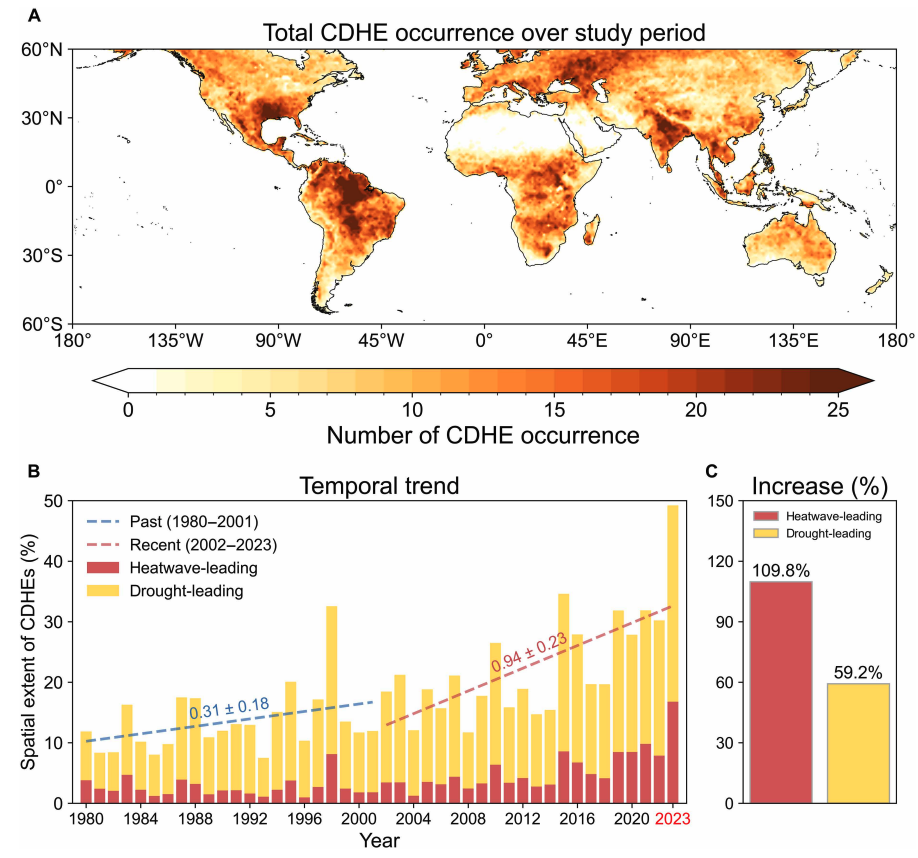
The research finds that the area of land affected by CDHEs has “increased substantially” since the early 2000s.
Heatwave-led events have been the main contributor to this increase, the study says, with their spatial extent rising 110% between 1980-2001 and 2002-23, compared to a 59% increase for drought-led events.
The map below shows the global distribution of CDHEs over 1980-2023. The charts show the percentage of the land surface affected by a heatwave-led CDHE (red) or a drought-led CDHE (yellow) in a given year (left) and relative increase in each CDHE type (right).
The study finds that CDHEs have occurred most frequently in northern South America, the southern US, eastern Europe, central Africa and south Asia.
Threshold passed
The authors explain that the increase in heatwave-led CDHEs is related to rising global temperatures, but that this does not tell the whole story.
In the earlier 22-year period of 1980-2001, the study finds that the spatial extent of heatwave-led CDHEs rises by 1.6% per 1C of global temperature rise. For the more-recent period of 2022-23, this increases “nearly eightfold” to 13.1%.
The change suggests that the rapid increase in the heatwave-led CDHEs occurred after the global average temperature “surpasse[d] a certain temperature threshold”, the paper says.
This threshold is an absolute global average temperature of 14.3C, the authors estimate (based on an 11-year average), which the world passed around the year 2000.
Investigating the recent surge in heatwave-leading CDHEs further, the researchers find a “regime shift” in land-atmosphere dynamics “toward a persistently intensified state after the late 1990s”.
In other words, the way that drier soils drive higher surface temperatures, and vice versa, is becoming stronger, resulting in more heatwave-led compound events.
Daily data
The research has some advantages over other previous studies, Yeh says. For instance, the new work uses daily estimations of CDHEs, compared to monthly data used in past research. This is “important for capturing the detailed occurrence” of these events, says Yeh.
He adds that another advantage of their study is that it distinguishes the sequence of droughts and heatwaves, which allows them to “better understand the differences” in the characteristics of CDHEs.
Dr Meryem Tanarhte is a climate scientist at the University Hassan II in Morocco, and Dr Ruth Cerezo Mota is a climatologist and a researcher at the National Autonomous University of Mexico. Both scientists, who were not involved in the study, agree that the daily estimations give a clearer picture of how CDHEs are changing.
Cerezo-Mota adds that another major contribution of the study is its global focus. She tells Carbon Brief that in some regions, such as Mexico and Africa, there is a lack of studies on CDHEs:
“Not because the events do not occur, but perhaps because [these regions] do not have all the data or the expertise to do so.”
However, she notes that the reanalysis data used by the study does have limitations with how it represents rainfall in some parts of the world.
Compound impacts
The study notes that if CDHEs continue to intensify – particularly events where heatwaves are the precursors – they could drive declining crop productivity, increased wildfire frequency and severe public health crises.
These impacts could be “much more rapid and severe as global warming continues”, Yeh tells Carbon Brief.
Tanarhte notes that these events can be forecasted up to 10 days ahead in many regions. Furthermore, she says, the strongest impacts can be prevented “through preparedness and adaptation”, including through “water management for agriculture, heatwave mitigation measures and wildfire mitigation”.
The study recommends reassessing current risk management strategies for these compound events. It also suggests incorporating the sequences of drought and heatwaves into compound event analysis frameworks “to enhance climate risk management”.
Cerezo-Mota says that it is clear that the world needs to be prepared for the increased occurrence of these events. She tells Carbon Brief:
“These [risk assessments and strategies] need to be carried out at the local level to understand the complexities of each region.”



The post Heatwaves driving recent ‘surge’ in compound drought and heat extremes appeared first on