

The “vast majority” of the UK government’s plans to prepare for climate hazards have made virtually no progress over the past two years, according to the Climate Change Committee (CCC).
In that time, the world has experienced the hottest year on record, while England has seen its wettest ever 18-month stretch between 2022 and 2024.
(Climate adaptation – outside of some issues such as defence – is mostly a devolved matter, with separate plans in place from the administrations for Scotland, Wales and Northern Ireland.)
The previous government introduced a new adaptation strategy for England in 2023, covering plans for rising temperatures and more extreme weather in the country.
However, in its latest analysis of the government’s progress, the CCC states that the current approach to adaptation in England is “not working” and requires “urgent strengthening”.
The government is failing to make “good” progress in adapting to climate change on any of the 46 outcomes measured by the committee, ranging from better healthcare during heatwaves to preparing financial institutions for climate risk.
The report marks the latest in a series of appraisals by the CCC that have repeatedly identified large gaps in the nation’s adaptation efforts.
This time, with a relatively new Labour government that has said it will act on adaptation, the committee says its report “must serve as the turning point”.
But the CCC also says it is “seriously concerned” that the government will cut funding for adaptation, ultimately leading to much higher future costs as temperatures continue to rise.
- Climate adaptation is ‘vital’
- What progress has been made?
- What does the CCC recommend?
- How prepared are different sectors for climate change?
Climate adaptation is ‘vital’
There is “unequivocal evidence” that climate change is already making extreme weather in the UK “more likely and more extreme”, the CCC says.
The report lays out major risks facing the country, noting that the number of properties at risk from flooding is set to increase from 6.3m today to 8m by 2050. Roads and railways at risk from flooding could increase from a third of the total length to half over the same timeframe.
At least 59% of top-quality farmland is already at risk from flooding, the report says, adding that this could also increase over the coming decades.
Meanwhile, annual heat-related deaths could increase “several times over” to pass 10,000 in an average year by 2050, the CCC says.
It also cites an Office for Budget Responsibility (OBR) report from 2024 that concludes the UK’s GDP could be around 3% lower by 2074, even under the Paris Agreement’s “below 2C” goal. It says this could increase to 5% in a “below 3C” scenario, according to the OBR.
High-quality climate adaptation is therefore “vital to ensure that these risks are managed most efficiently and at least cost”, according to the committee. Otherwise, government policy could “lock in” risks or even make them worse.
The CCC reports on adaptation progress in England every two years, as required under the 2008 Climate Change Act. These reports have consistently highlighted adaptation as an issue that has been “underfunded and ignored” by successive governments.
There have been a few major developments since the committee’s last report.
Notably, the previous Conservative government launched its third national adaptation programme (NAP3), which is the cornerstone of the nation’s adaptation policy, in summer 2023. (NAP3 covers adaptation policy in England, as well as non-devolved issues that affect the whole UK, such as defence.)
In a highly critical initial appraisal of the programme, the CCC concluded that it fell “far short of what is needed” and “must be strengthened”. NAP3 has also faced an ultimately unsuccessful legal challenge from activists, arguing that it breached people’s human rights.
Another big development since the committee’s last report is Labour winning the general election in 2024. The CCC acknowledges that the new government “inherited a NAP that fell short of the task”, but says it finds “little evidence of a change of course”.
What progress has been made?
The report looks at both the “policies and plans” underpinning climate adaptation, as well as the actual “delivery and implementation” of those plans. It states:
“Whilst there is some evidence of policies and plans improving [since 2023], it is clear that NAP3 has been ineffective in driving the critical shift towards effective delivery of adaptation.”
The CCC assesses the planning and delivery of 46 outcomes from adaptation policy across five overarching themes. It scores them using roughly the same monitoring framework used in its last report in 2023.
It notes that 11 policies and plans have improved over the past two years, including a new adaptation strategy from the Ministry of Justice and a green finance strategy.
Over the same period, it says four have gotten worse, among them investment in flood protection projects, as “plans no longer align with their stated objectives”.
The lack of significant improvement between 2023 and 2025, based on the CCC’s scoring system, can be seen in the chart below.

As for the government actually delivering on its plans, the CCC says the “vast majority of our outcomes have received the same score as in 2023, most at low levels”.
The small number of improvements mainly relate to the latest round of implementation of the “adaptation reporting power”, which allows the government to ask infrastructure providers to disclose how they deal with climate risks.
The chart below, which compares the scores given to different adaptation outcomes between 2023 and 2025, demonstrates the lack of progress in the intervening years.
The CCC concludes that none of the outcomes could be classified as making “good” progress, in terms of delivery. Only four of them saw improvements over this period.
It highlights the water supply as an area where there has been backsliding over the past two years, noting that “continued slow rate of leakage reduction is now clearly inconsistent with meeting the sector’s targets”.

The CCC also points out that “tracking progress on adaptation remains challenging due to limited national-scale, up-to-date and relevant data”.
While there has been an improvement since 2023, nine of the 46 assessed outcomes for England still lacked enough evidence to assess progress, the report says.
These include important areas such as the impact of climate change on food supplies and the vulnerability of telecommunications and information and communication technology (ICT) assets.
In addition, ahead of NAP3, the CCC recommended – as part of its 2023 progress report – a list of 89 actions to close what it viewed as “policy gaps in government’s adaptation planning”.
It suggested that these could be dealt with either in NAP3 itself, or as part of other policy programmes.
However, only four of these recommendations have been achieved, with a further 14 seeing “partial progress”.
The report highlights food security, community preparedness and buildings as some of the areas where the government did not follow through on its recommendations.
What does the CCC recommend?
The CCC’s report echoes previous advice that, despite some improvements in NAP3 on previous efforts, the nation’s climate adaptation strategy needs an overhaul:
“The UK’s current approach to adaptation policy making is not working. Adaptation is not the cross-government priority that it needs to be, which is holding back delivery.”
NAP3 covers a five-year period from 2023 to 2028. With the latest report coming at a halfway point in this cycle, the committee says it “must serve as the turning point” for the government on climate adaptation.
As part of the “urgent strengthening” suggested in the report, the committee sets out key areas that it says should be improved.
“Adaptation” can mean different things in different contexts. The CCC stresses the need for a set of “specific and measurable sectoral targets” that can be used to guide progress, with clarity on how to monitor them and who is responsible.
The government has signalled its intention to strengthen adaptation objectives. The committee says that such objectives “must” be developed as a priority, no later than the end of 2025.
The CCC report highlights the “data gaps” that need to be closed, with “monitoring and evaluation…still not treated with sufficient urgency”. It says the government should direct relevant agencies to collect data on climate risks and the delivery of adaptation measures.
Adaptation is a topic that affects every area of government, from healthcare to education. Yet the CCC highlights that there is not enough coordination of activities between departments and says this should be improved.
In order to carry out adaptation policies, the CCC also stresses that the government “needs to ensure sufficient funding is available” as it undertakes its spending review. Baroness Brown, chair of the CCC’s adaptation committee, told journalists in a press briefing:
“We are seriously concerned that resilience and climate adaptation may be cut in the spending review. [The] government needs to recognise that this is not a future problem, this is today’s problem…I know the government is under a lot of pressure to make cuts, but this isn’t the easy one.”
Given the cost of future climate risk, the committee stresses that ignoring adaptation would not, ultimately, save money. In fact, acting early would “minimise the overall costs of tackling climate change”, it explains.
In the press briefing, CCC chief executive Emma Pinchbeck emphasised the “real need” for the government to think about the future when implementing key policies, such as home-building programmes and other major infrastructure developments.
“If you think about potential waste in terms of investment into the NHS, if we then have to retrofit hospitals to make them cooler,” she said, as an example.
How prepared are different sectors for climate change?
The CCC progress report looks at specific outcomes broken down across five broad sectors.
Within these, it highlights key problems and makes specific recommendations for each area.
Land, nature and food
The CCC highlights various “foundational” strategies covering farming and land that the Department for Environment, Food and Rural Affairs (Defra) is expected to publish in the coming months, including the land-use framework and the food strategy.
Delays in publishing such documents have “hampered” adaptation progress. However, the report highlights them as opportunities to set out clear objectives and responsibilities for the sector.
As it stands, important issues such as boosting climate-resilient farming and protecting food supply chains are rated “insufficient” for both government planning and implementation.
The CCC highlights the relatively new “environmental land management schemes” (Elms), which constitute England’s successor to the EU’s farm payments policy.
The report says these schemes lack guidance for climate adaptation, adding that the government should provide “certainty” about how much farmers will be paid for such measures.
As for the fishing industry, the report has downgraded its climate-adaptation plans, noting that they “no longer look credible”. It says the government’s marine strategy, published earlier this year, “does not include any specific or targeted adaptation actions”.
Infrastructure
According to the CCC, when the government publishes its 10-year infrastructure strategy, it should set out “clear resilience standards” for new infrastructure projects.
It also notes that major funding packages – for new roads and electricity networks, for example – should include incentives to fund climate adaptation.
Two out of the three adaptation policies that are scored as “good” are in the infrastructure sector, namely the plans for maintaining reliability in the road and rail networks.
Despite this, actual progress in improving transport resilience is largely “stagnant”, the committee says. It highlights increased flooding on railways and an increased number of roads deemed “susceptible” to flooding.
This is also the sector that has seen the most improvement in terms of delivery and implementation. The water, energy, telecommunications and transport sectors are all described as improving the identification and management of “interdependencies”.
This refers to better evidence of links between different sectors, which is being unveiled via adaptation reporting power. Notably, none of the sectors that have seen improvements are rated as “good”, indicating they still have work to do in this area.
Built environment and communities
Flooding is highlighted as the key risk facing many communities around England.
While the Environment Agency-led flood defence programme has been successful, “its budget in real terms is shrinking as risks are escalating, meaning delivery is falling short of targets and the condition of flood defence assets is declining”, according to the CCC.
The government’s investment programme needs “long-term” targets for cutting the risk posed by floods and coastal erosion, supported by sufficient funds, the report concludes.
It also recommends a “long-term cross-sector plan to manage future heat risk and drive joined-up action”.
The CCC is currently unable to track many of the important measures around heat risk, such as how many buildings are overheating, due to a lack of data.
Overall, none of the efforts to implement better protections for homes and communities have seen any positive change since 2023, despite this being a record period of heat and flooding.
Health and wellbeing
The CCC notes that there are only “limited” policies and plans in place to protect population health and healthcare delivery in the face of escalating climate hazards.
Extreme heat is the main risk identified in this context. As it stands, there are long-term, increasing trends of heat-associated deaths and overheating in hospital settings, the committee says.
In this context, the report recommends that the government develop an “improved climate and public health adaptation plan” that builds on the existing adverse weather and health plan.
Also, as part of the government’s decade-long plan to improve the NHS, the CCC says any upgrades must “make it more resilient to climate extremes today and in the future”.
Economy
The committee says that while businesses can take action to protect their own affairs from climate change, “barriers remain” and adaptation finance “remains nascent”.
It therefore highlights an important role for the government in removing these barriers, providing high-quality information and “correcting market failures”.
The report recommends setting up a portal for adaptation-related data that can be accessed by companies.
It also says the government should ensure that the UK’s sustainable disclosure requirements incorporate “adaptation-related disclosure”, to better prepare the private sector for climate risks.
The CCC also points out that an adaptation finance “deliverables and action plan”, promised for 2024, has not been produced. Among other things, this plan should lay out ways to “mobilise” private investment into adaptation projects, it adds.



The post CCC: England’s approach to climate adaptation is ‘not working’ appeared first on Carbon Brief.
CCC: England’s approach to climate adaptation is ‘not working’

Drought and heatwaves occurring together – known as “compound” events – have “surged” across the world since the early 2000s, a new study shows.
Compound drought and heat events (CDHEs) can have devastating effects, creating the ideal conditions for intense wildfires, such as Australia’s “Black Summer” of 2019-20 where bushfires burned 24m hectares and killed 33 people.
The research, published in Science Advances, finds that the increase in CDHEs is predominantly being driven by events that start with a heatwave.
The global area affected by such “heatwave-led” compound events has more than doubled between 1980-2001 and 2002-23, the study says.
The rapid increase in these events over the last 23 years cannot be explained solely by global warming, the authors note.
Since the late 1990s, feedbacks between the land and the atmosphere have become stronger, making heatwaves more likely to trigger drought conditions, they explain.
One of the study authors tells Carbon Brief that societies must pay greater attention to compound events, which can “cause severe impacts on ecosystems, agriculture and society”.
Compound events
CDHEs are extreme weather events where drought and heatwave conditions occur simultaneously – or shortly after each other – in the same region.
These events are often triggered by large-scale weather patterns, such as “blocking” highs, which can produce “prolonged” hot and dry conditions, according to the study.
Prof Sang-Wook Yeh is one of the study authors and a professor at the Ewha Womans University in South Korea. He tells Carbon Brief:
“When heatwaves and droughts occur together, the two hazards reinforce each other through land-atmosphere interactions. This amplifies surface heating and soil moisture deficits, making compound events more intense and damaging than single hazards.”
CDHEs can begin with either a heatwave or a drought.
The sequence of these extremes is important, the study says, as they have different drivers and impacts.
For example, in a CDHE where the heatwave was the precursor, increased direct sunshine causes more moisture loss from soils and plants, leading to a drought.
Conversely, in an event where the drought was the precursor, the lack of soil moisture means that less of the sun’s energy goes into evaporation and more goes into warming the Earth’s surface. This produces favourable conditions for heatwaves.
The study shows that the majority of CDHEs globally start out as a drought.
In recent years, there has been increasing focus on these events due to the devastating impact they have on agriculture, ecosystems and public health.
In Russia in the summer of 2010, a compound drought-heatwave event – and the associated wildfires – caused the death of nearly 55,000 people, the study notes.

The record-breaking Pacific north-west “heat dome” in 2021 triggered extreme drought conditions that caused “significant declines” in wheat yields, as well as in barley, canola and fruit production in British Columbia and Alberta, Canada, says the study.
Increasing events
To assess how CDHEs are changing, the researchers use daily reanalysis data to identify droughts and heatwaves events. (Reanalysis data combines past observations with climate models to create a historical climate record.) Then, using an algorithm, they analyse how these events overlap in both time and space.
The study covers the period from 1980 to 2023 and the world’s land surface, excluding polar regions where CDHEs are rare.
The research finds that the area of land affected by CDHEs has “increased substantially” since the early 2000s.
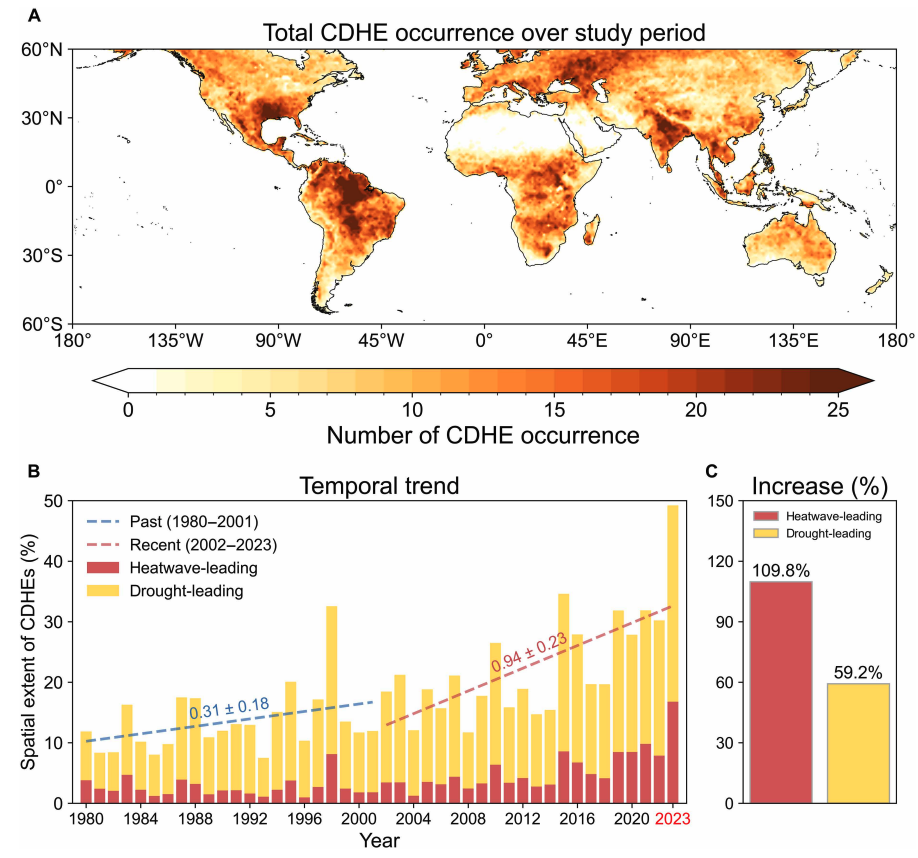
Heatwave-led events have been the main contributor to this increase, the study says, with their spatial extent rising 110% between 1980-2001 and 2002-23, compared to a 59% increase for drought-led events.
The map below shows the global distribution of CDHEs over 1980-2023. The charts show the percentage of the land surface affected by a heatwave-led CDHE (red) or a drought-led CDHE (yellow) in a given year (left) and relative increase in each CDHE type (right).
The study finds that CDHEs have occurred most frequently in northern South America, the southern US, eastern Europe, central Africa and south Asia.
Threshold passed
The authors explain that the increase in heatwave-led CDHEs is related to rising global temperatures, but that this does not tell the whole story.
In the earlier 22-year period of 1980-2001, the study finds that the spatial extent of heatwave-led CDHEs rises by 1.6% per 1C of global temperature rise. For the more-recent period of 2022-23, this increases “nearly eightfold” to 13.1%.
The change suggests that the rapid increase in the heatwave-led CDHEs occurred after the global average temperature “surpasse[d] a certain temperature threshold”, the paper says.
This threshold is an absolute global average temperature of 14.3C, the authors estimate (based on an 11-year average), which the world passed around the year 2000.
Investigating the recent surge in heatwave-leading CDHEs further, the researchers find a “regime shift” in land-atmosphere dynamics “toward a persistently intensified state after the late 1990s”.
In other words, the way that drier soils drive higher surface temperatures, and vice versa, is becoming stronger, resulting in more heatwave-led compound events.
Daily data
The research has some advantages over other previous studies, Yeh says. For instance, the new work uses daily estimations of CDHEs, compared to monthly data used in past research. This is “important for capturing the detailed occurrence” of these events, says Yeh.
He adds that another advantage of their study is that it distinguishes the sequence of droughts and heatwaves, which allows them to “better understand the differences” in the characteristics of CDHEs.
Dr Meryem Tanarhte is a climate scientist at the University Hassan II in Morocco, and Dr Ruth Cerezo Mota is a climatologist and a researcher at the National Autonomous University of Mexico. Both scientists, who were not involved in the study, agree that the daily estimations give a clearer picture of how CDHEs are changing.
Cerezo-Mota adds that another major contribution of the study is its global focus. She tells Carbon Brief that in some regions, such as Mexico and Africa, there is a lack of studies on CDHEs:
“Not because the events do not occur, but perhaps because [these regions] do not have all the data or the expertise to do so.”
However, she notes that the reanalysis data used by the study does have limitations with how it represents rainfall in some parts of the world.
Compound impacts
The study notes that if CDHEs continue to intensify – particularly events where heatwaves are the precursors – they could drive declining crop productivity, increased wildfire frequency and severe public health crises.
These impacts could be “much more rapid and severe as global warming continues”, Yeh tells Carbon Brief.
Tanarhte notes that these events can be forecasted up to 10 days ahead in many regions. Furthermore, she says, the strongest impacts can be prevented “through preparedness and adaptation”, including through “water management for agriculture, heatwave mitigation measures and wildfire mitigation”.
The study recommends reassessing current risk management strategies for these compound events. It also suggests incorporating the sequences of drought and heatwaves into compound event analysis frameworks “to enhance climate risk management”.
Cerezo-Mota says that it is clear that the world needs to be prepared for the increased occurrence of these events. She tells Carbon Brief:
“These [risk assessments and strategies] need to be carried out at the local level to understand the complexities of each region.”




The post Heatwaves driving recent ‘surge’ in compound drought and heat extremes appeared first on Carbon Brief.
Heatwaves driving recent ‘surge’ in compound drought and heat extremes
Greenhouse Gases
DeBriefed 6 March 2026: Iran energy crisis | China climate plan | Bristol’s ‘pioneering’ wind turbine
Welcome to Carbon Brief’s DeBriefed.
An essential guide to the week’s key developments relating to climate change.