

The Brazilian diplomats presiding over the COP30 climate summit in November have said they want an “early harvest” at June’s mid-year climate negotiations in Bonn, aiming to secure agreements on two key issues that were left unresolved at COP29 last year.
Brazil’s lead climate diplomat Liliam Chagas told reporters this week she is seeking “real advances in the Bonn sessions” on the fledgling Just Transition Work Programme (JTWP) and recommendations from the 2023 Global Stocktake (GST) of government climate action, so that decisions to move them forward can be approved at COP30.
The JTWP is a series of dialogues on how to make the transition to a greener world fair while the GST discussions focus on how the world’s governments should respond to being collectively off track to meet their goal to limit global warming to 1.5C above pre-industrial times.
Negotiators began talks at Climate Week, a UN event held in Panama this week, using an informal format called “world café” – grouping them in tables to discuss issues such as the role of Indigenous people and communities, economic drivers and social protections.
Surfer, first lady and former PM among Brazil’s COP30 envoys
Late last year, at COP29 in Baku, governments were split over what aspects of fairness the JTWP should tackle and whether finance should be included, as well as on whether transitioning away from fossil fuels should be mentioned in texts on how to take the GST forward.
Chagas said these issues had not been settled at COP29 because separate talks there on a new finance goal had proven so “lengthy and difficult”, but added that she was now trying to bring a “sense of urgency” to officials.
“These decisions, at this point in the year, they are something that will show that the COP process works [and] is resilient,” she said, adding that she wants to “early harvest some of the decisions in order to not leave everything for [COP30] in November”.
The COP30 Presidency expressed similar sentiments in its third open letter to negotiators released on Friday.
Global stocktake
The GST was a review of progress on climate change carried out in 2023 which found that, while government action had reduced the amount of global warming expected, it was still insufficient to limit average temperature rise to 1.5C.
At the COP28 climate talks in Dubai at the end of that year, governments jointly agreed to respond to this by calling on each other to take measures like tripling renewable energy capacity and transitioning away from fossil fuels in energy systems.
But the next year at COP29, they failed to include the same language on renewables and fossil fuels in the outcomes of a planned “UAE dialogue” on how to implement the recommendations of the GST. Saudi Arabia, which COP30 President André Corrêa do Lago visited on Friday, opposed any mention of fossil fuels in formal texts at COP29.
The Baku summit ended without agreement on the GST, with Chile’s lead negotiator Julio Cordano telling the closing plenary he was “concerned to see attempts to backtrack the agreements made last year”.
In its latest letter, the COP30 Presidency said the GST is “our guide to Mission 1.5”, a collective roadmap to keep to the 1.5C warming limit – and responding to it should include accelerating the global energy transition and halting and reversing deforestation and forest degradation by 2030.
“We must support one another to advance collectively on tripling renewable energy capacity globally, doubling the global average annual rate of energy efficiency improvements, and transitioning away from fossil fuels in energy systems, in a just, orderly, and equitable manner,” said the letter.
Brazil calls on local groups to “inspire” governments in boosting climate action
COP30 CEO Ana Toni told negotiators at Panama’s Climate Week that governments must now figure out the details of how they plan to achieve the GST, discussing options for support in the form of new regulations, finance and capacity-building.
“If in the past people thought that federal governments going from COP to COP and just having the (Paris Agreement) rulebook would be enough, we know that it is not enough. We need to go from commitments from companies, governments and civil society now to action,” Toni emphasised.
Mexican lead negotiator Camila Zepeda welcomed this approach during a panel discussion at Climate Week and said the Dubai agreement would be the “north star” of Mexico’s new nationally determined contribution, an emissions-cutting plan that all countries must deliver before September.
Andreas Sieber, associate director of global policy and campaigns at advocacy group 350.org, praised the Brazilians for “finally pivoting to a language of delivery” and for linking the GST decision to tripling renewables and phasing out fossil fuels.
But “political signals alone won’t deliver outcomes,” he added. He called on them to “exercise clear, strategic diplomacy and throw [their] full political weight behind securing an ambitious formal COP30 outcome that actually accelerates the Global Stocktake and energy transition”.
Just Transition Work Programme
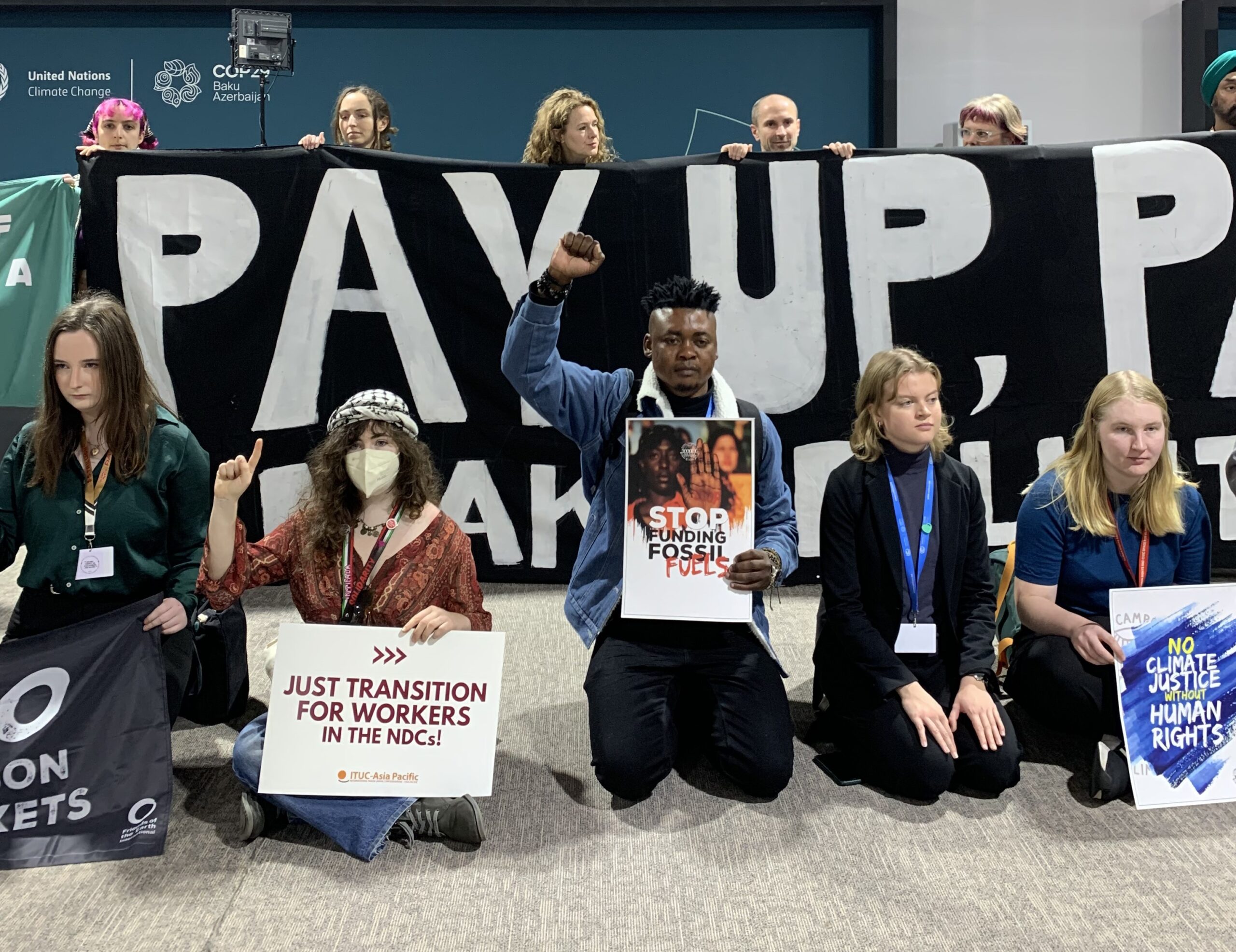
Governments also failed to reach agreement on the JTWP in Baku last year, with divisions on issues of human and labour rights, measures seen as restricting free trade, adaptation and emissions reductions.
A major bone of contention was whether to designate finance to support plans for a just transition, with developing countries wanting funding included and developed countries opposed.
Negotiations on this issue fell down the COP29 presidency’s list of priorities as the talks on the new finance goal became heated. It set up a last-minute contact group and presented a final draft to save the JTWP, but no agreement was reached.
After Baku setback, activists call for ‘just transition’ to be front and centre at COP30
The COP30 Presidency’s letter this week called the JTWP “a dynamic concept of paramount relevance to people’s real lives”, adding “let’s build on the discussions from COP29 and demonstrate ambition to agree on the scope and focus for this powerful concept”.
Anabella Rosemberg, who follows JTWP discussions for Climate Action Network International, said “the pace [of negotiations] will have to be accelerated to make up for the lost time since COP29”.
But, she added, “a solid agreement” on just transition is “within reach”. “The COP30 Presidency is sending the right signal,” she said. “Time for governments to seize the opportunity.”
Global goal on adaptation
The third negotiating track highlighted by the new COP30 letter is the Global Goal on Adaptation (GGA), which it said should be “a robust framework to track collective progress”.
Corrêa do Lago told reporters that adaptation – meaning becoming more resilient to the impacts of climate change – “has become absolutely central because climate change change is here”.
The GGA is a set of 11 targets for adaptation which government negotiators are hoping to agree how to measure, using a set of indicators which they must fix at COP30, after slow progress at COP29.
Negotiators have been divided on whether to include adaptation finance to meet these goals, with developed countries against and developing nations in favour.
Governments have also struggled to agree on how to define, measure and track progress on broad issues like how improved water supply or sanitation can help people adjust better to climate change.
Baku-Belém roadmap
One issue that will not be negotiated, Corrêa do Lago clarified to reporters, is the Baku-Belém roadmap on how to mobilise $1.3 trillion a year of climate finance from all sources, in addition to an agreed $300 billion of public finance annually by 2035.
The COP30 top diplomat said he would work with Azerbaijan’s COP29 President Mukhtar Babayev to launch this roadmap at COP30, after extensive consultation with governments – including finance ministers – and other “stakeholders” around the world. A draft roadmap will be published on September 8. “I believe it can be a very interesting document but we’re still in listening mode,” he said.
Azerbaijani lead negotiator Yalchin Rafiyev told Climate Week’s opening ceremony that success “will now depend less on what governments agree and more on what nations deliver”.
Comment: Let’s use early milestones to stay focused on climate action
“We are calling on donors to set out how they will deliver their fair share of the $300bn that they pledged in Baku. We are making sure that they are focused on early milestones,” said Rafiyev, who added that as part of that, developed countries must double adaptation finance this year compared to 2019 levels and by 2030 reach the $300bn climate finance target.
Juan Carlos Navarro, environment minister of Panama and host of Climate Week, demanded “clear targets” on the financial contributions of developed nations, adding that “only if we have clarity and achieve concrete outcomes will we be able to succeed”.
Call to avoid agenda fight
Previous mid-year climate talks in Bonn have been marked by lengthy debates on what should be on the agenda. For example, in 2023, a debate over how to include finance and emissions-cutting measures in the formal discussions continued for seven days.
At COP28 and COP29, a proposal by the BASIC group of emerging economies – which includes Brazil – to discuss the EU and US’s alleged “unilateral restrictive trade measures” proved controversial and eventually unsuccessful.
The COP30 Presidency’s letter this week said it is “advisable to avoid introducing potentially contentious new agenda items that could further burden the [UN climate negotiation] process or detract from agreed priorities”.
The letter also acknowledged “ongoing calls for COPs reform” and said that, as COPs are moving from “a negotiation-centered to an implementation-centered era”, governments should “consider the future of the process itself” – and come up with solutions to challenges like an excessive number of agenda items and barriers that prevent the participation of smaller country delegations.
The post Brazil seeks early deals on two stalled issues at Bonn climate talks appeared first on Climate Home News.
Brazil seeks early deals on two stalled issues at Bonn climate talks

The UN’s flagship climate fund has selected five locations for its new regional offices, a move aimed at bringing it physically closer to developing countries and making its finance easier to access.
After fraught discussions during a meeting last week, the board of the Green Climate Fund (GCF) decided in a secret vote on Saturday to open regional offices in Panama City, Amman in Jordan, Suva in Fiji, Nairobi in Kenya and Abidjan in Côte d’Ivoire. The African office will be split across two locations to better serve the continent with the largest number of countries and projects supported by the fund.
The decision marks a significant shift for the fund, which has operated from its headquarters in Songdo, South Korea, since its launch in 2013.
“This is a landmark moment for [the] GCF,” said the fund’s executive director Mafalda Duarte. “It has taken a lot of work, careful negotiation and persistent advocacy for a model that will bring us closer to the countries, to our partners and the communities we were created to serve”.
‘Less delay, more action’
The new offices are expected to act as the GCF’s front line, working more closely with governments, the private sector and civil society to improve access to climate finance and support the delivery of projects aimed at cutting emissions and strengthening resilience to climate impacts.
Welcoming the decision in a LinkedIn post, Fiji’s Permanent Secretary for the environment and climate change Sivendra Michael described it as “a win for the entire Pacific”, citing “long hours” and “tough negotiations” behind the outcome. “Less delay, more action — real support where it matters most,” he added.
-
Can new CEO steer Global Center on Adaptation back on course?
Madagascar’s Rindra Rabarinirinarison takes the helm of the troubled organisation promising to prioritise fundraising, rebuild trust with donors and hone its mission

A total of 43 countries applied to host the new offices, with 16 making a final shortlist after the GCF secretariat assessed bids on criteria including cost, connectivity and the ability to attract a “world-class workforce” through quality of life and access to international schools.
Panama emerged as the top-ranked location overall, according to a document seen by Climate Home News, while some selected hosts, including Amman and Abidjan, scored lower than rival candidates in their regions.
Establishing the new hubs is expected to cost an initial $6.5 million, but the fund anticipates these upfront expenses will be offset over time through operational savings, including lower staff and travel costs.
First Palestinian entity approved
The GCF board also accredited the first organisation in Palestine that will be able to directly apply for and access funding.
Created by the Palestinian Authority in the West Bank, the Municipal Development and Lending Fund supports local infrastructure projects and services. Working with partners, including the World Bank, it is developing projects to help communities cope with escalating climate risks such as drought and extreme heat.
In the West Bank, which is occupied by Israel, just under half of the population lives in areas classified as having high to very high climate exposure, according to a recent study.
The post Green Climate Fund picks locations for five developing country hubs appeared first on Climate Home News.
Green Climate Fund picks locations for five developing country hubs
Farmers and fishermen in the Maldives have long relied on an ancient calendar to guide their daily lives.
The Nakaiy system divides the year into 27 distinct periods, each named after a star or constellation in the night sky.
Any one period in the calendar tells you about expected weather and tidal patterns, navigational routes, and fishing conditions. The Nakaiy was created through centuries of careful observation and local knowledge, passed down through families as an essential tool for survival.
But things are now changing. The climate crisis is leading to more extreme weather events across the Indian Ocean island nation and upending the Nakaiy calendar.
“When you go and speak to communities and ask them what kind of impacts they are facing, a lot of elders will tell you that the weather, it doesn’t follow the calendar anymore,” explained Aishath Reesha Suhail, a programme officer in the Maldives’ Ministry of Tourism and Environment.
As the effects of climate change worsen, it is a real prospect that the Nakaiy may be abandoned by local people, representing a major cultural loss to the Maldives.
‘Systemic and growing threat’
With extreme weather becoming the norm, communities are observing a domino effect of consequences in their everyday lives. The slow onset of heritage loss is now being seen across continents, but notably among small islands in remote parts of the ocean.
“Climate change represents a systemic and growing threat to cultural heritage worldwide,” a UNESCO spokesperson told Climate Home, adding that the World Heritage Committee has identified climate change as “one of the most significant long-term risks affecting properties across all regions.”
UNESCO, the UN body for education, science and culture, defines the loss of cultural heritage as “the erosion of traditional knowledge systems, craftsmanship, social practices and identity, particularly where communities are displaced or livelihoods disrupted”. A clear example is historical sites and even entire islands washed into the ocean as a result of rising sea levels and coastal erosion.
The Maldives is dealing with such a situation now. The Koagannu Cemetery is a 900-year-old resting place, located on the country’s southernmost atoll, a mere 50 metres from the shoreline. The monument’s intricate coral gravestones are being actively threatened by the encroaching Indian Ocean.
The government and local community have responded to this challenge with emergency protection measures. Sandbags and concrete structures have been installed along the coastline, complemented by large numbers of palm trees to create a seawall. A wider solution is ‘beach nourishment’, a common practice in the Maldives where sand from elsewhere is brought in to replace what has been lost through erosion. Taken together, these solutions have so far protected the cemetery.
Among the many issues climate change creates, cultural heritage is not always front of mind. In the Maldives, one of the main barriers people face is awareness. “Most of what we are dealing with relates to the erosion of our islands along with areas such as fisheries… but we are quite limited in our capacity to do something about it,“ Suhail said.
“We don’t understand the full breadth of the issue at present because we haven’t been able to do extensive research on the matter,” she added. However, assessing the extent of the damage – and how to respond effectively – is a key priority for the government, outlined in its latest climate plan, known as a Nationally Determined Contribution, and as part of its National Adaptation Plan process.
Fishing is at the core of the country’s culture and identity, employing thousands of people. Most dishes include fish – “we have it for breakfast, lunch and dinner,” Suhail noted – but the climate crisis and overfishing are shifting how and when communities can fish. Tuna makes up 98% of all fish caught in the Maldives, but warmer ocean temperatures are changing migratory patterns, pushing the species into deeper, colder waters.
As a critical economic and cultural resource, the government has outlined a range of solutions to protect the fisheries sector in its first Biennial Transparency Report to the UN. These include using real-time tracking data to improve the efficiency of fishing operations; investing in canneries to increase fish storage; and diversifying away from tuna through marine farming.

Culture and nature go hand-in-hand
The same pattern is playing out elsewhere.
Palau and the Maldives are not close to one another. The two states are separated by around 4,000 miles and sit in different corners of the ocean. But both are experiencing very similar climate challenges, based on their position as a set of scattered, low-lying islands surrounded by an imposing body of blue water.
In the same way as the Maldives, Palau’s cultural heritage is closely tied to “land, coastlines and traditional food systems,” according to Toni Soalabla, at the Palau Office of Climate Change.
“Many of the places that hold stories, history and identity of our communities are located along the coast and are increasingly exposed to erosion and sea level rise,” she said.
One of these places is Ngerutechei village, reportedly the oldest in Palau, and home to ancient stone paths and carvings. The village provides a glimpse into the past social values and culture of the people in this western Pacific nation.
As part of the development of Palau’s National Adaptation Plan, the government has worked with local leaders to identify similar sites of cultural significance. The plan encourages communities to use their own knowledge to create protective measures for these sites.
Climate change is also prompting communities to take up traditional land and food practices again. These include cultivating taro, a stable food source that has historically supported water, soil and food security on the islands.
“These systems developed over generations in response to local environmental conditions, so strengthening them today is both a climate adaptation measure and a way of maintaining cultural knowledge that might otherwise fade,” said Soalabla.
Cultural practices in Palau have developed alongside the natural ecosystems that people rely on to survive. It is within this context that researchers believe adaptation policies should be created. Recognising this relationship “can strengthen both community identity and environmental resilience at the same time”, according to Soalabla.


Heritage on the global stage
The issue of cultural loss has not gone unnoticed in international climate negotiations.
Small island states such as the Maldives have used their role at the UN to push for greater awareness and action, with some key successes.
In 2015, the Paris Agreement established a Global Goal on Adaptation (GGA) which recognised that countries needed to do something about climate change now and not later. However, it took six years before a framework and a set of adaptation targets were agreed at the UN climate summit in Glasgow to pursue this goal.
From this came the establishment of seven overall themes – from poverty eradication to access to health – to guide adaptation action and a set of around 60 indicators to measure progress against the targets.
World leaders invited to see Pacific climate destruction before COP31
Emilie Beauchamp, an adaptation specialist at the International Institute for Sustainable Development (IISD), said that “cultural heritage was highlighted as one of the global priorities [of the GGA Framework] and is one of the seven themes, so it is considered very important by the international community.”
The much-debated set of indicators, only finalised in Belém at last year’s COP30, include five related to cultural heritage with a focus on preserving cultural practices and important sites that are “guided by traditional knowledge, Indigenous Peoples’ knowledge and local knowledge systems”. A spokesperson for UNESCO said the inclusion of heritage indicators “marks an important recognition that climate impacts extend beyond economic losses”.
While critics said the set of final indicators was rushed through by the Brazilian presidency, they now serve as guidance for national governments that wish to implement plans to protect their common heritage. The missing piece of the puzzle remains how to finance these plans – something notably absent from the Belém text, which made clear that the adaptation indicators “do not create new financial obligations or commitments, nor liability or compensation”.
The lack of financial commitments proved disappointing for many small states grappling with how to prevent their cultural history from being entirely forgotten, especially at a time when adaptation finance remains below requirements. A recent UNEP report found that developing nations would need an estimated US$310 billion per year in 2035 to adapt to climate change, while current public financing was around $26 billion.
At these low levels “only a small percentage of what the framework outlines could be implemented,” according to Beauchamp.

The challenge of cultural heritage
When looking at low-lying islands on a map, they can appear as specks of land amid a vast ocean. Many of the stories from these remote places go unnoticed. But the specks represent millennia of human culture that is slowly being lost to the ocean.
While the international community has now recognised the problem and solutions exist, the recurring issue of scarce finance may prevent governments from taking sustained action. Island communities have already been forced to move home as sea levels rise, leaving behind their cultural connections to a place.
The value of any cultural asset, or of human heritage, can be judged by how it is engaged with over generations. Without human intervention, many historical sites, language, cuisine and other local customs would become a forgotten part of history. The rapid onset of climate change brings the role of cultural heritage into sharp relief, challenging communities to decide in real time what they value, what deserves saving, and how to achieve that.
Stories of cultural loss are not confined to small islands but it is here where the challenge is presenting most acutely. The experiences of these vulnerable nations in protecting their heritage will provide the litmus test for effective adaptation responses elsewhere.
Adam Wentworth is a freelance writer based in Brighton, UK.
(Main image: The Isdhoo Havitha is an ancient Buddhist monastery in the Maldives, located moments from the shoreline. Photo: Ashwa Faheem)
The post Island nations fight to save cultural heritage from climate change appeared first on Climate Home News.
Island nations fight to save cultural heritage from climate change
The invasive emerald ash borer, native to northeast Asia, has spread to 37 states over the past quarter century, killing nearly all of the ash trees it infests. But in Maine, a coalition of basketmakers, scientists and government officials are plotting a future for their trees.
Each strip of wood in Richard Silliboy’s hands started as a year of an ash tree’s life.



-
Greenhouse Gases8 months ago
Guest post: Why China is still building new coal – and when it might stop
-
Climate Change8 months ago
Guest post: Why China is still building new coal – and when it might stop
-

 Greenhouse Gases2 years ago
嘉宾来稿:满足中国增长的用电需求 光伏加储能“比新建煤电更实惠”
-
Climate Change2 years ago
Bill Discounting Climate Change in Florida’s Energy Policy Awaits DeSantis’ Approval
-

 Climate Change2 years ago
嘉宾来稿:满足中国增长的用电需求 光伏加储能“比新建煤电更实惠”
-
Climate Change Videos2 years ago
The toxic gas flares fuelling Nigeria’s climate change – BBC News
-

 Renewable Energy5 months ago
Sending Progressive Philanthropist George Soros to Prison?
-

 Carbon Footprint2 years ago
US SEC’s Climate Disclosure Rules Spur Renewed Interest in Carbon Credits