

Bald eagles and other raptors are among more than 100 bird species that have died from avian flu in the past four years—and the virus is still spreading.
When two bald eagles built a nest in Philadelphia in 2007, it was the first time one had been recorded in the area in 200 years.
Avian Flu Has Killed Thousands of Birds in the U.S. Pennsylvania Is at the Epicenter.

India has set a new target to reduce its “emissions intensity” – greenhouse gas emissions per unit of economic output – to 47% below 2005 levels by 2035.
The much-awaited announcement comes within India’s delayed new nationally determined contribution (NDC) for 2035 under the Paris Agreement, which had been due last year.
The pledge, which has not yet been published by the UN, was approved by India’s cabinet and issued as a government press release on 25 March.
The updated NDC from the world’s third-largest emitter lands amid the global energy crisis triggered by the Iran war, which has already led to Indians grappling with gas shortages.
In its pledge, India has committed to non-fossil energy making up 60% of its installed electricity-generating capacity by 2035.
The country has also announced an increase to its target for the amount of CO2 that will be absorbed by carbon sinks, such as forests – the first such rise since India made its first pledge to the Paris Agreement.
Some climate experts in India have welcomed the new pledge, saying the country “is pulling more than its weight given its minimal historical contribution to emissions” and “despite recent geopolitical headwinds”.
However, others point out that the targets “underestimate India’s potential” for clean-energy growth and “allow for an acceleration” of emissions, while “hiding” deforestation.
Below, Carbon Brief outlines India’s new climate pledge for 2035 and its implications for the nation’s energy sector, emissions and adaptation efforts.
This article will be updated once the full NDC has been formally published by the UN.
- What is in India’s updated climate pledge?
- What do India’s pledges mean for its energy sector?
- What do India’s pledges mean for its land sector?
- What are the political considerations behind India’s new climate pledge?
- How have India’s new pledges been received?
What is in India’s updated climate pledge?
The 1,200-word press release announcing the approval of India’s new NDC for 2035 is thin on detail. For example, it does not spell out any climate-finance needs for adaptation, mitigation or climate change-induced loss and damage.
The details provided in the press release include three headline quantified targets for three areas:
- GDP emissions intensity
- “Non-fossil fuel” share of electricity generation
- Land and forestry
First, India commits to cutting the “emissions intensity” of its GDP to 47% below 2005 levels by 2035, a small increase from the 45% target for 2030 set out in its previous pledge in 2022.
Emissions intensity is defined as the total amount of greenhouse gas emitted for each unit of GDP, which means it applies to all sectors of the economy and covers all gases, such as methane and nitrous oxide, as well as carbon dioxide (CO2).
However, there is no globally agreed benchmark to measure this type of target.
According to the Indian government’s fourth “biennial update report” submitted to the UN on 30 December 2024, India had already reduced its emissions intensity by 36% between 2005 and 2020.
By setting an intensity target, India would be able to continue increasing its emissions as its economy grows, as Carbon Brief has previously explained. This target, therefore, depends on the size of India’s economy in 2035, as well as its total emissions.
(Under the terms of the Paris Agreement and the first “global stocktake” agreed in 2023, only developed countries are expected to set “absolute” targets to cut their emissions. Developing countries are “encouraged” to move towards such targets “over time”.)
The two-point increase in India’s intensity target, to 47% by 2035, “will not bring any real emission reductions, given India’s fast-growing GDP”, says a statement from climate research group Climate Action Tracker.
It says this new goal is ‘unlikely to drive significantly more ambitious action”.
India’s GDP is expected to grow by an average 6.1% per year out to 2035, which is “more than any other major country or region”, according to the International Energy Agency (IEA).
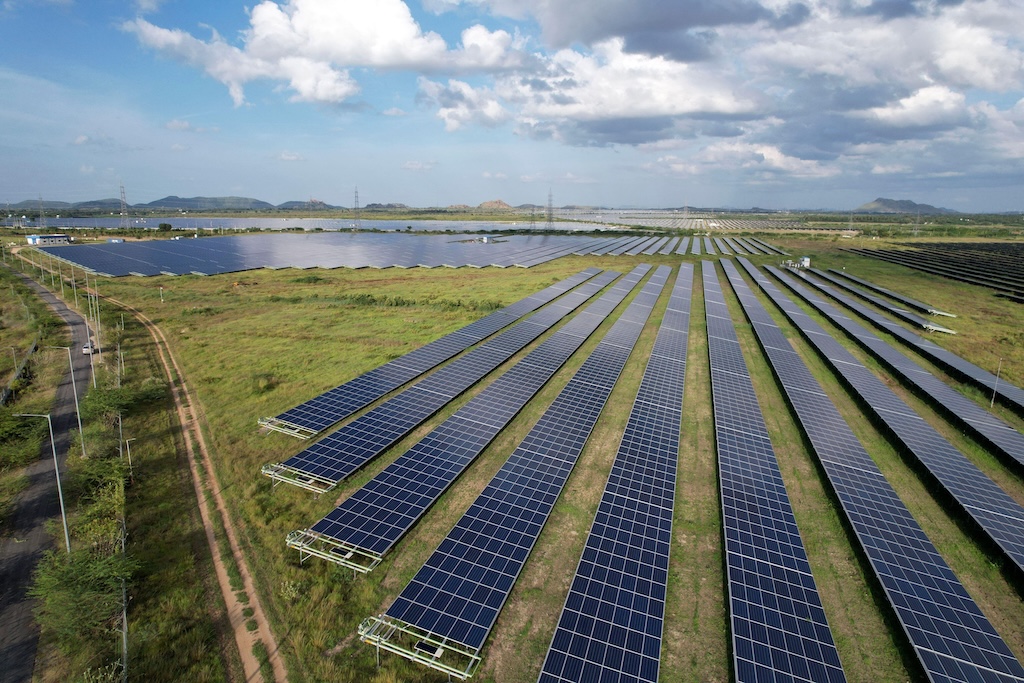
Second, the country has pledged to raise the share of “non-fossil fuel-based energy resources in installed electric power capacity” to 60%. (India defines “non-fossil sources” as including large-scale hydropower, nuclear, bioenergy, solar and wind power.)
The target is a 10-percentage point increase from the previous goal of “about 50%” by 2030.
In July 2025, the Indian government announced that it had achieved this target, five years ahead of schedule. As of February 2026, non-fossil sources already made up 52.6% of installed capacity.
The IEA estimates that India’s existing policies would be sufficient to achieve the newly targeted 60% share as early as 2030, reaching 70% by 2035.
Third, the country has raised its land and forestry sector target for the first time since 2015.
According to the press release description of the new pledge:
“[India has] further enhanced the ambition of creating [a] carbon sink through forest and tree cover to 3.5-4.0bn tonnes of CO2-equivalent [GtCO2e] by 2035 from 2005 level[s].”
However, the baseline from which India calculates its emissions reductions from forests was only clarified in 2024 and its metrics for measuring forest and tree cover remain controversial. (See: What does India’s pledge mean for its land sector?)
Additionally, the target corresponds to a “business-as-usual scenario”, according to India’s own forest authorities, with no additional policies required to achieve it.
Beyond the three quantitative headline goals, the NDC pledge also contains five qualitative targets. The government release says these are “intended to embed sustainability into everyday life and governance systems, promote climate-resilient development pathways and enable a just and inclusive transition for all sections of society”.
They include a target to “mobilise domestic, and new and additional finance from developed countries”.
Another qualitative target is a commitment to develop “resilient infrastructure” in order to “adapt to climate change in various sectors like agriculture, water resources, health, disaster management and fragile ecosystems”.
The government release does not explicitly mention the 1.5C aspirational global warming limit agreed as part of the Paris Agreement, but it does “recogni[se] that climate change impacts are already being felt”. It also says the government has “placed strong emphasis on adaptation and disaster resilience across the key actors of its economy”.
The release lists a range of adaptation actions and initiatives that the government is engaged in, from mangrove restoration to “heat action plans” and monitoring glacial lake outburst floods. However, it does not set any new adaptation goals.
According to India’s national economic survey for 2025/26, adaptation and “resilience-related” domestic spending “surged” to 5.6% of the country’s GDP in 2022-23, from 3.7% in 2016-17, with 98% of adaptation finance sourced domestically.
The Indian government says that the NDC “mark[s] a significant step towards the goal of achieving net-zero by 2070”, but does not offer further explanation.
Additionally, it does not mention two targets announced by president Narendra Modi in 2021 at COP26 in Glasgow. These were to install 500 gigawatts (GW) of non-fossil capacity by 2030 and to reduce cumulative emissions between 2021-30 to 1bn tonnes of CO2 (GtCO2) below expected levels.
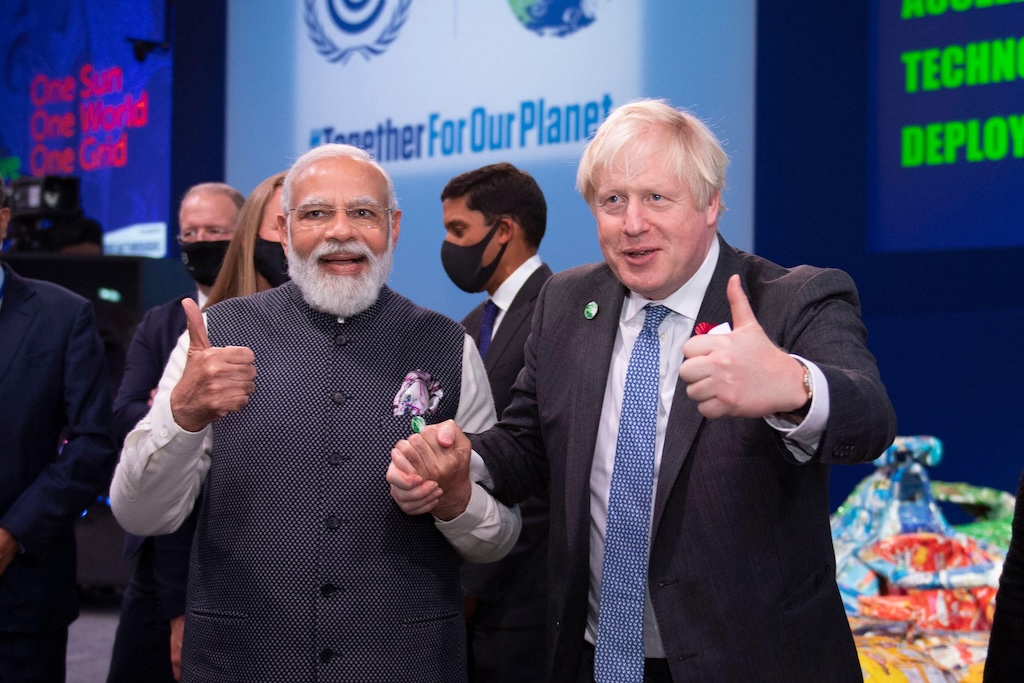
However, the release does reiterate that the “achievement of our targets ahead of time…provides strong confidence in the country’s ability to deliver on future commitments”.
The release also says that India has “considered” the outcomes of the first ”global stocktake” and the “need for greater ambition” in line with the Paris Agreement’s long-term temperature goal in “shaping” India’s 2035 NDC.
It adds that, when formulating the pledge, the government took into account the principles of equity and common, but differentiated responsibility, as well as development and energy security priorities.
What does India’s pledge mean for its energy sector?
India’s new target for non-fossil sources to make up 60% of installed electricity generating capacity builds on its 2022 NDC target to reach “about 50%” by 2030.
Although not specified in the latest release, the previous goal was said to have been conditional on the availability of low-cost international finance. In July 2025, India announced that it had already achieved this 50% target, five years ahead of schedule.
When this announcement was made in June last year, India’s installed non-fossil capacity comprised 38.1% renewables, 10.2% of large hydropower and 1.8% nuclear energy.
In January 2026, India’s non-fossil installed capacity reached 50.6% and, per the announcement, had already reached 52.6% in February.
Meeting the new 2035 target would, therefore, require only another 8 percentage-point increase in the non-fossil share of installed capacity over the next nine years.
This is much less ambitious than India’s own national generation adequacy plan, published in March 2026, which says that non-fossil fuel-based installed capacity would reach “70% of the total installed capacity by 2035-36”.
According to estimates from the Centre for Science and Environment (CSE), India could hit the 60% target as early as 2028.
Beyond the overall non-fossil capacity target, the NDC release does not include specific goals for domestic renewable generation or capacity installation.
According to the Central Electricity Authority, renewable energy, including large hydropower, only accounted for 22.4% of total electricity generation – a far lower share than the installed capacity percentage.
As of January 2026, coal-fired power still accounted for 69% of total generation.
India is still planning to add approximately 56GW of new coal-fired power generation capacity by 2030, because of the expected growth in peak electricity demand.
According to a report by government thinktank Niti Aayog, India’s coal consumption for all uses “could more than double by mid-century before plunging sharply”.
On the other hand, research for Carbon Brief by the Centre for Research on Energy and Clean Air (CREA) shows that electricity generation from coal in India fell by 3% year-on-year in 2025. It suggests that power-sector emissions could peak before 2030, if clean-energy capacity and electricity demand grow as expected.
The analysis found that the fall in coal-fired power was partly a result of accelerated clean-energy growth, which played a significant role in driving down coal generation for the first time.
Nevertheless, a range of challenges are holding back the growth of India’s grid-based solar power, according to a 2025 report by the Institute for Energy Economics and Financial Analysis (IEEFA), which points to issues including delays in power supply agreements and transmission challenges.
Solar manufacturing has seen a “13-fold jump” that has outpaced domestic demand. In September, it was reported that India had 44GW of renewable energy “ready for deployment”, but challenges around secure long-term power contracts were holding back its deployment.
Experts tell Carbon Brief that off-grid solar might absorb some of this glut, which could explain additional outlays for rooftop solar in India’s February budget. In 2025, India added 7.1GW of rooftop solar capacity, a 122% increase from the previous year.
However, Reuters reports that this rooftop solar push “is falling short of targets despite heavy subsidies” because of poor financing and limited support from state utilities and vendors.
The country is expanding its hydropower fleet in the high eastern Himalayan region – near a disputed border with China – despite biodiversity concerns, drought and flood impacts on dams and reservoirs.
According to Down To Earth, the country is also “prioritising pumped hydropower storage projects over battery systems”, expecting to add around 50GW of such capacity by 2032.
India is also looking to nuclear energy to serve as a steady source of power to complement variable renewable output.
In December 2025, the government enacted a landmark new nuclear law, dubbed the “Shanti” act – an acronym for “sustainable harnessing and advancement of nuclear energy for transforming India”.
It aims to help India increase its nuclear capacity more than tenfold, from 8GW in 2024 to 100GW by 2047. (India has some 6GW of nuclear capacity under construction.)
However, given high costs, extended timescales and India’s long history of public protests against nuclear energy over safety and land-acquisition concerns, it remains to be seen how quickly this capacity can be ramped up.
What does India’s pledge mean for its land sector?
For the first time since issuing its first target in 2015, India has raised its land and forestry carbon-sink goal in its updated NDC.
This target aims to create an additional annual carbon sink of 3.5GtCO2e through “additional tree and forest cover” by 2035, compared with 2005 levels.
This is a 1GCO2e increase from its target for 2030, which was to sequester 2.5-3GtCO2e through additional forest and tree cover by 2030. This time, India finally spells out a clear 2005 baseline from which these targets are to be measured.
According to the Forest Survey of India’s (FSI) last India state of forest report, the country had “already reached 2.29Gt of additional carbon sink” against its 2005 baseline in 2023.
Dr Sharad Lele, professor of environmental policy and governance at the Ashoka Trust for Research in Ecology and the Environment, tells Carbon Brief that the increase in India’s forest NDC target is “concerning” for several reasons.
First among these, Lele says, is that the FSI’s official claim of sequestration so far “is based on shaky methods and non-transparent datasets”. He continues:
“Second, the country continues to lose dense forests of high conservation and livelihood value to development projects while sequestration seems to be done through plantations.
Third, and most important, carbon as well as conservation goals should not bypass the rights of Indigenous and local communities, [which] continues to result in both forest destruction and plantation happening in ways that disregard community concerns and priorities.”

In recent years, the Modi government clarified two key missing components of India’s carbon-sink target, which had confused even forest authorities.
In 2024, the Indian government clarified the baseline year against which its carbon sink is measured, setting it to 2005.
Second, India retrospectively adopted an interpretation of annual forest cover metrics that allow it to meet its carbon sequestration target “without implementing additional measures per se for increasing forest carbon sink”, according to the FSI.
The FSI’s metrics have been questioned by the UN, scientists and the media for their lack of transparency and for “masking” deforestation. In addition, its definition of what constitutes forest cover is seen as controversial because it includes monocultures, commercial plantations and urban parks.
The FSI defines the term “forest cover” in India as follows:
“All lands, more than or equal to one hectare in area, with a tree canopy of more than or equal to 10%, irrespective of ownership and legal status; and includes orchards, bamboo and palm.”
Because of this definition and how it is measured, India’s forest cover has “shown a gradual and steady trend of increase in the last one and a half decades”, according to the FSI.
Souparna Lahiri, a climate and land-use expert with the Climate Land Ambition and Rights Alliance (CLARA), tells Carbon Brief that this approach means deforestation is “hidden”:
“When you choose a carbon sequestration target, what you’re trying to mask is the real health of India’s forests.…This is a self-rewarding scheme for when you have compensatory afforestation schemes for many, many years that are basically raising plantations.”
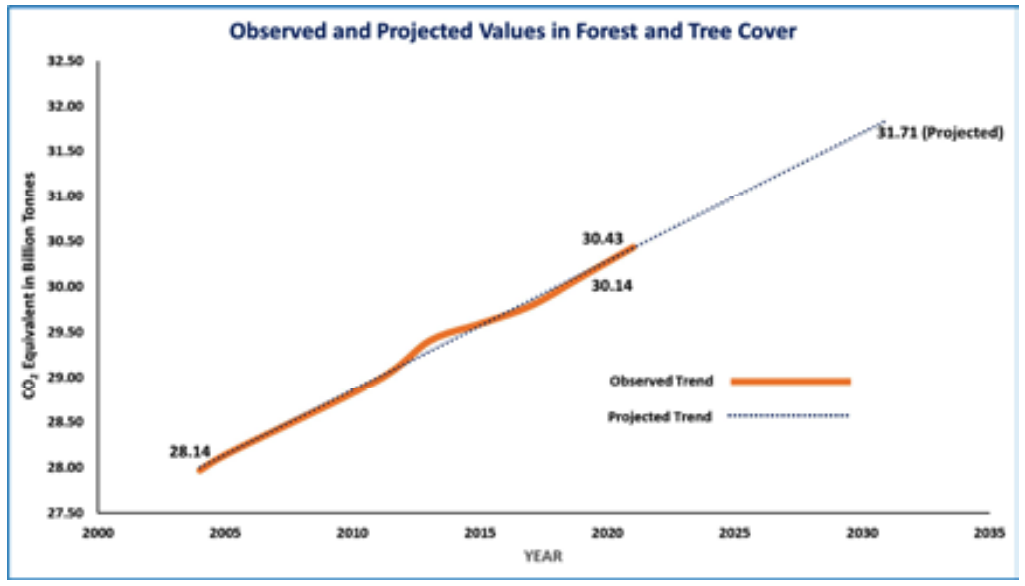
The chart below shows the FSI’s estimates of forest carbon stocks from 2005 to 2023 (orange) and its projections for further carbon sequestration out to 2030 (dotted line).
The figure shows that the FSI expects India to exceed its 2030 target of boosting forest carbon stocks by 2.5-3.0GtCO2e over 2005 levels, with a projected 3.57GtCO2e increase. Indeed, this projected increase would see the new 2035 target, for a 3.5GtCO2e increase over 2005 levels, being met by 2030, five years early.
Meanwhile, according to the forest data platform Global Forest Watch, India lost 1.3m hectares (mha) of tree cover from 2015 to 2024, equivalent to 5% of the forested area in 2010. It says this area would have sequestered 830MtCO2e prior to being deforested.
The country’s climate ministry has prioritised granting and fast-tracking permits for forest clearance for strategic infrastructure and energy projects, with further exemptions for critical minerals, exploration and other projects.
The Indian government has also allowed for private monoculture plantations on public forest land without compensating for the loss of primary forest.
Ashish Kothari, veteran environmentalist and founder of non-profit Kalpavriksh, tells Carbon Brief:
“There are so many contradictions. We’re currently fighting the Great Nicobar case, where the government wants to clearfell 130sqkm of rainforest and believes it can compensate for this with plantations 2,400km away in Haryana in north India. All of this never makes it to India’s NDC.”

At the same time, new research warns that increasing “ecological droughts” induced by climate change could weaken India’s forest carbon sinks.
Another study estimates that carbon uptake of India’s forests fell by 5-12% in the decade from 2010 to 2019, compared to the previous one.
Land availability for afforestation and restoration to meet India’s carbon-sink target is another key contention.
In a recent Carbon Brief guest post, researchers estimated that less than 0.5% of the country’s area is “immediately available for forest restoration”, which, if regenerated, could sequester less than 10% of India’s 2030 pledge.
Carbon markets under Article 6 of the Paris Agreement were a key priority for India in the run-up to COP30 and the country has been setting up its own domestic forest carbon market.
Lahiri points out that India’s carbon market is “still restricted” within the energy sector, but now has a “green credit scheme” for the land sector – spanning afforestation, mangrove restoration and wetland conservation – where one tree can equal one “green credit” unit.
Lahiri says that this shows India is intending to “balance the energy sector emissions from carbon sequestration”.
What are the political considerations behind India’s new climate pledge?
India’s climate pledges have been delayed in the past, so the late arrival of its latest NDC is not necessarily a significant sign. However, the new pledge was announced amid an energy shock triggered by the US-Israel war on Iran.
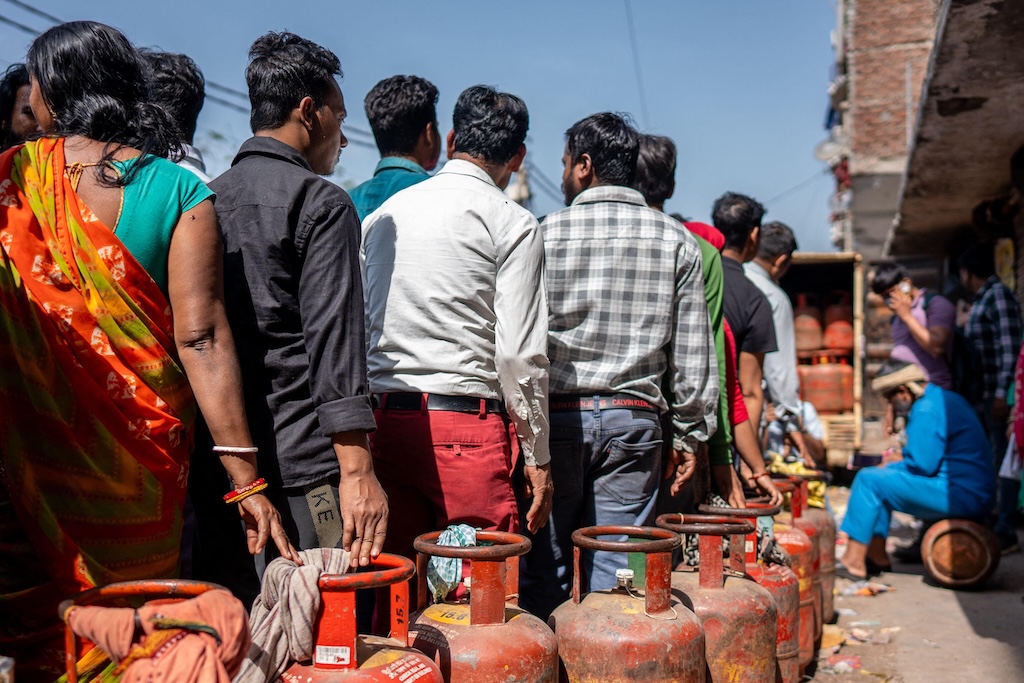
This means that India is trying to secure energy supplies from different sources, as people around the country face widespread shortages. Additionally, key state elections are being held in April.
While the country was hailed in 2022 for proposing language to “phase out all fossil fuels” and not just coal, recent events indicate less tolerance for such a stance.
A key consideration for India’s level of climate commitment within its latest NDC has also been the $300bn a year climate-finance target agreed at COP29 in Baku. Since then, many developed countries have cut their aid budgets.
At COP29, India called the climate-finance outcome “a joke” and accused the presidency of pushing the deal through without proper consent, following chaotic last-minute negotiations.
![Bluesky post by Aruna Chandrasekhar, handle @arunacsekhar.bsky.social. Bluesky post says: INDIA: "We informed the #COP29 presidency we wanted to make a statement prior to any decision on the adoption lof the #NCQG finance goal]." "This has been stage-managed, and we are extremely disappointed." "This document is nothing more than an optical illusion. India opposes [its] adoption." There is a photo attached of a woman speaking at COP29.](https://breakingclimatechange.com/wp-content/uploads/2026/03/bsky.app_profile_arunacsekhar.bsky_.social_post_3lbnm6cq5p22o-862x1024-4.png)
According to government sources quoted in the Indian Express earlier in 2026, India’s NDC was expected to “reflect the disappointment of COP29 outcome on climate finance”.
In addition, the US exit from the Paris Agreement, the UNFCCC, IPCC, climate funds and even the India-led International Solar Alliance has fuelled fears around the future of multilateral environmental governance.
War and conflict have also contributed to an increased emphasis on energy security.
Finally, India’s climate diplomacy position has historically been to “underpromise and overdeliver”. In this wider context, some experts welcomed the fact that India had announced an NDC with higher targets than the previous version, in the current geopolitical climate.
For example, according to Dhruba Purkayastha, consultant to the UNFCCC’s standing committee on finance, the announcement “is a clear sign of leadership” on climate action at a time when “it is evident that the west is not going to lead”. Puryakastha said in a statement:
“At a time when the world order stands diminished and when there is little traction for climate – which seems to have lost its standing as a global public good – it is good to see that India is staying on track. And, given that India is the BRICS chair, this announcement probably paves the way for a BRICS-led climate action.
On the other hand, Dr Nandini Das – climate economist and India lead at Climate Action Tracker – said in a statement that the country “missed an opportunity to come up with a national, economy-wide 2035 target to cut greenhouse gas emissions.”
How have India’s new pledges been received?
The new pledge has received a positive response from many climate experts in India, but a more cautious reception from overseas commenters.
Avantika Goswami, programme manager of climate change at CSE, tells Carbon Brief that the new targets stand out “in the current context” and “represent a commitment” to climate multilateralism. She tells Carbon Brief:
“At a time when developed countries are backtracking on ambition, deepening their fossil-fuel entrenchment and dragging the world towards military conflict, the signal from India shows that global south leadership on climate ambition is concrete and real.”
Prof Navroz K Dubash, professor of public and international affairs at Princeton University, tells Carbon Brief that India’s new pledge falls into an “ongoing pattern” of NDCs that “under-commit and will overcomply”, a description he says also fits China’s recent pledge.
Dubash elaborates:
“This pattern suggests that statements of ambition are no longer the driver of climate action, if indeed they ever were. Instead, indications of implementation on the ground – real domestic policy and investment trends – are the more useful benchmark of progress.”
In a statement, Dr Arunabha Ghosh, director at the Council on Energy, Environment and Water (CEEW), says that the pledge balances “energy security and resilience”, as the country faces “macroeconomic shocks and climate extremes”.
Ghosh points out that India’s power markets are evolving rapidly and, if “supply chain disruptions” ease, India could exceed its targets again. He says:
“A targeted 60% share of non-fossil electricity capacity in 2035 suggests that, while India has raised its ambition to decarbonise the power sector, it is also doubling down on energy security and affordability for hundreds of millions of its citizens.”
Madhura Joshi, programme lead at climate change thinktank E3G, says the NDC shows “strong intent to bet on clean energy at home as part of a strategic move to improve its energy security and prosperity”.
In a statement, she adds:
“India’s raising of ambition on non-fossil fuel capacity, emissions intensity and on carbon sinks reflects a measured and meaningful step forward, but India’s strong track record suggests that it will surpass these targets ahead of schedule.”
Others have been more cautious about the NDC targets, with Lauri Myllyvirta, lead analyst and co-founder at CREA, saying in a statement that the targets “underestimate the country’s potential for transformative clean energy growth”.. He adds:
“Under current plans, the target of 60% clean-power capacity will be achieved before 2030, rather than by 2035. Continuing the current clean-energy growth at rates already achieved in 2024-25 would enable India to peak power-sector emissions well before 2030 and significantly slow down its CO2 emission growth rates.
“Yet, the carbon-intensity target…allows for an acceleration of emissions growth compared with past rates, if GDP growth is at target. India’s booming clean-energy industry is highly likely to deliver much faster progress than policymakers were prepared to commit to today.”




The post Q&A: What does India’s new Paris Agreement pledge mean for climate action? appeared first on Carbon Brief.
Q&A: What does India’s new Paris Agreement pledge mean for climate action?
As the bill heads to Gov. Ron DeSantis, experts seek more specifics on how it will be implemented.
Legislation awaiting Gov. Ron DeSantis’ signature is aimed at ensuring hyper-scale data centers in Florida bear the full financial burden of powering their own facilities and that costs do not fall to average Floridians.
Legislation Aims to Protect Floridians From Data Center Costs, but Will It?
Researchers identified 24 new creatures and an entire superfamily of species in the Pacific, all while NOAA moves to fast-track deep-sea mining permits there.
Beneath the neon lights of a laser-scanning microscope, newly classified species glow in vivid greens and oranges—a far cry from the pitch-black abyss of their natural ocean floor.



-
Greenhouse Gases8 months ago
Guest post: Why China is still building new coal – and when it might stop
-
Climate Change8 months ago
Guest post: Why China is still building new coal – and when it might stop
-

 Greenhouse Gases2 years ago
嘉宾来稿:满足中国增长的用电需求 光伏加储能“比新建煤电更实惠”
-
Climate Change2 years ago
Bill Discounting Climate Change in Florida’s Energy Policy Awaits DeSantis’ Approval
-

 Climate Change2 years ago
嘉宾来稿:满足中国增长的用电需求 光伏加储能“比新建煤电更实惠”
-
Climate Change Videos2 years ago
The toxic gas flares fuelling Nigeria’s climate change – BBC News
-

 Carbon Footprint2 years ago
US SEC’s Climate Disclosure Rules Spur Renewed Interest in Carbon Credits
-

 Renewable Energy5 months ago
Sending Progressive Philanthropist George Soros to Prison?