

One of the headline outcomes to emerge from COP30 was a new target to “at least triple” finance for climate adaptation in developing countries by 2035.
Vulnerable nations stress that they urgently need to strengthen their infrastructure as climate hazards intensify, but they struggle to attract funding for these efforts.
The new goal, which builds on a previous target agreed four years ago to double adaptation finance by 2025, was a central demand for many developing countries at the UN climate summit in Belém.
Yet, throughout the two-week negotiations, developed-country parties opposed new targets that would give them more financial obligations.
As a result of this opposition, the final target is less ambitious than the idea originally floated by developing countries, resulting in less pressure on developed countries to provide public funds.
This article looks at precisely what the final COP30 outcome does – and does not – say about tripling adaptation finance, as well as the implications for developing countries.
- 1) The final COP30 decision delayed the ‘tripling’ target by five years and added uncertainty
- 2) The new target is looser than the previous ‘doubling’ goal for adaptation finance
- 3) The target also falls far short of developing countries’ adaptation needs
1. The final COP30 decision delayed the ‘tripling’ target by five years and added uncertainty
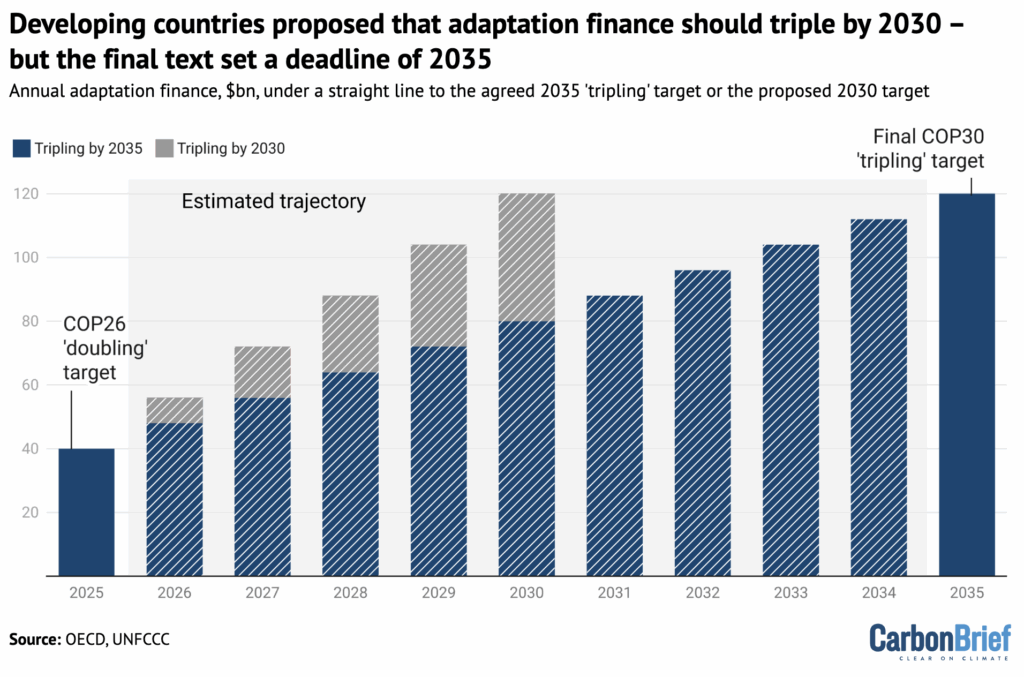
At COP26 in Glasgow in 2021, a target was agreed for developed nations to double the amount of adaptation finance they would provide to developing countries by 2025.
This target has been broadly interpreted as approximately $40bn by 2025, using the agreed baseline of $18.8bn in 2019.
As of 2022, the latest year for which official data is available, annual adaptation finance from developed countries had reached $28.9bn. (Final confirmation of whether the target has been met will not come until 2027, due to the delay in climate-finance reporting.)
With the “doubling” target set to expire this year, some developing countries came to COP30 with the aim of agreeing on a new target.
The least-developed countries (LDCs) group called for “a tripling of grant-based adaptation finance by 2030 to at least $120bn”. They were backed by small-island states, the African group and some Latin American countries.
This proposal was included in the first draft of the “global mutirão“, the key overarching decision text produced by the COP30 presidency.
However, the text that ultimately emerged pushed the “tripling” deadline back to 2035. As the chart below shows, this delayed target could mean far less adaptation finance in the short term, due to developed countries taking longer to ramp up their contributions.
Lina Yassin, an adaptation advisor to the LDCs, tells Carbon Brief that this goal is “fundamentally out of step” with the obligation for developed countries to achieve a “balance” between adaptation and mitigation finance.
(This obligation is set out in the Paris Agreement, but, in practice, developed countries provide far more finance for mitigation initiatives, such as clean-energy projects. Adaptation finance has been around a third of the total in recent years and this would still be the case if the overall $300bn climate-finance and tripling adaptation finance targets are both met.)
The final text also removed a mention of 2025 as the baseline year, adding uncertainty as to what precisely the 2035 target means.
“The [LDCs] wanted a clear number, tied to a clear baseline year, that you can actually track and hold providers accountable for,” Yassin explains.
The text does allude to the “doubling” target agreed at COP26 in Glasgow, which some analysts say is an indicator of what the baseline should be.
“It is obviously deliberately vaguely written, but we think the reference to the Glasgow pledge means they should triple that pledge,” Gaia Larsen, director for climate finance access at the World Resources Institute (WRI), tells Carbon Brief.
2. The new target is looser than the previous ‘doubling’ goal for adaptation finance
The “doubling” target set at COP26 was based on adaptation finance “provided” by developed countries.
This means it exclusively comes as publicly funded grants and loans from many EU member states, the US, Japan and a handful of other nations, including finance they raise via multilateral development banks (MDBs) and funds.
The LDCs’ original proposal for the “tripling” goal was even more specific. It called for “grant-based finance”, meaning any loans would not be included.
Amid widespread cuts to aid budgets, notably in the US, developed countries have been unwilling to commit to new targets based solely on them providing public finance.
Instead, they stressed at COP30 that any new pledges should align with the “new collective quantified goal” (NCQG) to raise $300bn by 2035, which was agreed last year. This is reflected in the final decision, which says the tripling target is “in the context of” the NCQG.
Unlike the COP26 goal, the NCQG covers finance from a variety of sources, including “mobilised” private finance and voluntary contributions from wealthier developing countries.
Assuming $120bn as the 2035 objective, WRI has estimated what its composition could be, based on the looser accounting allowed under the new adaptation-finance goal.
As the chart below shows, the institute estimates that more than a quarter of the target could be met by these new sources, with the rest coming from developed-country governments.
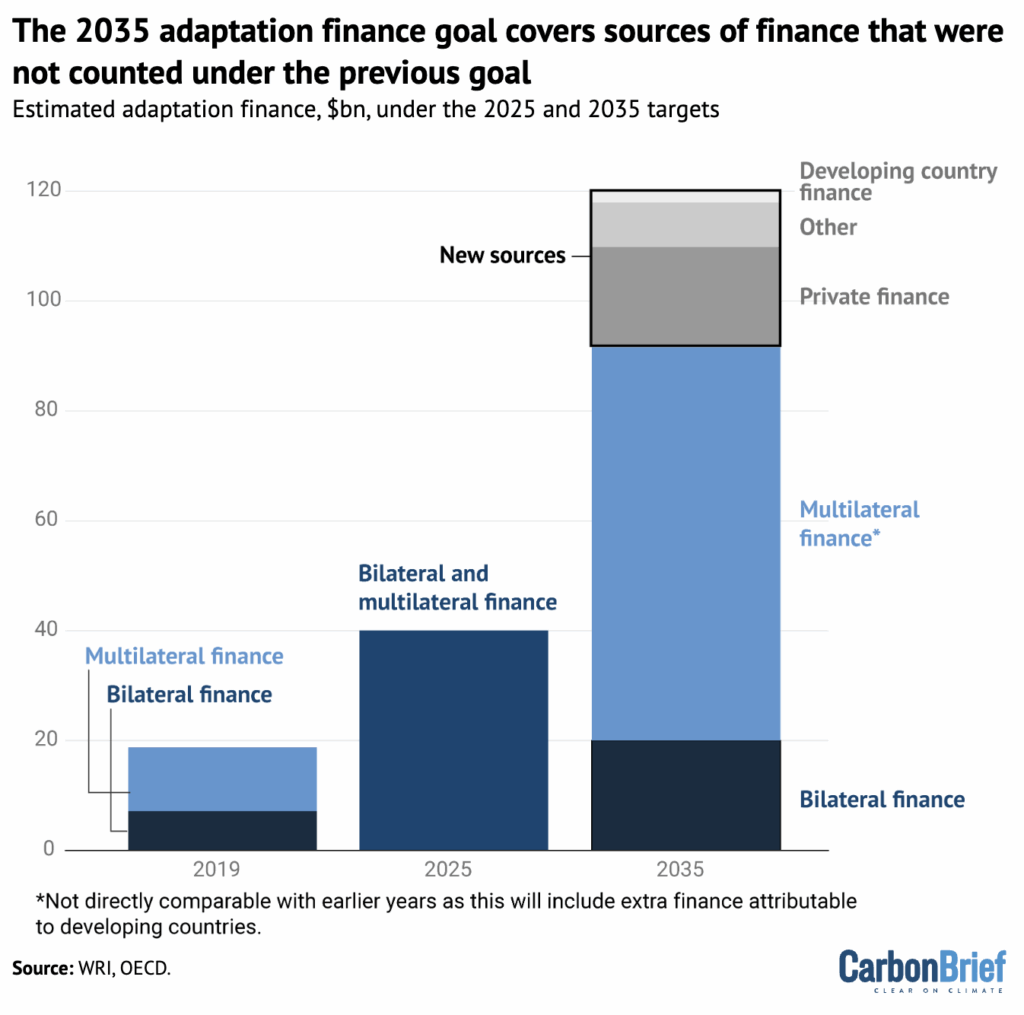
WRI assumes that MDBs will play a “critical role” in meeting the 2035 target, amid calls for them to triple their overall finance. More MDB funding would also automatically be counted, as the new adaptation goal includes MDB funds that are attributable to developing countries, as set out in the NCQG.
The WRI analysis also assumes a big increase in the amount of private finance for adaptation that is “mobilised” by public spending, scaling up significantly to $18bn by 2035.
Traditionally, it has been difficult to raise private investment for adaptation initiatives, as they provide less return on investment than clean-energy projects.
3. The target also falls far short of developing countries’ adaptation needs
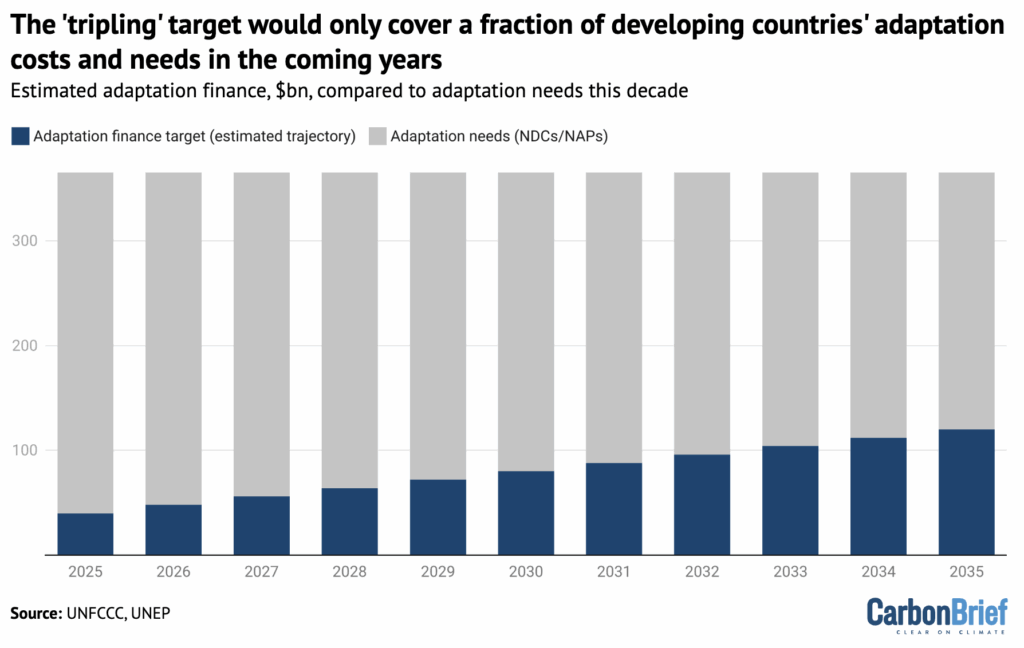
The UN Environment Programme’s (UNEP) recent “adaptation gap” report estimates that developing countries’ adaptation investment requirements – based on modelled costs – will likely hit $310bn each year by 2035.
Developing countries have self-reported even higher financial “needs” in their nationally determined contributions (NDCs) and national adaptation plans (NAPs) submitted to the UN.
When added together, UNEP concludes these needs amount to $365bn each year for developing countries between 2023 and 2035.
(According to NRDC, most of this discrepancy comes from middle-income countries reporting significantly higher needs than the UNEP-modelled costs.)
As the chart below shows, the new COP30 target would not cover more than a third of these estimated needs by 2035.
Both domestic spending and private-sector investment that is independent of developed-country involvement are expected to play a role in meeting developing countries’ adaptation needs.
Nevertheless, UNEP states that the overarching climate-finance goals set by countries are “clearly insufficient” to close the adaptation-finance “gap”.
Even in a scenario based on the LDCs’ original proposal of tripling adaptation finance to $120bn by 2030, the UNEP report concluded that a “significant” gap would have remained.



The post Analysis: Why COP30’s ‘tripling adaptation finance’ target is less ambitious than it seems appeared first on Carbon Brief.
Analysis: Why COP30’s ‘tripling adaptation finance’ target is less ambitious than it seems

Consumers remain vulnerable to price spikes despite record domestic oil and gas production. But experts doubt the crisis will boost clean energy, absent strong policy.
In President Donald Trump’s telling, the United States has fuel enough to hover above the chaos that his attack on Iran has triggered in global energy markets.
Iran Energy Shock Tests Limits of Trump’s Vision of US Energy Dominance
A World War II-era policy is stopping old coal plants from closing, despite high costs and the wishes of their owners.
At one time, the U.S. electricity grid ran mostly on coal.
Italy has delayed the permanent closure of its four coal-fired power plants to 2038, after the war in the Middle East caused the cost of producing electricity from gas to spike.
The government inserted the measure into a broader bill aimed at addressing the energy crisis. Parliament approved the legislation on Wednesday after the government tied it to a confidence vote, meaning that losing the vote would see the right-wing coalition government collapse.
The decision marks a climbdown from a pledge first made under centre-left Prime Minister Paolo Gentiloni in 2017 to phase out coal by 2025 on the mainland and by 2028 on the island of Sardinia.
The Mediterranean island’s 1.5 million people remain heavily dependent on coal for electricity due to limited grid connections with the European mainland and a slow rollout of renewable energy.
Riccardo Molinari, a member of Parliament for the governing coalition Lega party, which championed the amendment, said the plants could be kept open as a “strategic reserve”, which can be turned on if needed.
“Unnecessary” decision
But analysts say the practical impact of the move is likely to be limited. Luca Bergamaschi, executive director of Italian climate think tank ECCO, described the extension as “largely symbolic”.
“Keeping them open will not materially affect electricity prices, which are driven by gas – for most hours of the day – and EU market rules,” he told Climate Home News. “The decision sends a negative signal but we don’t expect any meaningful impact on prices or emissions, which shows how unnecessary this is”.
-
Charging worries, high prices put brakes on EV growth in Bangladesh
Sales of e-bikes and rickshaws are up amid queues at fuel stations, but a lack of charging infrastructure and high prices still deter many Bangladeshis from going electric

Coal has already been largely phased out of Italy’s power mix. Generation from coal has fallen over 90% since 2012 and accounted for less than 2% of electricity production last year, almost entirely in Sardinia.
In 2024, Italy got about half of its electricity from gas and half from clean sources like hydropower, solar and wind.
Coal plants on stand-by
Italy has four coal-fired power plants left but only two, both in Sardinia, are still producing electricity.
The other two are run by the country’s largest utility Enel, in Brindisi and Civitavecchia. They were shut down at the end of last year after they became uneconomic.
The company had planned to begin decommissioning them, but the government intervened at the last minute, requiring them to remain on standby in case of an energy crisis.
Gilberto Pichetto Fratin, Italy’s Minister of Environment and Energy Security, said at the end of March that these two power plants could be switched back on “right away, with a government decree”.
“If the price of gas exceeds 70 euros per megawatt hour, producing with coal would be convenient,” he told Italian newspaper Il Corriere della Sera.
European gas prices spiked to just below that level in mid-March as the Iran war escalated, but have since come down to around 50 euros per megawatt hour.
Coal surge in Asia
Italy’s move comes amid a broader, though limited, shift back towards coal in some parts of the world as countries respond to restricted gas supply. Germany slightly increased coal-fired generation in March and has considered reactivating idle plants as a precaution.
Outside Europe, the trend has been more pronounced. Several Asian countries heavily exposed to disruptions in Gulf gas supplies have increased coal use.
Nepal’s EV revolution pays off as oil crisis causes pain at the pumps
Japan has allowed its coal power plants to operate at a higher rate to reduce the need for liquified natural gas (LNG). Bangladesh, Thailand and the Philippines have also increased electricity generation from coal since the start of the conflict in the Middle East.
But analysis from Zero Carbon Analytics suggested that producing electricity from solar is cheaper than coal in most south-east Asian countries.
“Energy security in Southeast Asia will not come from switching between fossil fuels,” Amy Kong added. “It will come from reducing dependence on them altogether.”
The post Italy pushes coal exit back after gas prices rise appeared first on Climate Home News.

Solar Plus Batteries Can Meet 90% of India’s Electricity Needs, Says Ember
Bioleaching Breakthrough in Canada: How MIRARCO’s Pilot Facility Turns Mine Waste into Critical Minerals
Iran Energy Shock Tests Limits of Trump’s Vision of US Energy Dominance
-
Climate Change8 months ago
Guest post: Why China is still building new coal – and when it might stop
-
Greenhouse Gases8 months ago
Guest post: Why China is still building new coal – and when it might stop
-

 Greenhouse Gases2 years ago
嘉宾来稿:满足中国增长的用电需求 光伏加储能“比新建煤电更实惠”
-
Climate Change2 years ago
Bill Discounting Climate Change in Florida’s Energy Policy Awaits DeSantis’ Approval
-

 Climate Change2 years ago
嘉宾来稿:满足中国增长的用电需求 光伏加储能“比新建煤电更实惠”
-
Climate Change Videos2 years ago
The toxic gas flares fuelling Nigeria’s climate change – BBC News
-

 Renewable Energy6 months ago
Sending Progressive Philanthropist George Soros to Prison?
-

 Carbon Footprint2 years ago
US SEC’s Climate Disclosure Rules Spur Renewed Interest in Carbon Credits