

The UK’s right-leaning newspapers have unleashed a huge wave of editorials attacking energy secretary Ed Miliband since last year’s general election, Carbon Brief analysis reveals.
In the first half of 2024, newspapers published 16 editorials – articles that are considered the newspaper’s formal “voice” – attacking Miliband. In the second half of the year, since Labour’s election win, this increased to 45 – roughly two every week.
Right-leaning outlets such as the Sun and the Daily Mail repeatedly called Miliband an “eco-zealot”, a “madman” and a “hysterical eco-obsessive”, due to his support for net-zero policies.
More broadly, there were 368 editorials published in UK newspapers last year that were about climate change and energy. This is the second-highest annual tally recorded by Carbon Brief’s long-running project, which tracks UK newspaper editorials back to 2011.
In 2024, unprecedented numbers of these editorials opposed climate action in general, as well as renewable energy, specifically.
As the new Labour government pursues a clean power system by 2030 and other net-zero policies, right-leaning newspapers argued that such measures would be costly and harmful.
This continues a recent trend of the right-leaning press rejecting net-zero policies, after briefly embracing climate action during Boris Johnson’s Conservative government.
Attacking Miliband
In his role as energy security and net-zero secretary, Miliband has been the face of Labour’s plan to achieve a clean power system by 2030 and is a long-standing and staunch defender of climate policies in general.
Last year, newspapers such as the Sun, the Daily Mail and the Daily Telegraph continued to push back against net-zero policies, with much of their criticism personally focused on Miliband himself.
Carbon Brief’s analysis identified 61 editorials that directly criticised Miliband in 2024. All of these, barring one published in the Independent, were in right-leaning newspapers.
A particular uptick followed the general election on 4 July, which saw Miliband enter government for the first time in 14 years. Newspapers published 45 critical editorials between election day and the end of the year, amounting to nearly two a week, on average, as the chart below shows.

By far the biggest critic of Miliband was the Sun, which published 29 editorials attacking him. This was followed by the Daily Mail, with 12, and the Daily Telegraph, with nine. The Sunday editions of these three newspapers also published a handful of critical editorials.
The favoured editorial criticism was that Miliband is a “muddled climate zealot”, prone to “demented fantasies”, who places the “mad rush to net-zero” ahead of – the newspapers claim – more pressing issues. Newspapers alleged – often with little supporting evidence – that “his” policies will lead to higher energy bills and the “lights going out”.
This claim was often in response to Miliband stating that renewables would help curb the UK’s reliance on expensive gas, as well as bring down energy prices.
There were several calls for prime minister Keir Starmer to “rein in” Miliband, calling him a “drag” on the Labour government.

Such specific and personal attacks are not directed at all government ministers. As a comparison, Carbon Brief only identified two editorials in 2024 that took specific aim at Miliband’s Conservative predecessor, Claire Coutinho, even though she held the role for half of the year.
(The criticism of Coutinho was also fairly mild in comparison to the claims about Miliband, focusing on the difficulties of building nuclear power. For example, the Sun said she needed a “reality check” and that “both main parties have been an abject failure” on nuclear.)
Miliband, who introduced the landmark Climate Change Act during his first stint as climate secretary in 2008, has long been a target for the right-leaning press and climate sceptics. The same newspapers criticising him now ran a similarly personal campaign to oppose Miliband becoming prime minister, when he was leader of the Labour party in 2015.
Record climate opposition
In total, Carbon Brief identified 368 editorials that touched on climate and energy issues in 15 UK newspapers last year, averaging one per day
Of these, 169 dealt explicitly with climate change. In an election year that saw Labour take power with a clean energy-focused manifesto, many of these editorials referred to measures the new government was pledging or starting to implement.
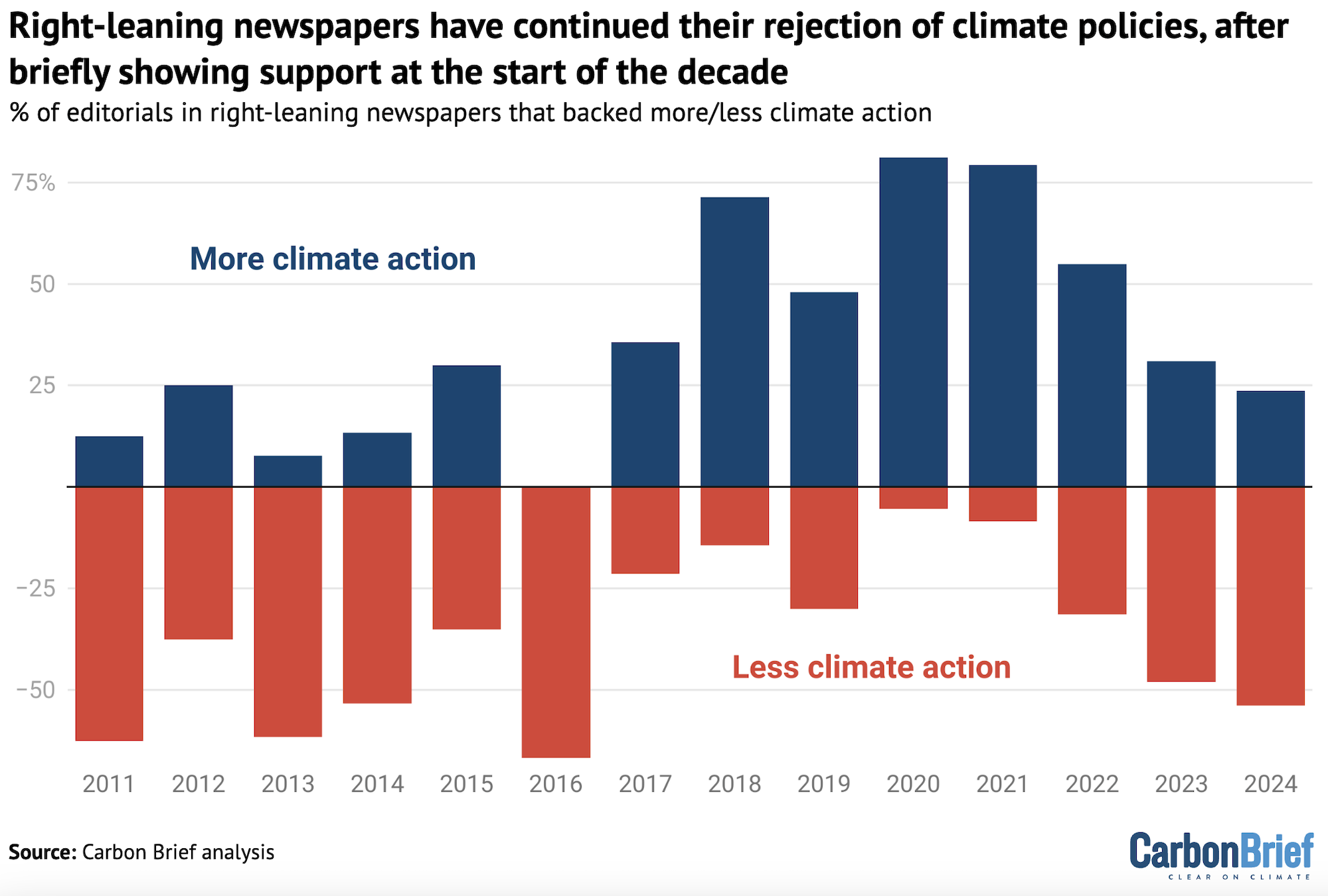
According to Carbon Brief’s analysis, a record 44 of the editorials published in 2024 argued for less climate action. This is the third record-breaking year in a row for such editorials in UK newspapers, as the chart below shows.

While there were still more than twice as many supportive editorials calling for more climate action, they were heavily skewed towards certain publications.
In total, 80 of the 99 editorials calling for “more action” were published in left-leaning and “centrist” publications, with the Guardian alone publishing 40 of them.
Right-leaning titles, which tend to have higher readerships, published just 19 editorials advocating for climate action, 14 of which were in the Times. The Sun, which is one of the UK’s most-read daily newspapers, did not publish any editorials supporting climate action.
For a brief period, peaking in 2020, these right-leaning publications appeared to have shifted in their attitudes. Publications with long histories of publishing climate-sceptic journalism, such as the Sun and the Daily Express, made public commitments to cover climate change.
This coincided with the Conservative government of Boris Johnson, which made major climate commitments, and the build-up to the UK hosting the COP26 climate summit.
However, since 2020 there has been a steep decline in support for climate action by these newspapers. As the chart below shows, the share of their editorials supporting and opposing climate policies is now back where it was a decade ago.
Carbon Brief’s analysis also assesses the themes present in newspaper editorials.
It shows that, once again, the most common argument against climate action was that there would be a negative economic impact of climate policies. Last year, 35 climate-related editorials, or one-fifth of the total, made this argument.
The “cost of net-zero” has been a key talking point in the right-leaning press. This can be seen in editorial headlines such as “the untenable costs of net-zero” and “it’s time MPs were honest about the true cost of net-zero”, in the Daily Telegraph and Sunday Times, respectively.
Economic benefits of climate policies, on the other hand, were mentioned in 29 climate-related editorials – 16% of the total. Analysis for the UK government has repeatedly demonstrated that switching to clean technologies will save people money, offsetting upfront investment costs, as well as delivering significant social benefits.
Another common negative theme – mentioned in around a sixth of climate editorials – was criticism of climate advocates, from Just Stop Oil to Ed Miliband.
Right-leaning newspapers frequently denounced such advocates for “green piety” and “hypocrisy”, or called them “fanatics” and “extremists”.
Renewable pushback
Carbon Brief analysed 79 editorials that focused specifically on three major energy technologies – renewables, nuclear power and fracking.
Fracking has fallen off the political agenda since plans to overturn a ban on the practice came to nothing in 2022. Only two editorials mentioned it at all in 2024.
Nuclear power was mentioned in 20 editorials, with none expressing anti-nuclear sentiments. Notably, the technology enjoyed support across the political spectrum of newspapers, as it has in previous years.
Renewable energy was far more divisive. Mirroring the results for climate action more generally, 2024 saw a record 25 UK newspaper editorials opposing wind, solar and other renewable energy sources. As the chart below shows, there was also a dip in the number of editorials actively supporting renewables.
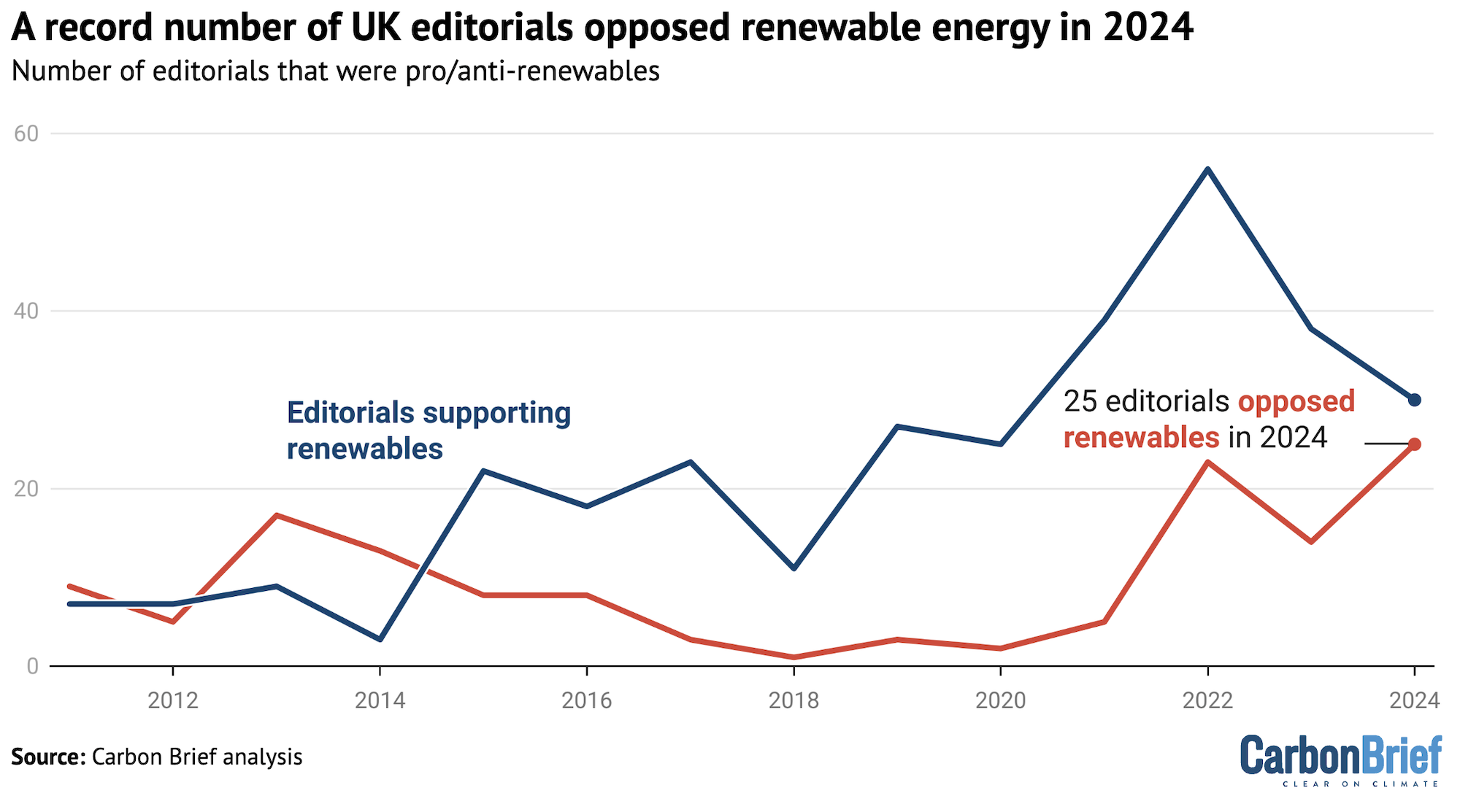
All but one of the editorials opposing renewables were published in right-leaning newspapers, particularly the Daily Mail – with 11 – and the Sun, with seven.
Again, the supposed economic cost of renewables was the main reason cited. The Daily Mail said “eye-watering subsidies” were required to support renewables, while the Sun called the government’s plan to cut reliance on expensive gas, in favour of renewables a “ruinous fantasy”.
In contrast, some newspapers made the economic case for renewables. In an editorial about wind power, the Guardian said that “exploiting the British Isles’ most obvious natural asset is environmentally and economically the right thing to do”.
Methodology
This is a 2024 update of previous analysis conducted for the period 2011-2021 by Carbon Brief in association with Sylvia Hayes, then a PhD researcher and now a research fellow at the University of Exeter. Previous updates were published in 2022 and 2023.
The count of editorials criticising Ed Miliband was not conducted in previous years.
The full methodology can be found in the original article, including the coding schema used to assess the language and themes used in editorials concerning climate change and energy technologies.
The analysis is based on Carbon Brief’s editorial database, which is regularly updated with leading articles from the UK’s major newspapers.


The post Analysis: UK newspaper editorials attacked Ed Miliband relentlessly throughout 2024 appeared first on Carbon Brief.
Analysis: UK newspaper editorials attacked Ed Miliband relentlessly throughout 2024

A first set of biodiversity plans filed by countries to reverse nature loss are “insufficient” to meet this decade’s global targets, including a landmark goal to protect at least 30% of the world’s land and marine ecosystems by 2030, a landmark UN report warned on Thursday.
The State of Biodiversity Action, put together by a panel of technical experts for the UN Convention on Biological Diversity (CBD), was released in Yerevan, ahead of the COP17 nature talks starting on Monday in the Armenian capital.
Over the next two weeks, governments will for the first time take stock of progress towards the Global Biodiversity Framework (GBF) agreed in 2022 – a set of 23 targets also known as the “Paris Agreement for nature” – and will decide on policy guidelines for ramping up ambition before the 2030 deadline. The UN report will be the main basis for these negotiations.
At a press conference in Armenia, UN Secretary-General António Guterres highlighted that, while there has been some progress on the GBF, the “bad news” is that less than half of country plans are on track to meet its targets.
If current commitments are met by the end of the decade, only 26% of land ecosystems and 12% of marine ecosystems will be protected – falling “real short” of the 30% target agreed in Montreal in 2022, Guterres said. “The war on nature has not yet ended,” he added.
UN Environment chief Inger Andersen said the report “sets the tone for the focus, ambition and urgent action we need to deliver” in Armenia, including by reducing subsidies that harm nature and mobilising new finance for biodiversity. “All leaders and all negotiators must respond to these findings,” she emphasised.
Andersen added that climate change amplifies threats to biodiversity, which makes protection all the more important as global warming is now almost certain to rise above a key threshold. “Exceedence of 1.5C increases the likelihood of forest diebacks, phenological shifts, warming oceans that become more inhospitable to species, irreversible tipping points and so much more,” she said.
-
Global deforestation slowed in 2025 but Brazil’s election could undo “fragile” gains
Countries remain 70% off track to meet a goal to end deforestation by 2030, as progress in Latin America offset by failures in Africa -
Carbon capture industry faces tough future, as UK raids green spending
Despite a spate of projects getting underway, the mood at an industry conference in London this week was low with government subsidies set to shrink -
World Bank and IMF should lead the financial system in responding to the climate crisis
Multilateral development banks have a vital role to play in delivering on donors’ climate finance promises and protecting the most vulnerable



Progress on land but ocean lags behind
The report shows that if countries meet all the biodiversity targets in their plans, this would protect about 27% of the world’s land and sea by 2030, a fivefold increase in the span of ten years.
Progress has been uneven, with most conservation efforts focused on terrestrial ecosystems. The report suggests that currently about 19% of land ecosystems are protected, up two percentage points from 2020, which UN authorities welcomed but said is not a fast enough pace.
However, the real gap is at sea, where only about 10% of the global ocean has some sort of protection. Coastal areas under national jurisdiction have done better, as currently 23% of this marine territory is protected, but the report shows most of the deep ocean is not.
Brian O’Donnell, director of Campaign for Nature, an advocacy group, said the new High Seas Treaty – which entered into force this year and will allow for the creation of Marine Protected Areas in the deep ocean – represents an opportunity, as only about 1.5% is under protection so far.
A group of environmental NGOs including WWF and Bloomberg Philanthropies has issued a call for governments to scale up ocean conservation and to designate $16 billion annually for marine protection measures, up from $1.8bn now.
SE Asia speeds up plan for connected clean power grid after oil shock
Some countries did not set a conservation target at all for both land and sea, the report says, blaming technical challenges like how to account for overlapping protected areas, difficulty recognising protections for private land and land-accounting methodologies changing over time.
A separate report by Campaign for Nature suggests that the 30×30 goal could still be met with “increased ambition and commitment”, and says that around 50 countries have already protected about 30% of their land.
A group of environmental NGOs has warned that, beyond the 30% headline figure, protected areas need to be “high integrity” and recognise the stewardship of local communities and Indigenous peoples.

Developing countries call for finance
Rich countries will arrive at COP17 with shrinking aid budgets and geopolitical preoccupations – yet they will likely hear the same plea they’ve heard for the past few years: stepping up commitments will require finance.
A submission by African countries in August said the “implementation gap” has at its core a shortfall in the provision of funds, and that bridging it will require predictable and accessible finance.
Pacific island nations launched a similar call, arguing there is “a treaty obligation” that developing countries, including themselves, will effectively implement commitments depending on the finance and technology made available by developed nations.
To close this gap, the EU made a proposal at preliminary talks in Nairobi in August to expand the base of donors so that richer developing countries could voluntarily assume donor responsibilities. Saudi Arabia and Qatar rejected the idea, while China said this should not weaken the responsibility of developed nations.
Pre-COP draws attention to Pacific’s climate plight and 1.5C goal
So far, wealthy governments have missed a target to provide $20bn per year in international public finance for nature protection by 2025, reaching only about $16bn per year from 2023 to 2025, according to an OECD report. By 2030, the GBF aims for developed countries to directly transfer $30bn per year, and mobilise $200bn from all sources.
The UN report released on Thursday shows even slower progress in redirecting harmful subsidies such as those which encourage the overuse of fertilisers and the production and consumption of new fossil fuels, and below-market fees that encourage overfishing. UN Environment estimates that for every dollar spent protecting nature, $30 goes on destroying it.
UN biodiversity chief Astrid Schomaker told journalists in Yerevan that “if you hear there is no finance, please do not believe it” because economies are continuing to grow. “It is being spent on activities that harm the economy rather than those that work with nature and sustain life on this planet,” she said.
Guterres said developed countries tend to say they are grappling with budget constraints due to increased defence expenditure, which “in my view does not justify a reduction” in international aid. He added that existing resources can be multiplied if they are used to mobilise private capital.
Campaigners, companies and the Armenian government want to shift the needle on this situation at COP17 by highlighting how positive subsidies help restore biodiversity. They will launch a flagship call to action that will be taken forward by countries and groups working to reform damaging incentives.

Global review: the main act
The Global Review of Colle