Connect with us

Published

on

Nearly 100 UK newspaper editorials opposed climate action in 2025, a record figure that reveals the scale of the backlash against net-zero in the right-leaning press.

Carbon Brief has analysed editorials – articles considered the newspaper’s formal “voice” – since 2011 and this is the first year opposition to climate action has exceeded support.

Criticism of net-zero policies, including renewable-energy expansion, came entirely from right-leaning newspapers, particularly the Sun, the Daily Mail and the Daily Telegraph.

In addition, there were 112 editorials – more than two a week – that included attacks on Ed Miliband, continuing a highly personal campaign by some newspapers against the Labour energy secretary.

These editorials, nearly all of which were in right-leaning titles, typically characterised him as a “zealot”, driving through a “costly” net-zero “agenda”.

Taken together, the newspaper editorials mirror a significant shift on the UK political right in 2025, as the opposition Conservative party mimicked the hard-right populist Reform UK party by definitively rejecting the net-zero target that it had legislated for and the policies that it had previously championed.

Record climate opposition

Nearly 100 UK newspaper editorials voiced opposition to climate action in 2025 – more than double the number of editorials that backed climate action.

As the chart below shows, 2025 marked the fourth record-breaking year in a row for criticism of climate action in newspaper editorials.

This also marks the first time that editorials opposing climate action have overtaken those supporting it, during the 15 years that Carbon Brief has analysed.
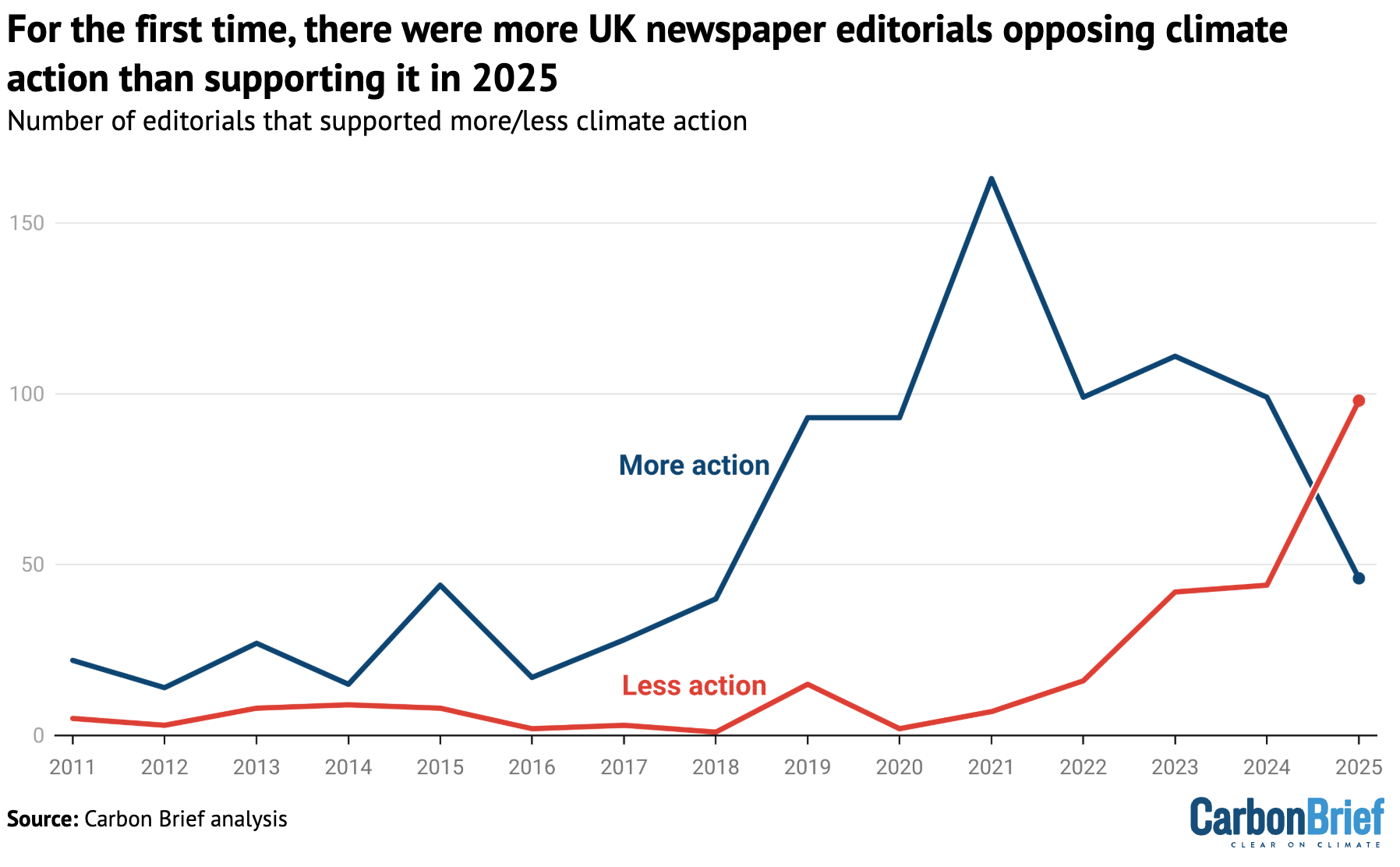
Chart showing that for the first time, there were more UK newspaper editorials opposing climate action than supporting it in 2025
Number of UK newspaper editorials arguing for more (blue) and less (red) climate action, 2011-2025. Some editorials also present a “balanced” view, which is categorised as advocating for neither “more” nor “less” climate action. These editorials are not represented in this chart. Source: Carbon Brief analysis.

This trend demonstrates the rapid shift away from a long-standing political consensus on climate change by those on the UK’s political right.

Over the past year, the Conservative party has rejected both the “net-zero by 2050” target that it legislated for in 2019 and the underpinning Climate Change Act that it had a major role in creating. Meanwhile, the Reform UK party has been rising in the polls, while pledging to “ditch net-zero”.

These views are reinforced and reflected in the pages of the UK’s right-leaning newspapers, which tend to support these parties and influence their politics.

All of the 98 editorials opposing climate action were in right-leaning titles, including the Sun, the Daily Mail, the Daily Telegraph, the Times and the Daily Express.

Conversely, nearly all of the 46 editorials pushing for more climate action were in the left-leaning and centrist publications the Guardian and the Financial Times. These newspapers have far lower circulations than some of the right-leaning titles.

In total, 81% of the climate-related editorials published by right-leaning newspapers in 2025 rejected climate action. As the chart below shows, this is a marked difference from just a few years ago, when the same newspapers showed a surge in enthusiasm for climate action.

That trend had coincided with Conservative governments led by Theresa May and Boris Johnson, which introduced the net-zero goal and were broadly supportive of climate policies.
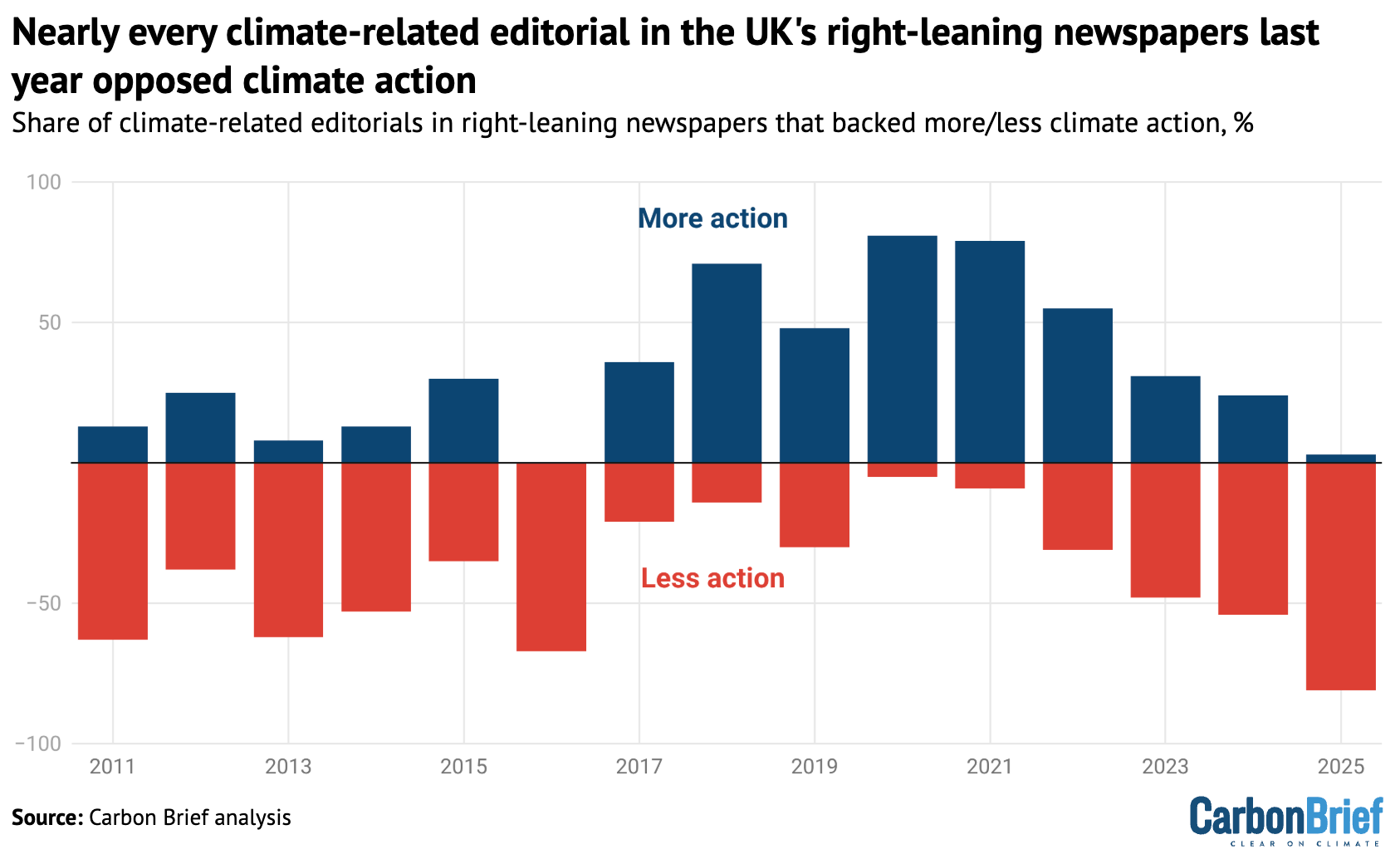
Chart showing nearly every climate-related editorial in the UK's right-leaning newspapers last year opposed climate action
The share of right-leaning, climate-related UK newspaper editorials arguing for more (blue) and less (red) climate action, 2011-2025, %. Some editorials also present a “balanced” view, which is categorised as advocating for neither “more” or “less” climate action. These editorials are not represented in this chart. Source: Carbon Brief analysis.

Notably, none of the editorials opposing climate action in 2025 took a climate-sceptic position by questioning the existence of climate change or the science behind it. Instead, they voiced “response scepticism”, meaning they criticised policies that seek to address climate change.

(The current Conservative leader, Kemi Badenoch, has described herself as “a net-zero sceptic, not a climate change sceptic”. This is illogical as reaching net-zero is, according to scientists, the only way to stop climate change from getting worse.)

In particular, newspapers took aim at “net-zero” as a catch-all term for policies that they deemed harmful. Most editorials that rejected climate action did not even mention the word “climate”, often using “net-zero” instead.

This supports recent analysis by Dr James Painter, a research associate at the University of Oxford, which concluded that UK newspaper coverage has been “decoupling net-zero from climate change”.

This is significant, given strong and broad UK public support for many of the individual climate policies that underpin net-zero. Notably, there is also majority support for the “net-zero by 2050” target itself.

Much of the negative framing by politicians and media outlets paints “net-zero” as something that is too expensive for people in the UK.

In total, 87% of the editorials that opposed climate action cited economic factors as a reason, making this by far the most common justification. Net-zero goals were described as “ruinous” and “costly”, as well as being blamedfalsely – for “driving up energy costs”.

The Sunday Telegraph summarised the view of many politicians and commentators on the right by stating simply that said “net-zero should be scrapped”.

While some criticism of net-zero policies is made in good faith, the notion that climate change can be stopped without reducing emissions to net-zero is incorrect. Alternative policies for tackling climate change are rarely presented by critical editorials.

Moreover, numerous assessments have concluded that the transition to net-zero can be both “affordable” and far cheaper than previously thought.

This transition can also provide significant economic benefits, even before considering the evidence that the cost of unmitigated warming will significantly outweigh the cost of action.

Miliband attacks intensify

Meanwhile, UK newspapers published 112 editorials over the course of 2025 taking personal aim at energy security and net-zero secretary Ed Miliband.

Nearly all of these articles were in right-leaning newspapers, with the Sun alone publishing 51. The Daily Mail, the Daily Telegraph and the Times published most of the remainder.

This trend of relentlessly criticising Miliband personally began last year in the run up to Labour’s election victory. However, it ramped up significantly in 2025, as the chart below shows.
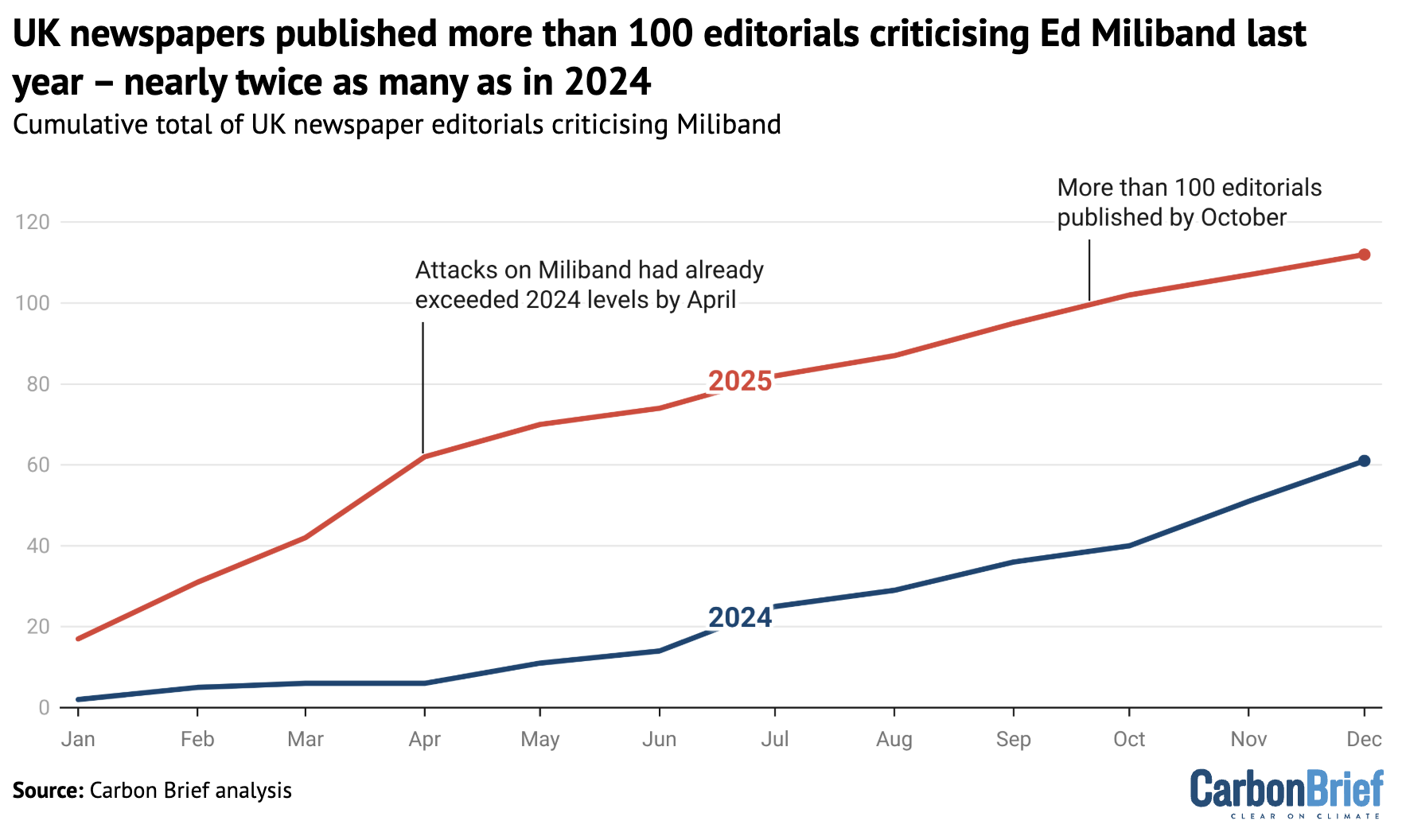
Chart showing UK newspapers published more than 100 editorials criticising Ed Miliband last year – nearly twice as many as in 2024
Cumulative number of UK newspaper editorials criticising energy secretary Ed Miliband in 2024 (light blue) and 2025 (dark blue). Source: Carbon Brief analysis.

Around 58% of the editorials that opposed climate action used criticism of climate advocates as a justification – and nearly all of these articles mentioned Miliband, specifically.

Editorials denounced Miliband as a “loon” and a “zealot”, suffering from “eco insanity” and “quasi-religious delusions”. Nicknames given to him include “His Greenness”, the “high priest of net-zero” and “air miles Miliband”.

Many of these attacks were highly personal. The Daily Mail, for example, called Miliband “pompous and patronising”, with an “air of moral and intellectual superiority”.

Frequently, newspapers refer to “Ed Miliband’s net-zero agenda”, “Ed Miliband’s swivel-eyed targets” and “Mr Miliband’s green taxes”.

These formulations frame climate policies as harmful measures that are being imposed on people by the energy secretary.

In fact, the Labour government decisively won an election in 2024 with a manifesto that prioritised net-zero policies. Often, the “targets” and “taxes” in question are long-standing policies that were introduced by the previous Conservative government, with cross-party support.

Moreover, the government’s climate policy not only continues to rely on many of the same tools created by previous administrations, it is also very much in line with expert evidence and advice. This is to prioritise the expansion of clean power and to fuel an economy that relies on increasing levels of electrification, including through electric cars and heat pumps.

Despite newspaper editorials regularly calling for Miliband to be “sacked”, prime minister Keir Starmer has voiced his support both for the energy secretary and the government’s prioritisation of net-zero.

In an interview with podcast The Rest is Politics last year, Miliband was asked about the previous Carbon Brief analysis that showed the criticism aimed at him by right-leaning newspapers.

Podcast host Alastair Campbell asked if Miliband thought the attacks were the legacy of his strong stance, while Labour leader, during the Leveson inquiry into the practices of the UK press. Miliband replied:

“Some of these institutions don’t like net-zero and some of them don’t like me – and maybe quite a lot of them don’t like either.”

Renewable backlash

As well as editorial attitudes to climate action in general, Carbon Brief analysed newspapers’ views on three energy technologies – renewables, nuclear power and fracking.

There were 42 newspaper editorials criticising renewable energy in 2025. This meant that, for the first time since 2014, there were more anti-renewables editorials than pro-renewables editorials, as the chart below shows.

As with climate action more broadly, this was a highly partisan issue. The Times was the only right-leaning newspaper that published any editorials supporting renewables.
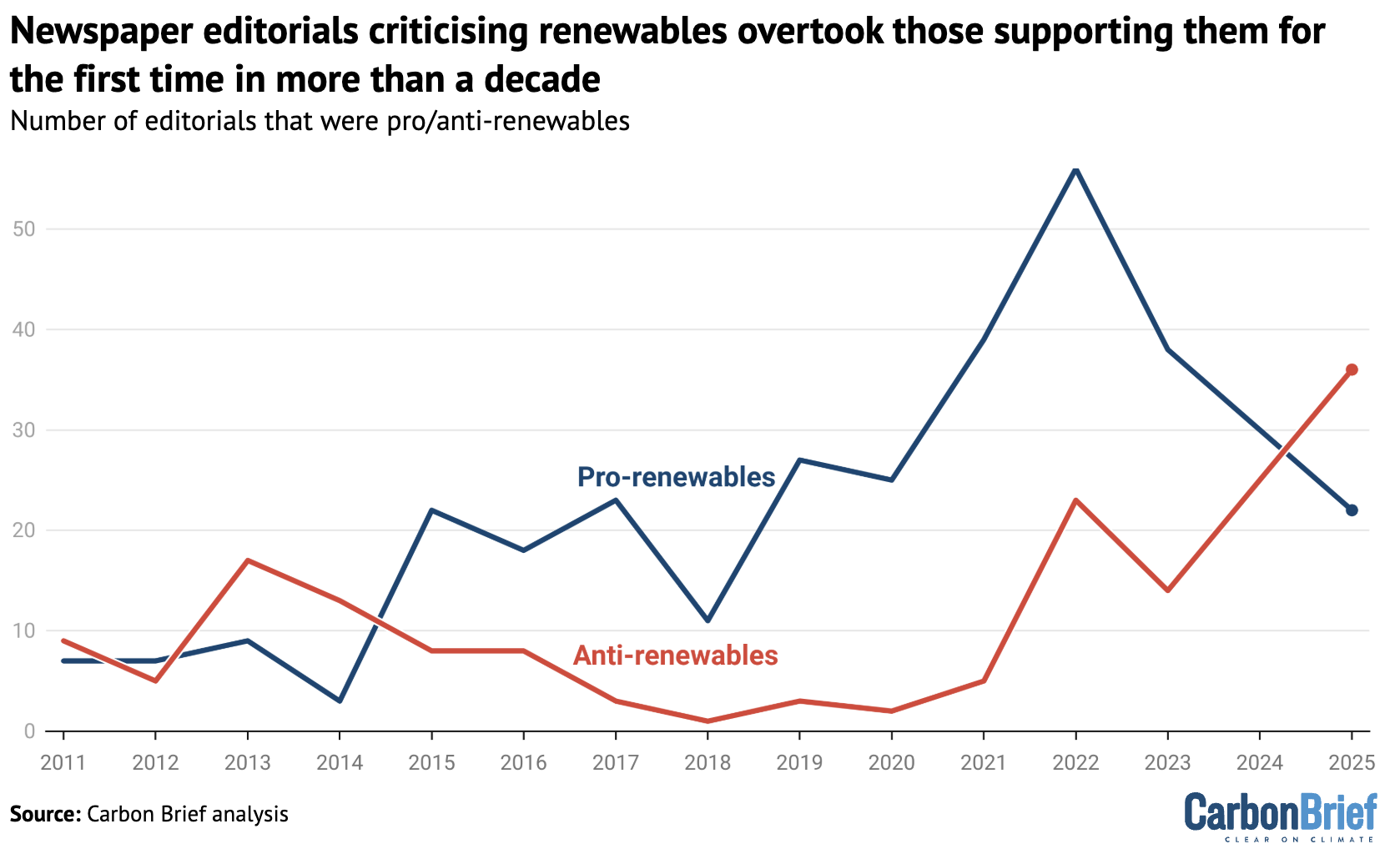
Chart showing newspaper editorials criticising renewables overtook those supporting them for the first time in more than a decade
Number of UK newspaper editorials that were pro- (blue) and anti-renewables (red), 2011-2025. Some editorials also present a “balanced” view, which is categorised as advocating for neither “more” or “less” climate action. These editorials are not represented in this chart. Source: Carbon Brief analysis.

By far the most common stated reason for opposing renewable energy was that it is “expensive”, with 86% of critical editorials using economic arguments as a justification.

The Sun referred to “chucking billions at unreliable renewables” while the Daily Telegraph warned of an “expensive and intermittent renewables grid”.

At the same time, editorials in supportive publications also used economic arguments in favour of renewables. The Guardian, for example, stressed the importance of building an “affordable clean-energy system” that is “built on renewables”.

There was continued support in right-leaning publications for nuclear power, despite the high costs associated with the technology. In total, there were 20 editorials supporting nuclear power in 2025 – nearly all in right-leaning newspapers – and none that opposed it.

Fracking was barely mentioned by newspapers in 2023 and 2024, after a failed push by the Conservatives under prime minister Liz Truss to overturn a ban on the practice in 2022. This attempt had been accompanied by a surge in supportive right-leaning newspaper editorials.

There was a small uptick of 15 editorials supporting fracking in 2025, as right-leaning newspapers once again argued that it would be economically beneficial.

The Sun urged current Conservative leader Badenoch to make room for this “cheap, safe solution” in her future energy policy. The government plans to ban fracking “permanently”.

North Sea oil and gas remained the main fossil-fuel policy focus, with 30 editorials – all in right-leaning newspapers – that mentioned the topic. Most of the editorials arguing for more extraction from the North Sea also argued for less climate action or opposed renewable energy.

None of these editorials noted that the UK is expected to be significantly less reliant on fossil-fuel imports if it pursues net-zero, than if it rolls back on climate action and attempts to squeeze more out of the remaining deposits in the North Sea.

Methodology

This is a 2025 update of previous analysis conducted for the period 2011-2021 by Carbon Brief in association with Dr Sylvia Hayes, a research fellow at the University of Exeter. Previous updates were published in 2022, 2023 and 2024.

The count of editorials criticising Ed Miliband was not conducted in the original analysis.

The full methodology can be found in the original article, including the coding schema used to assess the language and themes used in editorials concerning climate change and energy technologies.

The analysis is based on Carbon Brief’s editorial database, which is regularly updated with leading articles from the UK’s major newspapers.
The post Analysis: UK newspaper editorial opposition to climate action overtakes support for first time appeared first on Carbon Brief.

Analysis: UK newspaper editorial opposition to climate action overtakes support for first time

Continue Reading

Climate Change

Explainer: Will AI data centres make or break the energy transition?

Published

on

For tech entrepreneur Elon Musk, the answer to the rocketing energy needs of artificial intelligence (AI) data centres is to launch them into space, where they could tap limitless energy from the sun. But until that happens, the places on Earth where these number-crunching mega-hubs are located face big spikes in electricity demand to run them.

In the US, this has sparked fears of higher energy prices for consumers. To allay those concerns, President Donald Trump will reportedly convene big tech firms this week to sign a pledge to provide or pay for the extra energy supplies they will need as their AI data centres expand.

According to the International Energy Agency (IEA), data centres accounted for 1.5% of electricity demand worldwide in 2024 – a share set to rise to about 3% by 2030. Overall, data centre demand is expected to more than double to about 945 terawatt-hours (TWh) by then, which is slightly above the electricity consumption of Japan today.

AI data centres, where AI models are trained and deployed, put far more strain on power supplies than traditional data centres, which each use between 10 and 25 megawatts (MW). In comparison, demand from a “hyperscale” AI centre can exceed 100 MW at any given time, which if running at full capacity could consume as much electricity in a year as 100,000 households.

Data-centre electricity consumption in household electricity consumption equivalents (million households), 2024

(Source: IEA, Paris, 2025, Licence: CC by 4.0)

(Source: IEA, Paris, 2025, Licence: CC by 4.0)

We look at where this power might come from and whether, as some warn, AI is going to blow the world’s efforts to transition away from fossil fuels out of the water.

Why does AI need so much electricity?

AI data centres differ in how they use electric power. In a conventional data centre, data requests from businesses, individuals and other users come in a randomised way, translating into a steady load level on the servers, with relatively little fluctuation in demand.

But in an AI data centre, processors need to go through training or learning periods, using so-called “graphical processing units”. These are synchronised, being started up and switched off at the same time. This translates into “power bursts”, which last just a few seconds, but happen very frequently and concurrently, according to Gerhard Salge, chief technology officer at Hitachi Energy.

“That is a different challenge than just providing the power and the energy for the conventional data centres,” he told journalists at the International Renewable Energy Agency assembly in Abu Dhabi earlier this year.

Here, officials and business executives discussed how to meet those demand peaks, noting they cannot be dealt with just by installing huge batteries as those would wear out quickly.

Martin Pibworth, chief executive of SSE, a Scotland-based energy firm, said AI-led demand will put pressure on the power system, but “the problem we all have is no one really knows the pace and trajectory of that demand lift”. In the UK, the government’s Clean Power Plan will be needed to make sure electricity operators can meet demand from AI and other data centres as more come online, he added.

    In the US, meanwhile, the Trump administration is eager to ensure that communities that are home to data centres, as well as the wider public, do not turn against the industry due to its perceived unfairly high use of energy and water.

    Ahead of a meeting scheduled on March 4, where US tech titans are due to sign a pledge on powering their own data centres, White House spokesperson Taylor Rogers told CNBC: “Under this bold initiative, these massive companies will build, bring, or buy their own power supply for new AI data centres, ensuring that Americans’ electricity bills will not increase as demand grows.”

    Will electricity for data centres and AI come from clean or dirty sources of energy?

    The answer to this question is key to how countries tackle climate change, as it will affect their energy mix, how electricity is produced and distributed, and therefore the trajectory of their greenhouse gas emissions. Decisions made by governments and businesses will shape how the AI industry powers the technology on which it relies.

    Under pro-fossil fuel Trump, the US has walked away from policy support for clean energy, meaning data centre operators can choose their energy sources freely. In January, data from Global Energy Monitor (GEM) showed the US now has the most gas-fired power capacity in development, surpassing China and accounting for nearly a quarter of the world’s total.

    More than one-third of this capacity is set to directly power data centres on-site, in hotspots like Texas, and many more grid-connected gas-fired projects are planned to meet an expected increase in energy demand from AI, GEM said.

    On the other hand, some tech companies – especially multinationals – have set goals to cut their emissions to net zero, and so are choosing to power their data centres with renewables, including in the US.

    For example, French energy giant TotalEnergies recently signed two long-term Power Purchase Agreements (PPA) to deliver 1 gigawatt (GW) of solar capacity for Google’s data centres in Texas. This followed two other PPAs with Google for 1.2 GW secured by Clearway, a California-based renewables company 50%-owned by TotalEnergies.

    Sources of global electricity generation for data centres – base case, 2020-2035

    (Source: IEA, Paris, Licence: CC by 4.0)

    (Source: IEA, Paris, Licence: CC by 4.0)

    Some countries are also moving to ensure the power needed for AI and the data centre industry is produced using clean energy.

    In Ireland, an effective ban on new data centre connections was lifted in December, provided at least 80% of the centres’ annual energy demand is met by new renewable electricity sources. The government also plans to build Green Energy Parks, where data centres can be located alongside renewables plants to avoid straining the national grid.

    Salge of Hitachi Energy said that with big investors wanting to drive investment in AI data-crunching so fast, “there is no other power generation technology than variable renewables which you can build in such a timeline” of two to three years. “Anything else will be in the 2030s and later,” he added.

    Some governments – such as Sweden’s centre-right coalition have proposed nuclear as a clean energy solution for AI data centres, saying they could fuel a “renaissance”. But building nuclear power plants requires massive investment and long timelines, while new small-scale modular reactors are not yet commercially available.

    How are power systems and regulators coping so far?

    In a February report forecasting electricity demand out to 2030, the IEA said AI and data centres are contributing to generation growth in advanced economies, which is now accelerating again after 15 years of stagnation. However, it flagged bottlenecks in connecting new data centres, because grids are not being built or improved fast enough to keep up with rising power demand, forcing big customers to wait.

    The report noted that at least 150 GW of queued data centre projects are estimated to be in the advanced stages, while one-fifth of the global data centre build-out is at risk of delay due to grid congestion.

    Comment: Using energy-hungry AI to detect climate tipping points is a paradox

    Planning, permitting and completing new grid infrastructure can take five to 15 years, whereas data centres need one to three years. Prices for key grid components have also nearly doubled over the past five years, the IEA noted.

    The European Commission, meanwhile, aims to support those operators that can save on energy use. It plans to adopt a “Data Centre Energy Efficiency Package” in April that will contain an assessment of data submitted under a reporting scheme, introduce a rating scheme for data centres in the EU, and start work on minimum performance standards.

    Can AI help to resolve the issue?

    Experts say it’s important to look at both sides of the coin, pointing to ways in which AI can contribute to more effective power grid management and integration of renewables into national power supplies.

    According to new analysis by energy think-tank Ember, AI applications such as short-term renewables forecasting, predictive maintenance, and real-time monitoring and adjustment of transmission line capacity can deliver operational improvements in power systems.

    It estimates that AI could enable Southeast Asian nations, for example, to reduce their power sector costs by $45 billion-$67 billion through to 2035, depending on how much renewable energy they deploy. Potential AI-driven efficiency gains could cut emissions by 290 million to 386 million tonnes of CO2 over the next decade in ASEAN countries, it adds.

    “While power-hungry AI might initially stress the power systems, with various powerful applications it has the potential to significantly accelerate the energy transition and offset consumed energy rapidly,” Ember data analyst Lam Pham said in a statement.

    The post Explainer: Will AI data centres make or break the energy transition? appeared first on Climate Home News.

    Explainer: Will AI data centres make or break the energy transition?

    Continue Reading

    Climate Change

    New Investigation Reveals Forced Labour Tied to Tuna Sold in Australia

    Published

    on

    A new investigative report released by Greenpeace Southeast Asia, in collaboration with the Uniting Church in Australia, Synod of Victoria and Tasmania, has uncovered disturbing links between suspected forced labour in the Indonesian tuna fishing industry and seafood sold in Australia.

    The investigation analysed testimonies from 25 fishers working on 17 Indonesian tuna fishing vessels that supply the Australian market. These vessels supply five Indonesian processing companies, which in turn export to 18 Australian seafood companies, including major brands seen on our supermarket shelves.

    The findings raise urgent questions about human rights protections at sea and the integrity of seafood supply chains reaching Australian supermarket shelves.

    The crew of an Asian-flagged tuna longliner at work during a transshipment to a carrier mothership. © Greenpeace

    What the Investigation Found

    Fishers interviewed described experiencing multiple internationally recognised indicators of forced labour.

    Of the 11 forced labour indicators identified by the International Labour Organisation, the most frequently reported were:

    • Abuse of vulnerability (56%)
    • Debt bondage (56%)
    • Deception (40%)

    The report reveals a multi-layered recruitment network in Indonesia that channels vulnerable workers from rural areas into exploitative situations. Labour brokers, known locally as calo, collaborate with vessel administrators and manage recruitment. Fishers reported being lured with promises of high salaries and advance loans, only to be charged illegal and inflated fees for travel, training and documentation.

    Diver Joel Gonzaga of the the Philippine purse seiner ‘Vergene’ at work in the international waters of high seas. © Alex Hofford / Greenpeace

    The investigation also found that labour exploitation at sea is intertwined with environmental crime. Companies allegedly pushed vessels and fishers to engage in illegal, unreported and unregulated fishing practices, including shark finning and the deployment of illegal fish aggregating devices.

    75 kilograms of shark fins from at least 42 sharks found in the freezer of the Shuen De Ching No.888. Under Taiwanese law and Pacific fishing rules, shark fins may not exceed 5% of the weight of the shark catch, and with only three shark carcasses reported in the log book, the vessel was in clear violation of both. © Paul Hilton / Greenpeace

    The link between labour abuse and environmental destruction is not accidental. It reflects an extractive system that externalises both human and ecological costs to sustain profit margins.

    Industrial fishing not only exploits vulnerable workers and undermines human rights, it also strips life from our oceans, degrading fragile ecosystems and pushing marine wildlife toward collapse.

    What Needs to Happen Now

    The report calls for urgent action from both governments and industry.

    The Indonesian Government must:

    • Enforce decent and effective work at sea policies aligned with international standards.
    • Ensure ethical recruitment practices.
    • Guarantee fair wages and protections for Indonesian fishers.

    The Australian Government must:

    • Prohibit seafood products linked to labour exploitation and forced labour from entering Australian markets.

    Seafood companies in both countries must:

    • Conduct robust human rights and environmental due diligence across their supply chains.

    These are not abstract policy fixes. They are necessary steps to prevent modern slavery at sea and to stop environmental crime from being embedded in global seafood trade.

    Environmental Justice and Ocean Protection Go Hand in Hand

    This investigation highlights something fundamental. Human rights and ocean protection are inseparable.

    Environmental justice means the fair treatment and meaningful involvement of everyone in creating a healthy environment. When workers are exploited and forced into dangerous conditions, environmental laws are often ignored too. Abuse at sea and ocean destruction are two sides of the same industrial system.

    Destructive industrial fishing methods such as longlining and bottom trawling continue to pillage and industrialise the ocean. They kill wildlife, destroy fragile habitats and undermine the resilience of marine ecosystems.

    If we want a thriving ocean, we must protect both the people who work on them and the ecosystems themselves.

    Why This Matters for Australia and the Global Ocean Treaty

    The Australian Government is on the cusp of ratifying the Global Ocean Treaty, the legal instrument allowing governments to create high seas ocean sanctuaries free from industrial fishing. Once Australia has ratified, it has the critical tool it needs to protect the ocean and safeguard beautiful and endangered species like whales, dolphins and sharks from destructive fishing methods in the high seas.

    A silky shark and other marine life. © Paul Hilton / Greenpeace

    Vast, robust ocean sanctuaries are a crucial solution to the ocean crisis. These high seas sanctuaries will provide a blue haven where wildlife can rest, recover and thrive. Greenpeace Australia Pacific is calling on the Australian government to champion multiple high sea ocean sanctuaries in our region, starting with a first generation ocean sanctuary in the South Tasman Sea between Australia and Aotearoa, free from industrial fishing, whaling and the threat of deep sea mining.

    As this investigation shows, the stakes are not only environmental, they are deeply human.

    Australia has an opportunity to lead by cleaning up seafood supply chains at home and by championing ambitious ocean protection globally by creating fully protected ocean sanctuaries. Protecting workers’ rights and protecting ocean wildlife must happen together.

    https://www.greenpeace.org.au/article/new-investigation-reveals-forced-labour-tied-to-tuna-sold-in-australia/

    Continue Reading

    Climate Change

    FORCED TO THE BOTTOM:SQUEEZING INDONESIAN FISHERSAND OCEANS FOR DIRTY TUNA PROFITS

    Published

    on

    Our colleagues at Greenpeace Southeast Asia, in collaboration with the Uniting Church in Australia, Synod of Victoria and Tasmania, launched a new investigative report, “Forced to the Bottom: Squeezing Indonesian Fishers and Oceans for Tuna Dirty Profits.” The report draws on testimonies from 25 fishers working on 17 Indonesian tuna vessels supplying the Australian market, documenting indicators of forced labour including abuse of vulnerability (56%), debt bondage (56%) and deception (40%). It also traces supply chain links to tuna sold here in Australian supermarkets. 

    Crucially, the investigation highlights that labour exploitation at sea is intertwined with illegal and destructive fishing practices, underscoring that human rights abuses and environmental degradation are part of the same extractive system. Industrial fishing not only undermines workers’ rights, it drives biodiversity loss and ecosystem damage. Vast, robust ocean sanctuaries are a crucial solution to the ocean crisis. These high seas sanctuaries will provide a blue haven where wildlife can rest, recover and thrive free from the hooks of industrial fishing. If Australia is serious about ocean leadership, it must ensure seafood linked to forced labour does not enter our markets and require robust human rights and environmental due diligence across supply chains. Protecting workers and protecting the ocean go hand in hand.

    REPORT: Forced To The Bottom – Squeezing Indonesian Fishers and Oceans For Dirty Tuna Profits

    Continue Reading

    Trending

    Copyright © 2022 BreakingClimateChange.com