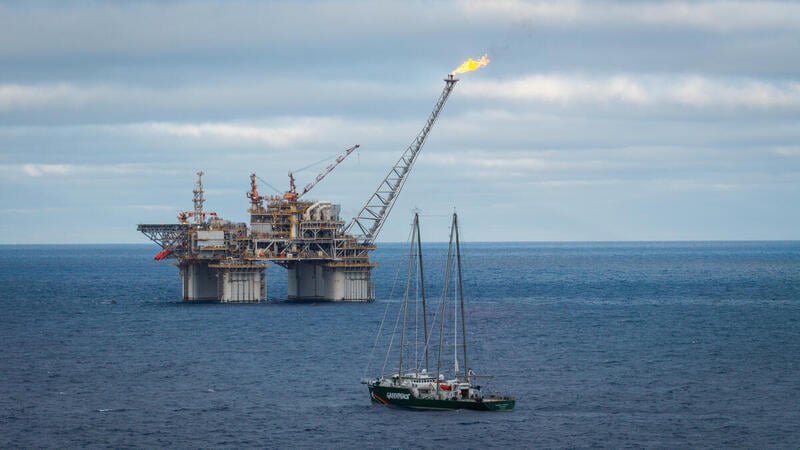
The UK government could approve 13 new oil and gas projects in the North Sea, with the fuel produced emitting 350m tonnes of CO2 equivalent (MtCO2e) if burned, Carbon Brief analysis shows.
The Labour government, which took power last month, has ruled out issuing new oil and gas licences for the North Sea.
However, it has not ruled out approving projects that already have a licence, but have not yet received consent to begin development.
A former senior official tells Carbon Brief that the government may now be “compelled” to greenlight them due to the risk of legal action from oil and gas companies.
Official documents show that up to 13 such licenced projects are likely to seek development consent from the Department for Energy Security and Net Zero (DESNZ), led by Ed Miliband, and the North Sea Transition Authority (NSTA). Many of these projects could seek such consent within months.
The projects could collectively produce 858m barrels of oil equivalent. If all of this fuel was burned, it would produce 350MtCO2e, according to Carbon Brief analysis.
This is equivalent to the annual emissions of 111 of the world’s lowest-emitting countries, which have a combined population of 649 million.
A wide range of scientific evidence shows that new fossil-fuel projects globally are “incompatible” with the world’s ambition of limiting global warming to 1.5C above pre-industrial levels.
Since the landmark Horse Hill judgment in June, DESNZ will likely need to consider the emissions produced from burning fossil fuels when deciding whether to grant development consent to new projects for the first time.
A spokesperson for DESNZ chose not to comment on the 13 projects, instead reaffirming to Carbon Brief that the department “will not issue new licences to explore new fields”, but will not revoke existing licences.
- What is the government’s stance on North Sea oil and gas?
- How much new oil and gas could be approved under Labour?
- What does this mean for efforts to tackle climate change?
What is the government’s stance on North Sea oil and gas?
The Labour party achieved a landslide victory in last month’s UK general election, with a campaign that promised major changes to the country’s climate and energy policies.
In its manifesto, Labour said it “will not issue new licences” for oil and gas, but that it “will not revoke existing licences”, leaving uncertainty around whether it will grant development consent to new projects that already have a licence.
The process for new North Sea oil and gas projects moving from obtaining a licence to reaching first production is complex, leading to a lot of confused reporting – with journalists often incorrectly describing Labour’s policy to end new licences as a “ban on new drilling”.
Under the previous Conservative government, multiple oil and gas licensing rounds took place.
Licensing rounds are carried out by the North Sea Transition Authority (NSTA), a company owned by DESNZ that acts as the UK’s oil and gas regulator.
(It is often pointed out that the NSTA is in the awkward position of being responsible for both ensuring the oil and gas sector reaches net-zero and maximising the economic recovery of oil from the North Sea.)
The most recent oil and gas licensing round took place from October 2022 to January 2023, leading to 82 licences being awarded to companies.
All of the licences awarded were production licences. This type of licence enables a company to explore for and then drill to extract oil and gas.
However, before they can set up operations and start drilling, they must obtain development consent from the NSTA, DESNZ and the Health and Safety Executive (HSE), the UK’s national regulator for workplace health and safety.
The “field development roadmap” below gives a sense of the various stages involved for a North Sea oil and gas project looking to obtain development consent.

The role of DESNZ in granting development consent for new oil and gas projects is highlighted in green.
Specifically, DESNZ is responsible for considering the environmental impact of a new oil and gas project.
As part of the environmental impact assessment, companies are asked to prepare an environmental statement, giving information on how the project could negatively affect the environment and what they plan to mitigate this. This could include, for example, how drilling activity could harm whales and dolphins living in the North Sea.
Until recently, when it came to the climate impact of their projects, companies only had to give information on the emissions caused by their operations. For example, from the energy used on oil rigs.
They did not have to provide DESNZ with data on the emissions that would be caused by burning the oil and gas they produce, which account for the vast majority of the emissions from a fossil-fuel project.
However, in June, the Supreme Court issued a landmark judgment ruling that all fossil-fuel projects seeking approval in the UK should provide decisionmakers with information on the emissions caused from burning the oil and gas that they plan to produce.
Delivering the majority judgment, Lord Leggett stated that the end use of any fossil-fuel extraction was always combustion, necessitating decisionmakers to take into account these emissions:
“The combustion emissions are manifestly not outwith the control of the site operators. They are entirely within their control. If no oil is extracted, no combustion emissions will occur.”
Lawyers tell Carbon Brief that the judgment means that North Sea oil and gas companies seeking development consent will now need to provide DESNZ with data on the emissions from burning the fuel extracted by their projects.
After considering the environmental impact of a project, DESNZ can either grant consent, request further information or refuse consent, if it considers the potential environmental impacts of the new project to be too large.
This decision, ultimately, lies with the secretary of state, Ed Miliband.
As noted above, Labour has not been clear on its position on development consent for new oil and gas projects that already have a licence.
Although DESNZ technically has the power to refuse new oil and gas projects on climate grounds, it might be difficult to do so in practice, says Adam Bell, head of policy at the consultancy group Stonehaven and former head of energy at the Department for Business, Energy and Industrial Strategy (which has now been split into DESNZ and two other departments). He tells Carbon Brief:
“To say no, the secretary of state would need to demonstrate that the relevant project would indeed have significant environmental impacts. What ‘significant’ in this context means is very much up for grabs and the regulations do extend the secretary of state scope to refuse a project on climate impact grounds.
“However, such a contention would be difficult to stand up in court unless the secretary of state could demonstrate that the project would have a greater impact on the climate than an imports counterfactual. This would be challenging.”
Because of this, the government might be forced to greenlight oil and gas projects seeking approval, Bell says:
“My expectation is that unless the government takes the position that any further extraction anywhere globally increases the risk of climate change – with consequent impacts on international relations – they will be compelled to consent the projects.”
Commenting on the chance of the Horse Hill judgment making a difference, he adds:
“My expectation is that how emissions [from burning oil and gas] are considered will be crucial; whether purely on territorial grounds or in the context of global emissions.
“One can make the case for projects on the former, and the framework for doing so is, ironically, [the] Paris [Agreement] and nationally determined contributions. On the latter, it becomes much harder to consent to projects.”
(See: “What does this mean for efforts to tackle climate change?”)
How much new oil and gas could be approved under Labour?
According to a 2024 overview from the NSTA, 13 new oil and gas projects are at a phase where they could soon be seeking development consent.
The NSTA says these projects would collectively produce 858m barrels of oil equivalent. When burned, this would produce around 350MtCO2e, Carbon Brief analysis shows.
The graphic below, which has been adapted from the NSTA’s overview, uses bubbles to indicate the relative size of the 13 projects that are likely to seek development consent, in terms of their oil and gas resources.

A spokesperson for the NSTA would not provide Carbon Brief with any further information on the projects represented in its overview, arguing this information is “commercially sensitive”.
However, Carbon Brief understands that some of the larger projects likely to seek development consent include the controversial Cambo oil project, the UK’s second-largest undeveloped oil and gas discovery in the North Sea, as well as the Buchan oil redevelopment project and the Avalon oilfield project.
Labour has previously publicly ruled out greenlighting the Cambo oil project – despite not ruling out approving other large oil and gas projects. (As noted above, it may be challenging for DESNZ to do this in practice.)
(Labour has also publicly pledged to stop the Rosebank oil and gas project, another large project that was approved for development by the previous Conservative government. The decision to approve Rosebank will face a legal challenge from environmental groups later this year.)
The NSTA spokesperson said that it is possible that not all of the 13 projects will “reach the stage” of seeking development consent. (A project with a licence may encounter economic or viability issues in its early stages.)
They added that “some may apply in the next few months”, while others will seek consent “over a longer time period”.
What does this mean for efforts to tackle climate change?
There is a wide range of evidence to show that new fossil fuel projects globally could blow efforts to limit global temperature rise to 1.5C, the aspiration of the Paris Agreement.
A scientific review of all known feasible routes for keeping to 1.5C published in 2022 concluded that developing new oil and gas fields is “incompatible” with the target.
It followed on from a landmark road map to net-zero released by the International Energy Agency in 2021, which said there are “no new oil and gas fields approved for development in our [1.5C] pathway”.
(In 2023, the IEA updated its wording to say that “no new long lead time conventional oil and gas projects are approved for development” in its 1.5C pathway.)
The latest UN Emissions Gap Report in 2023 said that the coal, oil and gas extracted over the lifetime of producing and under-construction mines and fields as of 2018 “would emit more than 3.5 times the carbon budget available to limit warming to 1.5C with 50% probability, and almost the size of the budget available for 2C with 67% probability”.
While the scientific case against new fossil fuel expansion is clear, North Sea advocates sometimes argue that the extraction of oil and gas in the UK has lower emissions than the global average and, therefore, offers an advantage.
In 2022, the UK’s climate advisers, the Climate Change Committee, published an analysis examining whether there is currently any climate benefit to using oil and gas produced in the UK, rather than that imported from overseas.
It found that the emissions intensity of oil and gas produced in the UK is lower than the global average, suggesting there may be a small “advantage” to domestic production.

But, although the UK has a climate “advantage” in terms of emissions during production when compared to the global average, it is not outperforming Norway, the country from which it currently sources most of its oil and gas imports.
An analysis published in 2022 found that, on average, UK production in the North Sea was nearly three times more emissions intensive than Norwegian production.
Furthermore, potential small climate “gains” from using domestic oil and gas over imports could be undermined because extracting more fossil fuels could impact global demand.
Namely, if the UK produces more oil and gas, it could contribute to falling prices and, thus, rising demand, fuelling more use and higher emissions.
Previous CCC analysis found that, even if every 100 units of new UK gas production only adds 14 units to global gas demand overall, the upstream emissions advantage would be wiped out by higher usage elsewhere.
Similarly, it concluded that the upstream emissions advantage for oil would be wiped out even if every 100 units of new oil production only added three units to global oil demand.
It is also worth noting that oil and gas produced in UK waters is sold to the global market and does not “belong” to the UK.
Around 80% of oil produced in UK waters is currently exported. Similarly, during the global energy crisis, UK gas exports soared.
The 13 projects looking to obtain development consent would produce 858m barrels of oil equivalent, the NSTA says. This is equal to around two years of UK oil and gas production at current levels.
However, the North Sea is already in decline. Oil production peaked in 1999, while gas production in the UK continental shelf peaked in 2000.
The journey to net-zero will see petrol and diesel cars replaced by electric cars, fossil-fuel boilers replaced by heat pumps and gas power stations replaced with low-carbon alternatives, such as renewables, nuclear and storage. All of this will see oil and gas demand plummet over the coming decades.
This means that new oil and gas will not do much to boost UK energy security – something noted by DESNZ. Referring specifically to oil and gas licences, a spokesperson tells Carbon Brief:
“We will not issue new licences to explore new fields because they will not take a penny off bills, cannot make us energy secure and will only accelerate the worsening climate crisis.”
Prime minister Keir Starmer has previously said that restoring the UK’s reputation as a climate leader is a key priority for his government.
Committing to stopping all new oil and gas projects, rather than just ending new licensing rounds, could give a boost to these efforts, says Tessa Khan, an environmental lawyer and executive director of Uplift, the North Sea oil and gas transition campaign group. She tells Carbon Brief:
“Signalling an end to new oil and gas exploration will be a significant step forward in restoring the UK’s reputation as a climate leader. However, to really bring the UK into alignment with climate science, it needs to go even further and reject any new oil and gas developments – not just licences.”
She adds that setting a clear plan for ending new oil and gas projects – rather than leaving uncertainty over new projects – could help the sector prepare for a just transition:
“Clarity about the future of the oil and gas sector will help to plan a responsible transition that protects the workers and communities that have ties to the industry. If the UK takes these steps, it can set a real example of climate leadership.”
The post Analysis: UK could approve 13 new oil and gas projects despite North Sea pledge appeared first on Carbon Brief.
Analysis: UK could approve 13 new oil and gas projects despite North Sea pledge
Climate Change
Q&A: Where do the UN secretary general candidates stand on climate change?
Candidates are being nominated to take over as the UN secretary general, when António Guterres steps down after nearly a decade in the role at the end of 2026.
Since becoming the ninth secretary general on 1 January 2017, Guterres has been a strong advocate for climate action, saying in January 2026:
“We have been outspoken on the urgent need for climate action, demanding ambition and working to rally governments, businesses and civil society.”
According to the UN, his predecessor, Ban Ki-moon, also “fought tirelessly to ensure that climate change stays at the top of the leaders’ agendas”.
Following a call for nominations going out in November last year, member states are currently nominating candidates to be the next secretary general.
To date, six candidates have been nominated by UN member states, with more expected in the coming months.
Below, Carbon Brief looks at the candidates’ views on climate change.
The UN secretary general’s role in climate action
The UN charter describes the secretary general as the organisation’s “chief administrative officer”.
According to the UN, they are a “symbol of UN ideals and a spokesperson for the interests of the world’s peoples, in particular the poor and vulnerable among them”.
It adds that the role is “[e]qual parts diplomat and advocate, civil servant and CEO”.
Over the past two decades, UN secretaries general have used their platform to advance action on climate change.
They have done so both by serving as a “moral authority” on climate change and as mediators in the drive to bring countries together, according to the UN.
Ban Ki-moon, the UN secretary general from 2007 to 2016, oversaw and brokered negotiations that culminated in the Paris Agreement, which he described as a “peace pact with the planet”.
Additionally, he pushed for its rapid ratification by member states so it could enter into force in record time compared to other treaties – such as its predecessor the Kyoto Protocol, which took eight years to come into force – with Ban securing an early buy-in from the US and China.
He also worked to mobilise $100bn per year by 2020 in climate financing from developed to developing countries. (The target was, ultimately, met two years late.)
His successor and current secretary general, Guterres, had been Portugal’s prime minister from 1995 to 2002, making him the first former national leader to hold the position.
Guterres served as the UN’s high commissioner for refugees between 2005 and 2015, a period that saw the highest level of human displacement since the second world war.
Guterres was the first secretary general to be elected through the current process, which includes public hearings and anonymous polling. (See: Next steps.)
He was chosen as the successful candidate in 2016, when he was voted in without opposition “in a rare show of unity” by members of the security council.
In his near-decade in office, he has become known for his references to the climate “emergency” and his calls for nations to make rapid emissions cuts.

Describing climate change as a “battle for our lives” and the Intergovernmental Panel on Climate Change’s (IPCC) 2021 report as a “code red for humanity”, Guterres has repeatedly demanded immediate action towards limiting global warming to 1.5C.
In 2024, as the world edged closer to hitting 1.5C of warming in an individual year, Guterres said:
“The battle to limit temperature rise to 1.5C will be won or lost in the 2020s – under the watch of leaders today.”
Besides repeatedly urging developed countries to meet their climate-finance obligations, Guterres has also intervened in attempts to resolve gridlocked negotiations at the annual “COP” climate summits.
He is known for his pointed advocacy on phasing out fossil fuels and for regularly convening states to submit more ambitious climate pledges.
The candidates
In the run-up to the UN general assembly in September 2026, nations are putting forward candidates for the secretary general position.
According to Reuters, tradition dictates that the role rotates between regions, with Latin America and the Caribbean next in line.
Thus far, five of the six candidates are from South or Central America: Michelle Bachelet Jeria; Rebeca Grynspan Mayufis; Rafael Mariano Grossi; María Fernanda Espinosa Garcés; and Carolyn Rodrigues Birkett.
The outlier is Macky Sall, a former Senegalese president nominated by the east African nation of Burundi.
Reuters adds that there is an “unwritten rule” that the secretary general never comes from one of the five permanent members of the UN security council – the UK, China, France, Russia and the US – to avoid an over-concentration of power.
In its 80-year history, a woman has never held the position of UN secretary general. Four of the six candidates nominated to date are women.
As shown below, this fact was noted “with regret” by a UN general assembly resolution in 2025, setting out the rules of the process to appoint the next secretary general.

Speaking during the first candidates’ debate, Espinosa Garcés quipped:
“I think, of course, a woman – it’s about time, isn’t it? After 80 years [of the UN’s existence].”
The debate was held in June by the UN Foundation, in collaboration with women’s organisation GWL Voices.
Bachelet, Espinosa and Grynspan took part in person at the event in Geneva, Switzerland.
(Sall sent in a video intervention, played at the beginning of the debate. Grossi was, according to the presenter, “not available” to participate and “chose not to send” a message by video.)
The three candidates were asked by an audience member how they would “ensure the climate governance becomes more equitable in response to those on the front lines of the crisis”, if they were elected as secretary-general.
Bachelet called for increased urgency in tackling climate change. Grynspan highlighted the need for action on adaptation as well as mitigation. Espinosa emphasised the need for a wide range of people to be involved in climate action, from Indigenous people to the financial sector.
The three participants all emphasised the need for finance in their responses. Bachelet, for example, specifically highlighting the need for grant-based finance. She said that “we cannot” keep asking “states that are fighting with a terrible debt” to accept climate-finance loans, which, ultimately, add to their debt. She added:
“They’re drowning and we’re asking them to ask for loans with a debt service that’s so big.”
All six candidates attended the Jeju Forum for Peace and Prosperity, co-hosted in Geneva by the Ban Ki-moon Foundation, at the end of June, ahead of the scheduling of further debates.
Additionally, for the first time in the selection process, candidates have been asked to voluntarily disclose their funding sources at the time of nomination.
Below, Carbon Brief details the candidates that have been nominated so far, what climate-relevant roles they have held previously and their views on climate change. (The list will be updated as further candidates are announced.)
Michelle Bachelet Jeria

Dr Michelle Bachelet Jeria is a Chilean diplomat, politician and doctor, nominated to be the next UN secretary general by Brazil and Mexico.
Bachelet was the former UN high commissioner for human rights, having served as its seventh commissioner from 2018 to 2022 and as the first director of UN Women.
She originally trained as a doctor – an education that was disrupted by being exiled in 1975 following the Chilean coup d’état led by general Augusto Pinochet – and specialised in paediatrics and public health.
In 1990, she began taking on roles in government bodies, including work in the Ministry of Health. This led her to further study, completing courses in military strategy and continental defence.
She became health minister in March 2000, before becoming the first woman to be the defence minister in Chile and Latin America in 2002.
Bachelet was elected as Chile’s first – and only – woman president, serving two terms: from 2006 to 2010 and 2014 to 2018.
As president and in public office, she consistently framed action on climate change as a human-rights obligation and a preventive tool to mitigate the worst impacts, arguing that “there is no space for [climate] denial”.
During her second term as Chile’s president, the share of renewables in the nation’s energy mix grew from 6% to 17% in four years. Bachelet also enacted South America’s first carbon tax and announced a 70% by 2050 renewable-energy goal, as well as expanding marine protected areas.
Among the range of international positions she has held over the last 20 years, Bachelet was named as the first director of the UN Women agency by former UN secretary general Ban.
Throughout her first term as high commissioner for human rights, Bachelet advocated for the protection of environmental defenders at risk, particularly in Latin America and the Caribbean, as well as women and girls impacted by climate change.
In a 2022 address to the UN human rights council following devastating fires in the Amazon, Bachelet remarked: “We are burning up our future – literally.” She continued:
“The world has never seen a threat to human rights of this scope. This is not a situation where any country, any institution, any policymaker can stand on the sidelines.
“The economies of all nations; the institutional, political, social and cultural fabric of every State, and the rights of all your people – and future generations – will be impacted.”
In an interview after she stepped down as human rights chief, Bachelet described the “triple planetary crisis – climate change, pollution and biodiversity loss” – as the “worst threat for humanity”.
In February 2026, she “broke new ground” when she was nominated by multiple UN member states – Chile, Mexico and Brazil – for the secretary general position.
However, in March, Chile’s newly sworn-in right-wing government, led by José Antonio Kast, withdrew its backing for Bachelet. Her nomination was dubbed “unviable” and a “mistake” by figures in the new government.
This is the first time a nominating state has withdrawn its support for a candidate. Bachelet’s candidacy is still supported by Brazil and Mexico.
Additionally, more than two dozen Republican US lawmakers accused Bachelet of “prioritis[ing] an extreme abortion agenda” in a letter earlier in 2026. They called for the US to veto her nomination.
She pushed back during a hearing in New York, US, saying that she “will always be by the side of women”.
In her pitch for secretary general, Bachelet calls for “simplify[ing] access to climate funds”, “innovative financial instruments” to address biodiversity loss and climate change and “sustainable responses that ensure climate justice, particularly for developing countries and vulnerable communities”.
She calls for debt relief, “true reform” of the international financial architecture, promoting investment in sustainable infrastructure and accelerating a just energy transition, with special attention to small-island states and least-developed countries. She says:
“From climate change to armed conflict, from growing inequality to technological disruption, the future of the UN will depend on its ability to adapt, renew and lead.”
Rebeca Grynspan Mayufis

Rebeca Grynspan Mayufis is a Costa Rican economist, diplomat and the former vice-president of Costa Rica. The nation backed her nomination.
In 2021, Grynspan became the first woman to be appointed secretary general of the UN Conference on Trade and Development (UNCTAD).
As part of this role, in February 2022, she outlined the UN’s vision for a sustainable recovery from the Covid-19 pandemic that “avoid[s] another lost decade of development for developing countries”.
In July 2022, Grynspan was credited with playing a “central” role in negotiating the Black Sea grain initiative struck between Russia, Ukraine, Turkey and the UN.
Brokered on behalf of the UN and as part of the Istanbul agreements, the initiative allowed grain and fertiliser exports blocked by Russia to resume to some of the world’s most food-insecure nations, with global food prices falling 23% in response to the deals.
In her pitch to become secretary general, Grynspan prioritises “durable peace and security” and UN reform as the first two of her three key priorities.
She warns that the world is “sleepwalking into dangerous climate-change scenarios”. Still, she adds that “technology offers new paths to development”, including through clean energy and critical minerals that are becoming “as valuable as oil”.
Grynspan has been especially vocal on the interconnections between climate and debt, observing that “financing is really key for any objective that we set to stick to the 1.5C target”.
Grynspan also supports the Bridgetown Initiative, championed by Barbados’ prime minister, Mia Mottley, to reform the global financial architecture and address debt and climate change, particularly in climate-vulnerable countries.
In her pitch, Grynspan warns that many millions “will continue to live in crushing scarcity and face compounding crises” if current trends continue.
These, she says, include small-island states “hit by cyclones that grow fiercer each year, landlocked nations facing the brunt of rising trade costs [and] developing economies servicing debt while capital moves past them”. She continues:
“Many states, including middle-income countries that are home to most of the world’s poor, struggle to fully access the trade, finance, technology and investment opportunities of the global economy.
“The UN must help widen the pathways to economic opportunities and help remove the structural constraints that stifle people’s potential. Sustainable development is not given, but unleashed.”
Rafael Mariano Grossi

Rafael Mariano Grossi is an Argentine diplomat and has served as the director-general of the UN’s nuclear watchdog – the International Atomic Energy Agency (IAEA) – since 2019.
Grossi was nominated by Argentina in November 2025.
A month later, Iran opposed his candidacy for failing to condemn US-Israeli attacks against “safeguarded, peaceful nuclear facilities”. It has since accused him of political bias and “destructive statements”.
While his “vision statement” for the UN does not directly mention “climate” or “climate change”, he refers to progress on the UN’s Sustainable Development Goals as “unfulfilled aspirations”.
Grossi suggests a “grounded, sectoral approach” to the world’s challenges through “collaborative partnerships” with “civil society, the private sector and the scientific community”.
In the statement – his pitch for the secretary general position – Grossi writes:
“Development cooperation must deliver tangible benefits, including access to health care, food, water and energy security, environment, education and real opportunities for a better quality of life, especially in countries facing the greatest challenges. Words must lead to action, and action to impact.”
Grossi takes credit for helping to achieve “global consensus around the need for nuclear power in the energy transition”.
At the UN climate summit COP28 in Dubai in 2023, Grossi delivered a statement saying:
“Net-zero needs nuclear power. The world needs nuclear power to fight climate change and action should be taken to expand the use of this clean energy source and help build a low-carbon bridge to the future.”
At the conference, a declaration to triple nuclear energy was endorsed by 22 national governments, including the US, France, the UAE and the UK.
More recently, Grossi has described the annual COP summits as “unmanageable” due to their size. According to the National, he has also “said he hoped to bridge the gap between climate agreements and growing energy demands, particularly in developing countries”.
Macky Sall

Macky Sall is a Senegalese politician who served as prime minister from 2004 to 2007 and then president from 2012 to 2024. He has been nominated by Burundi, which is currently the chair of the African Union (AU).
However, Sall’s candidacy has been rejected by other AU states, with Rwanda calling the use of a “silent procedure” to push through consensus on the African candidate for the position “a gross breach of AU rules and regulations”.
In his “vision statement”, Sall says that “peace and security cannot be sustained when the foundations of development are undermined by poverty, inequality, exclusion and climate vulnerability”.
While Sall underlines shortfalls in development financing, he emphasises that a “solidarity-based approach, founded on trust in crisis management, combined with sustained efforts for prevention and strengthening of early warning initiatives and mechanisms” is needed to address the challenges created by climate change.
Although Sall’s 12-year stint as president focused on “reducing power cuts and connecting remote villages to the power grid”, his candidacy is also facing charges of corruption, protestor crackdowns and media repression, according to Al Jazeera.
During the early part of Sall’s presidency, Senegal discovered oil and gas reserves – and the country’s oil exports have since surged from $0.4bn in 2015 to $2.4bn in 2024.
He was supportive of the African oil-and-gas sector, with much of the development of Senegal’s first oil production site undertaken during his term in office.
In 2019, a BBC Africa Eye investigation alleged that a company owned by Aliou Sall – Sall’s brother – received secret payments from businessmen who had obtained licences for two offshore gas blocks that same year. Sall denied the allegations.
María Fernanda Espinosa Garcés

María Fernanda Espinosa Garcés is an Ecuadorian linguist, poet, politician and conservationist. She was nominated by Antigua and Barbuda on 12 May, the only Caribbean state to put forward a candidate in this year’s selection process.
Espinosa was the president of the UN general assembly (UNGA) from 2018 to 2019. She has also served as Ecuador’s minister of foreign affairs twice, as well as its defence minister.
Before her political career, Espinosa was known for her work with Indigenous communities in the Ecuadorian Amazon and biodiversity conservation.
She established the socio-environmental studies programme at the Latin American Faculty of Social Sciences (FLACSO) and served as the regional director for South America at the International Union for the Conservation of Nature (IUCN) from 2005 to 2007.
Espinosa is no stranger to climate talks: she was Ecuador’s chief climate negotiator at UN COPs from Copenhagen in 2009 to Paris in 2015.
In a statement ahead of COP24 in Katowice, Poland, Espinosa – as UNGA president – remarked:
“I clearly remember the long negotiation days; the emotions, the frustrations, the sense of duty fulfilled in Cancun, Johannesburg or Copenhagen; the great hope of Paris. Clearly, we have come a long way, and much has been achieved, but we must rise to the new evidence and the new threats.
“The current climate crisis gives us now the opportunity to show the world that effective, results-oriented multilateralism is not an option but a survival necessity.”
In a 2024 paper, she lists fragmentation, “coordination challenges” and an “implementation deficit” as some of the key hurdles undermining the UN’s global environmental governance framework. She argues that its effectiveness “is significantly compromised by its very structure”.
In the same paper, Espinosa observes that the UNFCCC’s consensus-based decision-making “paradoxically contributes” to challenges in responding to climate change.
In her vision statement, Espinosa says that she plans to encourage a “more coherent international response” to support highly indebted, climate-vulnerable countries.
She states that the UN must act as a platform to strengthen cooperation on energy and support states during energy shocks.
According to Espinosa, “energy security, access, sustainability, trade and strategic autonomy are central to global stability”, with the energy transition “reshaping patterns of dependence and competition”.
She also says critical mineral extraction is being “unevenly distributed and developing at breakneck speed”.
If selected as secretary general, Espinosa plans to establish a “global energy security coordination mechanism” between UN member states and “other key actors” to manage the impacts of global energy shocks. These include impacts on energy access and affordability, food security, development and social stability, according to her nomination statement.
At a special UNGA meeting on climate ambition and sustainable development in 2019, Espinosa warned the gathering:
“We are the last generation that can prevent irreparable damage to our planet. Climate justice is intergenerational justice.”
Carolyn Rodrigues Birkett

Carolyn Rodrigues-Birkett is a politician, diplomat, former school teacher and Guyana’s permanent representative to the UN. She was nominated by her home nation on 15 June 2026, becoming the first Indigenous candidate in the current elections.
Rodrigues-Birkett served as Guyana’s minister for Amerindian affairs – the Indigenous population – in 2001 and 2006.
Appointed at the age of 27, Birkett is widely recognised as one of the “architects” of the Amerindian Act of 2006 – a piece of legislation described as “a milestone for Amerindian land rights, not only in Guyana but the western hemisphere”.
The act codified Indigenous land rights, governance and mandates their consent before mining or development projects on communally owned forest land.
In 2008, Birkett was appointed the country’s minister for foreign affairs and trade for two terms, the first and youngest woman of Indigenous descent to rise to the role.
Birkett has served as Guyana’s envoy in the security council in its two-year tenure between 2024 to 2025, supporting statements on the linkages between climate, peace, security and food insecurity.
Between 2015 and 2020, she coordinated the Food and Agriculture Organization’s (FAO) work with other UN organisations and its outreach to parliamentarians, particularly in Africa, Latin America and the Caribbean.
In her vision statement for the role, Birkett places a strong emphasis on climate finance and unmet sustainable development goals. She says:
“While trillions exist globally in potential financing, many developing countries continue to struggle with access. There has also been a profound shift in the risk landscape characterised by interconnected threats and climate-related challenges.”
The new secretary general, she says, must work with member states to “champion the implementation of existing commitments”. She adds that “there must be continued support to [m]ember [s]tates as they implement agreed” climate commitments.
If elected, Birkett pledges to use the secretary general’s convening powers to “bring all stakeholders together to address climate impacts and protect the environment”.
Next steps
While parties were encouraged to submit their candidates by April 2026, they can continue to make nominations for the next UN secretary general until the end of July.
At this point, the 15-member security council will begin to discuss the candidates “behind closed doors”.
Candidates will need to clear a “straw poll” vote by the council. These are informal, anonymous ballots to determine the viability of candidates.
Security council members have the option to “encourage” or “discourage” a candidate within these straw polls, as well as state that they have no opinion.
Polls are run numerous times until a consensus is found on a candidate. For example, when Guterres was selected in 2016, it took six straw polls for the council to reach agreement.
The selected candidate is then publicly put to a vote, in which non-permanent members of the council have a single vote and the five permanent members each have a power of veto.
This results in a council “resolution”, recommending the appointment of a candidate. This resolution must secure support from nine out of 15 members and no vetoes to pass.
Subsequently, there is a formal vote by the UN general assembly to endorse the council’s recommendation – although Reuters notes that this final vote has “long been seen as a rubber stamp”.
Ultimately, the security council process is likely to be finalised between August and October, ahead of the general assembly formalising the appointment at the end of the year.
The next secretary general is due to take office on 1 January 2027.
The post Q&A: Where do the UN secretary general candidates stand on climate change? appeared first on Carbon Brief.
Q&A: Where do the UN secretary general candidates stand on climate change?
Climate Change
In Guatemala, Indigenous women build climate resilience with old and new farming methods
In Guatemala’s southwest region lies a large lake with a storied history.
Lake Atitlán is one of Central America’s most critical local sources of drinking water, and is surrounded by volcanoes, a thriving tourism industry and an ancient Mayan culture. The Sololá region has long been home to Indigenous communities who have been attracted to its fertile land and pristine natural resources.
But in recent years, this site of natural beauty in Guatemala’s highlands has had to contend with the growing impacts of the climate and nature crises. Climate change is disrupting the rain cycle and significant areas of land show signs of erosion and loss of soil fertility. These changes are threatening crop production and pushing local people into food insecurity.
Elena Wason, co-executive director at Natün, a local non-profit supporting Indigenous people, told Climate Home News that community leaders have “identified deforestation and the effects of climate change in their communities as among their greatest concerns”. Forest cover declined by an estimated 12% in the past two years alone.
Women are often the social group most exposed to these changes and Natün has focused its efforts on reviving Indigenous agriculture techniques in a bid to improve climate resilience and empower female farmers.
How to fight drought
The impacts of climate change on Indigenous communities can often lead to further environmental damage as farmers are forced to rely on unsustainable practices, such as cutting down trees to clear more land. This can accelerate water scarcity, soil erosion and ultimately food insecurity.
An ongoing adaptation project led by Natün has sought to reverse these impacts, working with local people to combine modern climate-smart agriculture and ancestral knowledge. The approach involves the use of drought-resistant crops, organic pest management and soil conservation techniques. This is increasingly recognised as an effective way to strengthen climate resilience.
“Our approach is based on soil analysis and the use of locally resilient, endemic tree species, significantly increasing survival rates and ensuring sustainable water availability despite changing rainfall patterns,” Wason explained.


A US$170,000 grant from the Adaptation Fund-UNDP innovation platform (through the AFCIA programme) also allowed it to scale. For example, Natün established over 300 family food gardens – small spaces with shared resources that focus on growing nutrient-rich crops.
The project was built for the long-term by embedding innovation within Indigenous knowledge systems, organic farming and Mayan land stewardship rather than imposing external solutions. In this way, it ensures that communities remain the architects of their own resilience. Diversified revenue streams, including carbon credits and replicable learning kits, further support its longevity.
Nearly all of the typical Mayan gardens are managed by women, with the project training up to 30 women in climate-resilient practices, such as seed bank management. The approach has paid dividends by bolstering local food security and providing almost 19,000 people with sustainable food sources.
Young South Africans take up sustainable agriculture for food security
“The project uses locally led innovation by helping to restore sustainable Indigenous Mayan practices, while empowering vulnerable communities and women to build resilience and adapt to climate change and bolster food security,” said Mikko Ollikainen, head of the Adaptation Fund.
“Community-led approaches like these can have profound positive impacts on the directly affected communities and beyond by creating practical scalable solutions,” he added.
Growing incomes
The programme was expanded in 2025 with the creation of over 260 small poultry farms, further diversifying family incomes. The early results have been positive: two-thirds of families with both a garden and poultry now have surplus produce and incomes that have grown by an estimated $61 per month.
“These impacts especially benefit women, who not only make up 75% of programme participants and have taken leadership roles in managing community gardens, but also generally take on the responsibility of providing nutritious food for their families,” said Wason.
The project follows an earlier $5.4 million activity in Guatemala, also funded by the Adaptation Fund, that focused on honey bee production, forest conservation and ancestral knowledge across Suchitepéquez and Sololá. The aim was to empower vulnerable communities and Indigenous populations to adapt to floods and landslides, while enhancing diverse production landscapes and livelihoods.
Advancing women’s rights and empowerment in climate adaptation
That project resulted in 6,093 hectares under forest management and conservation, nearly 1,500 beehives in operation, and 328 family gardens with the purpose of helping women adapt. Utilising such ancestral practices have helped to increase agricultural resilience in the Nahualate River basin, benefiting some 1,125 people.


Enduring benefits
The long-term benefits of the Lake Atitlán project will be in providing communities, especially women, with practical tools to respond to the environmental challenges of drought, storms and deforestation in the Sololá region. These challenges are becoming more pronounced as the climate becomes more extreme and unpredictable.
Guatemala is ranked among the most exposed countries to climate risk. The World Bank estimates that up to 83% of its GDP is generated in areas prone to disasters. As such, it is not only the people around Lake Atitlán who stand to benefit from sustainable farming techniques.
The Natün project is easily replicable by harnessing local knowledge and offering a practical model that can be adapted across Indigenous communities facing similar climate pressures. In a country with an Indigenous population of over 6 million people, this approach will be of importance to many other communities as they face similar existential crises in a warming world.
Adam Wentworth is a freelance journalist based in Brighton, UK.
The post In Guatemala, Indigenous women build climate resilience with old and new farming methods appeared first on Climate Home News.
In Guatemala, Indigenous women build climate resilience with old and new farming methods
Climate Change
World Bank’s climate work can endure without finance target, experts say
The World Bank has scrapped its headline climate finance target under pressure from the Trump administration, but experts believe the survival of its wider climate programme should preserve support for clean energy and resilience in developing nations.
Following tense negotiations between its government shareholders, the global lender announced this week it would extend its Climate Change Action Plan (CCAP) while “retiring” its commitment to direct 45% of its financing to projects with climate benefits – a target it has already met.
“It could have been a lot worse,” said Danny Scull, a senior policy advisor at think-tank E3G. “I would have loved to see the most ambitious outcome possible, but it is far less likely we’ll see a scenario where the bank all of a sudden reverses its current trajectory and starts delivering less on climate,” he added.
Introduced in 2021, the CCAP has been credited with overhauling the World Bank’s approach to climate finance after years of criticism over the development finance institution’s lukewarm support for cutting planet-heating emissions and building resilience to extreme weather and rising seas.
Since the CCAP began, the World Bank’s climate finance nearly doubled to $39.2 billion in 2025, with 48% of its financing showing climate “co-benefits” and exceeding the target first set at COP28.
US attack partially rebuffed
With the CCAP due to lapse at the end of June, the US – the World Bank’s largest shareholder – mounted a campaign for the lender to axe the programme entirely. Last April, US Treasury Secretary Scott Bessent publicly welcomed the plan’s upcoming expiration, urging the bank to “shift its myopic focus on climate” and abandon its “distortionary” 45% climate finance target.
But Washington was left increasingly isolated during protracted negotiations in recent months as both European governments and a wide-ranging coalition of developing countries held firm on the plan’s extension, sources with knowledge of the discussions told Climate Home News.
In May, executive directors representing a bloc of nearly 100 countries, including China, Brazil, Saudi Arabia and Russia, sent a letter to the World Bank’s board requesting the CCAP be extended and calling for an independent review of the programme.
While the US had previously seemed unwilling to compromise with its European counterparts, that intervention got it to “back off from its most extreme positions”, E3G’s Scull said.
Focus on “outcomes”
In its statement on Monday, the World Bank Group said it would place less weight on the amount of money flowing into projects with climate benefits and shift its focus to “outcomes”, including indicators such as greenhouse gas emissions avoided and the number of people better shielded from climate risks.
The UK’s international development minister, Jenny Chapman, said in a post on LinkedIn this week that the extension of the CCAP is “a critical step forward”, adding that the stronger emphasis on results “is essential to ensure maximum impact, and the UK will hold the Bank to account to ensure delivery”.
Despite ditching its headline goal, the international lender is still expected to keep counting the volumes of climate finance for the vast majority of its activities. That’s because the individual entities belonging to the group continue to have their own climate targets embedded in their current mandates.
World Bank climate funding greens African hotels while fishermen sink
For example, the International Development Association (IDA), which supports the world’s poorest nations, has committed to providing 45% of its funding to climate-related activities until 2028. And its larger lending arm, the International Bank for Reconstruction and Development (IBRD), should keep aiming for 30% of its financing to have climate benefits.
Joe Thwaites, a climate finance expert at the Natural Resources Defense Council (NRDC), said these targets “can be a backstop against the bottom falling out”. “Client countries are emphasising that they want to see more investments in clean energy and resilience,” he added.
No major change expected
The World Bank’s provision of climate finance is also crucial for wealthy countries’ efforts to meet a commitment to provide $300 billion a year for developing countries by 2035 under the new UN climate goal agreed at COP29 in 2024.
That year, multilateral development banks (MDBs) accounted for around half of all climate finance provided by developed countries under the previous $100-billion-a-year goal, according to calculations by the Organisation for Economic Co-operation and Development.
UK development minister Chapman said this week that the bank “must continue to meet the expectations of the wider international community, including those set out at COP29”. There, MDBs said that by 2030, their annual joint climate financing for low- and middle-income countries would reach an estimated $120 billion.
Fractious COP29 lands $300bn climate finance goal, dashing hopes of the poorest
Rajneesh Bhuee, just transition lead at campaign group Recourse, said it was a “blow” that the World Bank’s headline target had been dropped, but she doesn’t expect to see climate financing reducing – at least in the short term.
“This is the [bank] management’s way of alleviating pressure from the US and ensuring they can have some sort of calm internally,” she told Climate Home News.
Thwaites said shareholder countries should hold the bank’s leadership accountable for delivering what countries have “agreed and need” on climate action.
“If World Bank climate finance does start to fall, donors should focus their support on other international financial institutions that continue to prioritise climate,” he added.
IMF also steps back from climate focus
Regional development banks outside of the Americas may be under less pressure to water down their climate mission. But the World Bank’s sister institution – the International Monetary Fund (IMF) – has seen its enthusiasm for climate action ebb, according to a report released in June by its official watchdog, the Independent Evaluation Office.
The report said that in 2021, the fund placed great emphasis on tackling climate change, as shown by its flagship climate strategy published that year and the establishment of the Resilience and Security Trust in 2022.
But in the last year or so, it found “decreasing emphasis on climate-related issues” which coincided with IMF cost-cutting, “emerging geopolitical challenges” and reduced support for climate action from some unnamed IMF member countries.
Last year, US finance minister Bessent accused the IMF of “mission creep”, accusing it of spending too much time on climate action, gender and social issues.
The evaluation report found that the focus on climate change among the IMF’s management and executive board has weakened, and its flagship reports have not included any climate-related chapters since 2023. IMF head Kristalina Georgieva and other managers mentioned climate-related terms in speeches and statements to the board far less in 2025 than the preceding years, it noted.
While most of the nearly 700 IMF’s staff surveyed welcomed the swing away from climate work, others bemoaned it and felt “self censored” when working to promote awareness of the risks of climate change to the global economy – which the IMF is tasked with protecting.
The post World Bank’s climate work can endure without finance target, experts say appeared first on Climate Home News.
World Bank’s climate work can endure without finance target, experts say
-
Greenhouse Gases11 months ago
Guest post: Why China is still building new coal – and when it might stop
-
Climate Change11 months ago
Guest post: Why China is still building new coal – and when it might stop
-
Greenhouse Gases2 years ago嘉宾来稿:满足中国增长的用电需求 光伏加储能“比新建煤电更实惠”
-
Climate Change2 years ago嘉宾来稿:满足中国增长的用电需求 光伏加储能“比新建煤电更实惠”
-
Renewable Energy8 months agoSending Progressive Philanthropist George Soros to Prison?
-
Climate Change2 years ago
Bill Discounting Climate Change in Florida’s Energy Policy Awaits DeSantis’ Approval
-
Carbon Footprint2 years agoUS SEC’s Climate Disclosure Rules Spur Renewed Interest in Carbon Credits
-
Greenhouse Gases12 months ago
嘉宾来稿:探究火山喷发如何影响气候预测