

The amount of foreign aid the UK spends on climate action reached a record high of around £3bn last year, according to government figures obtained by Carbon Brief.
However, Carbon Brief analysis shows that more than £500m of this sum comes from controversial changes in the way the UK calculates its climate aid for developing countries.
By leaning on private-sector investment and including existing aid projects in the total, the government is able to inflate its figures without providing as much new climate funding.
Including this money puts the UK on track for its five-year goal of providing £11.6bn by 2026 to support climate action in developing countries, even as it cuts the overall aid budget.
Climate aid – which is often referred to as “international climate finance” (ICF) – will likely still need to rise above £3bn in 2025, if the UK is to achieve its target over the next year.
The new data, released to Carbon Brief via freedom-of-information (FOI) requests, covers provisional 2024-25 spending across the three major government departments that fund climate projects overseas.
This analysis is the latest in a series of articles by Carbon Brief documenting the UK’s ICF contributions since 2011.
Key findings from the most recent year include:
- By far the largest payment last year was a £482.3m contribution to boost British International Investment’s (BII) private-sector interests in developing countries.
- Ethiopia was the largest recipient of bilateral climate finance (£92.3m). Other major recipients include Pakistan (£55.8m), Afghanistan (£43.7m) and Sudan (£41.1m).
- The biggest single project to receive funding was a World Bank initiative helping developing countries to sell carbon offsets, which received £153.9m.
- Large portions of climate finance also went to the Green Climate Fund (£227m) and the Global Environment Facility (£64.8m).
- Without the government’s changes, which mimic the looser accounting used by some other countries, climate finance would have needed to increase 78% this year. With the changes, climate finance only has to increase by 2%.
- Around £1.3bn – nearly a sixth of the UK’s ICF over the past four years – can be linked to the government’s accounting changes.
Target achieved?
After it was elected last year, Labour confirmed that it would honour the previous government’s pledge to provide £11.6bn of climate finance over the five-year period ending in 2025-26.
This money is the UK’s contribution, under the Paris Agreement, to help developing countries cut emissions and protect themselves from the threat of climate change.
Since the goal was first announced in 2019, experts have regularly voiced doubts that it can be achieved due to major cuts to the foreign-aid budget by successive governments.
More uncertainty followed the announcement in February that the Labour government would cut aid further – from 0.5% of gross national income to 0.3% – ostensibly to fund defence spending. (The government insisted that the remaining aid would “prioritise” climate.)
Despite these changes and uncertainty, the figures provided to Carbon Brief via FOI reveal that the UK is, in fact, on track to meet its £11.6bn target.
Climate-finance spending reached a record high of just under £3bn in the financial year 2024-25, more than £700m higher than the previous year.
(Note that these figures are “provisional” and subject to revision. Due to methodology changes, the final figures for UK climate finance in 2023-24 were much higher than those provided to Carbon Brief via a previous FOI. See the Methodology for more details.)
Assuming the provisional figures for 2024-25 are accurate, the UK would still need to raise its climate finance to £3.1bn in 2025-26 in order to meet the £11.6bn target, as shown in the figure below.

This level of climate finance would need to be maintained, even as the government scales back its overall aid budget in 2025.
When asked at a recent committee hearing whether there would be any new money for the £11.6bn goal, international development minister Baroness Chapman spoke frankly:
“I think the search for new money at the moment is going to be pretty fruitless…Is there going to be any new money for climate in a world where we have just gone from 0.5% to 0.3%? I think you can probably work that out.”
Instead of new funding, the upward trajectory of climate aid has been largely driven by the UK expanding what it counts towards the total. These changes were initially made under the Conservatives, but Labour has retained them.
By relabelling existing funding for multilateral development banks (MDBs), humanitarian aid and private-sector investments via BII as “climate finance”, the UK has inflated the figures without allocating genuinely new funds, making the £11.6bn goal easier to achieve.
Based on data acquired through successive FOIs, Carbon Brief estimates that £528m, or 18% of climate finance provided in 2024-25, can be linked to these accounting changes.
Since 2021, the running total of climate finance resulting from these changes is more than £1.3bn, Carbon Brief analysis suggests, amounting to nearly a sixth of spending to date.
Experts have pointed out that this amounts to a real-world cut in climate aid, as it means less additional funding than was originally pledged.
Without the accounting changes, UK climate finance would only have reached around £2.5bn last year, as the chart below shows.
To achieve the £11.6bn goal from this position, climate finance would have needed to increase by 78% this year, nearly doubling from a year earlier. In comparison, the accounting changes mean it only has to increase by 2%.

The government says that its accounting changes merely brought it in line with other countries. A Foreign, Commonwealth and Development Office (FCDO) spokesperson tells Carbon Brief:
“We will continue to account for all of our international climate finance using internationally agreed OECD guidelines. Meeting our £11.6bn commitment by March 2026 remains our ambition and it is only right that we accurately reflect the funding going to support this aim.”
In response, NGOs and aid experts have argued the UK should have retained its former position as a leader in climate-finance accounting standards, rather than aligning with the looser methodologies used by many others, such as Germany and France.
Moreover, the £11.6bn goal was meant to be a doubling of the government’s previous £5.8bn target, which was based on the original accounting methodology. If the previous target had also been based on a broader definition of climate aid, then the current £11.6bn target would have needed to be higher to represent a doubling.
As the UK nears the end of its third five-year ICF target, it is expected to announce another goal covering the period 2026-27 onwards. This will feed into the $300bn global climate finance target that nations agreed at the COP29 climate summit last year.
Amid the aid cuts, climate NGOs say that the accounting changes should be reversed and the UK should turn to “polluter-pays” measures to generate the required public funds. Catherine Pettengell, executive director of Climate Action Network UK, tells Carbon Brief:
“Our main concern is that we now have the spending review, but there is still no clarity – or vision – on current or future climate finance from the UK.”
Big investments
The UK is now leaning heavily on private-sector investments to achieve its climate-finance goals, according to Carbon Brief’s analysis.
By far the largest climate-finance input last year was a £482m contribution to the UK’s development finance institution, BII.
This is the biggest climate-finance contribution the UK has ever made in a single year, according to the data that Carbon Brief has collected in recent years.
It also amounted to nearly a fifth of the total climate finance last year and almost three times more than the UK has ever channelled into BII before.
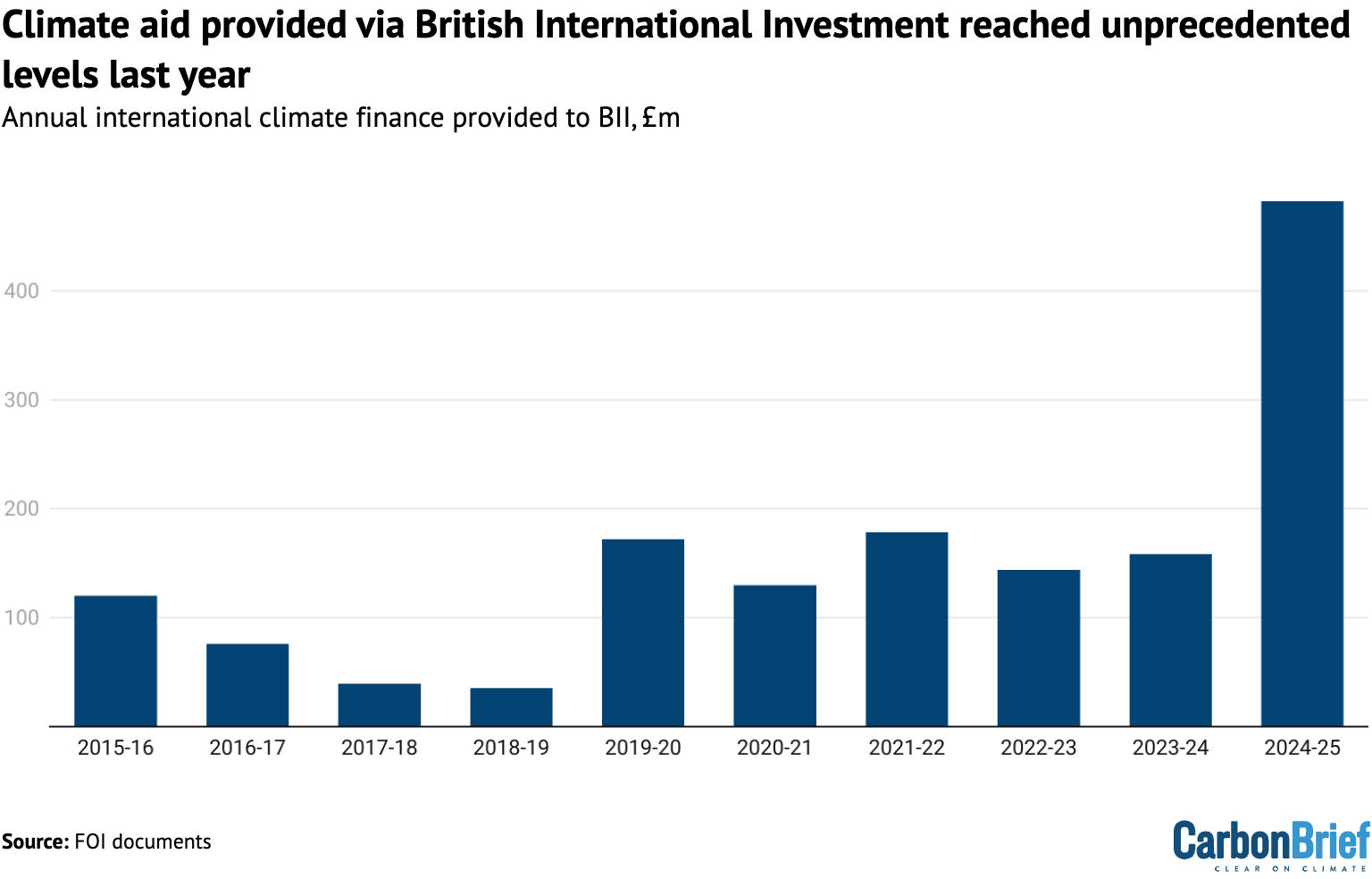
BII is a publicly owned, for-profit company that largely supports itself with its £7.3bn portfolio of investments in developing countries, but it also receives regular injections of aid money.
The surge in BII climate finance last year can be attributed to two things.
First, the government now counts more of its BII investments as climate finance than it did previously, following the accounting changes. It argues that this more accurately reflects BII’s expanding focus on investing in clean-energy projects overseas.
The government also decided to invest an extra £400m – largely from underspending on housing asylum seekers in the UK – into BII, bringing its total budget for the year up to £881m.
Prior to these changes, the government expected BII climate finance to be worth £126m in 2024-25, according to forecasts previously obtained by Carbon Brief.
It has, therefore, added an extra £356m to BII’s contribution. Carbon Brief estimates that £218m of this can be attributed to the accounting changes, rather than the increase in funding. (See: Methodology.)
Critics argue that BII, which focuses on loans and equity finance rather than grants, is not capable of supporting climate action in the poorest and most climate-vulnerable nations. (Separately, it has also been criticised for continuing to support fossil-fuel developments.)
Last week’s spending review provided the FCDO with at least £300m annually out to 2029-30 for BII and similar organisations, even as billions are cut from its aid budget. In this context, Ian Mitchell, a senior policy fellow at the Center for Global Development, tells Carbon Brief:
“BII looks set to become the government’s main climate-finance vehicle. Though, whether this is compatible with its historic focus on Africa and the poorest countries remains to be seen.”
Meanwhile, the biggest single project to receive funding from the UK last year was the World Bank initiative titled: “Scaling Climate Action by Lowering Emissions (SCALE).” The government provided it with an initial contribution of £154m.
SCALE aims to help around 20 countries generate carbon credits that can be sold by companies on the voluntary offset market or internationally via Article 6 carbon markets.
According to the UK government, one aim is to “maximise the mobilisation of additional finance through the sale of carbon credits”.
Selling carbon offsets has long been touted as a way to channel climate finance into developing countries, but the practice has faced intense scrutiny and accusations of “greenwashing” in recent years.
Accounting changes
Other large portions of funding in the UK’s 2024-25 climate-finance budget can also be attributed to changes in the government’s accounting methodology.
For example, as of 2023, the UK started counting portions of its “core” payments into MDBs as climate finance, significantly inflating its climate-aid total.
This money is used by the banks to issue loans and – to a lesser extent – grants for projects in developing countries. While many of these projects will be climate-related, relabelling some of the UK’s contributions as “climate finance” does not result in any additional funds being distributed.
In 2024-25, this relabelling accounted for at least £103m of the total climate finance, including £84m for the African Development Bank (AfDB), £11m for the Asian Development Bank (ADB) and £8m for the Caribbean Development Bank (CDB) Special Development Fund.
In terms of bilateral aid from the UK, several of the projects with the largest share of climate finance last year were in nations facing war, famine and natural disasters.
This can partly be attributed to accounting changes that mean 30% of all humanitarian funding in the most climate-vulnerable countries – including Afghanistan, Sudan and Somalia – is now automatically counted as climate finance within government accounting.
Some of these nations have, therefore, risen to be top recipients of bilateral “climate aid” from the UK – as shown in the figure below – through programmes such as Sudan Humanitarian Preparedness and Response.
(Such programmes tend to involve the UK supporting NGOs rather than providing funds to governments. For example, FCDO has two “flagship” humanitarian programmes in Afghanistan – both with an ICF component – but does not provide funds to the Taliban.)
This accounting change was viewed by the previous Conservative government as a way to avoid a “trade-off” between climate and humanitarian projects, amid aid budget cuts.
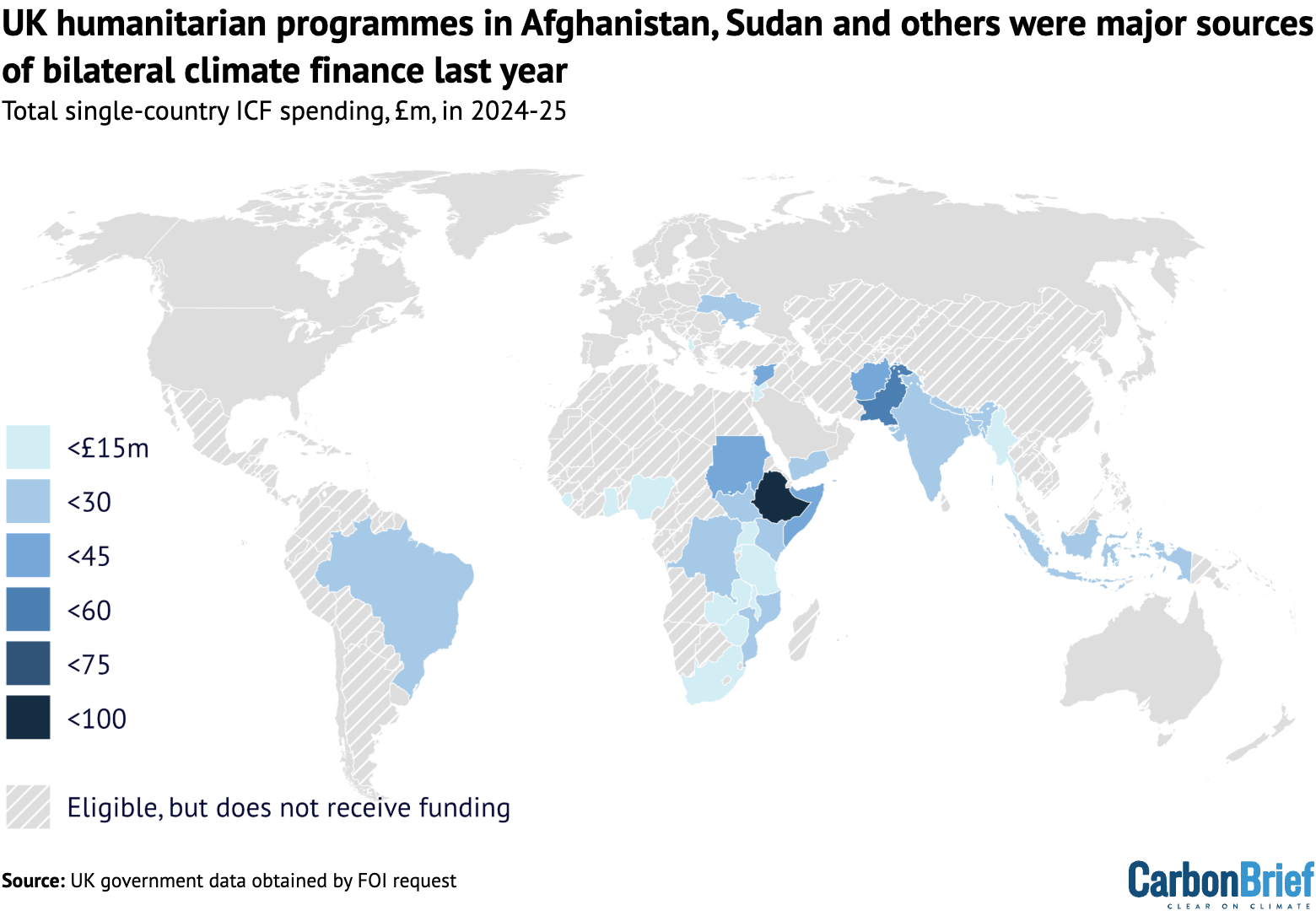
As the map above shows, Ethiopia remained the largest recipient of UK climate finance via single-country projects last year, with £92.3m in total. This has been the case for more than a decade.
The finance largely comes from two programmes, which aim to improve climate resilience in regions of Ethiopia that have been afflicted by drought and flooding. The country has faced years of regional conflicts that have been exacerbated by climate shocks.
Rather than directly supporting individual projects in individual countries, most UK climate finance is distributed to international bodies and initiatives that serve many countries.
Some of the biggest payments are to well-established international grant providers. These include £227m for the Green Climate Fund, £64m for the Global Environment Facility and £26m for the Global Biodiversity Framework Fund (GBFF).
Other large payments went to long-running initiatives to help “build financial markets and institutions” in Africa and “mobilise private investment in infrastructure” in developing countries.
Methodology
This analysis is the latest part of Carbon Brief’s efforts to assess the UK’s ICF contributions by financial year. Detailed data underpinning these contributions is not released publicly, but is required to track progress towards the UK’s ICF targets.
Total ICF figures for the years 2011-12 to 2023-24 are based on summary public statements made by the government. Ministers have quoted different figures on different occasions, but Carbon Brief is using a March statement from FCDO minister Stephen Doughty for the 2011-12 to 2023-24 period, as this is understood to be the most up-to-date.
The figures for 2024-25 are based on FOI responses from the three major departments responsible for the UK’s overseas climate-related aid projects: FCDO, the Department for Energy Security and Net Zero (DESNZ) and the Department for Environment Food and Rural Affairs (Defra). Around 80% of climate finance provided by the UK is overseen by the FCDO.
All three of these departments provided the data for 2024-25, stressing that it is provisional. This means it is “subject to year-end accounting and audit adjustments, which are still being processed”. Carbon Brief also received the final (i.e. non-provisional) figures for 2023-24, having been given the provisional figures last year.
(The provisional figures released to Carbon Brief in 2023-24 last year were significantly lower than the final figures – amounting to £1.8bn rather than £2.3bn. This is almost entirely due to the provisional data not factoring in most of the accounting methodology changes described in this article. The provisional figures for 2024-25 appear to have factored in these methodology changes already.)
The Department for Science, Innovation and Technology (DSIT) also oversees a small number of ICF projects overseas. Unlike the other departments, DSIT rejected Carbon Brief’s FOI requests. Carbon Brief understands that its projects were worth £42m in 2023-24, roughly 1% of the total. For the sake of this analysis, Carbon Brief assumes that this amount remained the same in 2024-25.
Carbon Brief relied on previous FOI results to calculate how much of the UK’s climate finance derives from accounting changes in recent years:
- BII: According to an internal document, under its old methodology, the government originally forecast 30% of BII core capital to be climate finance in 2024-25, amounting to £126m. The final figure provided to Carbon Brief, which is also based on a higher core capital figure, is £482m. If the government had counted 30% of the higher core capital contribution as ICF, under its old methodology, the total would be £264.3. This suggests the remaining £218m of the £482m could be attributed to the methodology changes.
- MDBs: The FOI results provided to Carbon Brief show contributions to the AfDB, ADB and CDB amounting to £103m.
- Humanitarian projects: Carbon Brief has used the estimates from an internal document showing how much climate finance the government expects humanitarian aid projects to provide, including £69m in 2024-25. This may be an underestimate, as some of the projects listed in this document have higher ICF totals in the new FOI data released to Carbon Brief.
- “Scrubbed” projects: The government also asked civil servants to reappraise the existing aid portfolio in order to identify any extra ICF that could be counted. Carbon Brief has obtained an incomplete list of these projects, which states that £138m was added to the 2024-25 total in this way.
Together, these changes add up to £528m. The actual figure may be higher, as these are provisional figures.
Carbon Brief’s estimate of the cumulative impact of the accounting changes by 2024-25 – some £1.3bn – aligns with an estimate of £1.72bn for the entire five-year period out to 2025-26, made by the Independent Commission for Aid Impact (ICAI). The final figure may be higher, as ICAI’s calculation was based on government documents that did not, for example, include the increased capital contribution to BII in 2024-25.




The post Analysis: UK climate aid to hit £11.6bn goal – but only due to accounting rule change appeared first on Carbon Brief.
Analysis: UK climate aid to hit £11.6bn goal – but only due to accounting rule change

Mae Buenaventura is the manager of the debt justice programme of the Asian Peoples’ Movement on Debt and Development, a regional alliance of peoples’ movements, community organizations, coalitions, NGOs and networks
A potentially historic shift in public debt governance is set to unfold in Washington DC this week as Global South governments take a collective stand to stop a “silent killer” of development financing.
The first-ever UN-hosted borrowers’ forum will officially be launched on April 15 on the sidelines of the 2026 Spring Meetings of the International Monetary Fund (IMF) and the World Bank. Led by five convening countries – Zambia, Egypt, Nepal, the Maldives and Pakistan – the initiative is one of the key wins of last year’s 4th Financing for Development Conference (FFD4) in Sevilla, Spain.
The forum’s mandate is to establish a platform for borrower countries, supported by a UN secretariat, “to discuss technical issues, share information and experiences in addressing debt challenges, increase access to technical assistance and capacity-building in debt management, coordinate approaches and strengthen borrower countries’ voices in the global debt architecture”.
Instead of facing lenders alone, these countries will now use a UN-backed platform to share technical expertise and coordinate their approach to a global debt system that is fundamentally broken.
Debt grips climate-vulnerable nations
The human cost of the current debt architecture is staggering. According to the UN trade and development agency, UNCTAD, more than 40% of the global population – roughly 3.4 billion people – live in countries where the government is forced to spend more on debt payments than on the health, education and social protection of its citizens.
In so-called low-income countries, governments spend an average of 7.5% of their total budgets on debt service, with interest payments consuming up to 20% of total government revenue in these regions.
The Philippines is a case study in this financial stranglehold. It is part of a global majority forced to watch its public services crumble and infrastructure lag while its wealth is siphoned off to satisfy foreign lenders.
The policy of automatic appropriations – a legacy of the rule of late former President Ferdinand Marcos Sr. – mandates that debt servicing takes precedence over any other public expenditure, effectively placing the demands of lenders above the needs of the Filipino people. Even as it faces a $1.5 trillion regional financing gap to achieve the Sustainable Development Goals (SDGs) by 2030, its hands remain tied by a legal framework that values credit ratings over human lives.
-
GEF raises $3.9bn ahead of funding deadline, $1bn below previous budget
Amid aid cuts, donor governments pledge less nature and climate funding to the Global Environment Facility (GEF), with the four-year package to be finalised in late May -
Charging worries, high prices put brakes on EV growth in Bangladesh
Sales of e-bikes and rickshaws are up amid queues at fuel stations, but a lack of charging infrastructure and high prices still deter many Bangladeshis from going electric


As a “middle-income country” (MIC), the Philippines is stuck in a frustrating purgatory. It is often deemed “too wealthy” for the G20’s debt-relief framework, yet too poor to absorb global economic shocks. Last year, Finance Undersecretary Joven Balbosa hit the nail on the head when he called for support that goes “beyond the simplistic income categorization” that ignores a country’s actual vulnerabilities.
Without an inclusive and equitable global debt architecture, nations including the Philippines are left to navigate catastrophic climate risks and economic shocks with zero fiscal breathing space.
No respite during climate disasters
The regional evidence of this systemic failure is everywhere. Take Pakistan, which in 2022 was hit by catastrophic flooding that submerged a third of the country and caused billions in losses. Despite this climate-driven disaster, World Bank data shows that Pakistan made payments in 2023 of $11.8 billion for public and publicly guaranteed (PPG) external debt, while its PPG external debt reached $93 billion that same year, surpassing pre-pandemic debt of $87 billion (2020).
Sri Lanka followed IMF prescriptions throughout 16 lending programs since 1991, only to become the first Asian country this century to default. Its MIC status prevents application for debt relief and restructuring measures. Today, the Sri Lankan people bear the brunt of harsh conditionalities, including raising VAT from 8% to 15%, slashing food and fuel subsidies, and the erosion of hard-earned worker pensions.

Currently, the global rules of lending and borrowing are set by a “creditors’ club” composed of the IMF, the World Bank and the Global Sovereign Debt Roundtable it set up, and the Paris Club.
These institutions measure “debt sustainability” through a narrow lens of a country’s capacity to make timely repayments. They largely ignore internal economic inequalities, gender disparities and the existential threat of climate change.
Crises should trigger debt service cancellation
By organising the new borrowers’ forum, the Global South is signalling that the era of passive “standard-setting” by lenders is over.
The ultimate goal for global civil society and debt justice movements is the establishment of a UN Debt Convention; a democratic, binding and inclusive framework that governs both lenders and borrowers. This mechanism would ensure that debt restructuring and cancellation are sufficient to allow countries to fulfill their international human rights obligations and implement necessary climate actions.
Green Climate Fund picks locations for five developing country hubs
To be truly transformative, debt sustainability analyses must align with human rights and sustainable development needs. This means conducting impact assessments – both before and after loans are issued – to identify “illegitimate” debts that do not benefit the public.
Crucially, we need an automatic debt service cancellation mechanism that triggers during extreme climatic, environmental or health shocks. We also need a binding global debt registry to ensure that every loan is transparent and subject to public scrutiny.
Whether the borrowers’ forum becomes a true milestone depends on its courage to challenge the status quo. We can no longer allow debt to act as a “silent killer” of our future. It is time to demand a financial system that serves humanity, not just the balance sheets of the powerful.
The post Broken debt system must be fixed to confront future climate shocks appeared first on Climate Home News.
Broken debt system must be fixed to confront future climate shocks
Greenpeace and allies will be protesting outside Woodside’s Annual General Meeting to show the WA and federal governments strong community opposition to Woodside’s proposal to drill for gas at Scott Reef.
What: Protest outside Woodside Energy’s Annual General Meeting
When: 8am Thursday 23rd April 2026Where: Kagoshima Park (on the corner of Great Eastern Highway and Bolton Avenue)
What’s at stake
Scott Reef is a pristine ocean ecosystem off the north-west coast of Australia.
It is home to endangered and endemic species, including pygmy blue whales and the dusky sea snake, and a nesting ground for green sea turtles. Scott Reef is a place of extraordinary natural beauty, and a vital marine environment that supports a wide range of marine life.
What Woodside is proposing
Dirty fossil fuel corporation, Woodside Energy, is seeking approval to drill more than 50 gas wells underneath and around Scott Reef as part of its Browse project.
The gas would be extracted and transported to the Burrup Hub, the most polluting fossil fuel project in Australia. This proposal would industrialise the doorstep of Australia’s largest freestanding oceanic reef system – threatening the marine life that relies on it and the climate.
Why this can’t go ahead
The WA Environmental Protection Authority has already identified the risks of this project as “unacceptable”, issuing a preliminary rejection.
Serious concerns include:
- The risk of an oil spill
- Impacts on pygmy blue whales
- Damage to green sea turtle nesting grounds
These risks are severe, and potentially irreversible. But the decision hasn’t been made yet. The project is still being assessed.
The Federal Environment Minister is approaching a decision that will determine whether Scott Reef is protected – or vulnerable to decades of industrial gas destruction.
This is a defining moment.
Make opposition visible
Across Australia, people are speaking out to protect Scott Reef and oppose Woodside’s Browse project.
Showing that opposition is visible, coordinated and growing helps increase pressure on decision-makers ahead of this critical decision.
Join the protest
A protest outside Woodside’s AGM is a key public moment to demonstrate opposition and help protect Scott Reef.
Kagoshima Park (on the corner of Great Eastern Highway and Bolton Avenue) 8am, Thursday 23rd April 2026
Join the protest and help show how many people support protecting Scott Reef before the government makes its decision.
Join Greenpeace to save Scott Reef from Woodside’s dirty gas
As demand for whale meat declines at home, Norway exports it to Japan, markets it to tourists and sells it online as dog food.
Norway reopened its annual whale hunting season earlier this month, continuing a practice most countries abandoned decades ago.
Norway Reopens Annual Whale Hunt Despite Pressure to End Commercial Whaling



-
Climate Change8 months ago
Guest post: Why China is still building new coal – and when it might stop
-
Greenhouse Gases8 months ago
Guest post: Why China is still building new coal – and when it might stop
-

 Greenhouse Gases2 years ago
嘉宾来稿:满足中国增长的用电需求 光伏加储能“比新建煤电更实惠”
-
Climate Change2 years ago
Bill Discounting Climate Change in Florida’s Energy Policy Awaits DeSantis’ Approval
-

 Climate Change2 years ago
嘉宾来稿:满足中国增长的用电需求 光伏加储能“比新建煤电更实惠”
-
Climate Change Videos2 years ago
The toxic gas flares fuelling Nigeria’s climate change – BBC News
-

 Renewable Energy6 months ago
Sending Progressive Philanthropist George Soros to Prison?
-

 Carbon Footprint2 years ago
US SEC’s Climate Disclosure Rules Spur Renewed Interest in Carbon Credits