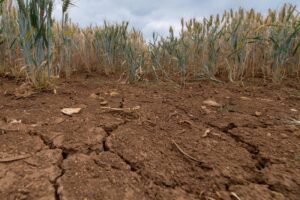
Wildfires have scorched more than 40,000 hectares of land so far this year across the UK – an area more than twice the size of the Scottish city of Glasgow.
This is already a record amount of land burned in a single year, far exceeding the previous high, Global Wildfire Information System (GWIS) data shows.
It is also almost four times the average area burned in wildfires by this stage of the year over 2012-24 – and 50% higher than the previous record amount burned by this time in 2019.
The burned area overtook the previous annual record in April, BBC News reported at the time, and has continued to soar in the months since.
Major wildfires
The chart below shows that UK wildfires in 2025 so far have already burned by far the largest area of land over any calendar year since GWIS records began in 2012. The previous record year was 2019, followed by 2022, while 2024 saw the lowest area size burned.

Annual land area burned by wildfires across the UK from 2012 to 2025 (red), alongside the average area burned each year over 2012-24. Source: Global Wildfire Information System.
Climate change can increase the risk and impact of wildfires. Warmer temperatures and drought can leave land parched and dry out vegetation, which helps fires spread more rapidly. Climate change is making these types of extreme conditions more likely to occur, as well as more severe.
Fire services in England and Wales responded to 564 wildfires from January to June 2025 – an increase from 69 fires in the same period last year, the National Fire Chiefs Council (NFCC) said in a statement in June.
Most wildfires in the UK are caused by human activity, whether accidental or deliberate, according to the NFCC. Some common ignition sources are disposable barbecues, lit cigarettes and campfires.
Jessica Richter, a research analyst at Global Forest Watch, says that, while fires are also a key part of some ecosystems, climate change is the “major driver behind the increasing fire activity around the globe”. She tells Carbon Brief:
“As we see more fires, we’re going to see more carbon being emitted and that’s just going to be, for lack of a better phrasing, adding fuel to the fire.”
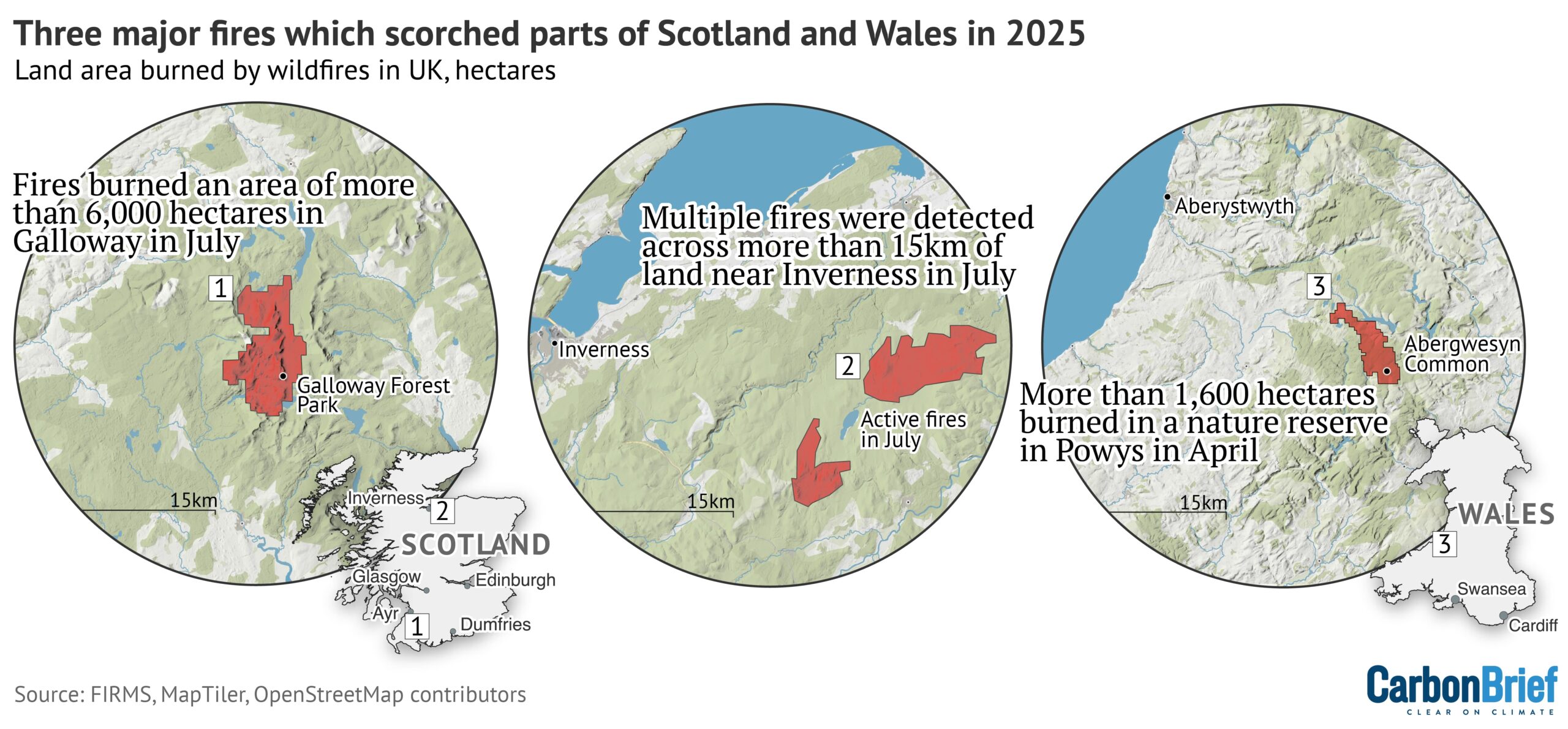
Examples of 2025 wildfires around Galloway (1) and Inverness (2) in Scotland, and a wildfire in Powys (3) in Wales. Source: FIRMS, MapTiler, OpenStreetMap contributors.
The UK has also recorded its highest-ever wildfire emissions this year, according to Copernicus, which was “primarily driven” by major wildfires in Scotland from late June to early July.
These were the largest wildfires ever recorded in the country, reported the Scotsman. They “ravaged” land in Moray and the Highlands in the north of the country, the newspaper added.
Scotland experienced an extreme wildfire in Galloway Forest Park in April, which was “so intense it could be seen from space”, the Financial Times said.
Elsewhere, in April, the Belfast News Letter reported that firefighters tackled almost 150 fires on the Mourne Mountains in Northern Ireland.
More recently, BBC News reported that firefighters in Dorset, England received “non-stop” wildfire calls in the first weekend of August, with one blaze “engulf[ing] an area the size of 30 football pitches”.
Wildfires have also caused devastation across many parts of Europe in recent weeks – including Albania, Cyprus, France, Greece, Spain and Turkey – as well as in the US and Canada.

The post Analysis: Record UK wildfires have burned an area twice the size of Glasgow in 2025 appeared first on Carbon Brief.
Analysis: Record UK wildfires have burned an area twice the size of Glasgow in 2025
Climate Change
Corpus Christi Cuts Timeline to Disaster as Abbott Issues Emergency Orders
The governor’s office said the city’s two main reservoirs could dry up by May, much sooner than previous timelines. But authorities still offer no plan for curtailment of water use.
City officials in Corpus Christi on Tuesday released modeling that showed emergency cuts to water demand could be required as soon as May as reservoir levels continue to decline.
Corpus Christi Cuts Timeline to Disaster as Abbott Issues Emergency Orders
Climate Change
Middle East war is another wake-up call for fossil fuel-reliant food systems
Lena Luig is the head of the International Agricultural Policy Division at the Heinrich Böll Foundation, a member of the Global Alliance for the Future of Food. Anna Lappé is the Executive Director of the Global Alliance for the Future of Food.
As toxic clouds loom over Tehran and Beirut from the US and Israel’s bombardment of oil depots and civilian infrastructure in the region’s ongoing war, the world is once again witnessing the not-so-subtle connections between conflict, hunger, food insecurity and the vulnerability of global food systems dependent on fossil fuels, dominated by a few powerful countries and corporations.
The conflict in Iran is having a huge impact on the world’s fertilizer supply. The Strait of Hormuz is a critical trade route in the region for nearly half of the global supply of urea, the main synthetic fertilizer derived from natural gas through the conversion of ammonia.
With the Strait impacted by Iran’s blockades, prices of urea have shot up by 35% since the war started, just as planting season starts in many parts of the world, putting millions of farmers and consumers at risk of increasing production costs and food price spikes, resulting in food insecurity, particularly for low-income households. The World Food Programme has projected that an extra 45 million people would be pushed into acute hunger because of rises in food, oil and shipping costs, if the war continues until June.
Pesticides and synthetic fertilizer leave system fragile
On the face of it, this looks like a supply chain issue, but at the core of this crisis lies a truth about many of our food systems around the world: the instability and injustice in the very design of systems so reliant on these fossil fuel inputs for our food.
At the Global Alliance, a strategic alliance of philanthropic foundations working to transform food systems, we have been documenting the fossil fuel-food nexus, raising alarm about the fragility of a system propped up by fossil fuels, with 15% of annual fossil fuel use going into food systems, in part because of high-cost, fossil fuel-based inputs like pesticides and synthetic fertilizer. The Heinrich Böll Foundation has also been flagging this threat consistently, most recently in the Pesticide Atlas and Soil Atlas compendia.
We’ve seen this before: Russia’s invasion of Ukraine in 2022 sparked global disruptions in fertilizer supply and food price volatility. As the conflict worsened, fertilizer prices spiked – as much from input companies capitalizing on the crisis for speculation as from real cost increases from production and transport – triggering a food price crisis around the world.
Since then, fertilizer industry profit margins have continued to soar. In 2022, the largest nine fertilizer producers increased their profit margins by more than 35% compared to the year before—when fertilizer prices were already high. As Lena Bassermann and Dr. Gideon Tups underscore in the Heinrich Böll Foundation’s Soil Atlas, the global dependencies of nitrogen fertilizer impacted economies around the world, especially state budgets in already indebted and import-dependent economies, as well as farmers across Africa.
Learning lessons from the war in Ukraine, many countries invested heavily in renewable energy and/or increased domestic oil production as a way to decrease dependency on foreign fossil fuels. But few took the same approach to reimagining domestic food systems and their food sovereignty.
Agroecology as an alternative
There is another way. Governments can adopt policy frameworks to encourage reductions in synthetic fertilizer and pesticide use, especially in regions that currently massively overuse nitrogen fertilizer. At the African Union fertilizer and Soil Health Summit in 2024, African leaders at least agreed that organic fertilizers should be subsidized as well, not only mineral fertilizers, but we can go farther in actively promoting agricultural pathways that reduce fossil fuel dependency.
In 2024, the Global Alliance organized dozens of philanthropies to call for a tenfold increase in investments to help farmers transition from fossil fuel dependency towards agroecological approaches that prioritize livelihoods, health, climate, and biodiversity.
In our research, we detail the huge opportunity to repurpose harmful subsidies currently supporting inputs like synthetic fertilizer and pesticides towards locally-sourced bio-inputs and biofertilizer production. We know this works: There are powerful stories of hope and change from those who have made this transition, despite only receiving a fraction of the financing that industrial agriculture receives, with evidence of benefits from stable incomes and livelihoods to better health and climate outcomes.
New summit in Colombia seeks to revive stalled UN talks on fossil fuel transition
Inspiring examples abound: G-BIACK in Kenya is training farmers how to produce their own high-quality compost; start-ups like the Evola Company in Cambodia are producing both nutrient-rich organic fertilizer and protein-rich animal feed with black soldier fly farming; Sabon Sake in Ghana is enriching sugarcane bagasse – usually organic waste – with microbial agents and earthworms to turn it into a rich vermicompost.
These efforts, grounded in ecosystems and tapping nature for soil fertility and to manage pest pressures, are just some of the countless examples around the world, tapping the skill and knowledge of millions of farmers. On a national and global policy level, the Agroecology Coalition, with 480+ members, including governments, civil society organizations, academic institutions, and philanthropic foundations, is supporting a transition toward agroecology, working with natural systems to produce abundant food, boost biodiversity, and foster community well-being.
Fertilizer industry spins “clean” products
We must also inoculate ourselves from the fertilizer industry’s public relations spin, which includes promoting the promise that their products can be produced without heavy reliance on fossil fuels. Despite experts debunking the viability of what the industry has dubbed “green hydrogen” or “green or clean ammonia”, the sector still promotes this narrative, arguing that these are produced with resource-intensive renewable energy or Carbon Capture and Storage (CCS), a costly and unreliable technology for reducing emissions.
As we mourn this conflict’s senseless destruction and death, including hundreds of children, we also recognize that peace cannot mean a return to business-as-usual. We need to upend the systems that allow the richest and most powerful to have dominion over so much.
This includes fighting for a food system that is based on genuine sovereignty and justice, free from dependency on fossil fuels, one that honors natural systems and puts power into the hands of communities and food producers themselves.
The post Middle East war is another wake-up call for fossil fuel-reliant food systems appeared first on Climate Home News.
Middle East war is another wake-up call for fossil fuel-reliant food systems
Climate Change
Are There Climate Fingerprints in Tornado Activity?
Parts of the Southern and Northeastern U.S. faced tornado threats this week. Scientists are trying to parse out the climate links in changing tornado activity.
It’s been a weird few weeks for weather across the United States.
-
Greenhouse Gases7 months ago
Guest post: Why China is still building new coal – and when it might stop
-
Climate Change7 months ago
Guest post: Why China is still building new coal – and when it might stop
-
Greenhouse Gases2 years ago嘉宾来稿:满足中国增长的用电需求 光伏加储能“比新建煤电更实惠”
-
Climate Change2 years ago
Bill Discounting Climate Change in Florida’s Energy Policy Awaits DeSantis’ Approval
-
Climate Change2 years ago嘉宾来稿:满足中国增长的用电需求 光伏加储能“比新建煤电更实惠”
-
Climate Change Videos2 years ago
The toxic gas flares fuelling Nigeria’s climate change – BBC News
-

Carbon Footprint2 years agoUS SEC’s Climate Disclosure Rules Spur Renewed Interest in Carbon Credits
-
Renewable Energy2 years ago
GAF Energy Completes Construction of Second Manufacturing Facility