

Just 28% of countries have met a UN call to submit new plans on addressing nature loss – a year after the original deadline, Carbon Brief analysis shows.
Several of the world’s most biodiverse countries – including Brazil, the Democratic Republic of the Congo and South Africa – are among those that have not yet released their nature plans.
Countries were asked to submit their pledges, known as national biodiversity strategies and action plans (NBSAPs), by the start of the COP16 biodiversity summit in Colombia on 21 October 2024.
After only 15% of nations met the original deadline, countries agreed at the summit to a new text that “urges” countries to release their NBSAPs “as soon as possible”.
Many developing countries have expressed that a lack of available funding has prevented them from publishing their NBSAPs.
A spokesperson for the Global Environment Facility (Gef), the multilateral fund that provides funding to help with the preparation of NBSAPs, tells Carbon Brief that 120 out of 139 countries that have requested financial support since COP16 have been able to access it.
The spokesperson adds that the UN Environment Programme is “working to resolve outstanding issues” to allow the remaining 19 countries to access financial assistance.
Lack of action
In 2022, nations signed a landmark agreement called the Kunming-Montreal Global Biodiversity Framework (GBF), which aims to halt and reverse nature loss by 2030. It is often described as the “Paris Agreement for nature”.
As part of the agreement, countries agreed to submit new NBSAPs “by” COP16, which began on 21 October 2024 in Cali, Colombia. (Countries failed to find agreement on some key issues in Colombia and met again in Rome, Italy, in February 2025 for a resumed session of COP16.)
NBSAPs are blueprints for how individual countries plan to tackle biodiversity loss and ensure they meet the targets outlined in the GBF.
They are similar to nationally determined contributions (NDCs), the plans that outline how individual countries envisage meeting the goals of the Paris Agreement. However, a key difference is that countries are legally obliged to submit NDCs, but not NBSAPs.
The publishing of new NBSAPs was meant to ensure that countries actually implement the targets of the GBF within their borders.
A lack of implementation was widely cited as one of the major factors behind the failure of the last set of global biodiversity rules, the Aichi targets, which were agreed in 2010.
A joint investigation by Carbon Brief and the Guardian found that 85% of countries missed the UN deadline to submit their NBSAPs by COP16.
At COP16, many countries lamented the lack of NBSAP submissions. At the summit, they agreed to a new text that notes the lack of action and “urges” countries to release their NBSAPs “as soon as possible”.
Now, new Carbon Brief analysis reveals that just 28% of nations (55 of 196 parties) have released their NBSAPs – a year after the deadline.
The map below shows countries that submitted their plans to the UN by the 21 October 2024 deadline (light green) and after the deadline (dark green).
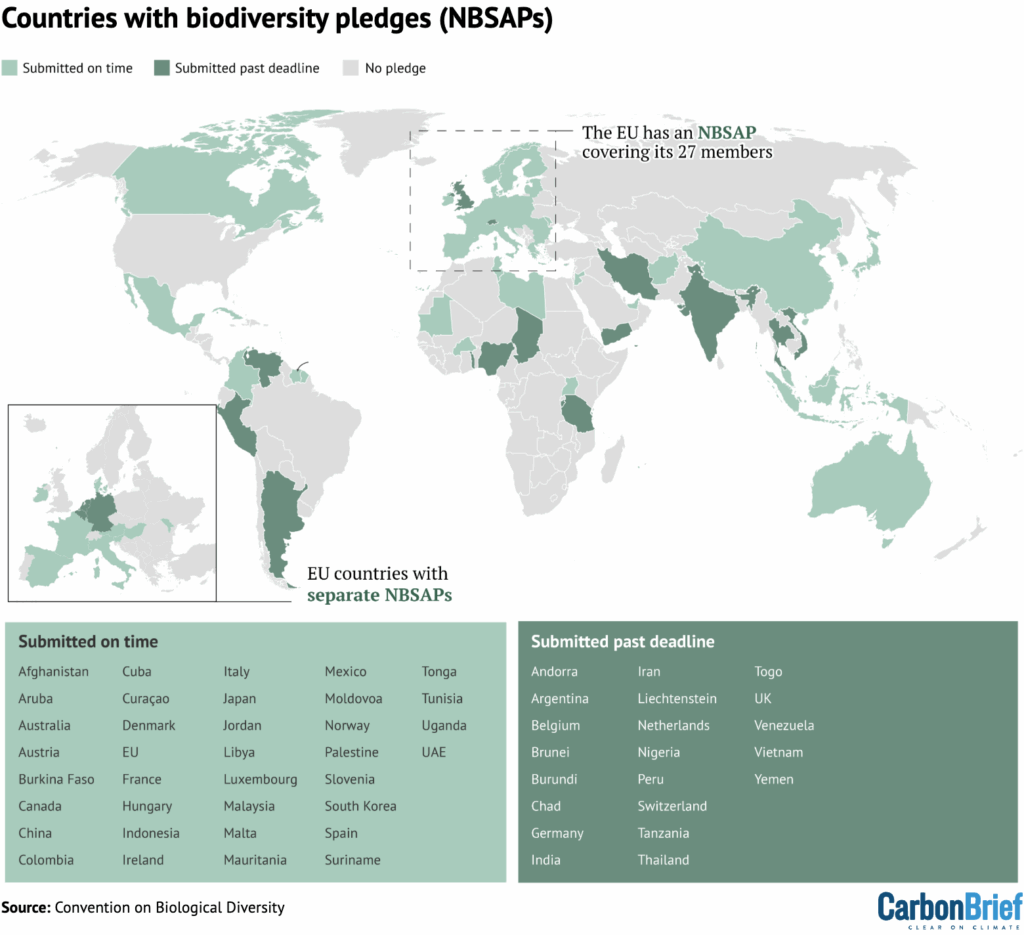
Since the original deadline, both Germany and the UK have submitted their NBSAPs. This means that the US, which is not a signatory to the UN Convention on Biological Diversity, is now the only G7 nation without a nature plan.
Eight of the “megadiverse countries” – 17 nations that together provide a home to 70% of the world’s biodiversity – are yet to produce their NBSAPs.
This includes Brazil, the world’s most biodiverse nation and host of the upcoming COP30 climate summit.
The other megadiverse countries that have not yet submitted their NBSAPs are the DRC, Ecuador, Madagascar, Papua New Guinea, the Philippines, South Africa and the US.
The host of next year’s COP17 biodiversity summit, Armenia, is also among those yet to produce an NBSAP.
According to the GBF and its underlying documents, countries that were “not in a position” to meet the deadline to submit NBSAPs ahead of COP16 were requested to instead submit national targets.
These submissions simply list biodiversity targets that countries will aim for, without an accompanying plan for how they will be achieved.
By the end of the COP16, some 119 parties had produced at least one national target. A year later, this figure has risen to 141, or 72% of countries.
Finance flows
At COP16 in 2024, many developing nations said that a lack of timely funding available from the Gef had prevented them from being able to produce new NBSAPs.
In acknowledgement of this, the NBSAPs text agreed at the summit “requests” the Gef to “provide timely support to all eligible parties, aligned with national circumstances and needs, upon request, to enable them” to release their plans.
A spokesperson for the Gef tells Carbon Brief that 120 out of 139 countries that requested financial support have been able to access it, saying:
“Since 2022, the Gef has approved $123.2m in two tranches to support 139 eligible countries through implementing agencies with their NBSAPs updates or revisions. The 138 countries that requested it had access to a first tranche of support of $44.7m.
“Since October 2024, the second tranche of support has been disbursed by UNDP and UNEP to 120 out of the 139 countries that requested it. UNEP is working to resolve outstanding issues and expedite pending disbursements of the second tranche of support for the remaining 19 countries.”
Panama to Yerevan
Country representatives are currently gathered in Panama City, Panama, for preparatory talks for the next UN biodiversity summit, COP17, which will take place in Yerevan, Armenia, over 19-30 October in 2026.
At COP17, the first global review of nations’ progress to achieving the goals of the GBF is set to take place.
This review will draw from the available NBSAPs, as well as national targets and separate national reports, which are due to be submitted by February 2026.
There is little evidence to suggest that the world is on track to meet the GBF’s mission to halt and reverse biodiversity loss in just five years.
For example, an investigation by Carbon Brief and the Guardian published this year revealed that more than half of nations that have submitted NBSAPs do not commit to the GBF’s flagship target of protecting 30% of land and seas for nature by 2030.



The post Analysis: Just 28% of countries have released nature pledges a year after UN deadline appeared first on Carbon Brief.
Analysis: Just 28% of countries have released nature pledges a year after UN deadline

Three countries have been named by the Paris Agreement’s compliance committee for failing to submit a nationally determined contribution (NDC) and repeatedly snubbing offers of help with their climate plans.
After months of internal debate over whether to identify serial non-responders, the Paris Agreement’s Implementation and Compliance Committee (PAICC) named the three countries which have failed to engage with it over their NDCs on Friday.
It named Democratic Republic of Congo, Senegal and North Korea in a footnote of its annual report, adding that it decided to name them “with a view to facilitating engagement”, adding that representatives of the three nations had been invited to its meeting in early 2027 “with the purpose of identifying any challenges and constraints”.
“The Committee noted the importance of Parties engaging with the Committee in a timely manner, while noting that some delays may be due to the national capabilities and circumstances of the Parties”, the report said.
-
Under US pressure, World Bank says it will back gas “where appropriate”
The US wants the World Bank to expand its gas support while climate campaigners are pushing for it to end – its head spoke this week of limited backing for the fossil fuel -
IPCC scientists vow to press on with climate reports despite political deadlock
After governments again failed to agree a timeline, nearly 120 IPCC authors pledged to complete their assessment on time and with full scientific rigour -
Paris Agreement committee snubbed over missing NDC climate plans
Many governments have still not submitted a nationally determined contribution to the UN, breaching a key requirement of the Paris Agreement


In July, PAICC said 12 countries had ignored its repeated attempts to discuss why they had not published an NDC as required every five years under the 2015 Paris accord.
Members of the committee had been divided over whether to name them, but at a September meeting decided to do so in their annual report to the annual climate COP summit.
By the time the report was published on Friday, only Congo, Senegal and North Korea “had not communicated an NDC or submitted a [Biennial Transparency Report] and had not yet responded to any of the Committee’s notifications, despite several reminders issued by the Committee in this regard”.
Rainforest and renewable energy ambitions
The silence from Congo and Senegal is notable because the former is home to much of the Congo Basin rainforest while the latter has sought billions of dollars in climate finance to support its renewable energy ambitions.
After Brazil, Congo has more rainforest than any country in the world. This forest, and the country’s peatlands, absorb huge amounts of greenhouse gas but are fast being lost to expanding farmland, charcoal production, logging and mining.
Senegal signed a Just Energy Transition Partnership with Canada and wealthy European nations in 2023, to help it meet its renewable energy targets under the-then government of Macky Sall. It was chair of the Least Developed Countries group between January 2022 and December 2023.

Tejas Rao, who is researching the PAICC as part of a doctoral thesis at Cambridge University, said the governments of the three countries should engage with the committee.
“Engagement costs these governments very little and the committee has shown it will listen,” he said.
“Silence leaves the committee with no basis to help, and it leaves the [governments] exposed to the narrative that they are simply disengaged,” he told Climate Home News.
Paris Agreement requirement
The 2015 Paris Agreement requires all parties to publish an NDC every five years outlining their emissions reduction targets, with each plan meant to be more ambitious than the country’s last NDC.
The latest set – the third round of plans, with new targets for 2035 – was due in February 2025. While most countries missed this deadline, all but around 30 – mostly small emitters but including Egypt, Vietnam and Argentina – have now submitted them.
Over the year, the PAICC – which is made up of government climate officials from developed and developing countries – has been communicating with governments that have not submitted NDCs and trying to overcome barriers to them doing so.
Some nations have cited exceptional circumstances as the reason for not submitting an NDC, a process that requires a significant amount of work in tracking emissions and consulting on how to curb them across the economy. For example, a letter from a Sudanese official to the PAICC, seen by Climate Home News, said that the country’s civil war had led to the suspension of its NDC preparation.
-
IPCC scientists vow to press on with climate reports despite political deadlock
After governments again failed to agree a timeline, nearly 120 IPCC authors pledged to complete their assessment on time and with full scientific rigour -
Under US pressure, World Bank says it will back gas “where appropriate”
The US wants the World Bank to expand its gas support while climate campaigners are pushing for it to end – its head spoke this week of limited backing for the fossil fuel -
Who shapes climate science? The equity question facing the IPCC
Early completion of the next global climate science assessment reports risks excluding research from the Global South, which is key to ensuring the findings are fair
The US and Iran are not signed up to the Paris Agreement and so do not have active NDCs, nor does Taiwan, which is not a UN member state.
Rao said that because the PAICC is “facilitative and non-punitive”, naming the countries “is meant to open a door, not close one – the invited consultation is the point”.
“In recent months, governments that explained their constraints, whether capacity, finance or domestic process, have been met with follow-up and support rather than sanction, and the number of silent governments has fallen sharply,” Rao said.
The post Paris Agreement committee names three countries snubbing it over NDCs appeared first on Climate Home News.
Paris Agreement committee names three countries snubbing it over NDCs