

From Berlin and Paris, to Brussels and Bucharest, European farmers have driven their tractors to the streets in protest over recent weeks.
According to reports, these agricultural protesters from across the European Union have a series of concerns, including competition from cheaper imports, rising costs of energy and fertiliser, and environmental rules.
Farmers’ groups in countries including Belgium, France, Germany, Greece, Lithuania, Poland and Romania have all been protesting over the past couple of months.
The UK’s Sunday Telegraph has tried to frame the protests as a “net-zero revolt” with several other media outlets saying the farmers have been rallying against climate or “green” rules.
Carbon Brief has analysed the key demands from farmer groups in seven countries to determine how they are related to greenhouse gas emissions, climate change, biodiversity or conservation.
The findings show that many of the issues farmers are raising are directly and indirectly related to these issues. But some are not related at all. Several are based on policy measures that have not yet taken effect, such as the EU’s nature restoration law and a South American trade agreement.
Why farmers are protesting
The issues EU farmers are raising centre around “falling sale prices, rising costs, heavy regulation, powerful and domineering retailers, debt, climate change and cheap foreign imports”, the Guardian reported.
Carbon Brief has gathered a range of specific concerns based on media reports and farmer union statements across seven EU countries.
Each one is classified around whether the concern is related to climate change and/or greenhouse gas emissions (green), biodiversity and/or conservation (yellow), or not related to either set of issues (red).
Note, this table is not exhaustive.
These issues relate to climate change and biodiversity in different ways.
In some countries, protesters are calling for more action on climate adaptation, particularly in Greece where farmers are asking for measures to prevent farmland being damaged by flooding and other extreme weather.
In other cases, farmers are calling for fuel subsidies to continue and for fertiliser and pesticide restrictions to be reconsidered.
The EU’s “farm to fork” strategy – the bloc’s broad sustainable food initiative – focuses on cutting both pesticides and fertilisers in the years ahead to optimise their use and reduce harm (read Carbon Brief’s Q&A on fertilisers and climate change).
Last November, politicians voted against the EU’s proposed pesticide regulation which aimed to halve the use and risk of chemical pesticides by the end of this decade. This “buried the bill for good”, the Associated Press noted. Any new proposal “would need to start from scratch” after the European parliament elections in June.
The EU said these rules would have “translate[d] our commitment to halt biodiversity loss in Europe into action”, highlighting the health risks and water quality issues associated with pesticide use.
European legislators are working to finalise a number of other climate and biodiversity rules this year ahead of the June elections.
How the protests have developed
In December, the German government announced plans to reduce subsidies and spending in an effort to fill a €17bn gap in the country’s 2024 budget.
The measures included cutting some agricultural subsidies and tax breaks, leading to an outburst of farmer protests (as covered in Carbon Brief’s Cropped newsletter).
In the weeks since then, other farmer groups across the EU have been taking to the streets with their own concerns.
Germany
The German government eased its budget cut plans in January by “giving up a proposal to scrap a car tax exemption for farming vehicles” and phasing-out agricultural diesel subsidies instead of outright removing them, the Associated Press reported.
German farmers continued to protest, calling for the subsidies to remain fully in place. The Financial Times said the subsidy issues were the “immediate trigger” for the protests, but German farmer Frank Schmidt told the outlet that he and others were already “at the end of our tether”.

The protests “tapped into wider discontent with Germany’s government”, the Associated Press said, with farmers raising similar concerns around requirements and cheap imported food.
Around 30,000 protestors and thousands of tractors brought Berlin’s city centre “to a standstill” in mid-January as the demonstrations continued, the Guardian said.
France
The protests in France also began partly over plans to reduce agricultural fuel subsidies, which the government rolled back at the end of January (but not before farmers in Dijon sprayed manure on a local government building).
Protests escalated last week as hundreds of tractors blocked off major roads into the country’s capital in what was called the “siege of Paris” by many media outlets, including BBC News.
President Emmanuel Macron was “scrambling to end an escalating political and social crisis”, the Times said. (Read last week’s edition of Carbon Brief’s Cropped newsletter for more details on the French protests.)

On 1 February, the country’s main farmer unions called for an end to the protests after “securing promises of government assistance” on issues around finance and regulations, according to Al Jazeera.
These included a government decision to suspend efforts to halve the use of pesticides by the end of this decade, the Daily Telegraph reported, which environmentalists described as a “major step backwards”. The newspaper said:
“Studies indicate the population of farmland birds has fallen by 30% in France over the past 30 years, with pesticides blamed as the primary cause for their demise.”
Belgium
Belgian farmers blocked roads in and out of Brussels last week, the Brussels Times reported, before the city was taken over by a wider protest on 1 February. Hundreds of “angry farmers” gathered outside the European parliament building, starting fires and throwing eggs in protest against “taxes, rising costs and cheap imports”, Sky News said.

EU farmers “won their first concession from Brussels” last week, the Guardian reported, after the commission proposed to delay rules for farmers to “set aside land to encourage biodiversity and soil health”.
This will offer “additional flexibility to farmers at a time when they are dealing with multiple challenges”, commission president Ursula von der Leyen said in a statement.
Farmers in Belgium and France are also concerned about competition from trade deals between the EU and other countries.
This includes the EU-Mercosur trade deal, which intends to boost trade between the EU and Argentina, Brazil, Paraguay and Uruguay. Many EU farmers believe that it will lead to unfair competition.
Most negotiations were finalised for the deal in 2019, but the final talks were paused “due to the positions of [former] Brazilian President Jair Bolsonaro on deforestation”, Euractiv reported. (An edition of Carbon Brief’s Cropped newsletter covered this in more detail last year.)
Since Luiz Inácio Lula da Silva took over office last year, the deal has gotten closer to completion despite continued opposition from countries including France and Ireland.
Talks are ongoing and the EU “continues to fulfil its objective of achieving an agreement that respects our sustainability goals and respects our sensitivities, particularly in agriculture”, a European commission spokesperson told Reuters last week.

Greece
At the ongoing protests in Greece, farmers raised concerns about accessing more reimbursement for lost crops due to “natural disasters and disease”, eKathimerini reported. Greece was badly impacted by wildfires last summer.
The government has said it will help farmers with energy costs and promised a “one-year extension of a tax rebate for agricultural diesel”, Reuters reported.
Romania
Romanian farmers and truck drivers cited a number of different concerns, many of which related to climate change or biodiversity in different ways.
A major issue for Romanian farmers and other eastern European countries is controlling Ukrainian grain imports. Farmers in countries surrounding Ukraine have been arguing for months that they “can’t compete” with the price of these imports.
Some in Romania also took issue with “disruptions caused by Ukrainian grain imports”, Politico said, noting that “Russia's blockade of Ukraine's Black Sea ports has made Romania a key transit hub for Ukrainian grain.”
In response to the protests, the Romanian government announced extra farmer funding and fuel subsidies on 26 January, according to Radio Romania International.

Last week, the European Commission proposed extending its free trade deal with Ukraine until June 2025, but with a new measure to prevent too many Ukrainian agricultural products being sold in EU states, Euronews reported.
Other EU countries
Farmer protests remain ongoing in Lithuania and Poland over similar concerns, many of which are outlined in the above interactive table.
In Ireland, protests began on 1 February in “solidarity” with other farmers, RTÉ reported. The president of the Irish Farmers Association, Francie Gorman, said there is “mounting frustration about the impact of EU policy”.
Elsewhere, France24 reported that more than 300 vehicles gathered in protest near Milan, Italy last week. Meanwhile, a small group of farmers protested in Portugal on 1 February, Reuters reported.
Farmers in Spain are preparing to take to the streets later this month. Similar plans are underway in Slovakia, where separate protests are ongoing against plans to close the country’s special prosecutor’s office.
Far right taking note
This year will see major elections across the globe.
EU citizens will elect new members of the European parliament in June and recent polling has suggested that there could be a “sharp turn to the right” in the results, Deutsche Welle reported.
As these protests continue, Politico said that right-wing parties in several European countries – such as France, Italy, the Netherlands and Germany – are “piggybacking on farmers’ noisy outrage”.

Dr Gilles Ivaldi, a politics researcher at Sciences Po who has examined the far right in Europe, says that right-wing groups may use the farmer protests to “boost their electoral support”. He tells Carbon Brief:
“What we see, particularly in France, is that the far right is seeking to capitalise on public discontent with the impact of the green transition, not only among farmers but also in social groups affected most by the economic cost of environmental policies.”
He says that in France’s case, the far right is “clearly trying to instrumentalise” the farmer protests to “mobilise against the government and the EU”. Sky News reported that the protests “are being seized upon by various groups”, including Marine Le Pen’s right-wing Rassemblement National party.
But Ivaldi notes that the far right’s EU election focus will mostly remain on topics such as immigration, the economy, the future of the EU and the bloc’s Green Deal. The “main factors” behind a potential right-wing surge will not come from agriculture alone. He adds:
“Far-right parties are currently capitalising on the economic crisis and rise in prices, on the immigration issue, particularly growing concerns about the massive influx of refugees in Germany and, more broadly, the many anxieties caused by the war in Ukraine and geopolitical instability.”


The post Analysis: How do the EU farmer protests relate to climate change? appeared first on Carbon Brief.
Analysis: How do the EU farmer protests relate to climate change?

Climate Change
DeBriefed 10 April 2026: Worst energy crisis ‘ever’ | India withdraws COP33 bid | Drag artists and climate change
Welcome to Carbon Brief’s DeBriefed.
An essential guide to the week’s key developments relating to climate change.
This week
Ceasefire causes oil price drop
CEASEFIRE SLUMP: Following the announcement on Tuesday of a two-week ceasefire agreement between Iran and the US and Israel, oil prices dropped below $96 per barrel, according to the Associated Press. However, price volatility resumed when a Saudi Arabian oil pipeline was hit just hours later, according to Reuters.
CRISIS COMBINED: Reuters and other outlets covered comments made by the International Energy Agency’s Fatih Birol to Le Figaro, where he said that the current energy crisis is worse than those of “1973, 1979 and 2022 combined”. It added that Birol said the “world has never experienced a disruption to energy supply of such magnitude”.
POLLUTERS PROFIT: The Guardian covered how the “worst polluters hold [the] world’s future in their hands as they benefit from higher fossil fuel prices”, but it added “global trends favour renewables”. The South China Morning Post reported that, according to experts, the diversification of energy sources is set to accelerate as the war continues to disrupt the world’s energy supplies.
Around the world
- CLIMATE GOALS PERIL: The UK opening new oil and gas fields in the North Sea “would imperil” international climate goals, experts told the Guardian. The warning came as the government pushed back against the speculation that it is set to approve new drilling projects, according to Sky News.
- COP33 CHANGES: The Indian government has withdrawn its offer to host the COP33 climate summit, “following a review of its commitments for the year 2028”, reported Climate Home News.
- ‘LONG-LASTING’ SHOCK: The Financial Times covered comments by EU energy commissioner Dan Jørgensen that the bloc was bracing for a “long-lasting” energy shock from the Iran war. Reuters reported that five EU countries have called for a windfall tax on energy companies’ profits in response to rising fuel prices.
- US BUDGET CUTS: US president Donald Trump’s 2027 budget proposal included targeting the “green new scam” with substantial cuts to energy and environment programmes, according to the Los Angeles Times.
- AFGHAN FLOODS: Since 26 March, at least 148 people have died and 216 have been injured due to heavy rains, floods, earthquakes and landslides in Afghanistan, reported Reuters.
- PENGUINS ENDANGERED: The “mass drowning” of emperor penguin chicks as sea ice melts due to climate change has led the International Union for Conservation of Nature to declare the species officially in danger of extinction, according to the Guardian.
86,120
The record number of battery electric vehicle sales registered in the UK in March, making up 22.6% of the total car market, according to the Society of Motor Manufacturers and Traders.
Latest climate research
- More than a quarter of the world’s population will face more frequent and severe hot-and-dry extreme events by 2100 under current climate policies | Geophysical Research Letters
- Climate change will increase wildfire exposure for nearly 10,000 species by the end of the century | Nature Climate Change
- A variety of climate hazards critically expose up to 30% of southern Africa to “environmental degradation” | PLOS One
(For more, see Carbon Brief’s in-depth daily summaries of the top climate news stories on Tuesday, Wednesday, Thursday and Friday.)
Captured
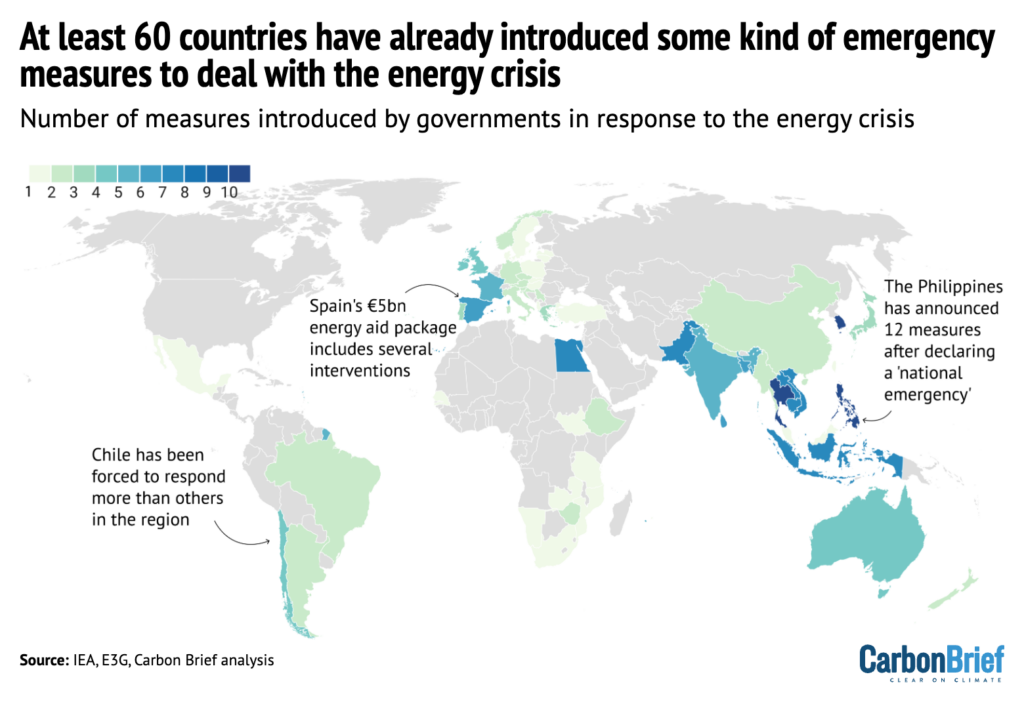
Carbon Brief analysis found that, since the beginning of the Iran war in late February, at least 60 countries have announced nearly 200 emergency energy-saving measures. Around 30 nations, from Norway to Zambia, have cut fuel taxes to help people struggling with rising costs, making this by far the most common domestic policy response to the crisis, said the analysis. Some countries have stressed the need to boost domestic renewable-energy construction, while others – including Japan, Italy and South Korea – have opted to lean more on coal, at least in the short term.
Spotlight
How drag is tackling climate change
This week, Carbon Brief looks at how some drag artists are using their performances to draw attention to climate change
Back in 2005, veteran climate journalist Bill McKibben wrote that “what the warming world needs now is art, sweet art” to help “build a general consciousness about climate change”.
Since then, the topic of climate change has spread to a host of art forms, from literature and music through to comedy and film.
One of the most recent art forms to take up the climate communication baton is drag, with performers using it as a “Trojan horse” to engage with audiences, according to Cheddar Gorgeous, a British drag performer.
‘Joy inspires momentum’
Drag artists around the world have begun to draw attention to the climate movement, using creativity, entertainment and their platforms to engage with their audiences.
In the UK, Cheddar Gorgeous declined a nomination for the British LGBT Awards due to its sponsorship by Shell and has made repeated calls for climate action.
Speaking on the “climate quickie” TEDx podcast, she argued:
“Drag can disrupt the master narratives that dictate our society. I love drag that makes you look at yourself and look at the world in a different way. And that can be deployed in all sorts of exciting ways.”
Drag has a proud history of disruption. As part of a TED talk titled, “Why joy is a serious way to take action”, US drag queen Pattie Gonia provided the audience with some “herstory” about the role of drag within protests. She said:
“Since the birth of the queer rights movement, drag performers and trans people have always been on the forefront of organising and protesting and community building.
“When we had the statistics and the facts on the millions of queer people dying of AIDS, yet no one was joining our fight, drag performers turned pain into joy and, in doing so, welcomed millions more people to fight with us.”

Pattie Gonia is arguably the best-known drag artist to engage with climate change. She is currently touring her environmental drag show “SAVE HER!” and has, according to her website, fundraised more than “$4.7m for LGBTQIA+, BIPOC and environmental non-profits”.
A key part of her message is the need for diversity and inclusion within the climate movement, adding that “our creativity is critical in this climate dilemma”. In her TED talk, she added:
“The problem in the climate movement isn’t just the abundance of carbon; it is the lack of joy. The scientific facts, the doom and gloom, they scare people, they wake them up. But joy is what will get people out of bed every day to take more action.”
Alongside Pattie Gonia, climate conversations are filtering into the wider drag movement, including being a topic repeatedly touched on in the highly successful TV drag contest, RuPaul’s Drag Race.
This ranges from drag artist Asia O’Hara explaining what global warming is in season 10 – telling her fellow contestants: “Bitch, the ice is melting!” – to queens dancing to “97% of scientists and four out of four Drag Race judges agree” that climate change “is real” during a challenge in season 11. (Drag Race host RuPaul Andre Charles has faced criticism for reportedly allowing fracking on his Wyoming ranch.)
Drag is opening up the climate movement to a wider audience, promoting diversity, inclusion and creativity in the space, according to its advocates. For Pattie Gonia, a key part of climate action has to be joy, she added:
“Joy provides an unbelievable opportunity to make the climate movement irresistible. Do not underestimate the power of joy. We deserve more than doom and gloom, because this is the only planet with a Beyoncé on it.”
Watch, read, listen
COOPERATION OVER CHAOS: In the Indian Express, Simon Stiell, the executive secretary of UN Climate Change, argued that “climate cooperation offers a way out of energy price chaos”.
ELECTRIC WORLD ORDER: On the Polycrisis podcast, Mark Blyth, a professor of international economics at Brown University, and Dr Naa Adjekai Adjei, a non-resident fellow, Africa, at the China Global South Project, discussed “what the US dollar has to do” with energy access in Africa.
‘THE RECKONING’: In the Equator, Mona Ali, associate professor of economics at the State University of New York, explored the closure of the Strait of Hormuz and the “end of American hegemony”.
Coming up
- 12 April: Hungarian elections
- 12 April: Peruvian elections
- 13-18 April: World Bank and International Monetary Fund Spring Meetings, Washington, DC, US
- 14 April: IEA Oil Market Report launch
Pick of the jobs
- Global Witness, several climate change jobs | Salary: Varied. Location: London
- London School of Economics, policy fellow – climate, gender and inclusivity | Salary: £53,949-£62,160. Location: London
- Climate Group, senior manager, international policy and advocacy | Salary: £47,160-£49,930. Location: London
- WWF, Nedbank green trust manager | Salary: Unknown. Location: Cape Town or Johannesburg, South Africa
- Greenpeace Australia Pacific, creative producer | Salary: AU$101,272. Location: Australia
- The Fairness Project, climate policy researcher | Salary: $96,000. Location: Remote (US)
DeBriefed is edited by Daisy Dunne. Please send any tips or feedback to debriefed@carbonbrief.org.
This is an online version of Carbon Brief’s weekly DeBriefed email newsletter. Subscribe for free here.


The post DeBriefed 10 April 2026: Worst energy crisis ‘ever’ | India withdraws COP33 bid | Drag artists and climate change appeared first on Carbon Brief.
The state Senate’s version of the bill offers more opportunities for utilities to profit, leading some observers to question whether the legislation will substantively lower costs for customers.
In its most recent energy affordability legislation, the Maryland Senate has reversed key utility accountability proposals passed by the state House and added new ways for utility companies to earn profit, including by reviving a billion-dollar gas subsidy that requires all ratepayers to cover the cost of running new gas pipelines to housing developments.
Utility Accountability Bills Divide Maryland’s Democratic Leadership
Marcelo Behar is the COP30 Special Envoy for Bioeconomy and co-founder of Ambition Loop Brazil.
Can we be the generation to end the rampant deforestation that is harming the planet’s ecosystems and climate? Back in February, the Brazilian COP30 Presidency opened a call for submissions on its proposed Roadmap for Halting Deforestation and Forest Degradation, which closes today.
What might look like a technical step quickly drew significant attention, with more than 100 responses submitted by governments, civil society organisations, businesses and other stakeholders.
This level of engagement is telling. It reflects both the urgency of the issue and the recognition that this process could shape whether the global goal to end deforestation by 2030 finally moves from ambition to delivery.
As a Brazilian, I see this moment with both pride and realism. Brazil has played a central role in elevating forests on the climate agenda, and the COP30 Presidency has shown leadership in carrying this issue forward far beyond the Belém summit.
COP30 rainforest fund unlikely to make first payments until 2028
But last year also offered a sobering signal. Despite strong efforts from the Brazilian Presidency, the proposed roadmap did not secure consensus in the final outcome of COP30. That outcome underlined a simple truth: while there is broad recognition of the importance of forests, agreeing on how to move forward remains complex. The road ahead is still long and likely uneven.
That is precisely why this moment matters.
Progress on commitments falling short
The world is not short of commitments. Over the past decade, countries have repeatedly pledged to halt and reverse deforestation by 2030. There is a growing body of experience through the REDD+ (Reducing Emissions from Deforestation and Degradation) programme, including the emergence of jurisdictional approaches that are beginning to connect forest protection with finance at scale.
Initiatives such as the Forest and Climate Leaders’ Partnership have helped sustain political attention and cooperation among countries, while national strategies continue to evolve, and Indigenous Peoples and local communities remain at the forefront of protecting forests.
And yet, progress is still falling short.
The gap is not only one of alignment. It is also one of political will – and of having a credible, shared pathway that brings together these efforts in a way that drives implementation at scale.
Civil society is watching this process closely. For many organisations working across climate, nature and conservation, this is not just another initiative – it is a priority. After years of advocating to end deforestation, there is a strong sense that this moment cannot be lost. The expectation is clear: this roadmap must move beyond intention and help unlock real progress.
The opportunity now is to ensure that it does exactly that. This cannot become another report.
Implementation key to roadmap success
A detailed assessment of pathways and challenges, however valuable, will not be enough to change outcomes on the ground. What is needed is an implementation roadmap, one that connects existing commitments, aligns incentives and provides clarity on how to move from ambition to delivery between now and 2030.
The consultation process is an important step. But its value will ultimately be judged by what it produces.
If the roadmap is to succeed, several priorities should guide its development.
-
With no COP30 roadmap, hopes of saving forests hinge on voluntary initiatives
The world is falling short of a target to halt deforestation by 2030, but the “Amazon COP” failed to agree a concrete global plan to save rainforests despite backing by over 80 nations -
Deep in the Amazon, forest protection cash must vie with glitter of illegal gold
The TFFF fund launched at COP30 aims to pay communities to protect the rainforest, but will it be enough? On French Guiana’s border with Brazil, the profits to be had from mining are far higher


First: policy. It must be designed as a tool for implementation. That means going beyond diagnosis to define concrete action: who needs to act, by when, and how progress will be tracked. The solutions are not new, but coordination has been missing.
Second: accountability. It should bring coherence to the existing landscape. The value of a roadmap lies not in creating new commitments, but in connecting what already exists: global targets, REDD+ experience, national action plans, Indigenous leadership and supply chain initiatives. Reducing fragmentation is essential to accelerating delivery.
Early milestones needed
Third: finance. It must be grounded in economic reality. Halting deforestation will not happen without addressing the incentives that underpin it. Aligning public finance, private investment, and market demand with forest protection is not a technical detail; it is the core of the transition.
Fourth: transparency. Legitimacy will depend on openness. A credible roadmap cannot be developed behind closed doors. Governments, Indigenous Peoples and local communities, civil society, business and finance actors all have a role to play and must be able to see how their contributions shape the outcome.
Fifth: urgency. Progress must be visible in 2026. Without early milestones, momentum will fade. By the time climate negotiators gather in Bonn mid-year, the roadmap should have a clear structure, priority actions and growing political backing.
Governments must deliver on the plan
Finally, countries themselves will need to step forward. Last year’s outcome showed that support alone is not enough. Delivering this roadmap will require active political engagement. That means governments that are willing not only to participate in the process, but to help shape and implement it.
Brazil has created an important opening. It has also taken on the responsibility that comes with leadership: to help turn a widely supported idea into something that can deliver in practice.
The commitment to end deforestation by 2030 already exists. What is still needed is a path. And the courage to walk it.
The post How a Brazil-led roadmap can rescue global pledge to halt deforestation appeared first on Climate Home News.
How a Brazil-led roadmap can rescue global pledge to halt deforestation

AI Data Centers Power Crisis: Massive Energy Demand Threatens Emissions Targets and Latest Delays Signal Market Shift

DeBriefed 10 April 2026: Worst energy crisis ‘ever’ | India withdraws COP33 bid | Drag artists and climate change
Utility Accountability Bills Divide Maryland’s Democratic Leadership
-
Climate Change8 months ago
Guest post: Why China is still building new coal – and when it might stop
-
Greenhouse Gases8 months ago
Guest post: Why China is still building new coal – and when it might stop
-

 Greenhouse Gases2 years ago
嘉宾来稿:满足中国增长的用电需求 光伏加储能“比新建煤电更实惠”
-
Climate Change2 years ago
Bill Discounting Climate Change in Florida’s Energy Policy Awaits DeSantis’ Approval
-

 Climate Change2 years ago
嘉宾来稿:满足中国增长的用电需求 光伏加储能“比新建煤电更实惠”
-
Climate Change Videos2 years ago
The toxic gas flares fuelling Nigeria’s climate change – BBC News
-

 Renewable Energy6 months ago
Sending Progressive Philanthropist George Soros to Prison?
-

 Carbon Footprint2 years ago
US SEC’s Climate Disclosure Rules Spur Renewed Interest in Carbon Credits