Connect with us

Published

on

To predict the future, you have to create it. This was the phrase I connected with this Juneteenth as I thought about the stories of my ancestors and how they flow into the stories of the future. 

When I Think of Juneteenth, I Think of Energy

Jasmine Graham, Executive Director of the Mid-Hudson Energy Transition, recently spoke on “Climate with Kiana” about energy justice. She reminded the audience, “The very first form of energy to be commodified was the unpaid physical labor of enslaved people.” 

Juneteenth is not only about the past – it is also a day to think about the present and the future. June 19th, 1865 was a day in history that signaled the end of chattel slavery for Black enslaved people in America, but it did not uproot the sociocultural norms and connected systems of exploitation of people and planet’s energy and the marginalization of Black communities and beyond. 

From the historic discriminatory practices of redlining to build out our US highway systems to the current unethical land use and labor practices seen within green tech and manufacturing projects, there is still much work to be done to manifest a world where the collective descendants of an energy system based in enslavement are free and healthy. Transforming our energy and mobility systems is an opening and opportunity to build a better future based on just principles and a respect of life and livelihood. 

Black Communities Cannot Breathe
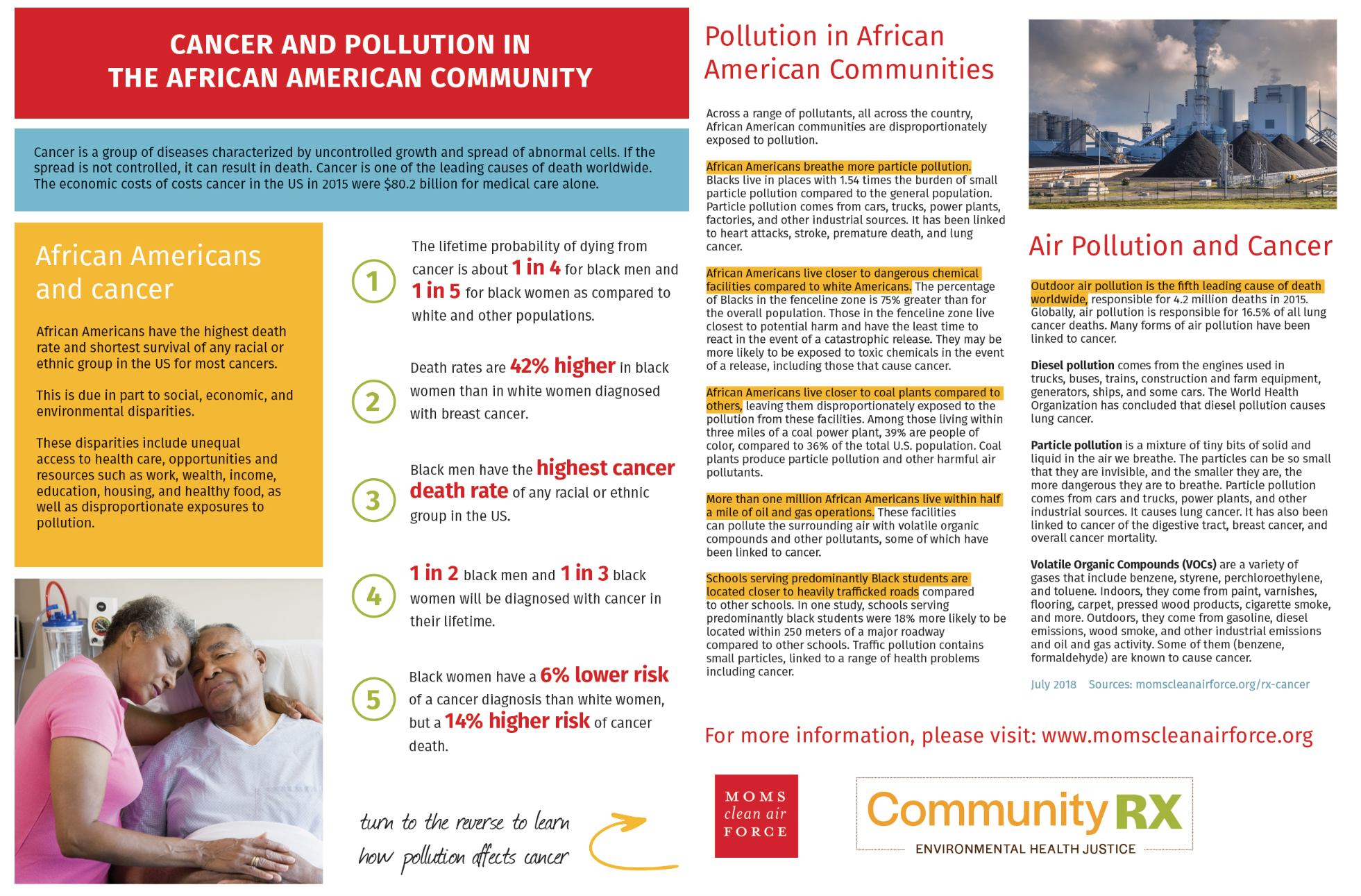
moms for clean CANCER AND POLLUTION IN THE AFRICAN AMERICAN COMMUNITY

Black Americans are 75 percent more likely than other Americans to live in areas situated near facilities that produce hazardous waste. In Albany, Georgia, a majorly Black town in Southwest Georgia, there are seven brownfield sites and two superfund sites just within a mile radius from the center of town. Similarly as concerning, Black American seniors are three times more likely to die from exposure to particle pollution than white seniors. In an article from Capital B Atlanta, it was shared that in a pocket of neighborhoods in Northwest Atlanta “…there are wastewater treatment plants, a train yard, a power plant, a concrete facility, and an asphalt plant. Within the same 3-mile radius, more than 150 jets depart and arrive from Fulton County Airport each day, emitting toxic exhaust that irritates airways.” To imagine this impact plus the major polluting heavy-duty vehicles that make rounds every day, I can feel my throat constrict and my chest burn. As a Black person seeing these impacts first hand, the weight of living in a world that doesn’t value the health of all bodies feels heavy and grim.

Why Should I Keep Hope? 

Environmental anxiety, also known as climate anxiety or eco-anxiety, are terms that have grown in popularity. The constant weight of the destruction of our environment and people looms over us every second. Social media shows us flowers blooming in Antarctica, children in body bags, fires sweeping through the wilderness, and leaders continuing to make decisions that see all the world’s creatures and resources as things to be exploited and depleted. The current reality in front of my eyes scares me and makes me question– what’s the point if the world is doomed? 

And then I think about my ancestors. I think about all the meanings of Juneteenth. I imagine what it must have felt like for my enslaved ancestors. To live in a world where they were only valued for their metabolic energy and how daunting and hopeless it must have felt. But still, my ancestors laughed, danced, and took action toward change to predict and create a future that saw them free.   

I imagine my grandmother, who used to have rocks and glass bottles thrown at her head at segregated concerts, but still, she chose to continue showing up and dancing with her friends. 

I imagine my mother as a child living as part of the first Black families on the street. Waking up one night to the sound of screeching tires and a car packed with dynamite in the front yard. Yet still, my mother continued to play in that exact front yard the next day.    

When I imagine my ancestors’ feelings, it always astonishes me; on the flip side of their pain is their capacity for joy. So how did they do it? How did they continue to find joy in a painful world? The answer I’ve come to is because they didn’t let others write their future for them. 

In Dianne D. Glave’s book, Rooted in the Earth: Reclaiming the African American Environmental Heritage, the author boldly uses creative storytelling to recreate Black naturalists’ stories of the past to explore and reclaim the Black experience of the natural world. Glave demonstrated in each chapter how jumping into the psyche of past ancestors can aid us in understanding the world of then and its connections to now. Traveling through space and time is an imaginative and organizing power that is braided into the culture, spirituality, and philosophy of Black people. 

“Black People are Self-Sufficient” – Stacey Robinson’s Tenets of Afrofuturism

Recently coined as Afrofuturism in many circles, it is a movement that imagines alternate futures or reimagines history through a lens that centers on Black experiences, identities, and perspectives from practices rooted in ancient Africa. From drumming, weaving, and metallurgy to recent historical practices in the Black dysphoria like spoken word, miming, and hip-hop culture, these are just a few of the many modes of communicative practices and knowledge production methods that guide and inform Black knowers throughout the world. 

To take a page from Glave’s method, I imagined a scene. A future that sees a young Black girl traveling in her neighborhood. A vision shaped by intergenerational justice and the ability to breathe deeply. A dream of joy and freedom. Here’s a clip from my envisioned future: 

Skipping out onto the porch, she is greeted with an intermingling roux of sounds. Laughter and the gentle whispers of rustling leaves spirals around her and into the mountain of curls on her head. The ground pulsates with a deep bass of footsteps pounding the sidewalk. The air is crisp and invigorating, carrying with it the sweet aroma of blooming flowers and the earthy scent of mammals sweating. Other children confidently run before her, playing a serious game of freeze tag, all hoping to be frozen under the cool shade of a poplar tree. 

With jubilation, she begins to stride forward through the gumbo of sounds. As she walks through her neighborhood, her ears perk as she passes the melodious symphony of red cardinals and matriarchs gossiping away. The constant chirping soothing her soul and awakening her senses as she rounds the corner. 

Syncopated and energetic beats blast through a speaker. The crunch and scrapes of high-top sneakers on cardboard slice the air as dancers glide, stomp, and spin. A pack of excited onlookers tapping their screens gather to capture the scene. The girl couldn’t help but match her pace to the groove as she shimmied by.  

Moving further down the street, applauding rows of crows perched between two poles enjoy the linemen’s finale. Workers piling into their humming trucks to head towards warm dinners and much deserved rest time. Their vehicle weaves into the buzzing flow of cars, bikes, and trains on their journey home. 

A few blocks down, the girl comes to a leisurely stop. A person with hair like cattails stands next to her, each loc standing taut at their scalp as they wait under the roof of a covered bench. She gasps as she realizes sitting next to her is one of the healers of the neighborhood. An elder who acts as a conduit to understanding the world. A million thoughts run wild like frenzied mice in her mind as she wonders what she should say. Should she ask about her life? The history of the town? Maybe she could just-

“Are you going to get on the bus, sweetheart?” they softly ask. Confused, the girl switches her gaze to see the bus quietly sneak up on them. The elder laughs and holds out their hand, “You mind helping me to a seat?”

Holding onto their hand, the girl leads them towards a spacious seat near the front. Feeling a little embarrassed about getting lost in her thoughts, she stays quiet. 

“You know,” the elder says, breaking the silence, “Back when I was your age, these buses would spit out black smoke. The kind that makes your eyes water and your lungs burn.”  

“Really?” The girl asks in surprise, happy the elder wants to make conversation. 

“Yes,” they lament. “Every time we breathed, it was killing us back then. Cancer, asthma. The sky was hazy from all the pollution. We knew we had to do something about it, cause they weren’t doing anything to help us. We had to create a better future for ourselves.”   

The girl’s eyes are wide as they continue to tell harrowing stories of joy, pain, wins, and losses all the way to their bus stop. These histories fascinate her but also make her realize the unfinished work that still needs to be done to honor the elders’ work. In this moment, as the nuances of daily existence and the whir of the bus surrounds them, a profound sense of peace and gratitude washed over the girl. She was thankful in that moment to hear and experience the clear rhythm of conversation, environment, and life. She took a deep breath and smiled.    

Electric Black Futures 

To lean on the words of Outkast, “the South got something to say”. The South is a hotbed of innovation and through the rapid creation of electric vehicle (EV) and battery hubs, this region is being put in a unique position to shape and influence a mobility culture that works better for everyone.

Georgia is one of the states being tailored as an EV hub and is positioned to receive billions of dollars in benefits from this emerging clean technology. Initiatives like Electric Black Futures, a recently launched project advocating for crafting just e-mobility futures and narratives in Black communities in Georgia, are an opportunity to reimagine an energy and transportation system that sees communities as people, not products.

By bolstering and connecting the preexisting visions and work of Black knowers to the cross-sector work of the electric transportation field, it allows us to address and dismantle oppressive energy and mobility practices from production to consumption. Expanding upon the collective efforts of environmental justice reimagining work that’s happening in Georgia has the potential to evolve an energy system based in pain into an energy system based in joy.  

As the mother of the environmental justice movement, Hazel M. Johnson said, “It’s all very well to embrace saving the rain forests and conserving endangered animal species, but such global initiatives don’t even begin to impact communities inhabited by people of color.” The electric transition is a people transition as much as it is an emissions solution. As transformational funding funnels into states like Georgia, Black and other marginalized communities who experience the worst and first of environmental degradation and climate impacts must have their knowledge and minds at the helm of ideating and implementing solutions that are self-sufficient, sustainable, and transcend the barriers of our past and current energy system. As Juneteenth teaches us, freedom is not won until freedom is felt by all, people and planet must be considered as we paint a future toward collective wellness.

Electric Black Futures is a collaborative program between Southern Alliance for Clean Energy, EVNoire, and Clean Cities Georgia, committed to invigorating e-mobility leadership and job opportunities in Black communities in Atlanta, Savannah, and Albany, Georgia. By centering communities’ knowledge, vision, culture, and imagination, this project aims to put more Black hands at the helm of driving the direction and crafting the electric future. To learn more, visit the Electric Black Futures website, sign up for email updates, or email info@electricblackfutures.org.

Stay Updated With Electric Black Futures

The post A Time to Reimagine our Energy Future appeared first on SACE | Southern Alliance for Clean Energy.


A Time to Reimagine our Energy Future

Continue Reading

Renewable Energy

Sunrez Prepreg Cuts Blade Repairs to Minutes

Published

on

Weather Guard Lightning Tech

Sunrez Prepreg Cuts Blade Repairs to Minutes

Bret Tollgaard from Sunrez joins to discuss UV-curing prepreg that cuts blade repair time by up to 90% and has recently recieved OEM approval.

Sign up now for Uptime Tech News, our weekly newsletter on all things wind technology. This episode is sponsored by Weather Guard Lightning Tech. Learn more about Weather Guard’s StrikeTape Wind Turbine LPS retrofit. Follow the show on YouTubeLinkedin and visit Weather Guard on the web. And subscribe to Rosemary’s “Engineering with Rosie” YouTube channel here. Have a question we can answer on the show? Email us!

Allen Hall: Brett, welcome back to the program. 

Bret Tollgaard: Thanks for having me again.

Allen Hall: So a lot’s happening at sunrise at the moment. Uh, there’s, uh, activity with sunrise materials on a lot of blades this year.

Over the last couple of years actually, ISPs, operators, OEMs, are realizing that UV curing is a huge advantage.

Bret Tollgaard: Turns out there’s a lot of value added, uh, to the entire process when utilizing UV cure, uh, pre-req.

Allen Hall: So the, the pre pres are, have been available for a couple of years. The qualification though was always the concern.

Has the OEM qualified this material? Are they gonna give you the blessing? Does this show up in the manual? If I call the OEM, are they gonna say they have talked to you guys? A lot of those hurdles have been cleared at this point.

Bret Tollgaard: Yeah, great question. And we are happy to announce that we have finally been approved by a large OEM for use on the epoxy blade for now all general kind of repairs.

We have several more OEMs that have already passed their phase one mechanical testing, and we’re iterating through now [00:01:00] their, uh, secondary and tertiary kind of tests. And so we do expect to be fully qualified by several OEMs before the end of the year, which should make the ISPs integration and utilization of our materials much, much easier.

Allen Hall: So the, the, the problem you’re solving is repairs in the field for the most part, or sometimes in the factory. Mm-hmm. But a lot of times in the field that those repairs. It happened quite a bit. They’re the same repair, the same area, the same kind of thing over and over and over again. And wetting out fabric on site takes time.

Particularly if you’re using standard materials, you have to bag it. You have to apply heat in some cases to get it to kick, and then you have to wait several hours for it to cure. So in the repair cycle time, most of your time is waiting.

Bret Tollgaard: It sure is. Uh, and on top of all that, we all know that there aren’t enough technicians in this industry to even do all the repairs, uh, that would like to be done.

Yeah. And so to really kind of streamline all of that, [00:02:00] uh, we’ve rolled out a couple of new things and we’ve had a lot more interest in some pre consolidated preki patches for customers. Uh, if a particular blade model has an issue that is a standardized kind of repair. We’re actually now building custom prepregs, or we will build the appropriate width length, stack it, consolidate it, uh, wrap it between our films.

So then all the customer has to do when they get on site is, uh, you know, do do the appropriate surface prep. Scarfing, apply a little bit of our UV surface primer to the backside of that patch. But now they can go up tower, single peel, stick, roll out, and then they’re cured.

Allen Hall: And that’s a. How many hours of saving is that?

It’s gotta be like six, 12 hours of saving, of, of

Bret Tollgaard: labor. It’s upwards of 80 to 90% of the labor that’s gonna actually need to be done to apply that. Otherwise, and then same thing too. We’ve had a couple instances where we took a several day repair down to one, to two to three hours. And these are multi-meter long repairs that were fast tracked because we pre consolidated preki [00:03:00] everything.

Some were in flat sheet forms, some were much longer on rolls, where you’re actually then rolling out with a team. Um, and so we’ve been able to demonstrate several times, uh, over the last 12 months, uh, the, the value that a UV cure preprint.

Allen Hall: Well, sure, because that, that would make sense. The issue about wetting out fabric in the field you just done in the back of a trailer or something, somewhere like that.

Usually it is, it’s that you’re never really sure that you got the fabric wetted out. The experienced technicians always feel like, have done it enough that they get very consistent results. But as you mentioned, getting technicians is hard and, and there’s so many repairs to do. So you’re doing those wetting out composite things takes practice and skill.

Just buying it, preki it, where you have control over it. And you guys sell to the military all the time. So that, and you’re, are you ass 91 qualified yet? You’re in the midst of that?

Bret Tollgaard: So we, I mean, a, we just got ISO certified, uh, at the end of last year in December. So our [00:04:00] QMS system and everything like that’s up to date, that’s huge.

Another big qualification for the OEMs that want to see, you know, true quality and output.

Allen Hall: That’s it. I, if I’m gonna buy a preki patch, so, uh, uh, that would make sense to me, knowing that. There’s a lot of rigor as a quality system. So when I get out the the site and I open that package, I know what’s inside of it every single time.

Bret Tollgaard: Well, and that’s just it. And like we got qualified based on the materials that we can provide and the testing that’s being done in real world situations when you’re wetting out by hand and you’re vacuum backing and you’re trying to cure. It is a little bit of an art form when you’re doing that. It is, and you might think you have a great laminate, you got void content, or you haven’t properly went out that glass ’cause humidity or the way the glass was stored or it was exposed.

The sizing and the resin don’t really bite. Well. You might think you have a great repair, but you might be prematurely failing as well after X cycles and fatigue. Uh, simply because it’s not as easy to, to truly do. Right? And so having the [00:05:00] pre-wet, uh, pre impregnated glass really goes a long way for the quality, uh, and the consistency from repair to repair.

Allen Hall: Well, even just the length of the season to do repairs is a huge issue. I, I know I’ve had some discussions this week about opening the season up a little bit, and some of the ISPs have said, Hey, we we’re pretty much working year round at this point. We’re, we’ll go to California. We’ll go to Southern Texas.

We’ll work those situations. ’cause the weather’s decent, but with the sunrise material, the temperature doesn’t matter.

Bret Tollgaard: Correct. And I was actually just speaking to someone maybe half hour ago who came by and was talking about repairs that they had to do in Vermont, uh, in December. They could only do two layers of an epoxy repair at a time because of the amount of the temperature.

Allen Hall: Yeah.

Bret Tollgaard: Whereas you could go through, apply a six or an eight layer pre-reg cure it in 20 minutes. Uh, you know, throughout that entire length that he had and you would’ve been done. That’s, and so it took several days to do a single repair that could have been done in sub one hour with our material.

Allen Hall: I know where those wind turbines are.

[00:06:00] They weren’t very far from, we used to live, so I understand that temperature, once you hit about November up in Vermont, it’s over for a lot of, uh, standard epoxy materials and cures, it is just not warm enough.

Bret Tollgaard: Yeah, we, we’ve literally had repairs done with our materials at negative 20 Fahrenheit. That were supposed to be temporary repairs.

They were installed four or five years ago. Uh, and they’re still active, perfectly done patches that haven’t needed to be replaced yet. So,

Allen Hall: so, because the magic ingredient is you’re adding UV to a, a chemistry where the UV kicks it off. Correct. Basically, so you’re, it’s not activated until it’s hit with uv.

You hit it with uv that starts a chemical process, but it doesn’t rely on external heat. To cure

Bret Tollgaard: exactly. It, it is a true single component system, whether it’s in the liquid pre preg, the thickened, uh, the thickened putties that we sell, or even the hand lamination and effusion resin. It’s doped with a, a variety of different food initiators and packages based on the type of light that’s [00:07:00] being, uh, used to, to cure it.

But it will truly stay dormant until it’s exposed to UV light. And so we’ve been able to formulate systems over the last 40 years of our company’s history that provide an incredibly long shelf life. Don’t prematurely gel, don’t prematurely, uh, you know, erode in the packaging, all those

Allen Hall: things.

Bret Tollgaard: Exactly.

Like we’ve been at this for a really long time. We’ve been able to do literally decades of r and d to develop out systems. Uh, and that’s why we’ve been able to come to this market with some materials that truly just haven’t been able to be seen, uh, delivered and installed and cured the way that we can do it.

Allen Hall: Well, I think that’s a huge thing, the, the shelf life.

Bret Tollgaard: Mm-hmm.

Allen Hall: You talk to a lot of. Operators, ISPs that buy materials that do have an expiration date or they gotta keep in a freezer and all those little handling things.

Bret Tollgaard: Yep.

Allen Hall: Sunrise gets rid of all of that. And because how many times have you heard of an is SP saying, oh, we had a throwaway material at the end of the season because it expired.

Bret Tollgaard: Oh, tremendously

Allen Hall: amount of, hundred of thousands of dollars of material, [00:08:00]

Bret Tollgaard: and I would probably even argue, say, millions of dollars over the course of the year gets, gets thrown out simply because of the expiration date. Um, we are so confident in our materials. Uh, and the distributors and stuff that we use, we can also recertify material now, most of the time it’s gonna get consumed within 12 months Sure.

Going into this kind of industry.

Allen Hall: Yeah.

Bret Tollgaard: Um, but there have been several times where we’ve actually had some of that material sent back to us. We’ll test and analyze it, make sure it’s curing the way it is, give it another six months shelf, uh, service life.

Allen Hall: Sure.

Bret Tollgaard: Um, and so you’re good to go on that front

Allen Hall: too.

Yeah. So if you make the spend to, to move to sun, you have time to use it.

Bret Tollgaard: Yes.

Allen Hall: So if it snows early or whatever’s going on at that site where you can’t get access anymore, you just wait till the spring comes and you’re still good with the same material. You don’t have to re-buy it.

Bret Tollgaard: Exactly. And with no special storage requirements, like you mentioned, no frozen oven or frozen freezer, excuse me, uh, or certain temperature windows that has to be stored in, uh, it allows the operators and the technicians, you know, a lot more latitude of how things actually get

Allen Hall: done.

And, and so if. When we [00:09:00] think about UV materials, the, the questions always pop up, like, how thick of a laminate can you do and still illuminate with the UV light? And make sure you curate I I, because you’re showing some samples here. These are,

Bret Tollgaard: yeah.

Allen Hall: Quarter inch or more,

Bret Tollgaard: correct. So

Allen Hall: thick samples. How did you cure these?

Bret Tollgaard: So that was cured with the lamp that we’ve got right here, which are standard issued light, sold a couple hundred into this space already. Um, that’s 10 layers of a thousand GSM unidirectional fiber. Whoa. This other one is, uh, 10 layers of, of a biox. 800 fiber.

Allen Hall: Okay.

Bret Tollgaard: Uh, those were cured in six minutes. So you can Six

Allen Hall: minutes.

Bret Tollgaard: Six minutes.

Allen Hall: What would it take to do this in a standard epoxy form?

Bret Tollgaard: Oh, hours,

Allen Hall: eight hours maybe?

Bret Tollgaard: Yeah. About for, for the, for the post cure required to get the TGS that they need in the wind space, right? Absolutely. And so yeah, we can do that in true minutes. And it’s pre impregnated. You simply cut it to shape and you’re ready to rock.

Allen Hall: And it looks great when you’re done, mean the, the surface finish is really good. I know sometimes with the epoxies, particularly if they get ’em wetted out, it doesn’t. It [00:10:00] doesn’t have that kind of like finished look to it.

Bret Tollgaard: Exactly. And the way that we provide, uh, for our standard, uh, you know, pre pprs are in between films and so if you cure with that film, you get a nice, clean, glossy surface tack free.

But as more and more people go to the pre consolidation method down tower, so even if they buy our standard prereg sheets or rolls, they’re preki down tower, you can also then just apply a pre, uh, a peel ply to that top film. Oh, sure. So if you wet out a peel ply and then you build your laminate over the top.

Put the primer and the black film over when they actually get that up on tower, they can then just remove that fuel ply and go straight to Sandy or uh, uh, painting and they’re ready to rock.

Allen Hall: Wow. Okay. That’s, that’s impressive. If you think about the thousands and thousands of hours you’ll save in a season.

Where you could be fixing another blade, but you’re just waiting for the res, the cure,

Bret Tollgaard: and that’s just it. When you’re saving the amount of labor and the amount of time, and it’s not just one technician, it’s their entire team that is saving that time. Sure. And can move on to the next [00:11:00] repair and the next process.

Allen Hall: So one of the questions I get asked all the time, like, okay, great, this UV material sounds like space, age stuff. It must cost a fortune. And the answer is no. It doesn’t cost a fortune. It’s very price competitive.

Bret Tollgaard: It, it really is. And it might be slightly more expensive cost per square foot versus you doing it with glass and resin, but you’re paying for that labor to wait for that thing to cure.

And so you’re still saving 20, 30, 40 plus percent per repair. When you can do it as quickly as we can do it.

Allen Hall: So for ISPs that are out doing blade repairs, you’re actually making more money.

Bret Tollgaard: You are making more money, you are saving more money. That same group and band of technicians you have are doing more repairs in a faster amount of time.

So as you are charging per repair, per blade, per turbine, whatever that might be, uh, you’re walking away with more money and you can still pass that on to the owner operators, uh, by getting their turbines up and spinning and making them more money.

Allen Hall: Right. And that’s what happens now. You see in today’s world, companies ISPs that are proposing [00:12:00] using UV materials versus standard resin systems, the standard residence systems are losing because how much extra time they’re, they’re paying for the technicians to be on site.

Bret Tollgaard: Correct.

Allen Hall: So the, the industry has to move if you wanna be. Competitive at all. As an ISP, you’re gonna have to move to UV materials. You better be calling suns

Bret Tollgaard: very quickly. Well, especially as this last winter has come through, the windows that you have before, bad weather comes in on any given day, ebbs and flows and changes.

But when you can get up, finish a repair, get it spinning, you might finish that work 2, 3, 4 later, uh, days later. But that turbine’s now been spinning for several days, generating money. Uh, and then you can come back up and paint and do whatever kind of cosmetic work over the top of that patch is required.

Allen Hall: So what are the extra tools I need to use Sunz in the kits. Do I need a light?

Bret Tollgaard: Not a whole lot. You’re gonna need yourself a light. Okay. You’re gonna need yourself a standard three to six inch, uh, bubble buster roller to actually compact and consolidate. Sure. Uh, that’s really all you need. There’s no vacuum lights.

And you sell the lights. We do, we, [00:13:00] we sell the lights. Um, our distributors also sell the lights, fiberglass and comp one. Uh, so they’re sourced and available, uh, okay. Domestically, but we sell worldwide too. And so, uh, we can handle you wherever you are in the world that you wanna start using uv, uh, materials.

And yeah, we have some standardized, uh, glass, but at the same time, we can pre-reg up to a 50 inch wide roll. Okay, so then it really becomes the limiting factor of how wide, how heavy, uh, of a lamette does a, a technician in the field want to handle?

Allen Hall: Yeah, sure. Okay. In terms of safety, with UV light, you’re gonna be wearing UV glasses,

Bret Tollgaard: some standard safety glasses that are tinted for UV protection.

So they’ll

Allen Hall: look yellow,

Bret Tollgaard: they’ll look a little yellow. They’ve got the shaded gray ones. Sunglasses, honestly do the same.

Allen Hall: Yeah.

Bret Tollgaard: But with a traditional PPE, the technicians would be wearing a tower anyways. Safety glasses, a pair of gloves. You’re good to go. If you’re doing confined space, work on the inside of a, a, a blade, uh, the biggest value now to this generation of material that are getting qualified.

No VOC non [00:14:00] flammable, uh, no haps. And so it’s a much safer material to actually use in those confined spaces as well as

Allen Hall: well ship

Bret Tollgaard: as well as ship it ships unregulated and so you can ship it. Next day air, which a lot of these customers always end. They do. I know that.

Allen Hall: Yeah.

Bret Tollgaard: Um, so next day air, uh, you know, there’s no extra hazmat or dangerous goods shipping for there.

Uh, and same thing with storage conditions. You don’t need a, a flammable cabinet to actually store the material in.

Allen Hall: Yeah.

Bret Tollgaard: Um, so it really opens you up for a lot more opportunities.

Allen Hall: I just solves all kinds of problems.

Bret Tollgaard: It, it really does. And that’s the big value that, you know, the UV materials can provide.

Allen Hall: So. I see the putty material and it comes in these little tubes, squeeze tubes. What are these putties used for?

Bret Tollgaard: So right now, the, the existing putty is really just the same exact thickened, uh, resin that’s in the pre-print.

Allen Hall: Okay.

Bret Tollgaard: And it’s worked well. It’s, it’s nice we’re kind of filling some cracks and some faring, some edges and stuff if things need to be feathered in.

But we’ve [00:15:00] been working on this year that we’ll be rolling out very, very soon is a new structural putty. Okay. So we’ll actually have milled fibers in there and components that will make it a much more robust system. And so we’ve been getting more inquiries of, particularly for leading edge rehabilitation.

Where Cat three, cat four, even cat five kind of damage, you need to start filling and profiling before any kind of over laminates can really be done properly. And so we’re working on, uh, rolling that out here very, very soon. Um, and so that will, I think, solve a couple of needs, um, for the wind market. Uh, and then in addition to some new products that we’re rolling out, uh, is gonna be the LEP system that we’re been working on.

Uh, the rain erosion testing showed some pretty good results. But we’re buying some new equipment to make a truly void free, air free system that we’re gonna it, uh, probably submit end of April, beginning of May for the next round, that we expect to have some very, very good, uh, duration and weather ability with,

Allen Hall: because it’s all about speed,

Bret Tollgaard: it’s durability.

Allen Hall: All about e

Bret Tollgaard: Exactly. And ease of use by someone in the [00:16:00] field. Yeah. Or OEMs on, you know, in the manufacturing plant. Um, there has yet, in my opinion, to be a true winner in the LEP space. That is just the right answer. And so by applying our materials with the really high abrasion resistance that we expect this to have and be as simple to do as it really appeal, stick and cure, um, we think it’s gonna be a bit of a game changer in this industry.

Allen Hall: Well, all the sunrise materials, once they’re cured, are sandal

Bret Tollgaard: correct.

Allen Hall: And I think that’s one of the things about some of the other systems, I always worry about them like, alright, they can do the work today, but tomorrow I have to come back and touch it again. Do I have a problem? Well, and the sun rests stuff is at least my playing around with it has been really easy to use.

It’s, it’s. Uh, things that I had seen maybe 20 years ago in the aerospace market that have they thought about using the material not only [00:17:00] in the factory, but outside the factory. How easy is it to adapt to, how easy to, to paint, to all those little nuances that come up? When you’re out working in the field and trying to do some very difficult work, uh, the sunroom material is ready to go, easy to use and checks all the boxes, all those little nuances, like it’s cold outside, it’s wet outside.

Uh, it’s, it’s hot outside, right? It’s all those things that, that stop ISPs or OEMs from being super efficient. All those parameters start to get washed away. That’s the game changer and the price point is right. How do. People get a hold of you and learn about the sun rose material. Maybe they, you can buy through fiberglass or through composite one.

Mm-hmm. That’s an easy way to do, just get to play with some samples. But when they want to get into some quantity work, they got a lot of blade repair. They know what they’re doing this summer or out in the fall or this winter come wintertime. How do they get [00:18:00] started? What do they do?

Bret Tollgaard: Well, one of the first things to do is they can reach us through our website.

Um, we’re developing a larger and larger library now for how to videos and install procedures, um, generating SOPs that are, you know, semi, uh, industry specific. But at the same time too, it’s a relatively blanket peel and stick patch, whether it’s a wind turbine blade, a corroded tank, or a pressure pipe. Um, and so yeah, www.suns.com Okay, is gonna be a great way to do it.

Uh, we’re actively building more videos to put on, uh, our YouTube channel as well. Um, and so that’s kind of gonna be the best way to reach out, uh, for us. One of the big things that we’re also pushing for, for 26 is to truly get people, uh, in this, in industry, specifically trained and comfortable using the products.

At the end of the day, it’s a composite, it’s a pre impregnated sheet. It’s not difficult, but there are some tips and tricks that really make the, the use case. Uh, the install process a lot easier.

Allen Hall: Sure.

Bret Tollgaard: Uh, and so just making sure that people are, are caught up on the latest and greatest on the training techniques will [00:19:00] go a long way too.

Allen Hall: Yeah. It’s only as good as the technician that applies it

Bret Tollgaard: e Exactly.

Allen Hall: Yeah. That’s great. Uh, it’s great all the things you guys are doing, you’re really changing the industry. In a positive way, making repairs faster, uh, more efficient, getting those turbines running. It’s always sad when you see turbines down with something that I know you guys could fix with sun.

Uh, but it does happen, so I, I need the ISPs to reach out and start calling Sun and getting in place because the OEMs are blessing your material. ISPs that are using it are winning contracts. It’s time to make the phone call to Sun Rez. Go to the website, check out all the details there. If you wanna play with your material, get ahold of fiberglass or composite one just.

Order it overnight. It’ll come overnight and you can play with it. And, and once you, once you realize what that material is, you’ll want to call Brett and get started.

Bret Tollgaard: A hundred percent appreciate the time.

Allen Hall: Yeah. Thanks Brett, for being on the podcast. I, I love talking to you guys because you have such cool material.

Bret Tollgaard: Yeah, no, we’re looking, uh, forward to continuing to innovate, uh, really make this, uh, material [00:20:00] splash in this industry.

Sunrez Prepreg Cuts Blade Repairs to Minutes

Continue Reading

Renewable Energy

Infringing on the Rights of Others

Published

on

I agree with what Ricky Gervais says here; I would only add that there are dozens of ways religion impinges on others.

In my view, the most common is that it impedes our implementing science in things like climate change mitigation.  If you believe, as is explicit in the Book of Genesis, that “only God can destroy the Earth,” you have a good excuse to ignore the entirety of climate science.

Infringing on the Rights of Others

Continue Reading

Renewable Energy

Could You Be Paid to Sew Disinformation into Our Society?

Published

on

99% of this totally incorrect.

But hey, who cares, right? There’s a huge market for disinformation, and I’m sure you were handsomely paid.

Could You Be Paid to Sow Disinformation into Our Society?

Continue Reading

Trending

Copyright © 2022 BreakingClimateChange.com