

As countries ramp up pressure for a COP30 decision on a roadmap to transition away from fossil fuels, they have yet to push hard in the Amazon city of Belém for another much-anticipated roadmap to end deforestation.
Discussions on both mechanisms took off after Brazilian President Luiz Inácio Lula da Silva told world leaders at the summit’s opening that COP30 must deliver “roadmaps to plan in a fair way the reversal of deforestation, reducing the dependency on fossil fuels and to mobilise the necessary resources to reach these objectives”.
Since then, more than 80 countries have rallied behind a fossil fuel transition roadmap – yet negotiators from tropical countries and observers say a roadmap to end deforestation has not gained the same momentum at the UN climate talks.
At least 42 countries have expressed support for a deforestation roadmap – among them the European Union, the AILAC group of Latin American countries and the Environmental Integrity Group which includes Mexico, Liechtenstein, Monaco, South Korea, Switzerland and Georgia.
World failing on goal to halt deforestation by 2030, raising stakes for Amazon COP
Current negotiating drafts include an option to convene a dialogue of ministers on the creation of national roadmaps to end deforestation, which observers told Climate Home News is a weak option that must be improved with more pressure from countries.
Panama’s head of delegation Juan Carlos Monterrey told an event hosted by Climate Home News this week that a plan to protect forestats has to be one of the key outcomes of COP30. “If we don’t get a roadmap to end deforestation at the Amazonia COP, we will never get it,” he said.
Irene Vélez Torres, Colombia’s environment minister, called on countries to support the roadmap in an op-ed, adding that time is of the essence – and that ending deforestation can’t be achieved by “just blindly marching forward without a clear sense of direction”.
At COP26, more than 140 countries agreed to halt and reverse deforestation and land degradation by 2030 – a pledge that was reiterated in the landmark COP28 deal where countries also agreed to transition away from fossil fuels.
But a recent report by conservation groups and research institutions shows that governments are far off track, as deforestation levels last year were 63% higher they should be to meet the deforestation goal.
Need to pick up momentum
Observers told Climate Home News that forests have been a predominant theme in Belém outside the formal talks, where the Brazilian government has launched initiatives like the Tropical Forest Forever Facility (TFFF) – a new fund to protect rainforests.
But inside the negotiations, countries need to pick momentum, said Fernanda Carvalho, head of policy for climate and energy at WWF, given that they have been presented with a “unique opportunity” to agree on a deforestation roadmap.
Norway pledges $3bn in boost for Brazil-led tropical forest fund
Carolina Pasquali, executive director of Greenpeace Brazil, said conversations should include commitments on both fossil fuels and forests, adding “it’s not one or the other”.
“For me, the sad part about this is that I have not heard a single party saying they are against it. So if this doesn’t happen just because not enough momentum was created, what kind of result is that?” she told journalists in Belém.
Any roadmap to end deforestation would need to create a “clear international process” that allows countries to coordinate action and “send a strong signal that forests are central to the climate solution”, said Kendall Damon, climate policy associate at The Nature Conservancy.
Veteran Brazilian tropical scientist Carlos Nobre told a press conference that important ecosystems like the Amazon rainforest and coral reefs across the world are approaching a dangerous tipping point, which could cause them to collapse irreversibly.
Indigenous peoples call for forest outcome
A strong outcome in the COP30 “Mutirão” political decision on reversing deforestation is one of the main Indigenous demands, said Juan Carlos Jintiach, an Indigenous activist from the Ecuadorian Amazon and executive secretary of the Global Alliance of Territorial Communities.
He added that any plan to reverse deforestation must also address the rights of Indigenous communities, emphasising that “for us, any conversation on forests is a conversation on land tenure”.
During COP30, Indigenous groups in Brazil have secured major victories in demarcation of their land, with the creation of 10 new territories, after several protests at the conference venue in Belém and a meeting on the sidelines with the ministers for environment and Indigenous peoples.
Earlier in the two-week summit, 35 countries and philanthropic organisations renewed a five-year pledge to provide Indigenous people, local communities and Afro-descendent communities with $1.8 billion to help secure their land rights in key ecosystems.
“We will cooperate with any goal to halt deforestation – but governments need to work with us directly,” said Jintiach. “Countries need to be coherent in the applicability of their commitments.”
The post As fossil fuels dominate Amazon COP, a roadmap to end deforestation falls behind appeared first on Climate Home News.
As fossil fuels dominate Amazon COP, a roadmap to end deforestation falls behind

© Harriet Spark / Grumpy Turtle Film / Greenpeace
The banner drop is a distinctive part of the Greenpeace repertoire.
The moment of the unfolding is intrinsically dramatic. It is the reveal; when the moral and scientific truth of a situation is unveiled to the world. The wrong is being labelled—not through a written submission, or a social media post, or a statement in a meeting—but in words emblazoned in real physical space, chosen and occupied with precision, for all to see. There is jeopardy and transgression. And there are consequences—for the activists and for Greenpeace, as well as for the target of the communication. One of the reasons the banner remains such an effective tool in our toolbox is because of its undeniable clarity in cutting through, driving change and accountability in a way that few other tactics can. It is naming the wrong: in giant, clear letters.
We’ve hung these massive messages at environmental crime scenes, corporate headquarters, and iconic landmarks; on government buildings, ships and planes—in locations all around the world, for years.
My own memories unfurl even as I write this, but because the campaign to stop Woodside at Scott Reef is so pressing, what immediately springs to mind are two of our banners in that campaign: one on a crane outside their Perth HQ, and another on some of their corroding industrial junk at sea. What about you? Is there a particular banner that you picture when you think of Greenpeace?
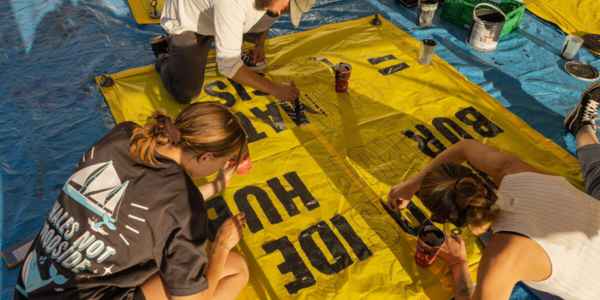
The banners can attract global attention, but they have quiet beginnings. Each one is made by hand, often by volunteers. It is the invisible labour behind each spectacular public moment. One of the key pieces of equipment in our workshop at Rainbow Warrior House is the sewing machine. Sometimes our workshop is full of people and noise; at others it is quiet, the only sound being the gentle, purposeful, whir and buzz of a banner being sewn. It is usually our warehouse manager, Kieran Holmes, on the tools, head over the machine, carefully pouring over the raw canvas or tarp as the banner takes shape. Kieran’s one of those people who seems to be able to turn his hand to almost anything, but you wouldn’t know it because he’s old-school modest. In addition to being incredibly skilled, Kieran’s an all-round beaut human to have in the heart of our headquarters; never too busy to take the time to show a newcomer, or curious visitor, around his domain.
Once the banner is sewn up, the lettering needs to be outlined. This is done on a magnetic wall—a fit-for-purpose feature at Rainbow Warrior House, where the banner is held up with magnets, and the edges of the letters neatly traced from a projection.
Next comes the painting. It usually starts late in the afternoon, sometimes going into evenings and weekends, with volunteers, staff, mates crowded around, brushes in hand. It is a calming meditative feeling of shared purpose, giving each letter its visual heft, the colour building power and presence with each stroke.
Then you stand back, stretch, and look at the message, now ready.
S A V E S C O T T R E E F
Throughout history, every great push for social change has required some form of invisible labour; preparation in the form of quiet things seldom seen, but vital. It is the enabling work of love instantiated in action. And of course, so much of the time it has been women who have done this labour, so that the men could get the chance to make the speeches and stand on the podiums. The inaugural Greenpeace voyage to stop nuclear testing in 1971 had a male-only crew, but wouldn’t have happened without the ideas and work of women behind the scenes.
It is what we do together, after all, that changes the world. Sometimes that work happens on a stage, a ship on the wild seas, or up the side of a building. But mostly, it is the hidden diligence of those who care and contribute to all the enabling work that makes a change once thought impossible, inevitable. It is Kieran at his sewing machine. It was Dorothy Stowe doing the administrative work of the ‘Don’t Make A Wave Committee’ that became Greenpeace.
When we think of social change, it is the sturm and drang that we remember. The drop of the banner, the chant of the crowd, the raising of the new flag. But look behind the curtain, and there’ll be a crew of people who are taking responsibility for the administration, the sewing and the painting, making the food, checking the bus timetables, getting stuff done. And behind them are even more handsinvisibly donating time and trust; the financial, material and expert resources that make it all possible. There’s love, camaraderie and know-how at every stage.
We are social and cooperative creatures by nature. And we human beings have been stitching for millenia, sewing the possibilities of our common future. Political and corporate bullies and algorithmically manipulative platforms would have us forget this, and abandon who we are. But we should be in no doubt that the brighter prospects for ourselves and life on earth continue to be stitched and painted; collaboratively and with love, by the diligent hands of millions of people who care, each day, in every community and city across the world.
With Love,
David
Q & A
I always get great questions when interviewing prospective new team members. One that came up again recently was: “Is Greenpeace actually one organisation?”
Around the world, people know Greenpeace by our one global name, united by a shared mission: securing an Earth capable of nurturing life in all its magnificent diversity, with a particular focus on climate and biodiversity. Behind the scenes, though, we’re organised as a network of 25 legally autonomous national and regional offices, including Greenpeace Australia Pacific, working alongside Greenpeace International.
That structure gives us the best of both worlds: we work together leveraging the power of a global network on the issues that matter most, while each office remains legally independent and deeply connected to the communities, cultures and political realities where we’re embedded. Local knowledge informs global action, and global collaboration strengthens and supports local campaigns.
It’s a model that has enabled Greenpeace to take on some of the world’s biggest challenges for over five decades–while withstanding challenges and attacks from governments and corporations. Global enough to tackle global problems, local enough to understand our communities and the natural places we love.
If you’re curious to learn more, you can read about the Greenpeace Global Network structure here.
Steven Stone is acting director of the United Nations Environment Programme’s Office of Science
In 1934, American economist Simon Kuznets presented a paper to Congress advocating for a new way of measuring economic performance.
The United States was reeling from the Great Depression, and Kuznets – a future Novel prize winner – wanted to gauge just how badly the country’s economy had been dented.
His metric, which would come to be known as gross domestic product (GDP), was a breakthrough. But as pioneering as it was, Kuznets saw its limitations.
“The welfare of a nation can scarcely be inferred from a measure of national income,” he wrote in the 1934 paper.
Some nine decades on, we have largely forgotten that message. GDP has become a barometer of economic progress, a kind of one-number-that-rules-them-all upon which national policies turn and governments rise and fall.
With the climate crisis deepening by the day – as evidenced by the heatwaves and wildfires now searing Europe – our attachment to GDP is looking like a problem.
In a single-minded pursuit of GDP growth, humanity is inadvertently feeding several environmental crises that, over the long run, threaten to make most of us poorer, sicker and more miserable. Climate change alone could slice 20 per cent off global GDP by 2100 – a staggering number.
Clear-cutting boosts GDP not wealth
We need to broaden our vision and definition of economic success before it’s too late.
I grew up in the 1970s and 80s surrounded by the mixed hardwood forests of the northeastern United States. For me, the trees were a refuge, a place to run, discover and savor the history and mystery of the land and its people.
Those experiences with my friends were more important than the amount of money in my pocket. And they led to a realization early on in my career as an economist: that wealth is about more than just income.
This is one of GDP’s most significant oversights.
With every forest we clear cut and every ounce of fossil fuel we burn, GDP rises. But through those actions, we are whittling away at the natural world, which supplies us with food, water, medicine, clean air and countless other essentials.
-
China’s coal power rebounds as record clean energy goes to waste
Long-term contracts guarantee coal plants buyers regardless of demand, crowding out renewables, report finds -
Southeast Asia’s fragile grids threaten billions in clean energy investment
Renewables developers need reliable electricity infrastructure and stable policies to help the region meet climate goals and surging demand for power
By focusing only on GDP, we’re ignoring what’s happening to the natural assets on which our prosperity ultimately depends. It’s like we’re driving a car and only looking at the speedometer, not the energy remaining in the battery.
That is the difference between measuring income versus measuring wealth.
The answer to this dilemma lies in looking beyond GDP. We must start considering a broader range of indicators when making policy decisions.
From an environmental perspective, that means measuring and valuing natural assets like forests, water, soil, biodiversity and clean air. By assigning a value to nature, decision-makers can better understand the economic consequences of, say, strip-mining a mountain top or letting plastic waste overwhelm a river.
There is still some debate over how exactly to do this kind of natural capital accounting. But that’s not a reason to dismiss it, as many have done. It took years of refinement to end up with the GDP formula we have today.
Costa Rica’s example
The idea of looking beyond GDP isn’t only a theoretical debate. Countries and communities around the world have started to make economic decisions based on their natural assets. A prime example is Costa Rica, a biodiversity hotspot where a years-long effort to conserve land and seascapes has led to a boom in tourism. That in part helped elevate the country into the club of high-income nations.
This kind of environmentally focused economic decision making can pay huge dividends. By stabilizing the climate, ending pollution and halting the loss of the natural world, humanity could save millions of lives a year and create US$20 trillion in economic benefits annually by 2070, found the Global Environment Outlook 7, a 2025 report from the United Nations Environment Programme (UNEP). The report was funded by the European Union among others.
I began my career as an economist before moving to UNEP, which focuses on solving the world’s thorniest environmental problems. During that time, I’ve come to appreciate that “wealth” means more than simply “income.” True prosperity means being able to provide for ourselves now and into the future. Anything short of that is an empty kind of affluence – and ultimately doomed to be short-lived.
As deadly heat blankets our cities, species slip into extinction and the planet struggles with rising toxicity and pollution, I am convinced that we can do better at measuring what matters. And that means updating and expanding how we measure economic progress.
The post As fires burn and temperatures soar, it’s time to imagine a world beyond GDP appeared first on Climate Home News.
As fires burn and temperatures soar, it’s time to imagine a world beyond GDP
Amira Odeh Quiñones is a hydrologist and Caribbean organiser for the 350.org climate campaign group
El Niño, likely to be one of the strongest in modern history, has arrived on Caribbean shores.
Drought is slowly creeping up on our islands. But unlike the fiery wildfires ravaging parts of Europe, there’s no smoke signalling the damage being done, no sirens to warn of the danger. Only announcements from public health officials to stay indoors and remain hydrated — as if outdoor workers and farming communities have the luxury to heed such advice.
During El Niño, strong atmospheric winds alter rain patterns and trap heat across the Caribbean. But while we have experienced El Niño many times before, it has become very visible in recent years how climate change is making this natural phenomenon worse.
Across the Greater Antilles, temperatures are soaring past 38°C (100°F), with real-feel indexes reaching a gruelling 43°C in parts of Puerto Rico where I live. Cuba has it worse. Widespread power outages mean that methods for cooling down are unavailable for most of the day, leaving millions of vulnerable people at risk of heat stroke when temperatures hit 38°C.
Santa Marta coalition tested as co-chair Colombia turns back to fossil fuels
During the last strong drought a decade ago, I had water only two days a week in my home. Today, there are many families whose taps are about to run completely dry. Water authorities have already begun strict rationing in some municipalities, with more on the list scheduled for rationing if conditions don’t change.
Water rationing is far more than an inconvenience; it is an immediate health risk. This means thousands of people need to constantly haul heavy buckets up flights of stairs just so they could bathe, cook, stay hydrated – the basics of survival.
Heat causes health problems
Puerto Rico is home to roughly 300,000 elderly residents. Many live alone, isolated and without support. They risk severe physical injury when carrying heavy water containers, and are wont to suffer from silent heat exhaustion in unventilated rooms.
Furthermore, when water shortages force residents to store water in open household containers, it inadvertently creates breeding grounds for Aedes aegypti mosquitoes. Paired with scorching temperatures that tend to shorten the mosquito breeding cycle, the region is facing explosive outbreaks of dengue fever that endanger our most vulnerable: children and the elderly.
The economic fallout is equally devastating. Dry fields mean millions of dollars in lost crops, forcing small agricultural businesses to collapse, needing urgent government relief to survive. Extreme fuel shortages have already paralyzed Cuba’s agricultural sector, cutting food output by 60% – the El Niño dry spell threatens to decimate it.
At sea, warmer ocean waters fuel massive influxes of sargassum seaweed. Rotting sargassum chokes our beaches, destroying the local tourism industry that so many working families rely on. Tangled seaweed also damages nets and boat engines, slashing fish catches and driving up equipment costs for local fishers.
In the south of Puerto Rico, the coastal town of La Parguera is currently witnessing a historic amount of sargassum on its shores. This has halted most of the boating activity in the area, which is the seaside town’s main tourist draw and economic driver.
All over the Caribbean, from town halls to local group gatherings, the story I hear is always the same: constant headaches, lost work hours, failing health, and a sense that quality of life is silently being stolen. The compounding effects of heatwaves, drought, and marine destruction are exhausting our people, our islands.
Climate change to blame
Climate change makes each El Niño year hotter and more damaging. Higher baseline global temperatures increase the energy and moisture available for extreme weather. Latest projections show that El Niño may push the monthly global average temperature past 2°C of warming for the first time in early 2027. In the Caribbean islands, that will not just be breaking records – it’ll be breaking lives.
Recently, I had the opportunity to share a panel with climate scientists behind what is known as the field of “attribution science” – or the science that compares today’s climate conditions to what the Earth’s climate would be like without human activity, particularly burning fossil fuels. They’re unequivocal: it’s no longer a question of whether extreme weather is caused by climate change, it’s just a question of how much.
-
Southeast Asia’s fragile grids threaten billions in clean energy investment
Renewables developers need reliable electricity infrastructure and stable policies to help the region meet climate goals and surging demand for power -
Quarter of countries still missing UN climate plans 18 months after deadline
Egypt, Vietnam, Argentina and the Philippines are among the 45 nations which have breached the Paris Agreement by not submitting their climate plan to the UN -
China’s coal power rebounds as record clean energy goes to waste
Long-term contracts guarantee coal plants buyers regardless of demand, crowding out renewables, report finds

Attribution science recently got a boost from the U.S.’ top scientific advisory body. The National Academies of Sciences, Engineering and Medicine recognized that researchers’ methods have advanced considerably in recent years, resulting in better assessments on how much extreme weather can be attributed to human-caused climate change. It noted that attribution findings could be relevant in some types of legal cases, including those seeking damages from oil companies for climate impacts.
This crisis, which is already taking a heavy toll on our communities’ survival, needs real, urgent, and structural action that goes beyond aid. With similar droughts now gripping parts of Asia and Africa, we’re falling into the familiar narrative of treating the looming humanitarian crisis as if no one was to blame, as if it is being caused solely by a natural phenomenon we can’t control.
It’s not. The world was already on fire before its regular visitor, El Niño, came. While we need humanitarian action, we need climate action too, in order to permanently put out the flames.
The post When taps run dry in the Caribbean, it’s not enough to blame El Niño appeared first on Climate Home News.
When taps run dry in the Caribbean, it’s not enough to blame El Niño



-
Climate Change12 months ago
Guest post: Why China is still building new coal – and when it might stop
-
Greenhouse Gases12 months ago
Guest post: Why China is still building new coal – and when it might stop
-

 Greenhouse Gases2 years ago
嘉宾来稿:满足中国增长的用电需求 光伏加储能“比新建煤电更实惠”
-

 Climate Change2 years ago
嘉宾来稿:满足中国增长的用电需求 光伏加储能“比新建煤电更实惠”
-
Climate Change2 years ago
Bill Discounting Climate Change in Florida’s Energy Policy Awaits DeSantis’ Approval
-

 Renewable Energy10 months ago
Sending Progressive Philanthropist George Soros to Prison?
-
Greenhouse Gases1 year ago
嘉宾来稿:探究火山喷发如何影响气候预测
-

 Carbon Footprint2 years ago
US SEC’s Climate Disclosure Rules Spur Renewed Interest in Carbon Credits