Connect with us

Published

on

The Brazilian COP30 presidency has published a “Baku to Belém roadmap” on how climate finance could be scaled up to “at least $1.3tn” a year by 2035.

The idea for the roadmap was a late addition to the outcome of COP29 last year, following disappointment over the formal $300bn-per-year climate-finance goal agreed in Baku.

The new document, published ahead of the UN climate talks in Belém, Brazil, says it is not designed to create new financing schemes or mechanisms.

Instead, the roadmap says it provides a “coherent reference framework on existing initiatives, concepts and leverage points to facilitate all actors coming together to scale up climate finance in the short to medium term”.

It details suggested actions across grants, concessional finance, private finance, climate portfolios, capital flows and more, designed to drive up climate finance over the next decade.

Despite geopolitical uncertainty, there is hope that this roadmap can lay out a pathway to the “trillions” in climate finance that developing countries say they need to meet their climate targets.

Countries have divergent views on how to get there, but some notable trends have emerged from the roadmap, which was spearheaded by the Azerbaijani and Brazilian COP presidencies.

Below, Carbon Brief details what the Baku to Belém roadmap is, why it was launched and what the key points within it are. 

Why was the ‘Baku to Belém roadmap’ launched?

A mounting body of evidence shows that developing countries will need trillions of dollars in the coming years if they are to achieve their climate goals.

While much of this finance will likely be sourced domestically within those countries, a large slice is expected to come from international actors.

This climate finance is part of the “grand bargain” at the heart of the Paris Agreement, whereby developing countries agree to set more ambitious climate plans if they receive financial support from developed countries.

Ahead of COP29, developing countries hoped that the post-2025 climate finance target – known as the new collective quantified goal (NCQG) – would reflect their full “needs and priorities”, as set out in the Paris Agreement.

They also pushed for developed-country parties such as the EU, the US and Japan to contribute a large portion of this finance, preferably on favourable terms such as grants.

They were left largely disappointed, with a final target that fell well short of what many developing countries had been proposing.

The central target agreed at COP29 was “at least” $300bn a year by 2035, with an expectation that developed countries would “take the lead” in providing these funds from “a wide variety of sources”, including private finance.

This goal – which was effectively the successor to the previous $100bn-per-year target – was far short of what developing countries had wanted. However, another key part of the text agreed in Baku alludes to their ambitions, with a loose request that “all actors” scale up finance to at least $1.3tn per year by 2035:

“[The COP] calls on all actors to work together to enable the scaling up of financing to developing country parties for climate action from all public and private sources to at least $1.3tn per year by 2035.”

In contrast to the $300bn target, this $1.3tn figure, which first appeared in a proposal by the African Group in 2021, reflects developing-country demands and needs. It also aligns with influential analysis of developing-country needs by the Independent High-Level Expert Group on Climate Finance (IHLEG).

Yet, this part of the text lacked binding language and detail on who precisely would be responsible for providing these funds. It has therefore been described by civil-society groups as more of an aspirational “call to action” than a target.

(“Calls on” is the weakest form of words in which UN legal texts can make a request.)

However, the COP29 text contained another relevant decision, added as negotiations drew to a close. It mentioned a “Baku to Belém roadmap to $1.3tn” – a report that could flesh out ways to scale up finance further and help developing countries achieve their climate targets.
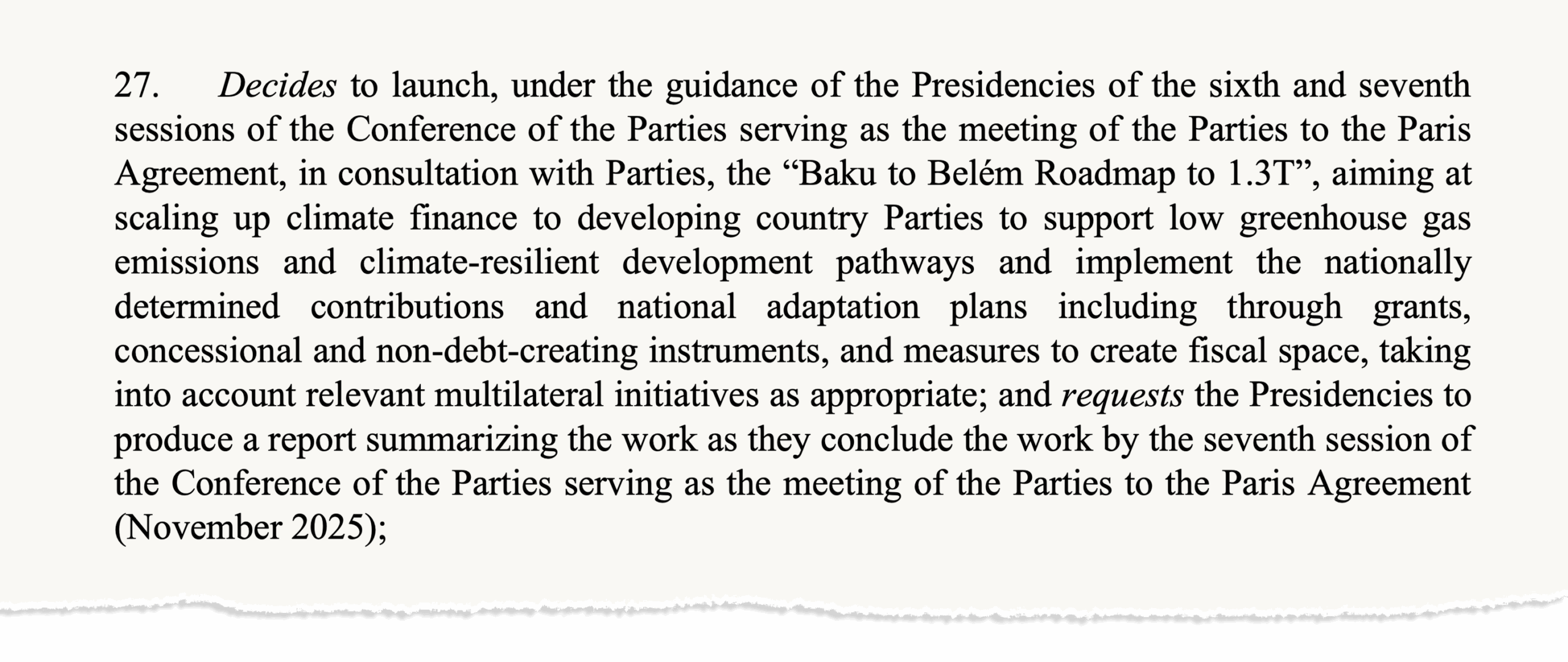
Text taken from Report of the Conference of the Parties serving as the meeting of the Parties to the Paris Agreement on its sixth session, held in Baku from 11 to 24 November 2024 saying "Decides to launch, under the guidance of the Presidencies of the sixth and seventh sessions of the Conference of the Parties serving as the meeting of the Parties to the Paris Agreement, in consultation with Parties, the “Baku to Belém Roadmap to 1.3T”, aiming at scaling up climate finance to developing country Parties to support low greenhouse gas emissions and climate-resilient development pathways and implement the nationally determined contributions and national adaptation plans including through grants, concessional and non-debt-creating instruments, and measures to create fiscal space, taking into account relevant multilateral initiatives as appropriate; and requests the Presidencies to produce a report summarizing the work as they conclude the work by the seventh session of the Conference of the Parties serving as the meeting of the Parties to the Paris Agreement (November 2025);"
Source: UNFCCC.

The Azerbaijani COP29 presidency and the incoming Brazilian presidency were tasked with assembling this roadmap ahead of COP30 in 2025.

In the months that followed, the presidencies engaged with governments, civil-society groups, businesses and other relevant actors. They gathered information to build a “library of knowledge and best practices”, which could boost climate finance for developing countries.

Back to top

What is the goal of the roadmap?

The roadmap comes at a difficult time for climate finance, with a particularly “bleak” outlook for public funding from developed countries. Major donors – particularly the US – have made large cuts to their aid budgets, threatening climate spending overseas.

At the same time, private investment has also faltered, with successive economic shocks raising the cost of capital for clean-energy projects in developing countries.

For years, finance experts and development leaders have talked of a “billions to trillions” agenda, suggesting that public money could help to “mobilise” trillions of dollars of private investments that could be used to build low-carbon infrastructure in the global south.

Yet, the “billions to trillions” concept has also faced growing scrutiny, with even the World Bank chief economist Indermit Gill branding it “a fantasy”. Critics have highlighted wider issues constraining developing countries, such as high levels of debt.

The NCQG text from COP29 set out the roadmap’s overarching goal of scaling up annual climate finance to $1.3tn, through means including “grants, concessional and non-debt-creating instruments, and measures to create fiscal space”.

On the current trajectory, financial sources potentially covered by the target could hit around $427bn for developing countries a year by 2035, less than a third of the goal, according to analysis by the thinktank NRDC.

Achieving $1.3tn of finance relies on what one report calls “yet-to-be-defined mechanisms”, which go beyond the ones covered by the $300bn target.

Countries and other relevant parties were asked by the presidencies for their views on “short-term” – actions by 2028 and “medium-to-long term” actions beyond 2028 that could ramp up finance further. They were asked about new sources of finance and thoughts on scaling up adaptation finance, in particular.

There have already been numerous ideas and programmes put forward for scaling up international climate finance. These include G20-led reforms of the multilateral development banks (MDBs), this year’s International Conference on Financing for Development, as well as UN sovereign debt restructuring efforts.

Accordingly, the Baku to Belém roadmap was also given a remit to “tak[e] into account relevant multilateral initiatives as appropriate”. Parties were also asked for suggestions of organisations and initiatives that should be involved.

Rebecca Thissen from Climate Action Network (CAN) International tells Carbon Brief:

“The roadmap could support the UNFCCC to be sending strong signals to the international community…But also using the convening power that the UNFCCC could have, so bringing those different actors to the table in a more structured and predictable way.”

Back to top

What are different countries’ views on climate finance?

There were over 227 submissions into the Baku to Belém roadmap, including 38 from countries and party groupings. The remainder came mainly from NGOs, businesses, financial experts and researchers, as shown in the figure below.

Submissions split between parties and groups of parties (brown) and non-party stakeholders (blue). Source: Baku to Belém roadmap.

The submissions partly reflect what the thinktank C2ES describes as the “pockmarked baggage of the climate finance negotiations”, with many parties demonstrating the same entrenched, often opposing views on climate finance that they have held for decades.

Carbon Brief has captured the submissions by countries and party groupings in the interactive table below, comparing their views on key issues.

There is broad agreement among countries that the roadmap should not reopen the NCQG discussions or involve a new, negotiated outcome at COP30.

However, some parties still call for more accountability in achieving the existing goals.

Latin American countries within the AILAC grouping call for the roadmap to “define concrete milestones for scaling up climate finance”. Egypt goes further, proposing that developed countries alone commit “at least $150bn annually in public concessional finance by 2028”, mainly as grants.

A key divergence in submissions is on which governments and institutions, precisely, should be responsible for scaling finance up to $1.3tn.

Several developing-country groups stress the importance of centring developed countries as the primary contributors, referencing Article 9.1 of the Paris Agreement.

The Like-Minded Developing Countries (LMDCs) group, which includes India, China and Saudi Arabia, states that “the roadmap must place Article 9.1 as its central pillar”. The G77 and China – a group representing all developing countries – stresses the “additional role developed countries will play in the context of Article 9.1, which is additional to the $300bn”.

Meanwhile, many developed countries focus on what Canada refers to as “a necessary broadening of climate finance” within the roadmap. In practice, this often amounts to a greater push for private finance, as well as “innovative” new sources such as global levies.

While developing countries do not often outright oppose such sources, some of them propose tighter limits. For example, China says “purely commercial investment flows should not be included” in the $1.3tn, which should only count funds “mobilised through public interventions”.

A related dispute centres on the roadmap’s scope, with the EU suggesting it should “extend beyond the UNFCCC framework”.

Parties such as India reject the idea of involving other multilateral fora, such as the G20. This would involve moving beyond the UN climate process, where developed countries have traditionally been the ones responsible for channelling climate finance.

The submissions also show notable differences among developing-country groupings. On the topic of defining what should be counted as “climate finance”, the Alliance of Small Island States (AOSIS) opposes the inclusion of funding for fossil-fuel projects, while the Arab Group says it does not support “any exclusionary criteria”.

There is coalescence between parties around other issues, albeit with various subtle differences.

Areas of broad agreement include the importance of more funding for climate adaptation, dealing with “barriers” to funding in developing countries and improving the transparency of climate-finance provision.

The roadmap details some of the potential sources of finance identified within the submissions.

This includes direct budget contributions, which the submissions suggest could generate an additional $197bn in financing; improved rechanneling and new issuances of special drawing rights ($100-500bn per year); carbon pricing ($20-4,900bn, dependent on rate and geographies); and fees on aviation or maritime transport($4-223bn).

Additionally, a range of taxes were identified as candidates for raising new climate finance. These include taxes on specific goods such as luxury fashion, technology and military goods ($34-112bn), financial transactions taxes ($105-327bn), minimum corporate taxes ($165-540bn) and wealth taxes ($200-1,364bn).

In a statement, Rebecca Newsom, global political expert at Greenpeace International, said:

“It’s notable that the roadmap recognises new taxes and levies as key to unlocking public climate finance. Given reported profits from just five international oil and gas giants over the last decade reached almost $800bn, taxing fossil fuel corporations is clearly a huge opportunity to overcome national fiscal constraints.

“The roadmap’s recognition that the UN tax convention provides an opportunity to raise new sources of concessional climate finance is also highly welcome, and is an opportunity governments must now seize.”

Back to top

What are the solutions that the roadmap has identified?

The roadmap sets out “five action fronts” for reaching $1.3tn by 2035.

These are designed to “help deliver on the at-least-$1.3tn aspiration by strengthening supply, making demand more strategic, and accelerating access and transparency”.

The report titles these five action fronts as “replenishing, rebalancing, rechanneling, revamping and reshaping”.

Within each of these, the roadmap lays out key points to help “transform scientific warning into a global blueprint for cooperation and tangible results”.

The first, “replenishing”, refers to grants, concessional finance and low-cost capital, including multilateral climate funds and MDBs.

It notes that there is a “growing role” for MDBs in advancing climate action, as well as a need for developed countries to achieve “manyfold increases in the delivery of grants and concessional climate finance, including through bilateral and multilateral channels”.

Access to grants and concessional finance is a key enabling factor for an “efficient” flow of public funding, the roadmap notes.

The roadmap calls for coordination in the international finance system, bilateral finance that is concessional and low-cost, multilateral climate funds, innovative sources of concessional finance with simplified access pathways and more.

This coordination could be key, with Sarah Colenbrander, director of ODI’s climate and sustainability programme, telling Carbon Brief:

“The bigger risk is probably that some countries will allocate their climate finance differently, so that they can report more money going out the door without a commensurate increase in fiscal effort. For example, they might shift from grants to concessional loans, and from concessional loans to market-rate loans. If the money will be repaid, there is less lift for taxpayers at home.

“Alternatively, countries might focus on using public finance to mobilise private finance that can also count towards the $300bn goal. Private finance has a very important role to play in both mitigation and adaptation, but it is very unlikely to meet the needs of the most vulnerable communities, given their high adaptation investment needs and very limited ability to pay.”

In particular, the roadmap suggests MDBs “intensify their engagement on climate finance through a strategic approach that recognises and amplifies their catalytic role in providing and mobilising capital”.

Second, “rebalancing” refers to fiscal space and debt sustainability. The roadmap calls on creditor countries, the International Monetary Fund (IMF) and MDBs to work together to “alleviate onerous debt burdens faced by developing countries”.

The roadmap notes that external debt servicing costs of developing countries have more than doubled since 2014, to $1.7tn per year in 2023.

Developing countries’ net interest payments on public debt reached $921bn in 2024, a 10% increase compared to 2023, it adds.

The roadmap notes the need to “remove barriers and address disenablers faced by developing countries in financing climate action”. It adds that developing countries face at least two- to four-times the borrowing costs of developed countries.

It points to a number of “promising” solutions already being implemented, such as climate-resilient debt clauses and “debt-for-climate swaps” and debt restructuring.

In particular, MDBs, the IMF, UN agencies and regional UN economic commissions could work together to create a “one-stop shop” for assistance in these areas, the roadmap says.

Third, “rechannelling” refers to “transformative” private finance and affordable cost of capital.

It notes that mobilisation of private finance has been “stubborn to scale”: The level of private finance leveraged by official development interventions has grown by 7% per year from 2016 to 2019 and then 16% per year from 2020 to 2023, to reach $46bn.

The roadmap says that “blended finance” can play a role in scaling up climate finance and that private finance for the implementation of “nationally determined contributions” to cutting global emissions (NDCs) and national adaptation plans (NAPs) has “significant potential for growth”.

“Innovative instruments” are listed as a key approach to improving private finance, including “catalytic equity”, guarantees, foreign exchange risk management, securitisation platforms and more.

To support this, the roadmap calls for target-setting and data transparency, along with increasing, coordinating and harmonising guarantee offerings and channelling concessional finance into long-term foreign exchange hedging facilities, along with other actions.

Relying heavily on private finance could pose a risk, Jan Kowalzig, senior policy adviser for climate at Oxfam Germany, tells Carbon Brief, adding:

“The much larger problem, however, is the plan to massively rely on private finance in the future. While private finance has a key role to play to transform economies, [it] cannot replace much-needed public finance, especially for adaptation and for responding to loss and damage.

“Interventions in these sectors often do not generate return to satisfy investors’ expectations. Forcing projects to become profitable can come at great social cost for frontline communities struggling to survive in the worsening climate crisis.”

The roadmap suggests financial institutions move towards “originate-to-distribute” and “originate-to-share” business models, support the development of climate-aligned domestic financial systems and expand investor bases and diverse sources of capital, amongst other proposals.

Fourth is “revamping”, referring to capacity and coordination for scaled climate portfolios. This “demands institutions to manage risks locally, develop project pipelines, ensure country ownership and track progress and impact”.

It notes that “whole-of-government” approaches to the transition can be strengthened, with NDCs and NAPs integrated throughout national investment strategies. Additionally, it points to country-led coordination or platforms as a route for improving investment.

The roadmap suggests readiness support and project preparation as routes to “revamp” climate finance, alongside support to scale, coordinate and tailor capacity building, the development of country platforms and the provision of “predictable and flexible support for investment frameworks”.

The final “R” is “reshaping”, focused on systems and structures for capital flows. It highlights a number of barriers that still remain for capital flows through developing countries, including outdated clauses in investment treaties.

It recommends prudential regulation, interoperability of taxonomies, climate disclosure frameworks and investment treaties, as key actions to support the reshaping of capital flows.

Additionally, the roadmap suggests that credit rating agencies further refine their methodologies, that jurisdictions adopt voluntary disclosure of climate-related financial risks of financial institutions and that climate stress-test requirements are gradually embedded in supervisory reviews and bank risk management.

Beyond the “five [finance] action fronts”, the roadmap sets out five thematic areas, noting that “where and how finance is directed” matters.

These are: adaptation and loss and damage; clean-energy access and transitions; nature and supporting its guardians; agriculture and food systems; and just transitions.

Within each, it sets out some of the key challenges and suggests routes for financial support.

Back to top

What happens next?

The Baku to Belem roadmap is not a formal part of COP30 negotiations, but there will be a major launch event at the summit.

Beyond that, the final section of the roadmap sets out that this is the “beginning [of] the journey”. It and details suggested short-term contributions (2026-2028), to serve as “initial, practical steps to inform and guide the early implementation of the roadmap”.

This includes the Azerbaijani and Brazilian presidencies convening an expert group tasked with refining data and developing “concrete financing pathways” to get to $1.3bn in 2035. This will build on the action fronts set out in the roadmap, with the first such report due by October 2026.

Throughout 2026, the presidencies will convene dialogue sessions with parties and stakeholders to discuss how to progress the action fronts over the medium to long term.

The roadmap suggests that to improve predictability, developed countries “could consider” working together on a delivery plan to outline how they expect to achieve the at-least $300bn goal by 2030, as well as other elements of the NCQG.

Additional suggestions in the roadmap are listed in the table below.

(Notably, almost all of these suggestions are made using loose, voluntary language. For example, the roadmap says that developed countries “could” create a delivery plan for their NCQG pathways.)

Who What When
COP29 and COP30 presidencies Convene an expert group to develop “concrete financing pathways” October 2026
COP29 and COP30 presidencies Convene dialogue sessions with parties and stakeholders 2026
Developed countries Creating a delivery plan to set out intended contributions and pathways for NCQG targets End of 2026
Parties to the Paris Agreement Request the Standing Committee on Finance to provide an aggregate view on pathways for NCQG 2027
Governments Request UN entities to examine and review collaboration options October 2026
Multilateral climate funds Report annually on the implementation of their “operational framework” on complementarity and coherence, to enhance cross-fund collaboration. Annually
Multilateral climate funds Develop monitoring and reporting frameworks and coordination plans, explaining their operations by region, topic and sector October 2027
Multilateral development banks Collective report on achieving a new aspirational climate finance target for 2035 October 2027
Multilateral development banks Adopt “explicit, ambitious and transparent targets for adaptation and private capital mobilisation” October 2027
International Monetary Fund Conduct an assessment of the costs, benefits and feasibility of a new issuance of “special drawing rights” October 2027
UN regional economic commissions Develop a study on the potential for expanding debt-for-climate, debt-for-nature and sustainability-linked finance End of 2027
UNSG-convened working group Propose a consolidated set of voluntary principles on responsible sovereign borrowing and lending. October 2026
Crediting rating agencies Develop a structured dialogue platform with ministries of finance to make progress on refinements to credit rating methodologies. October 2027
Philanthropies Expand funding of knowledge hubs October 2026
UN treaty executive secretariats Develop a joint report with proposals on economic instruments to support co-benefits and efficiencies End of 2027
Insurance Development Forum and the V20 Establish a plan for achieving cheaper and more robust insurance and pre-arranged finance mechanisms for climate disasters October 2026
Financial Stability Board, the Basel Committee on Banking Supervision and the International Association of Insurance Supervisors Conduct a joint assessment of whether and how barriers to investment in developing countries could be reduced October 2027
World’s 100 largest companies Report annually on how they are contributing towards the implementation of NDCs and NAPs Annually
World’s 100 largest institutional investors Report annually on how they are contributing towards the implementation of NDCs and NAPs Annually

COP29 president Mukhtar Babayev and COP30 president André Aranha Corrêa do Lago conclude in the foreword of the report that while the $1.3bn “journey” is beginning amid “turbulent times”, they are confident that “technological and financial solutions exist”. They add:

“Communities and cities are acting. Families and workers are ready to roll up their sleeves and deliver more action. If resources are strategically redirected and deployed effectively – and if the international financial architecture is reset to fulfil its original purpose of ensuring decent prospects for life – the $1.3tn goal will be an achievable global investment in our present and our future. We are optimistic.”

Back to top

The post COP30: What does the ‘Baku to Belém roadmap’ mean for climate finance? appeared first on Carbon Brief.

COP30: What does the ‘Baku to Belém roadmap’ mean for climate finance?

Continue Reading

Greenhouse Gases

DeBriefed 9 January 2026: US to exit global climate treaty; Venezuelan oil ‘uncertainty’; ‘Hardest truth’ for Africa’s energy transition

Published

on

Welcome to Carbon Brief’s DeBriefed.
An essential guide to the week’s key developments relating to climate change.

This week

US to pull out from UNFCC, IPCC

CLIMATE RETREAT: The Trump administration announced its intention to withdraw the US from the world’s climate treaty, CNN reported. The move to leave the UN Framework Convention on Climate Change (UNFCCC), in addition to 65 other international organisations, was announced via a White House memorandum that states these bodies “no longer serve American interests”, the outlet added. The New York Times explained that the UNFCCC “counts all of the other nations of the world as members” and described the move as cementing “US isolation from the rest of the world when it comes to fighting climate change”.

MAJOR IMPACT: The Associated Press listed all the organisations that the US is exiting, including other climate-related bodies such as the Intergovernmental Panel on Climate Change (IPCC) and the International Renewable Energy Agency (IRENA). The exit also means the withdrawal of US funding from these bodies, noted the Washington Post. Bloomberg said these climate actions are likely to “significantly limit the global influence of those entities”. Carbon Brief has just published an in-depth Q&A on what Trump’s move means for global climate action.

Oil prices fall after Venezuela operation

UNCERTAIN GLUT: Global oil prices fell slightly this week “after the US operation to seize Venezuelan president Nicolás Maduro created uncertainty over the future of the world’s largest crude reserves”, reported the Financial Times. The South American country produces less than 1% of global oil output, but it holds about 17% of the world’s proven crude reserves, giving it the potential to significantly increase global supply, the publication added.

TRUMP DEMANDS: Meanwhile, Trump said Venezuela “will be turning over” 30-50m barrels of oil to the US, which will be worth around $2.8bn (£2.1bn), reported BBC News. The broadcaster added that Trump claims this oil will be sold at market price and used to “benefit the people of Venezuela and the US”. The announcement “came with few details”, but “marked a significant step up for the US government as it seeks to extend its economic influence in Venezuela and beyond”, said Bloomberg.

Around the world

  • MONSOON RAIN: At least 16 people have been killed in flash floods “triggered by torrential rain” in Indonesia, reported the Associated Press.
  • BUSHFIRES: Much of Australia is engulfed in an extreme heatwave, said the Guardian. In Victoria, three people are missing amid “out of control” bushfires, reported Reuters.
  • TAXING EMISSIONS: The EU’s landmark carbon border levy, known as “CBAM”, came into force on 1 January, despite “fierce opposition” from trading partners and European industry, according to the Financial Times.
  • GREEN CONSUMPTION: China’s Ministry of Commerce and eight other government departments released an action plan to accelerate the country’s “green transition of consumption and support high-quality development”, reported Xinhua.
  • ACTIVIST ARRESTED: Prominent Indian climate activist Harjeet Singh was arrested following a raid on his home, reported Newslaundry. Federal forces have accused Singh of “misusing foreign funds to influence government policies”, a suggestion that Singh rejected as “baseless, biased and misleading”, said the outlet.
  • YOUR FEEDBACK: Please let us know what you thought of Carbon Brief’s coverage last year by completing our annual reader survey. Ten respondents will be chosen at random to receive a CB laptop sticker.

47%

The share of the UK’s electricity supplied by renewables in 2025, more than any other source, according to Carbon Brief analysis.


Latest climate research

  • Deforestation due to the mining of “energy transition minerals” is a “major, but overlooked source of emissions in global energy transition” | Nature Climate Change
  • Up to three million people living in the Sudd wetland region of South Sudan are currently at risk of being exposed to flooding | Journal of Flood Risk Management
  • In China, the emissions intensity of goods purchased online has dropped by one-third since 2000, while the emissions intensity of goods purchased in stores has tripled over that time | One Earth

(For more, see Carbon Brief’s in-depth daily summaries of the top climate news stories on Monday, Tuesday, Wednesday, Thursday and Friday.)

Captured

Chart showing that the US is more responsible for climate change than anyone else

The US, which has announced plans to withdraw from the UNFCCC, is more responsible for climate change than any other country or group in history, according to Carbon Brief analysis. The chart above shows the cumulative historical emissions of countries since the advent of the industrial era in 1850.

Spotlight

How to think about Africa’s just energy transition

Mr Ibrahima Aidara

African nations are striving to boost their energy security, while also addressing climate change concerns such as flood risks and extreme heat.

This week, Carbon Brief speaks to the deputy Africa director of the Natural Resource Governance Institute, Ibrahima Aidara, on what a just energy transition means for the continent.

Carbon Brief: When African leaders talk about a “just energy transition”, what are they getting right? And what are they still avoiding?

Ibrahima Aidara: African leaders are right to insist that development and climate action must go together. Unlike high-income countries, Africa’s emissions are extremely low – less than 4% of global CO2 emissions – despite housing nearly 18% of the world’s population. Leaders are rightly emphasising universal energy access, industrialisation and job creation as non-negotiable elements of a just transition.

They are also correct to push back against a narrow narrative that treats Africa only as a supplier of raw materials for the global green economy. Initiatives such as the African Union’s Green Minerals Strategy show a growing recognition that value addition, regional integration and industrial policy must sit at the heart of the transition.

However, there are still important blind spots. First, the distributional impacts within countries are often avoided. Communities living near mines, power infrastructure or fossil-fuel assets frequently bear environmental and social costs without sharing in the benefits. For example, cobalt-producing communities in the Democratic Republic of the Congo, or lithium-affected communities in Zimbabwe and Ghana, still face displacement, inadequate compensation, pollution and weak consultation.

Second, governance gaps are sometimes downplayed. A just transition requires strong institutions (policies and regulatory), transparency and accountability. Without these, climate finance, mineral booms or energy investments risk reinforcing corruption and inequality.

Finally, leaders often avoid addressing the issue of who pays for the transition. Domestic budgets are already stretched, yet international climate finance – especially for adaptation, energy access and mineral governance – remains far below commitments. Justice cannot be achieved if African countries are asked to self-finance a global public good.

CB: Do African countries still have a legitimate case for developing new oil and gas projects, or has the energy transition fundamentally changed what ‘development’ looks like?

IA: The energy transition has fundamentally changed what development looks like and, with it, how African countries should approach oil and gas. On the one hand, more than 600 million Africans lack access to electricity and clean cooking remains out of reach for nearly one billion people. In countries such as Mozambique, Nigeria, Senegal and Tanzania, gas has been framed to expand power generation, reduce reliance on biomass and support industrial growth. For some contexts, limited and well-governed gas development can play a transitional role, particularly for domestic use.

On the other hand, the energy transition has dramatically altered the risks. Global demand uncertainty means new oil and gas projects risk becoming stranded assets. Financing is shrinking, with many development banks and private lenders exiting fossil fuels. Also, opportunity costs are rising; every dollar locked into long-lived fossil infrastructure is a dollar not invested in renewables, grids, storage or clean industry.

Crucially, development today is no longer just about exporting fuels. It is about building resilient, diversified economies. Countries such as Morocco and Kenya show that renewable energy, green industry and regional power trade can support growth without deepening fossil dependence.

So, the question is no longer whether African countries can develop new oil and gas projects, but whether doing so supports long-term development, domestic energy access and fiscal stability in a transitioning world – or whether it risks locking countries into an extractive model that benefits few and exposes countries to future shocks.

CB: What is the hardest truth about Africa’s energy transition that policymakers and international partners are still unwilling to confront?

IA: For me, the hardest truth is this: Africa cannot deliver a just energy transition on unfair global terms. Despite all the rhetoric, global rules still limit Africa’s policy space. Trade and investment agreements restrict local content, industrial policy and value-addition strategies. Climate finance remains fragmented and insufficient. And mineral supply chains are governed largely by consumer-country priorities, not producer-country development needs.

Another uncomfortable truth is that not every “green” investment is automatically just. Without strong safeguards, renewable energy projects and mineral extraction can repeat the same harms as fossil fuels: displacement, exclusion and environmental damage.

Finally, there is a reluctance to admit that speed alone is not success. A rushed transition that ignores governance, equity and institutions will fail politically and socially, and, ultimately, undermine climate goals.

If Africa’s transition is to succeed, international partners must accept African leadership, African priorities and African definitions of development, even when that challenges existing power dynamics in global energy and mineral markets.

Watch, read, listen

CRISIS INFLAMED: In the Brazilian newspaper Folha de São Paulo, columnist Marcelo Leite looked into the climate impact of extracting more oil from Venezuela.

BEYOND TALK: Two Harvard scholars argued in Climate Home News for COP presidencies to focus less on climate policy and more on global politics.

EU LEVIES: A video explainer from the Hindu unpacked what the EU’s carbon border tax means for India and global trade.

Coming up

Pick of the jobs

DeBriefed is edited by Daisy Dunne. Please send any tips or feedback to debriefed@carbonbrief.org.

This is an online version of Carbon Brief’s weekly DeBriefed email newsletter. Subscribe for free here.

The post DeBriefed 9 January 2026: US to exit global climate treaty; Venezuelan oil ‘uncertainty’; ‘Hardest truth’ for Africa’s energy transition appeared first on Carbon Brief.

DeBriefed 9 January 2026: US to exit global climate treaty; Venezuelan oil ‘uncertainty’; ‘Hardest truth’ for Africa’s energy transition

Continue Reading

Greenhouse Gases

Q&A: What Trump’s US exit from UNFCCC and IPCC could mean for climate action

Published

on

The Trump administration in the US has announced its intention to withdraw from the UN’s landmark climate treaty, alongside 65 other international bodies that “no longer serve American interests”.

Every nation in the world has committed to tackling “dangerous anthropogenic interference with the climate system” under the 1992 UN Framework Convention on Climate Change (UNFCCC).

During Donald Trump’s second presidency, the US has already failed to meet a number of its UN climate treaty obligations, including reporting its emissions and funding the UNFCCC – and it has not attended recent climate summits.

However, pulling out of the UNFCCC would be an unprecedented step and would mark the latest move by the US to disavow global cooperation and climate action.

Among the other organisations the US plans to leave is the Intergovernmental Panel on Climate Change (IPCC), the UN body seen as the global authority on climate science.

In this article, Carbon Brief considers the implications of the US leaving these bodies, as well as the potential for it rejoining the UNFCCC in the future.

Carbon Brief has also spoken to experts about the contested legality of leaving the UNFCCC and what practical changes – if any – will result from the US departure.

What is the process for pulling out of the UNFCCC?

The Trump administration set out its intention to withdraw from the UNFCCC and the IPCC in a White House presidential memorandum issued on 7 January 2026.

It claims authority “vested in me as president by the constitution and laws of the US” to withdraw the country from the treaty, along with 65 other international and UN bodies.

However, the memo includes a caveat around its instructions, stating:

“For UN entities, withdrawal means ceasing participation in or funding to those entities to the extent permitted by law.”

(In an 8 January interview with the New York Times, Trump said he did not “need international law” and that his powers were constrained only by his “own morality”.)

The US is the first and only country in the world to announce it wants to withdraw from the UNFCCC.

The convention was adopted at the UN headquarters in New York in May 1992 and opened for signatures at the Rio Earth summit the following month. The US became the first industrialised nation to ratify the treaty that same year.

It was ultimately signed by every nation on Earth – making it one of the most ratified global treaties in history.

Article 25 of the treaty states that any party may withdraw by giving written notification to the “depositary”, which is elsewhere defined as being the UN secretary general – currently, António Guterres.

The article, shown below, adds that the withdrawal will come into force a year after a written notification is supplied.

Excerpt from Article 25 of the UNFCCC (1992)
Excerpt from Article 25 of the UNFCCC (1992). Credit: UNFCCC

The treaty adds that any party that withdraws from the convention shall be considered as also having left any related protocol.

The UNFCCC has two main protocols: the Kyoto Protocol of 1997 and the Paris Agreement of 2015.

Although former US president Bill Clinton signed the Kyoto Protocol in 1998, its formal ratification faced opposition from the Senate and the treaty was ultimately rejected by his successor, president George W Bush, in 2001.

Domestic opposition to the protocol centred around the exclusion of major developing countries, such as China and India, from emissions reduction measures.

The US did ratify the Paris Agreement, but Trump signed an executive order to take the nation out of the pact for a second time on his first resumed day in office in January 2025.

Back to top

Is it legal for Trump to take the US out of the UNFCCC unilaterally?

Whether Trump can legally pull the US out of the UNFCCC without the consent of the Senate remains unclear.

The US previously left the Paris Agreement during Trump’s first term. 

Both the UNFCCC and the Paris Agreement allow any party to withdraw with a year’s written notice. However, both treaties state that parties cannot withdraw within the first three years of ratification.

As such, the first Trump administration filed notice to exit the Paris Agreement in November 2019 and became the first nation in the world to formally leave a year later – the day after Democrat Joe Biden won the 2020 presidential election

On his first day in office in 2021, Biden rejoined the Paris Agreement. This took 30 days from notifying the UNFCCC to come into force.

The legalities of leaving the UNFCCC are murkier, due to how it was adopted.

As Michael B Gerrard, director of the Sabin Center for Climate Change Law at Columbia Law School, explains to Carbon Brief, the Paris Agreement was ratified without Senate approval.

Article 2 of the US Constitution says presidents have the power to make or join treaties subject to the “advice and consent” of the Senate – including a two-thirds majority vote (see below).

Source: US Constitution.

However, Barack Obama took the position that, as the Paris Agreement “did not impose binding legal obligations on the US, it was not a treaty that required Senate ratification”, Gerrard tells Carbon Brief.

As noted in a post by Jake Schmidt, a senior strategic director at the environmental NGO Natural Resources Defense Council (NRDC), the US has other mechanisms for entering international agreements. It says the US has joined more than 90% of the international agreements it is party to through different mechanisms.

In contrast, George H Bush did submit the UNFCCC to the Senate in 1992, where it was unanimously ratified by a 92-0 vote, ahead of his signing it into law. 

Reversing this is uncertain legal territory. Gerrard tells Carbon Brief:

“There is an open legal question whether a president can unilaterally withdraw the US from a Senate-ratified treaty. A case raising that question reached the US Supreme Court in 1979 (Goldwater vs Carter), but the Supreme Court ruled this was a political question not suitable for the courts.”

Unlike ratifying a treaty, the US Constitution does not explicitly specify whether the consent of the Senate is required to leave one.

This has created legal uncertainty around the process.

Given the lack of clarity on the legal precedent, some have suggested that, in practice, Trump can pull the US out of treaties unilaterally.

Sue Biniaz, former US principal deputy special envoy for climate and a key legal architect of the Paris Agreement, tells Carbon Brief: 

“In terms of domestic law, while the Supreme Court has not spoken to this issue (it treated the issue as non-justifiable in the Goldwater v Carter case), it has been US practice, and the mainstream legal view, that the president may constitutionally withdraw unilaterally from a treaty, ie without going back to the Senate.”

Additionally, the potential for Congress to block the withdrawal from the UNFCCC and other treaties is unclear. When asked by Carbon Brief if it could play a role, Biniaz says:

“Theoretically, but politically unlikely, Congress could pass a law prohibiting the president from unilaterally withdrawing from the UNFCCC. (The 2024 NDAA contains such a provision with respect to NATO.) In such case, its constitutionality would likely be the subject of debate.”

Back to top

How could the US rejoin the UNFCCC and Paris Agreement?

The US would be able to rejoin the UNFCCC in future, but experts disagree on how straightforward the process would be and whether it would require a political vote.

In addition to it being unclear whether a two-thirds “supermajority” vote in the Senate is required to leave a treaty, it is unclear whether rejoining would require a similar vote again – or if the original 1992 Senate consent would still hold. 

Citing arguments set out by Prof Jean Galbraith of the University of Pennsylvania law school, Schmidt’s NRDC post says that a future president could rejoin the convention within 90 days of a formal decision, under the merit of the previous Senate approval.

Biniaz tells Carbon Brief that there are “multiple future pathways to rejoining”, adding:

“For example, Prof Jean Galbraith has persuasively laid out the view that the original Senate resolution of advice and consent with respect to the UNFCCC continues in effect and provides the legal authority for a future president to rejoin. Of course, the Senate could also give its advice and consent again. In any case, per Article 23 of the UNFCCC, it would enter into force for the US 90 days after the deposit of its instrument.”

Prof Oona Hathaway, an international law professor at Yale Law School, believes there is a “very strong case that a future president could rejoin the treaty without another Senate vote”.

She tells Carbon Brief that there is precedent for this based on US leaders quitting and rejoining global organisations in the past, explaining:

“The US joined the International Labour Organization in 1934. In 1975, the Ford administration unilaterally withdrew, and in 1980, the Carter administration rejoined without seeking congressional approval.

“Similarly, the US became a member of the United Nations Educational, Scientific and Cultural Organization (UNESCO) in 1946. In the 1980s, the Reagan administration unilaterally withdrew the US. The Bush administration rejoined UNESCO in 2002, but in 2019 the Trump administration once again withdrew. The Biden administration rejoined in 2023, and the Trump Administration announced its withdrawal again in 2025.”

But this “legal theory” of a future US president specifically re-entering the UNFCCC “based on the prior Senate ratification” has “never been tested in court”, Prof Gerrard from Columbia Law School tells Carbon Brief.

Dr Joanna Depledge, an expert on global climate negotiations and research fellow at the University of Cambridge, tells Carbon Brief:

“Due to the need for Senate ratification of the UNFCCC (in my interpretation), there is no way back now for the US into the climate treaties. But there is nothing to stop a future US president applying [the treaty] rules or – what is more important – adopting aggressive climate policy independently of them.”

If it were required, achieving Senate approval to rejoin the UNFCCC would take a “significant shift in US domestic politics”, public policy professor Thomas Hale from the University of Oxford notes on Bluesky.

Rejoining the Paris Agreement, on the other hand, is a simpler process that the US has already undertaken in recent years. (See: Is it legal for Trump to take the US out of the UNFCCC unilaterally?) Biniaz explains:

“In terms of the Paris Agreement, a party to that agreement must also be a party to the UNFCCC (Article 20). Assuming the US had rejoined the UNFCCC, it could rejoin the Paris Agreement as an executive agreement (as it did in early 2021). The agreement would enter into force for the US 30 days after the deposit of its instrument (Article 21).”

The Center for Climate and Energy Solutions, an environmental non-profit, explains that Senate approval was not required for Paris “because it elaborates an existing treaty” – the UNFCCC. 

Back to top

What changes when the US withdraws from the UNFCCC?

US withdrawal from the UNFCCC has been described in media coverage as a “massive hit” to global climate efforts that will “significantly limit” the treaty’s influence.

However, experts tell Carbon Brief that, as the Trump administration has already effectively withdrawn from most international climate activities, this latest move will make little difference.

Moreover, Depledge tells Carbon Brief that the international climate regime “will not collapse” as a result of US withdrawal. She says:

“International climate cooperation will not collapse because the UNFCCC has 195 members rather than 196. In a way, the climate treaties have already done their job. The world is already well advanced on the path to a lower-carbon future. Had the US left 10 years ago, it would have been a serious threat, but not today. China and other renewable energy giants will assert even more dominance.”

Depledge adds that while the “path to net-zero will be longer because of the drastic rollback of domestic climate policy in the US”, it “won’t be reversed”.

Technically, US departure from the UNFCCC would formally release it from certain obligations, including the need to report national emissions.

As the world’s second-largest annual emitter, this is potentially significant.

“The US withdrawal from the UNFCCC undoubtedly impacts on efforts to monitor and report global greenhouse gas emissions,” Dr William Lamb, a senior researcher at the Potsdam Institute for Climate Impact Research (PIK), tells Carbon Brief.

Lamb notes that while scientific bodies, such as the IPCC, often use third-party data, national inventories are still important. The US already failed to report its emissions data last year, in breach of its UNFCCC treaty obligations.

Robbie Andrew, senior researcher at Norwegian climate institute CICERO, says that it will currently be possible for third-party groups to “get pretty close” to the carbon dioxide (CO2) emissions estimates previously published by the US administration. However, he adds:

“The further question, though, is whether the EIA [US Energy Information Administration] will continue reporting all of the energy data they currently do. Will the White House decide that reporting flaring is woke? That even reporting coal consumption is an unnecessary burden on business? I suspect the energy sector would be extremely unhappy with changes to the EIA’s reporting, but there’s nothing at the moment that could guarantee anything at all in that regard.”

Andrew says that estimating CO2 emissions from energy is “relatively straightforward when you have detailed energy data”. In contrast, estimating CO2 emissions from agriculture, land use, land-use change and forestry, as well as other greenhouse gas emissions, is “far more difficult”.

The US Treasury has also announced that the US will withdraw from the UN’s Green Climate Fund (GCF) and give up its seat on the board, “in alignment” with its departure from the UNFCCC. The Trump administration had already cancelled $4bn of pledged funds for the GCF.

Another specific impact of US departure would be on the UNFCCC secretariat budget, which already faces a significant funding gap. US annual contributions typically make up around 22% of the body’s core budget, which comes from member states.

However, as with emissions data and GCF withdrawal, the Trump administration had previously indicated that the US would stop funding the UNFCCC. 

In fact, billionaire and UN special climate envoy Michael Bloomberg has already committed, alongside other philanthropists, to making up the US shortfall.

Veteran French climate negotiator Paul Watkinson tells Carbon Brief:

“In some ways the US has already suspended its participation. It has already stopped paying its budget contributions, it sent no delegation to meetings in 2025. It is not going to do any reporting any longer – although most of that is now under the Paris Agreement. So whether it formally leaves the UNFCCC or not does not change what it is likely to do.”

Dr Joanna Depledge tells Carbon Brief that she agrees:

“This is symbolically and politically huge, but in practice it makes little difference, given that Trump had already announced total disengagement last year.”

The US has a history of either leaving or not joining major environmental treaties and organisations, such as the Paris Agreement and the Kyoto Protocol. (See: What is the process for pulling out of the UNFCCC?)

Dr Jennifer Allan, a global environmental politics researcher at Cardiff University, tells Carbon Brief:

“The US has always been an unreliable partner…Historically speaking, this is kind of more of the same.”

The NRDC’s Jake Schmidt tells Carbon Brief that he doubts US absence will lead to less progress at UN climate negotiations. He adds:

“[The] Trump team would have only messed things up, so not having them participate will probably actually lead to better outcomes.”

However, he acknowledges that “US non-participation over the long-term could be used by climate slow-walking countries as an excuse for inaction”.

Biniaz tells Carbon Brief that the absence of the US is unlikely to unlock reform of the UN climate process – and that it might make negotiations more difficult. She says:

“I don’t see the absence of the US as promoting reform of the COP process. While the US may have had strong views on certain topics, many other parties did as well, and there is unlikely to be agreement among them to move away from the consensus (or near consensus) decision-making process that currently prevails. In fact, the US has historically played quite a significant ‘broker’ role in the negotiations, which might actually make it more difficult for the remaining parties to reach agreement.”

After leaving the UNFCCC, the US would still be able to participate in UN climate talks as an observer, albeit with diminished influence. (It is worth noting that the US did not send a delegation to COP30 last year.)

There is still scope for the US to use its global power and influence to disrupt international climate processes from the outside.

For example, last year, the Trump administration threatened nations and negotiators with tariffs and withdrawn visa rights if they backed an International Maritime Organization (IMO) effort to cut shipping emissions. Ultimately, the measures were delayed due to a lack of consensus.

(Notably, the IMO is among the international bodies that the US has not pledged to leave.)

Back to top

What about the US withdrawal from the IPCC?

As a scientific body, rather than a treaty, there is no formal mechanism for “withdrawing” from the IPCC. In its own words, the IPCC is an “organisation of governments that are members of the UN or World Meteorological Organization” (WMO). 

Therefore, just being part of the UN or WMO means a country is eligible to participate in the IPCC. If a country no longer wishes to play a role in the IPCC, it can simply disengage from its activities – for example, by not attending plenary meetings, nominating authors or providing financial support.

This is exactly what the US government has been doing since last year.

Shortly before the IPCC’s plenary meeting for member governments – known as a “session” – in Hangzhou, China, in March 2025, reports emerged that US officials had been denied permission to attend.

In addition, the contract for the technical support unit for Working Group III (WG3) was terminated by its provider, NASA, which also eliminated the role of chief scientist – the position held by WG3 co-chair Dr Kate Cavlin.

(Each of the IPCC’s three “working groups” has a technical support unit, or TSU, which provides scientific and operational support. These are typically “co-located” between the home countries of a working group’s two co-chairs.)

The Hangzhou session was the first time that the US had missed a plenary since the IPCC was founded in 1988. It then missed another in Lima, Peru, in October 2025.

Although the US government did not nominate any authors for the IPCC’s seventh assessment cycle (AR7), US scientists were still put forward through other channels. Analysis by Carbon Brief shows that, across the three AR7 working group reports, 55 authors are affiliated with US institutions.

However, while IPCC authors are supported by their institutions – they are volunteers and so are not paid by the IPCC – their travel costs for meetings are typically covered by their country’s government. (For scientists from developing countries, there is financial support centrally from the IPCC.)

Prof Chris Field, co-chair of Working Group II during the IPCC’s fifth assessment (AR5), tells Carbon Brief that a “number of philanthropies have stepped up to facilitate participation by US authors not supported by the US government”.

The US Academic Alliance for the IPCC – a collaboration of US universities and research institutions formed last year to fill the gap left by the government – has been raising funds to support travel.

In a statement reacting to the US withdrawal, IPCC chair Prof Sir Jim Skea said that the panel’s focus remains on preparing the reports for AR7:

“The panel continues to make decisions by consensus among its member governments at its regular plenary sessions. Our attention remains firmly on the delivery of these reports.”

The various reports will be finalised, reviewed and approved in the coming years – a process that can continue without the US. As it stands, the US government will not have a say on the content and wording of these reports.

Field describes the US withdrawal as a “self-inflicted wound to US prestige and leadership” on climate change. He adds:

“I don’t have a crystal ball, but I hope that the US administration’s animosity toward climate change science will lead other countries to support the IPCC even more strongly. The IPCC is a global treasure.”

The University of Edinburgh’s Prof Gabi Hegerl, who has been involved in multiple IPCC reports, tells Carbon Brief:

“The contribution and influence of US scientists is presently reduced, but there are still a lot of enthusiastic scientists out there that contribute in any way they can even against difficult obstacles.”

On Twitter, Prof Jean-Pascal van Ypersele – IPCC vice-chair during AR5 – wrote that the US withdrawal was “deeply regrettable” and that to claim the IPCC’s work is contrary to US interests is “simply nonsensical”. He continued:

“Let us remember that the creation of the IPCC was facilitated in 1988 by an agreement between Ronald Reagan and Margaret Thatcher, who can hardly be described as ‘woke’. Climate and the environment are not a matter of ideology or political affiliation: they concern everyone.”

Van Ypersele added that while the IPCC will “continue its work in the service of all”, other countries “will have to compensate for the budgetary losses”.

The IPCC’s most recent budget figures show that the US did not make a contribution in 2025.

Carbon Brief analysis shows that the US has provided around 30% of all voluntary contributions in the IPCC’s history. Totalling approximately $67m (£50m), this is more than four times that of the next-largest direct contributor, the EU.

However, this is not the first time that the US has withdrawn funding from the IPCC. During Trump’s first term of office, his administration cut its contributions in 2017, with other countries stepping up their funding in response. The US subsequently resumed its contributions.

Chart showing the largest direct contributors to the IPCC since its inception in 1988, with the US (red bars), European Union (dark blue) and UNFCCC/WMO/UNEP (mid blue) highlighted. Grey bars show all other contributors combined. Figures for 2025 are January to June inclusive. Figures for 1988-2003 are reported per two years, so these totals have been divided equally between each year. Source: IPCC (2025) and (2010). Contributions have been adjusted, as per IPCC footnotes, so they appear in the year they are received, rather than pledged.

At its most recent meeting in Lima, Peru, in October 2025, the IPCC warned of an “accelerating decline” in the level of annual voluntary contributions from countries and other organisations, reported the Earth Negotiations Bulletin. As a result, the IPCC invited member countries to increase their donations “if possible”.

Back to top

What other organisations are affected?

In addition to announcing his plan to withdraw the US from the UNFCCC and the IPCC, Trump also called for the nation’s departure from 16 other organisations related to climate change, biodiversity and clean energy.

These include:

As well as participating in the work of these organisations, the US is also a key source of funding for many of them – leaving their futures uncertain.

In a letter to members seen by Carbon Brief, IPBES chair and Kenyan ecologist, Dr David Obura, described Trump’s move as “deeply disappointing”.

He said that IPBES “has not yet received any formal notification” from the US, but “anticipates that the intention expressed to withdraw will mean that the US will soon cease to be a member of IPBES”, adding:

“The US is a founding member of IPBES and scientists, policymakers and stakeholders – including Indigenous peoples and local communities – from the US have been among the most engaged contributors to the work of IPBES since its establishment in 2012, making valuable contributions to objective science-based assessments of the state of the planet, for people and nature.

“The contribution of US experts ranges from leading landmark assessment reports, to presiding over negotiations, serving as authors and reviewers, as well as helping to steer the organisation both scientifically and administratively.” 

Despite being a party to IPBES until now, the US has never been a signatory to the UN Convention on Biological Diversity (CBD), the nature equivalent of the UNFCCC.

It is one of only two nations not to sign the convention, with the other being the Holy See, representing the Vatican City.

The lack of US representation at the CBD has not prevented countries from reaching agreements. In 2022, countries gathered under the CBD adopted the Kunming-Montreal Global Biodiversity Framework, often described as the “Paris Agreement for nature”.

However, some observers have pointed to the lack of US involvement as one of the reasons why biodiversity loss has received less international attention than climate change.

Back to top

The post Q&A: What Trump’s US exit from UNFCCC and IPCC could mean for climate action appeared first on Carbon Brief.

Q&A: What Trump’s US exit from UNFCCC and IPCC could mean for climate action

Continue Reading

Greenhouse Gases

Analysis: World’s biggest historic polluter – the US – is pulling out of UN climate treaty

Published

on

The US, which has announced plans to withdraw from the global climate treaty – the UN Framework Convention on Climate Change (UNFCCC) – is more historically responsible for climate change than any other country or group.

Carbon Brief analysis shows that the US has emitted a total of 542bn tonnes of carbon dioxide (GtCO2) since 1850, by burning fossil fuels, cutting down trees and other activities.

This is the largest contribution to the Earth’s warming climate by far, as shown in the figure below, with China’s 336GtCO2 significantly behind in second and Russia in third at 185GtCO2.

Chart showing that the US is more responsible for climate change than anyone else
Top 10 countries in terms of their cumulative historical CO2 emissions from fossil fuels, cement, land use, land use change and forestry, 1850-2025, billion tonnes. Source: Source: Carbon Brief analysis of figures from Jones et al (2023), Lamboll et al (2023), the Global Carbon Project, CDIAC, Our World in Data, the International Energy Agency and Carbon Monitor.

The US is responsible for more than a fifth of the 2,651GtCO2 that humans have pumped into the atmosphere between 1850 and 2025 as a result of fossil fuels, cement and land-use change.

China is responsible for another 13%, with the 27 nations of the EU making up another 12%.

In total, these cumulative emissions have used up more than 95% of the carbon budget for limiting global warming to 1.5C and are the predominant reason the Earth is already nearly 1.5C hotter than in pre-industrial times.

The US share of global warming is even more disproportionate when considering that its population of around 350 million people makes up just 4% of the global total.

On the basis of current populations, the US’s per-capita cumulative historical emissions are around 7 times higher than those for China, more than double the EU’s and 25 times those for India.

The US’s historical emissions of 542GtCO2 are larger than the combined total of the 133 countries with the lowest cumulative contributions, a list that includes Saudi Arabia, Spain and Nigeria. Collectively, these 133 countries have a population of more than 3 billion people.

See Carbon Brief’s previous detailed analysis of historical responsibility for climate change for more details on the data sources and methodology, as well as consumption-based emissions.

Additionally, in 2023, Carbon Brief published an article that looked at the “radical” impact of reassigning responsibility for historical emissions to colonial rulers in the past.

This approach has a very limited impact on the US, which became independent before the vast majority of its historical emissions had taken place.

The post Analysis: World’s biggest historic polluter – the US – is pulling out of UN climate treaty appeared first on Carbon Brief.

Analysis: World’s biggest historic polluter – the US – is pulling out of UN climate treaty

Continue Reading

Trending

Copyright © 2022 BreakingClimateChange.com