Disseminated on behalf of Surge Battery Metals Inc.
Electric vehicles (EVs), energy storage systems (BESS), and clean energy technologies depend heavily on lithium. Yet even with fast-rising demand, the United States still produces far less lithium than it needs.
In 2024, U.S. production reached only about 25,000 tonnes of lithium carbonate equivalent (LCE) – roughly 2% of global supply, which totaled around 1.2 million tonnes. That output is enough for only about 158,000 Tesla Model 3 battery packs per year.
The gap between national demand and domestic production keeps widening. Most lithium used in the U.S. comes from imports, mainly from Chile, Australia, and China. This dependency exposes the country to supply disruptions, trade restrictions, and price volatility. If imports are interrupted, the U.S. battery and EV industries could face serious setbacks.
Growing Demand Creates a Structural Deficit
Global demand for lithium is growing quickly. Analysts expect it to quadruple by 2030 as more countries adopt EVs and build large-scale battery storage.
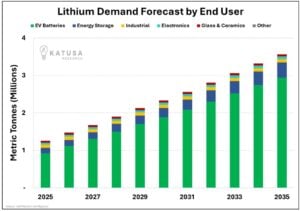
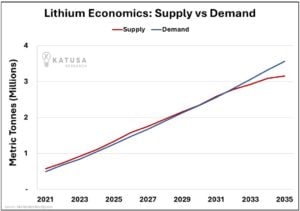
According to Katusa Research (2025), global lithium demand is projected to climb from 1.04 million tonnes in 2024 to 3.56 million tonnes by 2035 — a 3.5× increase. About 83% of that demand will come from EV batteries, while energy storage will account for another 11%.
Source: Katusa Research
Per the International Energy Agency, the U.S. alone may need over 625,000 tonnes of LCE per year by 2030, compared with only a small fraction produced domestically today.
Building new mines takes time – often 10 to 15 years from exploration to commercial production. This long timeline makes it difficult to ramp up supply fast enough to meet demand. Therefore, a lasting shortage is forming. If the U.S. does not accelerate new projects soon, it may depend on imports for decades.
Each EV battery pack uses large amounts of lithium. On average, an EV requires about 60 kilograms of LCE – or 8 to 10 kilograms per kilowatt-hour (kWh) of battery capacity. As automakers build more gigafactories, that adds up quickly.
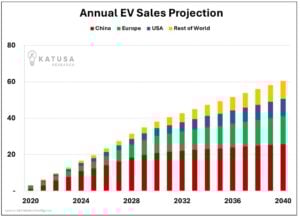
Katusa’s data also shows that global EV sales jumped from 2 million in 2020 to 11 million in 2024, a 450% surge — and could exceed 60 million units per year by 2040, more than half of all cars sold globally.
Source: Katusa Research
The U.S. is expected to have 440 gigawatt-hours (GWh) of battery manufacturing capacity by 2025 and more than 1,000 GWh by 2030. That growth alone could double or triple national lithium demand.
Introducing the Nevada North Lithium Project
One company aiming to help close this gap is Surge Battery Metals. Its flagship asset, the Nevada North Lithium Project (NNLP) in Elko County, Nevada, is one of the few high-grade lithium clay deposits in the United States.
The project has an inferred resource of 11.24 million tonnes of LCE, grading about 3,010 ppm lithium, making it the highest-grade lithium clay resource in the country.
The project benefits from ideal logistics. NNLP is only 13 kilometers from major power lines and close to all-season roads. The Bureau of Land Management (BLM) has issued a Record of Decision and a Finding of No Significant Impact (FONSI), allowing expanded exploration over 250 acres. These factors make NNLP a leading U.S. candidate for large-scale lithium development.
How NNLP Helps Close the Supply Gap
Surge Battery Metals’ Nevada North project has features that position it well to help close America’s lithium gap. Its high grade and large resource size suggest it could deliver significant output once in production. Higher-grade deposits typically allow lower extraction costs and shorter payback periods.
Because NNLP already has key permits and environmental clearance, it may reach production faster than many early-stage peers. That speed is critical as EV demand accelerates and the U.S. targets more domestic battery manufacturing.
Just as important, NNLP supports U.S. policy goals for supply chain security. Producing lithium domestically reduces reliance on imports, helping stabilize supply and pricing for American automakers. It also supports the Inflation Reduction Act, which requires that most EV battery minerals come from North America or allied countries by 2027.
In March 2025, the U.S. government took direct equity stakes in several lithium ventures, including Lithium Americas’ Thacker Pass, signaling a strong federal commitment to reshoring critical mineral production. This policy backdrop reinforces projects like NNLP as part of a national security priority.
Strengthening NNLP Through Strategic Partnership
Moreover, Surge Battery Metals signed a joint venture letter of intent (LOI) with Evolution Mining (ASX: EVN), allowing Evolution to earn up to 32.5% ownership by funding C$10 million toward the Preliminary Feasibility Study (PFS) for the Nevada North Lithium Project (NNLP). Surge retains majority control and project management, keeping its long-term vision and stakeholder priorities front and center.
This partnership delivers big strategic value. By merging Surge’s lithium expertise and mineral rights with Evolution’s 75% stake in 880 acres of private land – and over 21,000 added acres nearby – the deal significantly increases the JV’s land position. The expanded acreage boosts the overall exploration area and brings in mineral rights in key southern zones, possible clay unit extensions to the north, and territory in historic mining districts and key drainage areas.
Importantly, Evolution’s staged funding speeds up completion of the PFS and helps NNLP reach development milestones while lowering capital risk for Surge shareholders. If Evolution completes its full commitment, it will own 32.5% of the JV, but Surge remains the lead partner. This setup means Surge still directs the project, while using Evolution’s operations know-how and resources. With a larger land package and a joint operating committee, NNLP is well on its way to Tier 1 status and is strengthening its spot in North America’s battery metals supply chain – vital for clean energy and EV growth.
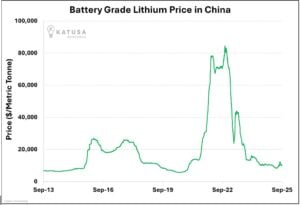
Like any mining venture, NNLP faces challenges. Lithium prices fell nearly 90% from their 2022 peak, but from June to September 2025, they rebounded 24%, showing early signs of recovery.
This cyclical pattern reflects Katusa’s “cost floor” concept — production costs in China and Australia now average around $5,000–6,000 per tonne LCE, while South American and U.S. projects need about $8,000/t to stay profitable. If prices fall near those levels, high-cost mines pause output, tightening supply again and stabilizing prices.
Another factor is resource expansion. NNLP’s current resource is inferred, but the company expects to complete its current drilling program at NNLP by the end of October 2025. Once the results are released, the lithium resource will be upgraded from Inferred to Indicated and Measured categories. This step will strengthen confidence in the deposit’s scale and quality, supporting the upcoming Pre-Feasibility Study (PFS).
Permitting and community engagement also remain important; even in a mining-friendly state like Nevada, water use and land reclamation practices must meet strict environmental standards.
Surge Battery Metals has emphasized sustainable practices, including water recycling and progressive site reclamation, as part of its exploration and development plan.
Competition is growing, too. Lithium projects across South America, Australia, and Canada are advancing quickly. Still, Nevada’s combination of stable governance, established mining laws, and proximity to major battery plants gives U.S. projects like NNLP a strong advantage.
A National View: U.S. Lithium Resources and Reserves
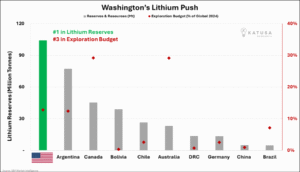
The U.S. is home to some of the world’s largest lithium reserves, but it still underdevelops them. According to the U.S. Geological Survey, global lithium reserves total around 21 million tonnes, with the U.S. holding roughly 12%. Nevada alone hosts the country’s biggest lithium resources, concentrated in the Thacker Pass region and the northern claystone belts – where NNLP is located.
Unlocking these resources is vital. Every new project that moves forward strengthens the domestic supply chain and supports national goals to lead in clean energy technology.
Surge Battery Metals plans to continue advancing NNLP through new drilling campaigns and metallurgical studies in 2025. These programs aim to expand and upgrade resources, optimize extraction processes, and confirm the potential to produce battery-grade lithium carbonate with 99.9% purity. The company is also evaluating potential offtake partnerships with battery and automotive manufacturers.
Analysts and investors will be watching for:
Updated resource estimates and grade expansion
Progress toward pre-feasibility studies
Partnerships or funding deals with strategic investors
Regulatory updates supporting U.S. critical mineral development
Positive results in these areas could accelerate NNLP’s move toward construction and help it become one of the first next-generation lithium clay projects to enter U.S. production.
Powering the U.S. Energy Future
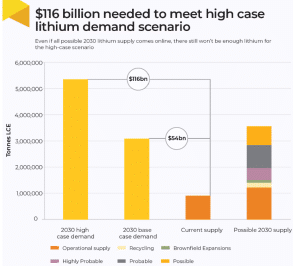
The U.S. faces a widening gap between lithium supply and demand that could slow its clean-energy transition. Katusa Research projects a 400,000-tonne global supply shortfall by 2035, roughly the world’s entire 2020 output – a deficit that could keep prices elevated long term.
Source: Katusa Research
Surge Battery Metals’ Nevada North Lithium Project provides a realistic and timely opportunity to help close that divide. With its high-grade resource, strong economics, strategic location, and environmental focus, NNLP could play a central role in building a stable, self-sufficient lithium supply for the United States.
As the nation races to electrify transportation and decarbonize energy, projects like NNLP will be critical. They are not only about producing lithium – they are about powering the next chapter of American industry and ensuring that the clean-energy future is built on secure, sustainable ground.
New Era Publishing Inc. and/or CarbonCredits.com (“We” or “Us”) are not securities dealers or brokers, investment advisers, or financial advisers, and you should not rely on the information herein as investment advice. Surge Battery Metals Inc. (“Company”) made a one-time payment of $50,000 to provide marketing services for a term of two months. None of the owners, members, directors, or employees of New Era Publishing Inc. and/or CarbonCredits.com currently hold, or have any beneficial ownership in, any shares, stocks, or options of the companies mentioned.
This article is informational only and is solely for use by prospective investors in determining whether to seek additional information. It does not constitute an offer to sell or a solicitation of an offer to buy any securities. Examples that we provide of share price increases pertaining to a particular issuer from one referenced date to another represent arbitrarily chosen time periods and are no indication whatsoever of future stock prices for that issuer and are of no predictive value.
Our stock profiles are intended to highlight certain companies for your further investigation; they are not stock recommendations or an offer or sale of the referenced securities. The securities issued by the companies we profile should be considered high-risk; if you do invest despite these warnings, you may lose your entire investment. Please do your own research before investing, including reviewing the companies’ SEDAR+ and SEC filings, press releases, and risk disclosures.
It is our policy that information contained in this profile was provided by the company, extracted from SEDAR+ and SEC filings, company websites, and other publicly available sources. We believe the sources and information are accurate and reliable but we cannot guarantee them.
CAUTIONARY STATEMENT AND FORWARD-LOOKING INFORMATION
Certain statements contained in this news release may constitute “forward-looking information” within the meaning of applicable securities laws. Forward-looking information generally can be identified by words such as “anticipate,” “expect,” “estimate,” “forecast,” “plan,” and similar expressions suggesting future outcomes or events. Forward-looking information is based on current expectations of management; however, it is subject to known and unknown risks, uncertainties, and other factors that may cause actual results to differ materially from those anticipated.
These factors include, without limitation, statements relating to the Company’s exploration and development plans, the potential of its mineral projects, financing activities, regulatory approvals, market conditions, and future objectives. Forward-looking information involves numerous risks and uncertainties and actual results might differ materially from results suggested in any forward-looking information. These risks and uncertainties include, among other things, market volatility, the state of financial markets for the Company’s securities, fluctuations in commodity prices, operational challenges, and changes in business plans.
Forward-looking information is based on several key expectations and assumptions, including, without limitation, that the Company will continue with its stated business objectives and will be able to raise additional capital as required. Although management of the Company has attempted to identify important factors that could cause actual results to differ materially, there may be other factors that cause results not to be as anticipated, estimated, or intended.
There can be no assurance that such forward-looking information will prove to be accurate, as actual results and future events could differ materially. Accordingly, readers should not place undue reliance on forward-looking information. Additional information about risks and uncertainties is contained in the Company’s management’s discussion and analysis and annual information form for the year ended December 31, 2024, copies of which are available on SEDAR+ at www.sedarplus.ca.
The forward-looking information contained herein is expressly qualified in its entirety by this cautionary statement. Forward-looking information reflects management’s current beliefs and is based on information currently available to the Company. The forward-looking information is made as of the date of this news release, and the Company assumes no obligation to update or revise such information to reflect new events or circumstances except as may be required by applicable law.
For more information on the Company, investors should review the Company’s continuous disclosure filings available on SEDAR+ at www.sedarplus.ca.
Disclosure: Owners, members, directors, and employees of carboncredits.com have/may have stock or option positions in any of the companies mentioned: None.
Carboncredits.com receives compensation for this publication and has a business relationship with any company whose stock(s) is/are mentioned in this article.
Additional disclosure: This communication serves the sole purpose of adding value to the research process and is for information only. Please do your own due diligence. Every investment in securities mentioned in publications of carboncredits.com involves risks that could lead to a total loss of the invested capital.
Copper has re-entered the spotlight. Prices on the London Metal Exchange surged to a record $14,527.50 per metric ton on January 29 and continue to hover above $13,000. That rally did not happen by chance. Instead, it reflects a powerful mix of AI-driven demand, tight global supply, and rising geopolitical risk.
Today, copper sits at the center of the electrification and digital revolution. From AI data centers and electric vehicles to renewable power grids and defense systems, the red metal powers it all. As a result, investors, miners, and manufacturers are repositioning for what many now call a structural copper deficit.
Source: LME
AI and Electrification Are Redefining Copper Demand
The global critical minerals market is entering a new phase. According to the International Energy Agency (IEA), the sector could grow two to three times by 2040. That expansion may require between $500 billion and $600 billion in new capital investment.
Electric vehicles need roughly four times more copper than traditional combustion cars. Wind turbines and solar farms require vast cabling networks. Meanwhile, grid upgrades demand heavy copper wiring to handle rising electricity loads.
AI-powered hyperscale data centers consume enormous amounts of copper for power distribution, cooling systems, and grounding infrastructure. A single large AI facility can require up to 50,000 metric tons of copper. That is three to four times more than a conventional data center.
J.P. Morgan estimates that copper demand from data centers alone could reach around 475,000 metric tons in 2026. That represents an annual increase of about 110,000 tons.
S&P Global study projects that global copper demand will grow from 28 million metric tons a year in 2025 to 42 million metric tons by 2040 – an increase of 50% above current levels.
Major tech players are already securing supply. In January, Amazon Web Services signed a two-year agreement with Rio Tintoto purchase domestically produced copper from an Arizona mine. The deal marked one of the first direct links between low-carbon copper and AI infrastructure development.
Deficit or Surplus? Analysts Clash Over Copper’s Outlook
While demand accelerates, supply struggles to keep pace. Analysts now describe copper’s imbalance as structural rather than cyclical. J.P. Morgan projects a refined copper shortfall of roughly 330,000 metric tons in 2026.
Meanwhile, the International Copper Study Group (ICSG) expects the market to shift to a 150,000-ton deficit after previously forecasting a surplus of 209,000 tons.
Source: ICSG
Even Goldman Sachs recently called copper the commodity with the highest growth potential this year, labeling it a “core target of the AI and electrification supercycle.” It projected that the copper market would record a surplus of around 160,000 metric tons this year. As a result, supply and demand are moving closer to balance. Given this outlook, the bank does not expect the global copper market to slip into a sustained shortage anytime soon.
Source: Goldman Sachs
Mining projects face permitting delays, rising capital costs, and operational disruptions. Ore grades are declining at several mature mines. Political tensions in key producing regions have also added uncertainty.
For example, Freeport-McMoRancontinues working to restore full operations at its massive Grasberg complex. The company expects production to ramp up in the second quarter of 2026, with about 85% of operations restored by the second half of the year. However, full recovery across all mining zones may not happen until 2027.
Freeport’s new smelter also remains on standby after a previous fire, though management expects concentrate intake to resume later in 2026. These challenges illustrate a broader trend: supply is not flexible enough to respond quickly to demand shocks.
US Inventories Surge, But Global Tightness Persists
Interestingly, the United States experienced a sharp rise in refined copper imports during 2025.
As per the latest reports, after the White House postponed its decision on tariffs, the price gap between U.S. copper traded on the CME and copper traded on the LME quickly narrowed. As a result, the trading opportunity disappeared for a short time. However, copper imports into the U.S. soon picked up again.
In December alone, nearly 200,000 metric tons entered the U.S. market. According to the World Bureau of Metal Statistics (WBMS), total U.S. refined copper imports reached 1.4 million tons in 2025. That marked a year-on-year increase of 730,000 tons.
Similarly, according to Benchmark, earlier in 2025, the price gap between U.S. and global copper prices rose to nearly $3,000 per ton. That large difference pulled huge volumes of copper into the country.
It estimates that more than 730 kt of copper is effectively “trapped” in the U.S. This surge created a sizeable inventory build inside the country.
Yet, global supply remains tight. Much of the imported metal reflects precautionary stockpiling and strategic positioning rather than structural oversupply. Outside North America, deficits still loom large.
Therefore, while U.S. warehouses appear full, the broader market remains stretched.
Best Copper Stocks to Watch as the Deficit Deepens
With prices elevated and deficits emerging, mining companies are scaling up investments. Selective producers with strong balance sheets and operations in stable jurisdictions may benefit most if copper prices reaccelerate. In this global outlook, Canadian and allied-country producers enjoy added appeal.
For instance:
Teck Resources
The miner reiterated 2026 production guidance of between 455,000 and 530,000 tonnes. The company continues ramping up the Quebrada Blanca Phase 2 project in Chile, with peak capital spending nearing $2 billion. A proposed merger with Anglo American could create one of the world’s top five copper producers.
Hudbay Minerals
It reported record revenue and EBITDA in 2025. The company doubled its quarterly dividend and increased 2026 capital spending to support both sustaining operations and growth initiatives, including the Copper World project in Arizona.
Lundin Mining
Similarly, Lundin Mining delivered record revenue of $4.1 billion in 2025. Copper production reached over 331,000 tonnes at competitive cash costs. The company expects output to remain stable in 2026, while continuing to advance development projects across its portfolio.
Developers also see opportunity. Capstone Copper projects 2026 production between 200,000 and 230,000 tonnes. It plans significant sustaining and exploration investments to strengthen long-term growth. In addition, North American manufacturers are expanding. Revere Copper Products secured a $207.5 million credit facility in January to fund capacity expansion tied to electrification and data center demand.
So it’s clearly the industry is preparing for sustained strength.
Can Prices Stay Above $13,000?
The key question now is sustainability. A Reuters poll of 31 analysts published January 29 placed the median 2026 copper price forecast at $11,975 per ton. That figure sits well below recent peaks, yet it represents the highest consensus forecast ever recorded.
In other words, even cautious analysts expect historically strong pricing.
In conclusion, copper’s surge above $14,000 per ton signals more than a short-term rally. It reflects a big structural change. AI data centers, electrification, and energy transition projects are rewriting demand projections. At the same time, supply growth struggles under operational, political, and financial constraints.
Although price volatility will likely persist, the broader setup remains supportive. Producers with low costs, strong balance sheets, and exposure to stable jurisdictions may offer strategic advantages in this new cycle.
In many ways, copper has become the backbone of the AI and clean energy economy. And if current trends continue, the red metal’s supercycle may only be getting started.
India is stepping into the global AI race with bold ambition. The Adani Group has unveiled a massive USD 100 billion plan to build renewable-powered, AI-ready hyperscale data centers by 2035. The strategy goes beyond digital infrastructure. Instead, it combines clean energy, advanced computing, and sovereign control into one integrated national platform.
If delivered as planned, this initiative could reshape India’s role in the global AI economy.
A $250 Billion Renewable-Backed AI Ecosystem Taking Shape
First and foremost, the scale of investment stands out. Adani’s direct $100 billion commitment is expected to catalyze another $150 billion across server manufacturing, advanced electrical systems, sovereign cloud platforms, and related industries. As a result, India could see the creation of a $250 billion AI infrastructure ecosystem over the next decade.
Currently, India’s data center capacity stood at 1,263 MW last year. However, projections suggest this could exceed 4,500 MW by 2030, backed by up to $25 billion in investments. At present, nearly 80% of capacity is concentrated in three metro cities. Therefore, policymakers are now pushing for more balanced regional expansion.
Data Source: Colliers
This broader vision aligns closely with AdaniConnex’s roadmap. The company plans to expand its existing 2 GW national footprint toward a 5 GW target. Consequently, India could emerge as one of the world’s largest integrated renewable-powered AI data center platforms.
Importantly, strategic partnerships are already in motion. The Group is working with Google to build a gigawatt-scale AI data center campus in Visakhapatnam. At the same time, it is collaborating with Microsoft on major campuses in Hyderabad and Pune.
In addition, discussions with Flipkart aim to develop a second AI-focused facility tailored for high-performance digital commerce and large-scale AI workloads. Together, these alliances strengthen India’s ambition to become a serious AI infrastructure hub.
Integrating Renewable Energy and Hyperscale Compute
Unlike traditional data center projects, this 5 GW rollout integrates renewable power generation, transmission networks, storage systems, and hyperscale AI computing within a single coordinated architecture. In other words, energy and compute capacity will expand together, not separately.
Source: Adani
This approach matters because AI workloads are becoming increasingly energy-intensive. Modern AI racks often draw 30 kW or more per unit.
Therefore, high-density compute clusters require advanced liquid cooling systems and efficient power designs to maintain uptime and reduce waste.
At the same time, data sovereignty remains a priority. Dedicated compute capacity will support Indian large language models and national data initiatives. As a result, sensitive data can remain within the country while still benefiting from global-scale infrastructure.
Reliable transmission networks and resilient grids will underpin the system. By aligning generation, storage, and processing, the platform aims to ensure stability even at hyperscale.
Leveraging India’s Renewable Advantage
AI growth is directly tied to energy access. Globally, the surge in AI adoption has triggered concerns about rising electricity demand and carbon emissions. According to the IEA, 83 percent of India’s power sector investment in 2024 went to clean energy.
Adani plans to anchor its AI expansion on renewable energy. A key pillar is the 30 GW Khavda renewable project in Gujarat, where more than 10 GW is already operational. Moreover, the Group has pledged another $55 billion to expand its renewable portfolio, including one of the world’s largest battery energy storage systems.
Battery storage will help manage peak loads and smooth intermittent renewable supply. Consequently, hyperscale AI campuses can operate reliably without heavy reliance on fossil fuels.
In addition, cable landing stations at Adani-operated ports will enhance global connectivity. These links will support low-latency data flows between India and major regions across the Americas, Europe, Africa, and Asia. Thus, India’s AI infrastructure will remain globally integrated while being powered by domestic renewable energy.
Building Domestic Supply Chains and Digital Sovereignty
Another critical element of the strategy focuses on reducing supply-chain risks. Global disruptions have exposed vulnerabilities in sourcing transformers, power electronics, and grid systems. Therefore, Adani plans to co-invest in domestic manufacturing partnerships to produce high-capacity transformers, advanced power electronics, inverters, and industrial thermal management solutions within India.
This step not only lowers external dependence but also strengthens India’s industrial base. Over time, the country could evolve from being a data hub into a producer and exporter of next-generation AI infrastructure.
Furthermore, the Group intends to integrate agentic AI across its logistics, ports, and industrial corridors. By doing so, it connects digital intelligence with physical infrastructure. This alignment supports national infrastructure programs while modernizing heavy industries through secure automation.
Expanding Access to High-Performance Compute
Beyond infrastructure scale, accessibility is equally important. India’s AI startups and research institutions often face compute shortages. Therefore, Adani plans to reserve a portion of GPU capacity for domestic innovators.
This move could significantly reduce entry barriers for startups and deep-tech entrepreneurs. As a result, innovation may accelerate across sectors such as healthcare, logistics, climate modeling, and advanced manufacturing.
The strategy also aligns with India’s five-layer AI framework—applications, models, chips, energy, and data centers. By participating across these layers, the Group strengthens the entire AI stack.
In parallel, partnerships with academic institutions will establish AI infrastructure engineering programs and applied research labs. A national fellowship initiative will further address the country’s growing AI skills gap.
India’s AI Data Center Market Gains Massive Momentum
Meanwhile, market fundamentals remain strong. According to Mordor Intelligence, India’s AI-optimized data center market is valued at $1.19 billion in 2025 and could reach $3.10 billion by 2030, growing at over 21% annually.
Source: Modor Intelligence
Several factors are driving this acceleration. Data localization requirements are tightening. Enterprises increasingly treat sovereign data processing as a strategic necessity rather than a cost burden. Moreover, energy-efficient AI hardware and hyperscale cloud expansions are fueling capital expenditure.
The Mumbai–Bangalore corridor has emerged as a key AI backbone due to its fiber density, cloud presence, and renewable energy agreements. Major hyperscalers have expanded aggressively, creating spillover demand for colocation providers and secondary cities.
Taken together, Adani’s $100 billion renewable-powered AI platform represents one of the most ambitious integrated energy-and-compute commitments ever announced at a national scale.
Importantly, this is about aligning renewable energy, grid resilience, hyperscale compute, domestic manufacturing, and digital sovereignty into a single long-term strategy. It would reduce India’s compute scarcity, accelerate clean energy deployment, and secure a leadership role in the global Intelligence Revolution.
Two fresh developments put carbon policy and carbon credits back in the spotlight. First, a new peer-reviewed study in Nature Communications estimates that national climate policy packages reduced real-world emissions substantially in 2022. Second, the UN carbon market approved the first-ever issuance of credits under the Paris Agreement.
Both stories focus on one core issue. Countries need to cut emissions fast, and they need tools they can trust. Policy rules can push change inside national borders. Carbon credits can help move money to projects that cut emissions on the ground. The hard part is proving results and avoiding double-counting.
What the New Study Measured: Inside the 3,917-Policy Climate Dataset
The Nature Communications study looks at national “policy portfolios.” That means many climate policies work together, not one rule at a time. The authors used the International Energy Agency (IEA) Policies and Measures Database and built a dataset of 3,917 climate policies from 2000 to 2022. They studied 43 countries, covering OECD members plus major emerging economies in the BRIICS group.
The study links larger and stronger policy portfolios with faster declines in fossil CO₂ emission intensity. Emission intensity means CO₂ per unit of economic output.
The paper also finds that policy results improve when countries pair policies with clear long-term targets and supportive institutions. The authors point to factors like national emissions reduction targets and dedicated energy or climate ministries.
The study’s most cited figure is its estimate of “avoided emissions.” The authors compare observed emissions to a counterfactual case where those policy portfolios did not exist.
Across the full 43-country sample, they estimate 27.5 GtCO₂ avoided over 2000–2022, and 3.1 GtCO₂ avoided in 2022 alone.
How Big is 3.1 Gigatons?
A reduction of 3.1 GtCO₂ in 2022 is large. It equals 3.1 billion tonnes of CO₂ in one year, compared with the study’s no-policy scenario. In comparison, the International Energy Agency reports that global energy-related CO₂ emissions reached over 36.8 Gt in 2022.
If you put those two numbers side by side, 3.1 Gt is roughly a single-digit share of global energy-related emissions in that year.
That comparison is not perfect because the study focuses on a 43-country sample and uses a specific method. Still, it gives a sense of scale. Climate policies can measurably reduce emissions, but the world still emits tens of gigatons each year.
The study also highlights that results vary by country group. For the BRIICS subset, it estimates 14.6 GtCO₂ avoided over 2000–2022, and 1.8 GtCO₂ avoided in 2022. This suggests emerging economies play a major role in the total, because their emissions are large and still changing fast.
Notes: Upper panel [a] shows median (blue line) and extreme values (blue band) of climate policy accumulation and median (red line) and extreme values (red band) of fossil CO2 emission intensity over 2000–2022 for three country groups (OECD countries in the EU, non-EU OECD countries, and BRIICS). Lower panel [b] maps cumulative numbers of climate policies in 2022, with hatching for countries selected for policy vignettes (see text for details). Source: https://doi.org/10.1038/s41467-026-68577-z
Article 6.4 Moves From Blueprint to First Issuance
On 26 February 2026, the UNFCCC announced that a UN body approved the first credits to be issued under the UN carbon market created by the Paris Agreement. The approval covers a clean-cooking project in Myanmar that distributes efficient cookstoves. UNFCCC says the stoves reduce harmful household air pollution and reduce pressure on local forests.
This matters because Article 6.4 is meant to be the Paris Agreement’s centralized crediting system. It aims to generate “Article 6.4 Emission Reductions,” which countries can use to cooperate on meeting climate targets. The UNFCCC release frames this first approval as a shift from designing the market to operating it in the real world.
Source: UNFCCC
The release also includes details about how the credits will be used. It says the project is coordinated with authorized participants from the Republic of Korea.
Credits authorized for use in Korea can be transferred to Korean entities for use in the Korean Emissions Trading System. They can also support Korea’s climate target. UNFCCC says the remaining credits will support Myanmar’s own target.
The UN body also explains how it handled integrity concerns around older systems. It says the project previously received a provisional issuance under the Kyoto Protocol’s Clean Development Mechanism (CDM).
Under the Paris mechanism, the UN applied updated values and more conservative calculations. The Supervisory Body Chair, Mkhuthazi Steleki, said the credited reductions are about 40% lower than what older systems would have issued. He specifically noted:
“This initial issuance reflects the careful application of the rules set by countries under the Paris Agreement. By applying updated values and more conservative calculations, the credited reductions are about 40 percent lower than what older systems would have issued. The result is consistent with environmental integrity requirements and ensures that each credited tonne genuinely represents a tonne reduced and contributes to the goals of the Paris Agreement.”
Source: UNFCCC
UNFCCC notes that a short process step remains. Approval stays subject to a 14-day appeal period, during which project participants, the host country, and directly affected stakeholders can submit an appeal.
The Nature study and the UN issuance story connect in a simple way. The study focuses on what national policies can achieve at scale. The UN story focuses on how the world may credit and trade smaller project-level emission cuts under shared rules. Both depend on measurement and accounting.
The Nature study tries to answer this question: Do policies, as a package, actually reduce emissions? It uses a cross-country econometric approach and estimates a 2022 “avoided emissions” value from those national portfolios.
The UN carbon market tries to answer another question: Do project credits represent real reductions, and can countries use them without counting the same reduction twice? In the first issuance decision, UNFCCC emphasizes stronger safeguards and more conservative calculations compared with older crediting rules.
This matters for buyers and for governments. If credits overstate results, buyers may claim progress without a real climate impact. If countries double-count, global totals look better on paper than they are in the atmosphere. The UNFCCC framing of “about 40% lower than older systems” shows it wants to build credibility early.
Scale, Transparency, and the Real Test for Carbon Markets
The near-term question is scale. One issuance is symbolic, but global carbon markets and national plans need volume and variety.
UNFCCC says more than 165 host-Party-approved projects are in the pipeline to transition from the CDM into the new Paris Agreement Crediting Mechanism. It also says these activities span sectors such as waste management, energy, industry, and agriculture. That pipeline suggests more issuances could follow if projects meet updated standards.
At the same time, the Nature study suggests that national policy portfolios already avoid gigatons of emissions, but not enough to meet Paris goals on their own. That creates a practical lesson for carbon markets.
Carbon credits work best when they complement strong domestic policies, not replace them. Countries still need power-sector rules, efficiency standards, clean-industry support, and enforcement.
In 2026, three measurable signals will shape progress. More Article 6.4 issuances are expected to follow after appeals and reviews are completed. Host countries and buyer countries will need to maintain clear records on where credits go and how they are used. National policy packages must also continue to expand in ways that deliver real emission reductions, not just targets on paper.