

Welcome to Carbon Brief’s DeBriefed.
An essential guide to the week’s key developments relating to climate change.
This week
Europe’s energy plan
ENERGY CUSHION: On Wednesday, the European Commission set out a package of measures to offset surging energy prices caused by the Iran war, reported Reuters. The draft “actions” include cutting electricity taxes and coordinating the filling of fossil-gas storage this summer, the newswire explained. It added that the package stopped short of “major market interventions”, such as capping gas prices or taxing the windfall profits of energy companies. (Carbon Brief published an interactive table of the 44 actions.)
‘BAD SCENARIO’: The newswire quoted EU energy commissioner Dan Jorgensen, who said to expect higher gas prices for a “couple of years”, adding: “We really do need to get rid of our dependency on gas as fast as possible. So, for us, this means speeding up more clean energy.” Legal proposals to change tax rules are expected in May, the article said, noting: “Tax changes require unanimous approval from EU countries, making them difficult to pass.”
FLIGHT RISK: The 16-page “AccelerateEU” document also includes plans to coordinate on jet fuel and diesel supplies “to fend off a looming shortage”, said Politico. Jorgensen told Sky News that European summer holidays were “very likely” at risk of “flight cancellations or very, very expensive tickets”. The Financial Times reported that German airline Lufthansa has already “cancelled 20,000 flights between May and October to save fuel”.
Around the world
- RENEWABLES RECORD: Renewable energy overtook coal last year to become the world’s largest source of electricity, according to analysis by thinktank Ember, covered by Carbon Brief.
- ‘PRIORITISE UNITY’: France chose to omit climate change from the agenda of a G7 meeting in Paris this week in order to “avoid a row with the US”, said Agence France-Presse.
- CHINA WARNING: China has pledged to “strictly control” coal use and will grade local authorities on how well they meet the country’s climate goals, according to two new policies covered in a Q&A by Carbon Brief.
- ‘DOUBLE DOWN’: The UK government said it will “move…to break [the] link between gas and electricity prices” in response to the spike in fossil-fuel prices, reported Carbon Brief.
- EXTREME HEAT: A report from the UN Food and Agriculture Organization (FAO) and the World Meteorological Organization (WMO) warned that global food systems are being “pushed to the brink” by increasingly common and severe heatwaves on land and at sea, reported the Guardian.
- WHAT’S IN A NAME: In a national vote, Japan selected “kokushobi” – translated as “cruelly hot” – as the new term to describe days that hit 40C, reported BBC News.
£785
The amount that a new electric vehicle is cheaper, on average, than a new petrol car, according to car sales website Autotrader. The Guardian described this as a “significant milestone in Britain’s transition away from fossil fuels”.
Latest climate research
- Climate-driven extremes in temperature and pH put “underwater cultural heritage”, such as shipwrecks in the Taiwan strait, at greater risk of corrosion | Climate Services
- As many as 98% of environmental claims and commitments made by meat and dairy companies over 2021-24 could be categorised as “greenwashing” | PLOS Climate
- Bioenergy with carbon capture and storage (BECCS) is “unlikely to generate negative emissions within 150 years” and is “likely to increase electricity costs by ~3.5-fold” | Nature Sustainability
(For more, see Carbon Brief’s in-depth daily summaries of the top climate news stories on Monday, Tuesday, Wednesday, Thursday and Friday.)
Captured
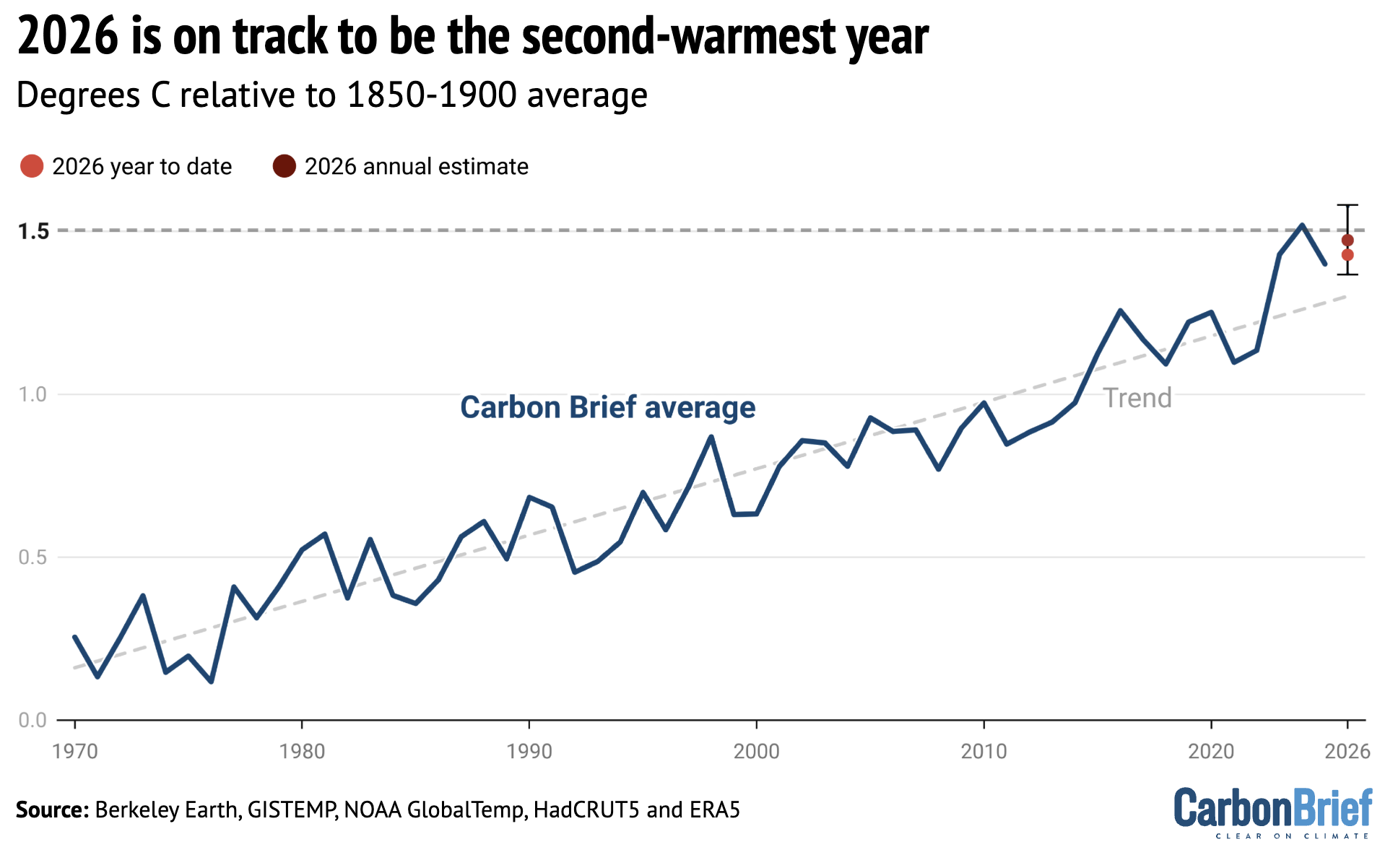
With a strong – or even “super” – El Niño event expected to develop later this year, Carbon Brief estimated that 2026 is on track to be the second-warmest year on record. The prediction puts global average temperature in 2026 at between 1.37C and 1.58C above pre-industrial levels, with a best estimate of 1.47C. This means that 2024 is “virtually certain” to be one of the top-four warmest years, but there is still a 19% chance that 2026 will be the warmest year on record – beating the prior record set in 2024.
Spotlight
Countries mull fossil-fuel transition in Colombia
This week, Carbon Brief reports from a first-of-its-kind summit on transitioning away from fossil fuels being held in Santa Marta, Colombia.
Around 60 countries are arriving in Santa Marta, Colombia today where – against a backdrop of white-sand beaches, rolling forested hills and stifling humidity – they will consider ways to move away from fossil fuels.
The first global summit on transitioning away from fossil fuels comes after a large group of nations campaigned for – but, ultimately, failed – to get all countries to formally agree to a “roadmap” away from coal, oil and gas at the COP30 climate summit in Brazil last November.
The nations gathering in Santa Marta for the summit, co-hosted by Colombia and the Netherlands, call themselves the “coalition of the willing”.
Together, they account for one-third of global fossil-fuel demand and one-fifth of global production, according to the Colombian government.
The group includes major oil-and-gas producers such as the UK, Canada, Australia, Brazil and Norway. Some big emitters – such as the US, China and India – are not expected to attend. (There is a question mark over whether China and India were invited.)
Academics to advise
In a departure from COP summits, the six-day event, from 24-29 April, will begin with a “science pre-conference”, where academics from across the world will present and discuss the latest scientific evidence on ways to transition away from fossil fuels.
Ahead of this, countries attending the talks have already been handed a draft scientific report with “action recommendations”, such as “halting all new fossil-fuel expansion” and “reject[ing] gas as a bridging fuel”, as revealed by Carbon Brief.
The report will be further debated and refined by scientists attending the academic segment of the Santa Marta talks, before a final version is made public towards the end of April, Carbon Brief understands.
The science pre-conference will also separately see the launch of a new advisory panel on fossil-fuel transition and a scientifically led roadmap for how Colombia can transition away from fossil fuels, sources tell Carbon Brief.
Alongside the science pre-conference, dialogues will also be held with Indigenous peoples, environmental organisations and other stakeholders.
‘High-level segment’
The science pre-conference will be followed by a “high-level segment” from 28-29 April, where ministers and other policymakers will meet to consider ways to transition away from fossil fuels. (Colombia’s president Gustavo Petro Urrego is expected to speak.)
At the end of the conference, countries are due to release a report featuring a “menu of solutions” for transitioning away from fossil fuels, according to Colombia’s environment minister Irene Vélez Torres.
This report is, in turn, set to inform a global “roadmap” on transitioning away from fossil fuels being developed by the Brazilian COP30 presidency, which is due to be presented at COP31 in Turkey this November.
The Brazilian COP30 presidency offered to bring forward a “voluntary” fossil-fuel transition “roadmap” outside of the official COP process, after countries failed to formally agree to one during negotiations in Belém.
Watch, read, listen
‘SHADOW DOCKET’: The New York Times obtained the “secret memos” behind the US supreme court’s decision in 2016 to block the Obama administration’s clean-power plan.
EGREGIOUS ENGAGEMENT: DeSmog identified multiple social media accounts in Sri Lanka posting AI-generated “energy policy rage bait” to UK Facebook feeds (as first revealed by Carbon Brief’s Leo Hickman).
CHINA ‘DOMINANCE’: A “Bloomberg originals” video looked at the “race to challenge China’s EV lead”.
Coming up
- 24-29 April: First conference on transitioning away from fossil fuels, Santa Marta, Colombia
- 28-29 April: Innovation Zero world congress, London, UK
- 29 April: Stop food waste day
- 6-7 May:GLF Africa 2026: stewarding our rangelands, Nairobi, Kenya
Pick of the jobs
- Natural England, chief executive officer | Salary: circa £130,000. Location: UK
- ETH Zurich, postdoctoral position in climate science | Salary: Unknown. Location: Zurich, Switzerland
- International Energy Agency, partnership manager – clean energy ministerial | Salary: €97,180. Location: Paris, France
- Greenpeace, media diversification press officer | Salary: £48,396-£55,644. Location: London, UK (hybrid)
- Our World In Data, writer | Salary: £80,000-£120,000. Location: Oxford, UK or remote
DeBriefed is edited by Daisy Dunne. Please send any tips or feedback to debriefed@carbonbrief.org.
This is an online version of Carbon Brief’s weekly DeBriefed email newsletter. Subscribe for free here.


The post DeBriefed 24 April 2026: Europe’s energy-crisis plan | Renewables overtake coal | Colombia’s fossil-fuel summit appeared first on Carbon Brief.

For the first time, new-energy vehicles (NEVs) made up 67% of new car sales in China in September, according to the latest data from the China Passenger Car Association (CPCA).
The figures show that NEVs, which include battery electric cars and plug-in hybrids, captured a record share of sales, even though fewer were sold than last year.
This is because sales of combustion-engine cars are falling steeply, a trend that the CPCA has attributed to rising petrol prices following the start of the Hormuz crisis.
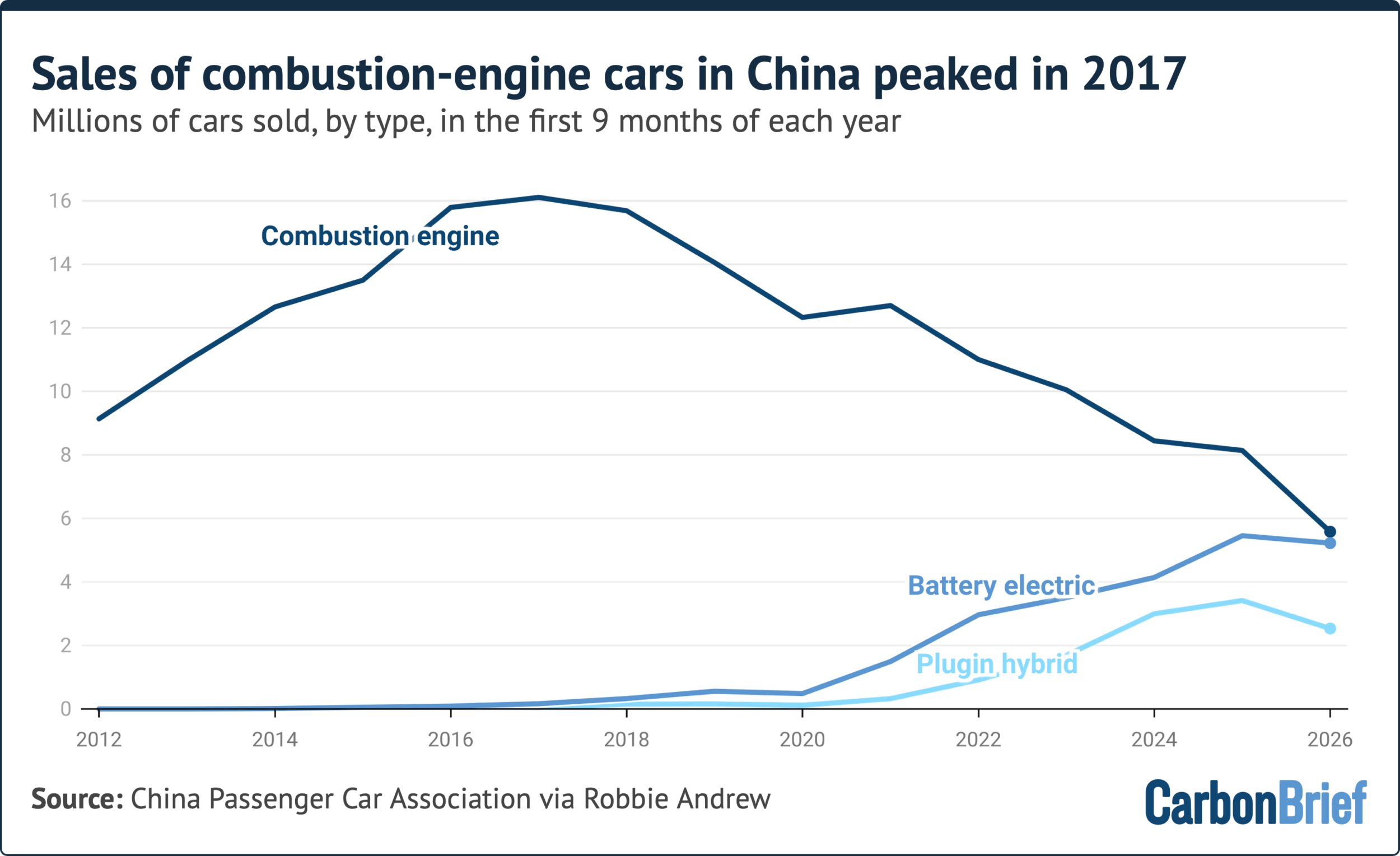
Indeed, sales of fuel-only cars were down 31% year-on-year in the first nine months of 2026, with plug-in hybrid sales down 26% – whereas battery EV sales were only down 4%.
One analyst tells Carbon Brief that China’s rapidly growing EV fleet has offset demand for 143m barrels of oil since the start of the Hormuz crisis.
Another says that the crisis is “reinforcing China’s electrification of road transport”.
Meanwhile, amid slowing domestic sales, Chinese carmakers’ exports of NEVs more than doubled [in 2026 to date / in September] from a year earlier.
NEV record
A record two out of every three cars sold in September in China were NEVs, according to CPCA data, as shown in the figure below.
(NEVs predominantly include battery electric vehicles – BEVs – and plug-in hybrids – PHEVs. BEVs only run on electricity, whereas PHEVs also have a combustion engine.)
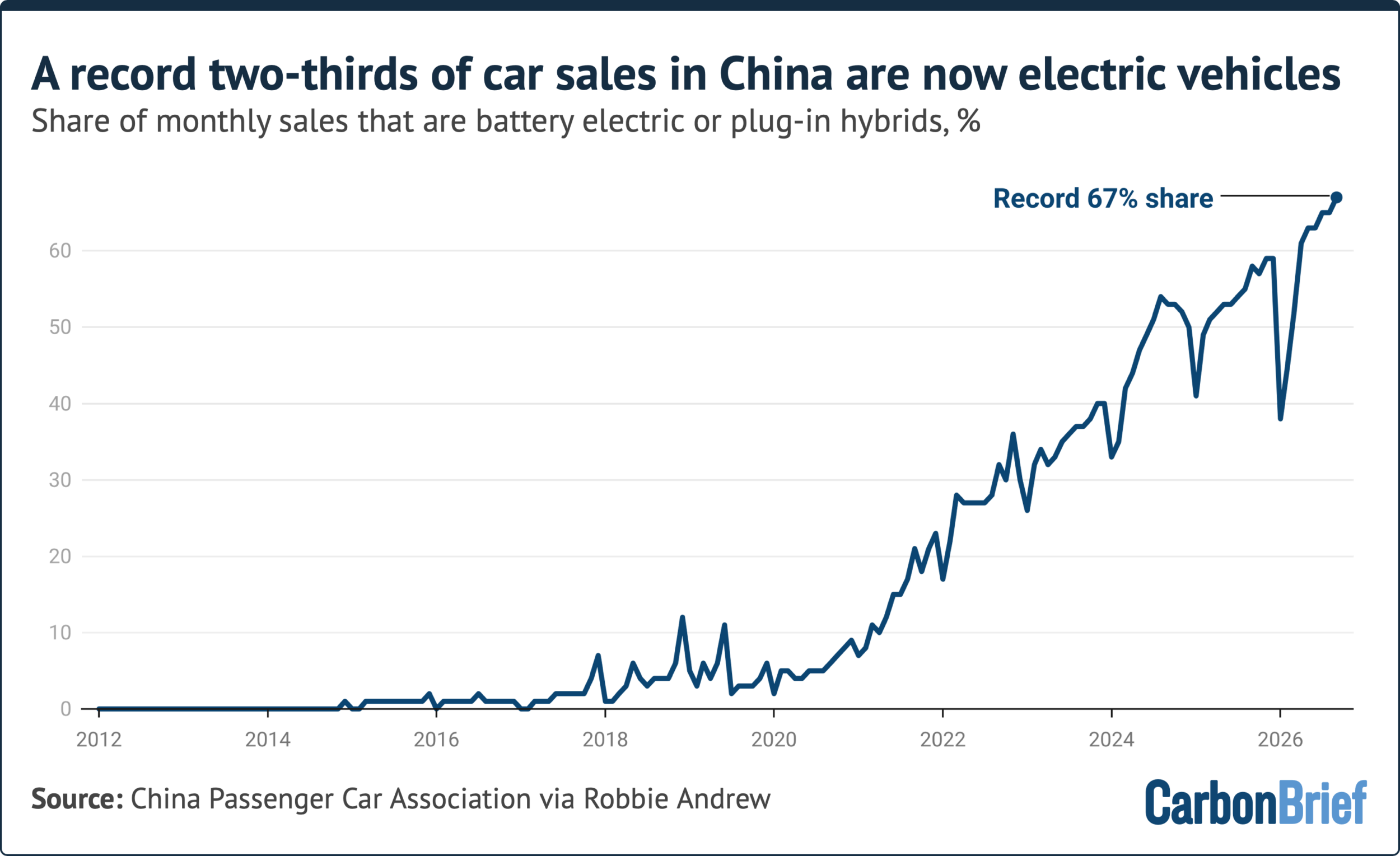
This marks a rapid rise for NEVs from just 6% of new car sales in 2020 up to 58% in 2026 to date – and a record 67% in the month of September.
This year, NEVs’ share of sales has also bounced back from a low of 39% in January, after the full purchase tax exemption that had been in place for more than a decade came to an end in December 2025.
The gain in NEV share in 2026 has come amid a slowdown across the wider domestic passenger-car market, which has hit sales of combustion-engine vehicles particularly hard.
This September, passenger-car retail sales across all categories declined, with overall sales volumes falling 28% year-on-year.
The contraction was led by combustion-engine vehicles, which saw sales fall 43% year-on-year in September and 31% in 2026 to date.
However, sales of PHEVs also fell by 36% year-on-year in September and by 26% in 2026 to date. By comparison, BEVs performed better, although sales still declined 8.5% from a year earlier in September and 4% in 2026 to date.
As a result, NEV sales overall fell by 17% in September and 13% in 2026 to date.
While the market changes in 2026 to date were particularly dramatic, they reflect a broad continuation of trends seen over the past decade.
Indeed, sales of combustion-engine cars in China peaked in 2017 and they have been declining ever since, shown in the figure below.
Impact of Hormuz
Part of the reason for the advance of NEVs in 2026, said Chinese technology news outlet OFweek, was petrol cars “giving up market share” as they were outperformed by electric alternatives.
Cui Dongshu, secretary-general of the CPCA, cited higher petrol prices as an explanation for September’s weak combustion-car sales, in comments to financial news outlet National Business Daily.
Imports of oil into China in January-September have fallen 15% compared to 2025, equivalent to 470m barrels, as ongoing conflict tightened supply and drove up prices.
China’s passenger-car NEV fleet has displaced 143m barrels of oil so far during the strait of Hormuz crisis, Euan Graham, senior energy analyst at thinktank Ember, tells Carbon Brief.
EVs “accounted for 12% of the decrease in China’s oil use post-Hormuz”, according to an estimate provided to thinktank the Brookings Institute by an unnamed analyst.