
Connect with us

Published

on

Forest Finance Hits Record Growth in 2025: Investment Doubles for Nature-Based Climate Action

Forests are regaining global financial attention. According to the UNEP State of Finance for Forests 2025 report, investment in sustainable forest management, restoration, and conservation is increasing after years of underfunding. Governments, private firms, and international institutions are now channeling more capital into nature-based solutions as part of global climate strategies.

The report highlights an encouraging shift: while current funding still falls short of what’s needed to halt deforestation, the pace of growth in forest finance has accelerated sharply since 2020. If the trend continues, forests could play a stronger role in both climate mitigation and green economic recovery.

A Rising Wave of Forest Investment

Between 2020 and 2024, global finance flowing toward forests and nature-based climate solutions nearly doubled. The report estimates that around $23.5 billion per year is now directed toward protecting and restoring forests worldwide, up from less than $12 billion annually just five years ago.

Public finance remains the largest source, accounting for roughly 60% of total flows. Governments and development banks fund reforestation, community forest management, and sustainable agriculture programs.

However, private capital is catching up fast. Private investments now represent 40% of forest-related finance, compared to about 25% in 2020.
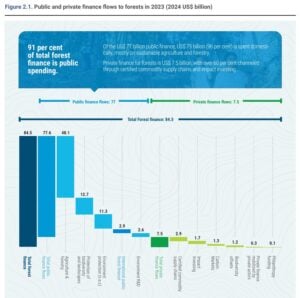
Public and private finance flows to forests in 2023
Source: UNEP Report

Key drivers include growing corporate commitments to net-zero emissions and the expansion of carbon markets. The demand for verified forest carbon credits has encouraged companies to back reforestation and avoided-deforestation projects in Latin America, Southeast Asia, and Africa.

At the same time, emerging “blended finance” models — which combine public risk guarantees with private investment — have made nature projects more bankable. This mix has become crucial for attracting institutional investors who traditionally avoided forestry due to long payback periods and perceived risks.

Nature as an Economic Engine

The economic case for forest investment is becoming clearer. Forests absorb about 7.6 billion tonnes of CO₂ every year, roughly one-fifth of global emissions. Yet they receive less than 2% of total climate finance, according to UNEP data.

The 2025 report argues that increasing forest investment could deliver major returns. Every dollar spent on forest restoration can yield up to $30 in ecosystem services, such as water regulation, soil protection, and biodiversity conservation.

Moreover, the jobs generated by sustainable forestry are rising. Forest-related sectors already employ over 30 million people worldwide, many in rural areas. Expanding restoration and reforestation could create an additional 15 million green jobs by 2030, based on projections from the International Labour Organization.

Several countries have made measurable progress. Brazil and Indonesia, once deforestation hotspots, are now expanding conservation incentives and attracting foreign funding for forest protection.

In Africa, Ghana and Gabon are scaling up REDD+ (Reducing Emissions from Deforestation and Forest Degradation) programs, linking carbon revenue directly to forest governance improvements.
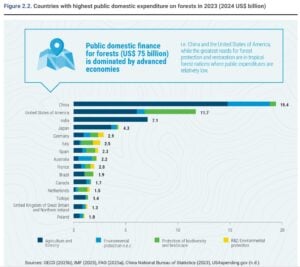
Countries with highest public domestic expenditure on forests in 2023

Private Capital Steps Up

Private investment in forests has grown from niche to mainstream in recent years. Asset managers, corporations, and impact investors are increasingly allocating funds to forestry and land-use projects that deliver both profit and carbon benefits.

The State of Finance for Forests 2025 report notes that private flows reached nearly $9 billion in 2024, led by large climate funds, corporate carbon credit purchases, and green bonds.

Notably, sustainability-linked bonds and loans are emerging as key financial tools. These instruments tie interest rates or repayment terms to measurable sustainability outcomes, such as reforestation acreage or emissions reduction.

Some of the largest moves include:

  • Sovereign green bonds issued by countries like Indonesia and Chile, raising billions for forest protection.
  • Corporate reforestation partnerships, such as Nestlé’s and Unilever’s investments in agroforestry supply chains.
  • Investment funds like Mirova, Climate Asset Management, and the &Green Fund, which collectively manage more than $5 billion in nature-based assets.

Private actors are also entering carbon markets more actively. Voluntary carbon credit demand reached an estimated 250 million tonnes of CO₂ in 2024, with forestry projects representing nearly 50% of total credits traded.

VCM Transaction Volumes, Values, and Prices by Forestry and Land Use Project Types

The Global Funding Gap

Despite progress, the funding gap remains wide. To meet global forest and land-use goals by 2030, annual investments need to reach $460 billion, the report finds. That is nearly 20 times current levels.
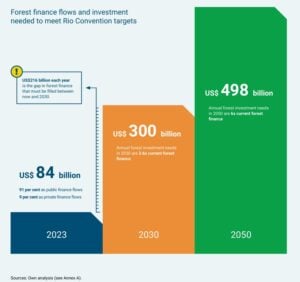
Forest finance flows and investment needed

The shortfall reflects structural barriers: unclear land tenure, lack of local project pipelines, and limited data on returns. In many regions, smallholders lack access to affordable finance for sustainable farming and reforestation.

However, international climate finance mechanisms are helping bridge the gap. The Green Climate Fund and the Global Environment Facility have both expanded forest-related programs. Since 2020, more than $6 billion has been committed through multilateral channels, supporting over 50 countries in their efforts to protect and restore forests.

The report also highlights that emerging markets — particularly in Africa and Latin America — could attract much larger investments if credit risks were reduced. Blended finance remains one of the most promising tools to make this possible.

Integrity and Innovation Take Root

A key focus of the 2025 report is ensuring that forest finance delivers real, measurable impact. This means improving transparency and strengthening safeguards against greenwashing.

New global standards are now being applied to forest projects. The Integrity Council for the Voluntary Carbon Market (ICVCM) and the Forest Stewardship Council (FSC) are working to align certification systems with climate integrity principles. This includes satellite-based monitoring, standardized carbon accounting, and stronger community engagement.

More than 70% of new private forest projects launched in 2024 adopted third-party verification standards, showing a growing shift toward credibility. These frameworks are helping investors gain confidence that their money is delivering genuine environmental and social benefits.

Technology also plays a growing role. Digital tools such as remote sensing, AI-powered forest monitoring, and blockchain-based traceability systems are improving project tracking and investor reporting.

From Billions to Trillions: The Next Frontier

The overall tone of the State of Finance for Forests 2025 report is optimistic. It finds that forest finance has entered a period of acceleration, with stronger collaboration between governments, investors, and communities.

If growth continues at the current pace, total annual forest finance could exceed $50 billion by 2030 — more than four times the 2020 level. However, the report stresses that this is still below what’s needed to achieve global forest protection targets.

UNEP and the World Bank project that scaling up nature-based investment to the trillion-dollar range will require systemic changes:

  • Embedding forests in national climate plans and green recovery packages.
  • Expanding carbon pricing and nature credit markets.
  • Strengthening transparency and local governance.

As deforestation pressures persist, the momentum around forest finance offers hope. The sector is no longer seen as an environmental niche but as a pillar of global climate and economic strategy.

Forests store carbon, support livelihoods, and protect biodiversity. Mobilizing finance at scale can help unlock their full potential — transforming them from victims of climate change into powerful drivers of climate resilience.

The post Forest Finance Hits Record Growth in 2025: Investment Doubles for Nature-Based Climate Action appeared first on Carbon Credits.

Continue Reading

Carbon Footprint

Microsoft Secures 1.8M Carbon Credits from Africa’s Rainforest Builder

Published

on

Microsoft is doubling down on nature-based carbon removal, and this time in West Africa. The tech giant has signed a long-term offtake agreement with Rainforest Builder, a fully integrated tropical forest restoration company, to support Project Buffalo in Sierra Leone. The deal will deliver up to 1.8 million carbon removal credits over 15 years, making it one of the largest single-project carbon removal agreements announced in Africa to date.

More than just a credit purchase, the partnership signals growing confidence in Africa’s high-integrity carbon markets. It also reinforces Microsoft’s aggressive push to become carbon negative by 2030.

A Landmark Carbon Removal Deal in Africa

Rainforest Builder operates across Sierra Leone, Ghana, and Guinea, employing more than 2,500 people. The company follows a science-led, community-focused model that blends ecosystem restoration with economic development.

Under the Microsoft agreement, Project Buffalo will restore 15,000 hectares of degraded community land in Sierra Leone. The initiative will plant more than 10 million trees, rebuilding native forest ecosystems in the Upper Guinean Forest — one of the most biodiverse yet threatened rainforest regions in the world.

So far, Rainforest Builder’s Sierra Leone team has planted more than 1.8 million trees since 2023. The scale-up now underway will dramatically expand restoration efforts.

Importantly, this is not a short-term offset arrangement. The 15-year offtake structure provides long-term revenue certainty. That stability helps finance restoration, workforce development, and monitoring systems. In turn, it raises the bar for project integrity and permanence.

Restoring the Upper Guinean Forest

The Upper Guinean Forest once stretched across West Africa as a dense tropical ecosystem rich in endemic species. Today, more than 90% of it has been cleared due to logging, agriculture, and land degradation.

In Sierra Leone, old-growth forest now covers less than 1% of the country’s total land area. Many mammal and plant species survive only in isolated fragments. Without intervention, biodiversity loss could accelerate.

Project Buffalo aims to reverse that trend. By restoring native species across 15,000 hectares, the project will rebuild wildlife habitat, strengthen carbon sinks, and restore ecological connectivity. The region contains the highest number of mammal species among the world’s biodiversity hotspots. Many species exist nowhere else.

Forest restoration here delivers dual impact: measurable carbon removal and biodiversity recovery.

Unlike avoided deforestation projects, reforestation physically removes carbon dioxide from the atmosphere and stores it in biomass and soil. When executed with scientific oversight and long-term monitoring, these removals can be accurately measured and verified.

Rainforest Builder operates under the stewardship of a Scientific Advisory Board. The company collaborates with research institutions across West Africa and conducts field trials to optimize species-site matching. These trials improve survival rates and accelerate ecosystem recovery.

Jobs, Infrastructure, and Community Benefits

In 2025 alone, Project Buffalo directly employed 1,200 people. Employment is expected to grow significantly as planting expands toward the 10 million tree target.

Beyond wages, the project includes a broad benefit-sharing structure. This includes:

  • Community land leasing agreements
  • Smallholder agricultural improvement programs
  • Rural road infrastructure upgrades
  • A community development fund

This model ensures local communities remain long-term stakeholders in forest recovery.

Carbon Credits Could Unlock Billions for Africa’s Economy

Africa contributes just 3.9% of global CO₂ emissions. Yet it faces some of the most severe climate impacts, including extreme weather, crop loss, and land degradation. Carbon markets, therefore, represent more than an environmental solution — they present an economic development pathway.

High-integrity African carbon credits could generate up to $6 billion annually by 2030. Longer-term projections suggest the market could scale to $120 billion per year by 2050, supporting as many as 30 million jobs.

  • In 2024, Africa issued approximately 75 million carbon credits, valued at around $15 billion. That represented roughly 14% of the global voluntary carbon market.

Initiatives such as the Africa Carbon Markets Initiative (ACMI) are accelerating this momentum. The ACMI has secured more than $1 billion in commitments, including major purchase agreements from global financial institutions.

Deals like Microsoft’s with Rainforest Builder strengthen both supply credibility and demand confidence.

africa carbon market
Source: ACMI

Microsoft’s Expanding Carbon Removal Portfolio

The agreement also fits perfectly within Microsoft’s climate strategy.

The company has committed to becoming carbon negative by 2030 and to removing all historical emissions by 2050. To reach those goals, Microsoft shifted in 2020 away from avoided emissions credits and toward carbon dioxide removal (CDR).

MICROSOFT CARBIN REMOVAL
Source: Microsoft

In fiscal year 2024, Microsoft signed long-term agreements covering 22 million metric tons of carbon removal — more than all previous years combined. Of that volume, 2.8 million metric tons are expected to contribute directly to its 2030 carbon negativity milestone. Additional tons extend into FY31 and beyond.

Microsoft’s approach has evolved. For example, in 2022, it signed its first long-term CDR agreement, purchasing 10,000 tons over 10 years from Climeworks’ direct air capture facility in Iceland.

Then in 2023, it scaled up to multi-million-ton agreements with developers capable of designing large projects from inception.

  • And most importantly, the company refined commercial offtake structures and strengthened due diligence standards with its Criteria for High-Quality Carbon Dioxide Removal.

One of its significant milestones includes innovative climate finance structures. For example, it worked alongside Brazilian reforestation company Mombak and the World Bank to help unlock a $225 million outcome bond supporting Amazon restoration. That model blends natural capital investment with performance-based finance.

And the Rainforest Builder agreement follows a similar logic: long-term contracts create investment certainty, which enables scale.

Why This Matters for Africa’s Carbon Future

Africa’s carbon market remains primarily voluntary today. However, future integration with compliance systems, including mechanisms under Article 6 of the Paris Agreement, could dramatically increase demand.

To capture that opportunity, projects must demonstrate integrity, permanence, biodiversity co-benefits, and strong community engagement.

It restores degraded land rather than displacing communities. It plants native species rather than monocultures. It incorporates scientific oversight. And it delivers measurable socioeconomic benefits.

Ultimately, the Microsoft–Rainforest Builder partnership represents more than a bilateral agreement. It reflects a shift in how global corporations approach climate responsibility. Instead of short-term offsets, buyers are increasingly committing to long-duration, high-integrity carbon removal backed by science and community impact.

The post Microsoft Secures 1.8M Carbon Credits from Africa’s Rainforest Builder appeared first on Carbon Credits.

Continue Reading

Carbon Footprint

Meta Strikes 80 MW Solar Deal to Power Data Centers and Cut Carbon Impact

Published

on

Meta Strikes 80 MW Solar Deal to Power Data Centers and Cut Carbon Impact

Meta Platforms Inc., the owner of Facebook, Instagram, and WhatsApp, has signed a long-term power purchase agreement (PPA) with renewable energy developer MN8 Energy LLC. Under the deal, the tech giant will buy 100% of the electricity generated by MN8’s 80 megawatt (MW) Walker Solar Project in Juniata County, Pennsylvania. The agreement marks the first direct clean-energy contract between the two companies.

Meta will use solar power to help supply electricity to its data centers in the United States. The project is scheduled to begin operations by the end of 2026.

The Walker Solar project will supply power to the PJM Interconnection grid. This grid is the biggest wholesale electricity market in the U.S. It serves over 65 million people in 13 states and Washington, D.C.

Urvi Parekh, Director of Global Energy at Meta, said:

“We are thrilled to partner with MN8 ​Energy​ to bring new renewable energy to Pennsylvania and help support our operations with 100% clean energy.”

Inside the 80 MW Walker Solar Deal

The solar facility will generate about 80 MW of clean electricity when complete. Under the PPA, Meta will acquire all of the project’s output.

The agreement is a long-term contract. Meta will buy renewable power from MN8 Energy for years. This will help meet part of its data center electricity demand with clean energy.

MN8 Energy, a New York-based renewable energy and battery storage company, will develop and build the solar plant. It has about 4 GW of operational and under-construction solar projects nationwide. The company also operates 1.1 gigawatt-hours (GWh) of battery capacity and over 40 high-power EV charging stations in the U.S.

The Walker Solar project will supply energy to the regional grid and create local jobs during construction. It will also generate tax revenue for Juniata County and strengthen local energy infrastructure.

Powering AI Growth With Long-Term Solar

Meta has set a clear long-term climate goal. The company aims to reach net-zero emissions across its full value chain by 2030. This includes direct operations and supply chain emissions.

The tech giant has matched 100% of its global electricity use with clean and renewable energy since 2020. This covers its offices and data centers. To support this goal, Meta has helped add nearly 29 gigawatts (GW) of new clean energy capacity to power grids worldwide.

Meta renewable energy projects map
Source: Meta

Since 2021, Meta reports that its renewable energy procurement has helped reduce emissions by 23.8 million metric tons of CO₂ equivalent (CO₂e). These reductions come from large-scale wind and solar projects tied to long-term power purchase agreements.

However, electricity demand continues to grow. Meta’s data centers are expanding to support artificial intelligence and digital services. The company notes that rising data center demand makes decarbonization more complex, even as renewable energy use increases.

Meta aims to go further. It wants to reach net zero across its full value chain by 2030. This means not only its own operations (Scope 1 and Scope 2 emissions) but also the emissions tied to its suppliers, hardware, and products (Scope 3). Scope 3 emissions, which are about 8.15 million metric tons of CO2e, account for 99% of its total carbon footprint.

Meta 2024 carbon footprint
Source: Meta

As of its latest report, 48% of its suppliers — based on emissions contribution — have set science-aligned emissions reduction targets. These supplier commitments are critical because Scope 3 emissions make up a large share of Meta’s total carbon footprint.

  • The company has also set a goal to reduce Scope 1 and Scope 2 emissions by 42% by 2031, using 2021 as a baseline year.

Meta’s sustainability reports also show that electricity use remains central to its climate strategy. Since using 100% renewable energy in operations, Meta has helped avoid millions of tons of CO₂ emissions.

Beyond Carbon Emissions: Biggest Clean Energy Buyer

Beyond carbon reductions, Meta includes water and biodiversity in its ESG strategy. Since 2017, Meta has supported more than 40 water restoration projects.

In 2024 alone, these projects helped restore over 1.6 billion gallons of water in regions facing high or medium water stress. The company has committed to becoming water positive by 2030, meaning it plans to restore more water than it consumes.

The Facebook owner also supports biodiversity near its facilities. It has allocated more than 4,000 acres of land, over half of its owned data center campus footprint, for habitat protection and restoration using native species.

carbon removal projects backed by Meta
Source: Meta

In addition, Meta invests in voluntary carbon removal. The company funds projects designed to remove carbon dioxide from the atmosphere to address emissions that are difficult to eliminate. It also works with industry groups and government initiatives to help scale high-quality carbon removal markets.

A recent BloombergNEF report highlights Meta’s role in large-scale corporate clean energy procurement. The tech company was the biggest corporate clean energy buyer in 2025. They signed over 10 GW in power purchase agreements (PPAs).

corporate clean energy purchases BNEF 2025
Source: BNEF

It also found that Meta and its peers, Amazon, Google, and Microsoft, accounted for nearly half of all corporate clean energy deals last year. This demonstrates Meta’s influence in driving new renewable capacity online.

These efforts show Meta is combining financial power with sustainability action. The Walker Solar PPA helps the tech giant meet the fast-growing electricity needs from its data centers and AI workloads. Data centers use a lot of power. Using renewables can help meet this demand and reduce carbon emissions from grid electricity.

New Solar Capacity Strengthens the PJM Grid

The solar project will deliver clean power into the PJM Interconnection market. PJM coordinates electricity flow across a broad region of the U.S. and manages one of the most complex power systems in North America.

Adding new generation capacity like Walker Solar contributes to grid resilience and supports broader decarbonization goals. Solar generation helps offset older fossil-fuel plants as they retire or reduce output.

Experts say utility-scale solar is key. As more sectors electrify, the demand for electricity keeps rising. More solar capacity means steady, low-carbon energy when the sun is out, which helps reduce overall system emissions.

The Walker Solar project is part of a larger trend in U.S. solar growth. The U.S. Energy Information Administration (EIA) says 2026 will bring a record increase in utility-scale solar capacity. Over 40 GW is set to be added, marking a big jump from previous years.

US electricity generation 2026 by source solar EIA
Source: EIA

Big Tech’s Expanding PPA Playbook

Meta’s solar PPA with MN8 reflects a broader trend in corporate renewable procurement. Many large technology companies have signed long-term deals to secure clean electricity for their operations.

Beyond Meta, firms like Google, Amazon, and Microsoft also regularly enter into PPAs for new solar and wind projects. These companies made up almost half of all corporate clean energy deals in 2025, based on market analysis.

Long-term solar PPAs give companies a way to lock in clean power at predictable costs. They also help developers secure financing for new projects, since a contracted buyer reduces risk for lenders and investors.

These corporate procurement strategies go beyond purchasing renewable energy certificates (RECs). They involve direct contracts tied to specific solar or wind projects. This practice supports actual builds of new clean capacity rather than shifting existing output on paper.

The Next Wave of Data Center Decarbonization

The Meta–MN8 Energy solar agreement highlights a shift in how major tech companies meet their clean energy goals. Long-term PPAs like this one are becoming a key tool for corporate decarbonization.

Analysts believe major data center operators will keep growing their PPA portfolios. This is due to increased electricity demand and investor expectations for ESG. This trend could help accelerate the broader deployment of solar and wind generation across the U.S. power system.

As the landscape changes, data center operators and renewable developers may look into hybrid solutions, which could mix solar power with battery storage, microgrids, and demand response systems. This approach aims to provide reliable, low-carbon power all day long.

The post Meta Strikes 80 MW Solar Deal to Power Data Centers and Cut Carbon Impact appeared first on Carbon Credits.

Continue Reading

Carbon Footprint

LEGO Expands Carbon Removal Portfolio with $2.8M Investment for Net-Zero Goals

Published

on

LEGO Expands Carbon Removal Portfolio with $2.8M Investment for Net-Zero Goals

The LEGO Group announced a new investment of DKK 18 million, or about $2.8 million, into carbon dioxide removal (CDR) projects. This funding adds to an earlier DKK 19 million, or about $2.6 million, commitment made in February 2025. These two amounts are separate. They support different groups of projects under LEGO’s expanding carbon removal portfolio.

LEGO has now invested about DKK 54 million, or $8–8.5 million, in carbon removal initiatives across eight projects. The company says these investments help it reach its goal of net-zero greenhouse gas emissions by 2050.

The toymaker emphasizes that it prioritizes cutting emissions within its own operations and supply chain first. It views carbon removal as a complementary tool for emissions that are difficult to eliminate.

Annette Stube, Chief Sustainability Officer at the LEGO Group, said:

“This purchase highlights our commitment to testing a broad range of credible pathways for nature and tech-based carbon removal. As the programme expands, it is helping to strengthen our understanding of different approaches and inform future decision-making on how carbon removal may complement our wider climate goals. While reducing emissions in our own operations remains our priority, this programme allows us to work with expert partners and contribute to solutions that may help scale effective climate action over time.”

Climate Experts Driving LEGO’s Carbon Removal

LEGO works with two specialist partners: Climate Impact Partners and ClimeFi.

Climate Impact Partners helps design and deliver nature-based carbon removal projects. ClimeFi focuses on engineered and technology-based removal solutions. These partnerships allow LEGO to support a mix of short-term and long-term carbon storage pathways.

The 2025 investment supports four projects, including biochar, enhanced rock weathering, and reforestation. The 2026 investment supports four additional projects. Together, they form a diversified carbon removal portfolio.

Nature-Based Carbon Removal: Forest Restoration in Mexico

One of the four new projects funded by the 2026 investment is a big reforestation effort in Quintana Roo State, Mexico. This project:

  • Restores more than 14,000 hectares of degraded tropical forests.
  • Includes native tree planting, species recovery, fire prevention, and community forest management.
  • Allocates over 20% of the budget to local job creation and income generation.
  • Bringing biodiversity benefits and supporting ecosystems for native wildlife.

This initiative is delivered through Climate Impact Partners in collaboration with Canopia Carbon. It adds to LEGO’s earlier help for reforestation in the Lower Mississippi Alluvial Valley (USA). These forest projects remove carbon dioxide from the atmosphere as trees grow and store it in biomass and soil.

Nature-based removal projects often provide co-benefits. These include biodiversity protection, watershed improvements, and community income. However, they can face risks such as fire or land-use change. Long-term monitoring and strong governance are, therefore, critical.

Lego carbon removal projects
Source: LEGO

Engineered Carbon Removal Technologies: From Biomass to Marine CDR

The other three 2026 projects involve emerging CDR technologies managed by ClimeFi:

  • Biomass Geological Storage: Uses slurry injection to store carbon-rich organic waste deep underground.
  • Mineralization: Transforms CO₂ into manufactured limestone using reactive waste materials that can serve as building inputs.
  • Marine Carbon Dioxide Removal: Enhances wastewater alkalinity to remove CO₂ and store it durably in ocean water.

LEGO invests in various pathways to gain hands-on experience with new solutions. These approaches have different durability profiles. This means they store CO₂ for different lengths of time and may also scale in various ways.

Engineered carbon removal often offers higher durability than many nature-based solutions. In some cases, storage can last hundreds to thousands of years. However, these technologies are still developing and can be expensive in the early stages.

LEGO chooses to try various pathways to understand costs, scalability, durability, and verification standards in the carbon removal market. It also aligns with its net-zero goals.

Net-Zero in Motion: LEGO’s Dual Approach to Emissions

The LEGO Group has committed to a net-zero greenhouse gas emissions target by 2050. This target covers its full value chain, including Scope 1, 2, and 3 emissions. LEGO’s near-term targets are validated by the Science Based Targets initiative (SBTi).

The toymaker has committed to reducing absolute Scope 1 and Scope 2 emissions by 37% by 2032 from a 2019 baseline. It also aims to reduce absolute Scope 3 emissions by 37% within the same timeframe. These targets align with limiting global warming to 1.5°C.

LEGO ghg emissions target
Source: LEGO

LEGO’s FY2024 Sustainability Statement says the company’s greenhouse gas emissions were around 1.7 million tonnes of CO₂ equivalent (tCO₂e).

While the statement does not yet include a full breakdown of emissions for that year, the most recent publicly disclosed data (for 2023) show that LEGO’s total emissions were about 1.82 million tCO₂ equivalent. In that year:

  • Scope 1 (direct emissions) were approximately 23,403 tCO₂e.
  • Scope 2 (purchased energy) was very low — effectively 1 tCO₂e when using market‑based accounting due to renewable energy matching.
  • Scope 3 (value chain emissions) accounted for about 1.80 million tCO₂e, representing roughly 99 % of total emissions.

The dominance of Scope 3 is consistent with LEGO’s industry profile:

Most emissions arise from materials, manufacturing by suppliers, transport, and end‑of‑life impacts, rather than from the company’s own direct operations. Scope 1 and 2 emissions accounted for roughly 1% of total emissions.

LEGO says it uses 100% renewable electricity for its operations. This comes from on-site solar panels and renewable energy certificates. The company first matched 100% of its electricity use with renewable energy generation in 2017.

In 2024, LEGO also reported progress in sustainable materials purchasing, which indirectly contributes to reduced emissions. About 47 % of the materials purchased to make LEGO elements were certified via mass balance principles. This translates to an estimated average of 33 % renewable sources in raw materials.

Half of all purchased materials were produced with sustainable sources. The same goes for its packaging materials, where 93% were from paper.

LEGO sustainable packaging
Source: LEGO

LEGO recognises that carbon removal projects are not a substitute for reducing emissions. They see CDR as a helpful tool. It targets emissions that are tough to fully eliminate.

Investing in both nature-based and technology-based removals allows the company to:

  • Understand emerging solutions.
  • Gain practical insight into quality, cost, and permanence.
  • Build relationships with expert partners.
  • Support broader climate goals beyond its own footprint.

LEGO’s climate disclosures stress that the company prioritizes operational cuts first. The company engages suppliers. It uses low-carbon materials and boosts energy efficiency. It also expands renewable energy in its value chain.

The company uses its CDR portfolio to guide future decisions, which helps scale effective climate action while focusing on reducing emissions. Their main goal is to achieve net zero by 2050.

Carbon Removal in Corporate Net-Zero Strategies

Carbon dioxide removal is becoming more important in corporate climate strategies. McKinsey & Company says that by mid-century, the world may need billions of tons of carbon removal each year to reach net-zero.

McKinsey estimates that the CDR market could grow to between $40 billion and $80 billion per year by 2030. By 2050, the market could reach $300 billion to $1.2 trillion annually if scaled to climate targets.

CDR credit demand annually 2030 McKinsey
Source: McKinsey & Company

Many climate models show that even aggressive emission cuts may leave 10% to 20% of emissions hard to eliminate. Carbon removal can help address these residual emissions.

Corporate demand plays a key role in building supply. Early buyers send price and volume signals that support project financing. Frontier and other groups have promised to spend hundreds of millions on future carbon removal credits. Members include major technology and consulting firms such as Google, McKinsey, and H&M Group.

Despite growth, current global carbon removal capacity remains far below what climate science suggests is needed. High-quality projects require strong measurement, reporting, and verification systems. Standards continue to evolve across voluntary carbon marke.

Learning and Leading: LEGO’s Early-Mover Advantage in CDR

LEGO’s total DKK 54 million commitment represents a learning strategy as much as a climate contribution. The company gains experience in evaluating project quality, permanence, and social impact. It also builds relationships in a fast-developing sector.

The company’s approach reflects a broader shift among multinational firms. Many now test different removal methods while continuing to reduce direct emissions. This dual strategy helps companies prepare for future regulatory frameworks and stakeholder expectations.

As the global carbon removal market expands, early investments like these help improve project standards, scale innovation, and attract more capital. The sector still faces cost and scalability challenges. But corporate participation provides one pathway to accelerate development.

LEGO’s CDR investments show a steady expansion of the company’s carbon removal portfolio. They also reveal how major consumer brands are integrating carbon removal into long-term climate strategies while continuing to prioritize emissions reduction.

The post LEGO Expands Carbon Removal Portfolio with $2.8M Investment for Net-Zero Goals appeared first on Carbon Credits.

Continue Reading

Trending

Copyright © 2022 BreakingClimateChange.com

