

Welcome to Carbon Brief’s China Briefing.
China Briefing handpicks and explains the most important climate and energy stories from China over the past fortnight. Subscribe for free here.
Key developments
Huang reported to lawmakers on climate action
NPCSC REPORT: Huang Runqiu, head of the Ministry of Ecology and Environment, told Chinese lawmakers that managing the country’s carbon dioxide (CO2) intensity has become “more challenging” due to the effects of the Covid-19 pandemic, extreme weather and growing trade tensions, Bloomberg reported. According to the full text of Huang’s remarks, made during a report to the National People’s Congress (NPC) Standing Committee, the minister remarked that China’s progress on meeting the target is “broadly in line” with its current international climate pledge for 2030. [Its CO2 intensity target for 2025 is likely to be missed.] He added that challenges have worsened around balancing climate action with economic development, managing “overall and local interests” and “aligning short-term with medium-to-long-term goals”.
TARGETS ‘SURPASSED’: Huang also highlighted the progress China had made in other areas, having “already surpassed” targets for wind and solar power capacity additions and new forest stock volume, the state-run newspaper China Daily said. According to current affairs outlet China News, Huang also noted that China has continued its “efforts to enhance the clean and efficient utilisation of fossil fuels”, including “reforms” for coal-fired power plants and “steadily increasing” gas production and utilisation.

GLOBAL INFLUENCE: China is “making important contributions to the implementation of the Paris Agreement”, Huang also said, according to the full text of his remarks, having “driven substantial reductions in the costs of wind and solar power” and “advanced international cooperation on climate change”, such as in south-south collaboration. He noted that in the face of “uncertainties”, such as the US withdrawal from the Paris Agreement and the expansion of the EU’s carbon border adjustment mechanism, China will enhance its “influence, guidance and shaping power in global climate governance”.
Movements ahead of UNGA
COP30 SIGNALS: Former climate envoy Xie Zhenhua travelled with Huang to Brussels to meet EU climate lead Teresa Ribera on 16 September, Reuters reported, in order to restart “climate negotiations” ahead of the UN general assembly and COP30. It added that current climate envoy Liu Zhenmin was not expected to be present. (A photo posted on Bluesky confirmed Xie’s presence in the city.) A few days earlier, COP30 executive director Ana Toni met Huang in Beijing, where he told her that China will support Brazil in hosting a COP that “sends a strong signal” about the importance of the Paris Agreement, climate news outlet Tanpaifang reported. Toni told reporters that Brazil expects a “huge Chinese delegation” at COP, the Global Times said. She also spoke at an event at Tsinghua University attended by Xie and followed online by Carbon Brief.
UK-CHINA: Meanwhile, the UK and China established a new industrial decarbonisation working group, according to a UK government statement, focusing on areas including carbon capture, utilisation and storage. Daniel Brooker, the head of the China office at UK Research and Innovation, told finance news outlet Yicai that climate cooperation with China is “one of our immediate priorities”.
INTERCONNECTED WORLD: Separately, vice-president Han Zheng used a conference speech to urge other countries to cooperate on developing “renewable energy generation, grid interconnectivity and smart energy systems” as a way of advancing the global energy transition, according to the Communist party-affiliated newspaper People’s Daily.
First auction under new renewable pricing system
LOWER PRICES: Shandong province held the country’s first renewable power auction, following the launch of new rules for the pricing of wind and solar power, industry news outlet BJX News reported, with the auction price of wind power set at 0.319 yuan per kilowatt-hour (yuan/kWh) and those for solar set at 0.225 yuan/kWh. The low prices set by the “bellwether” province signalled that “renewables prices [across China] in the future will be lower than under the previous system”, Reuters said, adding that it could “discourage” further investment. On LinkedIn, David Fishman, principal at the Lantau Group, said that while the wind power prices would likely be acceptable for developers, the solar prices would be “very tough”, citing one as saying they would likely “abandon” all future projects in the province.
-
Sign up to Carbon Brief’s free “China Briefing” email newsletter. All you need to know about the latest developments relating to China and climate change. Sent to your inbox every Thursday.
PLANS ‘PROMPT’: Meanwhile, the National Energy Administration (NEA) urged local governments during a video conference to “promptly” release their plans for implementing the pricing reforms, energy news outlet International Energy Net said, to “stabilise” industry expectations. Separately, the NEA revealed during the conference that, between January and July 2025, China’s installed renewable energy capacity grew by 283 gigawatts (GW) to 2,171GW, current affairs outlet China News reported. In August, BJX News said, thermal-power generation grew by 1.7% – slower than July’s growth rate – while wind power grew by just over 20%, solar grew by 16% and hydropower fell by 10%.
LOCALISED PROJECTS: The NEA also co-released a notice on “improving pricing mechanisms” for localised new-energy projects, International Energy Net reported, referring to projects that “both generate and consume electricity” such as zero-carbon industrial parks. The notice outlined benchmarks for how much of their own renewable energy such projects should sell and consume, clarifying that such projects should “bear transmission and distribution fees, system operation costs and other expenses”, it added.
China set targets for new AI energy projects
AI PILOTS: China plans to increase the use of AI in the country’s energy sector, state news agency Xinhua reported, in order to “enhance energy security, improve operational efficiency and support the country’s green and low-carbon transition”. China will “promote the deep application of at least five specialised large models”, which could be used in the power grid, power generation, coal, oil, gas or other areas, according to industry news outlet China Energy News. It also reported that China plans to identify ten or more “replicable, scalable and competitive” pilot projects. Consulting firm Trivium China wrote in a note that the plan “positions AI as an indispensable tool” on climate change.
DOUBLING STORAGE: China aims to “almost double” new-energy storage capacity by 2027 to 180GW, according to a new industry plan, Reuters reported. Lithium-ion battery storage is likely to comprise the bulk of new additions, economic news outlet Jiemian said. Meanwhile, according to a new government action plan for 2025-2026, new-energy power equipment companies are expected to achieve “steady” annual revenue increase, while traditional power equipment firms should aim to grow “approximately 6%” and “leading” companies by 10%, Xinhua said.
POLICY WATCH: China adopted the atomic energy law, its first foundational law for the nuclear sector, Jiemian reported. China’s environmental code – also the first of its kind – remains under discussion, according to China News. Elsewhere, the country updated its plan to “advance the three-north shelterbelt forest programme”, China Daily said. The National Development and Reform Commission called for “exploring” pathways for real estate investment trusts to invest in ultra-high voltage transmission projects, BJX News reported. BJX News also covered new guidance on improving electricity spot markets.
Spotlight
Q&A: Will China and the BRICS fill the ‘leadership gap’ on climate change?
Amid a rapidly fracturing geopolitical order, there have been growing calls for China to “step into [the] leadership gap” left by the US on climate change.
One platform that it could use to do so is BRICS, an increasingly influential and assertive group that includes COP30 host Brazil.
In this issue, Carbon Brief explores whether or not China, alongside the BRICS, could become climate leaders. The full article is available on Carbon Brief’s website.
The BRICS group represents a number of emerging economies that aim to “increas[e] the influence of global south countries in international governance”.
Active full members include founding members Brazil, Russia, India and China, as well as South Africa, Egypt, the United Arab Emirates, Ethiopia, Indonesia and Iran.
Together, they represent 27% of global gross domestic product, 49% of the world’s population and 52% of carbon dioxide emissions, according to Carbon Brief calculations.
Four of the members – Brazil, China, India and South Africa – also form the BASIC bloc, a group with a significant voice at UN climate summits and other negotiations.
How do the BRICS approach climate change?
Lucas Carlos Lima, professor of international law at the Federal University of Minas Gerais in Brazil, wrote that recent joint statements show the BRICS had “placed climate change squarely at the centre of the bloc’s agenda”.
In July, the BRICS summit resulted in a joint declaration demanding that “accessible, timely and affordable climate finance” is provided to developing countries.
The statement also highlighted the nations’ “resolve to remain united in the pursuit of the purpose and goals of the Paris Agreement”.
However, the BRICS leaders’ declaration also “acknowledge[s] fossil fuels will still play an important role in the world’s energy mix”.
The inclusion of this language “undermin[es] the positives” of the bloc’s other statements on climate action, according to a response from Jacobo Ocharan, head of political strategies at Climate Action Network International.
What is the role of fossil fuels in the BRICS?
Many BRICS nations remain heavily reliant on fossil fuels, both for electricity generation and to support their wider energy systems.
However, this picture is starting to shift, with almost all BRICS members having adopted net-zero targets ranging from 2050 to 2070.
More tangibly, the addition of new clean-power projects means that fossil-fueled electricity generating capacity now makes up less than half of the installed total in the BRICS group as a whole in 2024, as shown in the figure below.
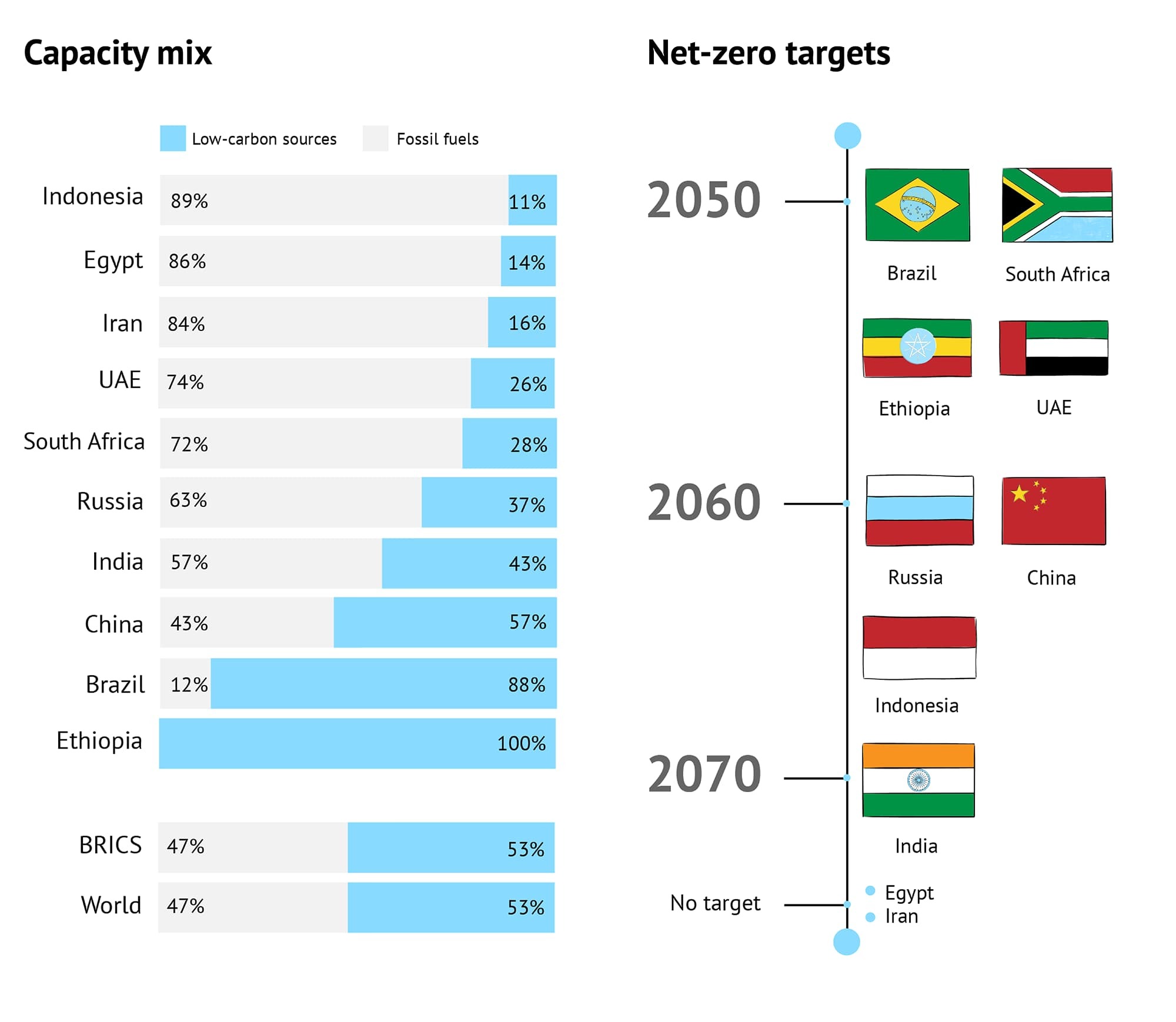
Non-fossil power, driven by “unprecedented” renewable energy growth in China, India and Brazil, accounted for 53% of the installed electricity generating capacity in BRICS countries in 2024, according to thinktank Global Energy Monitor (GEM).
Continued BRICS focus on clean energy makes it “unlikely that fossil capacity will overtake non-fossil again”, James Norman, research analyst at GEM, told Carbon Brief.
Several BRICS members, including Russia, the UAE, Iran and Indonesia, are nevertheless leading producers and exporters of fossil fuels.
China and India, meanwhile, are by some distance the world’s largest and second-largest coal users, respectively.
Nevertheless, in the short term, this might not affect the BRICS group’s climate ambition overall.
Russia does not seem to be “blocking” the “solid outcomes” of recent BRICS climate negotiations, said Kate Logan, director of the China climate hub and climate diplomacy at the Asia Society Policy Institute (ASPI).
Will China and the BRICS emerge as climate leaders?
With the withdrawal of the US from the Paris Agreement under the Trump administration, there have been increasing calls for China to take up the mantle of climate leadership.
China, at least publicly, is eschewing these calls, but does seem to be open to agreeing to “demonstrate leadership” in tandem with others, as seen in an EU-China joint statement on climate change published in late July.
Many are watching for signs of whether China’s upcoming international climate pledge, which may be published next week, will contain ambitious targets that will encourage greater global ambition.
Beatriz Mattos, research coordinator at Brazil-based climate-research institute Plataforma CIPÓ, tells Carbon Brief that China’s position as a “major investor in the renewable energy sector” means there is “enormous potential” for both it and the BRICS to assume a climate leadership role.
Watch, read, listen
NEW PARTNERS: The China-Global South Podcast examined the “stunning 113% jump” in Chinese investment into Brazil, a significant share of which was in oil and renewable energy.
PEAK ESTIMATE: A new report by Greenpeace East Asia found that China could “peak its power emissions in 2025”, at just over 5bn tonnes.
INSIDER VOICES: Three leading experts on China’s energy transition shared their insights in an event broadcasted by the Center for China and Globalization.
RESHAPING ENERGY: Ember published a “comprehensive review” of China’s energy transition and how it is “transforming global energy realities”.
$210 billion
The amount of foreign investment pledged by Chinese clean-energy technology manufacturers since 2022, according to a new report by the Net Zero Industrial Policy Lab covered by Bloomberg.
New science
Agricultural and Forest Meteorology
A new study examined the combined role of “forest activities and fire disturbance” (FAFD) on the effectiveness of China’s carbon sinks. It estimated that, between 1986 and 2020, the carbon emissions resulting from harvesting forests and forest fires offset around 54% of the carbon sequestration occurring through forestation. These findings, the authors said, “highlight the importance of accounting for carbon emissions from deforestation and forest fire when aiming to maximise carbon sequestration through forestation”.
Temperature extremes in early life and human capital: evidence from China’s labour market
Climatic Change
“Early-life exposure” to both extreme heat and extreme cold has “significant and persistent negative effects on adult labour income”, new research has found. The study, which draws from a dataset of more than one million individuals from China, said that, under a scenario with moderate warming (SSP2-4.5), average labour-income loss across China could total 0.77%, with the provinces of Qinghai, Henan, Fujian and Gansu most severely affected. It added that the impact of extreme heat on foetuses is “particularly pronounced”, with significant implications for future earnings.
China Briefing is compiled by Wanyuan Song and Anika Patel. It is edited by Wanyuan Song and Dr Simon Evans. Please send tips and feedback to china@carbonbrief.org

The post China Briefing 18 September 2025: MEE on the move; AI and energy; BRICS and climate appeared first on Carbon Brief.
China Briefing 18 September 2025: MEE on the move; AI and energy; BRICS and climate

June Rubis is a steering group committee member for the Cali Fund, from Sarawak in Malaysian Borneo.
At COP16 in Cali, governments made a significant commitment: at least half of the funding from the new Cali Fund should support the self-identified needs of Indigenous Peoples and local communities, including women and youth. It was a watershed moment for multilateral benefit-sharing.
The challenge now is to translate that commitment into access arrangements that recognise the different institutions, priorities and decision-making processes of Indigenous Peoples and local communities.
For generations, biodiversity and traditional Indigenous knowledge have provided significant value to companies who depend on nature’s genetic diversity to discover new drugs that fight diseases, create products that improve health, and grow crops resilient to extreme heat and flooding events. While some compounds are sampled directly from the source country, increasingly the digital blueprints are held in online public databases which are freely accessible to use for innovation and research.
Countries urged to ramp up “insufficient” nature policies at COP17
The Cali Fund was established at COP16 to encourage commercial users of Digital Sequence Information, or DSI, to share benefits arising from its use. Estimates suggest it could generate over $3.5 billion a year – a stark contrast to the modest $10,656 currently committed to the fund from just five SMEs, underlining how much progress must be made at COP17 over the next two weeks.
The COP16 decision that set up the fund offers two routes for money to reach Indigenous Peoples and local communities: through government authorities, and through direct payments to institutions identified by Indigenous Peoples and local communities themselves.
Varied ways of organising
Indigenous Peoples and local communities organise through a wide range of institutions. Some have national or regional organisations experienced in managing international grants. Others work through territorial organisations, customary institutions, community associations, cooperatives or networks. Some have professional finance teams and audited accounts; others have extensive experience governing territories, collective resources or conservation work without having been organised around international funding requirements.
For direct access, some questions are already apparent. Which institutions should be able to receive funds? How should they be identified? What fiduciary standards should apply? How should safeguards and accountability work where institutional capacities differ? What support may be needed where institutions have strong community mandates but less experience with international finance?
Comment: Protecting nature is a public duty, not a Wall Street profit opportunity
If access is designed mainly around institutions that already meet the expectations of large international finance mechanisms, early funding will tend to favour those already familiar to funders. They will gain further experience and become better positioned for future funding, while institutions with less administrative capacity may remain outside the system despite strong community mandates and long histories of stewardship.
These first decisions matter most, because they set the terms for everyone who follows.
The role of intermediaries requires care. Some Indigenous organisations may want a fiscal host to hold and manage funds on their behalf. Communities may choose to work through an NGO they trust. Government-facilitated arrangements may work well in particular national contexts.
What matters is the function an intermediary performs and the authority that comes with it. Providing administrative support is different from deciding which Indigenous organisations qualify, which priorities can receive support, or how success will be assessed. Direct access means communities keep that decision-making authority.
Decision-making power
The COP16 decision refers to institutions that Indigenous Peoples and local communities identify. But authority among Indigenous Peoples does not sit in one kind of body. It may sit with territorial organisations, customary institutions, community associations or combinations of these. Legal recognition and customary authority do not always align neatly.
Global deforestation slowed in 2025 but Brazil’s election could undo “fragile” gains
An important feature of the Cali Fund’s governance is that Indigenous Peoples and local communities participate as full members of the Steering Committee, rather than as observers. Seven Indigenous Peoples and local community representatives, one from each of the seven socio-cultural regions, participate in consensus-based decision-making alongside representatives of governments and UN entities. Six additional representatives from civil society, scientific institutions and the private sector participate as observers.
That representation carries responsibility. Institutional legitimacy, access and representation take different forms across the seven socio-cultural regions. Indigenous Peoples and local communities members therefore have an important role in bringing those differences into the Fund’s governance and in ensuring that arrangements developed for one context do not become the assumed model for everyone else.
Safeguards and clear responsibilities
COP17 can establish the core principles and direction, while allowing operational pathways to develop in ways that respond to different regional contexts. The decisions countries take in Yerevan will shape how that flexibility is realised in practice.
The choices made around access will influence which institutions are able to participate, which routes become established and which forms of authority are recognised within the funding architecture. The aim should be an architecture with enough structure to maintain confidence while allowing for different forms of Indigenous and community governance.
A credible direct-access pathway will need safeguards, financial oversight and clear responsibilities. This would give the 50% commitment a stronger institutional foundation.
The Cali Fund’s importance will ultimately depend not only on how much funding reaches Indigenous Peoples and local communities, but on whether they are able to determine how the money is accessed, governed and used. This requires access pathways that recognise their institutions, priorities and decision-making processes, rather than requiring them to conform to a single predetermined model.
The post COP17 must settle who decides how Cali Fund money is disbursed appeared first on Climate Home News.
COP17 must settle who decides how Cali Fund money is disbursed
The UK government has approved extraction at the Jackdaw gas field in the North Sea, despite acknowledging that this decision could make it harder for Britain to convince other countries to move away from fossil fuel production.
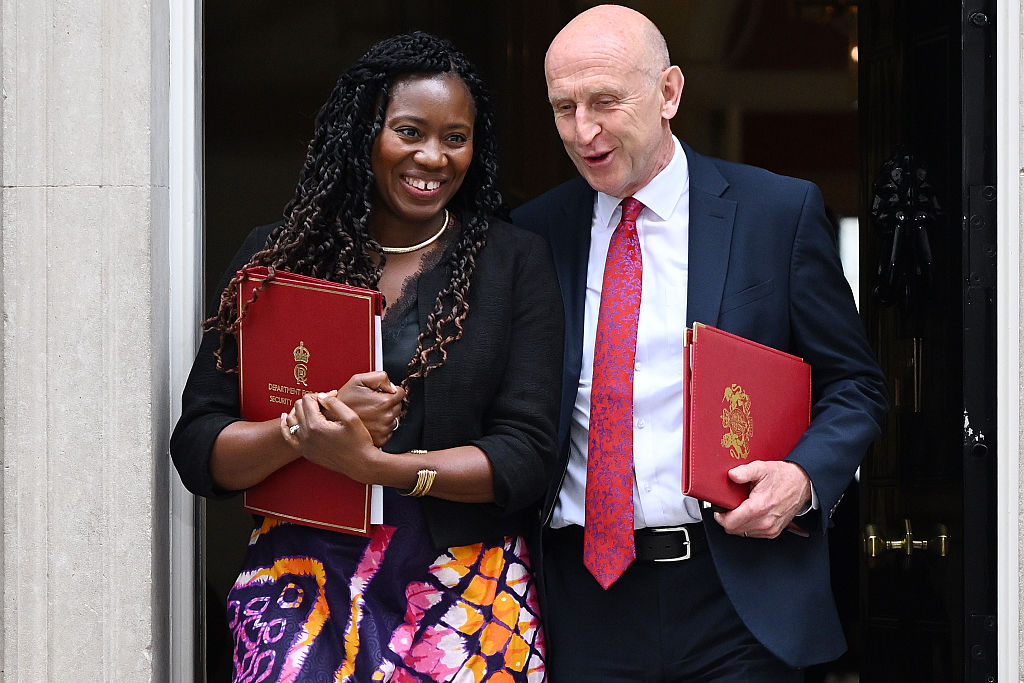
UK energy secretary Miatta Fahnbulleh approved the drilling on Wednesday after months of high-profile debate, fuelled in part by interventions from US President Donald Trump. She argued that the project would boost energy security in the wake of the Middle East fossil fuel crisis, protect hundreds of jobs and add £2.9 billion ($3.88bn) to the UK economy.
She said Jackdaw’s gas would be cleaner than imported gas and would not prevent the UK from meeting its legally-binding carbon targets and its goal of net zero by 2050. As the field is already licensed, she said extraction was consistent with the Labour Party’s 2024 manifesto promise not to issue any new oil and gas licenses.
The same morning, the government announced a new Energy Wealth Fund to reinvest oil and gas revenues in the climate transition. It will start with £2 billion ($2.67bn) from the government and be topped up over time with tax revenues from offshore oil and gas production.
Climate campaigners in the UK and abroad were quick to condemn the decision, while a leading legal expert told Climate Home News it goes against the advice of the International Court of Justice. Meanwhile, the government’s own documents reveal that it recognises the drilling could damage the UK’s reputation and its ability to push forward the global transition away from fossil fuels.
“Climate leadership” blow
The 92-page decision document says Fahnbulleh “acknowledges that international standing on climate is important and accepts that a decision to grant consent may not further the UK’s international climate leadership.”
It adds: “She acknowledges concerns about the potential implications for the UK’s credibility and influence – including the difficulty inherent in encouraging other states to move away from fossil fuel production while the UK continues, in a limited and transitional way, to draw on its own domestic resources.”
While noting that Jackdaw has not been issued with a new license – just permission to extract gas – the document says Fahnbulleh “accepts this does not fully resolve the underlying tension in the UK’s position” but “considers this alongside the substance of the UK’s wider record [on emissions reduction], which remains significant”.
It continues that she accepts these concerns are “legitimate” and weigh against approving gas extraction, but only gives this argument a “moderate negative weight” set against the benefits of gas production.
“Huge” wrong signal
In international climate talks, the UK has long supported the transition away from fossil fuels and is one of very few major oil and gas producers to ban new licenses. Across the North Sea, the Norwegian government continues to make offshore areas available for oil and gas exploration through annual licensing rounds.
Climate experts and campaigners shared the concern, acknowledged in the decision document, that approving Jackdaw could set a precedent for fossil fuel production elsewhere. Sam Fankhauser, professor of climate change economics at Oxford University, said the direct climate impact of Jackdaw is “much smaller than the debate around it would suggest” but the “wrong signal it sends, however, is huge”.