Welcome to Carbon Brief’s China Briefing.
China Briefing handpicks and explains the most important climate and energy stories from China over the past fortnight. Subscribe for free here.
Key developments
Floods killed 60 people after ‘year of rain in a week’
HUMAN TOLL: Heavy rainfall in late July killed at least 60 people across northern China, with flooding and landslides affecting Beijing and neighbouring Hebei province, Reuters reported, adding that “meteorologists link an increase in extreme weather…to climate change”. In some areas, a “year’s worth of rain fell in less than a week”, another Reuters article said. China’s “usually arid north has seen record rains in recent years”, but Beijing’s topography “amplif[ied] the deluge” that killed more than 30 people in the capital, the newswire added. Other affected regions included Shanxi, Shaanxi, Liaoning, Shandong, Tianjin and Inner Mongolia, according to various news outlets.
PERSISTENT HEAT: Five people were killed in southern Guangdong province due to “torrential rain”, said the state-run newspaper China Daily. Shanghai evacuated “around 280,000 people” as storm Co-may brought “strong winds and heavy rainfall”, Bloomberg said. Elsewhere, China Daily reported on “persistent high temperatures” in central China, adding that multiple regions faced intense heat or rainfall this week. The southern city of Chongqing “elevated its heatwave warning to the highest level” following temperatures “exceeding 40C for a week”, Reuters said.

RELIEF FUNDS: State broadcaster CGTN said China allocated more than one billion yuan ($139m) to areas across China for flood and drought relief efforts. Beijing and its neighbouring provinces received 550m yuan ($77m) for flood relief, reported the Hong Kong-based South China Morning Post (SCMP).
NEW OUTBREAK: Meanwhile, thousands of residents in southern China’s Guangdong province have contracted chikungunya, a mosquito-borne disease, Bloomberg reported, quoting an expert saying the “surge in chikungunya cases is likely due to favorable climatic conditions”. The outbreak “is the latest sign that tropical diseases…are expanding their reach, as climate change lets mosquitoes live in new territories”, it added.
Government tackled ‘Industrial Cthulhu’
OVERCAPACITY POLICIES: Regulators released a “draft amendment” to China’s pricing law that aims to “rein in price wars”, Reuters said. China will “name and shame” companies that continue to implement “ruinous competition”, said Bloomberg. Draft “guidance” was also issued on deploying government funds, SCMP reported, to prevent continued “overconcentrat[ion]” of local government investment in the “new three” and other sectors. China’s leadership also called for “reducing excess competition” and regulating “local government practices in attracting investment”, said Xinhua. According to Bloomberg, this showed “China’s leaders see the dangers” of China’s manufacturing strength “clearly”. (It added that some netizens had nicknamed the sector “Industrial Cthulhu”, in a “tongue-in-cheek” comparison that it said was meant to imply that “China’s manufacturing power is a beast”.)
SUPERCHARGING DEMAND: Domestic sales of new-energy vehicles (NEVs) between January and June 2025 rose 40% year-on-year to just under seven million units – 44% of total car sales – reported the Communist party-affiliated People’s Daily, while exports “surged” by 75%. Energy news outlet International Energy Net quoted a National Energy Administration (NEA) official saying China expects 2025 power demand for EV charging alone to equal the “annual power generation of the Three Gorges dam”.
HIDDEN FIGURES: While the figures show that 2025 is “shaping up to be another stellar year” for China’s EV industry “on paper”, Caixin said, “overcapacity” and fierce price wars mean the industry’s mood is “far from celebratory”. Separately, Reuters found it is “increasingly common” for automakers in China, including EV manufacturers and foreign brands, to “inflate car sales”.
EV TARIFFS: Meanwhile, Chinese EVs exports to the EU have made a “full comeback from tariffs set in place last year”, with Chinese automakers’ share in Europe’s EV market surpassing 10%, according to Bloomberg. Elsewhere, Thailand has “adjusted” EV subsidies to encourage exports as surging Chinese investment creates excess domestic “capacity”, said finance news outlet Caixin. EV manufacturer BYD has been offered a “short-term tariff break” in Brazil, but will face aggressive “hikes…in the long run”, SCMP reported.
Forecast for solar growth in 2025 rose to 300GW
GENERATION SHARE: Renewable energy accounted for “almost 40% of total power generation” in the first half of 2025, NEA officials said at a press conference covered by BJX News. New solar and wind generation also covered “total growth in electricity demand”, the energy news outlet added. BJX News also added that, according to the NEA officials, non-fossil fuel sources now account for 60% of China’s electricity mix. Meanwhile, the China Photovoltaic Industry Association “raised its forecast for new domestic solar installations this year” to 270-300 gigawatts (GW), citing the “minimal impact” of “new policies such as document 136” on large-scale clean-energy bases, reported business news outlet Jiemian. China had already installed 212GW of new solar capacity in the first half of the year, said China Daily.
-
Sign up to Carbon Brief’s free “China Briefing” email newsletter. All you need to know about the latest developments relating to China and climate change. Sent to your inbox every Thursday.
INDUSTRY INSPECTIONS: The government will conduct “energy conservation inspections” on polysilicon manufacturers, Jiemian said. It quoted an anonymous “industry insider” as saying the targeted companies are “not all…polysilicon projects for photovoltaic use”, adding that the inspections likely aim to identify “projects that consume resources without creating actual value”. Meanwhile, Reuters found “China’s biggest solar firms shed nearly one-third of their workforces last year”, illustrating the “pain from the vicious price wars”, while “more than 40 solar firms have delisted, gone bankrupt or been acquired” since 2024.
‘ORDERLY’ DEVELOPMENT: China issued a new policy on “further regulating the use of farmland for solar projects”, calling for better management and strict supervision of “solar projects involving the use of farmland”, reported International Energy Net. The NEA also pledged to “guide the orderly development of distributed [solar] projects and ensure safe and efficient consumption”, said another International Energy Net article.
Central bank boosted finance for ‘future energy’
NEW ENERGY FINANCE: China’s central bank, alongside several government ministries, released guidance on financing “new industrialisation”, BJX News reported, adding that it encouraged supporting sectors such as “new energy” in “raising capital” and encouraged state-run investment funds to focus on “future energy” and other “future industries”. The guidance also called for more support for “green and low-carbon transformation” and clean-energy technologies. Separately, China will evaluate the energy consumption and potential carbon emissions of “fixed asset” investments over a certain threshold of energy or coal consumption, said International Energy Net.
‘CLIMATE THREATS’: The CMA launched a new “initiative” to “establish a global early warning service network in the face of escalating climate threats”, CGTN said. China also issued a plan to “create greener, safer and more livable environments” in the face of “intensifying global climate change”, said People’s Daily. China’s agriculture ministry also released a work plan to “ensure a bountiful autumn grain harvest” in the face of an “above-average number of extreme weather and climate events this year”, Xinhua reported.
NDRC ON HIGH DEMAND: The National Development and Reform Commission (NDRC), China’s top economic planning agency, commented on recent high power demand, reported International Energy Net. It explained that the NDRC said China will “ensure an adequate and stable [power] supply” through effective management of coal production and will “integrate new energy’s supporting role” with coal’s role as a “bottom-line guarantee” (兜底保障) for power generation. Separately, the NDRC also highlighted “promoting…comprehensive transformation under dual-control of carbon mechanisms” as one of its “key tasks” for the rest of 2025, according to China Energy Net.
Spotlight
Guest spotlight: What an ‘ambitious’ 2035 electricity target looks like for China
A new study has found that China must at least double its wind and solar capacity by 2035 to align its power sector with a 2C global warming target.
In this issue, co-authors Zhenhua Zhang and Michael R Davidson, a PhD student and associate professor at the University of California, San Diego, respectively, explain how China could encourage climate ambition by setting power-sector targets.
The full article is available on Carbon Brief’s website.
China’s power sector is both the world’s largest emitter and the largest source of clean-energy growth.
This means it will be a key part of China’s next nationally determined contribution (NDC) – its climate pledge under the Paris Agreement for 2035.
In our new study, co-authored with experts from Tsinghua University, we model pathways for China’s power system up to 2035 that are consistent with its wider climate goals.
China has already surpassed its 2030 renewable deployment target, due to recent record-breaking annual additions.
However, new coal-power developments and rapid growth in electricity demand pose a threat to meeting China’s other targets.
Our research looks at the rate of growth from clean energy that would be required to not only meet China’s rapidly rising demand for electricity, but also to push down its coal generation and squeeze emissions from the power sector.
Staying below 2C
We simulate a range of scenarios for 2035, based around two different scenarios for China that are compatible with a global limit of 2C warming this century.
The basic 2C trajectory would see China’s power-sector emissions fall to 36% below 2024 levels by 2035, whereas the more ambitious 2C trajectory has a 42% decline.
It shows wind and solar energy would need to supply around 40% of China’s electricity by 2030, if the country aims to remain on track for 2C of global warming.
Solar and wind power generation would need to then rise to 50% by 2035, up from 17.9% in 2024.
This growth would substantially reduce the system’s reliance on coal and other fossil fuels, which would decrease to 35% of generation in 2030 and 25% in 2035.
The more ambitious scenario, which targets limiting global warming since the pre-industrial period to 1.5-2C, would see even higher wind and solar generation shares of 44% by 2030 and 54% by 2035.
Under the different scenarios, China’s wind and solar capacity would rise from around 1,700GW today to 2,350-2,780GW by 2030 and 2,910-3,800GW by 2030, requiring annual additions of 120-220GW.
Recent wind and solar additions have already exceeded this pace.
Challenges with grid integration and supporting infrastructure could slow future large-scale buildouts, meaning battery and grid capacity would need to rise by 6% and 5% per year to 2035, respectively to better integrate renewables into the grid.
The NDC and beyond
Due to the rapidly evolving economic and geopolitical situation, there are good reasons to expect that China’s topline emissions number in its NDC may be underwhelming. But there is an opportunity to emphasise and expand ambition within the power sector through additional sectoral targets.
While China has previously set a target for the absolute capacity of wind and solar, a goal for the share of electricity generation would set a narrower range for future power sector emissions.
Given current uncertainties around the pace of power demand growth, for example, a target for clean energy share might provide greater confidence than a capacity target alone.
Regardless of what targets are set, achieving the growth of clean energy modelled in our study would support China’s long-term climate commitments and demonstrate the nation’s intent to be a clean-energy powerhouse.
Watch, read, listen
‘UNSHAKEABLE’ GOAL: President Xi Jinping told attendees of the 2023 National Conference on Ecological and Environmental Protection that China’s commitment to its “dual-carbon” goals is “unshakeable”, according to a speech published in full, for the first time, by top ideological journal Qiushi.
CLIMATE REFUGEES: The United Nations Refugee Agency assistant high commissioner Raouf Mazou spoke with China Daily about China’s role in addressing “climate change-linked displacement”.
FINANCE FLOWS: The Environment China podcast explored what impact China’s push to develop “green finance” has had on the country’s energy transition.
PROVINCIAL PROGRESS: The Institute of Public & Environmental Affairs published a report assessing different provinces’ progress in reaching China’s “dual-carbon” goals.
1.35 billion
In tonnes per annum, the amount of coal-mine capacity that is “at various stages of development” in China, according to updated data from thinktank Global Energy Monitor – more capacity than “all other countries combined”.
New science
Communications Earth & Environment
A new study found a “significant increase” in both dry-hot and wet-hot extremes in China during the May-September warm season. The authors investigated changes in hot extremes in 136 Chinese cities over 1981-2022. They found that wet-hot extremes accounted for 36% of all hot days, while dry-hot days accounted for only 4%. The authors said their findings “underscore the urgent need for adaptive urban strategies to mitigate the growing risk of compound temperature-humidity extremes under ongoing urbanisation and climate change”.
China’s nationwide streamflow decline driven by landscape changes and human interventions
Science Advances
The amount of water running through rivers, or “streamflow”, has declined at more than 70% of Chinese hydrological stations over the past six decades, according to a new study. The authors combined data from more than 1,000 hydrological stations with climate models to produce a “comprehensive national assessment” of streamflow across China. They found that decreases in streamflow were mainly in northern China and were driven by changes in land use, but that increases in streamflow were found in the south, mainly driven by “climate change and variability”.
China Briefing is compiled by Wanyuan Song and Anika Patel, with contributions from Svetlana Onye. It is edited by Wanyuan Song and Dr Simon Evans. Please send tips and feedback to china@carbonbrief.org

The post China Briefing 7 August 2025: Deadly floods; ‘Industrial Cthulhu’; Higher solar forecast appeared first on Carbon Brief.
China Briefing 7 August 2025: Deadly floods; ‘Industrial Cthulhu’; Higher solar forecast

Saturday, 17 October 2026
7.18 AM AWST
Hi folks! We’re joining you live from the Rainbow Warrior where we will be providing you with updates as our four activists continue scaling and occupying Woodside’s gas platform. The activists are peacefully protesting against Woodside’s latest gas expansion plans, the Browse project, which would see up to 57 toxic wells drilled at Scott Reef.
“Right now our activists are scaling Woodside’s massive Floating Production Unit. They are scaling the South-East pillar and the underside of the Helideck. They’ll be setting up camp soon and have plenty of provisions with them – so stick around!”
5:45 AM AWST
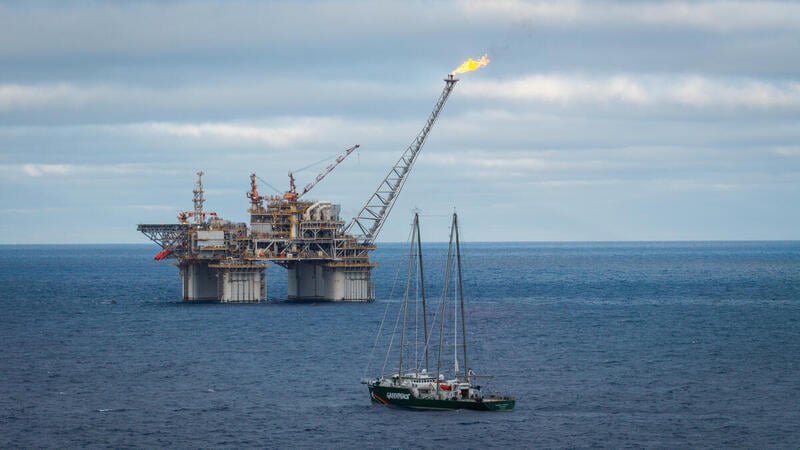
Our RHIBS are in the water! We’ve deployed our four activists and our ship crew on our small fast boats, headed to the gas platform. We’re carrying crew and equipment, plenty of food, all of our safety climbing gear, some big banners, cameras and a whole lot of heart… someone even has something to read after they get settled in.
5:26 AM AWST
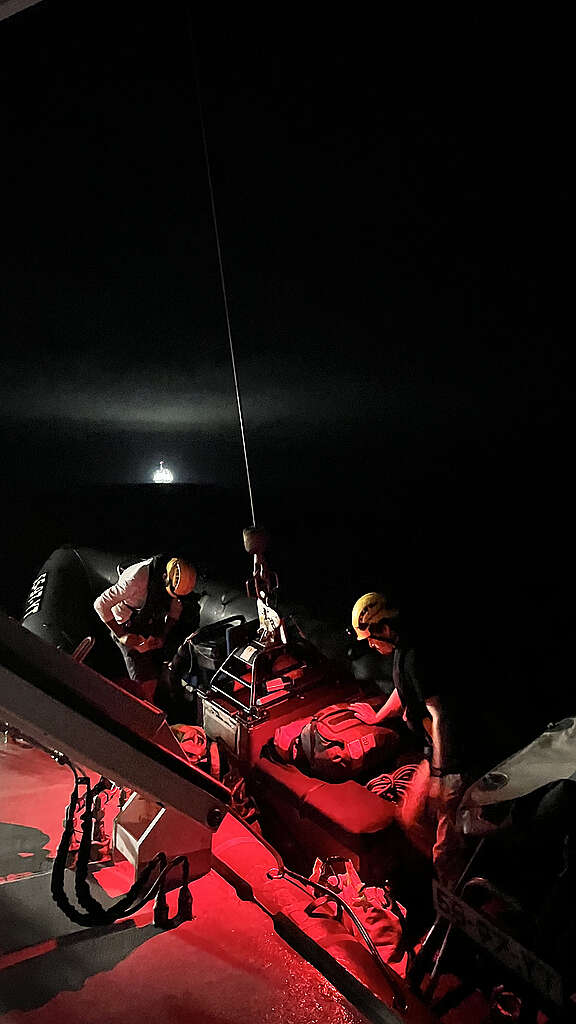
Before sunrise activists prepared to launch RHIBS from the Rainbow Warrior.
Looking for a front seat view?
You can follow along with the Live Rainbow Warrior bow cam here!
Looking for more?
Follow us on Instagram for a peek behind the scenes and hear from our Rainbow Warrior crew.
Live blog: Greenpeace activists occupy Woodside gas project to save Scott Reef
Climate Change
Greenpeace activists climb and occupy Woodside’s Scarborough gas project calling on the Australian government to “Stop Woodside’s Dirty Gas” and “Save Scott Reef”
PERTH, Saturday 17 October 2026 — Four Greenpeace Australia Pacific activists are scaling and occupying a Floating Production Unit at Woodside’s Scarborough gas project off the coast of Western Australia, displaying banners reading: “Stop Woodside’s Dirty Gas. Save Scott Reef.”
- Photos and video available here and here. More will be uploaded throughout the day.
- Content and live updates will be uploaded to a live blog and to Instagram
Early this morning at 05:45 AWST, Greenpeace Australia Pacific activists launched from the Rainbow Warrior, Greenpeace’s flagship vessel, scaling and attaching themselves to a Floating Production Unit (FPU), a key piece of gas processing infrastructure at the Scarborough gas field over 200km off the coast of Exmouth.
Woodside has since confirmed it has initiated a temporary shut down of the FPU.
Greenpeace Australia Pacific is occupying the gas platform in peaceful protest of Woodside’s plans to drill for oil and gas at Scott Reef as part of its Browse proposal.
David Ritter, CEO at Greenpeace Australia Pacific, said: “Greenpeace Australia Pacific is taking action today to expose the unacceptable risk to Scott Reef posed by Woodside’s plans.
“Australians love our oceans. Woodside’s reckless Browse gas proposal would turn the magnificent Scott Reef into an industrial gas zone. Woodside wants to drill up to 57 toxic wells around Scott Reef, Australia’s largest oceanic reef, home to nesting green sea turtles, and endangered species like pygmy blue whales and the dusky sea snake; it is a place like nowhere else on Earth.
“Woodside has an alarming track record of oil spills, incidents and environmental neglect, and can’t be trusted with our oceans. From whaling in Albany in the seventies, to Woodside’s threat to Scott Reef today, there’s more than fifty years of history, of Greenpeace taking action off WA’s coasts to protect our oceans.
“There’s no future in new gas projects. Our future is in secure homegrown renewable energy, green industry and exports, where communities and places like Scott Reef are protected — there’s no future in dirty gas shipped offshore.
“The prospect of drilling for oil or gas on the Great Barrier Reef would be considered absolute madness today, but that is exactly the decision before the government: save Scott Reef or risk its destruction at the hands of a gas corporation.”
From aboard the Floating Production Unit, Dr Chris Holden, Greenpeace Australia Pacific activist said: “As a doctor, when I see new fossil fuel projects like Woodside’s Browse project being put forward, I can’t help but think about the impact this is going to have on the health of our communities and planet, and feel a sense of duty to act.
“Not only will this project do irrevocable harm to nature at Scott Reef, it will have a terrible impact on our climate, putting all of our lives at risk.
“On the Rainbow Warrior I’m carrying a copy of the 2025 Lancet countdown report, which warns that health impacts of climate change are worsening, with millions dying needlessly each year due to fossil fuel dependence, growing emissions, and failure to adequately adapt.
“With warnings like this from the leading global health professionals, our government simply can’t allow fossil fuel projects like Woodside’s Browse project to go ahead. It is their duty to do what is in the best interest of our communities.”
Almost half a million people have signed a petition calling on the government to Save Scott Reef and Woodside’s Browse gas project.
-ENDS-
Notes:
- Dial-in, SimSat and Zoom interviews with Geoff Bice, WA Campaign Lead at Greenpeace Australia Pacific, currently aboard the Rainbow Warrior, can be organised separately
Media contact:
Greenpeace Australia Pacific media team on +61 406 231 892 or +61 407 581 404
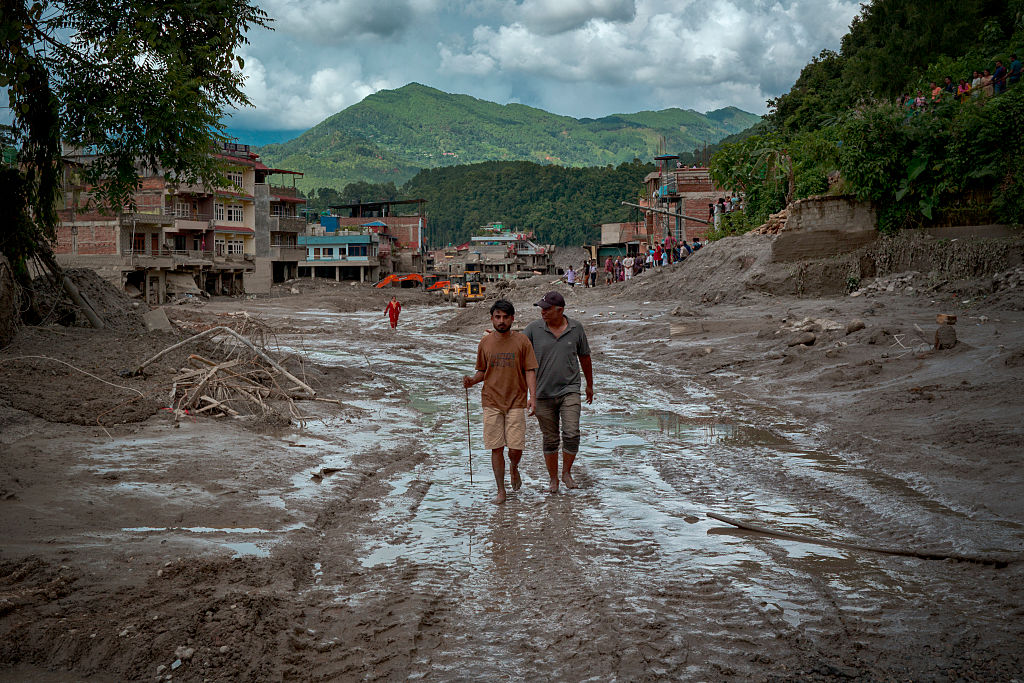
The board of the Fund for Responding to Loss and Damage (FRLD) will decide on Thursday on whether to “provisionally set aside” $20 million for Nepal to deal with some of the effects of the climate-driven flood it suffered in August.
The motion, seen by Climate Home News, has been drafted by a group of board members from both developed and developing countries and so is likely to pass easily at the fund’s first-ever extraordinary board meeting on October 22.
It invites the government of Nepal to submit a proposal for how to use the money, with the board then deciding at one of its regular board meetings whether to approve the proposal or not.
While Nepali officials have described $20 million as merely “symbolic” in the face of the $4.8 billion estimated costs of recovery and reconstruction, it would be the first time the new FRLD – agreed in 2022 months after devastating floods in Pakistan – has set aside money for a specific disaster.