

Dr. Niall McLoughlin is co-director at Climate Barometer.
Throughout recent weeks, Europe has yet again experienced the deadly effects of record-breaking extreme heat. Hundreds of heat alerts were put in place across the continent, as temperatures soared to 46C in some regions – with school closures and outdoor working bans in some nations.
Here in the UK, England may have just experienced its hottest June on record, with close to 600 people estimated to have died during the hottest period. Droughts have been declared in the North West of England and Yorkshire following the driest spring in 132 years; and wildfires recently scorched the earth across Scotland, Dartmoor and the Peak District. The land area burnt so far this year is already the highest in over a decade.
On Monday, the latest State of the UK Climate report showed that the number of days with temperatures 5C above the 1961-1990 average has doubled since that period for the most recent decade from 2015-2024. According to the Met Office, the hottest days experienced in the UK have dramatically increased in frequency in just a few decades, while the last three years have been in the country’s top five warmest on record.
Not prepared for extreme weather
Government statistics show there were more than 10,000 heat-related deaths in the UK alone between 2020 and 2024. Close to 3,000 people died amidst the record-breaking 2022 heatwaves, when UK temperatures exceeded 40C for the first time.
Despite this, the UK remains unprepared for extreme heat. In April this year, stark warnings were issued by the national government’s official climate adviser, the Climate Change Committee (CCC): The country is “not prepared” for climate impacts, progress has been “inadequate”, “too slow”, or has “stalled”. Encompassing heat risks, the CCC reported that not a single outcome of UK climate adaptation shows signs of ‘good’ delivery.
Scientists hail rapid estimate of climate change’s role in heat deaths as a first
The British public agrees the nation isn’t ready. Climate Barometer polling finds that more than three quarters (78%) believe the UK is ‘not prepared’ to deal with climate impacts, including extreme weather. Just 16% say there has been ‘good progress’ when it comes to climate adaptation.
In 2023, over two-thirds of the public said both national and local governments in the UK are not prepared for extreme heat events. Alarmingly, this sentiment is shared by paramedics, fire fighters, decision makers and community leaders who worked on the frontline of the 2022 heatwave response.
A disjointed landscape of heat communication
With most heat-related deaths being preventable, the way we communicate plays a pivotal role in reducing impacts. But we urgently need to improve the landscape of heat risk communication.
In the UK, while updated heat warning systems have been welcomed, aspects of the public-facing communication may be inadequate or unclear in terms of encouraging action. More widely, media portrayals of heatwaves continue to show people having ‘fun in the sun’, despite research showing this undermines the severity of heat risks.
Comment: Early warnings for heatwaves can save lives – and we need them now
Across Europe, in the absence of strong leadership on heat, political narratives are quickly forming around the moral need for air conditioning rollouts – despite AC units being costly, energy intensive, and making urban heat worse.
This all has knock-on consequences. Recently published UK-wide survey research shows that less than half of respondents (46%) said they felt ‘well-informed’ about heat risks. Very few felt that national (27%) and local governments (18%) were doing a ‘good job’ of communicating heat risks, and 20% said they lacked confidence in the accuracy of media coverage (37% were unsure).
Communicating better about heat
To help improve this disjointed landscape, here are three key suggestions:
1 – Heat communications must draw on social research. Studies show a very wide range of factors influence our actions and vulnerabilities when it comes to heat. From our belief about the risks, to where we live, to our cultural heritage, and the actions of our friends and family – these factors all play a role in shaping heat-related behaviour. Taking stock of these influences, alongside an awareness of the unequal impacts of heat, is necessary to inform better communication approaches. Social research also highlights the need for active, inclusive engagement that goes beyond one-way messaging (e.g. locally-led projects to increase tree cover, or community decision making about heat-resilient neighbourhoods).
2 – A focus on advance preparation is sorely needed. Preparation for heat should occur “all year round”, but typically UK risks aren’t treated in this way, with media coverage spiking as the heat takes hold. A review of heatwave research found an overwhelming focus on ‘protective actions’ (e.g. using a fan or drinking water to stay cool during heatwaves), rather than ‘preparative actions’ (e.g. installing shutters and blinds, or improving shading). This is despite the latter typically bringing benefits for more than one person, by reducing household vulnerability. Instead of an overemphasis on short-term coping, we need to build longer-term heat resilience.
3 – Effort is needed to address heat perception gaps. There are well known vulnerability gaps when it comes to climate impacts. Research by the British Red Cross found that “those most vulnerable to the effects of extreme weather often have the lowest awareness of their risk and the least knowledge of how to prepare”. Similar ‘perception gaps’ have been found in relation to heat impacts. For instance, people tend to believe they are less vulnerable to heat impacts than others in their community. Many in the UK look forward to heatwaves, despite the risks. And more than a third think heatwaves will only be a problem for the UK in the future. Tackling perception gaps like these could help unlock community preparedness.
Better communication alone is not enough. This must go hand-in-hand with policy changes, regulation, planning, and coordination. But with extreme heat a “new normal”, the way governments, community leaders and the media communicate about extreme heat matters now more than ever.
The more that social research insights are taken onboard, ultimately the more lives could be saved.
The post To help people prepare for extreme heat, we must communicate better appeared first on Climate Home News.
To help people prepare for extreme heat, we must communicate better

Countries will meet in Armenia this month to carry out the first global review of progress towards meeting key nature targets by 2030.
These targets – and the wider ambition to halt and reverse biodiversity loss around the world – were agreed in the landmark Kunming-Montreal Global Biodiversity Framework in 2022.
But the ambitions will not be achieved in time for the 2030 deadline unless action “accelerates rapidly”, a key UN report found.
It noted that nations are falling short on 22 of 23 nature targets, which focus on restoring ecosystems, increasing nature finance and reducing harmful subsidies.
This report and other findings will inform the global progress review taking place at the COP17 biodiversity summit in Armenia over 19-30 October.
The sections below summarise the report’s findings on where progress has – and has not – been made on each of the 23 targets.
They also rank the extent to which countries have addressed elements of each target on a national basis. Click on each target for more information. Key terms are defined throughout each section and in a glossary below.
The post COP17: Tracking progress towards the UN’s 2030 nature targets appeared first on Carbon Brief.
https://interactive.carbonbrief.org/nature-targets-2030-progress/
The amount of finance for nature delivered to date “falls far short” of what is needed to meet the UN’s global goals, according to a report released ahead of the COP17 biodiversity summit.
The global stocktaking report, prepared by the UN Convention on Biological Diversity (UN CBD) ahead of this month’s summit in Armenia, finds that developed nations are failing to close the $200bn “biodiversity finance gap”.
Initiatives designed to support this goal are also stumbling, with a special “framework” fund for biodiversity receiving less than $140m from developed countries in the past two years and the “landmark” Cali Fund receiving only $6,000 from private companies.
The availability of finance – or lack thereof – is likely to be a key point of contention in negotiations at COP17 in Yerevan, Armenia, which begin on 19 October.
Target for 2025 ‘not achieved’
At COP15 in 2022, 196 countries agreed to an ambitious global deal to reverse biodiversity loss by 2030, dubbed the Kunming-Montreal Global Biodiversity Framework (GBF).
Goal D of the agreement, shown below, states that countries must “close” a $700bn “biodiversity finance gap” by 2030.
This overall $700bn is made up of two parts: changes to nature-harming subsidies; and raising financial resources to support biodiversity.
Target 18 within the text calls for countries to “identify by 2025, and eliminate, phase out or reform incentives, including subsidies, harmful for biodiversity…progressively reducing them by at least $500bn per year by 2030”.
The remaining $200bn should be met by “mobilising” resources, according to target 19 of the GBF. It states that countries should “substantially and progressively increase the level of financial resources from all sources” to “at least” $200bn per year by 2030.
The overarching $200bn can be from national budgets, multilateral development banks or money “mobilised” from the private sector.
However, the target also specifically states that “at least $20bn per year by 2025 and…at least $30bn per year by 2030” should be public biodiversity funding provided to developing countries by developed countries – or others that “voluntarily assume” their obligations.
According to the global stocktaking report prepared by the CBD, between 2020 and 2023, countries mobilised a cumulative total of just $186.4bn. This is equivalent to an average of less than $50bn per year.
While the report – published on 10 September 2026 – cautions that it is “still too early to draw any conclusions”, it adds that this total “falls far short” of what is needed to close the $200bn-per-year biodiversity finance gap.
It continues to specify that the milestone of raising “at least $20bn per year by 2025” in public finance was also “likely not achieved”.
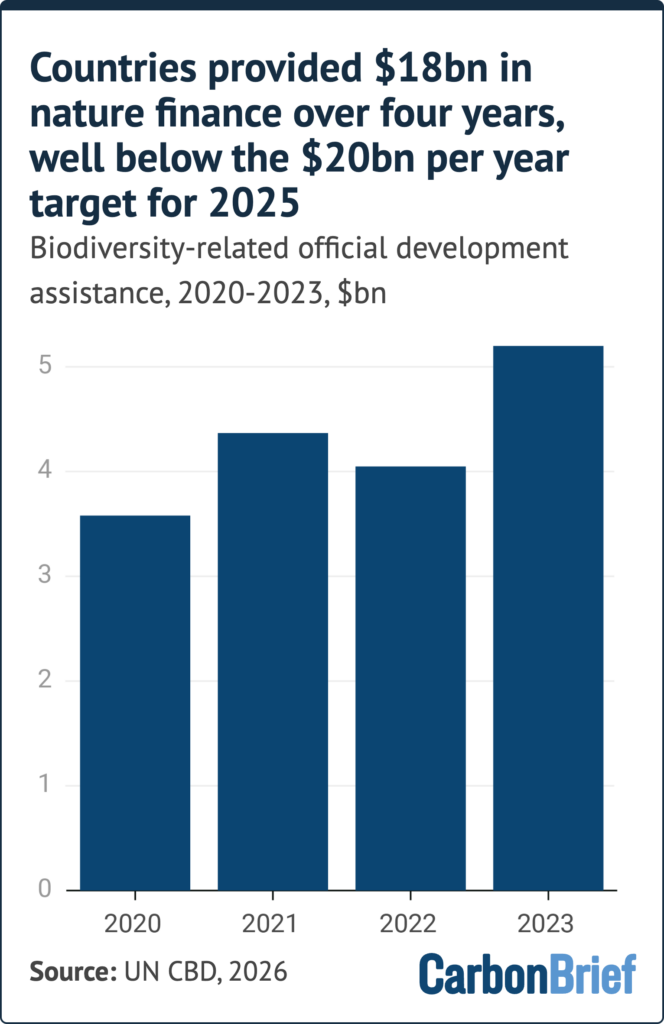
The report states that reporting countries raised a cumulative total of just $17.7bn in international public funding for biodiversity, across four years from 2020-23, as shown in the figure below. This amounts to an average of just $4.4bn per year.
These figures are supported by a report from the Organisation for Economic Co-operation and Development (OECD), which suggests that global biodiversity finance reached $74.9-92.4bn per year between 2023 and 2025.
It adds that, of this, international public finance contributed around $16.1bn per year on average – nearly $4bn below the 2025 goal.
Moreover, the OECD report says that only $7.9bn in 2023 to $8.5bn in 2024 was “biodiversity-specific” funding, with another $5.7bn and $6.5bn, respectively, coming in the form of funds for other priorities, in which support for biodiversity was a secondary aim.
While the GBF sets targets for nature finance in 2025 and 2030, developed countries should be making similar contributions every year, according to thinktank Third World Network.
Faltering initiatives
There are two main channels of international public finance that developed countries can use to meet their biodiversity finance commitments under the GBF. These are official development finance (ODF) and the Global Biodiversity Framework Fund (GBFF).
Separate figures for these channels also show financing falling behind the subtargets set out in the GBF.
This includes the Global Biodiversity Framework Fund (GBFF), which was established at COP15 in 2022.
It is currently housed under the Global Environment Facility (GEF) and reports directly to the biodiversity COP.
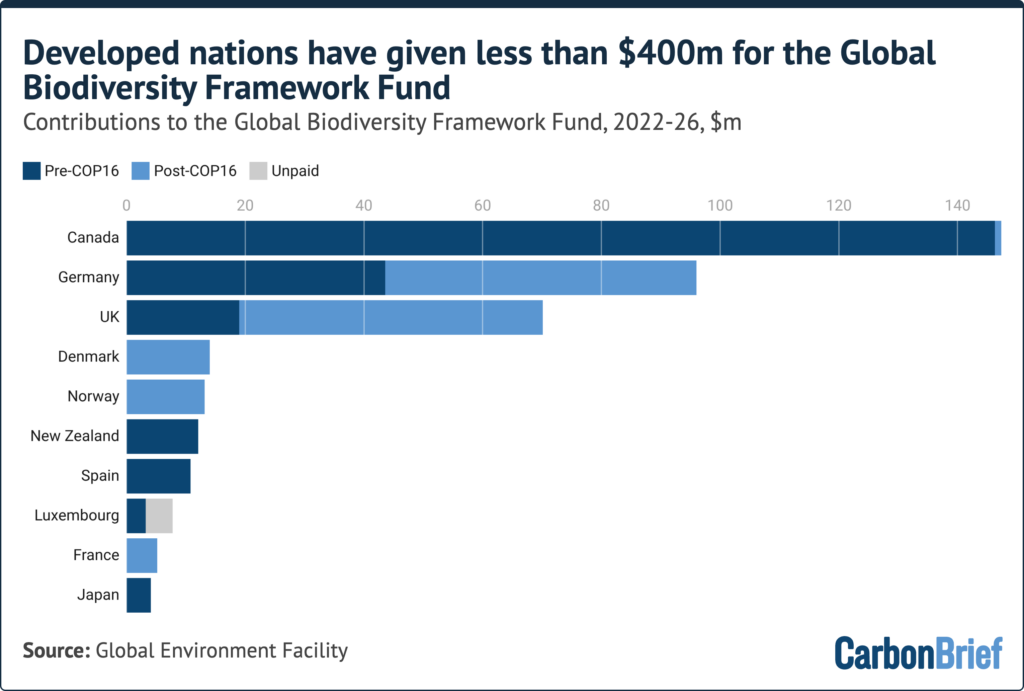
Despite an initial flurry of pledges for the initiative, developed nations had contributed less than $400m to the fund, as of July this year, according to data shared with Carbon Brief by the GEF.
Between August 2023 and 30 June 2026, the GBFF has received only $387.2m in signed commitments from 11 countries and one subnational government (Quebec in Canada).
The figure below shows that, after the initial pledges ahead of COP16 in 2024, there have only been a handful of new contributions to the fund.
Elsewhere, the Cali fund was created at the COP16 nature negotiations in Colombia in 2024.
It is the first-ever global fund for companies profiting from genetic data to contribute to conservation goals.
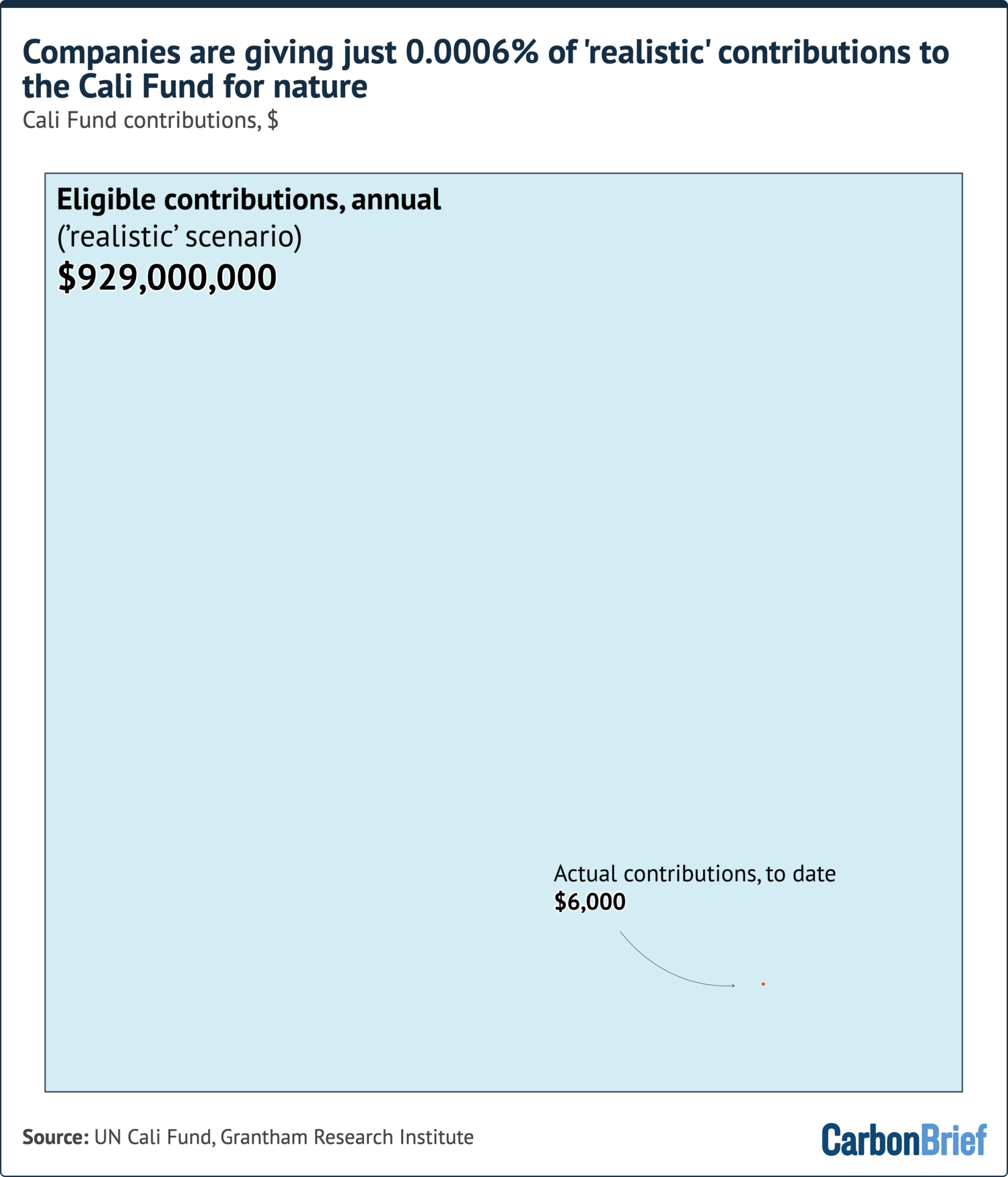
According to a working paper from the Grantham Research Institute at the London School of Economics, if all 21,690 eligible firms shared their profits according to the fund’s rules, they could raise $3.6bn for nature annually. The paper adds that, under a realistic uptake from companies, this could generate $929m annually for nature.
To date, however, the fund has received only two contributions, totalling $6,000.
Finance gap ‘fight’
Ahead of COP17 in Armenia, experts tell Carbon Brief that finance will be the most closely watched element of the stocktake of progress.
For developing countries that “hold most of the world’s biodiversity and bear the greater burden of implementation” of nature targets, the need for this financing is “very real”, says Lim Li Ching of the Third World Network speaking to Carbon Brief. She adds:
“These amounts fall far short of the GBF’s target 19. Developed countries have regrettably not met their legal obligations…[T]his failure should not be used as an excuse to pivot to the private sector or market-based mechanisms, which struggle to raise finance at scale and often deepen social and ecological harm.”
Options for private and “innovative” finance include debt-for-nature swaps, biodiversity offsets and carbon credits, but these are harder to monitor and have often faced criticism.
The Cali Fund is one avenue for companies to contribute directly to the CBD’s goals, with dedicated, transparent allocations for conservation projects and Indigenous peoples.
Dr Siva Thambisetty, associate professor of law at the London School of Economics, tells Carbon Brief that the fund is still a voluntary measure and it is up to countries “to create a constructive, ethical obligation” for companies to contribute. She adds:
“The private sector is doing what it always does: minimising outgoings and liability and maximising freedom to operate. I don’t believe the shift we need can be generated internally by businesses alone without outside pressure. States with jurisdiction over business need to take action.”
A non-profit initiative called the Cali Watch finds that “not a single government” has passed a law requiring companies to contribute to the fund. It estimates that eight companies alone should contribute more than $2bn, as part of what it calls their “Cali debt”.
Dr June Rubis, the Indigenous peoples and local communities lead on the Cali Fund’s steering committee, tells Carbon Brief that she is “worried about the pace” at which biodiversity finance is moving. Rubis continues:
“Each part of the finance architecture needs to start sending credible signals at the same time: developed countries on the $20bn commitment; donors on predictable finance for the GBFF; companies on Cali Fund contributions; and the Cali Fund itself on allocation and access. If one part moves while the others are repeatedly deferred, confidence in the wider biodiversity bargain becomes harder to sustain.”
She points out that for Indigenous peoples and local communities, “success also depends on whether finance can actually be accessed” to support communities’ priorities. She concludes:
“[H]eadline commitments matter, but so do the pathways through which money reaches people.”
The post COP17: Developed countries ‘fall far short’ of UN targets for nature finance appeared first on Carbon Brief.
COP17: Developed countries ‘fall far short’ of UN targets for nature finance
Latin American governments cracked down on forest clearing in 2025, leading global deforestation to fall by the most this decade, but political shifts and the likely impact of a strong El Niño threaten to undo those “fragile” gains, a new report has found.
Seven million hectares of forests – roughly the size of Ireland – were lost last year, a 15% drop from 2024. This marks the first meaningful slowdown in deforestation since 145 countries committed to ending deforestation by 2030 at COP26 in Glasgow in 2021, according to an annual assessment of the pledge.
But the researchers