

Call to triple adaptation finance
At COP26 four years ago, governments agreed to “urge” developed countries to double finance for adapting to climate change up to around $40 billion a year by 2025.
That goal ends this year, although we will not know until 2027 if it has been met. But at a press conference in Bonn this afternoon, the Least Developed Countries group chair Evan Njewa called for a successor goal – tripling adaptation finance by 2030 on 2022 levels. “Adaptation is a lifeline,” he explained.
Other developing countries are likely to back this. Grupo Sur and the Like-Minded Developing countries have made the same call in different negotiating rooms and Njewa said he was sure that the small islands group AOSIS would back it too.
“We’re never going to say no to adaptation finance,” AOSIS finance negotiator Thibyan Ibrahim told Climate Home in Bonn. But he noted that even tripling “does little to close the adaptation finance gap”. The UN estimates that developing countries need $160-340 billion a year by 2030, whereas tripling on 2022 levels would bring in just under $100 billion.
Last year in Baku, developed governments would not agree to having a sub-goal on adaptation in the wider $300-billion-by-2035 finance goal and it’s not currently clear which negotiating track a new adaptation goal could be included in.
The doubling-by-2025 goal was in the COP26 cover decision – a stand-alone declaration all governments agree to – but the COP30 Presidency has said it does not want a cover decision.
It would fit in the Baku to Belem roadmap to $1.3 trillion or the Global Goal on Adaptation. But the roadmap is not an official negotiated UN agreement – so may not be followed up on – and developed-country governments have been resisting financial indicators in the Global Goal on Adaptation.
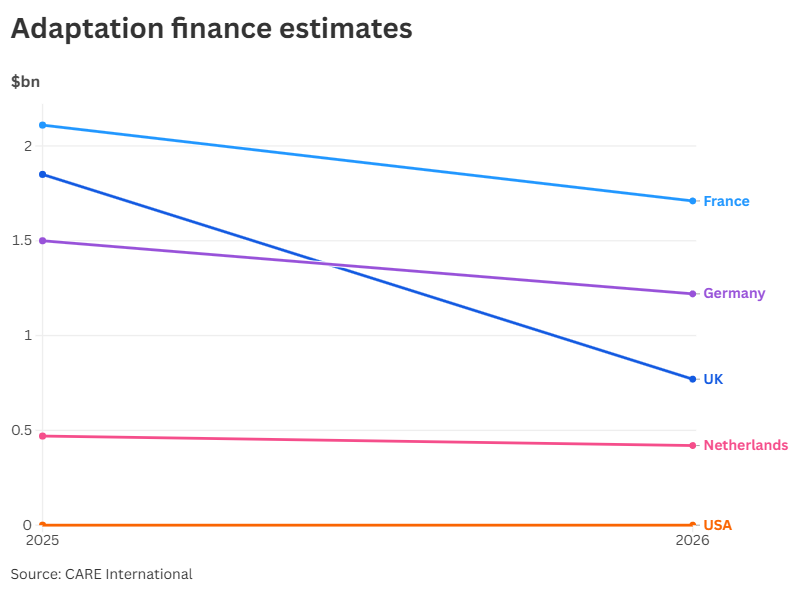
Meanwhile outside the world of UN climate talks, a recent CARE report showed that adaptation finance is likely to fall by 10% in 2026. France, Germany, the Netherlands and particularly the UK are set to make big cuts between 2025 and 2026.
The US is giving nothing in either 2025 or 2026. Commenting on US climate finance cuts generally, Njewa said he expects “someone somewhere to rise up and fill in the gap that that party has left”.
From Bonn to Nairobi?
Denouncing the visa problems faced by some developing country delegates heading to Bonn, more than 200 climate campaign groups made a joint call yesterday for governments to consider whether Germany should remain the default host for the mid-year climate talks.
Chanting “no borders, no nations, no visa applications”, a dozen campaigners gathered outside the conference centre on Tuesday morning, holding up a banner calling to move the annual talks to “visa-friendly countries”.
With many of those affected by the perennial issue unable to protest themselves, the demonstrators played a voice note from Roaa Alobeid, a young Sudanese climate activist who spoke movingly at COP28 about the war in her country.
She said she had gone to great lengths to get a visa for the Schengen area, which includes Germany, making an appointment, submitting 15 documents – including five letters of support and a bank statement – but was still rejected.
“I’m not there. I will never be there”, she said. “Why? I’m not worth it?” “We shouldn’t be left behind when we are the ones impacted.”
Cameroonian activist Zoneziwoh Mbondgulo-Wondieh did make it, but told the protest her one-year-old daughter had been refused a visa for being too young. She asked why Germany would implicitly tell a nursing mother they must stay at home and not work abroad.
When Climate Home questioned the German foreign office on this issue last year, a spokesperson said it was important to the government that all delegates could attend but there are legal requirements for getting a visa for the EU’s Schengen zone of free movement.
Rachitaa Gupta, head of the Global Campaign to Demand Climate Justice, said it would be better to hold the annual mid-year talks somewhere like Nairobi or Bangkok – where UN facilities already exist and visas are easier to obtain. Holding the meetings in the Global South would also be cheaper, Gupta added.
Climate finance on the rise – mostly for the rich
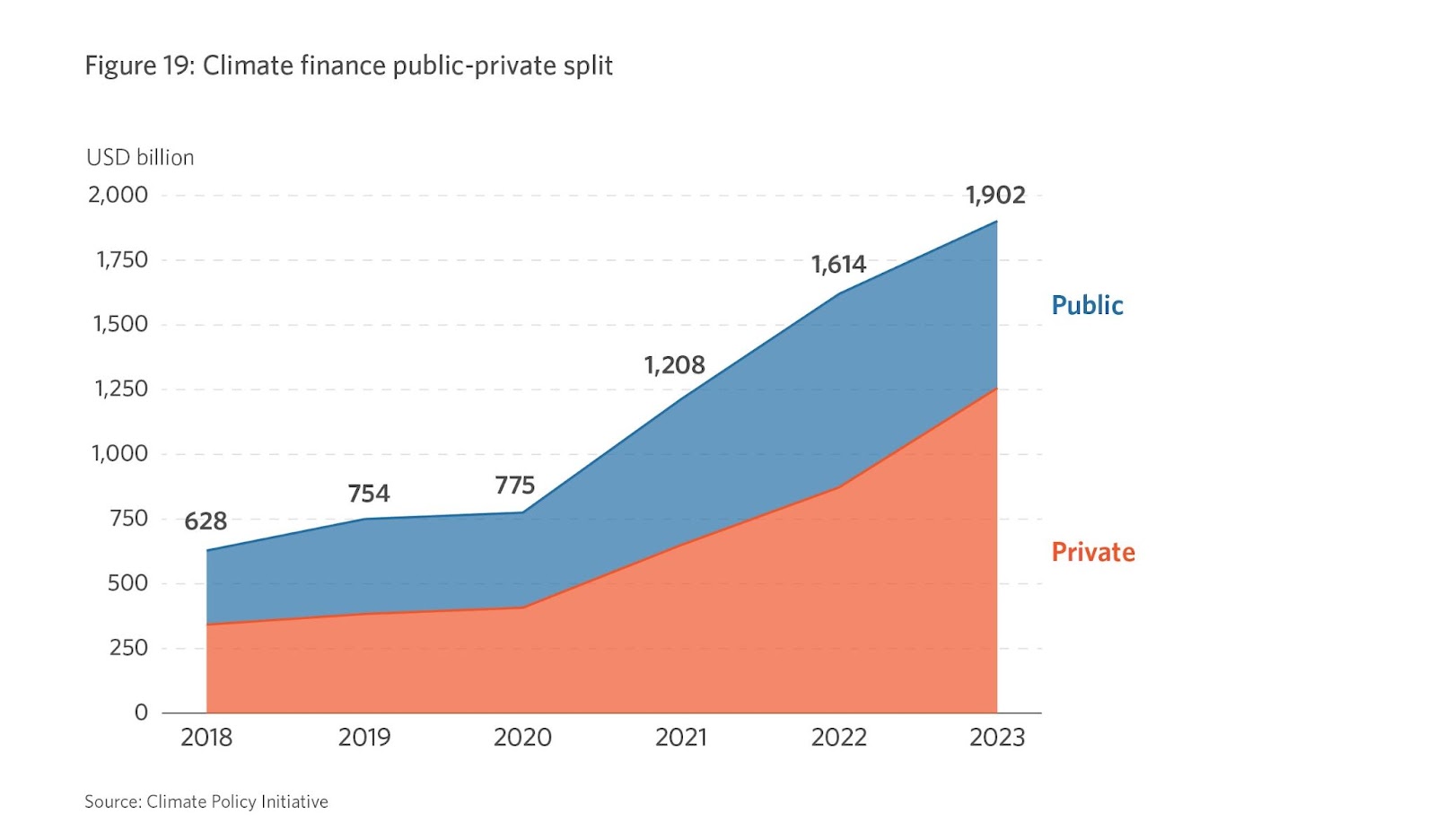
New figures out today paint a fairly positive picture of global climate finance, showing it climbed to a record $1.9 trillion in 2023, more than tripling over six years.
Climate Policy Initiative (CPI), which compiles the data, said that at the current rate of growth, the world could deliver $6 trillion in annual climate investment – the most conservative estimate of needs – by 2028.
Private-sector funding rose above $1 trillion for the first time in 2023, driven by household spending on electric vehicles, solar and energy-efficient housing – with clean energy in advanced economies and China receiving the bulk of the money.
While this suggests the long-touted need to “shift the trillions” towards green investment is underway, the headline numbers mask the fact that many of the poorest countries are still failing to receive anything like the amounts they need.
The CPI report shows that overall public climate finance fell by about 8% from 2022 to 2023, as government budgets were tight after the COVID-19 pandemic. It also warned that recently announced cuts to official development assistance, in countries such as the US and the UK, raise concern that money from this source could decline further.
International climate finance for emerging markets and developing countries reached $196 billion in 2023, with 78% of that from public sources. Yet while both climate-related development finance and private investment rose, CPI said the least-developed countries still face barriers to accessing affordable capital, and need more financial innovation and support.
In a separate report released on Monday, however, Oil Change International and 17 other NGOs warned that a widely used approach of using government money to lower investment risk and bring in more commercial cash – known as “blended finance” – is falling short of expectations.
The report found that every public dollar of concessional lending is bringing in 4-7 times less private investment than anticipated, leaving the Global South with massive shortfalls of cash for its energy transition. Most money, it said, is going to Global North countries and China, with the remaining 69% of the world’s population receiving just 15% of finance in 2023-2024.
“A just energy transition is dramatically more affordable than continued fossil fuel dependence. But unfortunately affordable doesn’t mean ‘attractive to banks and hedge funds’,” said Bronwen Tucker, global public finance lead at Oil Change. “It is clear from the data that private investors are not fit to lead the way to the fossil free future we need, and that governments must step in.”
Mineral justice for Africa
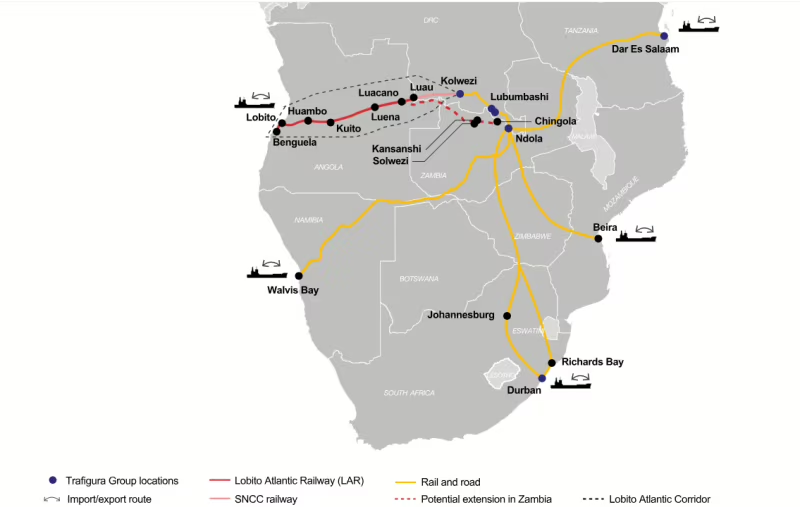
Efforts to revive the Lobito Corridor trade route in central Africa must prioritise local economic development over raw material exports, researchers at the International Institute for Environment and Development (IIED) said, as campaigners in Bonn call for justice for resource-rich countries and an end to the extractive injustices of the fossil fuel era.
The US and the European Union are providing financial support to Angola, the Democratic Republic of Congo and Zambia to upgrade their infrastructure to aid transport of critical energy transition minerals like cobalt and copper through a rail system which terminates at the port of Lobito on Angola’s Atlantic coast.
In a policy brief issued this week, highlighting the Corridor’s opportunities and challenges for a just transition, the researchers questioned how the project’s development will benefit the wider economies of the countries involved, while protecting social benefits and human rights including being fair to the people whose land it might encroach upon and the artisanal miners who dig up many of the raw materials.
They said the involvement of the EU and the US has raised concerns in participating countries such as Zambia, where a parliamentary committee has said the Lobito Corridor project appears to focus on “mopping up critical raw materials” to respond to the energy security concerns of wealthy nations without adding value to the countries.
Lorenzo Cotula, IIED principal researcher, said if the EU and other prospective funders are interested in a genuine, long-term partnership with Angola, Congo and Zambia, they should support their efforts to promote economic development and improve the lives of their citizens.
“This project shouldn’t just be a means to export more raw materials more quickly to wealthier countries, or another chess piece in the great power game,” Cotula said.
“Millions of people in mineral-rich, lower-income countries are being sidelined in a global rush for materials to power electric cars, computers and even military technologies in richer nations,” he added.
Sharing similar concern, campaigners from Power Shift Africa and the Natural Resource Governance Institute (NRGI) convened a press conference at the ongoing talks in Bonn calling for the need for just minerals in the just transition, because one cannot exist without the other.
Anabella Rosemberg, senior advisor on just transition at Climate Action Network International (CAN-I), said the transition that is happening is not one that is needed for a climate-compatible world because the needs of resource-rich countries are being ignored.
Rosemberg said there is need for international cooperation to overturn the current competition over resources, adding that “we know that investment and trade deals are being arranged to secure the supply of these minerals, and in the end, we are reproducing all the mistakes that have been done in the past with the fossil-based economy”.
Samira Ally, project officer at Power Shift Africa, said Africa’s mineral wealth can accelerate a global shift to net zero when governed by justice and stability with necessary guardrails in place.
To do this, she asked governments to integrate language from the G20 and the UN panel on critical minerals into the climate talks and national climate plans so that they “reference sustainable supply chains and the right to development and industrialisation in the Global South”.
The post Bonn bulletin: Developing nations call for adaptation finance to triple by 2030 appeared first on Climate Home News.
Bonn bulletin: Developing nations call for adaptation finance to triple by 2030

Australia’s network of marine parks is the largest in the world, covering more than half (52%) of Australia’s Commonwealth waters. You could be forgiven for assuming that a marine park is much like a national park on land: a highly protected place where people can enjoy nature while conservation efforts help habitats recover and wildlife thrive. You wouldn’t expect someone to bulldoze a national park, so why should they be allowed to bottom trawl in a marine park?
The reality is that not all marine parks are equally protected. Australia’s Marine Parks Network is divided into different zoning categories, with each zone determining which activities are permitted and the level of protection provided.
More than half of the Commonwealth Marine Parks Network allows industrial activities like oil and gas mining, and industrial fishing.
Our survival, and the survival of our planet, depends on the ocean. The ocean produces more oxygen than all of our forests combined, sustains communities and regulates the earth’s temperature. It’s home to wondrous wildlife and important ecosystems like coral reefs and kelp forests.
We love our big blue backyard
Australia’s ocean is teeming with life that is found nowhere else on earth. Schools of colourful fish, vibrant coral reefs, endemic shark nurseries, pods of dolphins, families of whales, playful seal pups and threatened Jurassic-era turtles call Australian waters home.
Since time began, from the turquoise waves to the deep blue, the ocean has connected our shorelines and communities, fed us, guided us and grounded us. We are intrinsically connected to our big blue backyard – more than 85% of us live within 50km of the shoreline. For tens of thousands of years, people have lived in harmony with the ocean and the wildlife within it, caring for and being sustained by its rich waters. Australia’s waters are some of the most unique and abundant places on Earth but our Marine Parks Network is falling short to properly protect them.
Australia’s marine parks aren’t living up to their name
The Australian Commonwealth Marine Parks Network covers commonwealth waters 5.5km from the coast. The network is divided into 7 regional management areas, overall the network contains 60 marine parks. Zoning types determine what activities are allowed in each area. Over half of the network allows industrial activities, risking our most precious and threatened ocean wildlife.
Within many of our marine parks, destructive industries are allowed to fish, trawl, dig and mine using barbaric and cruel methods. Here are some of the zones explained:
- Bottom Trawling: Special Purpose (trawl) zones allow bottom trawling. This covers 10 marine parks totalling almost 13 million hectares. Bottom trawlers bulldoze the seafloor with weighted nets, deforesting our underwater forests; a cruel, indiscriminate and inefficient way to fish.
- Other Industrial Fishing: Includes “Habitat Protection Zones, ““Multi Use Zones” and “Special Purpose Zones.” Fishing methods vary from park to park but many marine parks in these zones allow industrial fishing like longlining. Longlining involves setting lines that can be 100km long, bristling with deadly hooks designed to catch a specific fish species. But longlining is not a selective method of fishing – significant numbers of sharks, rays, turtles, dolphins and seabirds can be harmed or killed as bycatch in the process.
- Oil and Gas Mining: Many “Special Purpose” and “Multi Use” zones allow seismic blasting and oil and gas mining. 30 marine parks or 65 million hectares of Australia’s highest conservation value areas for ocean wildlife are open for mining and exploration of oil and gas.
- Ocean Sanctuaries: National Park and Sanctuary zones are fully and highly protected marine parks designed to conserve wildlife and their habitat, where fishing, mining, and other industrial activities are not allowed.
Industrial fishing is one of the biggest threats to the ocean
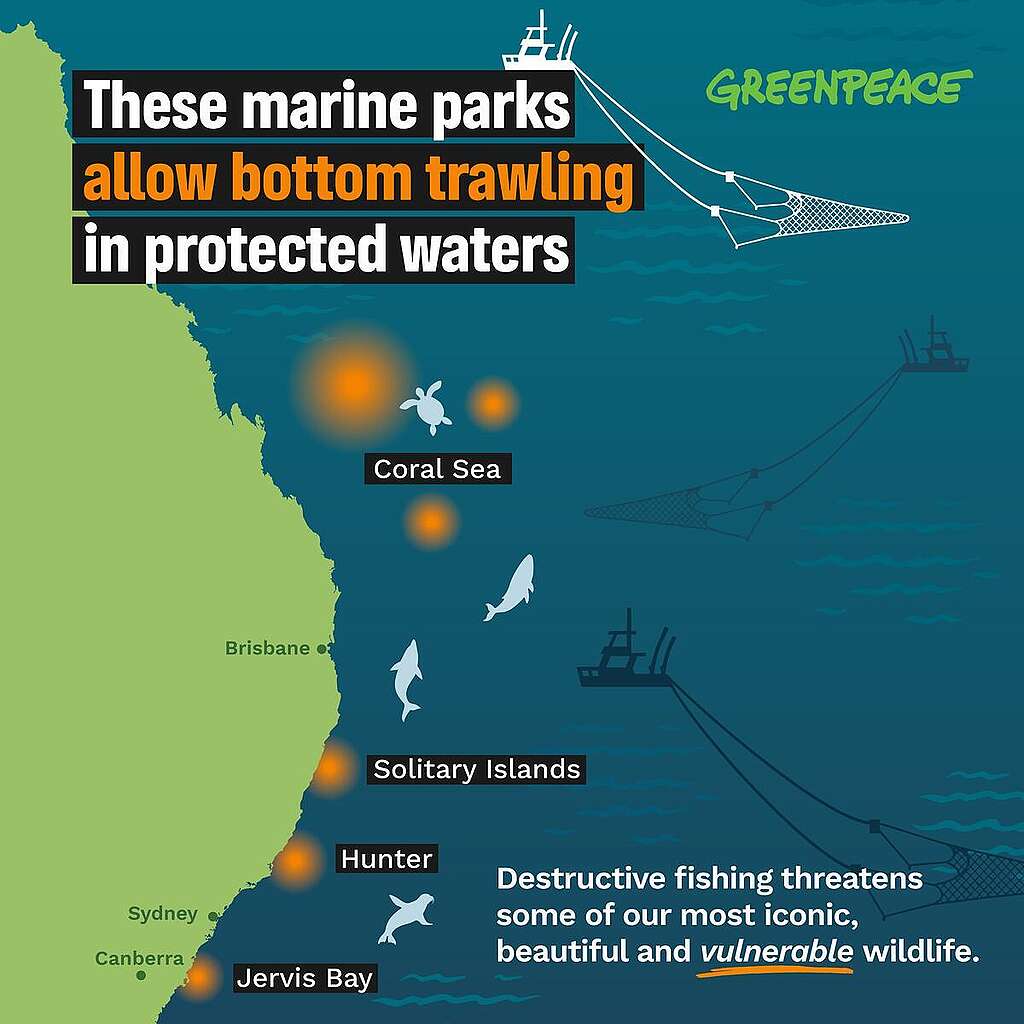
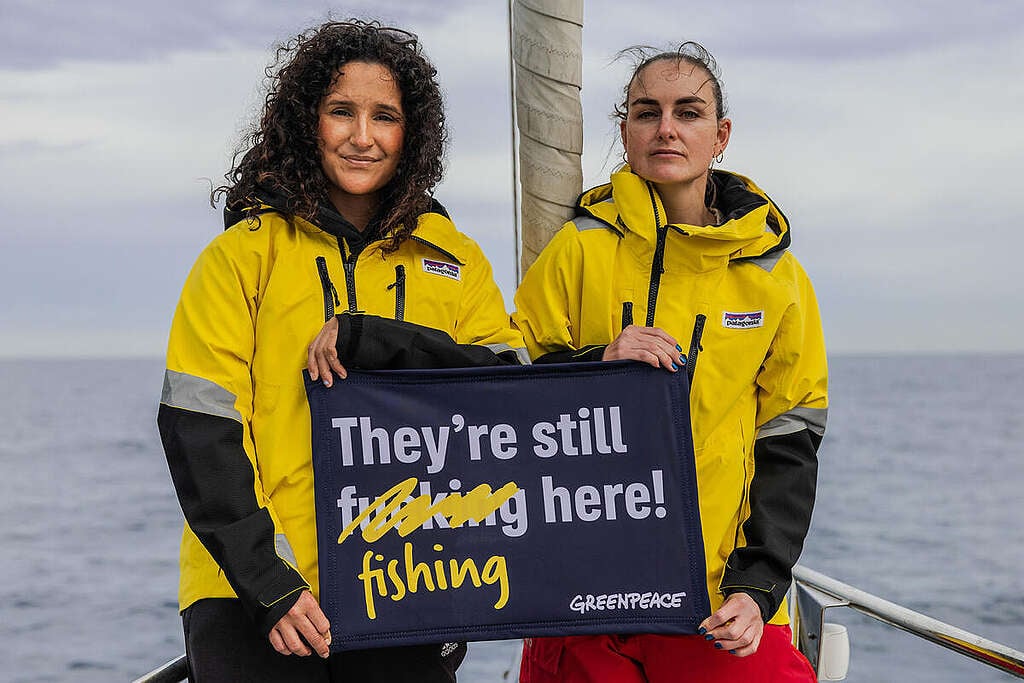
In May, Greenpeace Australia Pacific sailed our campaigning vessel Oceania through some of Australia’s most beautiful and threatened marine parks. Our crew visited Jervis and Hunter marine parks to document their beauty, showcase what’s at risk and aim to expose the industrial fishing activities in these protected waters. Both of these marine parks allow bottom trawling and longlining methods of industrial fishing.
Industrial fishing is ripping the ocean apart across the planet. Longlining, also known as longline fishing, is an industrial fishing method that involves the use of a fishing line with thousands of baited hooks. These fishing lines can stretch over 100 kilometers in length and are set to capture a fish species, often tuna or billfish species. But it is not a selective method of fishing and often results in significant bycatch. This includes a range of non-target species like sharks, rays, sea turtles, marine mammals, and seabirds which are often injured or killed as bycatch.
Bottom trawling involves dragging heavy weighted nets along the ocean floor. This fishing method is popular with commercial fishing companies, because it makes it easy to catch large quantities of fish in one go. But it also damages the seafloor, releasing carbon and can kill or injure non-target ocean life like coral, fur seals, dolphins and seabirds. You may have watched the reality of bottom trawling (and the benefits of ocean sanctuaries) in Ocean with David Attenborough, if not, add it to your watch list!
Fully protected ocean sanctuaries that ban industrial fishing and mining can protect ocean wildlife and underwater wonderlands for generations to come. Vast, robust sanctuaries create blue havens where ocean wildlife are safe from nets and hooks, and can truly rest, recover, thrive and replenish out into the surrounding waters. Ocean sanctuaries ensure a healthy ocean full of life.
A once-in-a-decade chance to fix what’s falling short
We have a unique opportunity to turn the tide.
The Australian Government is asking for your feedback on how our Commonwealth Marine Parks Network is managed. This is our once-in-a-decade chance to protect ocean wildlife, ban industrial fishing and create more ocean sanctuaries.
As part of the review the Government is asking for submissions from the public to hear from you on what improvements are needed to better protect our vast network of marine parks. Writing a submission is a powerful way to influence government decisions and create real change.
This is the moment to ban industrial activities like bottom trawling and oil and gas mining. But only if they hear from YOU. Add your name!
Greenpeace is calling on the Australian government to:
1. Ban industrial activities from Australia’s Marine Parks Network: Ban industrial activities, such as industrial fishing, seismic blasting and oil and gas mining, from Australia’s marine parks.
2. Create more ocean sanctuaries: Increase fully protected sanctuaries in Australia’s marine parks based on science principles.
3. Connect Australia’s Marine Parks Network to the High Seas: mCreate seascape connectivity by linking Australian marine parks to new high seas ocean sanctuaries.
References
Substantiation that more than half of the Marine Parks Network permits industrial activity comes from a peer-reviewed systematic literature review (Phillips et al. 2025, PLOS One, https://doi.org/10.1371/journal.pone.0307324). The study found that within the Commonwealth Marine Parks Network specifically, “all zones are considered partially protected areas, meaning areas where extractive activities are permitted, except ‘Pink zones’ (Preservation Zones; IUCN Ia) and ‘Green Zones’ (IUCN II).” In other words, every Commonwealth marine park zone type other than the network’s strict no-take sanctuary and national park zones (IUCN Ia and II) permits some form of extractive industrial activity. Since no-take zones are the minority zone type across the network by area, this supports the conclusion that the majority of the network’s area is zoned to permit industrial activity.
DCCEEW Australian Marine Parks spatial dataset (https://fed.dcceew.gov.au/datasets/erin::australian-marine-parks/explore), filtered by zone type. This confirms that 38.43% of the network’s area is zoned as Sanctuary or National Park zones (IUCN Ia and II). These are the no-take categories excluded from the peer-reviewed study’s definition of partially protected/industrial-permitting zones. The remaining 61.57% of the network falls within the zone categories the study classifies as permitting industrial activity (per The MPA Guide definition of “industrial” applied in Phillips et al. 2025), directly corroborating the peer-reviewed finding with current Commonwealth-specific spatial data.
For further information on activities permitted within the Marine Parks Network Zoning, you can refer to the Management Plans zoning and rules for each Marine Parks Network area, for example: Temperate East, Coral Sea, North.
A new report from Greenpeace Australia Pacific advocates for the closure of bottom trawling in Australia’s Commonwealth Marine Parks Network. Bottom trawling continues to be a pervasive threat to ocean life in Australia, with 10 marine parks totalling almost 13 million hectares, allowing bottom trawling.
Australia’s network of marine parks, which is the biggest in the world, covers more than half (52%) of Australia’s Commonwealth domestic waters, but not all parks are created equal. Australia’s Marine Parks Network is divided into different zoning categories, with each zone determining which activities are permitted and the level of protection provided. More than half of the Marine Parks Network allow industrial activities like industrial fishing and oil and gas mining. This includes zoning types that allow destructive fishing by longliners and bottom trawlers, who pillage underwater wonderlands, rip up coral and indiscriminately and violently catch any animal in their path, including turtles, seals and dolphins, all within areas labelled a marine park.
The Federal government has commenced a review into the majority of Australia’s Commonwealth Marine Parks Network management plans. This presents an opportunity to ban industrial activities from our marine parks and create more ocean sanctuaries.

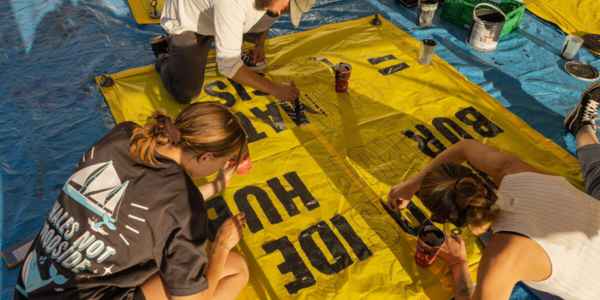
© Harriet Spark / Grumpy Turtle Film / Greenpeace
The banner drop is a distinctive part of the Greenpeace repertoire.
The moment of the unfolding is intrinsically dramatic. It is the reveal; when the moral and scientific truth of a situation is unveiled to the world. The wrong is being labelled—not through a written submission, or a social media post, or a statement in a meeting—but in words emblazoned in real physical space, chosen and occupied with precision, for all to see. There is jeopardy and transgression. And there are consequences—for the activists and for Greenpeace, as well as for the target of the communication. One of the reasons the banner remains such an effective tool in our toolbox is because of its undeniable clarity in cutting through, driving change and accountability in a way that few other tactics can. It is naming the wrong: in giant, clear letters.
We’ve hung these massive messages at environmental crime scenes, corporate headquarters, and iconic landmarks; on government buildings, ships and planes—in locations all around the world, for years.
My own memories unfurl even as I write this, but because the campaign to stop Woodside at Scott Reef is so pressing, what immediately springs to mind are two of our banners in that campaign: one on a crane outside their Perth HQ, and another on some of their corroding industrial junk at sea. What about you? Is there a particular banner that you picture when you think of Greenpeace?
The banners can attract global attention, but they have quiet beginnings. Each one is made by hand, often by volunteers. It is the invisible labour behind each spectacular public moment. One of the key pieces of equipment in our workshop at Rainbow Warrior House is the sewing machine. Sometimes our workshop is full of people and noise; at others it is quiet, the only sound being the gentle, purposeful, whir and buzz of a banner being sewn. It is usually our warehouse manager, Kieran Holmes, on the tools, head over the machine, carefully pouring over the raw canvas or tarp as the banner takes shape. Kieran’s one of those people who seems to be able to turn his hand to almost anything, but you wouldn’t know it because he’s old-school modest. In addition to being incredibly skilled, Kieran’s an all-round beaut human to have in the heart of our headquarters; never too busy to take the time to show a newcomer, or curious visitor, around his domain.
Once the banner is sewn up, the lettering needs to be outlined. This is done on a magnetic wall—a fit-for-purpose feature at Rainbow Warrior House, where the banner is held up with magnets, and the edges of the letters neatly traced from a projection.
Next comes the painting. It usually starts late in the afternoon, sometimes going into evenings and weekends, with volunteers, staff, mates crowded around, brushes in hand. It is a calming meditative feeling of shared purpose, giving each letter its visual heft, the colour building power and presence with each stroke.
Then you stand back, stretch, and look at the message, now ready.
S A V E S C O T T R E E F
Throughout history, every great push for social change has required some form of invisible labour; preparation in the form of quiet things seldom seen, but vital. It is the enabling work of love instantiated in action. And of course, so much of the time it has been women who have done this labour, so that the men could get the chance to make the speeches and stand on the podiums. The inaugural Greenpeace voyage to stop nuclear testing in 1971 had a male-only crew, but wouldn’t have happened without the ideas and work of women behind the scenes.
It is what we do together, after all, that changes the world. Sometimes that work happens on a stage, a ship on the wild seas, or up the side of a building. But mostly, it is the hidden diligence of those who care and contribute to all the enabling work that makes a change once thought impossible, inevitable. It is Kieran at his sewing machine. It was Dorothy Stowe doing the administrative work of the ‘Don’t Make A Wave Committee’ that became Greenpeace.
When we think of social change, it is the sturm and drang that we remember. The drop of the banner, the chant of the crowd, the raising of the new flag. But look behind the curtain, and there’ll be a crew of people who are taking responsibility for the administration, the sewing and the painting, making the food, checking the bus timetables, getting stuff done. And behind them are even more handsinvisibly donating time and trust; the financial, material and expert resources that make it all possible. There’s love, camaraderie and know-how at every stage.
We are social and cooperative creatures by nature. And we human beings have been stitching for millenia, sewing the possibilities of our common future. Political and corporate bullies and algorithmically manipulative platforms would have us forget this, and abandon who we are. But we should be in no doubt that the brighter prospects for ourselves and life on earth continue to be stitched and painted; collaboratively and with love, by the diligent hands of millions of people who care, each day, in every community and city across the world.
With Love,
David
Q & A
I always get great questions when interviewing prospective new team members. One that came up again recently was: “Is Greenpeace actually one organisation?”
Around the world, people know Greenpeace by our one global name, united by a shared mission: securing an Earth capable of nurturing life in all its magnificent diversity, with a particular focus on climate and biodiversity. Behind the scenes, though, we’re organised as a network of 25 legally autonomous national and regional offices, including Greenpeace Australia Pacific, working alongside Greenpeace International.
That structure gives us the best of both worlds: we work together leveraging the power of a global network on the issues that matter most, while each office remains legally independent and deeply connected to the communities, cultures and political realities where we’re embedded. Local knowledge informs global action, and global collaboration strengthens and supports local campaigns.
It’s a model that has enabled Greenpeace to take on some of the world’s biggest challenges for over five decades–while withstanding challenges and attacks from governments and corporations. Global enough to tackle global problems, local enough to understand our communities and the natural places we love.
If you’re curious to learn more, you can read about the Greenpeace Global Network structure here.



-
Climate Change12 months ago
Guest post: Why China is still building new coal – and when it might stop
-
Greenhouse Gases12 months ago
Guest post: Why China is still building new coal – and when it might stop
-

 Greenhouse Gases2 years ago
嘉宾来稿:满足中国增长的用电需求 光伏加储能“比新建煤电更实惠”
-

 Climate Change2 years ago
嘉宾来稿:满足中国增长的用电需求 光伏加储能“比新建煤电更实惠”
-
Climate Change2 years ago
Bill Discounting Climate Change in Florida’s Energy Policy Awaits DeSantis’ Approval
-

 Renewable Energy10 months ago
Sending Progressive Philanthropist George Soros to Prison?
-
Greenhouse Gases1 year ago
嘉宾来稿:探究火山喷发如何影响气候预测
-

 Carbon Footprint2 years ago
US SEC’s Climate Disclosure Rules Spur Renewed Interest in Carbon Credits