

Financial firms dropped terms like “ESG” (Environmental, Social and Governance) and “sustainable” from the names of hundreds of their funds in the year before new European Union rules to clamp down on greenwashing came into force in late May, new analysis shows.
The rules from the European Securities and Markets Authority (ESMA) say that funds with certain sustainability or environmental-related terms in their names cannot invest in companies that get more than a certain share of their revenue from coal, oil, gas or particularly polluting electricity generation.
Those funds now also have to show that 80% of their investments meet the ESG objectives referred to in their titles.
Before the new regulation was introduced, the fund managers that dropped environmental and other sustainability terms from the highest percentage of their fund names were State Street, UBS and Northern Trust, the analysis said. It estimates that around 674 funds have done this overall.
Alison Schultz, an analyst at the German campaign group Finanzwende who conducted the research, said fund managers had earlier betrayed investors’ trust by labelling their funds wrongly and misdirecting money that should have helped to advance the green transition towards supporting business as usual.
“Consumers bought the funds because they wanted to invest sustainably,” she said, adding that “renaming [them] instead of divesting undermines the credibility of a market that depends on financial products being what they claim to be”.
Many fund managers have replaced ESG terminology in the titles of their funds with alternative words like “screened”, “selection” or “committed”, according to research by Finanzwende, Urgewald and Facing Finance and a separate analysis from Morningstar Analytics, which sells research and information to investors.
For example, Invesco changed its “Sustainable Eurozone Equity Fund” into the “Transition Eurozone Equity Fund” in March. Fund documents show that in April 2025 it had investments in Italy’s Enel and Germany’s E.ON, two utilities that sell gas and fossil-fuel electricity.
“Screened” and “transition” funds
Funds with words like “screened” or “transition” in their name can continue to invest as much as they want in oil, gas and coal businesses under the new EU regulations. Hortense Bioy, head of sustainable investing research at Morningstar, told Climate Home the use of words like this suggests fund managers “are still keen to offer products that signal ESG characteristics in the name”.
According to earlier research on the same topic released in March by Urgewald and Facing Finance, more than half of the funds that have dropped environmental-related terms from their names held shares in large fossil fuel companies – with the investments worth around €14bn ($16bn). The name changes mean that they can keep those investments.
While some have gone down this path, Morningstar analysis suggests others have done the opposite – ditching fossil fuels investments and keeping their green names. Leading global fund managers like US-based BlackRock, the world’s largest asset manager, have taken a varied approach across their portfolios.
An email BlackRock sent to clients on March 18, which it shared with Climate Home, said it had responded to the ESMA naming guidelines by changing the names of 56 funds worth $51bn to drop sustainability terms. An example it gave was dropping “ESG” from the BSF Systematic ESG World Equity Fund.
On the other hand, the email said it had kept the ESG names of another 60 funds worth $92bn, “enhancing the sustainable characteristics”.
Funds drop Total, Galp and Eni
Morningstar found that ESG funds which did not rebrand themselves as less green were investing less in fossil fuel companies like TotalEnergies, Galp and Eni in March this year compared to May 2024.
“It is fair to assume that part of the decline can be attributed to stock divestments made to comply with the ESMA guidelines,” their analysis said.
While State Street renamed the highest percentage of these funds, other firms – like BlackRock and Amundi – have lots of sustainability-related funds that were grouped under broad EU green financial disclosure categories but never had these now-regulated terms in their names.
Cobalt and nickel-free electric car batteries boom in “good news” for rainforests
Last July, Climate Home revealed that EU-based funds like Blackrock’s, which claimed to be environmentally friendly, held shares worth at least $65 million in major coal companies. Under the new rules, they can continue as long as they don’t have “environmental” or “sustainable” terms in their name.
While funds with what the ESMA calls environmental, impact or sustainability related terms cannot invest in companies with fossil fuel revenues above a certain threshold (see chart above), funds with transition-related terms still can. These words include “transition”, “improve”, “progress”, “evolution”, “transformation” and “net zero”.
BlackRock also said it had either changed the names or investment methodologies of 18 funds worth $42bn for a “clearer alignment to transition” in response to the new rules.
Investors notified
Fund managers are required to notify investors of the name changes, usually in prospectuses sent to professional investment managers.
Bioy of Morningstar said she had seen many of these notifications and, in some of them, fund managers told investors they were lowering their sustainable investment allocations. “Some of them are not as ESG as they used to be,” she said. “They’ve become almost like traditional funds.”
But she said that firms that have renamed their funds cannot necessarily be accused of greenwashing before because there were “no rules” over what terms like ESG and sustainable meant. Investors now need to be educated on what these terms legally mean according to the new rules, she added.
The rules only affect funds marketed in EU countries but, according to Bioy, that is the vast majority of the world’s funds that make green claims, even though they make up a small proportion of the total.
Asked to comment, a BlackRock spokesperson told Climate Home the investment objectives of its funds “are clearly disclosed in each fund’s prospectus and on BlackRock’s website”.
Funds “are managed in line with applicable regulations governing sustainable investing”, they said, adding that “for investors that have decarbonization investment objectives we offer a range of products that provide such exposure”.
At the time of publication, State Street, UBS, Northern Trust and Invesco had not responded to requests for comment.
The post As EU acts to stop greenwash, funds drop climate claims from their names appeared first on Climate Home News.
As EU acts to stop greenwash, funds drop climate claims from their names

Next week, diplomats from around the world will descend on Yerevan, Armenia, to negotiate a series of decisions under the UN Convention on Biological Diversity (CBD).
Between 19 and 30 October, 196 parties will gather to hammer out the precise wording of the dozens of legal texts that make up the decisions under the Conference of the Parties (COP) to the CBD.
This year’s summit is particularly significant, as it marks the halfway point between the agreement of the Kunming-Montreal Global Biodiversity Framework and the deadline for achieving its targets.
The CBD has found that countries are currently not on track to meet 22 out of the framework’s 23 targets.
During the fortnight, delegates will also be negotiating decisions relating to the two supplemental protocols to the CBD: the Cartagena Protocol, which covers biosafety; and the Nagoya Protocol, which covers access and benefit-sharing for the use of genetic resources.
(The Cartagena and Nagoya Protocols, which are each governed by a “meeting of the parties”, or “MOP”, have fewer parties than the CBD as a whole, with 173 and 141, respectively.)
Carbon Brief is tracking the progress of countries towards consensus on dozens of negotiating texts using the interactive table below.
The tracker includes texts from the COP, as well as the MOPs for the Cartagena and Nagoya protocols. It also includes draft decisions from the most recent subsidiary body meetings, as these form the starting point for the negotiations in Yerevan.
The CBD has three subsidiary bodies: the subsidiary body on scientific, technical and technological advice (SBSTTA), the subsidiary body on implementation (SBI) and the subsidiary body on article 8(j) and other provisions (SB8J).
SB8J focuses on issues related to the Indigenous peoples and local communities. It was established at COP16 in Cali, Colombia, in 2024.
The first two columns of the interactive tracker list the topic of each agenda item and the relevant body, with subsequent columns including dates, page counts and links to the original documents.
The table is searchable and can be sorted using the arrows in the header.
Areas of disagreement in UN draft texts are denoted by square brackets. Counting the brackets in a particular iteration of a text therefore gives a sense of how far parties are from reaching consensus.
The bracket column is colour-coded, with dark green indicating a low number of brackets and red indicating a high number of brackets remaining.
Texts can also present parties with choices using “options” or alternatives (“alt”), which are counted together in the sixth column of the table.
The key discussions in Yerevan will centre around two agenda items in particular. The first is the global review, which will assess progress towards the GBF and make recommendations for accelerating action.
The second is finance, which can be separated into two parts: resource mobilisation and the financial mechanism. On resource mobilisation, biodiverse global south countries are likely to push for an increased amount of international finance for conservation.
Disagreement over the creation of the financial mechanism led to the suspension of COP16 in Cali in October 2024, as parties failed to find agreement on the mobilisation of finance before the end of the summit.
Global south countries want the establishment of a separate financial mechanism under the control of the CBD; global north countries largely prefer to maintain the existing mechanism, which sits under the Global Environment Facility.
At the resumed session of COP16 in Rome in early 2025, countries agreed on a roadmap that would lead to the establishment of a permanent mechanism.
related

Analysis: Lula presidency saved at least 20,000km2 of Brazilian Amazon since 2022
Why land-use emissions have fallen by a third this century – in six charts

Analysis: 84% of nations miss deadline to identify ‘nature-harming’ subsidies by 2025

UK withdraws millions in funding from world’s second-largest rainforest in Congo
The post Interactive: Tracking negotiating texts at the COP17 biodiversity summit appeared first on Carbon Brief.
Interactive: Tracking negotiating texts at the COP17 biodiversity summit
A beacon of love
On an outer island of Fiji, two thousand nautical miles from Sydney, is a shining light of hope and resilience for our troubled world.
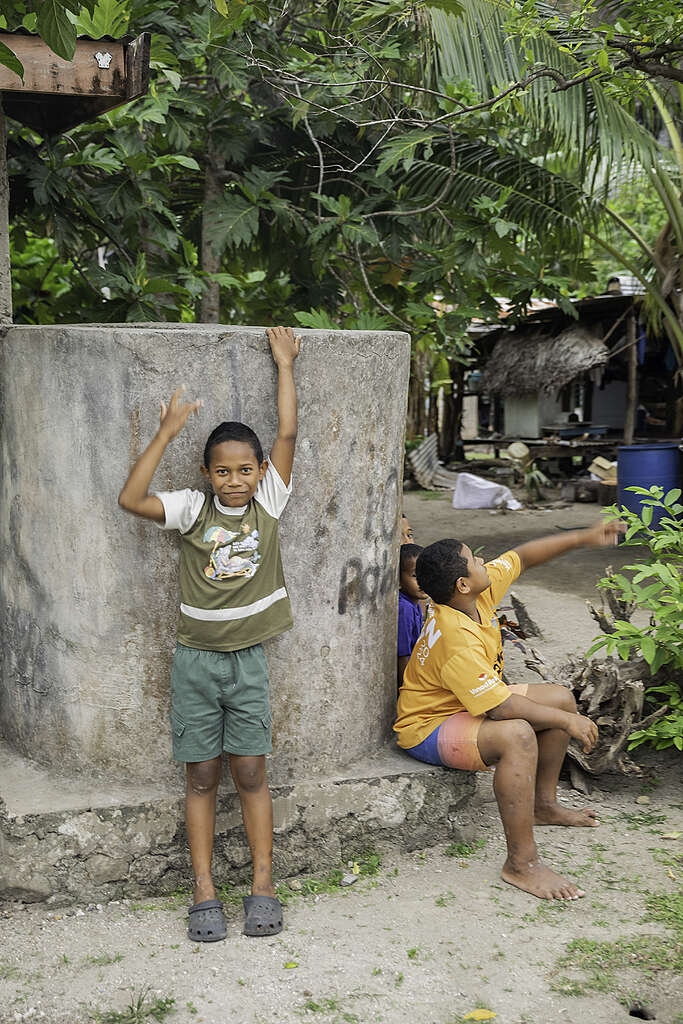
The island of Kioa is home to a Tuvaluan community who migrated from their atoll of Vaitupu in the late 1940s. It is a land of warm hearts, big smiles, and deep cultural roots; a place where the sound of a conch still summons the island together, where islanders paddle out to fish in carved outrigger canoes, and healthy happy children walk barefoot to school.
Here, culture is life. Kioans live sustainably through their traditional knowledge and practices. The island is alive with song, dance and the rhythms of a life tied to the tides, the winds, and the seasons.
Facing the future
Greenpeace has been lucky to have a relationship with Kioa for a number of years now, and we are continually learning from this remarkable community.
Last week, as part of our Voyaging Oceania project, we returned to the island. Our purpose was twofold —- to carry messages from the island to leaders gathering in Nadi this week for the Pacific Pre-COP, and to support the Kioa community in their efforts to improve water security for the island.
Unlike Tuvalu itself, with its eight atolls, Kioa is a mountainous, forested and richly fertile island. It will remain habitable far into the future. Kioans did not initially migrate from Vaitupu due to climate change, but the move was prophetic. They now have a lifeboat.
However, even Kioa faces challenges on our rapidly warming planet, in particular when it comes to water. Climate change is shifting once reliable rainfall patterns. On top of this, the island is already feeling the effect of this year’s intensifying El Niño event, which for Fiji means reduced rainfall and prolonged dry spells.
Right now, fresh water has to be carefully rationed, and is only available for a few hours a day. During last week’s visit aboard our campaigning ship Oceania, Greenpeace was privileged to work with the Kioa community on a new solar-powered water distribution project for the island.
Designed and led by the island, the project involves using a solar pump to move water from a reliable source to a storage tank and then using gravity to distribute the water around the village.
It was a lesson in how local knowledge and ingenuity can be the backbone of today’s climate solutions. To build a dam around the source, the local community knew the exact spot where they could gather gravel at low tide to mix with the cement. They took only what was needed, knowing that all resources must be carefully conserved. Kioa has no roads and no machinery, and it was an all-of-island effort to carry the materials up to the project site, including many heavy bags of sand and rock.
Such projects truly bring to life the vision of a resilient, locally-led, fossil fuel free Pacific.